
Building a statistical program to support evidencebased policy
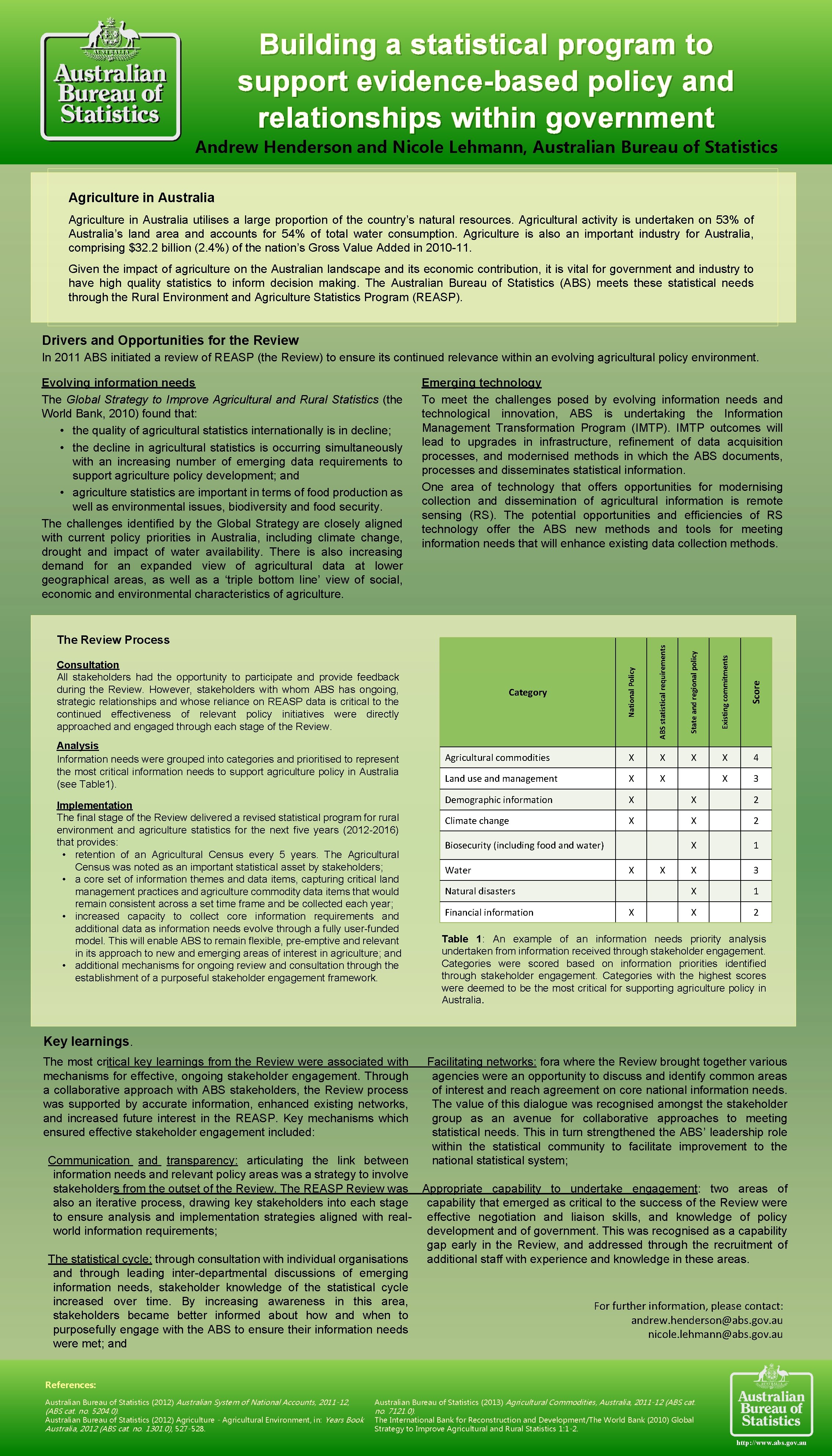
Building a statistical program to support evidence-based policy and relationships within government Andrew Henderson and Nicole Lehmann, Australian Bureau of Statistics Agriculture in Australia utilises a large proportion of the country’s natural resources. Agricultural activity is undertaken on 53% of Australia’s land area and accounts for 54% of total water consumption. Agriculture is also an important industry for Australia, comprising $32. 2 billion (2. 4%) of the nation’s Gross Value Added in 2010 -11. Given the impact of agriculture on the Australian landscape and its economic contribution, it is vital for government and industry to have high quality statistics to inform decision making. The Australian Bureau of Statistics (ABS) meets these statistical needs through the Rural Environment and Agriculture Statistics Program (REASP). Drivers and Opportunities for the Review In 2011 ABS initiated a review of REASP (the Review) to ensure its continued relevance within an evolving agricultural policy environment. Emerging technology To meet the challenges posed by evolving information needs and technological innovation, ABS is undertaking the Information Management Transformation Program (IMTP). IMTP outcomes will lead to upgrades in infrastructure, refinement of data acquisition processes, and modernised methods in which the ABS documents, processes and disseminates statistical information. One area of technology that offers opportunities for modernising collection and dissemination of agricultural information is remote sensing (RS). The potential opportunities and efficiencies of RS technology offer the ABS new methods and tools for meeting information needs that will enhance existing data collection methods. Analysis Information needs were grouped into categories and prioritised to represent the most critical information needs to support agriculture policy in Australia (see Table 1). X X Land use and management X X Demographic information X X 2 Implementation The final stage of the Review delivered a revised statistical program for rural environment and agriculture statistics for the next five years (2012 -2016) that provides: • retention of an Agricultural Census every 5 years. The Agricultural Census was noted as an important statistical asset by stakeholders; • a core set of information themes and data items, capturing critical land management practices and agriculture commodity data items that would remain consistent across a set time frame and be collected each year; • increased capacity to collect core information requirements and additional data as information needs evolve through a fully user-funded model. This will enable ABS to remain flexible, pre-emptive and relevant in its approach to new and emerging areas of interest in agriculture; and • additional mechanisms for ongoing review and consultation through the establishment of a purposeful stakeholder engagement framework. Climate change X X 2 X 1 X 3 X 1 X 2 Category Biosecurity (including food and water) Water X Natural disasters Financial information X X Score ABS statistical requirements Agricultural commodities Consultation All stakeholders had the opportunity to participate and provide feedback during the Review. However, stakeholders with whom ABS has ongoing, strategic relationships and whose reliance on REASP data is critical to the continued effectiveness of relevant policy initiatives were directly approached and engaged through each stage of the Review. Existing commitments National Policy The Review Process State and regional policy Evolving information needs The Global Strategy to Improve Agricultural and Rural Statistics (the World Bank, 2010) found that: • the quality of agricultural statistics internationally is in decline; • the decline in agricultural statistics is occurring simultaneously with an increasing number of emerging data requirements to support agriculture policy development; and • agriculture statistics are important in terms of food production as well as environmental issues, biodiversity and food security. The challenges identified by the Global Strategy are closely aligned with current policy priorities in Australia, including climate change, drought and impact of water availability. There is also increasing demand for an expanded view of agricultural data at lower geographical areas, as well as a ‘triple bottom line’ view of social, economic and environmental characteristics of agriculture. X X 4 X 3 Table 1: An example of an information needs priority analysis undertaken from information received through stakeholder engagement. Categories were scored based on information priorities identified through stakeholder engagement. Categories with the highest scores were deemed to be the most critical for supporting agriculture policy in Australia. Key learnings. The most critical key learnings from the Review were associated with mechanisms for effective, ongoing stakeholder engagement. Through a collaborative approach with ABS stakeholders, the Review process was supported by accurate information, enhanced existing networks, and increased future interest in the REASP. Key mechanisms which ensured effective stakeholder engagement included: Facilitating networks: fora where the Review brought together various agencies were an opportunity to discuss and identify common areas of interest and reach agreement on core national information needs. The value of this dialogue was recognised amongst the stakeholder group as an avenue for collaborative approaches to meeting statistical needs. This in turn strengthened the ABS’ leadership role within the statistical community to facilitate improvement to the national statistical system; Communication and transparency: articulating the link between information needs and relevant policy areas was a strategy to involve stakeholders from the outset of the Review. The REASP Review was Appropriate capability to undertake engagement: two areas of also an iterative process, drawing key stakeholders into each stage capability that emerged as critical to the success of the Review were to ensure analysis and implementation strategies aligned with real- effective negotiation and liaison skills, and knowledge of policy world information requirements; development and of government. This was recognised as a capability gap early in the Review, and addressed through the recruitment of The statistical cycle: through consultation with individual organisations additional staff with experience and knowledge in these areas. and through leading inter-departmental discussions of emerging information needs, stakeholder knowledge of the statistical cycle increased over time. By increasing awareness in this area, For further information, please contact: stakeholders became better informed about how and when to andrew. henderson@abs. gov. au purposefully engage with the ABS to ensure their information needs nicole. lehmann@abs. gov. au were met; and References: Australian Bureau of Statistics (2012) Australian System of National Accounts, 2011 -12, Australian Bureau of Statistics (2013) Agricultural Commodities, Australia, 2011 -12 (ABS cat. Australian Bureau of Statistics (2012) Agriculture - Agricultural Environment, in: Years Book Australia, 2012 (ABS cat. no. 1301. 0), 527 -528. The International Bank for Reconstruction and Development/The World Bank (2010) Global Strategy to Improve Agricultural and Rural Statistics 1: 1 -2. (ABS cat. no. 5204. 0). no. 7121. 0). http: //www. abs. gov. au
- Slides: 1