
Building a Shared Electronic Data Collection Instrument Library
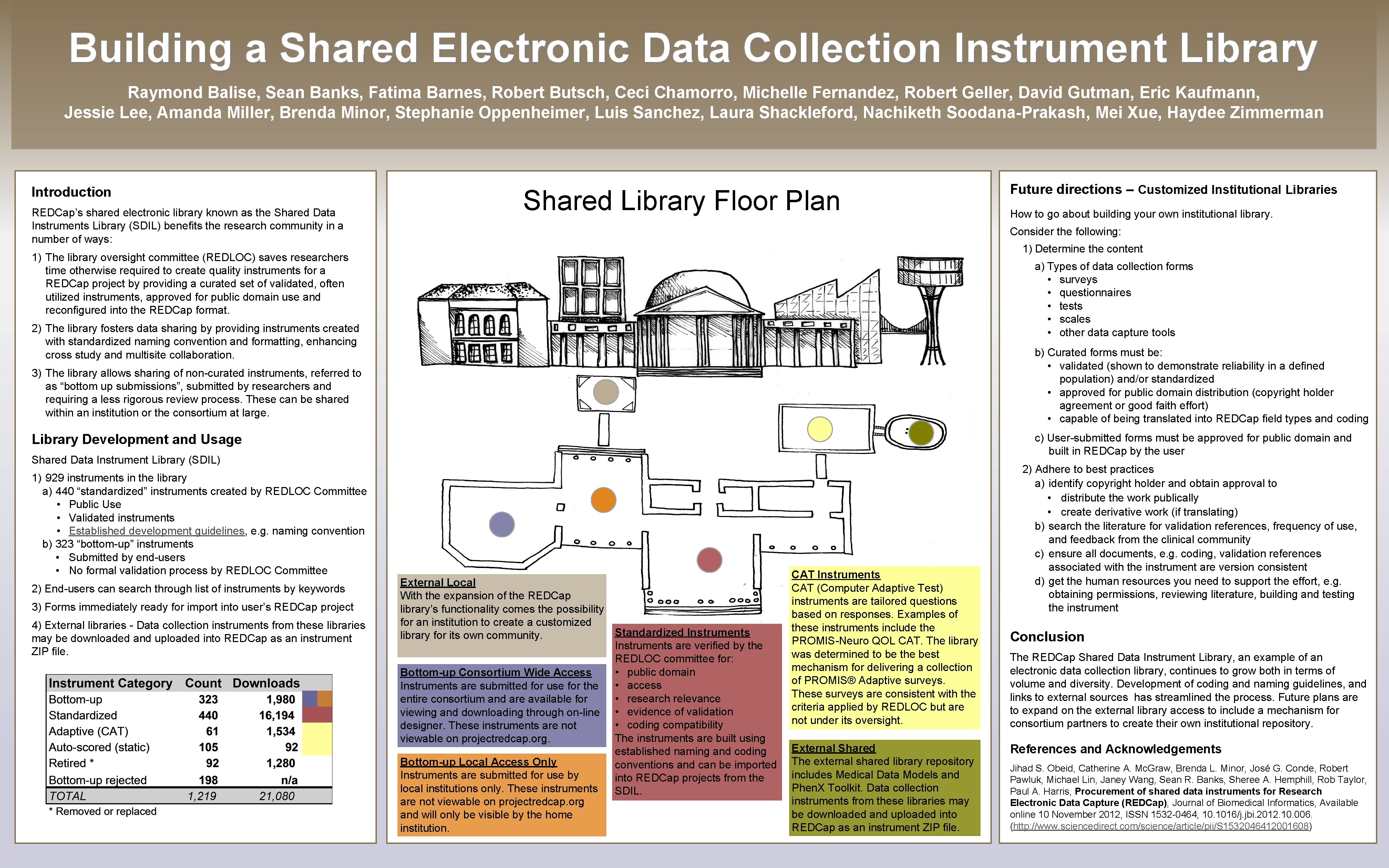
Building a Shared Electronic Data Collection Instrument Library Raymond Balise, Sean Banks, Fatima Barnes, Robert Butsch, Ceci Chamorro, Michelle Fernandez, Robert Geller, David Gutman, Eric Kaufmann, Jessie Lee, Amanda Miller, Brenda Minor, Stephanie Oppenheimer, Luis Sanchez, Laura Shackleford, Nachiketh Soodana-Prakash, Mei Xue, Haydee Zimmerman Introduction REDCap’s shared electronic library known as the Shared Data Instruments Library (SDIL) benefits the research community in a number of ways: Shared Library Floor Plan 1) Determine the content a) Types of data collection forms • surveys • questionnaires • tests • scales • other data capture tools 2) The library fosters data sharing by providing instruments created with standardized naming convention and formatting, enhancing cross study and multisite collaboration. b) Curated forms must be: • validated (shown to demonstrate reliability in a defined population) and/or standardized • approved for public domain distribution (copyright holder agreement or good faith effort) • capable of being translated into REDCap field types and coding 3) The library allows sharing of non-curated instruments, referred to as “bottom up submissions”, submitted by researchers and requiring a less rigorous review process. These can be shared within an institution or the consortium at large. Library Development and Usage c) User-submitted forms must be approved for public domain and built in REDCap by the user Shared Data Instrument Library (SDIL) 2) End-users can search through list of instruments by keywords 3) Forms immediately ready for import into user’s REDCap project 4) External libraries - Data collection instruments from these libraries may be downloaded and uploaded into REDCap as an instrument ZIP file. How to go about building your own institutional library. Consider the following: 1) The library oversight committee (REDLOC) saves researchers time otherwise required to create quality instruments for a REDCap project by providing a curated set of validated, often utilized instruments, approved for public domain use and reconfigured into the REDCap format. 1) 929 instruments in the library a) 440 “standardized” instruments created by REDLOC Committee • Public Use • Validated instruments • Established development guidelines, e. g. naming convention b) 323 “bottom-up” instruments • Submitted by end-users • No formal validation process by REDLOC Committee Future directions – Customized Institutional Libraries External Local With the expansion of the REDCap library’s functionality comes the possibility for an institution to create a customized Standardized Instruments library for its own community. Instruments are verified by the REDLOC committee for: • public domain Bottom-up Consortium Wide Access Instruments are submitted for use for the • access • research relevance entire consortium and are available for viewing and downloading through on-line • evidence of validation • coding compatibility designer. These instruments are not The instruments are built using viewable on projectredcap. org. established naming and coding Bottom-up Local Access Only conventions and can be imported Instruments are submitted for use by into REDCap projects from the local institutions only. These instruments SDIL. are not viewable on projectredcap. org and will only be visible by the home institution. CAT Instruments CAT (Computer Adaptive Test) instruments are tailored questions based on responses. Examples of these instruments include the PROMIS-Neuro QOL CAT. The library was determined to be the best mechanism for delivering a collection of PROMIS® Adaptive surveys. These surveys are consistent with the criteria applied by REDLOC but are not under its oversight. External Shared The external shared library repository includes Medical Data Models and Phen. X Toolkit. Data collection instruments from these libraries may be downloaded and uploaded into REDCap as an instrument ZIP file. 2) Adhere to best practices a) identify copyright holder and obtain approval to • distribute the work publically • create derivative work (if translating) b) search the literature for validation references, frequency of use, and feedback from the clinical community c) ensure all documents, e. g. coding, validation references associated with the instrument are version consistent d) get the human resources you need to support the effort, e. g. obtaining permissions, reviewing literature, building and testing the instrument Conclusion The REDCap Shared Data Instrument Library, an example of an electronic data collection library, continues to grow both in terms of volume and diversity. Development of coding and naming guidelines, and links to external sources has streamlined the process. Future plans are to expand on the external library access to include a mechanism for consortium partners to create their own institutional repository. References and Acknowledgements Jihad S. Obeid, Catherine A. Mc. Graw, Brenda L. Minor, José G. Conde, Robert Pawluk, Michael Lin, Janey Wang, Sean R. Banks, Sheree A. Hemphill, Rob Taylor, Paul A. Harris, Procurement of shared data instruments for Research Electronic Data Capture (REDCap), Journal of Biomedical Informatics, Available online 10 November 2012, ISSN 1532 -0464, 10. 1016/j. jbi. 2012. 10. 006. (http: //www. sciencedirect. com/science/article/pii/S 1532046412001608)
- Slides: 1