
Building a Safety Culture Through Effective Engagement of
Building a Safety Culture Through Effective Engagement of Line Staff Joanne Locke, RN, JD Former Director, Risk Management and Clinical Compliance Brigham and Women’s Faulkner Hospital joannelockejd@gmail. com Karen Fiumara, Pharm. D Executive Director, Patient Safety and Risk Management Brigham and Women’s Hospital Mass Coalition Patient Safety Forum May 4, 2018 1
Legal, Regulatory, and Policy Requirements Related to Medical Error • Federal/state statutes and regulations – Massachusetts Department of Public Health • Serious Reportable Events – Massachusetts BORM QPSD Division • Safety and Quality Reports (SQRs) – The Joint Commission • Culture of Safety • Hospital policies and Initiatives – IC, Pt Rights, Code of Professional Conduct, Disclosure and Apology • Distinction between regulators and internal review 2
Overview 1. Introduction What we expected v. what we found 2. BWFH Case for Change Safety Culture Survey Results of 2014 CRICO Risk Assessment Program of 2014 3. Strategy Development 4. Organization, Roll-out, Integration 5. Safety Culture Survey Results 0 f 2016 3
4 BWFH CRICO RAPP Strengths: • Strong clinical and non-clinical leadership that are committed to, engaged in, and supportive of patient safety activities. Evidence of a commitment to patient safety activities and strong engagement of line staff. • Overall, the CRICO RAPP found that BWFH is, • “. . . well on its way toward being a highly reliable, and transparent provider of excellent patient care. ” 4
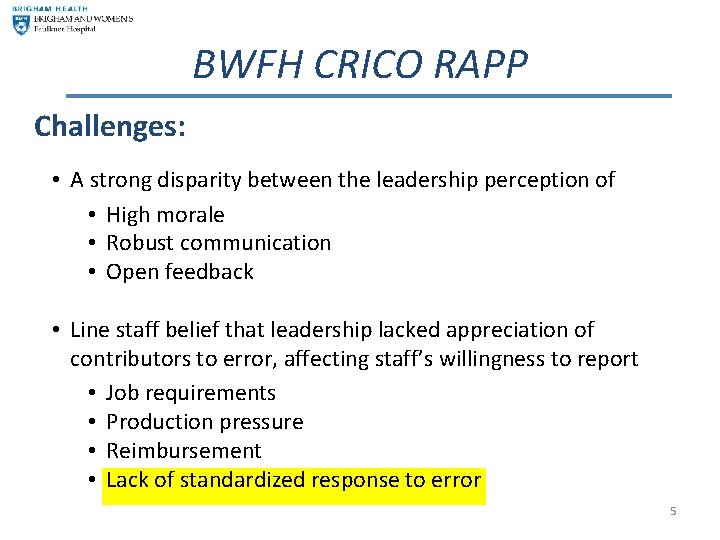
5 BWFH CRICO RAPP Challenges: • A strong disparity between the leadership perception of • High morale • Robust communication • Open feedback • Line staff belief that leadership lacked appreciation of contributors to error, affecting staff’s willingness to report • Job requirements • Production pressure • Reimbursement • Lack of standardized response to error 5
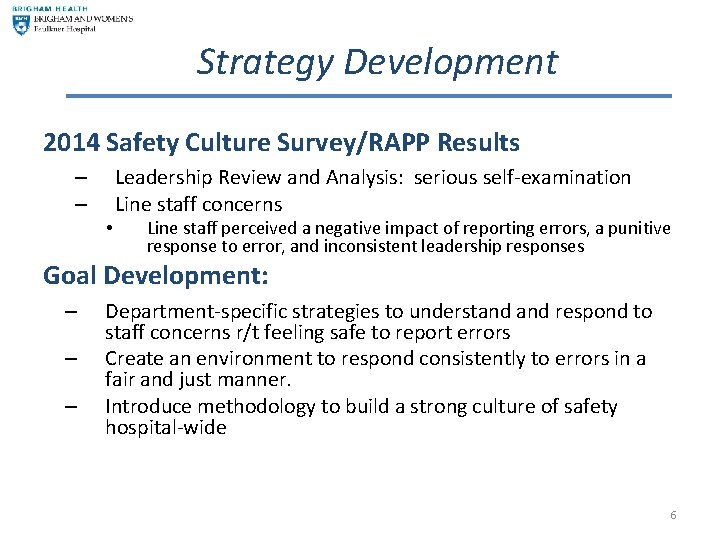
Strategy Development 2014 Safety Culture Survey/RAPP Results – – • Leadership Review and Analysis: serious self-examination Line staff concerns Line staff perceived a negative impact of reporting errors, a punitive response to error, and inconsistent leadership responses Goal Development: – – – Department-specific strategies to understand respond to staff concerns r/t feeling safe to report errors Create an environment to respond consistently to errors in a fair and just manner. Introduce methodology to build a strong culture of safety hospital-wide 6
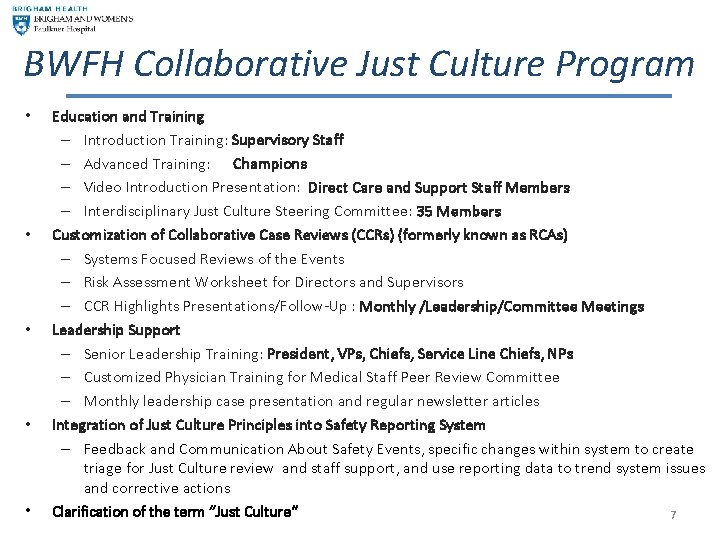
BWFH Collaborative Just Culture Program • • • Education and Training – Introduction Training: Supervisory Staff – Advanced Training: Champions – Video Introduction Presentation: Direct Care and Support Staff Members – Interdisciplinary Just Culture Steering Committee: 35 Members Customization of Collaborative Case Reviews (CCRs) (formerly known as RCAs) – Systems Focused Reviews of the Events – Risk Assessment Worksheet for Directors and Supervisors – CCR Highlights Presentations/Follow-Up : Monthly /Leadership/Committee Meetings Leadership Support – Senior Leadership Training: President, VPs, Chiefs, Service Line Chiefs, NPs – Customized Physician Training for Medical Staff Peer Review Committee – Monthly leadership case presentation and regular newsletter articles Integration of Just Culture Principles into Safety Reporting System – Feedback and Communication About Safety Events, specific changes within system to create triage for Just Culture review and staff support, and use reporting data to trend system issues and corrective actions Clarification of the term ”Just Culture” 7
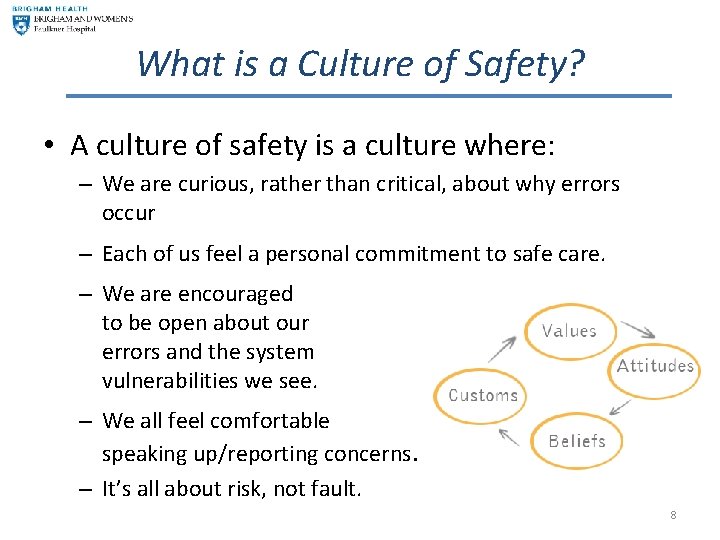
What is a Culture of Safety? • A culture of safety is a culture where: – We are curious, rather than critical, about why errors occur – Each of us feel a personal commitment to safe care. – We are encouraged to be open about our errors and the system vulnerabilities we see. – We all feel comfortable speaking up/reporting concerns. – It’s all about risk, not fault. 8
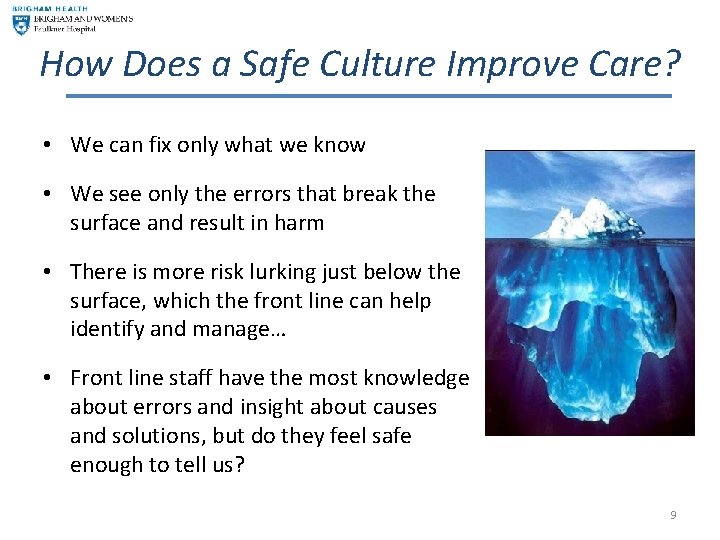
How Does a Safe Culture Improve Care? • We can fix only what we know • We see only the errors that break the surface and result in harm • There is more risk lurking just below the surface, which the front line can help identify and manage… • Front line staff have the most knowledge about errors and insight about causes and solutions, but do they feel safe enough to tell us? 9
Safety Culture and High Reliability • HR Framework – Risk identification, system development, behavior and performance, sustainment • Challenges of building HROs in healthcare – Safety is never the only value • Production, customer service, finances – Difficult to accept anticipation of human failure – No integrated/cross-functional regulation – Sustainment efforts require long-term view 10
How BWFH Defined “Just Culture” Framework for REDUCING FUTURE RISK, by evaluating our systems and behaviors to identify and mitigate vulnerabilities • • • Sometimes the risk is in our system, sometimes it is in our behaviors, and often it is in both Important to start with the system, not the individual Not outcome driven (left of BANG, not right) Guides us in how to respond to employee behaviors in a fair, just, and collaborative way • Just Culture is not about finding fault, it is about managing future risk. We want to move away from shame and blame and create a culture of continuous learning by being curious, not critical 11
Leadership Accountability for Safety • Leadership is accountable for: – Creating effective and resilient systems within their capabilities– zero error is an aspirational goal – Listening to employee safety concerns – Setting clear expectations – Responding to employee behaviors in a fair, just, and collaborative way • Understand the context of choices and error; remove “red line” policies • Look beyond the error future risk mitigation and improvement • Clearly communicate priorities when values conflict • Provide regular feedback and coaching to improve systems. 12
Shared Accountability for Safety • All employees are accountable for: – The quality of our choices – Reporting issues and vulnerabilities – Speaking up – what we don’t correct, we condone • Saying nothing is saying “Yes” – Participating in solutions to mitigate future risk – Leadership must be careful to look for system contributors to behavioral choices 13
System Analysis of Adverse Events • Identify the risk (s) – The severity and the likelihood of occurrence – What are the competing priorities? • Patient safety, production, efficiency, finance – Awareness of overt/covert messaging to staff • If current system is used as designed, is it effective in managing risk and resilient to vulnerabilities? – Will it adversely affect other critical operations? 14
Analysis of Employee Behaviors Were employer’s expectations clear? Was there a clear policy, procedure, practice? Was it possible for the ee to follow the p/p/p? Did the employee choose not to follow it? If so, did the employee not recognize the risk or mistakenly feel justified in not following p/p/p? • Was there conscious disregard of p/p/p? • • • 15
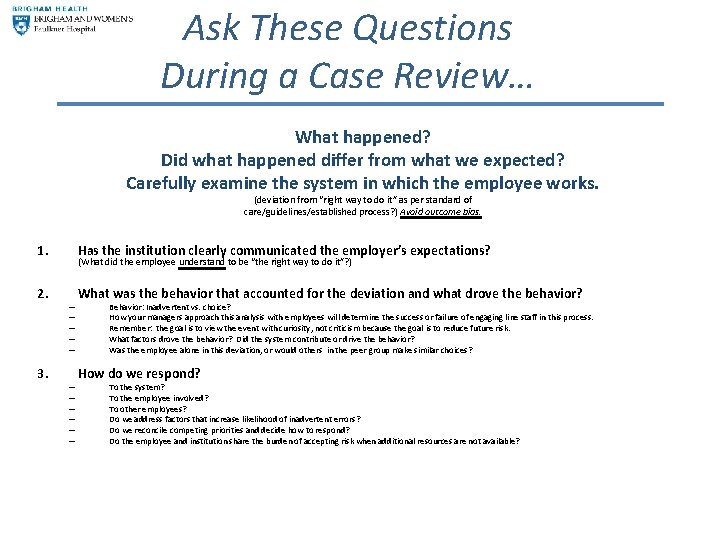
Ask These Questions During a Case Review… What happened? Did what happened differ from what we expected? Carefully examine the system in which the employee works. (deviation from “right way to do it” as per standard of care/guidelines/established process? ) Avoid outcome bias. 1. 2. 3. Has the institution clearly communicated the employer’s expectations? (What did the employee understand to be “the right way to do it”? ) – – – What was the behavior that accounted for the deviation and what drove the behavior? Behavior: Inadvertent vs. choice? How your managers approach this analysis with employees will determine the success or failure of engaging line staff in this process. Remember: the goal is to view the event with curiosity, not criticism because the goal is to reduce future risk. What factors drove the behavior? Did the system contribute or drive the behavior? Was the employee alone in this deviation, or would others in the peer group make similar choices? How do we respond? To the system? To the employee involved? To other employees? Do we address factors that increase likelihood of inadvertent errors? Do we reconcile competing priorities and decide how to respond? Do the employee and institution share the burden of accepting risk when additional resources are not available?
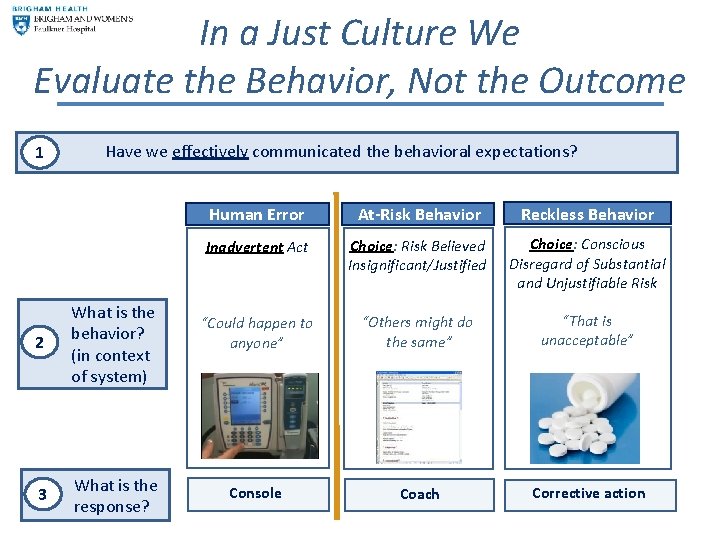
In a Just Culture We Evaluate the Behavior, Not the Outcome 1 Have we effectively communicated the behavioral expectations? 2 What is the behavior? (in context of system) 3 What is the response? Human Error At-Risk Behavior Reckless Behavior Inadvertent Act Choice: Risk Believed Insignificant/Justified Choice: Conscious Disregard of Substantial and Unjustifiable Risk “Could happen to anyone” “Others might do the same” “That is unacceptable” Console Coach Corrective action
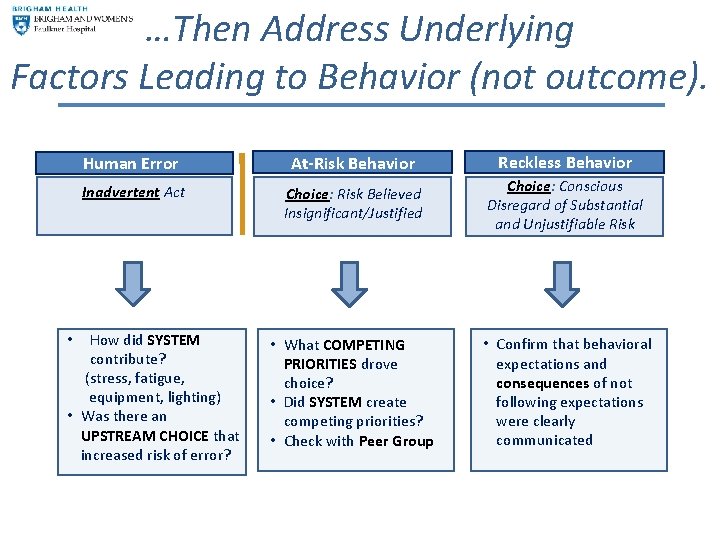
…Then Address Underlying Factors Leading to Behavior (not outcome). Human Error Inadvertent Act How did SYSTEM contribute? (stress, fatigue, equipment, lighting) • Was there an UPSTREAM CHOICE that increased risk of error? • At-Risk Behavior Choice: Risk Believed Insignificant/Justified • What COMPETING PRIORITIES drove choice? • Did SYSTEM create competing priorities? • Check with Peer Group Reckless Behavior At-Risk Behavior Choice: Conscious Disregard of Substantial and Unjustifiable Risk • Confirm that behavioral expectations and consequences of not following expectations were clearly communicated
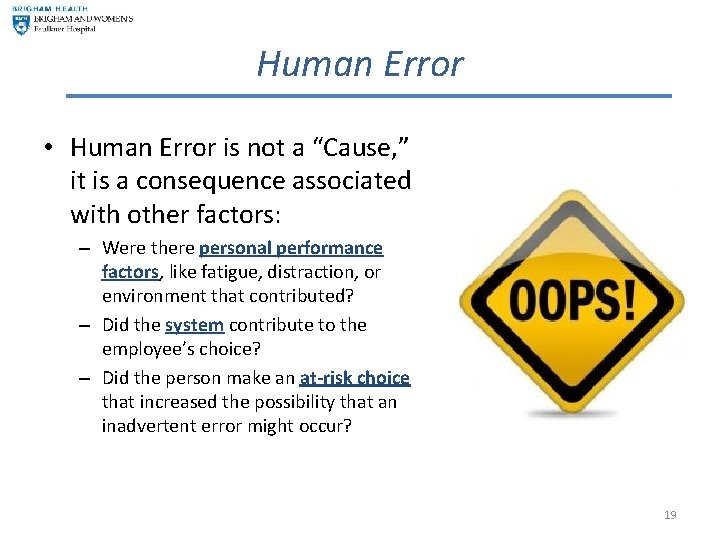
Human Error • Human Error is not a “Cause, ” it is a consequence associated with other factors: – Were there personal performance factors, like fatigue, distraction, or environment that contributed? – Did the system contribute to the employee’s choice? – Did the person make an at-risk choice that increased the possibility that an inadvertent error might occur? 19
At-Risk Behavior • Our largest bucket • Why? We don’t see the risk We “think we’re safe” Managing competing priorities Short on resources, staffing Unusual or difficult circumstances Shortcuts, cutting corners Staff never had a undesired outcome with work-around – Lack of “good” rule enforcement – New workers see and adopt “routine” violations – – – 20
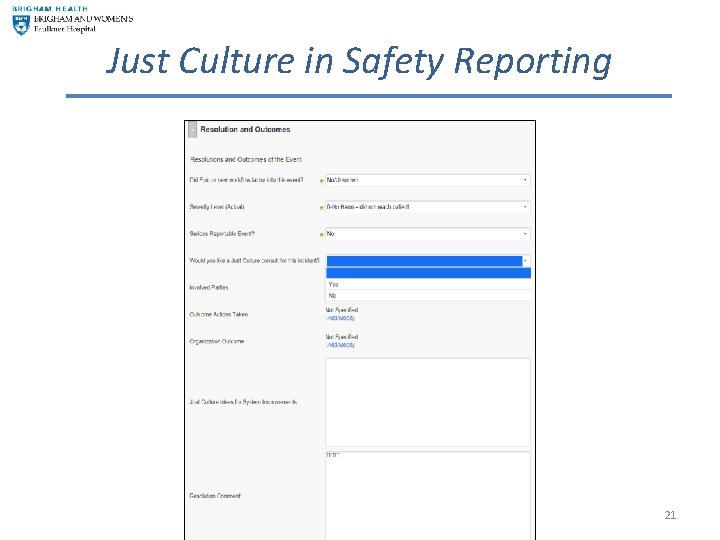
Just Culture in Safety Reporting 21
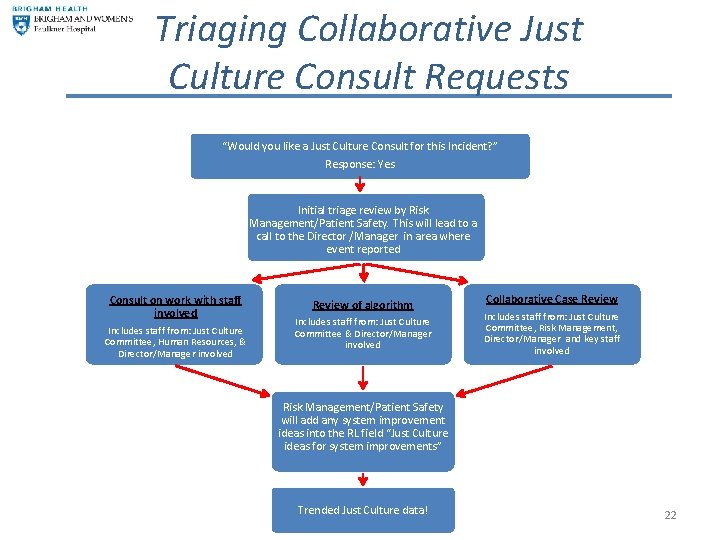
Triaging Collaborative Just Culture Consult Requests “Would you like a Just Culture Consult for this Incident? ” Response: Yes Initial triage review by Risk Management/Patient Safety. This will lead to a call to the Director /Manager in area where event reported Consult on work with staff involved Includes staff from: Just Culture Committee, Human Resources, & Director/Manager involved Review of algorithm Includes staff from: Just Culture Committee & Director/Manager involved Collaborative Case Review Includes staff from: Just Culture Committee, Risk Management, Director/Manager and key staff involved Risk Management/Patient Safety will add any system improvement ideas into the RL field “Just Culture ideas for system improvements” Trended Just Culture data! 22
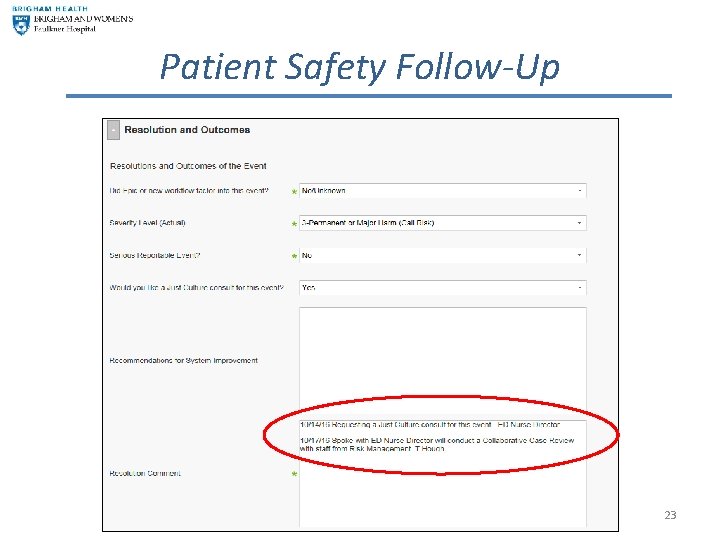
Patient Safety Follow-Up 23
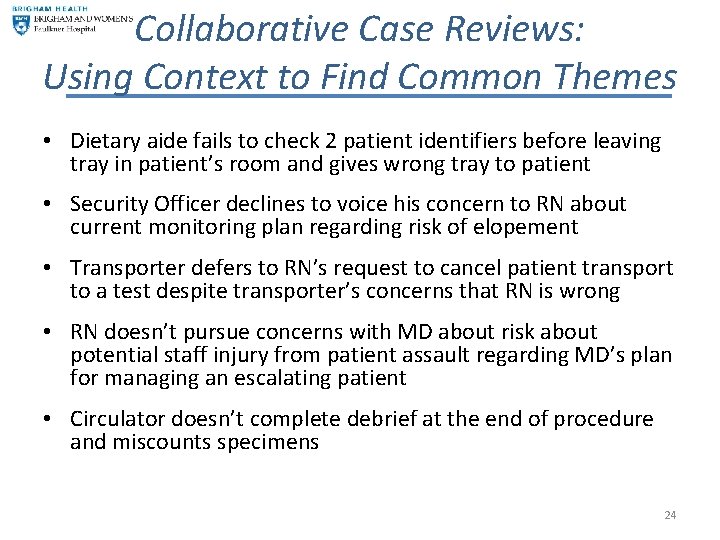
Collaborative Case Reviews: Using Context to Find Common Themes • Dietary aide fails to check 2 patient identifiers before leaving tray in patient’s room and gives wrong tray to patient • Security Officer declines to voice his concern to RN about current monitoring plan regarding risk of elopement • Transporter defers to RN’s request to cancel patient transport to a test despite transporter’s concerns that RN is wrong • RN doesn’t pursue concerns with MD about risk about potential staff injury from patient assault regarding MD’s plan for managing an escalating patient • Circulator doesn’t complete debrief at the end of procedure and miscounts specimens 24
Appreciating the Power Gradient • What is the Authority/Power Gradient? – Aviation term • Describes a factor that negatively affects communication between two members of a team who hold different positions in the hierarchy – Perceived differences in authority/power may inhibit an individual from questioning or challenging another viewed to be in a more senior position – Power gradients may contribute to adverse events, decrease reporting and increase the potential harm to staff and patients 25
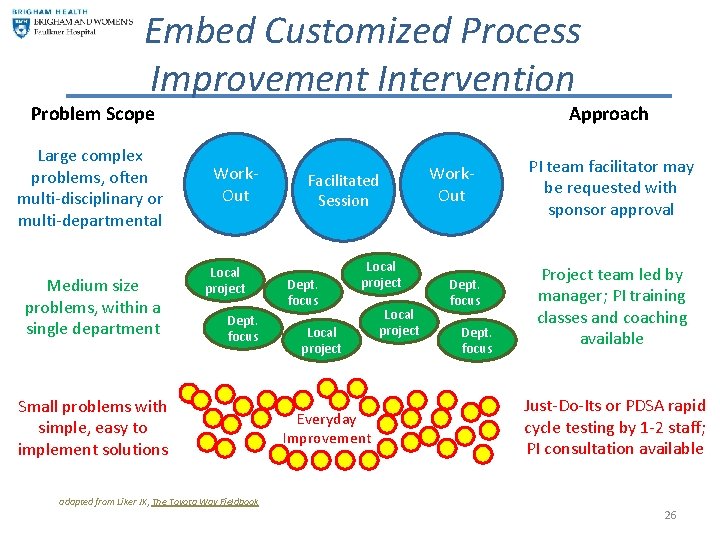
Embed Customized Process Improvement Intervention Approach Problem Scope Large complex problems, often multi-disciplinary or multi-departmental Medium size problems, within a single department Work. Out Local project Dept. focus Small problems with simple, easy to implement solutions adapted from Liker JK, The Toyota Way Fieldbook Facilitated Session Dept. focus Local project Everyday Improvement Local project Work. Out Dept. focus PI team facilitator may be requested with sponsor approval Project team led by manager; PI training classes and coaching available Just-Do-Its or PDSA rapid cycle testing by 1 -2 staff; PI consultation available 26
The Work Continues New Goals Ongoing Goals Sustainment strategies Stronger HR involvement Enhance role of Advisors Strengthen supervisor risk assessment skills • Accountability for pilots, f/up • Comprehensive review of “red line” policies; always review rules in the context of violation • Development of hospital policies consistent with methodology • Integrate Just Culture principles within HR policies • Continued engagement and recognition of support staff • Deepen supervisor case review skills to examine systems and behaviors algorithm • • 27
The AMC Perspective: Focus on Reliability Management System 1. Start at the end – Focus on long term goal of having robust high reliability system and safety culture 2. Be Patient – change takes time 3. Focus on Key Integrations and structural steps first A. Safety and Risk groups B. Key Partnerships: i. HR ii. Clinical Departments – integration with M&M iii. Nursing and allied health iv. Professionalism and Peer Support 4. We must see and understand risk – development of comprehensive “Risk Register” 28
Thank You! • Questions? 29
- Slides: 29