
BUILDING A SAFER FUTURE AN OVERVIEW OF UPCOMING
‘BUILDING A SAFER FUTURE’ AN OVERVIEW OF UPCOMING CHANGES IN BUILDING AND FIRE SAFETY Natasha Jones Associate, Global Investigations 25 February 2021

TALKING POINTS ● Why focus on building and fire safety? ● Proposed changes ○ Building Safety Bill ○ Fire Safety Bill ● Practical considerations ● Preparing for the new Bills
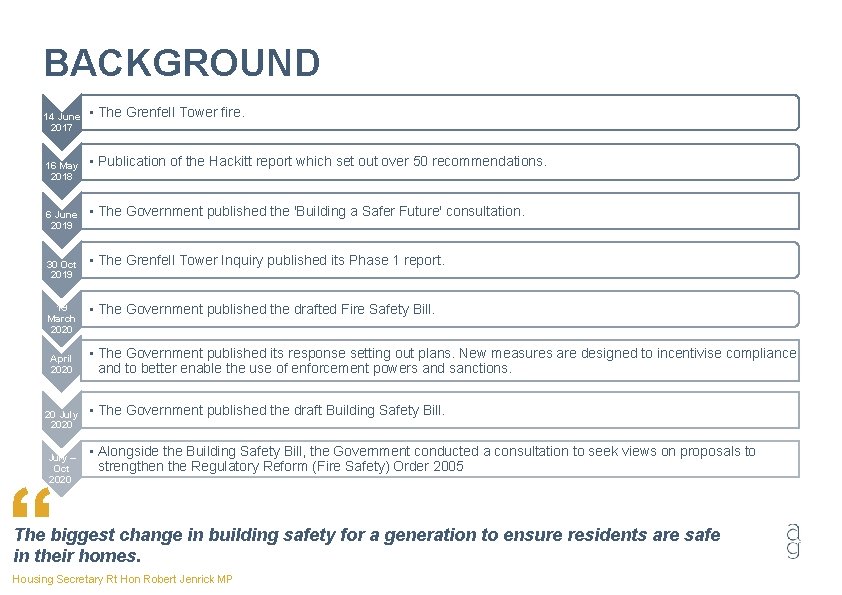
BACKGROUND 14 June 2017 16 May 2018 6 June 2019 30 Oct 2019 19 March 2020 April 2020 20 July 2020 July – Oct 2020 • The Grenfell Tower fire. • Publication of the Hackitt report which set out over 50 recommendations. • The Government published the 'Building a Safer Future' consultation. • The Grenfell Tower Inquiry published its Phase 1 report. • The Government published the drafted Fire Safety Bill. • The Government published its response setting out plans. New measures are designed to incentivise compliance and to better enable the use of enforcement powers and sanctions. • The Government published the draft Building Safety Bill. • Alongside the Building Safety Bill, the Government conducted a consultation to seek views on proposals to strengthen the Regulatory Reform (Fire Safety) Order 2005 The biggest change in building safety for a generation to ensure residents are safe in their homes. Housing Secretary Rt Hon Robert Jenrick MP

BUILDING SAFETY BILL Initially only applies to new higher risk buildings (i. e. multi occupied residential buildings of 18 m or more in height, or more than 6 storeys, whichever is reached first). Likely to be extended to existing and high risk buildings Focus on accountability for building owners and giving a voice to residents Establishes a new Building Safety Regulator within the Health & Safety Executive Will impose new obligations on dutyholders Will also establish a new dutyholder regime New roles - Accountable Person and Building Safety Manager
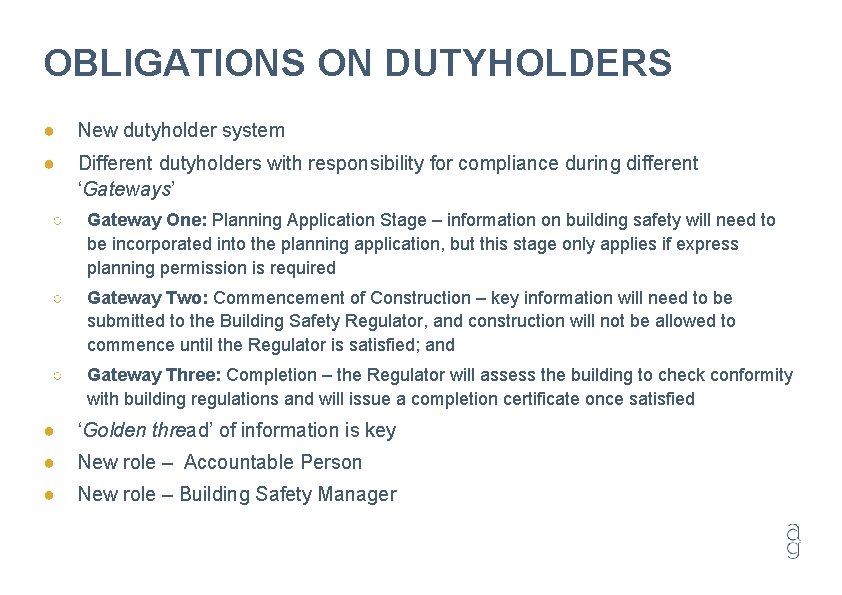
OBLIGATIONS ON DUTYHOLDERS ● New dutyholder system ● Different dutyholders with responsibility for compliance during different ‘Gateways’ ○ Gateway One: Planning Application Stage – information on building safety will need to be incorporated into the planning application, but this stage only applies if express planning permission is required ○ Gateway Two: Commencement of Construction – key information will need to be submitted to the Building Safety Regulator, and construction will not be allowed to commence until the Regulator is satisfied; and ○ Gateway Three: Completion – the Regulator will assess the building to check conformity with building regulations and will issue a completion certificate once satisfied ● ‘Golden thread’ of information is key ● New role – Accountable Person ● New role – Building Safety Manager
RESIDENT COMPLAINTS AND COSTS ● Focus on effective action taken in relation to serious safety concerns ● Internal complaints process outlined in the Resident Engagement Strategy ● Ability for residents to escalate matters to Building Safety Regulator or to go directly in serious situations ● Costs of remedial work on leaseholders – ‘building safety charge’ ● February 2021 Government announcement on the Building Safety Fund

BUILDING SAFETY REGULATOR ●To be established within HSE ● 3 main responsibilities: ○implementing new regulatory regime ○overseeing building safety and performance system ○encouraging competence amongst the industry ●Will operate a complaints handling system ●Tougher enforcement powers – issuing notices, increased time limit for prosecution and potential penalties include unlimited fine and/or 2 years’ imprisonment ●Corporate offence – neglect/consent/connivance ●Currently in shadow form until established under the Bill

THE FIRE SAFETY BILL The fire safety consultation, published alongside the draft Building Safety Bill, is key part of Government’s package of reform to improve building and fire safety. Responsible person to assess, manage and reduce fire risks by the structure and external walls This includes cladding, balconies, windows and individual doors opening onto common parts All multi occupied residential buildings Consultation Will not be dependent on the height of the building This may include hotels Expect that Consultation is likely to find that FSB should relate to a broader category of buildings The Home Office – October 2020 The Government is in the process of amending the Regulatory Reform (Fire Safety) Order 2005 (RRO) by way of draft Fire Safety Bill (FSB). ● The FSB seeks to clarify the scope of the RRO with a view to this leading to better identification and enforcement in high-rise buildings. 8 Encouraging those Responsible persons to identify materials and to update their FRAs Likely that Grenfell phase 1 recommendations will be incorporated into legislation after the conclusion of the Consultation
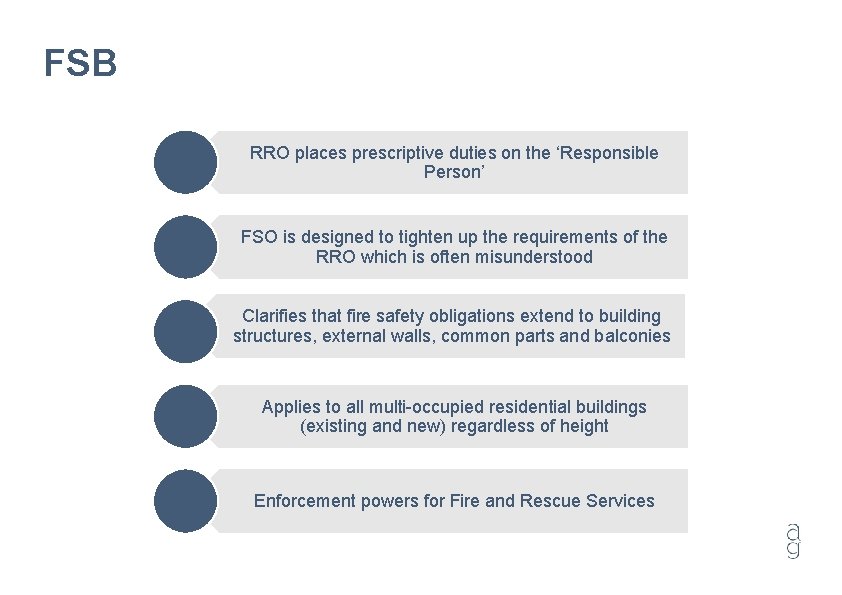
FSB RRO places prescriptive duties on the ‘Responsible Person’ FSO is designed to tighten up the requirements of the RRO which is often misunderstood Clarifies that fire safety obligations extend to building structures, external walls, common parts and balconies Applies to all multi-occupied residential buildings (existing and new) regardless of height Enforcement powers for Fire and Rescue Services
CONSULTATION, GRENFELL RECOMMENDATIONS AND PROGRESS ● Consultation to strengthen FSO, implement Grenfell recommendations and improve regulatory framework on how building control bodies consult with FRS. Sought views on: ○ responsible person ○ quality of FRAs ○ provision of information ○ higher risk workplaces ○ fees and charges ● FSB will pave the way for secondary legislation to implement the recommendations of the Grenfell Inquiry Phase 1 report ● Currently making its way through Parliament – House of Lords amendments were debated yesterday
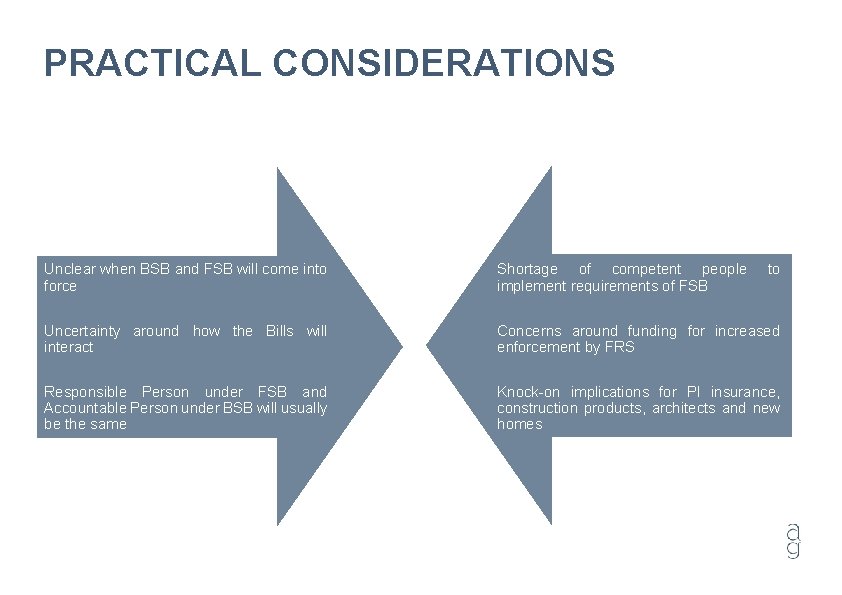
PRACTICAL CONSIDERATIONS Unclear when BSB and FSB will come into force Shortage of competent people implement requirements of FSB to Uncertainty around how the Bills will interact Concerns around funding for increased enforcement by FRS Responsible Person under FSB and Accountable Person under BSB will usually be the same Knock-on implications for PI insurance, construction products, architects and new homes
PREPARING FOR BSB AND FSB ●Be proactive – don’t wait for the law to change ●Initiate building and fire safety reviews now to manage risks and resolution ●Consider resources in place to attend to these issues ●Who will take on the roles of Accountable Person and Building Safety Manager? ●Think about your procurement practices – are contractors industry accredited? ●Review supply chain in advance of likely reforms to rules surrounding construction products and materials ●Consider your contracts – who bears costs of safety issues and how are these assessed? ●Conduct FRAs which take into consideration the wider structures caught by the FSB ●Start collating the information that will be required for the Safety Case Report and ‘golden thread’ ●Begin developing a Resident Engagement Strategy ●Seek advice where you have concerns or queries
ANY QUESTIONS? natasha. d. jones@addleshawgoddard. com

www. addleshawgoddard. com Aberdeen, Doha, Dubai, Edinburgh, Glasgow, Hamburg, Hong Kong, Leeds, London, Manchester, Muscat, Singapore and Tokyo* * a formal alliance with Hashidate Law Office © 2020 Addleshaw Goddard LLP. All rights reserved. Extracts may be copied with prior permission and provided their source is acknowledged. This document is for general information only. It is not legal advice and should not be acted or relied on as being so, accordingly Addleshaw Goddard disclaims any responsibility. It does not create a solicitor-client relationship between Addleshaw Goddard any other person. Legal advice should be taken before applying any information in this document to any facts and circumstances. Addleshaw Goddard is an international legal practice carried on by Addleshaw Goddard LLP (a limited liability partnership registered in England & Wales and authorised and regulated by the Solicitors Regulation Authority and the Law Society of Scotland) and its affiliated undertakings. Addleshaw Goddard operates in the Dubai International Financial Centre through Addleshaw Goddard (Middle East) LLP (registered with and regulated by the DFSA), in the Qatar Financial Centre through Addleshaw Goddard (GCC) LLP (licensed by the QFCA), in Oman through Addleshaw Goddard (Middle East) LLP in association with Nasser Al Habsi & Saif Al Mamari Law Firm (licensed by the Oman Ministry of Justice), in Hamburg through Addleshaw Goddard (Germany) LLP (a limited liability partnership registered in England & Wales) and in Hong Kong through Addleshaw Goddard (Hong Kong) LLP, a Hong Kong limited liability partnership pursuant to the Legal Practitioners Ordinance and regulated by the Law Society of Hong Kong. In Tokyo, legal services are offered through Addleshaw Goddard's formal alliance with Hashidate Law Office. A list of members/principals for each firm will be provided upon request. The term partner refers to any individual who is a member of any Addleshaw Goddard entity or association or an employee or consultant with equivalent standing and qualifications. If you prefer not to receive promotional material from us, please email us at unsubscribe@addleshawgoddard. com. For further information, including about how we process your personal data, please consult our website www. addleshawgoddard. com or www. aglaw. com.
- Slides: 14