
Building a Project Management Methodology Randall Alberts PMP
Building a Project Management Methodology Randall Alberts, PMP, SSBB ralberts@gsu. edu
![Copyright Statement Copyright Randall Alberts [2009]. This work is the intellectual property of the](http://slidetodoc.com/presentation_image_h/c56d28d83b88e9e7bd20374d3563fbd0/image-2.jpg "Copyright Statement Copyright Randall Alberts [2009]. This work is the intellectual property of the")
Copyright Statement Copyright Randall Alberts [2009]. This work is the intellectual property of the author. Permission is granted for this material to be shared for noncommercial, educational purposes, provided that this copyright statement appears on the reproduced materials and notice is given that the copying is by permission of the author. To disseminate otherwise or to republish requires written permission from the author.
Agenda �Introductions �What is Project Management? �Project Phases ◦ ◦ ◦ Initiation Planning Implementation / Execution Controlling Closeout �Wrap up
About Me �Randall Alberts ◦ Sr. Project Manager – Georgia State University ◦ PMO Manager ◦ Project Management Professional ◦ Six Sigma Black Belt ◦ ITIL Foundations Certification ◦ Two Educause Publications
About You �Name �Job Function �Your thoughts on Project Management �What you hope to gain from this session
Why Project Management? �The Standish Group Chaos Report ◦ Project Failures – 15% ◦ Challenged projects – 51% ◦ Project Success – 34% �Level of Success depends on: ◦ User Involvement ◦ Executive Support ◦ Having an Experienced Project Manager
Project Management Governance �The Project Management Institute (PMI) ◦ More than 265, 000 members in over 170 countries ◦ PMI is the leading membership association for the project management profession. ◦ Founded in 1969 by Project Managers ◦ Headquarters in Newton Square, PA ◦ Publishes the Project Management Body of Knowledge (PMBOK)
What is Project Management? �Project Management Institute (PMI) definition ◦ A project is a temporary endeavor undertaken to create a unique product, service, or result - A Guide to the Project Management Body of Knowledge: PMBOK Guide- Third Edition, 2004 Project Management Institute ◦ Key Note: A project has a definite end date

A Portfolio Definition of a Project �Meets ◦ ◦ one or more of the following: Work Effort is Greater than 80 Hours Requires budget outside of personnel time Work Crosses more than one department The initiative has institutional impact
Who is a Project Manager? �PMI defines a Project Manager as: ◦ The Person assigned by the performing organization to achieve the project objectives �Objectives ◦ Organizing the Project Team ◦ Keeping the Project Team on Task ◦ Communicating with the Project Sponsor �Down and Dirty: ◦ The person responsible for seeing the project through to completion
What the Project Manager IS NOT �The Project Manager is not the person doing the work ◦ Can be the same person, but the roles need to be separated �The Project Manager is not the person getting the blame or credit for the finished output ◦ Should be held accountable for keeping the project on task ◦ Should be able to escalate issues to the project sponsor

Project Sponsor �The person that provides the financial resources for the project ◦ Can be inside or outside of the organization ◦ Needs to be able to make the decisions about the project ◦ Needs to also play the project champion for the project

Project Phases �Defined ◦ ◦ ◦ by PMI as Initiation Planning Implementation / Execution Control Closeout
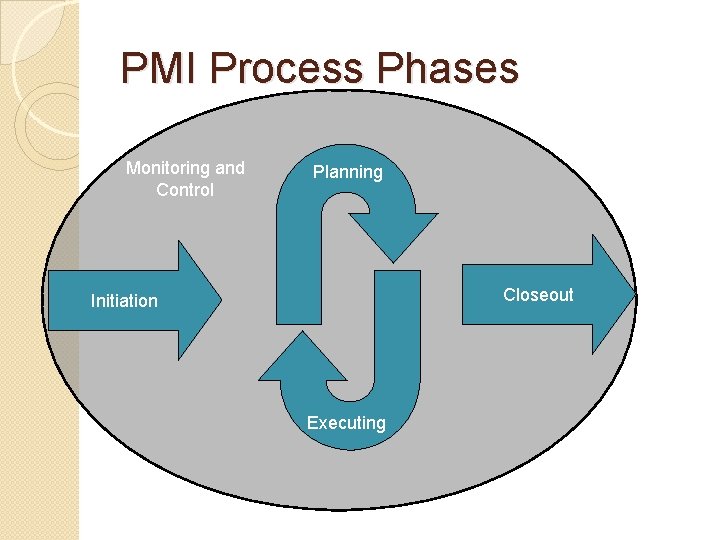
PMI Process Phases Monitoring and Control Planning Closeout Initiation Executing
Initiation Phase �The idea of the project comes to life �Organization decides if the project should be undertaken �Many projects may be taken forward for initiation, but fewer should be move into planning
What is the Project Charter �The contract �Defines the: ◦ ◦ ◦ of the Project What Scope Timeline Budget Stakeholders �The goal is to define the need, not the solution. The project team will define the best solution to meet the needs / goals of the project
Project Charter �The contract for the project with the customer �Should be a living document and updated as the project information changes �At the end of the project, the updated document should be filed for future reference of what was accomplished
Project Charter (Con’t) �Title Page ◦ The title of the project ◦ Covers the key players ◦ Shows the version and date in the case of version control �Signatures page ◦ Should be signed by the Sponsor and key players ◦ Signatures signify that everyone understands the scope and key deliverables
Project Charter (Con’t) �Revisions Page ◦ Document should be a living document ◦ Revisions show what was changed in the document �Project Information ◦ Used for categorization of the project ◦ Project Start and Finish dates are given as “Estimates” to show the impact of the project
Project Charter (Con’t) �Summary ◦ Should provide a short summary about the goals of the project ◦ Needs to be brief 2 – 3 paragraphs ◦ Don’t go into details about how the problem will be addressed �Priority / Priority Elaboration ◦ Priority should be given by the customer for the project ◦ Elaboration needs to identify if there any critical factors that might make this a higher project than others
Project Charter (Con’t) �Problem / Opportunity ◦ Should look at what this project hopes to address ◦ Needs to be put into words that the customer understands ◦ Should not define the “How” that will be addressed in the planning phase by the project team �Benefits ◦ Should be defined for the project ◦ Tangible can include direct cost savings or efficiency ◦ Intangible includes good will or customer service that can not be measured for the bottom line
Project Charter (Con’t) �Critical Success Factors ◦ Defines how the project will be measured a success ◦ Should be set by the customer ◦ Should be measurable ◦ Should define three to four that the team can monitor during the project process
Project Charter (Con’t) �In Scope ◦ Needs to be clearly defined what is to be accomplished by a project ◦ Avoid vague wording ◦ Can be clarified during the planning stages �Out of Scope ◦ Can often be more important than in scope ◦ Should expressly state things that will not be accomplished by the project ◦ Sponsors and others can often state that anything not listed in out of scope is in scope
Project Charter (Con’t) �Interdependencies ◦ Look at other projects that may depend of this project ◦ Look at projects this project depends on �Milestones ◦ Helps give the customer an idea of timeline ◦ Helps determine the key deliverables
Project Charter (Con’t) �Stakeholders ◦ Those people that will be impacted by the project ◦ Look for direct and indirect impact �Resources ◦ Look for roles needed, not names ◦ Identify is contractors may be needed ◦ Also identify non-people resources (rooms, software, etc. )
Project Charter (Con’t) �Assumptions ◦ These should be clearly identified ◦ This project will be successful if … ◦ Identify resource as well as technical assumptions �Constraints ◦ What is a limitation of the team ◦ Be sure to state cost limitations as a way to control scope ◦ Constraints may also be what you don’t know
Project Charter (Con’t) �Costs ◦ What are the costs associated with the project ◦ Be sure to account for all hardware and software ◦ Also account for the cost of people’s time (opportunity cost) ◦ Customer should determine the funding source ◦ Usually provided as a formal document attached to the project charter.
Lego Project Example �Work as a project team with those at your table �Use the project documents given in the handouts �Build the 1 st model described in the instructions �Pick one team member to act as the Project Manager
Lego Project Charter �Complete the project charter short form for your Lego project �Work with your team to define all of the sections �Take about 10 minutes to complete (followed by a 10 minute break) �Note: Project charters only need to be as long as needed so that all key areas are identified
Portfolio Management �A portfolio is a collection of projects grouped to facilitate effective management of resources so that projects can be completed that meet strategic business objectives �Includes a ranking of projects being undertaken by the organization ◦ Should be undertaken by Sr. Leadership including the customer ◦ Helps employees to better manage their time
Group Exercise �Project Ranking Spreadsheet
Building the Project Team �Led by the Project Sponsor and/or Project Manager �Each team member will have a responsibility to the project team �The Project Manager will have the responsibility to coordinate team members to move the project along �Project Teams will often go through the normal group phases of forming, storming, norming, and performing
4 Phases of Team Development �Forming – Team Members ask how do I fit into the project team? �Storming – Finding ways to work together and everything seems awkward. Power Plays �Norming – Group determines group norms and begins to work together. Some tendency to hold back must be overcome �Performing – Group learns how to constructively work together to complete the project
Moving into the Planning Phase �Review of the Project Charter �Double check with the Project Sponsor that the project should move forward �Review of lessons learned and information determined during initiation ◦ Budget ◦ Timeline ◦ Resources
Planning Phase �Most important phase of a project �Usually the largest amount of project time spent �Most project documentation is developed �Can easily be 50 – 60% of the project time
Project Meetings �Regularly held to gain status of a project �Should invite those that need to attend �Should be considerate of others time when planning �Best if scheduled on a reoccurring basis at the same time and same place if possible
Communication Plan �Defines what will be communicated and to whom ◦ Often overlooked ◦ Different communication for different stakeholders ◦ Determines when communication will be done with each group ◦ The most important part of the project team’s role is communicating
Work Breakdown Structure (WBS) �List of the activities needed to complete the project �Should be developed with the project team �Time estimated to complete tasks should be realistic considering the other ongoing projects, team members, etc. �Should be a living document and updated at each project meeting �If using an automated tool, such as Microsoft Project, be sure to baseline your project in the very beginning
Critical Path �Longest Path through a project �Shortest amount of time a project can be completed �If the project timeline should be shortened, then you need to shorten items on the critical path �Critical path can shift as task durations change
Critical Path Exercise �Identify the Critical Path for the given network diagram �Determine the Slack for each task on the network diagram �Determine how to reduce the length of the project by 2 days
Issues and Action Items �Make sure to document any issues that could cause disruption to the project �Record action items assigned or needed from team members not recorded in the WBS �Each issue and action item needs to have an owner responsible for completing �Should be reviewed at each project meeting �Don’t delete closed items as items have a bad habit of returning later
Risk Planning �PMI Definition: ◦ An uncertain event or condition that, if it occurs, has a positive or negative effect on the project’s objective. �Needs to be reviewed at each project meeting �New risks should be ranked for likeliness and impact
Status Report �Should be completed after each project team meeting �Gives a report as the status of the project since the last report �Becomes part of the official record of the project �Used to keep the Project Sponsor and stakeholders up to date on the project
Lego Project Meeting Planning �Take 15 minutes to meet with your project team �Review your project charter �Review your resources (pieces) with your plan and identify if there any risks or issues �Record risk of not completing this project
Moving into Implementation Phase �Review of Project Charter �Double Check with the Project Sponsor that the project should move forward �Review of lessons learned and information determined during planning ◦ Budget ◦ Timeline ◦ Resources �The further that a project progresses, the more expensive to close it down
Implementation Phase �Where the work of the project is completed �May need to cycle back through planning when issues or changes arise �Should continue to have status meetings to check on progress
Controlling – Are we on track? �Defined as: ◦ Regularly measures and monitors progress to identify variances from the project management plans so that corrective actions can be taken when necessary to meet project objectives �Should be completed at each point in the project
Change Order �Can be initiated by the project team or the project sponsor �The project team should have a matrix of what changes can be approved by the team and what needs sponsor approval �Will take the project back to the planning phase �Change order should be generated for any change to the project scope as documented in the project charter
Lego Execution and Change Request �As a project team, you have been given a change order �Evaluate the change order and see what effect it will have on the project �Build the project as stated in the project plan �Complete a project status report �You will have 20 minutes to complete and discuss with your team
Closeout �Completed after the project has met it’s objectives �Should be used to document lessons learned �Take the time to congratulate the team for the work that they performed
Move to Operational Status �Update documentation ◦ User documentation ◦ Support documentation ◦ Help Desk support documentation �Identify any change in service levels by moving to operations
Project Completion Report �Final Status Report to the Project Sponsor �Document accomplishments and any changes during the project �Should be completed with the project team
Lessons Learned Meeting �Held at the end of the project, and not during the project celebration �Gather up information to assist with future projects �Can be done in a meeting or virtually �Information should be shared with others planning projects �Should include all stakeholders including the Project Sponsor
Team Celebration �Does not have to be elaborate �Shows team members that their work was appreciated �Printed Certificated can be a huge morale booster �Recognition by Management of the work contributed �Can be the best investment for future projects
Closing Remarks �Randall Alberts ralberts@gsu. edu 404 -413 -4303
- Slides: 55