
BUILDING A POSITIVE SCHOOL CLIMATE CREATING A COMMUNITY
BUILDING A POSITIVE SCHOOL CLIMATE CREATING A COMMUNITY OF UPSTANDERS: PROMOTING LEARNING AS WELL AS PREVENTING CRUEL AND BULLYING BEHAVIORS JONATHAN COHEN, PH. D. NATIONAL SCHOOL CLIMATE CENTER; AND TEACHERS COLLEGE, COLUMBIA UNIVERSITY July 20, 2017 1: 00 to 2: 30 Changing the Story Together: Inspiring our Youth to Succeed in an Ever. Changing World
Goals 1) To describe the range of behaviors that undermine K-12 students feeling safe 2) To examine and consider the range of school-wide, instructional and relational improvement goals and strategies that have the potential to support students – and adults – feeling safe in schools 3) To recognize how you and your school/district may be involved with these improvement efforts already as well as to consider possible ‘next steps’
Discussion Questions What do you think are some of the most important experiences that undermine students’ feeling safe?
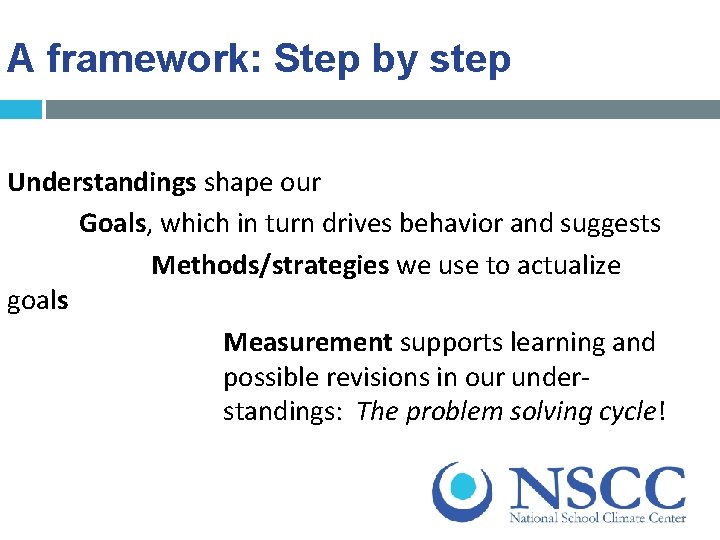
A framework: Step by step Understandings shape our Goals, which in turn drives behavior and suggests Methods/strategies we use to actualize goals Measurement supports learning and possible revisions in our understandings: The problem solving cycle!
Understandings On the limitations of the term “bullying” Perpetrator, target, witness roles: consistent and/or fluid? On the spectrum of mean, bullying and hateful behaviors that undermine feeling safes
Understandings: Behaviors that Undermine Feeling Safe • Normal moments of ‘stepping on each others emotional toes” and reacting to feeling frustrated, hurt and/or scared with anger • Unmet needs • Being intentionally hurtful: An individual and a social act • Hateful (horrible, terrible, unbearable, intolerable, insufferable, disgusting) acts
Moving From Understandings to Goal Setting and Actions Effective Prosocial Education 3. Moving from a reactive to a proactive stance Priority setting Specific improvement goals and strategies: (i) School wide goals and improvement strategies (ii) Instructional goals/improvement strategies (iii) Relational goals/improvement strategies 1. 2.
Moving from a reactive to a proactive stance 8
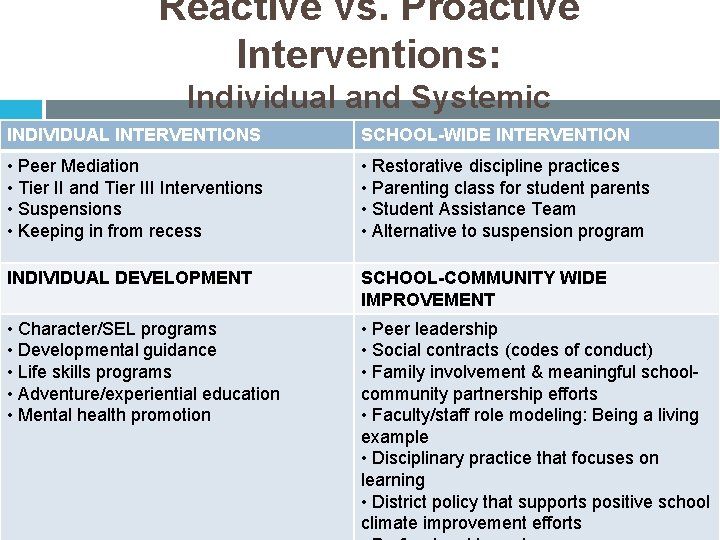
Reactive vs. Proactive Interventions: Individual and Systemic INDIVIDUAL INTERVENTIONS SCHOOL-WIDE INTERVENTION • Peer Mediation • Tier II and Tier III Interventions • Suspensions • Keeping in from recess • Restorative discipline practices • Parenting class for student parents • Student Assistance Team • Alternative to suspension program INDIVIDUAL DEVELOPMENT SCHOOL-COMMUNITY WIDE IMPROVEMENT • Character/SEL programs • Developmental guidance • Life skills programs • Adventure/experiential education • Mental health promotion • Peer leadership • Social contracts (codes of conduct) • Family involvement & meaningful schoolcommunity partnership efforts • Faculty/staff role modeling: Being a living example • Disciplinary practice that focuses on learning • District policy that supports positive school climate improvement efforts Citation 13
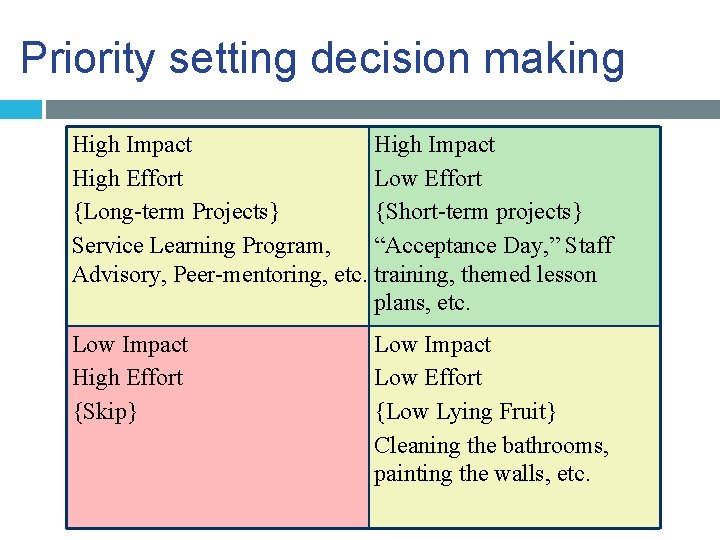
Priority setting decision making High Impact High Effort Low Effort {Long-term Projects} {Short-term projects} Service Learning Program, “Acceptance Day, ” Staff Advisory, Peer-mentoring, etc. training, themed lesson plans, etc. Low Impact High Effort {Skip} Low Impact Low Effort {Low Lying Fruit} Cleaning the bathrooms, painting the walls, etc.
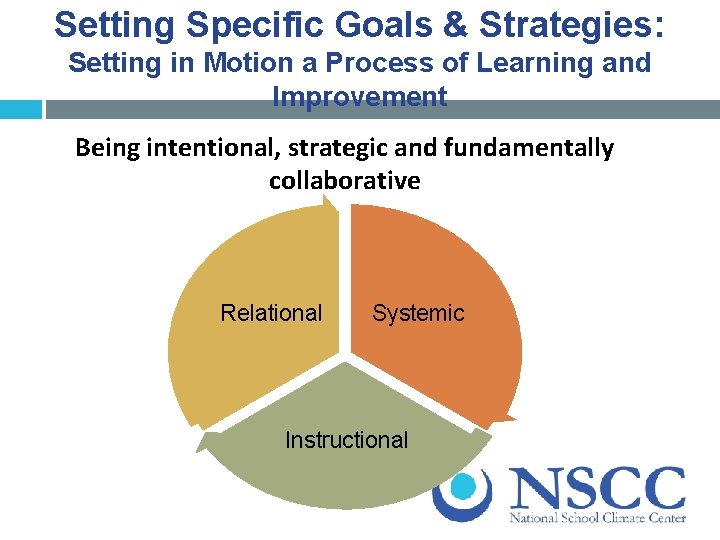
Setting Specific Goals & Strategies: Setting in Motion a Process of Learning and Improvement Being intentional, strategic and fundamentally collaborative Relational Systemic Instructional
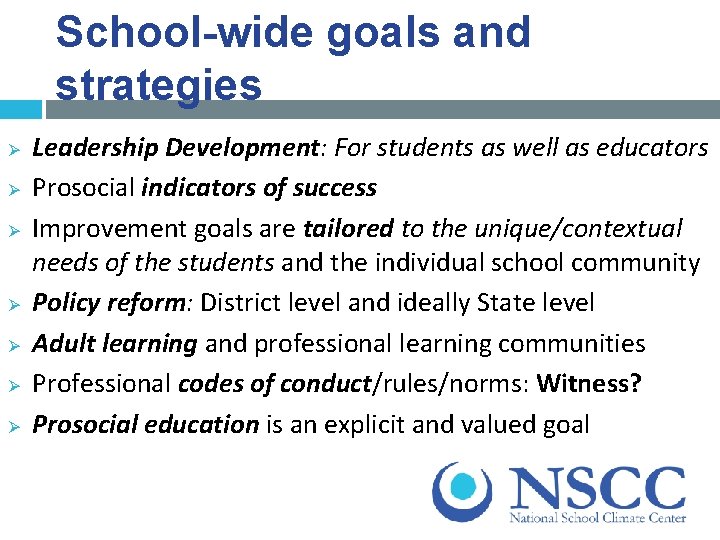
School-wide goals and strategies Ø Ø Ø Ø Leadership Development: For students as well as educators Prosocial indicators of success Improvement goals are tailored to the unique/contextual needs of the students and the individual school community Policy reform: District level and ideally State level Adult learning and professional learning communities Professional codes of conduct/rules/norms: Witness? Prosocial education is an explicit and valued goal
Instructional goals and strategies Ø Ø Being a helpful “living example” - modeling Managing classrooms and offices in dignified and democratically informed ways that always focus on student engagement, co-leadership and restorative practices. Utilizing pedagogies that promote prosocial instruction Implementing curriculum
Relational goals and strategies Ø Ø Ø Fostering meaningful & healthy student-teacher/staff relationships: Being connected! Supporting civic engagement and equity Parents, educators, and counselors learn and work together to recognize and respond to ‘at risk’ students
Reflections and conversations In what ways does the goal setting models make sense and/or not? ü ü ü Reactive vs. proactive? Priorities setting? Schoolwide, instructional and relational?

School climate improvement: Essential Questions & Conversations • A continuous process of students, parents/guardians, educators and even community members learning and working together: Ø Ø Ø What kind of school do we want ours to be? What are our current strengths, needs and weaknesses? Understanding what improvement goals we want to work on together?
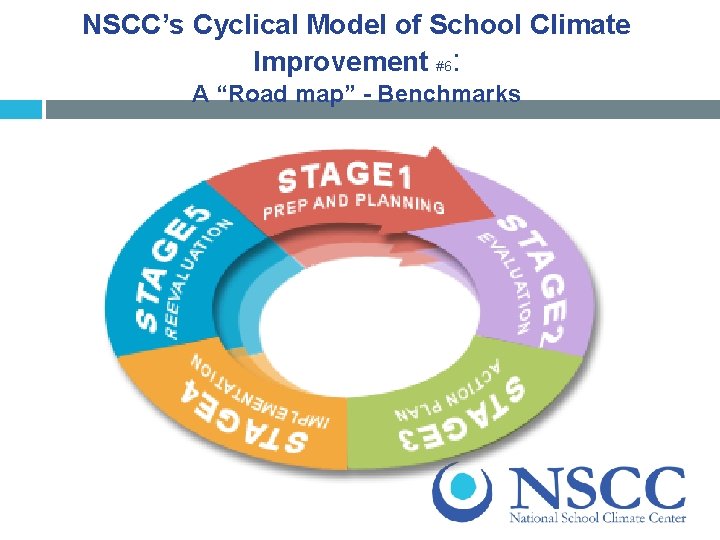
NSCC’s Cyclical Model of School Climate Improvement #6: A “Road map” - Benchmarks
Stage 1 - Planning and preparation: Laying the groundwork Promoting engagement & collaboration Ø Ø Forming a representative SC improvement leadership team and establishing ground rules collaboratively A shared vision: Building support and fostering “Buy In” for the improvement process Ø Establishing a “no fault” framework and promoting a culture of trust Ø Ensuring your team has adequate resources to support the process Ø Celebrating successes and building on past efforts Ø Reflecting and learning from Stage One work: Process assessments
Stage 2 - Assessment • Supporting the school community’s comprehensive understanding of strengths and potential areas for improvement: Ø Ø Ø Systematically evaluating the school’s strengths, needs and weaknesses: Prosocially, academically, behaviorally Developing plans to share evaluation findings with the school community Reflecting and learning from Stage Two work
Stage 3 - Action Planning • Engagement and the creation of a foundation for learning as well as implementation Ø Ø Understanding the evaluation findings Digging into the data to understand areas of consensus & discrepancy, and promoting learning & engagement. Prioritizing Goals Researching best practices and evidence-based instructional and systemic programs and efforts Ø Developing an action plan Ø Reflecting and learning from Stage Three work
Stage 4 - Implementing the Action Plan • Schoolwide, instructional and relational improvement efforts Ø Ø Coordinating evidence-based pedagogic and systemic efforts Efforts are implemented with fidelity, monitored and there is an ongoing attempt to learn from successes and challenges. The adults who teach and learn with students work to further their own social, emotional and civic learning. Reflecting and learning from Stage Four work.
Stage 5 -Re-evaluation & Beginning Anew • Learning from successes and challenges Ø Ø Discovering what has changed and how Discovering what has most helped and hindered further the school climate improvement process Ø Reevaluating the school’s strengths and challenges Ø Revising plans to improve the school climate Ø Reflecting and learning from Stage Five work
Learnings 1) 2) 3) 4) 5) Being intentional and strategic about our goals Fostering learning communities: Celebrating success and learning from failures/challenges Supporting inter generational school improvement efforts Making implicit social norms about the role of the witness explicit: From a culture of bystanders to one of Upstanders Fostering meaningful conversations
Next Steps 1) 1) What seems most important to you to consider now? How might you build on current efforts? Are there ways you can and would like to be a ‘teacher/learner’ with other classroom, school, district and/or state improvement leaders?
Thank you! Jonathan Cohen, Ph. D. • President, National School Climate Center (NSCC) 341 West 38 th Street, 9 th Floor, New York 10019 (212) 707 -8799; jonathancohen@schoolclimate. org • Adjunct Professor in Psychology and Education, Teachers College, Columbia University; • Co-editor, International Journal on School Climate and Violence Prevention. www. schoolclimate. org for news, resources, updates, and more! @school_climate @Bully. Bust
- Slides: 25