
Building a PMO from the Ground Up Karl
Building a PMO from the Ground Up Karl Knapp, MBA Amer. Us Group / Indianapolis Life
Agenda w Steps to Building & Maintaining a PMO: n n Step 1: Step 2: Step 3: Step 4: Assessment Approach Application Repeat w Case Study n n n Step 1: Assessment Step 2: Approach Step 3: Application Results Revised Approach w Questions & Answers

The Greatest Tool For a PMO Common Sense
Step 1: Assessment w w w w History Culture Perceptions of PM PM Maturity PM Talent Review Mission & Vision Gap Analysis
Historical Assessment w A historical assessment of the company allows you to understand where the company came from, what path it has traveled and how it has gotten to where it is currently at.
Cultural Assessment w The culture of the company has a major impact on the approach to take implementing a PMO.
Perceptual Assessment w The perception of project management in the company will GREATLY affect the right approach to implementing a PMO. w Find out about project failures. Drill down into why the happened, who got hurt, and who might be harboring ill thoughts about project management. w Find out about process successes, and drill down into these.
Maturity Assessment w At the outset of establishing a PMO, assess the project management maturity of the organization. w This early assessment will: n n Guide the areas of focus for the PMO Establish the baseline to track improvement in the project management maturity level of the organization.
Talent Assessment w The level of available project management talent in the organization is another key indicator of the approach to take. w Identify experienced and influential individuals. w Involvement of project managers throughout the organization is a key to success.
Mission Assessment w The mission answers the question, “why do we exist? ”. The mission should: n Provide a sense of timelessness n Involve both “ends” and “means” n Appeal to all stakeholders n Address all four basic needs (physical/economic, social/emotional, mental/ intellectual, & spiritual/holistic) n Be developed and owned at all levels
Vision Assessment w Vision communicates the future desired state and answers the questions, "Where are we going? Where do we want to be one year from now? Five years from now? Twenty years from now? “ w Qualities of Vision: n n n Is challenging, inspiring, and energizing Creates purpose, direction and commitment Goes beyond individual self-interest Becomes an integral part of the culture In uncomplicated, concise, easy to understand, and simple to communicate
GAP Assessment w Given where you are &, w Where you want to be w Identify the gaps as potential areas for development
Step 2: Approach w Given the results of the Assessment, determine the Approach that fits organizational: n n n n History Culture PM Maturity Available PM Talent PM Mission & Vision Gaps & Opportunities Current Situation
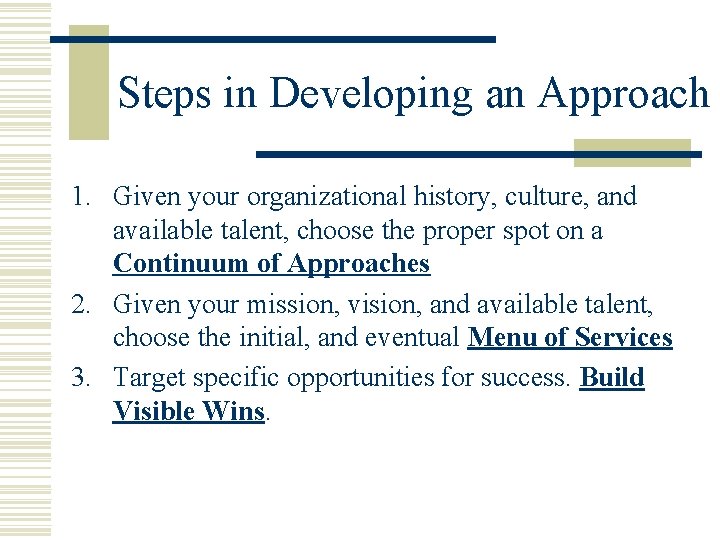
Steps in Developing an Approach 1. Given your organizational history, culture, and available talent, choose the proper spot on a Continuum of Approaches 2. Given your mission, vision, and available talent, choose the initial, and eventual Menu of Services 3. Target specific opportunities for success. Build Visible Wins.

PMO Continuum of Approaches Control Oversight Influence • PMO At Highest Level • Prioritization Leadership • Information Ownership • Project Managers Report • Project Staff May Report • Projects Run By PMO • Strict Standards • PMO System Reporting • Education Standardized • Certification Standardized • PMO At High Level • Prioritization Participation • Information Coordination • Project Managers Dotted • Project Staff Affiliated • Projects Coordinated • Standards Co-Developed • System Co-Selected • Education Offered • Certification Supported • PMO At Any Level • Prioritization Input • Limited Information • Project Manager Members • Project Staff Separate • Projects Not Coordinated • Standards Recommended • Systems Recommended • Education Is Key • Certification Encouraged
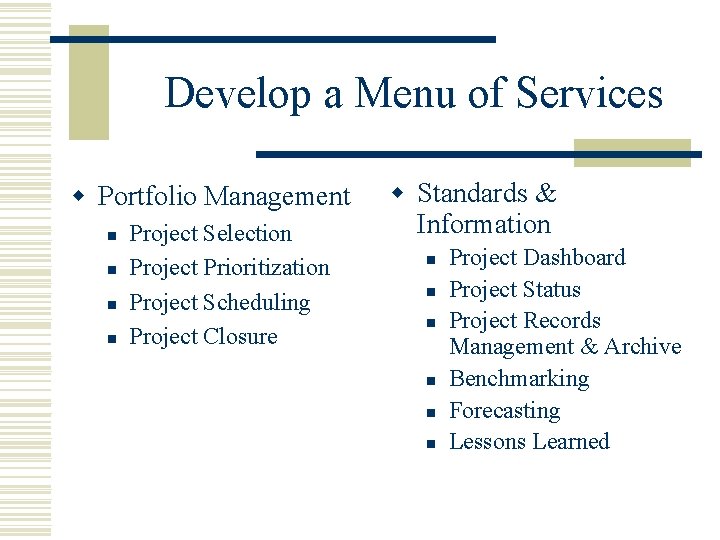
Develop a Menu of Services w Portfolio Management n n Project Selection Project Prioritization Project Scheduling Project Closure w Standards & Information n n n Project Dashboard Project Status Project Records Management & Archive Benchmarking Forecasting Lessons Learned
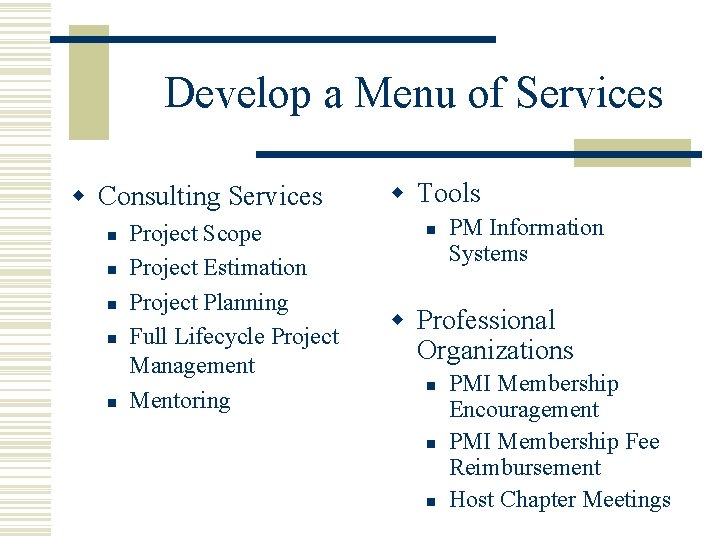
Develop a Menu of Services w Consulting Services n n n Project Scope Project Estimation Project Planning Full Lifecycle Project Management Mentoring w Tools n PM Information Systems w Professional Organizations n n n PMI Membership Encouragement PMI Membership Fee Reimbursement Host Chapter Meetings
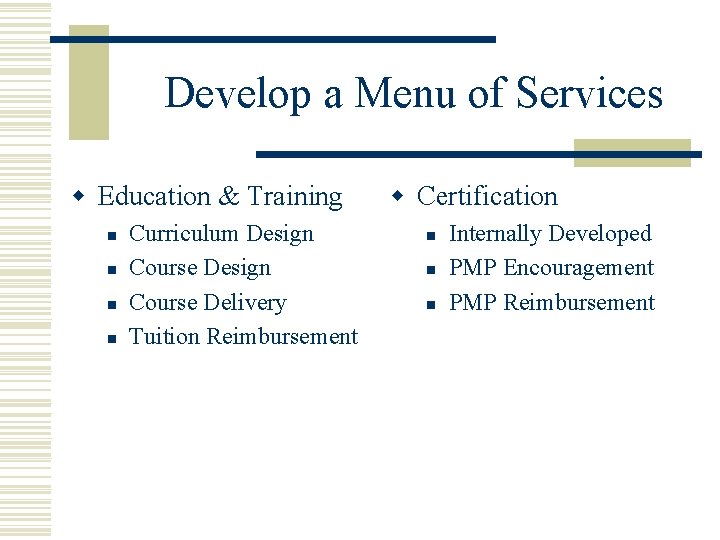
Develop a Menu of Services w Education & Training n n Curriculum Design Course Delivery Tuition Reimbursement w Certification n Internally Developed PMP Encouragement PMP Reimbursement
Opportunities for Success w Actions speak louder than words w Demonstrate the positive effect of good project management practice n n Find a runaway project to rein in Better yet, find a visible project, choose your best project manager and let them execute
Step 3: Application w Implementing a PMO is implementing change. w Use the eight steps to successfully leading change proposed by John Kotter in his 1996 book, Leading Change.
8 Steps to Leading Change (Kotter) w w w w Step 1: Step 2: Step 3: Step 4: Step 5: Step 6: Step 7: Step 8: Establish a sense of urgency Create the guiding coalition Develop a vision & a strategy Communicate the change vision Empower employees Generate short-term wins Consolidate wins & produce more change Anchor new approaches in the culture
1: Establish a Sense of Urgency w Build awareness of project management with the corporate management team w Highlight the results of good examples of project management w Highlight the need for project management in runaway projects w Compare the speed and effectiveness of your firm in others in your industry. Can you execute as well and as fast as your competition?
2: Create the Guiding Coalition w Identify the key influential stakeholders w For senior managers, pick one of their key projects as a pilot project (choose low-hanging fruit) w Create a project management counsel, steering committee or board of directors w Involve key project managers in the development of the PMO and in the determination of standards
3: Develop a Vision & Strategy w After creating the initial vision and strategy, refine it along with the guiding coalition w Have the key project managers involved in refining the mission, vision and strategy w Get the feedback of the project management counsel (senior management) on the mission, vision and strategy
4: Communicate the Vision w COMMUNICATE, COMMUNICATE! w Communicate the mission, vision and strategy to the organization w Package your message well w If possible, ask for help in designing professional looking logos to spruce up the presentation w Use town hall meetings, newsletters and the company Intranet to communicate
5: Empower Employees w w w Support or supply project management training Support PMI membership Support project management certification (PMP) Supply project management tools Create an environment for success - set realistic goals w Supply information
6: Generate Short-Term Wins w Pick low-hanging fruit (VERY IMPORTANT) w High visibility, FUNDED project as a pilot w Runaway projects (more negative but quick)
7: Consolidate Wins w Win Friends and Influence People w Build on project successes w Highlight project successes outside of the PMO for good examples of project management w DEMONSTRATE SUCCESS TO SENIOR MANAGEMENT AND BUILD w Once the ball is rolling, GO GO GO!
8: Anchor New Approaches w Involve more and more people in project management w Train project participants in the basics of project management w Embed project planning into organizational planning w Prioritize, schedule and fund projects w Project management should be embedded in every organizational change
Reevaluate and Repeat w Evaluate lessons learned w Reevaluate mission and vision w Reevaluate the menu of services
Summary w Assessment w Approach w Application
Case Study
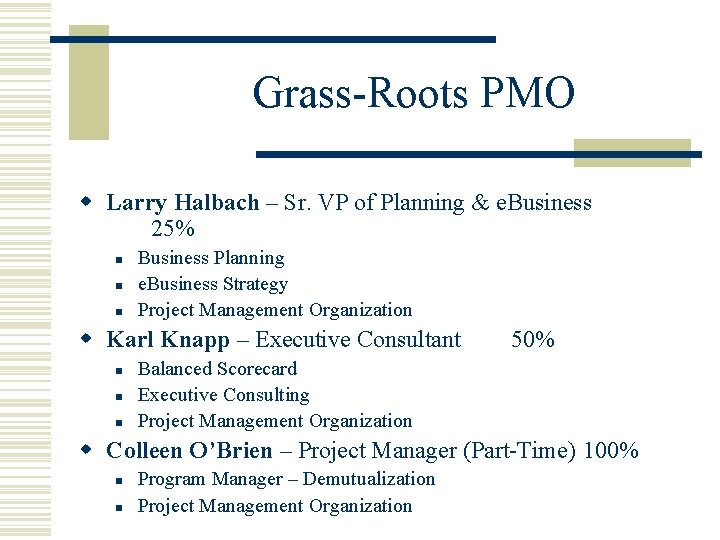
Grass-Roots PMO w Larry Halbach – Sr. VP of Planning & e. Business 25% n n n Business Planning e. Business Strategy Project Management Organization w Karl Knapp – Executive Consultant n n n 50% Balanced Scorecard Executive Consulting Project Management Organization w Colleen O’Brien – Project Manager (Part-Time) 100% n n Program Manager – Demutualization Project Management Organization
PMO Members w w w Part-Time Focus Other ‘jobs’ were primary Well respected Well qualified Belief in importance of project management
Assessment w w w w History Culture PM Perceptions PM Maturity PM Talent Review Mission & Vision GAP Analysis
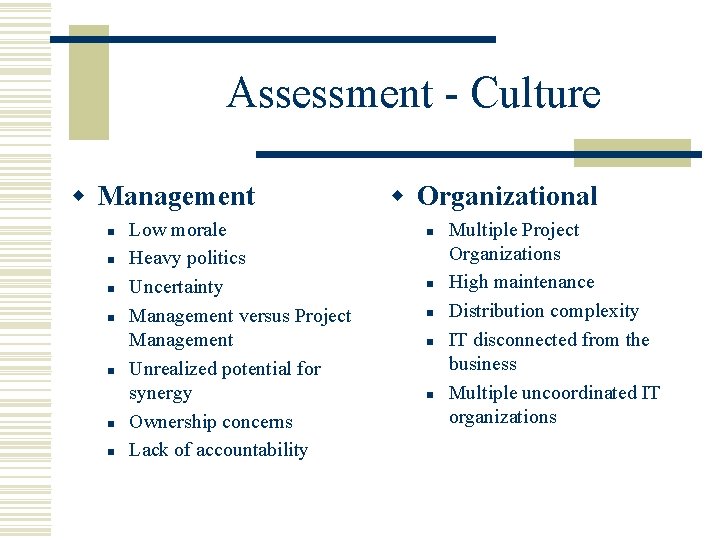
Assessment - Culture w Management n n n n Low morale Heavy politics Uncertainty Management versus Project Management Unrealized potential for synergy Ownership concerns Lack of accountability w Organizational n n n Multiple Project Organizations High maintenance Distribution complexity IT disconnected from the business Multiple uncoordinated IT organizations
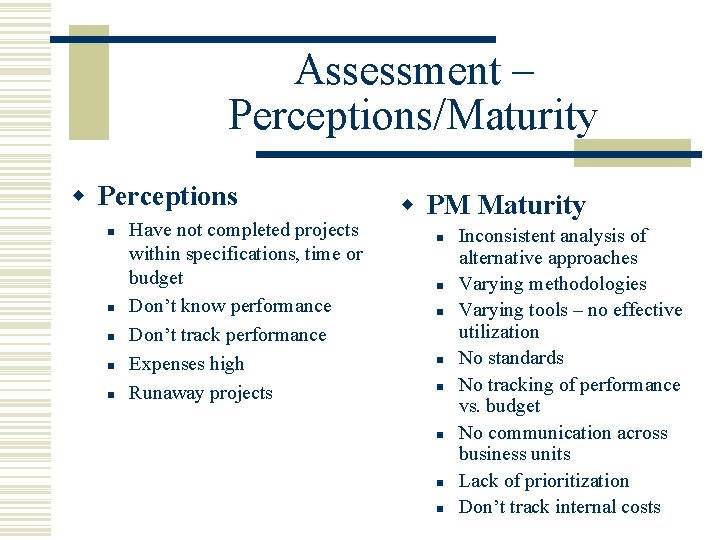
Assessment – Perceptions/Maturity w Perceptions n n n Have not completed projects within specifications, time or budget Don’t know performance Don’t track performance Expenses high Runaway projects w PM Maturity n n n n Inconsistent analysis of alternative approaches Varying methodologies Varying tools – no effective utilization No standards No tracking of performance vs. budget No communication across business units Lack of prioritization Don’t track internal costs
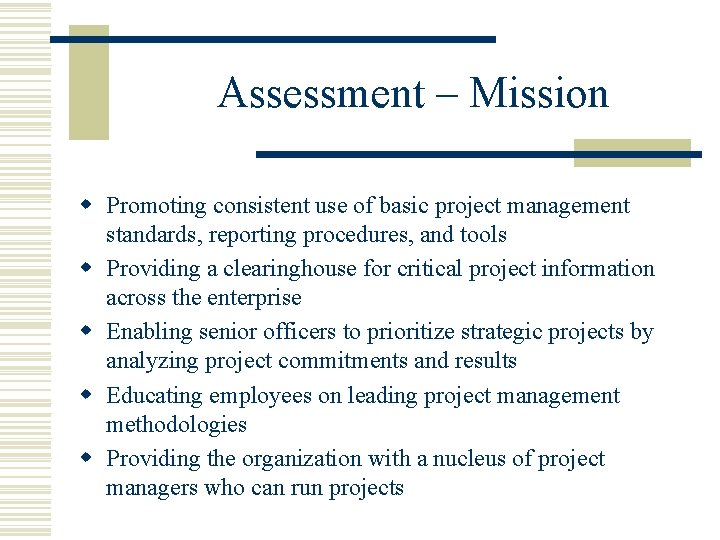
Assessment – Mission w Promoting consistent use of basic project management standards, reporting procedures, and tools w Providing a clearinghouse for critical project information across the enterprise w Enabling senior officers to prioritize strategic projects by analyzing project commitments and results w Educating employees on leading project management methodologies w Providing the organization with a nucleus of project managers who can run projects
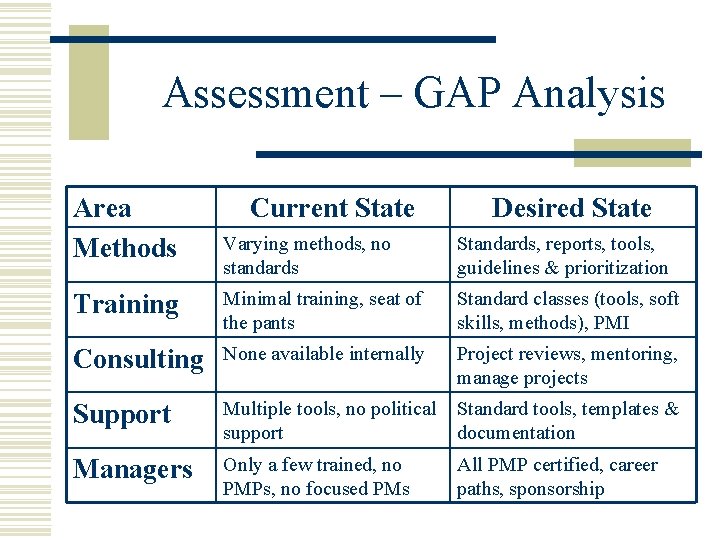
Assessment – GAP Analysis Area Methods Current State Desired State Varying methods, no standards Standards, reports, tools, guidelines & prioritization Training Minimal training, seat of the pants Standard classes (tools, soft skills, methods), PMI Consulting None available internally Project reviews, mentoring, manage projects Support Multiple tools, no political support Standard tools, templates & documentation Managers Only a few trained, no PMPs, no focused PMs All PMP certified, career paths, sponsorship
Approach w Continuum of Approaches w Menu of Services w Visible Wins

Approach - Continuum w Key Determinates: n n n Lacked a ‘mandate’ Uncertain support from senior management Needed to show rationale for project management and demonstrate success w Approach Selected: n Influencing the Organization
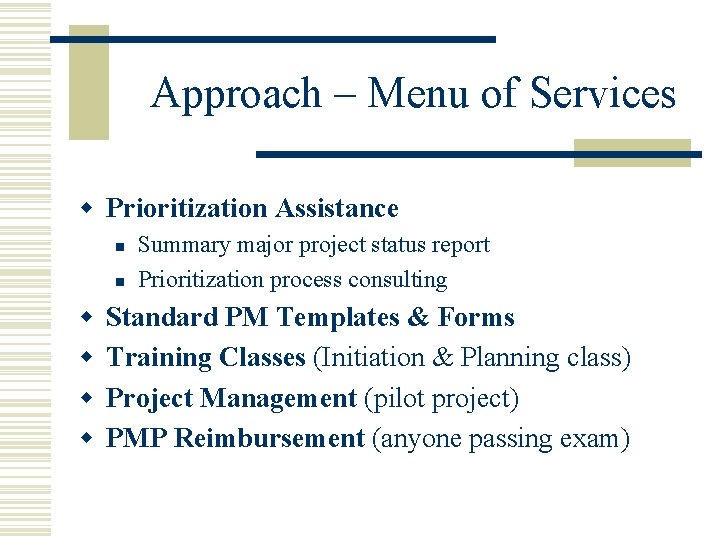
Approach – Menu of Services w Prioritization Assistance n n w w Summary major project status report Prioritization process consulting Standard PM Templates & Forms Training Classes (Initiation & Planning class) Project Management (pilot project) PMP Reimbursement (anyone passing exam)
The Project Center Is Born
Approach – Visible Wins w Manage Large, Visible Project n n n Demutualization Put best project manager in charge of the project Involved from the planning process forward w Assist Prioritization Committee n n Information – bi-weekly summary status report Process – facilitated design of prioritization process
Application w w w w Sense of urgency Guiding coalition Vision & strategy Communicate vision Empower employees Generate short-term wins Consolidate wins Anchor new approaches
Reevaluation & Repeat w w Accomplishments Lessons Learned Mission & Vision Menu of Services
Reevaluation - Accomplishments w Expanded the consistent use of project management standards, reporting procedures & tools n n n Adopted the Project Management Institute (PMI) body of knowledge as our basis Extended the Project Center to include key project managers throughout the organization in a Project Management Counsel Created a Project Management Handbook including new project management forms & processes w Reported critical project information n n Provided bi-weekly status and resource projection reports to the prioritization committee on key projects Deployed a web-based project dashboard for executives
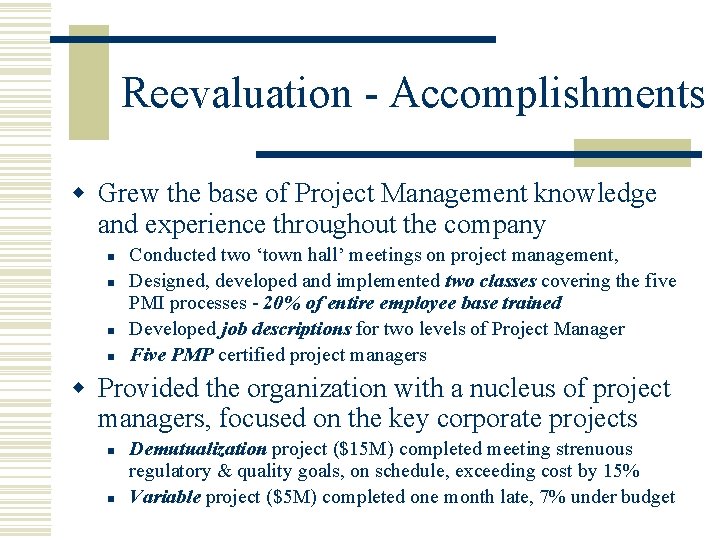
Reevaluation - Accomplishments w Grew the base of Project Management knowledge and experience throughout the company n n Conducted two ‘town hall’ meetings on project management, Designed, developed and implemented two classes covering the five PMI processes - 20% of entire employee base trained Developed job descriptions for two levels of Project Manager Five PMP certified project managers w Provided the organization with a nucleus of project managers, focused on the key corporate projects n n Demutualization project ($15 M) completed meeting strenuous regulatory & quality goals, on schedule, exceeding cost by 15% Variable project ($5 M) completed one month late, 7% under budget
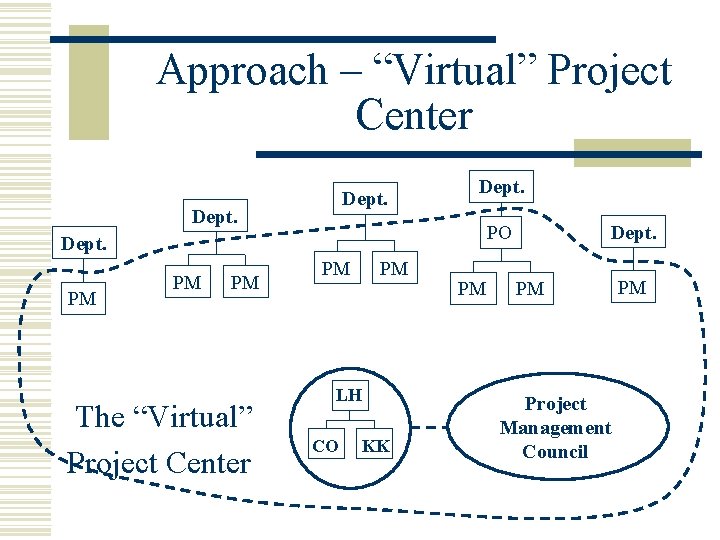
Approach – “Virtual” Project Center Dept. PM PM PM The “Virtual” Project Center Dept. PO Dept. PM PM LH CO KK PM PM Project Management Council PM
CHANGE w Merger with Amer. Us Group w Senior management combined w Loss of guiding coalition and sponsorship w The Project Center moved to the IT Department w What to do?
Of Course! w Assessment w Approach w Application w Reevaluation & Repeat
Open Discussion
- Slides: 52