
Building a Model House to Withstand a Hurricane
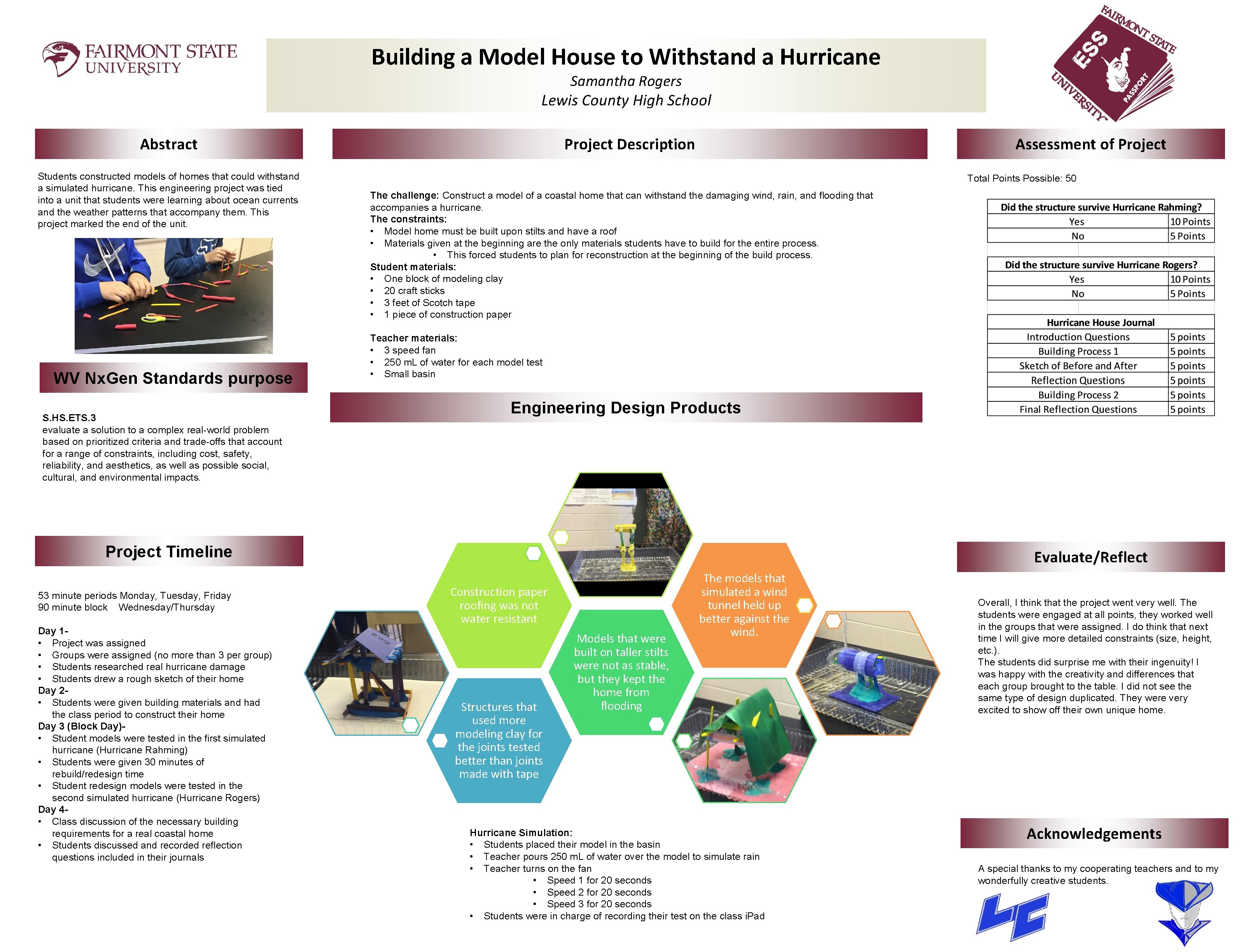
Building a Model House to Withstand a Hurricane Samantha Rogers Lewis County High School Abstract Students constructed models of homes that could withstand a simulated hurricane. This engineering project was tied into a unit that students were learning about ocean currents and the weather patterns that accompany them. This project marked the end of the unit. WV Nx. Gen Standards purpose S. HS. ETS. 3 evaluate a solution to a complex real-world problem based on prioritized criteria and trade-offs that account for a range of constraints, including cost, safety, reliability, and aesthetics, as well as possible social, cultural, and environmental impacts. Project Description Assessment of Project Total Points Possible: 50 The challenge: Construct a model of a coastal home that can withstand the damaging wind, rain, and flooding that accompanies a hurricane. The constraints: • Model home must be built upon stilts and have a roof • Materials given at the beginning are the only materials students have to build for the entire process. • This forced students to plan for reconstruction at the beginning of the build process. Student materials: • One block of modeling clay • 20 craft sticks • 3 feet of Scotch tape • 1 piece of construction paper Teacher materials: • 3 speed fan • 250 m. L of water for each model test • Small basin Engineering Design Products Project Timeline 53 minute periods Monday, Tuesday, Friday 90 minute block Wednesday/Thursday Day 1 • Project was assigned • Groups were assigned (no more than 3 per group) • Students researched real hurricane damage • Students drew a rough sketch of their home Day 2 • Students were given building materials and had the class period to construct their home Day 3 (Block Day) • Student models were tested in the first simulated hurricane (Hurricane Rahming) • Students were given 30 minutes of rebuild/redesign time • Student redesign models were tested in the second simulated hurricane (Hurricane Rogers) Day 4 • Class discussion of the necessary building requirements for a real coastal home • Students discussed and recorded reflection questions included in their journals Evaluate/Reflect Construction paper roofing was not water resistant Structures that used more modeling clay for the joints tested better than joints made with tape Models that were built on taller stilts were not as stable, but they kept the home from flooding The models that simulated a wind tunnel held up better against the wind. Hurricane Simulation: • Students placed their model in the basin • Teacher pours 250 m. L of water over the model to simulate rain • Teacher turns on the fan • Speed 1 for 20 seconds • Speed 2 for 20 seconds • Speed 3 for 20 seconds • Students were in charge of recording their test on the class i. Pad Overall, I think that the project went very well. The students were engaged at all points, they worked well in the groups that were assigned. I do think that next time I will give more detailed constraints (size, height, etc. ). The students did surprise me with their ingenuity! I was happy with the creativity and differences that each group brought to the table. I did not see the same type of design duplicated. They were very excited to show off their own unique home. Acknowledgements A special thanks to my cooperating teachers and to my wonderfully creative students.
- Slides: 1