
Building a Joint Information System JIS Changing the

Building a Joint Information System (JIS) Changing the paradigm: New communication and emergency response strategies for today’s environment
Why Change? The current standard for emergency communications during a declared emergency is antiquated Changing the Paradigm 2
What is a JIS? • A JIS is a holistic approach to emergency communications. It provides an important framework for reaching out to the public to provide accurate, timely information, as well as to protect and maintain company trust and credibility • A JIS allows flexible, scalable and portable communications to meet the demands of real world reporting Changing the Paradigm 3
Components • Pre-event planning • Virtual Joint Information Center (V-JIC) • Social media & emergency response • Message management during an event • JIC operations • Realistic drills and exercises • Protocol for response to an event of public interest Changing the Paradigm 4
Guidance for Pre-Event Planning Changing the Paradigm 5
Effective Partnership Corporate communications and emergency preparedness must partner for success. • Communications/EP working group • Outline communications support • Determine shared responsibilities • Review OE, procedural changes, etc • Joint Information Center “Guidebook” Changing the Paradigm 6
Normal Communications Event Communications • Utilize the resources and processes already in place • Do not need to “reinvent the wheel” • Communications takes the lead • Emergency Preparedness supports Communications Changing the Paradigm 7
Public Education and Outreach Program An effective public education program includes both public education material and community outreach. • Benefits of effective communication • Public education examples • Leverage state-wide or national events • National preparedness month • People will respond appropriately Changing the Paradigm 8
Establish a Group of Spokespersons • Spokesperson - public face of organization • Should be skilled at delivering messages • Proven leaders, organized, good listeners • Training – media training and drills • Mock media • Surrogates lead to negative training Changing the Paradigm 9
Develop Relationships with Stakeholder Public Information Officers • Annual meeting with key PIOs • Conduct media training for off-site PIOs • Review pre-approved templates/messages • Understanding of NIMS/ICS • Plant emergency communications manual • Press conference specifics • Conduct video interviews with PIOs Changing the Paradigm 10
Develop Working Relationships with Local Media Good relationships during normal operations will result in more balanced reporting during a declared emergency or unexpected event. • Periodic meetings with the news managers • Invite the media to the plant • Provide media with contact information • Review and update all contact lists Changing the Paradigm 11
Cultivate Third-Party Experts The general public places a high level of trust in third-party experts. • Provide them information • Grassroots efforts • Outreach to different groups • Social networks • Media training for identified experts Changing the Paradigm 12
Develop a Group of Simple, Easily. Understood Templates/Graphics Develop graphics and other collateral before an emergency occurs. • Fukushima - need for technical data, plant information and key facts, quickly • Materials should not be complicated - hard copy and electronic • Examples of materials Changing the Paradigm 13
Develop Emergency Message Mapping From NUREG/CR-7033 Ideally, each nuclear plant should: … • Develop a message map briefing book for different scenarios. • Develop a comprehensive risk and crisis communication plan. • Conduct regular message mapping practice sessions, drills, and exercises. Changing the Paradigm 14
Prepare for Hostile Action Events • Understanding the challenges • Identifying gaps in public information processes • The need for public information personnel at an incident command point (ICP) • Strong communications - ICP and JIC • National Response Framework (NRF) and ESF 15 Changing the Paradigm 15
Establish a Dark Website • Invisible site that can be activated quickly and made visible in a declared emergency • Important crisis communications tool • Recommended items to include on a dark site Changing the Paradigm 16
Virtual Joint Information Center (VJIC), Social Media and Realistic Drill and Exercises Changing the Paradigm 17
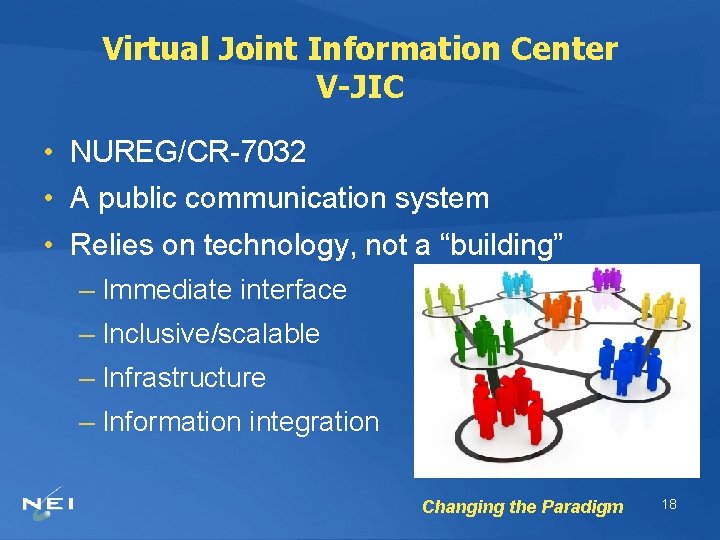
Virtual Joint Information Center V-JIC • NUREG/CR-7032 • A public communication system • Relies on technology, not a “building” – Immediate interface – Inclusive/scalable – Infrastructure – Information integration Changing the Paradigm 18
Recommendations for a V-JIC • Information to share – Plant status – Fact sheets – Links to participating/relevant agencies, videos, social media • Infrastructure – Conference bridge lines – Email distributions – Video conferencing-”Skype” – Share drives and software Changing the Paradigm 19
The Ultimate Goal • Validate and share information early, quickly and continually • Coordinate/integrate information across affected jurisdictions and organizations – no boundaries Changing the Paradigm 20
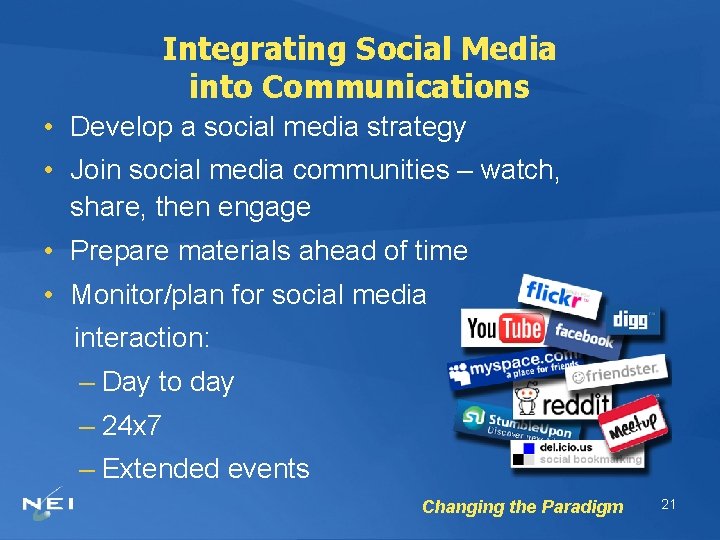
Integrating Social Media into Communications • Develop a social media strategy • Join social media communities – watch, share, then engage • Prepare materials ahead of time • Monitor/plan for social media interaction: – Day to day – 24 x 7 – Extended events Changing the Paradigm 21

Incorporating Social Media into Emergency Planning/JIC Operations • Formalize social media roles within ERO – Social media manager – Social media monitor – Social media/admin assistants • Develop processes for incorporating social media information • Drill social media – Use instant messaging/emails Changing the Paradigm 22
Guidance for Twitter Use • As soon as possible, state that event has occurred and you will provide updates • Share information from generic fact sheets/pre-approved content to keep information flowing • Include links - let media know where to download content • Update Google Ad. Words to direct people to your site Changing the Paradigm 23
Guidance for Twitter Use (cont’d) • Post spokesperson quotes and links to video • Look for ways to quell rumors through blog postings or follow up tweets • Continually monitor news monitoring tools • Promote/retweet Twitter handles of reputable organizations/individuals • Reach out to NEI for help Changing the Paradigm 24
Social Media Lessons Learned • OK to post raw/unedited video/photos (discuss approach with legal PRIOR to events) • Speed important but consistency, clarity and veracity MORE important – Resist urge to share information until details and messaging are established – Don’t respond to every tweet – look for repeated questions or major concerns • Become the credible source via your web Changing the Paradigm 25
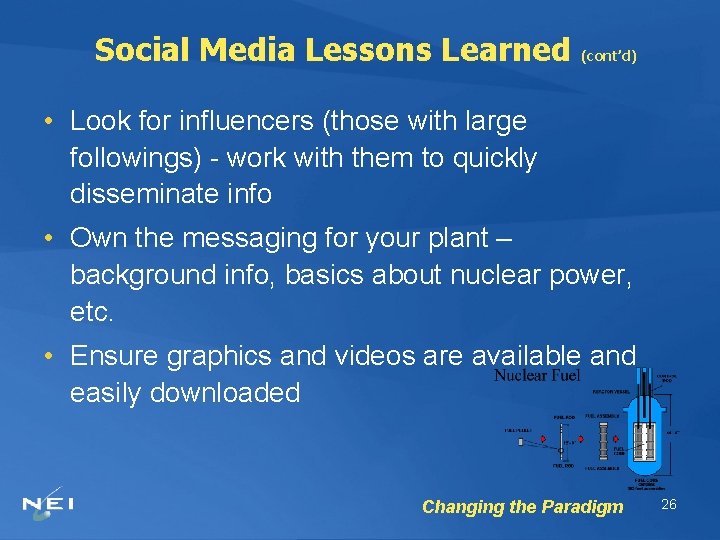
Social Media Lessons Learned (cont’d) • Look for influencers (those with large followings) - work with them to quickly disseminate info • Own the messaging for your plant – background info, basics about nuclear power, etc. • Ensure graphics and videos are available and easily downloaded Changing the Paradigm 26
Message Management during an Event Changing the Paradigm 27
Initial Emergency Message Coordination • Vital to speak with one voice to maintain credibility, prior to, and after JIC activation • Ability to provide near immediate information via a press release, Twitter and company website is a priority • Initial tweet acknowledges event and indicate where information will be posted • Once the JIC is activated, all communications and messaging should be coordinated from the JIC. Changing the Paradigm 28
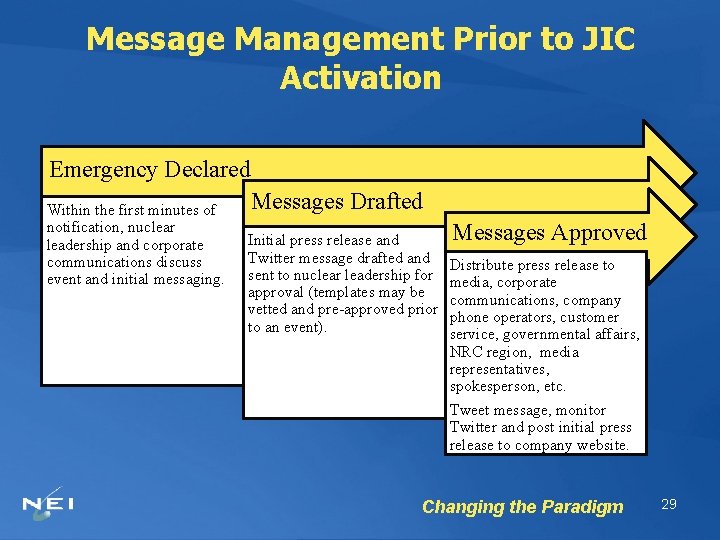
Message Management Prior to JIC Activation Emergency Declared Messages Drafted Within the first minutes of notification, nuclear leadership and corporate communications discuss event and initial messaging. Initial press release and Twitter message drafted and sent to nuclear leadership for approval (templates may be vetted and pre-approved prior to an event). Messages Approved Distribute press release to media, corporate communications, company phone operators, customer service, governmental affairs, NRC region, media representatives, spokesperson, etc. Tweet message, monitor Twitter and post initial press release to company website. Changing the Paradigm 29
Media Management at the Plant Site • Plan for managing media at the plant and corporate offices. • Cover the time period prior to JIC activation, (90 to 120 minutes), and for events where the media may not go to the JIC, or the JIC may not be activated. Changing the Paradigm 30
Media Management at the Plant Site • Two scenarios to consider: – Some media outlets will dispatch crews to the plant site and to the corporate office. – If the emergency has a newsworthy component, such as a fire that is visible from a distance or a hostile action against the plant, assume media outlets will remain at the plant site. Changing the Paradigm 31
Media Management at the Plant Site • Develop a kit of information and equipment. The kit may include: – laptop computer with internet/email connections, USB drives – satellite phone, pager, PDA w/wireless capability, equipment chargers – digital camera/flip cams – B-Roll/plant fact sheets/press kits – personal protective equipment – business cards, bios Changing the Paradigm 32
Message Management Following JIC Activation • Speaking with one voice is vital to success. The JIC facilitates communications between the site and corporate offices. The corporation should communicate with others, such as: – company crisis councils – executives – governmental affairs / investor relations – customer service / external customers – employees and retirees Changing the Paradigm 33
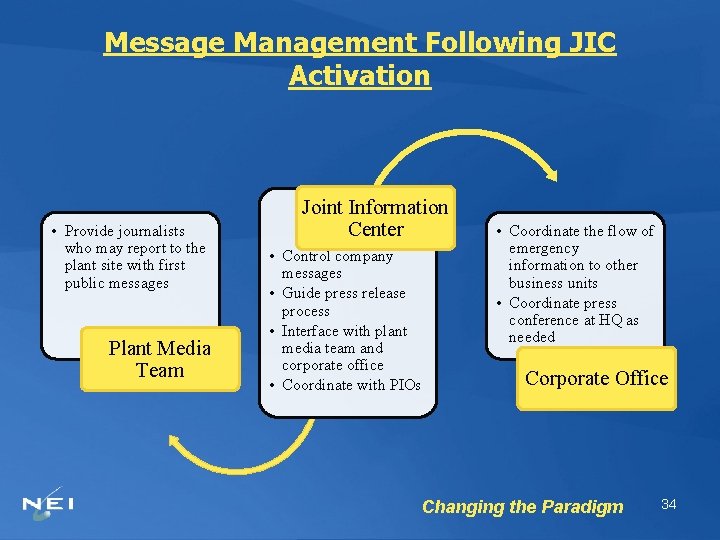
Message Management Following JIC Activation • Provide journalists who may report to the plant site with first public messages Plant Media Team Joint Information Center • Control company messages • Guide press release process • Interface with plant media team and corporate office • Coordinate with PIOs • Coordinate the flow of emergency information to other business units • Coordinate press conference at HQ as needed Corporate Office Changing the Paradigm 34
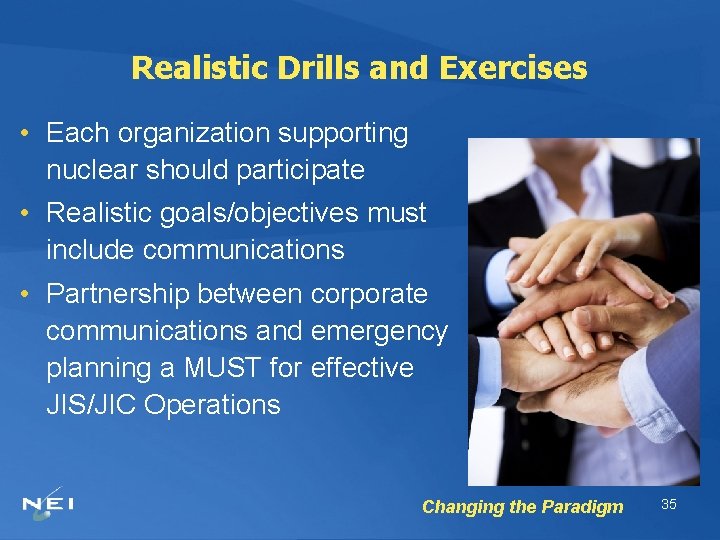
Realistic Drills and Exercises • Each organization supporting nuclear should participate • Realistic goals/objectives must include communications • Partnership between corporate communications and emergency planning a MUST for effective JIS/JIC Operations Changing the Paradigm 35
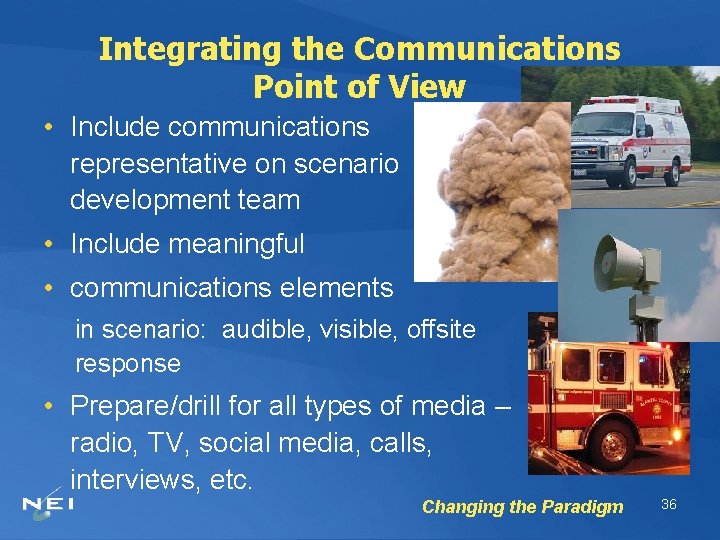
Integrating the Communications Point of View • Include communications representative on scenario development team • Include meaningful • communications elements in scenario: audible, visible, offsite response • Prepare/drill for all types of media – radio, TV, social media, calls, interviews, etc. Changing the Paradigm 36
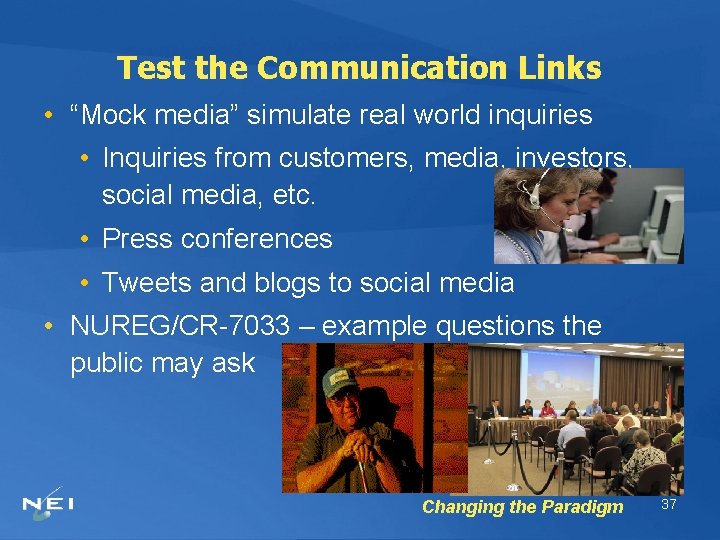
Test the Communication Links • “Mock media” simulate real world inquiries • Inquiries from customers, media, investors, social media, etc. • Press conferences • Tweets and blogs to social media • NUREG/CR-7033 – example questions the public may ask Changing the Paradigm 37
Rumor Control – Key Evaluation Element • Ability to identify, track and address rumors and inaccurate information • Important to monitor and coordinate ALL avenues of information • We are only as good as the information we provide Changing the Paradigm 38
Exercise Evaluation • NUREG 0654 - basis for JIC exercise objectives • Must broaden to address paradigm shift of technology and JIS communications • In addition to “standards” of timely, accurate information and adequate facilities, include ability to use social media and perform elements of a JIS Changing the Paradigm 39
Questions? 40
- Slides: 40