
Building a Foundation with the DMIS IDI and
Building a Foundation with the DMIS, IDI and the IDC WISE Conference (February 4 -5, 2016) Wake Forest University Penelope Pynes, Ph. D. University of North Carolina at Greensboro (pjpynes@uncg. edu)
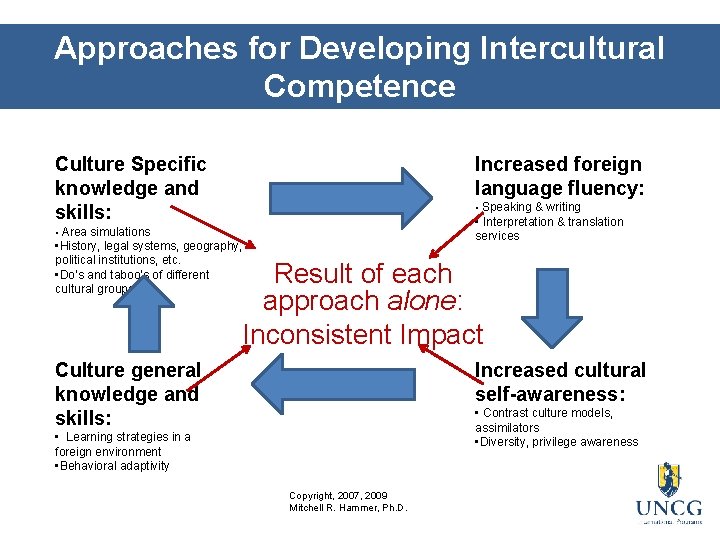
Approaches for Developing Intercultural Competence Increased foreign language fluency: Culture Specific knowledge and skills: • Speaking & writing • Interpretation & translation services • Area simulations • History, legal systems, geography, political institutions, etc. • Do’s and taboo’s of different cultural groups Result of each approach alone: Inconsistent Impact Culture general knowledge and skills: Increased cultural self-awareness: • Contrast culture models, assimilators • Diversity, privilege awareness • Learning strategies in a foreign environment • Behavioral adaptivity Copyright, 2007, 2009 Mitchell R. Hammer, Ph. D.
Culture Definition Working with someone next to you discuss briefly your definition of culture.
Objective/ Subjective Culture Objective culture: What human beings make, and pass on from generation to generation. Examples: music and art Subjective culture: The learned and shared patterns of beliefs, behaviors, and values of groups of interacting people. Source: Bennett 1998: 3.
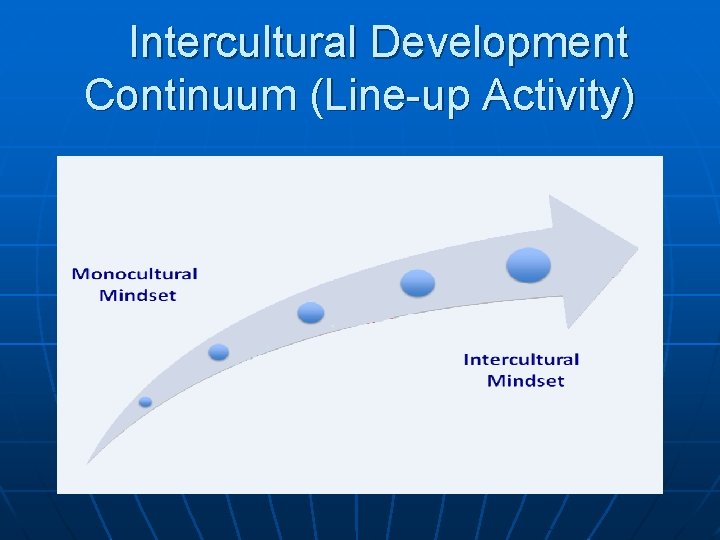
Intercultural Development Continuum (Line-up Activity)

Intercultural Development Continuum (IDC) • Cognitive Frame-shifting • Behavioral Code-shifting • Similarity • Universalism • Defense • Reversal • Disinterest • Avoidance Modified from the Developmental Model of Intercultural Sensitivity (DMIS), M. Bennett, 1986. Copyright, 2007, 2009 Mitchell R. Hammer, Ph. D.
Practice with Cards Working with a partner determine where on the continuum the statements on the cards fall.
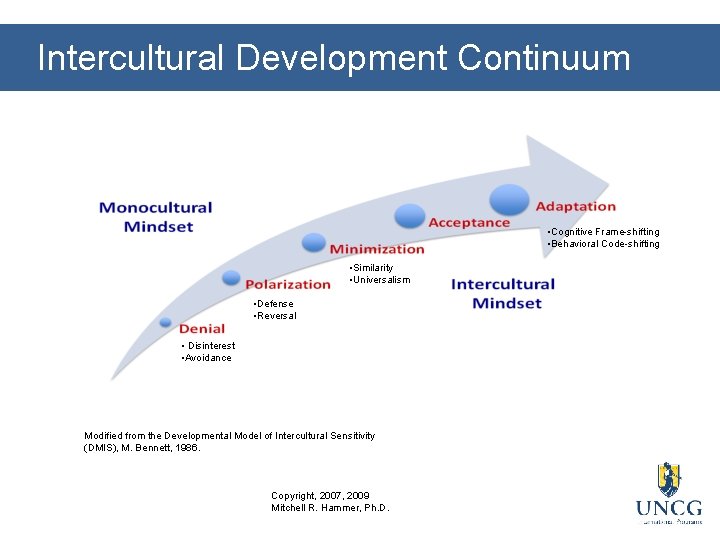
Intercultural Development Continuum • Cognitive Frame-shifting • Behavioral Code-shifting • Similarity • Universalism • Defense • Reversal • Disinterest • Avoidance Modified from the Developmental Model of Intercultural Sensitivity (DMIS), M. Bennett, 1986. Copyright, 2007, 2009 Mitchell R. Hammer, Ph. D.
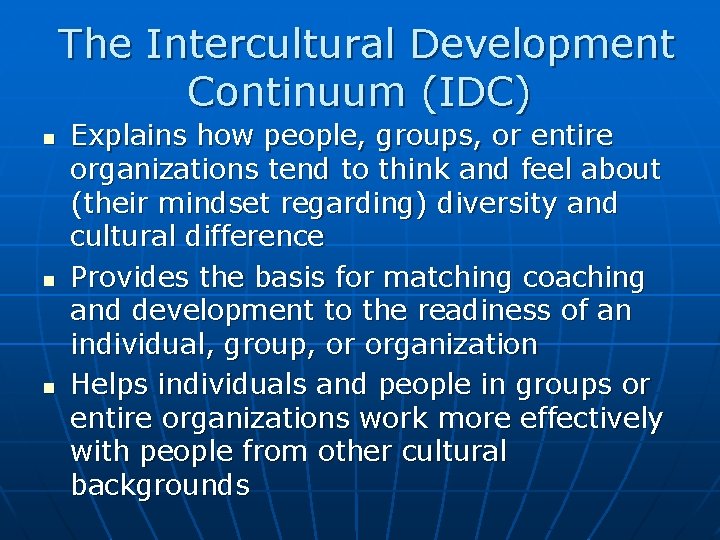
The Intercultural Development Continuum (IDC) n n n Explains how people, groups, or entire organizations tend to think and feel about (their mindset regarding) diversity and cultural difference Provides the basis for matching coaching and development to the readiness of an individual, group, or organization Helps individuals and people in groups or entire organizations work more effectively with people from other cultural backgrounds
Intercultural Development Inventory (IDI) The IDI is a 50 -item questionnaire (offered in 14 languages) that can be completed in 15 -20 minutes. Results are arrayed along the IDC (a model of intercultural competence grounded in the Developmental Model of Intercultural Sensitivity [DMIS]) Contexting questions (when completed) provide a cultural grounding for relating profile scores to the experience of the individual.
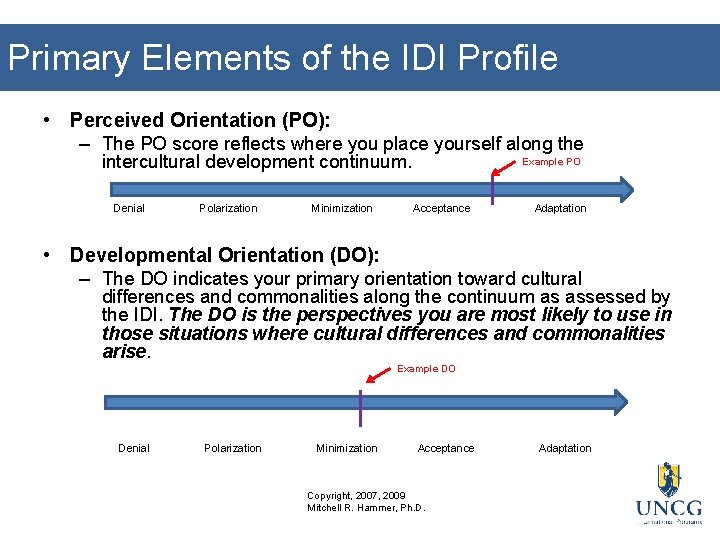
Primary Elements of the IDI Profile • Perceived Orientation (PO): – The PO score reflects where you place yourself along the intercultural development continuum. Denial Polarization Minimization Example PO Acceptance Adaptation • Developmental Orientation (DO): – The DO indicates your primary orientation toward cultural differences and commonalities along the continuum as assessed by the IDI. The DO is the perspectives you are most likely to use in those situations where cultural differences and commonalities arise. Example DO Denial Polarization Minimization Acceptance Copyright, 2007, 2009 Mitchell R. Hammer, Ph. D. Adaptation
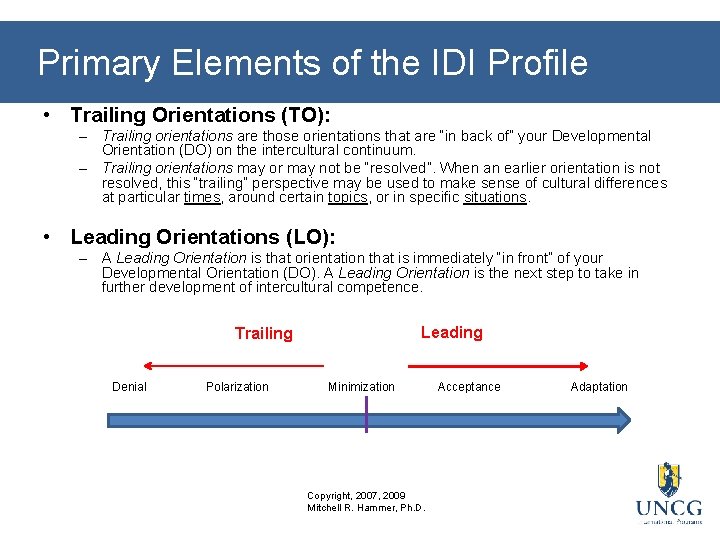
Primary Elements of the IDI Profile • Trailing Orientations (TO): – Trailing orientations are those orientations that are “in back of” your Developmental Orientation (DO) on the intercultural continuum. – Trailing orientations may or may not be “resolved”. When an earlier orientation is not resolved, this “trailing” perspective may be used to make sense of cultural differences at particular times, around certain topics, or in specific situations. • Leading Orientations (LO): – A Leading Orientation is that orientation that is immediately “in front” of your Developmental Orientation (DO). A Leading Orientation is the next step to take in further development of intercultural competence. Leading Trailing Denial Polarization Minimization Copyright, 2007, 2009 Mitchell R. Hammer, Ph. D. Acceptance Adaptation
Primary Elements of the IDI Profile • Cultural Disengagement (CD): – The Cultural Disengagement score indicates how connected or disconnected you feel toward your own cultural community. Cultural Disengagement is not a dimension of intercultural competence along the developmental continuum. IDI v 3 Group, Administrator & Individual Profile Reports Copyright, 2007, 2009 Mitchell R. Hammer, Ph. D.
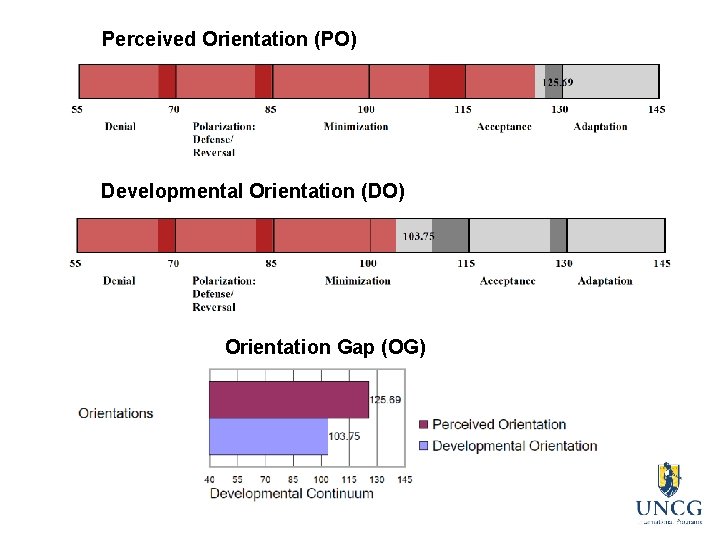
Perceived Orientation (PO) Developmental Orientation (DO) Orientation Gap (OG)
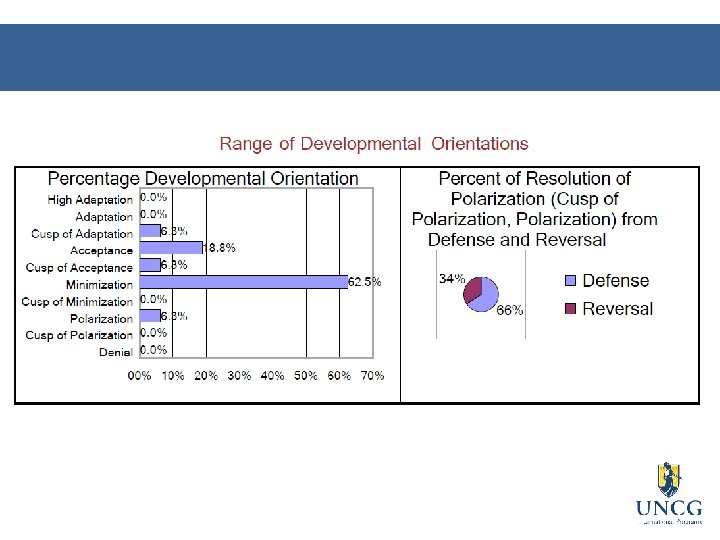
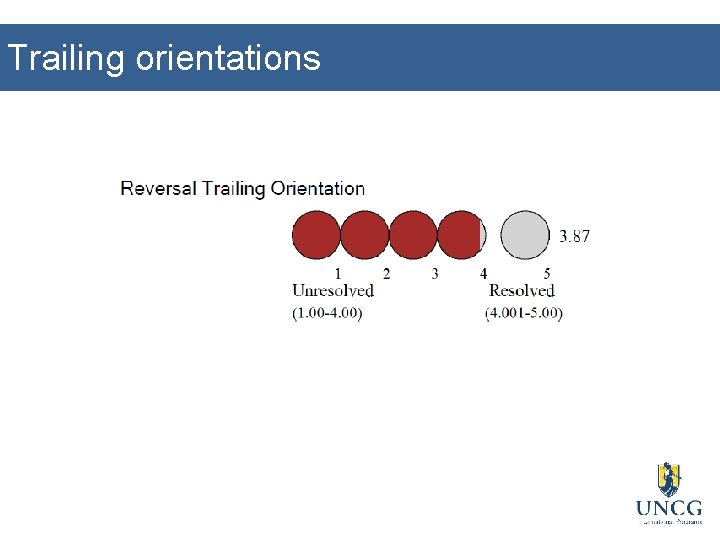
Trailing orientations
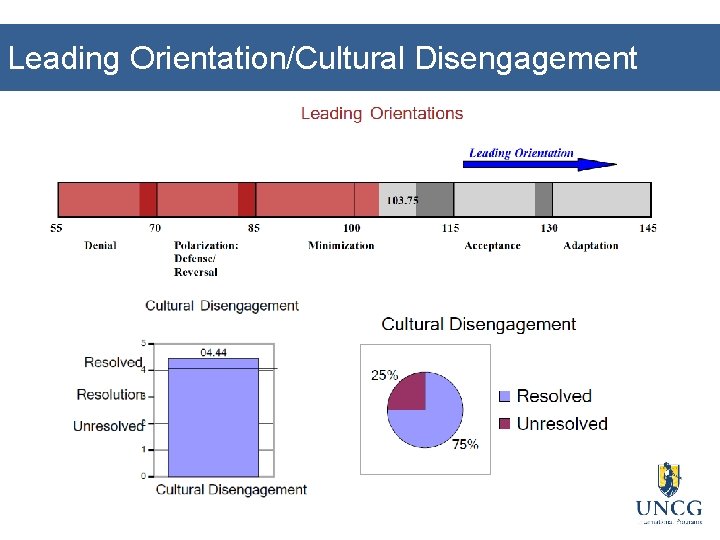
Leading Orientation/Cultural Disengagement
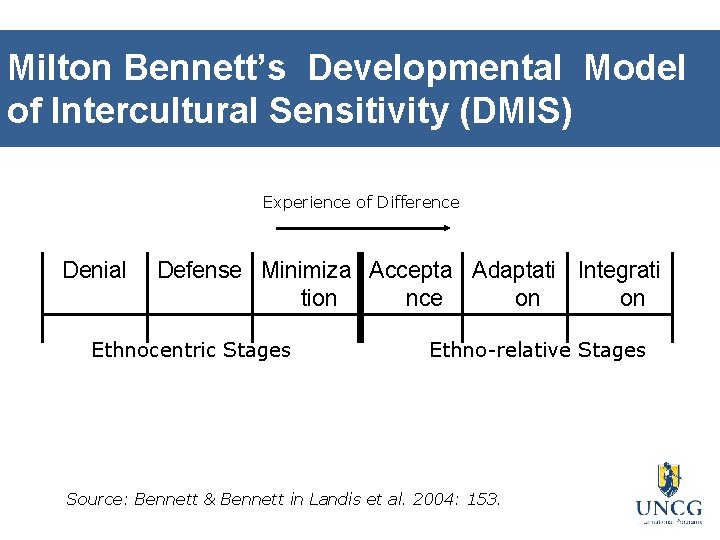
Milton Bennett’s Developmental Model of Intercultural Sensitivity (DMIS) Experience of Difference Denial Defense Minimiza Accepta Adaptati Integrati tion nce on on Ethnocentric Stages Ethno-relative Stages Source: Bennett & Bennett in Landis et al. 2004: 153.
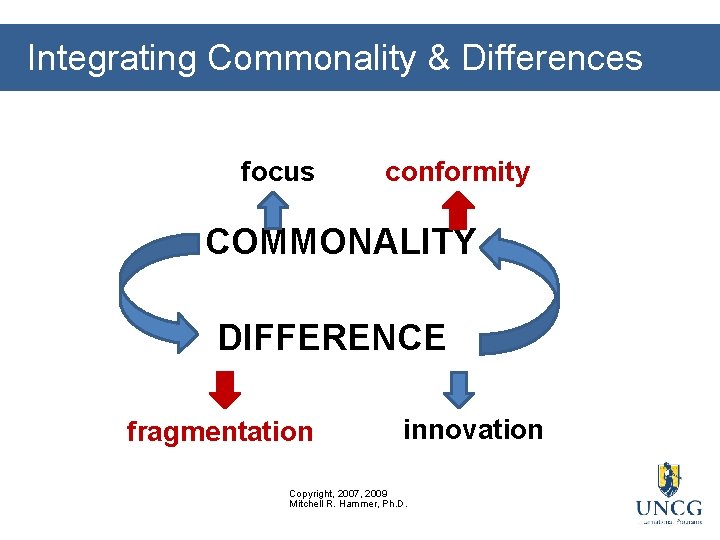
Integrating Commonality & Differences focus conformity COMMONALITY DIFFERENCE fragmentation innovation Copyright, 2007, 2009 Mitchell R. Hammer, Ph. D.
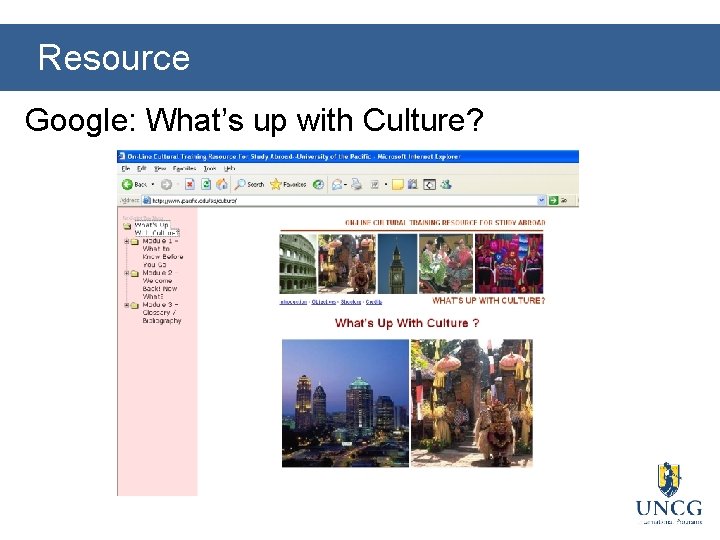
Resource Google: What’s up with Culture?
Resources • Vande Berg, Michael, et al. (eds. ). (2012). Student Learning Abroad (Stylus: Sterling Virginia). • Paige, R. Michael, et al. (2004). Maximizing Study Abroad: A Program Professionals’ Guide to Strategies for Language and Culture Learning and Use. (Minneapolis, MN, University of Minnesota: Center for Advanced Research on Language Acquisition).
Thank you! Questions? Comments? Power point will be posted to the WISE resource page
Four Core Intercultural Competencies • Increase cultural and personal self awareness through reflecting on our own experiences, past and present; • Increase awareness of others within their own cultural and personal contexts; • Learn to manage our emotions and thoughts in the face of ambiguity, change, and challenging circumstances & people; and • Learn to bridge cultural gaps-- that is, learn to shift our frames, attune our emotions to others, and adapt our behavior to unfamiliar or challenging cultural contexts. Mick Vande Berg, points made in IDI training
- Slides: 25