
Building a Culture of Excellence Catherine Neville VP
Building a Culture of Excellence Catherine Neville, VP and Lead Coach, Excellence Canada November 2016
Welcome and Thanks for Participating
Name one of the following (NO electronic device allowed!!): • Six of the wealthiest people in the world. • or • Last six Time magazine’s people of the year. • or • Six Nobel or Pulitzer Prize winners.
Name one of the following: • One teacher or coach who helped you through school. or • One person who taught you something worthwhile. or • One person who inspired you to improve performance in something.
Get it? • Leaders are less remembered for their money, fame or talent. • And more remembered for how they made someone else feel. • Great Leadership is felt through relationships. • How do you wish to be remembered in your as a leader? role
Session Overview 1. Key elements of Continual Improvement (CI): Excellence, Innovation and Wellness 2. Leadership’s vital role in continual improvement 3. 10 Steps to get started
Definition of Excellence Canada’s definition of “excellence”: A state where the organization continually improves performance; is innovative, agile, competitive, and customer focused; is transparent, healthy, inclusive, and sustainable; and is economically, socially, and environmentally responsible.
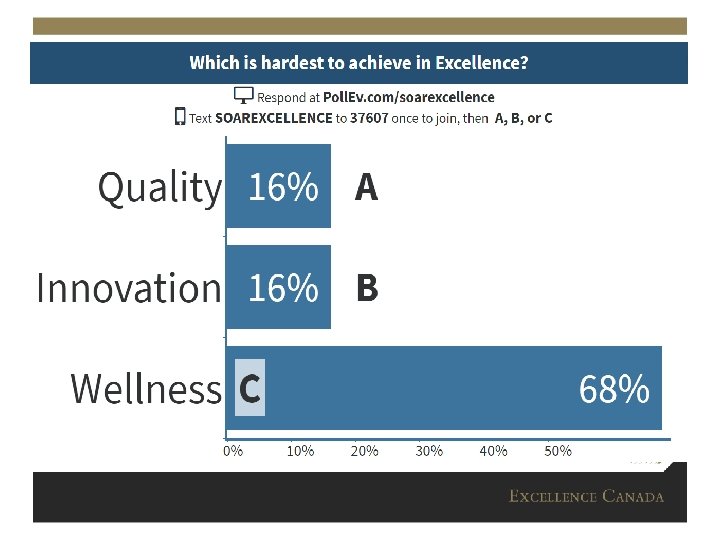
Quality Innovation Linkage • Some believe “quality” and “innovation” are at odds with each other. • Quality aims for high and sustainable performance in existing operational areas, while innovation aims for breakthrough. • To be successful, we need both.
Innovation Defined: Applied breakthrough thinking with measurable results? What does innovation look like in your organizations? Chat with your neighbours
Quality Innovation Linkage An empirical study: • Using empirical data drawn from 194 managers in Australian firms, the results indicate that there are strong and positive relationships between product quality and process innovation. Similar relationships also occur between product innovation and process innovation. Source: The relationships between quality, innovation and business performance: an empirical study, Daniel Praiogo, Pervaiz Ahmed , Monash University, Australia. '
Quality Innovation Wellness In order to promote innovation, we all need to feel engaged!
Employee Engagement “You want your employees to go the extra mile. This is more likely from people who feel valued. If you ask people to talk about a manager who has been important to them they will normally single out someone who has encouraged them, recognized them for what they are and what they are capable of. You need to develop them in the way your favorite boss did. ” Source: Lee Chalmers, Leadership Consultant for Large Corporates, Academia and the Arts (via Vitru – Aug 2015))
Some interesting statistics 1. 69% of employees say they would work harder if they felt their efforts were better recognized 2. 43% of highly engaged employees receive feedback at least once a week 3. 92% of respondents agreed with the assertion, “Negative (redirecting) feedback, if delivered appropriately is effective at improving performance. ” 4. 80% of Gen Y said they prefer on-the-spot recognition over formal reviews Source: 5 Employee Feedback Stats That You Need to See by Marten Hogan – Linked In Talent Blog, February 8, 2016
Excellence, Innovation and Wellness EIW Standard • Integrated management system • To sustain quality – a better focus is also needed on employee health and wellness and innovation • Step-by-step approach to a continual improvement (CI) system • Links to Canada Awards for Excellence • Benchmarks positively against other management systems, i. e. Malcolm Baldrige, European Quality Award, Deming Award; and ISO 9000.
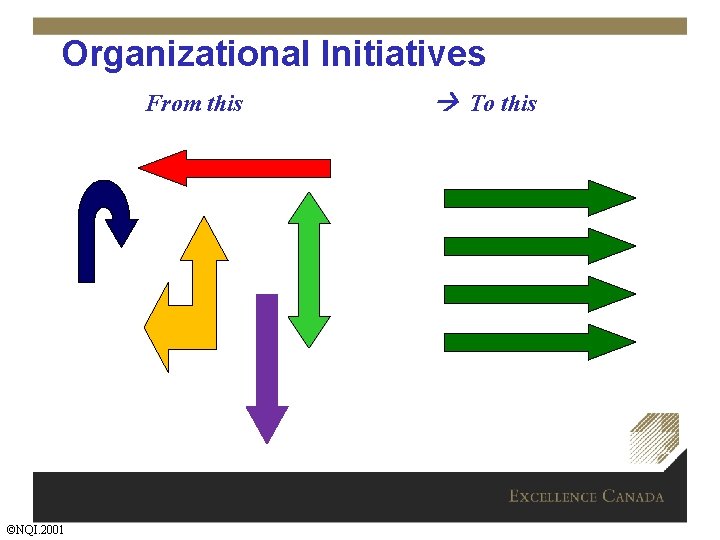
Organizational Initiatives From this ©NQI. 2001 To this
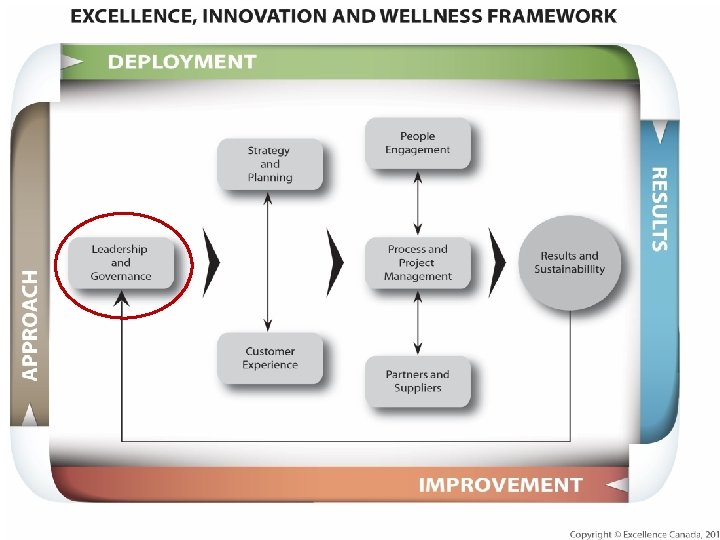
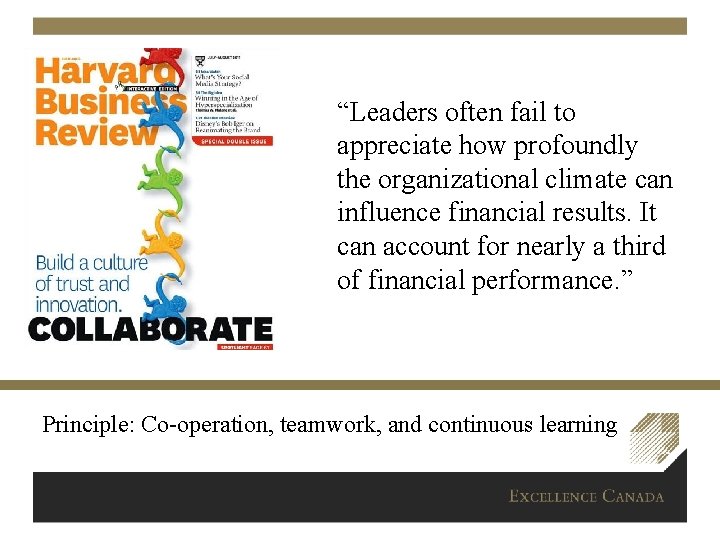
“Leaders often fail to appreciate how profoundly the organizational climate can influence financial results. It can account for nearly a third of financial performance. ” Principle: Co-operation, teamwork, and continuous learning
Leadership 1. 1 a) At Bronze (Level 1), it is important that the senior leadership team endorses and supports the following operating principles: 1. Leadership Involvement 2. Transparency and agility 3. Effective planning 4. A primary focus on the customer experience 5. Co-operation, teamwork, and people development 6. Respect for diversity and inclusion 7. Commitment to fact-based decision-making through the use of data and measurement 8. A focus on continual improvement and innovation
Stages of Leadership • Laissez-faire • Transactional • Transformational (e. g. former President Franklin Roosevelt) – Leader works with subordinates to identify needed change, and helps execute the required change together – Enhances the motivation, morale and job performance of followers through things like modelling behaviours, challenging followers to take greater ownership for their work, understanding the strengths and opportunities of each follower and alignment of tasks to enhance each follower’s performance Source: Wikipedia
Authentic Leaders • Reduce culture of entitlement • Title doesn`t drive brilliant ideas. • Authentic leaders create an environment where it is safe to be brilliant and innovative Excellence Canada: Thought Leaders Round Table at http: //www. nqi. ca/en/knowledge-centre/articles/discovering-your-authenticleadership
Authentic Leaders: • Consistently communicate the vision • Communicate strategy • Foster a safe environment where taking appropriate risks is okay and people are safe to make mistakes (in terms of innovation and improvement) • Reduce fear • No matter what they do and what they say their values remain the same • Give credit and pass it around • Admit mistakes
Authentic Leaders • Hire people smarter than them • Have time to listen to employees express concerns and passions • Allow for transparency to increase trust and respect • Recognize the education and learning value of failure • Navigate through complicated circumstances. • Recognize mistakes quickly and make slight and quick adjustment to error and failure
Your vital role in CI • Providing leadership by ensuring you, and your direct reports, make time (within reason) for continual improvement • Define your goals well and use an excellence framework to help you stay focused • Talk it up – what is important to you will be important to your direct reports • Most common reason for failure to achieve what you might in excellence is lack of support by all levels of management • Staff will take their cue from their immediate supervisor – it is critical that you ensure they are sending the right message…. by doing so yourselves
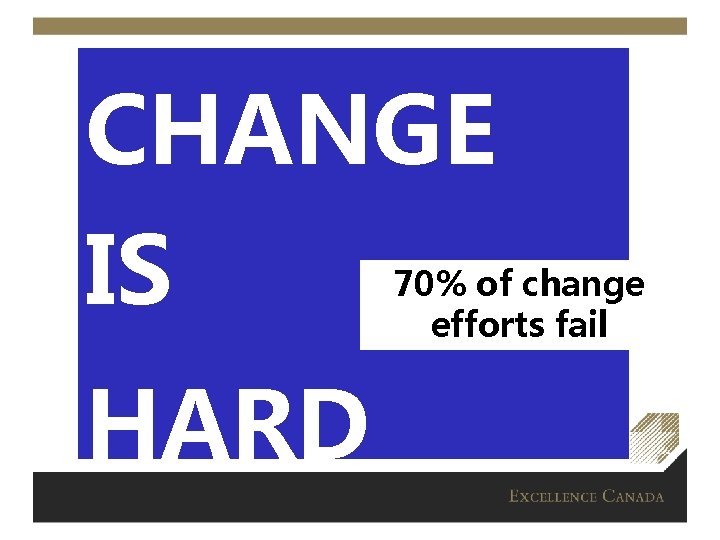
CHANGE IS HARD 70% of change efforts fail
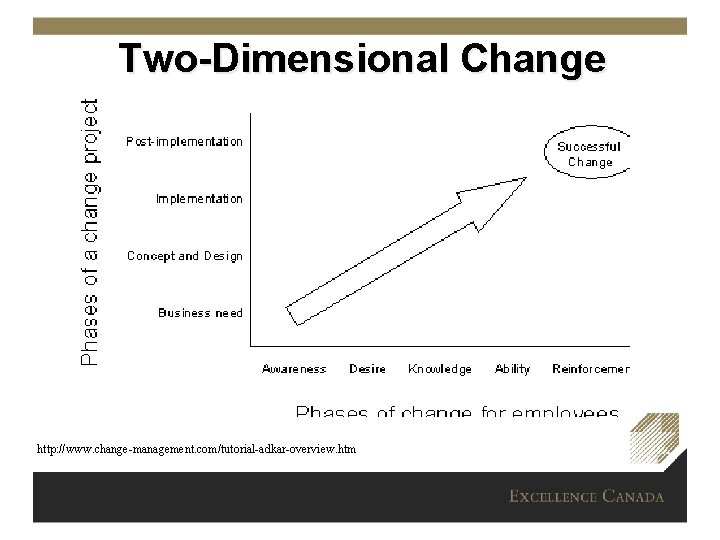
Two-Dimensional Change http: //www. change-management. com/tutorial-adkar-overview. htm
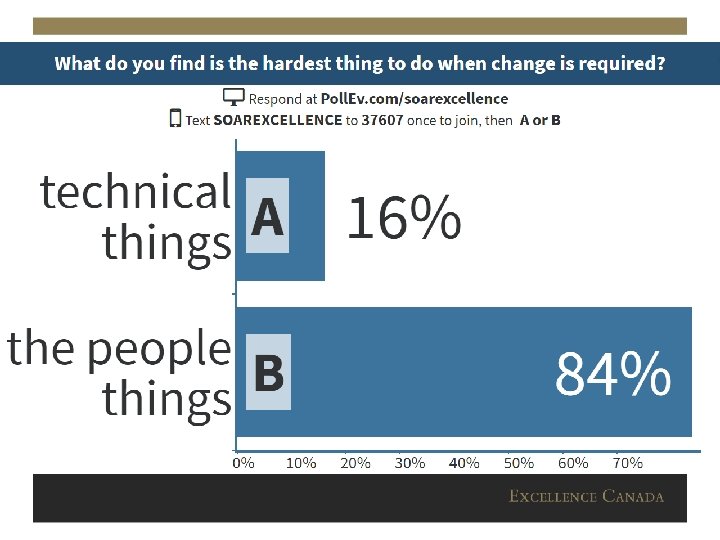

The so-called Soft Side of Continual Improvement Soft my …. . the soft stuff is hard!
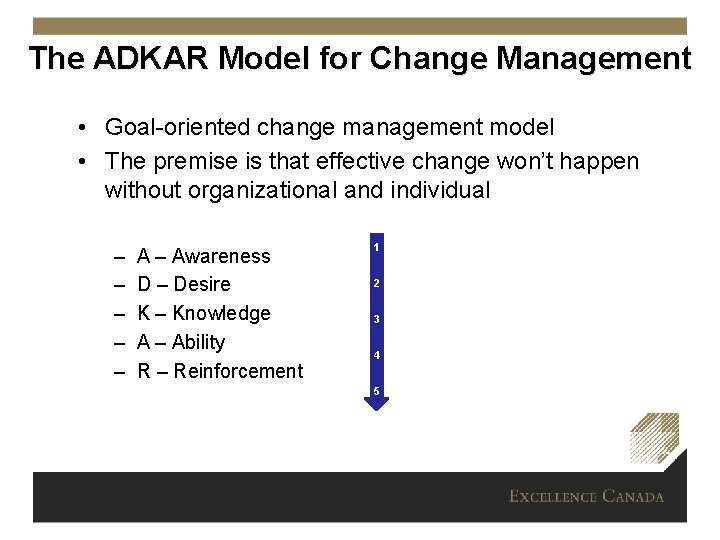
The ADKAR Model for Change Management • Goal-oriented change management model • The premise is that effective change won’t happen without organizational and individual – – – Awareness D – Desire K – Knowledge A – Ability R – Reinforcement 1 2 3 4 5

Five key goals – ADKAR Model • Awareness of the need to change • Desire to participate and support the change • Knowledge of how to change (and what the change looks like) • Ability to implement the change on a day-to-day basis • Reinforcement to keep the change in place
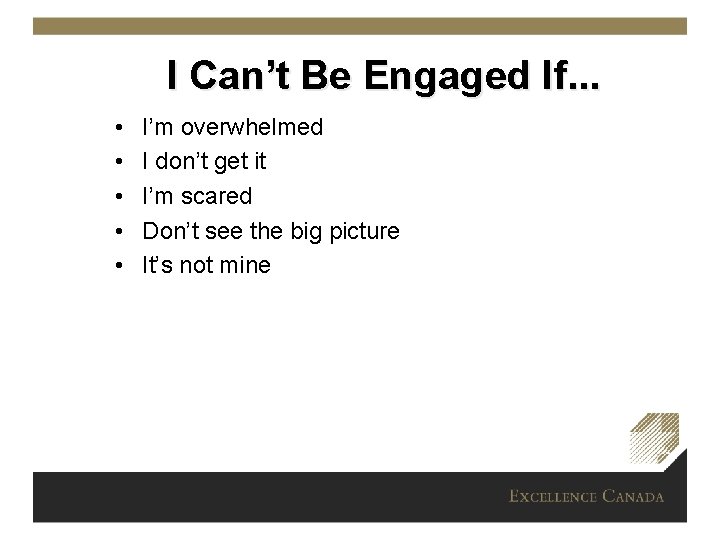
I Can’t Be Engaged If. . . • • • I’m overwhelmed I don’t get it I’m scared Don’t see the big picture It’s not mine
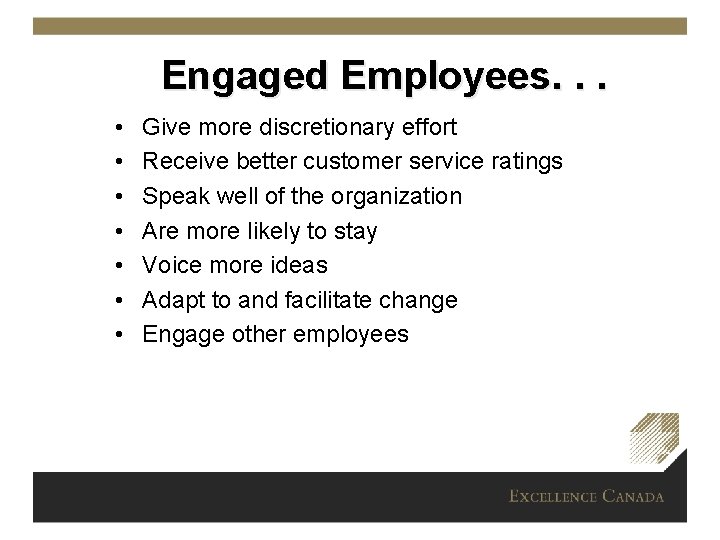
Engaged Employees. . . • • Give more discretionary effort Receive better customer service ratings Speak well of the organization Are more likely to stay Voice more ideas Adapt to and facilitate change Engage other employees
Consequences of Not Managing the People Side of Change • • • Lower productivity Resistance – active & passive Turnover of valued employees Disinterest in the current or future state Arguing about the need for change Changes not fully implemented People finding work-arounds People revert to the old way of doing things The change being totally scrapped Divides are created between ‘us’ and ‘them’
Remember…. People don't resist change; they resist being changed! - Peter Senge
Important for Continual Improvement Ø Ø Have an open mind to change; Think “Yes we can, if…. ” Involve those who do the work! Wisdom of many, not the knowledge of one Think in process terms § map key processes so you can see the and analyze them § Get to the root cause of the problem and then seek simple solutions through the use of things like Lean principles (Kaizen, not Six Sigma in most cases) § develop an action plan to address opportunities and then execute in a timely fashion § Remember Plan-Do-Check-Act Ø Use people’s creativity, not capital (wits not wallets) Ø Celebrate achievements! (and dare I say failures)
10 Steps to continual improvement 1. Know the results you are trying to achieve and share them in a Plan 2. Determine current performance (often using process/value stream maps) 3. Establish a need to improve (where there is one based on 1. above) 4. Obtain commitment and define the improvement objective 5. Carry out analysis to discover the cause of current performance 6. Produce improvement plans which specify how, by whom and by when the changes will be implemented
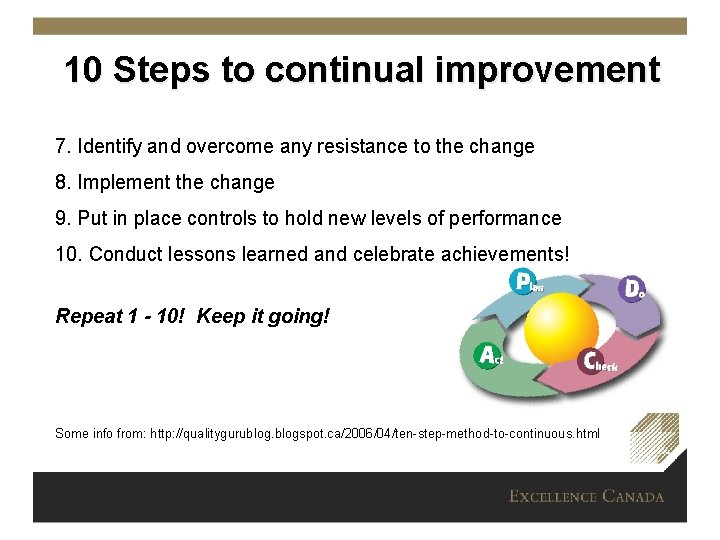
10 Steps to continual improvement 7. Identify and overcome any resistance to the change 8. Implement the change 9. Put in place controls to hold new levels of performance 10. Conduct lessons learned and celebrate achievements! Repeat 1 - 10! Keep it going! Some info from: http: //qualitygurublogspot. ca/2006/04/ten-step-method-to-continuous. html
Thanks for your time and participation
Purposeful Leadership TELL ME, I'LL FORGET SHOW ME, I MAY REMEMBER INVOLVE ME, ANDI'LL UNDERSTAND
Catherine Neville Vice President and Lead Coach catherine@excellence. ca www. excellence. ca


- Slides: 44