
Building a Confocal Raman Microscope Julian Rocha Jennifer
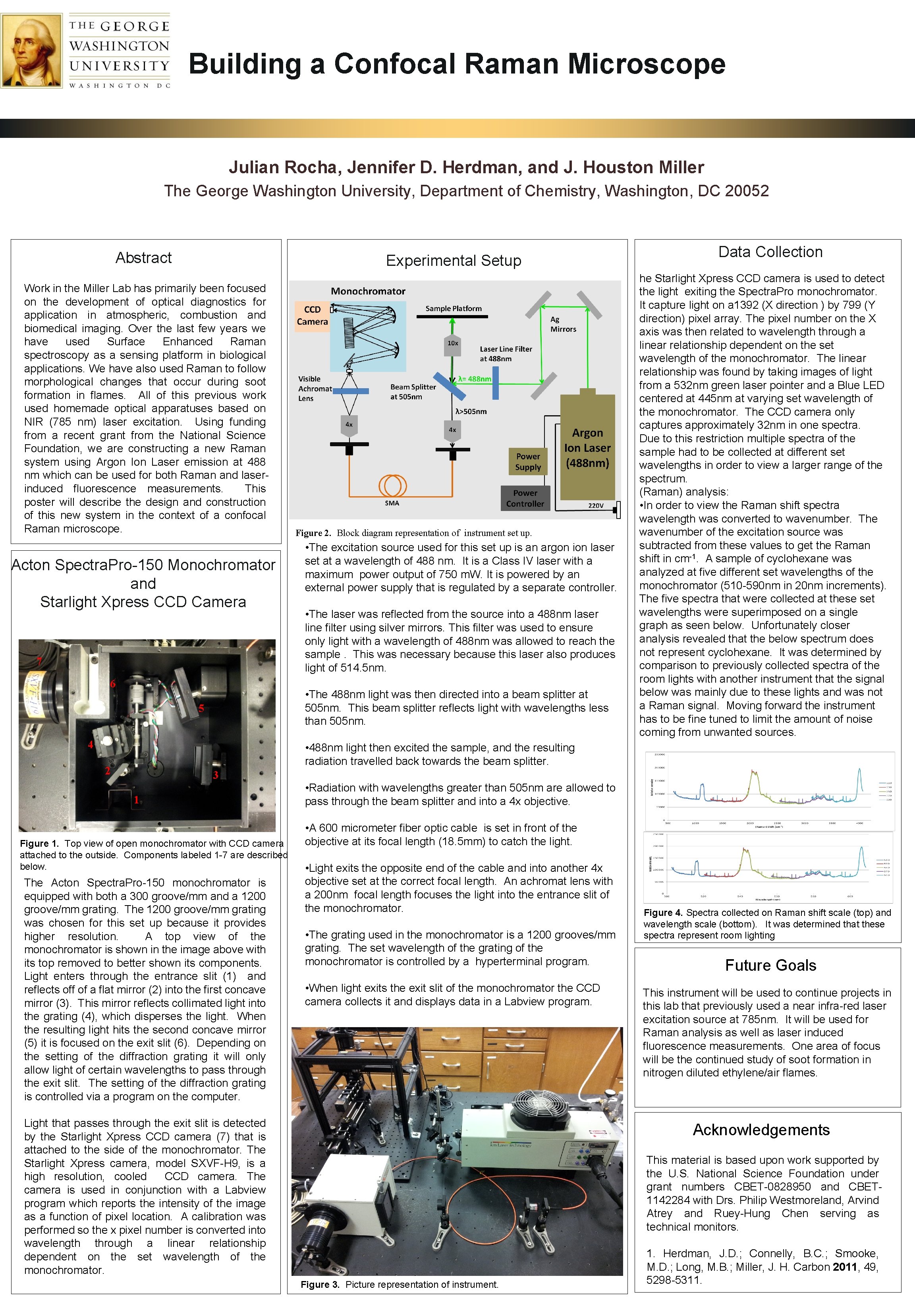
Building a Confocal Raman Microscope Julian Rocha, Jennifer D. Herdman, and J. Houston Miller The George Washington University, Department of Chemistry, Washington, DC 20052 Abstract Experimental Setup Work in the Miller Lab has primarily been focused on the development of optical diagnostics for application in atmospheric, combustion and biomedical imaging. Over the last few years we have used Surface Enhanced Raman spectroscopy as a sensing platform in biological applications. We have also used Raman to follow morphological changes that occur during soot formation in flames. All of this previous work used homemade optical apparatuses based on NIR (785 nm) laser excitation. Using funding from a recent grant from the National Science Foundation, we are constructing a new Raman system using Argon Ion Laser emission at 488 nm which can be used for both Raman and laserinduced fluorescence measurements. This poster will describe the design and construction of this new system in the context of a confocal Raman microscope. Acton Spectra. Pro-150 Monochromator and Starlight Xpress CCD Camera 7 6 Figure 2. Block diagram representation of instrument set up. • The excitation source used for this set up is an argon ion laser set at a wavelength of 488 nm. It is a Class IV laser with a maximum power output of 750 m. W. It is powered by an external power supply that is regulated by a separate controller. • The laser was reflected from the source into a 488 nm laser line filter using silver mirrors. This filter was used to ensure only light with a wavelength of 488 nm was allowed to reach the sample. This was necessary because this laser also produces light of 514. 5 nm. • The 488 nm light was then directed into a beam splitter at 505 nm. This beam splitter reflects light with wavelengths less than 505 nm. 5 4 Data Collection he Starlight Xpress CCD camera is used to detect the light exiting the Spectra. Pro monochromator. It capture light on a 1392 (X direction ) by 799 (Y direction) pixel array. The pixel number on the X axis was then related to wavelength through a linear relationship dependent on the set wavelength of the monochromator. The linear relationship was found by taking images of light from a 532 nm green laser pointer and a Blue LED centered at 445 nm at varying set wavelength of the monochromator. The CCD camera only captures approximately 32 nm in one spectra. Due to this restriction multiple spectra of the sample had to be collected at different set wavelengths in order to view a larger range of the spectrum. (Raman) analysis: • In order to view the Raman shift spectra wavelength was converted to wavenumber. The wavenumber of the excitation source was subtracted from these values to get the Raman shift in cm-1. A sample of cyclohexane was analyzed at five different set wavelengths of the monochromator (510 -590 nm in 20 nm increments). The five spectra that were collected at these set wavelengths were superimposed on a single graph as seen below. Unfortunately closer analysis revealed that the below spectrum does not represent cyclohexane. It was determined by comparison to previously collected spectra of the room lights with another instrument that the signal below was mainly due to these lights and was not a Raman signal. Moving forward the instrument has to be fine tuned to limit the amount of noise coming from unwanted sources. • 488 nm light then excited the sample, and the resulting radiation travelled back towards the beam splitter. 2 3 1 Figure 1. Top view of open monochromator with CCD camera attached to the outside. Components labeled 1 -7 are described below. The Acton Spectra. Pro-150 monochromator is equipped with both a 300 groove/mm and a 1200 groove/mm grating. The 1200 groove/mm grating was chosen for this set up because it provides higher resolution. A top view of the monochromator is shown in the image above with its top removed to better shown its components. Light enters through the entrance slit (1) and reflects off of a flat mirror (2) into the first concave mirror (3). This mirror reflects collimated light into the grating (4), which disperses the light. When the resulting light hits the second concave mirror (5) it is focused on the exit slit (6). Depending on the setting of the diffraction grating it will only allow light of certain wavelengths to pass through the exit slit. The setting of the diffraction grating is controlled via a program on the computer. • Radiation with wavelengths greater than 505 nm are allowed to pass through the beam splitter and into a 4 x objective. • A 600 micrometer fiber optic cable is set in front of the objective at its focal length (18. 5 mm) to catch the light. • Light exits the opposite end of the cable and into another 4 x objective set at the correct focal length. An achromat lens with a 200 nm focal length focuses the light into the entrance slit of the monochromator. • The grating used in the monochromator is a 1200 grooves/mm grating. The set wavelength of the grating of the monochromator is controlled by a hyperterminal program. • When light exits the exit slit of the monochromator the CCD camera collects it and displays data in a Labview program. Light that passes through the exit slit is detected by the Starlight Xpress CCD camera (7) that is attached to the side of the monochromator. The Starlight Xpress camera, model SXVF-H 9, is a high resolution, cooled CCD camera. The camera is used in conjunction with a Labview program which reports the intensity of the image as a function of pixel location. A calibration was performed so the x pixel number is converted into wavelength through a linear relationship dependent on the set wavelength of the monochromator. Figure 4. Spectra collected on Raman shift scale (top) and wavelength scale (bottom). It was determined that these spectra represent room lighting Future Goals This instrument will be used to continue projects in this lab that previously used a near infra-red laser excitation source at 785 nm. It will be used for Raman analysis as well as laser induced fluorescence measurements. One area of focus will be the continued study of soot formation in nitrogen diluted ethylene/air flames. Acknowledgements This material is based upon work supported by the U. S. National Science Foundation under grant numbers CBET-0828950 and CBET 1142284 with Drs. Philip Westmoreland, Arvind Atrey and Ruey-Hung Chen serving as technical monitors. Figure 3. Picture representation of instrument. 1. Herdman, J. D. ; Connelly, B. C. ; Smooke, M. D. ; Long, M. B. ; Miller, J. H. Carbon 2011, 49, 5298 -5311.
- Slides: 1