
Building A BulletProof Federal Retirement Presented By Vincent
Building A Bullet-Proof Federal Retirement Presented By Vincent J. Bono, J. D. and Carolyn Marie Tobin, MA Special Guest Speaker, Val Majewski If you have any questions please email them to Carolyn Tobin: Carolyn@federalwebinars. com 1
In the Summer of 2003, the Founders of our company were asked to assess the federal retirement system and the various components of the TSP. Much to their surprise, they found that the TSP Funds were not truly managed to maximize gains for the federal employees or minimize their losses. They also found that federal employees were not being shown how to maximize their federal pension or social security incomes, nor were they being taught how to properly plan for their retirement. If you have any questions about your federal retirement email Carolyn@federalwebinars. com 2
Our “Approved Webinar Hosts” are well vetted by us, and experts in helping federal employees better plan for their retirement. By agreement with us, our “Approved Webinar Hosts” do not charge federal employees for any of their retirement consultation services or reports, no matter how extensive their reports or retirement planning advice might be. Next week, when your Approved Webinar Host contacts you to answer any questions you might have about the content contained in this webinar, we suggest your reach back out to them, and take advantage of their federal retirement planning expertise. Nothing is ever done in person; it is accomplished on the phone utilizing the internet portals we built exclusively for Federal Employees. If you have any questions about your federal retirement email Carolyn@federalwebinars. com 3
One Of The Greatest Concerns Federal Employees Have As They Are Nearing Their Retirement Is The Concern Of Running Out Of Money During Retirement This concern is by no means irrational or unfounded…. According to the highly regarded EBRI Retirement Security Projection Model, an estimated 40. 6% of Americans will run out of money during their retirement, and this study was done long before the Corona Virus invaded our country. That 40. 6% estimate will certainly increase in time, especially in light of the fact that Social Security is on target to be significantly reduced in 2029 and the Stock Market could face a 40% correction as it did in 2008. FERS Federal Employees are also facing the risk that their “Annuity Supplement” will either be significantly reduced or totally eliminated. If you have any questions about your federal retirement email Carolyn@federalwebinars. com 4
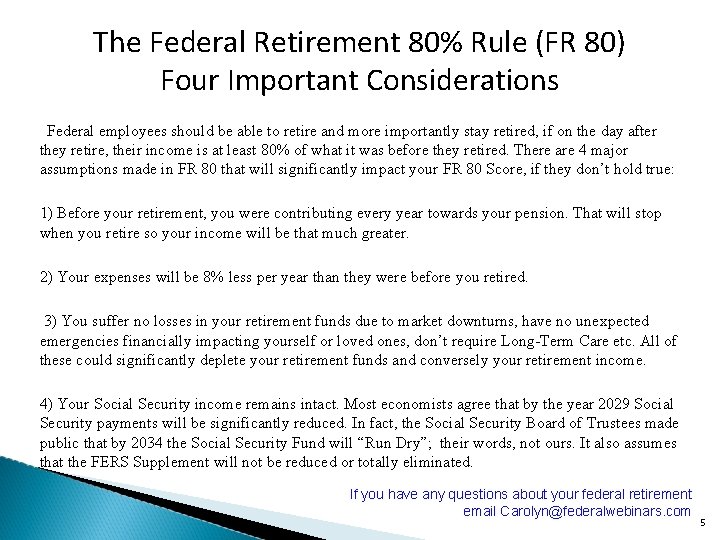
The Federal Retirement 80% Rule (FR 80) Four Important Considerations Federal employees should be able to retire and more importantly stay retired, if on the day after they retire, their income is at least 80% of what it was before they retired. There are 4 major assumptions made in FR 80 that will significantly impact your FR 80 Score, if they don’t hold true: 1) Before your retirement, you were contributing every year towards your pension. That will stop when you retire so your income will be that much greater. 2) Your expenses will be 8% less per year than they were before you retired. 3) You suffer no losses in your retirement funds due to market downturns, have no unexpected emergencies financially impacting yourself or loved ones, don’t require Long-Term Care etc. All of these could significantly deplete your retirement funds and conversely your retirement income. 4) Your Social Security income remains intact. Most economists agree that by the year 2029 Social Security payments will be significantly reduced. In fact, the Social Security Board of Trustees made public that by 2034 the Social Security Fund will “Run Dry”; their words, not ours. It also assumes that the FERS Supplement will not be reduced or totally eliminated. If you have any questions about your federal retirement email Carolyn@federalwebinars. com 5
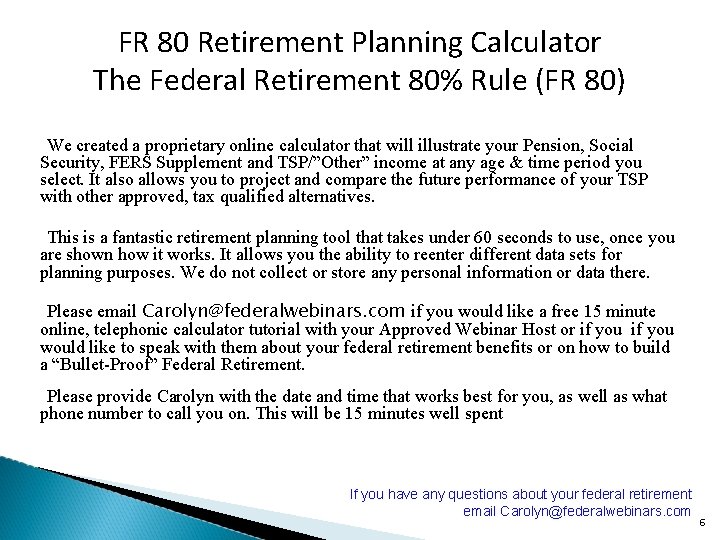
FR 80 Retirement Planning Calculator The Federal Retirement 80% Rule (FR 80) We created a proprietary online calculator that will illustrate your Pension, Social Security, FERS Supplement and TSP/”Other” income at any age & time period you select. It also allows you to project and compare the future performance of your TSP with other approved, tax qualified alternatives. This is a fantastic retirement planning tool that takes under 60 seconds to use, once you are shown how it works. It allows you the ability to reenter different data sets for planning purposes. We do not collect or store any personal information or data there. Please email Carolyn@federalwebinars. com if you would like a free 15 minute online, telephonic calculator tutorial with your Approved Webinar Host or if you would like to speak with them about your federal retirement benefits or on how to build a “Bullet-Proof” Federal Retirement. Please provide Carolyn with the date and time that works best for you, as well as what phone number to call you on. This will be 15 minutes well spent If you have any questions about your federal retirement email Carolyn@federalwebinars. com 6
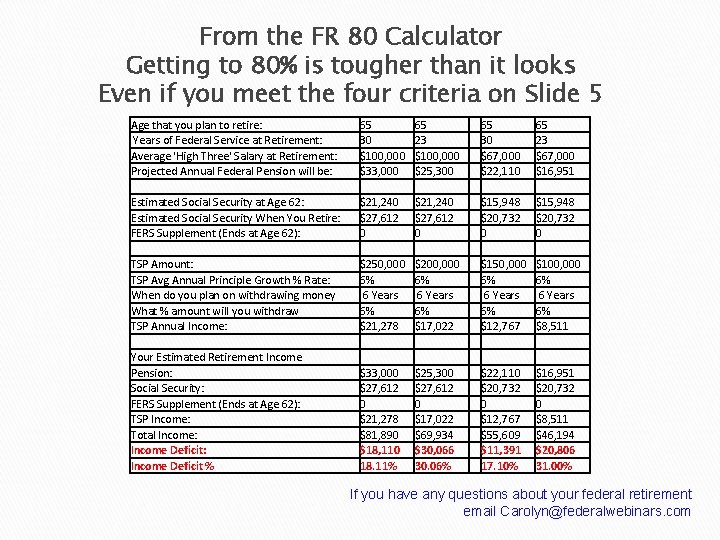
From the FR 80 Calculator Getting to 80% is tougher than it looks Even if you meet the four criteria on Slide 5 Age that you plan to retire: Years of Federal Service at Retirement: Average 'High Three' Salary at Retirement: Projected Annual Federal Pension will be: 65 30 $100, 000 $33, 000 65 23 $100, 000 $25, 300 65 30 $67, 000 $22, 110 65 23 $67, 000 $16, 951 Estimated Social Security at Age 62: Estimated Social Security When You Retire: FERS Supplement (Ends at Age 62): $21, 240 $27, 612 0 $15, 948 $20, 732 0 TSP Amount: TSP Avg Annual Principle Growth % Rate: When do you plan on withdrawing money What % amount will you withdraw TSP Annual Income: $250, 000 6% 6 Years 6% $21, 278 $200, 000 6% 6 Years 6% $17, 022 $150, 000 6% 6 Years 6% $12, 767 $100, 000 6% 6 Years 6% $8, 511 Your Estimated Retirement Income Pension: Social Security: FERS Supplement (Ends at Age 62): TSP Income: Total Income: Income Deficit % $33, 000 $27, 612 0 $21, 278 $81, 890 $18, 110 18. 11% $25, 300 $27, 612 0 $17, 022 $69, 934 $30, 066 30. 06% $22, 110 $20, 732 0 $12, 767 $55, 609 $11, 391 17. 10% $16, 951 $20, 732 0 $8, 511 $46, 194 $20, 806 31. 00% If you have any questions about your federal retirement email Carolyn@federalwebinars. com
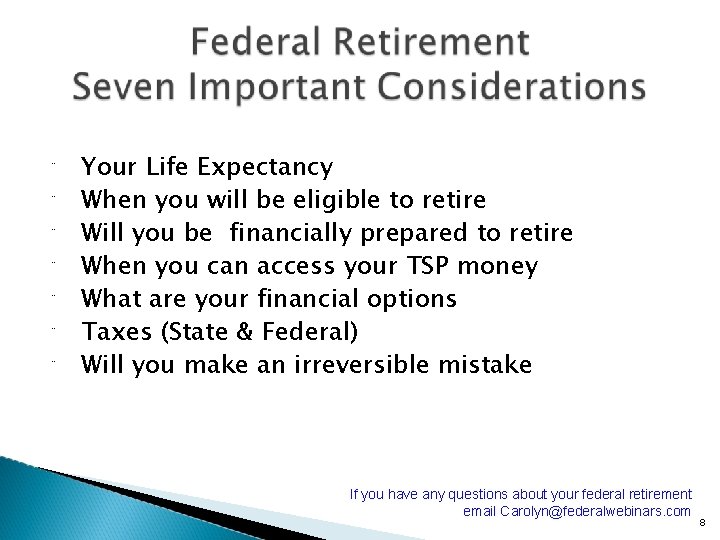
¨ ¨ ¨ ¨ Your Life Expectancy When you will be eligible to retire Will you be financially prepared to retire When you can access your TSP money What are your financial options Taxes (State & Federal) Will you make an irreversible mistake If you have any questions about your federal retirement email Carolyn@federalwebinars. com 8
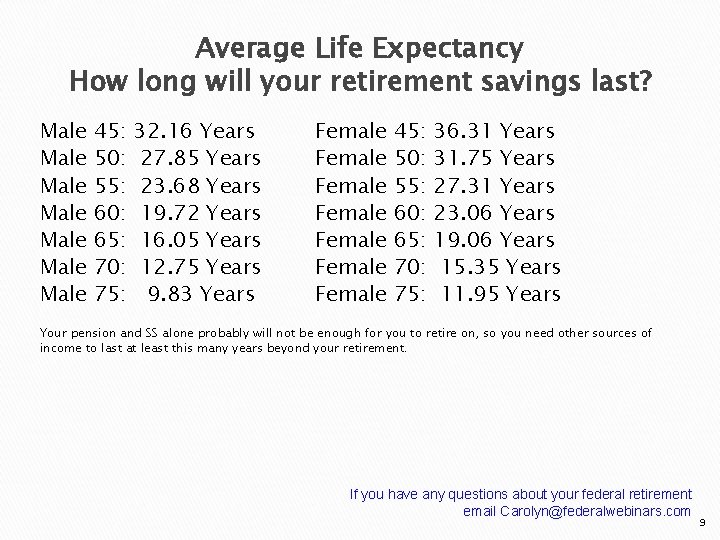
Average Life Expectancy How long will your retirement savings last? Male Male 45: 50: 55: 60: 65: 70: 75: 32. 16 Years 27. 85 Years 23. 68 Years 19. 72 Years 16. 05 Years 12. 75 Years 9. 83 Years Female Female 45: 50: 55: 60: 65: 70: 75: 36. 31 Years 31. 75 Years 27. 31 Years 23. 06 Years 19. 06 Years 15. 35 Years 11. 95 Years Your pension and SS alone probably will not be enough for you to retire on, so you need other sources of income to last at least this many years beyond your retirement. If you have any questions about your federal retirement email Carolyn@federalwebinars. com 9
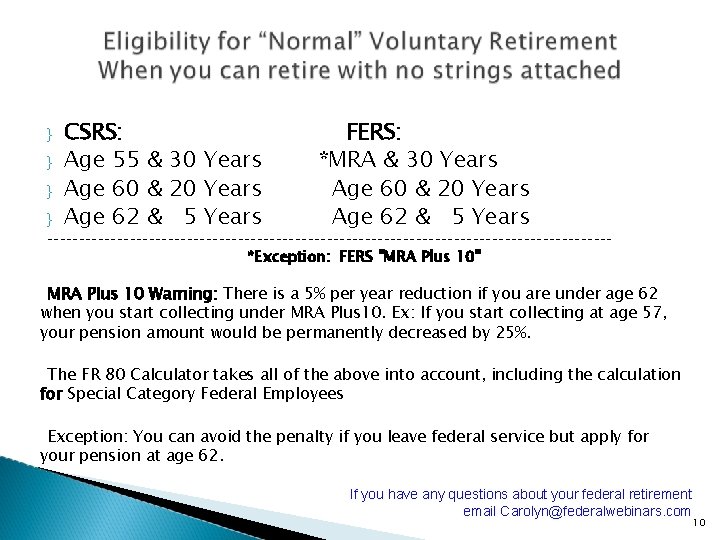
} } CSRS: Age 55 & 30 Years Age 60 & 20 Years Age 62 & 5 Years FERS: *MRA & 30 Years Age 60 & 20 Years Age 62 & 5 Years --------------------------------------------- *Exception: FERS "MRA Plus 10" MRA Plus 10 Warning: There is a 5% per year reduction if you are under age 62 when you start collecting under MRA Plus 10. Ex: If you start collecting at age 57, your pension amount would be permanently decreased by 25%. The FR 80 Calculator takes all of the above into account, including the calculation for Special Category Federal Employees Exception: You can avoid the penalty if you leave federal service but apply for your pension at age 62. If you have any questions about your federal retirement email Carolyn@federalwebinars. com 10
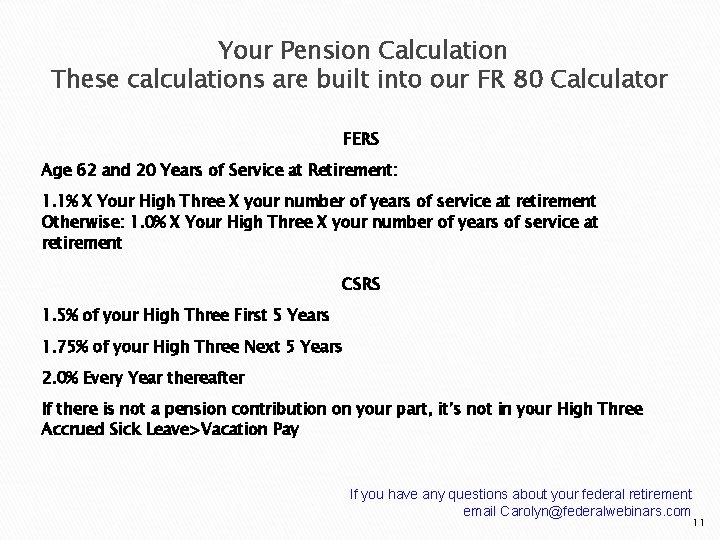
Your Pension Calculation These calculations are built into our FR 80 Calculator FERS Age 62 and 20 Years of Service at Retirement: 1. 1% X Your High Three X your number of years of service at retirement Otherwise: 1. 0% X Your High Three X your number of years of service at retirement CSRS 1. 5% of your High Three First 5 Years 1. 75% of your High Three Next 5 Years 2. 0% Every Year thereafter If there is not a pension contribution on your part, it’s not in your High Three Accrued Sick Leave>Vacation Pay If you have any questions about your federal retirement email Carolyn@federalwebinars. com 11
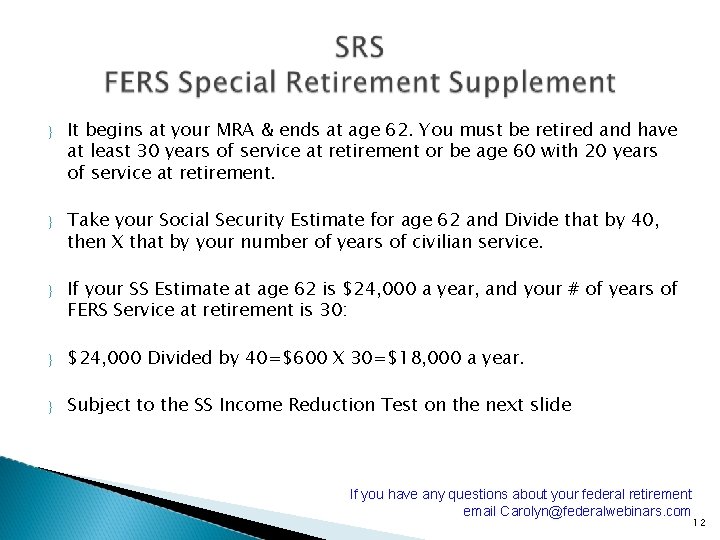
} } } It begins at your MRA & ends at age 62. You must be retired and have at least 30 years of service at retirement or be age 60 with 20 years of service at retirement. Take your Social Security Estimate for age 62 and Divide that by 40, then X that by your number of years of civilian service. If your SS Estimate at age 62 is $24, 000 a year, and your # of years of FERS Service at retirement is 30: } $24, 000 Divided by 40=$600 X 30=$18, 000 a year. } Subject to the SS Income Reduction Test on the next slide If you have any questions about your federal retirement email Carolyn@federalwebinars. com 12
If you have not reached your “Social Security Full Retirement Age” (65, 66 or 67) and start collecting, for every $2. 00 you earn above $18, 960 your benefit will be reduced by $1. 00. Your pension income is not included-only Wages & Business income. This Income Based Reduction also applies to the FERS Special Supplement. Once you achieve your “Social Security Full Retirement Age”, there are no reductions, regardless of your income. In the year you reach your “Social Security Full Retirement Age”, you can earn $50, 520, without any reduction of benefits. For every $3. 00 over that amount, your benefit will be reduced by $1. 00. If you have any questions about your federal retirement email Carolyn@federalwebinars. com 13
If you start collecting Social Security before your “Social Security Full Retirement Age” (65, 66 or 67), your payments will reduced by 6. 25% for every year earlier that you start to collect. Example: Assuming your Social Security FRA is age 66, collecting at age 62 causes a permanent 25% reduction (6. 25% x the four years until your FRA). If you started collecting at Age 64=12. 5% reduction. This is a permanent reduction! If you retire & start collecting at age 70, your payments will be 32. 5% more than if you retired & collected at your FRA, again assuming your Social Security FRA is 66. Age 78 1/2 is your “Break Even” Point if you wait until your FRA. If you have any questions about your federal retirement email Carolyn@federalwebinars. com 14
} There is a misconception that your federal retirement, social security and TSP withdrawals are not federally taxed. } Social Security: Taxed Subject to the Income Test illustrated on the next Slide, and is in addition to the reductions mentioned on the previous Slides. } Federal Retirement: Taxed to the extent of the Governments contribution. There is no Income Test } TSP Withdrawals: Taxed unless it’s a Roth. If you have any questions about your federal retirement email Carolyn@federalwebinars. com 15
} Single Taxpayer: If your “Income” is between $25, 000 and $34, 000, you may have to pay income tax on up to 50 percent of your payments. (not a 50% tax). Income for this test includes your “Adjusted Gross Income”, Non-Taxable Interest, and 50% of your Social Security payments. } Single Taxpayer: If your “Income” is more than $34, 000, up to 85 percent of your benefits may be taxable (not an 85% tax). } Married filing jointly: If you and your spouse have a combined income that is between $32, 000 and $44, 000, you may have to pay income tax on up to 50 percent of your benefits } Married filing jointly: If you and your spouse have a combined income of more than $44, 000, up to 85 percent of your benefits may be taxable. If you have any questions about your federal retirement email Carolyn@federalwebinars. com 16
TSP Modernization Act Effective September 15 th, 2019: If you are still working at your federal job and are over age 59 ½, you are allowed Four withdrawals every year. If you are separated from federal service, your withdrawals are unlimited, but must be 30 days apart. If you have any questions about your federal retirement email Carolyn@federalwebinars. com 17
Ask Carolyn For These Free Resources Carolyn@federalwebinars. com Article: ”What Is Your Federal Retirement Destiny”. Article: “To G or Not to G-That Is The Federal Retirement Question” 7 ½ Minute Video: 18
Roth IRAs For “The under age 55 Crowd” Roth IRAs allow Federal Employees to set aside money every month, through Salary Allotment, to help narrow their potential FR 80 income gap. They first began in 1997 and have had growing popularity mainly because the money is withdrawn on a Tax Free Basis, as it is funded with Post Tax income. The concept is that your money will grown in time so the amount you will eventually withdraw will be far greater that the amount you put in and were taxed on. Ask your Approved Webinar Host about Roth IRAs if you are under age 55 years old and want to supplement your federal retirement income while you still have time. If you have any questions about your federal retirement email Carolyn@federalwebinars. com
● Post Retirement: Leave your money in the TSP and take withdrawals. ● Post Retirement: Swap out your TSP money for a Met. Life guaranteed income annuity. ● At age 59 ½ while you are still working or Post Retirement: Transfer your money to the company of your choice, where you can participate in the upside of the stock market without any market risk. That is what the next 5 minutes is all about…. . If you have any questions about your federal retirement email Carolyn@federalwebinars. com 20
TSP Fund “Allocation Maximization” The Next Slide Say It All… Making the right “percentage allocation” between the TSP Funds could add 33% to your account over time. ● G Fund: The G Fund buys a nonmarketable U. S. Treasury security that is guaranteed by the U. S. Government, so it can’t lose money. ● F Fund: Government, corporate, and mortgage-backed bonds. Attempts to match the performance of the Barclays Capital U. S. Aggregate Bond Index ● C Fund: Attempts to match the performance of the S&P 500 ● S Fund: Attempts to match the performance of the Dow Jones U. S. Completion TSM Index ● I Fund: Attempts to match the performance of the MSCI EAFE Index ● L Funds: Invested in the G, F, C, S, and I Funds. The closer you are to the Fund Expiration Date (2030, 2040, 2050), the more it is weighted to the G Fund. The Further out the Expiration Date, the more it is weighted to the C, S, and I Funds) If you have any questions about your federal retirement email Carolyn@federalwebinars. com 21
TSP Fund “Allocation Maximization” What You Don’t Know Will Hurt You! ● Fact: During the past 5 years the I Fund earned 65% less than the C&S Funds. ● Fact: The I Fund has lost money in years where the C & S Funds made money. ● Fact: The G Fund is on pace to earn 0. 8% in 2021. In essence the G Fund does lose money because it does not keep up with inflation and there are “lost opportunity costs” associated with owning it. ● Fact: The L Fund has a significant amount invested in the I Fund and G Fund. ● Fact: The C & S Funds have a huge downside exposure because they are “Administered” and not “Managed” to maximize gains and minimize losses. ● Fact: If you are retiring within the next 12 years, your retirement savings should not be at risk to lose value…So how do you protect yourself? If you have any questions about your federal retirement email Carolyn@federalwebinars. com
Enhanced Fixed Indexed Annuities The Best of Both Worlds ● They are Safe & Secure ● Like your TSP C, S, I & L Funds, Enhanced Fixed Indexed Annuities participate in the upside of the Stock Market. Built-In Safety Valves ● Unlike those TSP Funds, Enhanced Fixed Indexed Annuities can not lose money due to “Market Conditions”. ● Unlike those TSP Funds, Enhanced Fixed Indexed Annuities can not have prior gains “Clawed Back” due to “Market Conditions”. If you are age 59 ½ and older, you can participate If you retire from federal service, you can participate If you have a prior 401 K from another employer, you can participate If you have any questions about your federal retirement email Carolyn@federalwebinars. com 23
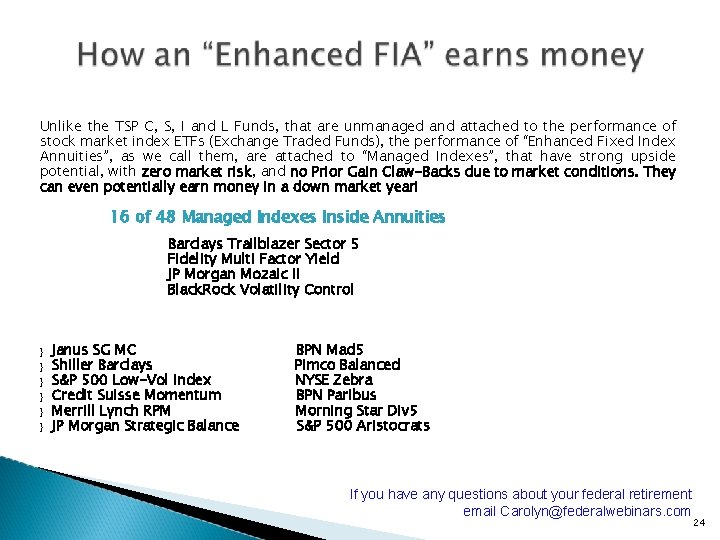
Unlike the TSP C, S, I and L Funds, that are unmanaged and attached to the performance of stock market index ETFs (Exchange Traded Funds), the performance of “Enhanced Fixed Index Annuities”, as we call them, are attached to “Managed Indexes”, that have strong upside potential, with zero market risk, and no Prior Gain Claw-Backs due to market conditions. They can even potentially earn money in a down market year! 16 of 48 Managed Indexes Inside Annuities Barclays Trailblazer Sector 5 Fidelity Multi Factor Yield JP Morgan Mozaic II Black. Rock Volatility Control } } } Janus SG MC Shiller Barclays S&P 500 Low-Vol Index Credit Suisse Momentum Merrill Lynch RPM JP Morgan Strategic Balance BPN Mad 5 Pimco Balanced NYSE Zebra BPN Paribus Morning Star Div 5 S&P 500 Aristocrats If you have any questions about your federal retirement email Carolyn@federalwebinars. com 24
- Slides: 24