
Building a Barrier Reducing harmful water runoff from
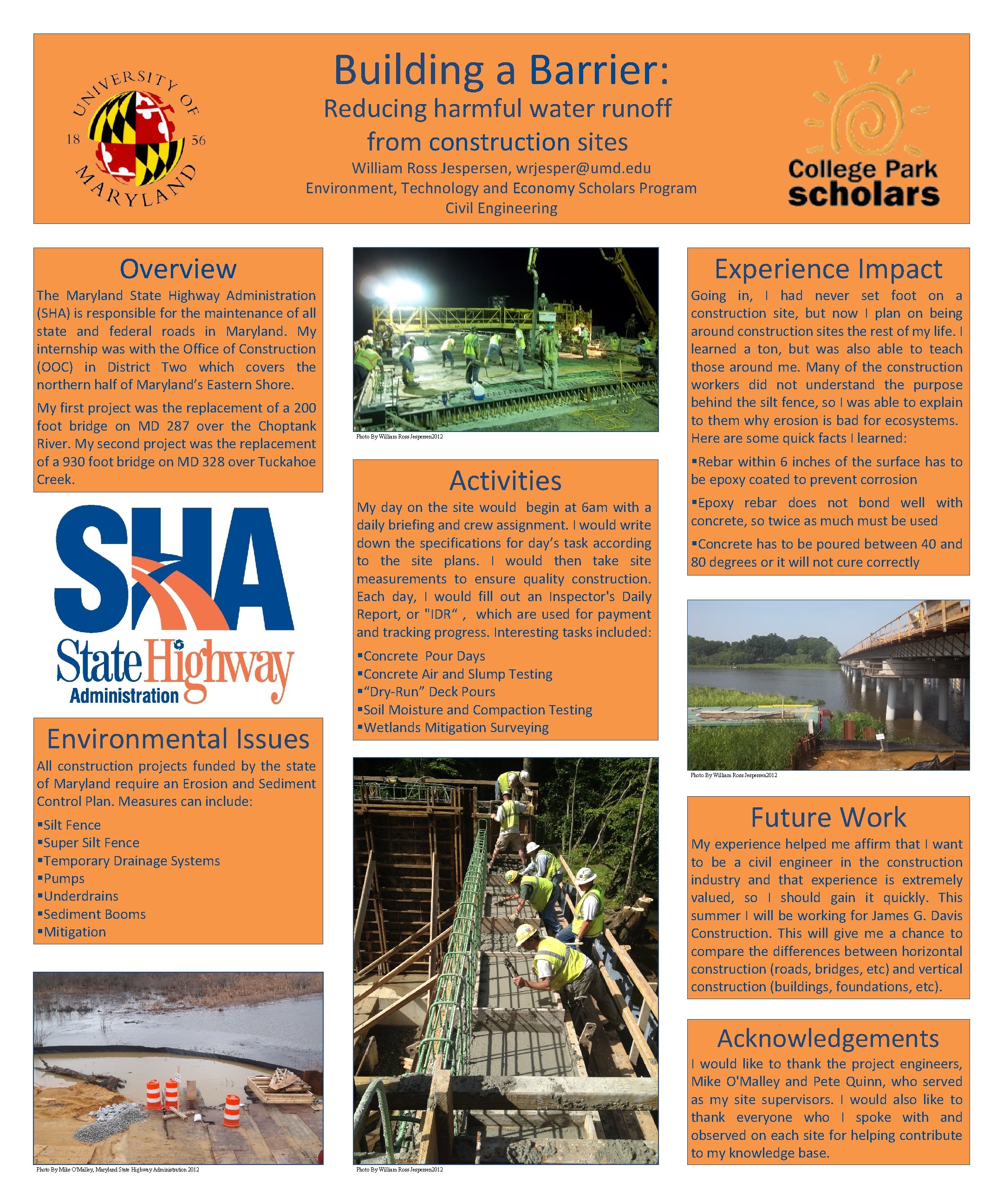
Building a Barrier: Reducing harmful water runoff from construction sites William Ross Jespersen, wrjesper@umd. edu Environment, Technology and Economy Scholars Program Civil Engineering Overview Experience Impact The Maryland State Highway Administration (SHA) is responsible for the maintenance of all state and federal roads in Maryland. My internship was with the Office of Construction (OOC) in District Two which covers the northern half of Maryland’s Eastern Shore. My first project was the replacement of a 200 foot bridge on MD 287 over the Choptank River. My second project was the replacement of a 930 foot bridge on MD 328 over Tuckahoe Creek. Going in, I had never set foot on a construction site, but now I plan on being around construction sites the rest of my life. I learned a ton, but was also able to teach those around me. Many of the construction workers did not understand the purpose behind the silt fence, so I was able to explain to them why erosion is bad for ecosystems. Here are some quick facts I learned: Photo By William Ross Jespersen 2012 Activities My day on the site would begin at 6 am with a daily briefing and crew assignment. I would write down the specifications for day’s task according to the site plans. I would then take site measurements to ensure quality construction. Each day, I would fill out an Inspector's Daily Report, or "IDR“ , which are used for payment and tracking progress. Interesting tasks included: Environmental Issues §Rebar within 6 inches of the surface has to be epoxy coated to prevent corrosion §Epoxy rebar does not bond well with concrete, so twice as much must be used §Concrete has to be poured between 40 and 80 degrees or it will not cure correctly §Concrete Pour Days §Concrete Air and Slump Testing §“Dry-Run” Deck Pours §Soil Moisture and Compaction Testing §Wetlands Mitigation Surveying All construction projects funded by the state of Maryland require an Erosion and Sediment Control Plan. Measures can include: Photo By William Ross Jespersen 2012 Future Work §Silt Fence §Super Silt Fence §Temporary Drainage Systems §Pumps §Underdrains §Sediment Booms §Mitigation My experience helped me affirm that I want to be a civil engineer in the construction industry and that experience is extremely valued, so I should gain it quickly. This summer I will be working for James G. Davis Construction. This will give me a chance to compare the differences between horizontal construction (roads, bridges, etc) and vertical construction (buildings, foundations, etc). Acknowledgements I would like to thank the project engineers, Mike O'Malley and Pete Quinn, who served as my site supervisors. I would also like to thank everyone who I spoke with and observed on each site for helping contribute to my knowledge base. Photo By Mike O'Malley, Maryland State Highway Administration 2012 Photo By William Ross Jespersen 2012
- Slides: 1