
Building a 1 DEM for Australia Water for
Building a 1” DEM for Australia Water for a Healthy Country Dr David Lemon Research Stream Leader – Water Informatics September 2008
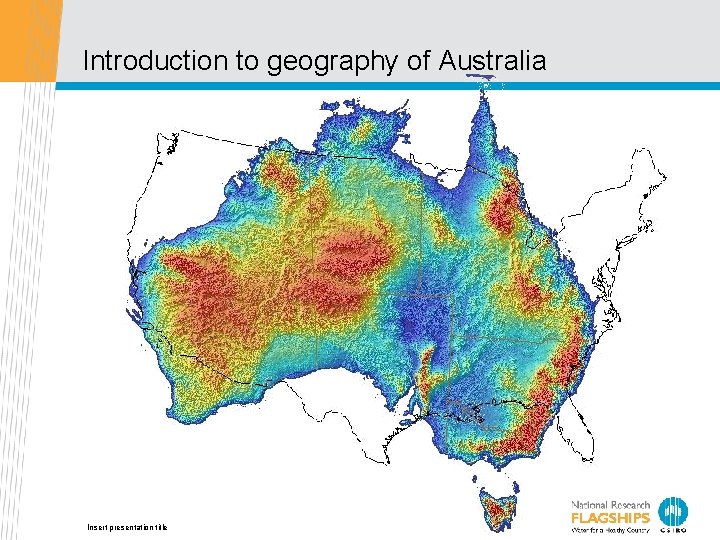
Introduction to geography of Australia Insert presentation title
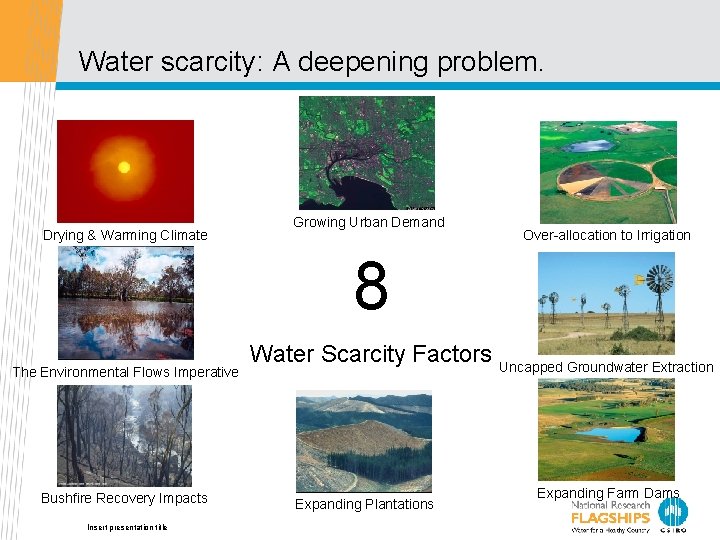
Water scarcity: A deepening problem. Drying & Warming Climate Growing Urban Demand Over-allocation to Irrigation 8 The Environmental Flows Imperative Bushfire Recovery Impacts Insert presentation title Water Scarcity Factors Uncapped Groundwater Extraction Expanding Plantations Expanding Farm Dams
Options for a new National DEM • The 9 second (250 m) DEM is the only national bare-earth DEM • • ALOS PRISM/PALSAR • • • 20 m postings 10 -15 m Z (DTED 2) COTS solution Requires large investment in data and photogrammetry for DEM SRTM • • 5 -10 m postings & 3 -10 m Z (DTED 2. 5) Requires large investment in photogrammetry SPOT HRS • • Does not meet requirements DTED 2 a significant improvement on DTED 1 Existing Regional DEMs and Elevation data • Not a national coverage Insert presentation title
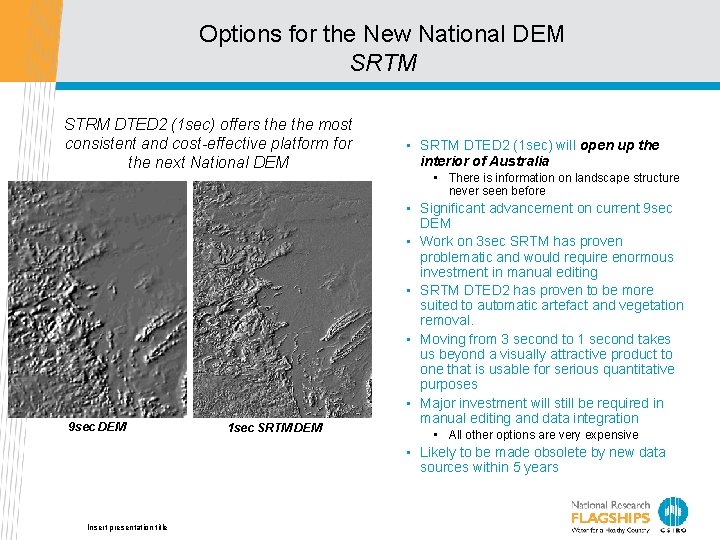
Options for the New National DEM SRTM STRM DTED 2 (1 sec) offers the most consistent and cost-effective platform for the next National DEM 9 sec DEM 1 sec SRTM DEM • SRTM DTED 2 (1 sec) will open up the interior of Australia • There is information on landscape structure never seen before • Significant advancement on current 9 sec DEM • Work on 3 sec SRTM has proven problematic and would require enormous investment in manual editing • SRTM DTED 2 has proven to be more suited to automatic artefact and vegetation removal. • Moving from 3 second to 1 second takes us beyond a visually attractive product to one that is usable for serious quantitative purposes • Major investment will still be required in manual editing and data integration • All other options are very expensive • Likely to be made obsolete by new data sources within 5 years Insert presentation title
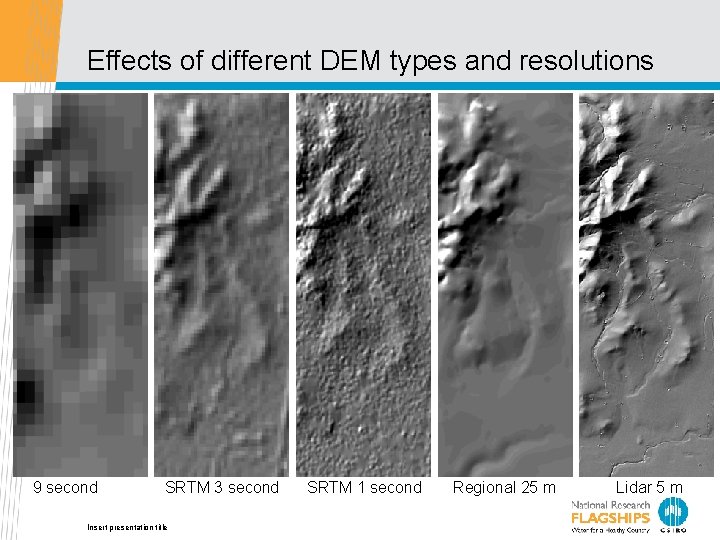
Effects of different DEM types and resolutions 9 second SRTM 3 second Insert presentation title SRTM 1 second Regional 25 m Lidar 5 m
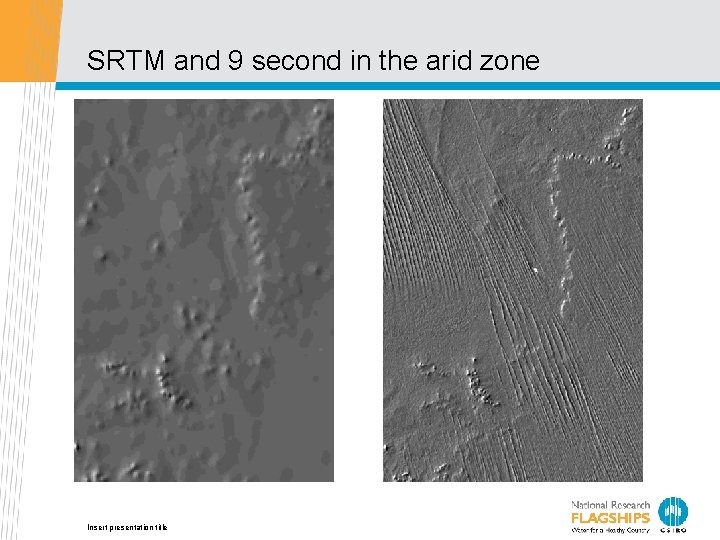
SRTM and 9 second in the arid zone Insert presentation title
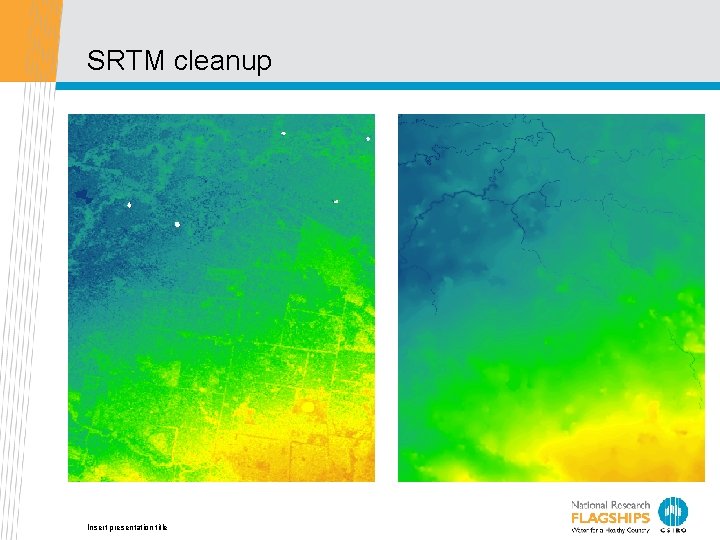
SRTM cleanup Insert presentation title
Processing steps • Fourier transform filtering to remove systematic stripes (sensor artifacts) • Removal of vegetation offsets • Identification of affected areas using vegetation mapping from remote sensing and direct detection from DEM • Measurement of vegetation height offset and construction of vegetation height surface • Removal of height offset in affected areas • 1 second data greatly facilitates this process • Adaptive smoothing to reduce random height variations in flatter areas • Drainage enforcement with ANUDEM using mapped streams • Quality assurance yet to be performed • Manual intervention will be required in some areas Insert presentation title
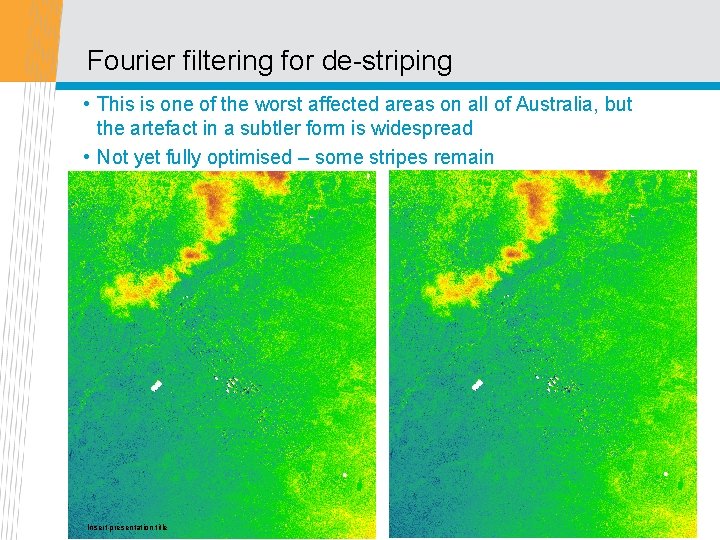
Fourier filtering for de-striping • This is one of the worst affected areas on all of Australia, but the artefact in a subtler form is widespread • Not yet fully optimised – some stripes remain Insert presentation title
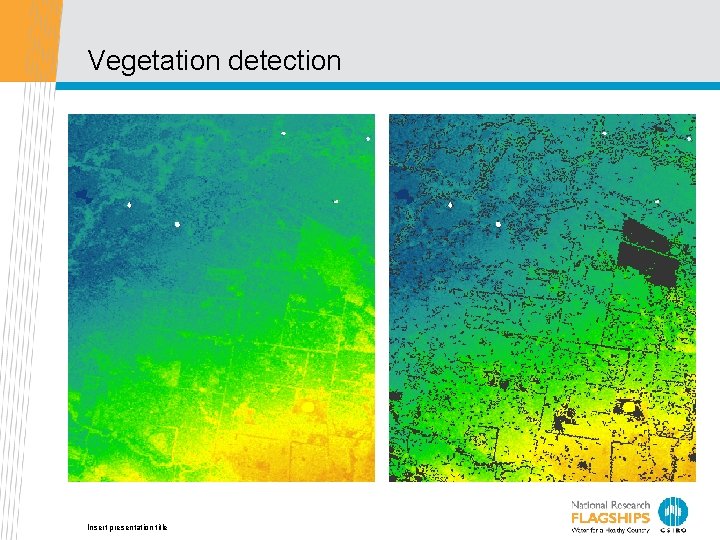
Vegetation detection Insert presentation title
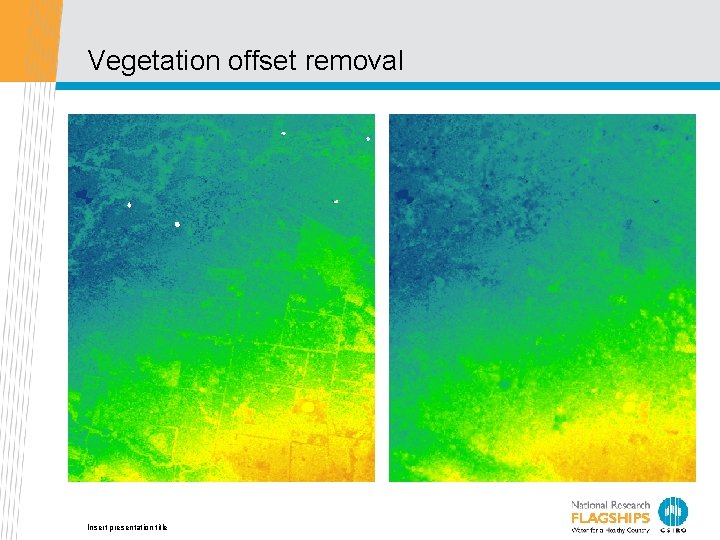
Vegetation offset removal Insert presentation title
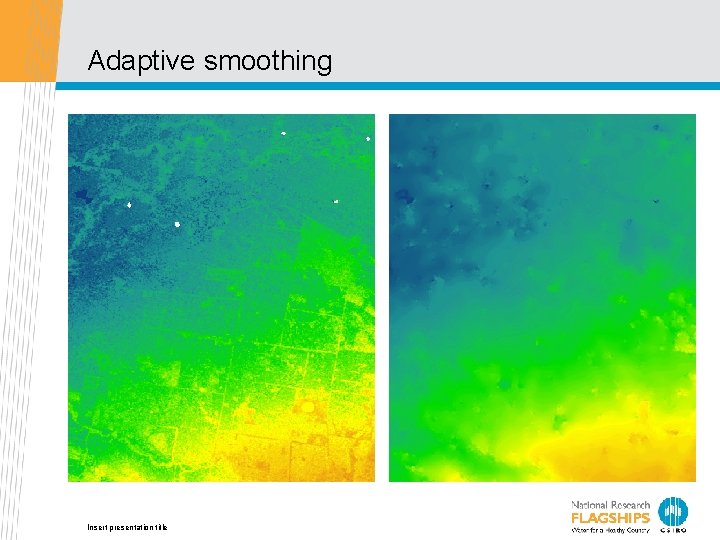
Adaptive smoothing Insert presentation title
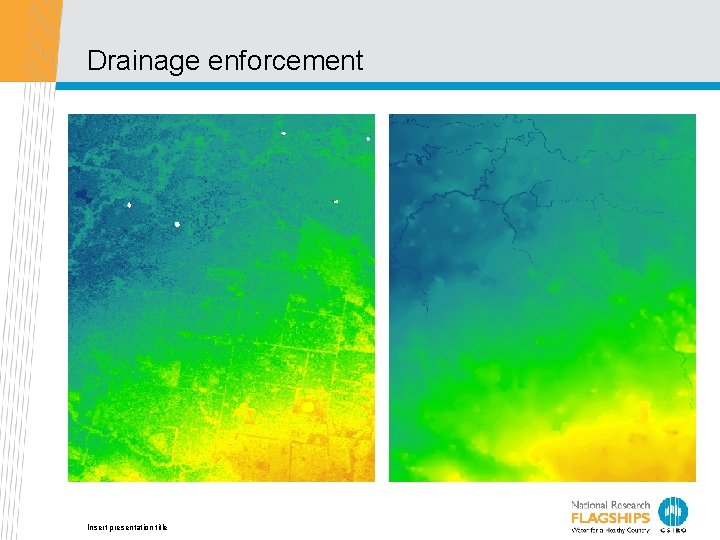
Drainage enforcement Insert presentation title
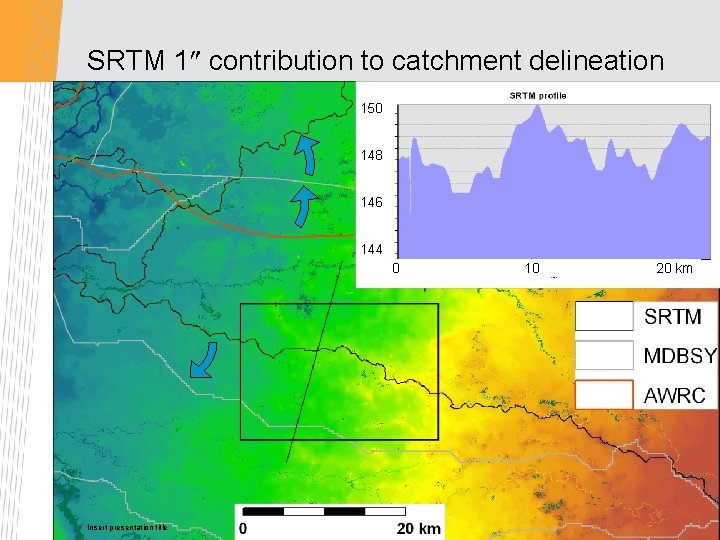
SRTM 1 contribution to catchment delineation 150 148 146 144 0 Insert presentation title 10 20 km
Key advantages of 1 second data • Cleanup of SRTM data is much easier and much more effective using the 1 second data • 3 second data blurs the edges we need to identify for vegetation removal • Released product ideally based on 1 second, not 3 second • Quantitative analysis demands better than 3 second data • Representing surface shape • Capturing correlations with soil properties • Matching natural and constructed features in the landscape Insert presentation title
Summary • SRTM cleanup process is operational • • Room for improvement, development is continuing 1 second data provides much better basis for veg removal QA and correction will be required before release Currently scoping effort required • Cleaned SRTM without drainage enforcement can provide a useful DEM for non-hydrological purposes • Vegetation height information as a byproduct • With appropriate stream data SRTM can construct the geospatial fabric for water resource management, in combination with other DEMs as necessary • Release of SRTM 1 second data would enable a host of applications that are not possible with pre-SRTM data and have limited value using 3 second SRTM Insert presentation title

CSIRO Land Water Dr David Lemon Research Stream Leader – Water Informatics Phone: +61 2 6246 5724 Email: David. Lemon@csiro. au Web: www. csiro. au/clw Thank you Contact Us Phone: 1300 363 400 or +61 3 9545 2176 Email: Enquiries@csiro. au Web: www. csiro. au
- Slides: 18