
Build and Implement a 9 Box Talent Grid
Build and Implement a 9 -Box Talent Grid to Assess Employee Talent If you want to successfully develop talent, you’ve got to start by effectively evaluating it. Mc. Lean & Company is a research and advisory firm that provides practical solutions to human resources challenges with executable research, tools, and advice that will have a Mc. Lean & Company is a research and advisory firm providing practical solutions to human resources challenges©via executable research, tools and advice that clear and measurable impact on your business. 1997 -2016 Mc. Lean & Company. have a clear and measurable impact on your business. © 1997 - 2016 Mc. Lean & Company. Mc. Lean Company is a division of Info-Tech Group Mc. Lean & Company is a & division of Info-Tech Research Group. Research Inc. Mc. Lean & Company 1
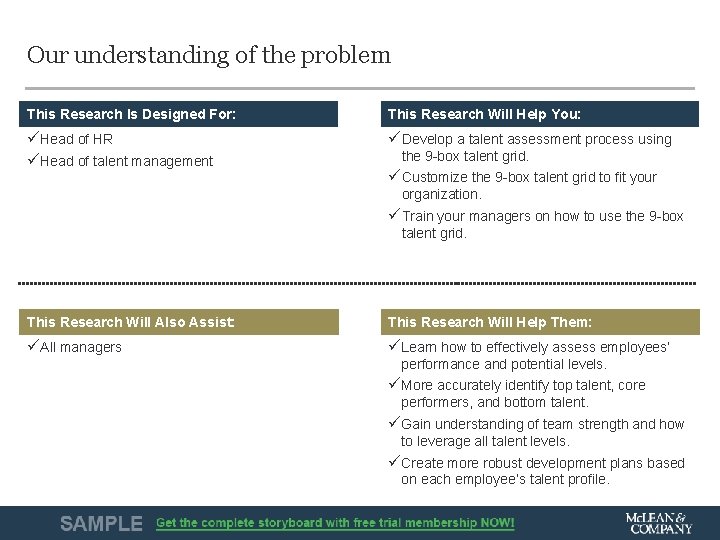
Our understanding of the problem This Research is Is Designed For: This Research Will Help You: üHead of HR üHead of talent management üDevelop a talent assessment process using the 9 -box talent grid. üCustomize the 9 -box talent grid to fit your organization. üTrain your managers on how to use the 9 -box talent grid. This Research Will Also Assist: This Research Will Help You: Them: üAll managers üLearn how to effectively assess employees’ performance and potential levels. üMore accurately identify top talent, core performers, and bottom talent. üGain understanding of team strength and how to leverage all talent levels. üCreate more robust development plans based on each employee’s talent profile. Mc. Lean & Company 2
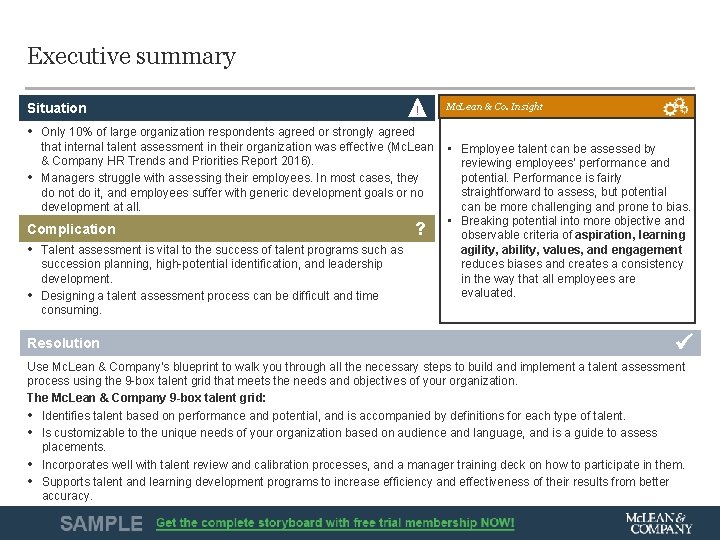
Executive summary Situation ! Mc. Lean & Co. Insight • Only 10% of large organization respondents agreed or strongly agreed • that internal talent assessment in their organization was effective (Mc. Lean & Company HR Trends and Priorities Report 2016). Managers struggle with assessing their employees. In most cases, they do not do it, and employees suffer with generic development goals or no development at all. Complication • Talent assessment is vital to the success of talent programs such as • succession planning, high-potential identification, and leadership development. Designing a talent assessment process can be difficult and time consuming. ? • Employee talent can be assessed by reviewing employees’ performance and potential. Performance is fairly straightforward to assess, but potential can be more challenging and prone to bias. • Breaking potential into more objective and observable criteria of aspiration, learning agility, ability, values, and engagement reduces biases and creates a consistency in the way that all employees are evaluated. Resolution Use Mc. Lean & Company’s blueprint to walk you through all the necessary steps to build and implement a talent assessment process using the 9 -box talent grid that meets the needs and objectives of your organization. The Mc. Lean & Company 9 -box talent grid: • Identifies talent based on performance and potential, and is accompanied by definitions for each type of talent. • Is customizable to the unique needs of your organization based on audience and language, and is a guide to assess placements. • Incorporates well with talent review and calibration processes, and a manager training deck on how to participate in them. • Supports talent and learning development programs to increase efficiency and effectiveness of their results from better accuracy. Mc. Lean & Company 3
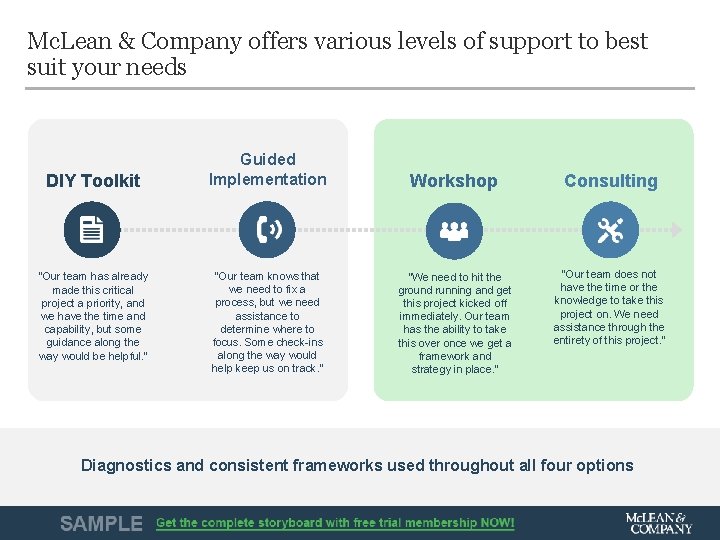
Mc. Lean & Company offers various levels of support to best suit your needs DIY Toolkit “Our team has already made this critical project a priority, and we have the time and capability, but some guidance along the way would be helpful. ” Guided Implementation Workshop Consulting “Our team knows that we need to fix a process, but we need assistance to determine where to focus. Some check-ins along the way would help keep us on track. ” “We need to hit the ground running and get this project kicked off immediately. Our team has the ability to take this over once we get a framework and strategy in place. ” “Our team does not have the time or the knowledge to take this project on. We need assistance through the entirety of this project. ” Diagnostics and consistent frameworks used throughout all four options Mc. Lean & Company 4
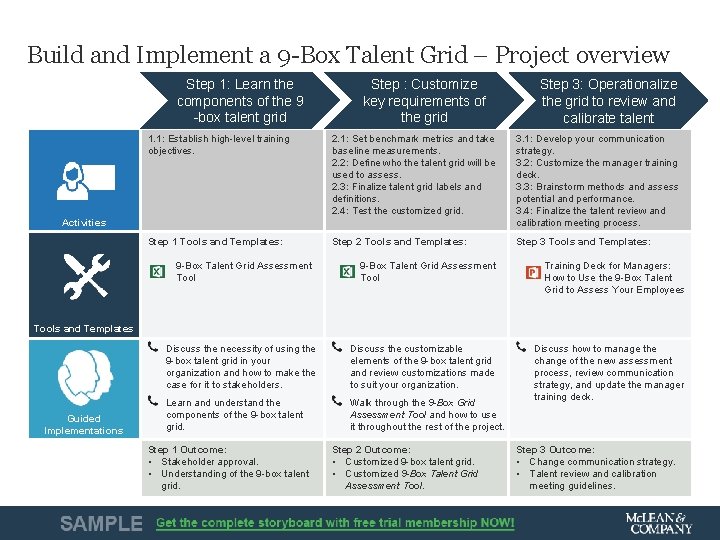
Build and Implement a 9 -Box Talent Grid – Project overview Step 1: Learn the components of the 9 -box talent grid Step : Customize key requirements of the grid Step 3: Operationalize the grid to review and calibrate talent 1. 1: Establish high-level training objectives. 2. 1: Set benchmark metrics and take baseline measurements. 2. 2: Define who the talent grid will be used to assess. 2. 3: Finalize talent grid labels and definitions. 2. 4: Test the customized grid. 3. 1: Develop your communication strategy. 3. 2: Customize the manager training deck. 3. 3: Brainstorm methods and assess potential and performance. 3. 4: Finalize the talent review and calibration meeting process. Step 1 Tools and Templates: Step 2 Tools and Templates: Step 3 Tools and Templates: Activities 9 -Box Talent Grid Assessment Tool Training Deck for Managers: How to Use the 9 -Box Talent Grid to Assess Your Employees Discuss the necessity of using the 9 -box talent grid in your organization and how to make the case for it to stakeholders. Discuss the customizable elements of the 9 -box talent grid and review customizations made to suit your organization. Learn and understand the components of the 9 -box talent grid. Walk through the 9 -Box Grid Assessment Tool and how to use it throughout the rest of the project. Discuss how to manage the change of the new assessment process, review communication strategy, and update the manager training deck. Tools and Templates Guided Implementations Step 1 Outcome: • Stakeholder approval. • Understanding of the 9 -box talent grid. Step 2 Outcome: • Customized 9 -box talent grid. • Customized 9 -Box Talent Grid Assessment Tool. Step 3 Outcome: • Change communication strategy. • Talent review and calibration meeting guidelines. Mc. Lean & Company 5
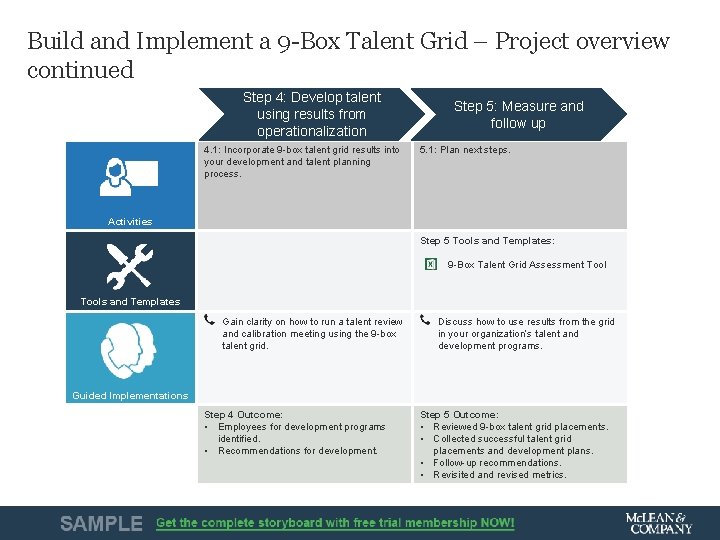
Build and Implement a 9 -Box Talent Grid – Project overview continued Step 4: Develop talent using results from operationalization 4. 1: Incorporate 9 -box talent grid results into your development and talent planning process. Step 5: Measure and follow up 5. 1: Plan next steps. Activities Step 5 Tools and Templates: 9 -Box Talent Grid Assessment Tools and Templates Gain clarity on how to run a talent review and calibration meeting using the 9 -box talent grid. Discuss how to use results from the grid in your organization’s talent and development programs. Guided Implementations Step 4 Outcome: • Employees for development programs identified. • Recommendations for development. Step 5 Outcome: • Reviewed 9 -box talent grid placements. • Collected successful talent grid placements and development plans. • Follow-up recommendations. • Revisited and revised metrics. Mc. Lean & Company 6
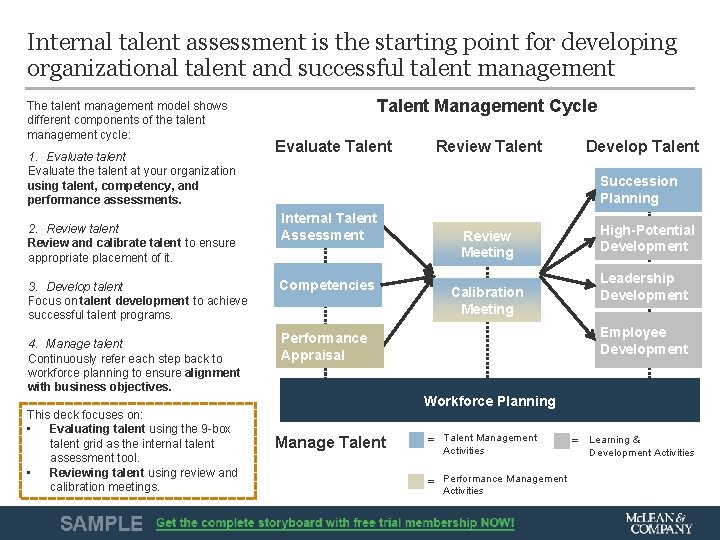
Internal talent assessment is the starting point for developing organizational talent and successful talent management The talent management model shows different components of the talent management cycle: 1. Evaluate talent Evaluate the talent at your organization using talent, competency, and performance assessments. 2. Review talent Review and calibrate talent to ensure appropriate placement of it. 3. Develop talent Focus on talent development to achieve successful talent programs. 4. Manage talent Continuously refer each step back to workforce planning to ensure alignment with business objectives. This deck focuses on: • Evaluating talent using the 9 -box talent grid as the internal talent assessment tool. • Reviewing talent using review and calibration meetings. Talent Management Cycle Evaluate Talent Review Talent Develop Talent Succession Planning Internal Talent Assessment Competencies High-Potential Development Review Meeting Leadership Development Calibration Meeting Employee Development Performance Appraisal Workforce Planning Manage Talent = Talent Management = Learning & Activities Development Activities = Performance Management Activities Mc. Lean & Company 7
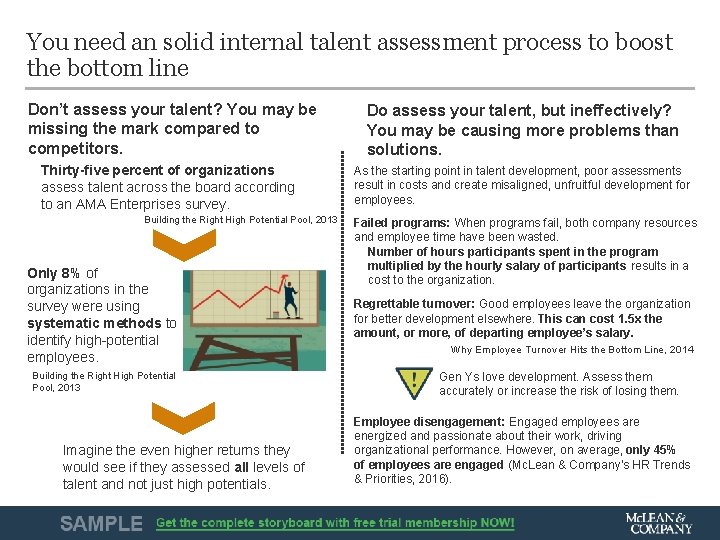
You need an solid internal talent assessment process to boost the bottom line Don’t assess your talent? You may be missing the mark compared to competitors. Thirty-five percent of organizations assess talent across the board according to an AMA Enterprises survey. Building the Right High Potential Pool, 2013 Only 8% of organizations in the survey were using systematic methods to identify high-potential employees. Building the Right High Potential Pool, 2013 Imagine the even higher returns they would see if they assessed all levels of talent and not just high potentials. Do assess your talent, but ineffectively? You may be causing more problems than solutions. As the starting point in talent development, poor assessments result in costs and create misaligned, unfruitful development for employees. Failed programs: When programs fail, both company resources and employee time have been wasted. Number of hours participants spent in the program multiplied by the hourly salary of participants results in a cost to the organization. Regrettable turnover: Good employees leave the organization for better development elsewhere. This can cost 1. 5 x the amount, or more, of departing employee’s salary. Why Employee Turnover Hits the Bottom Line, 2014 Gen Ys love development. Assess them accurately or increase the risk of losing them. Employee disengagement: Engaged employees are energized and passionate about their work, driving organizational performance. However, on average, only 45% of employees are engaged (Mc. Lean & Company’s HR Trends & Priorities, 2016). Mc. Lean & Company 8
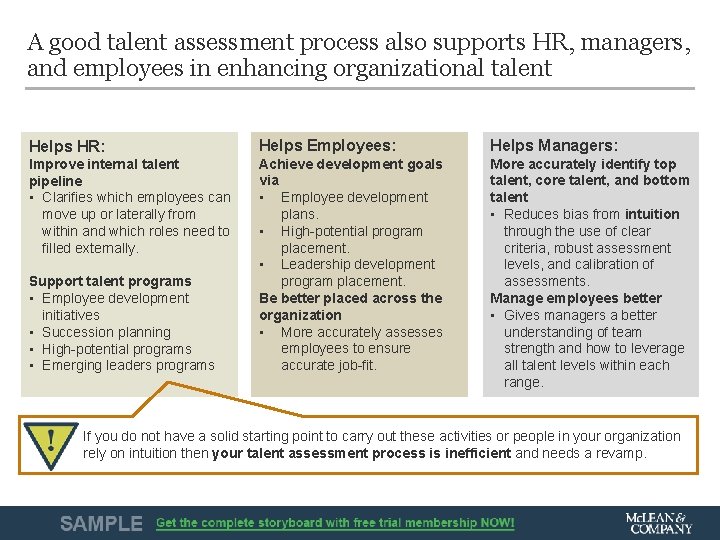
A good talent assessment process also supports HR, managers, and employees in enhancing organizational talent Helps HR: Helps Employees: Helps Managers: Improve internal talent pipeline • Clarifies which employees can move up or laterally from within and which roles need to filled externally. Achieve development goals via • Employee development plans. • High-potential program placement. • Leadership development program placement. Be better placed across the organization • More accurately assesses employees to ensure accurate job-fit. More accurately identify top talent, core talent, and bottom talent • Reduces bias from intuition through the use of clear criteria, robust assessment levels, and calibration of assessments. Manage employees better • Gives managers a better understanding of team strength and how to leverage all talent levels within each range. Support talent programs • Employee development initiatives • Succession planning • High-potential programs • Emerging leaders programs If you do not have a solid starting point to carry out these activities or people in your organization rely on intuition then your talent assessment process is inefficient and needs a revamp. Mc. Lean & Company 9
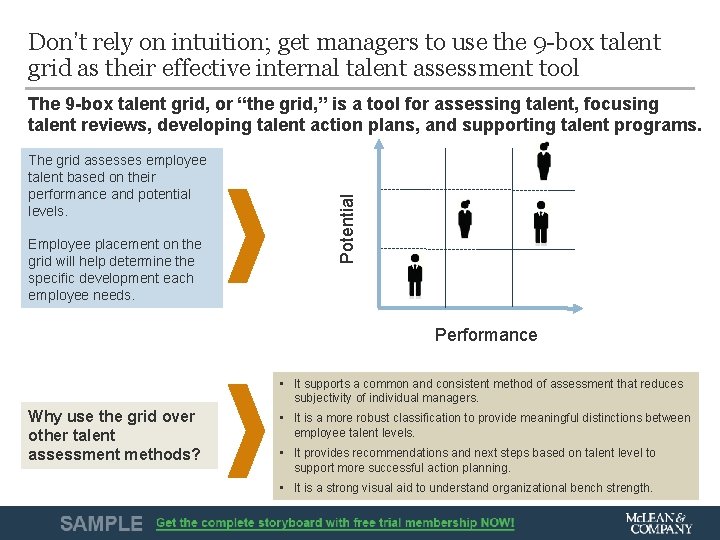
Don’t rely on intuition; get managers to use the 9 -box talent grid as their effective internal talent assessment tool The grid assesses employee talent based on their performance and potential levels. Employee placement on the grid will help determine the specific development each employee needs. Potential The 9 -box talent grid, or “the grid, ” is a tool for assessing talent, focusing talent reviews, developing talent action plans, and supporting talent programs. Performance • It supports a common and consistent method of assessment that reduces subjectivity of individual managers. Why use the grid over other talent assessment methods? • It is a more robust classification to provide meaningful distinctions between employee talent levels. • It provides recommendations and next steps based on talent level to support more successful action planning. • It is a strong visual aid to understand organizational bench strength. Mc. Lean & Company 10
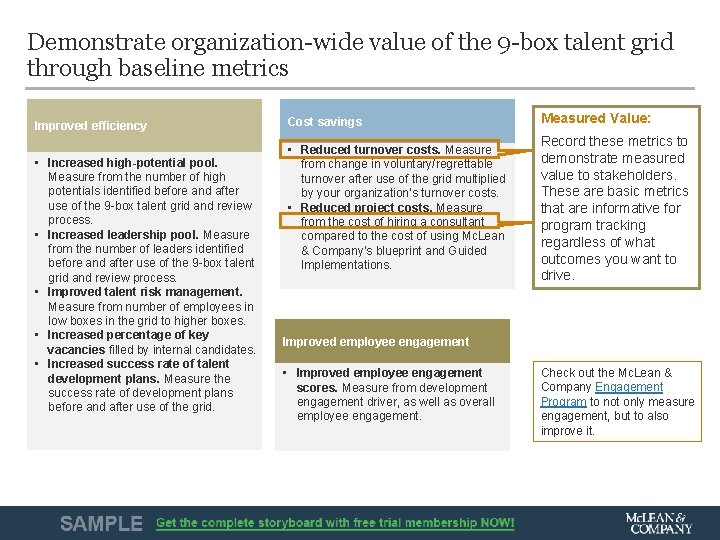
Demonstrate organization-wide value of the 9 -box talent grid through baseline metrics Improved efficiency • Increased high-potential pool. Measure from the number of high potentials identified before and after use of the 9 -box talent grid and review process. • Increased leadership pool. Measure from the number of leaders identified before and after use of the 9 -box talent grid and review process. • Improved talent risk management. Measure from number of employees in low boxes in the grid to higher boxes. • Increased percentage of key vacancies filled by internal candidates. • Increased success rate of talent development plans. Measure the success rate of development plans before and after use of the grid. Cost savings Measured Value: • Reduced turnover costs. Measure from change in voluntary/regrettable turnover after use of the grid multiplied by your organization’s turnover costs. • Reduced project costs. Measure from the cost of hiring a consultant compared to the cost of using Mc. Lean & Company’s blueprint and Guided Implementations. Record these metrics to demonstrate measured value to stakeholders. These are basic metrics that are informative for program tracking regardless of what outcomes you want to drive. Improved employee engagement • Improved employee engagement scores. Measure from development engagement driver, as well as overall employee engagement. Check out the Mc. Lean & Company Engagement Program to not only measure engagement, but to also improve it. Mc. Lean & Company 11
Mc. Lean & Company Helps HR Professionals To: ü Empower management to applyü HR best practices ü Develop effective talent acquisition & retention strategies ü Build a high performance culture Maintain a progressive set of HR policies & procedures ü Demonstrate the business impact of HR ü Stay abreast of HR trends & technologies Sign up for free trial membership to get practical solutions for your HR challenges "Mc. Lean & Company provides practical research, tools and advice covering the entire spectrum of HR & Leadership issues to ensure you experience measurable, positive results. " • - Rob Garmaise, VP of Customer Experience Toll Free: 1 -877 -281 -0480 Mc. Lean & Company hr. mcleanco. com 12
- Slides: 12