
Build a Value Measurement Framework Focus product delivery
Build a Value Measurement Framework Focus product delivery on business value–driven outcomes. Info-Tech Research Group, Inc. is a global leader in providing IT research and advice. Info-Tech’s products and services combine actionable insight and relevant advice with ready-to-use tools and templates that cover the full spectrum of IT concerns. © 1997 -2019 Info-Tech Research Group Inc. Info-Tech Research Group 1
ANALYST PERSPECTIVE A meaningful measurable definition of value is the key to effectively managing the intake, prioritization, and delivery of technologyenabled products and services. Cole Cioran, Senior Director, Research – Application Development and Portfolio Management Info-Tech Research Group 2
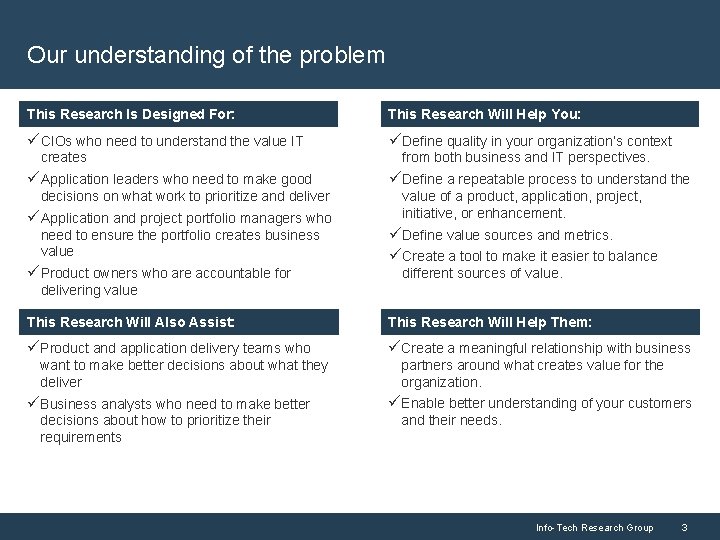
Our understanding of the problem This Research Is is Designed For: This Research Will Help You: üCIOs who need to understand the value IT üDefine quality in your organization’s context creates üApplication leaders who need to make good decisions on what work to prioritize and deliver üApplication and project portfolio managers who need to ensure the portfolio creates business value üProduct owners who are accountable for from both business and IT perspectives. üDefine a repeatable process to understand the value of a product, application, project, initiative, or enhancement. üDefine value sources and metrics. üCreate a tool to make it easier to balance different sources of value. delivering value This Research Will Also Assist: This Research Will Help Them: You: üProduct and application delivery teams who üCreate a meaningful relationship with business want to make better decisions about what they deliver üBusiness analysts who need to make better decisions about how to prioritize their requirements partners around what creates value for the organization. üEnable better understanding of your customers and their needs. Info-Tech Research Group 3
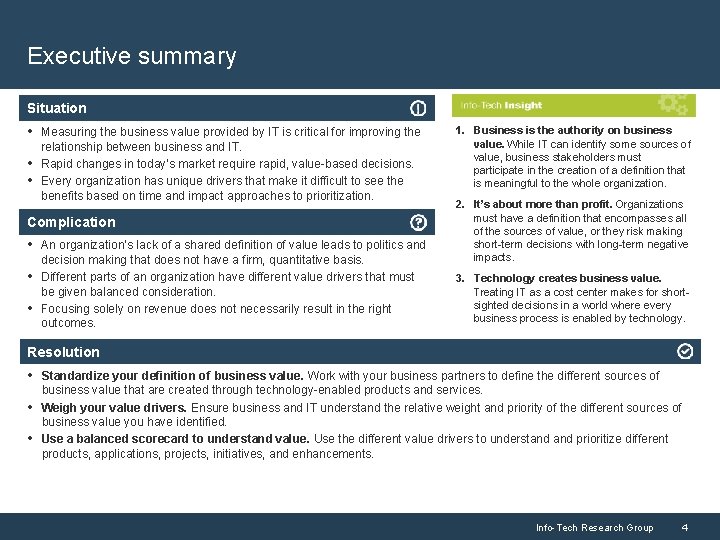
Executive summary Situation • Measuring the business value provided by IT is critical for improving the • • relationship between business and IT. Rapid changes in today’s market require rapid, value-based decisions. Every organization has unique drivers that make it difficult to see the benefits based on time and impact approaches to prioritization. Complication • An organization’s lack of a shared definition of value leads to politics and • • decision making that does not have a firm, quantitative basis. Different parts of an organization have different value drivers that must be given balanced consideration. Focusing solely on revenue does not necessarily result in the right outcomes. 1. Business is the authority on business value. While IT can identify some sources of value, business stakeholders must participate in the creation of a definition that is meaningful to the whole organization. 2. It’s about more than profit. Organizations must have a definition that encompasses all of the sources of value, or they risk making short-term decisions with long-term negative impacts. 3. Technology creates business value. Treating IT as a cost center makes for shortsighted decisions in a world where every business process is enabled by technology. Resolution • Standardize your definition of business value. Work with your business partners to define the different sources of • • business value that are created through technology-enabled products and services. Weigh your value drivers. Ensure business and IT understand the relative weight and priority of the different sources of business value you have identified. Use a balanced scorecard to understand value. Use the different value drivers to understand prioritize different products, applications, projects, initiatives, and enhancements. Info-Tech Research Group 4
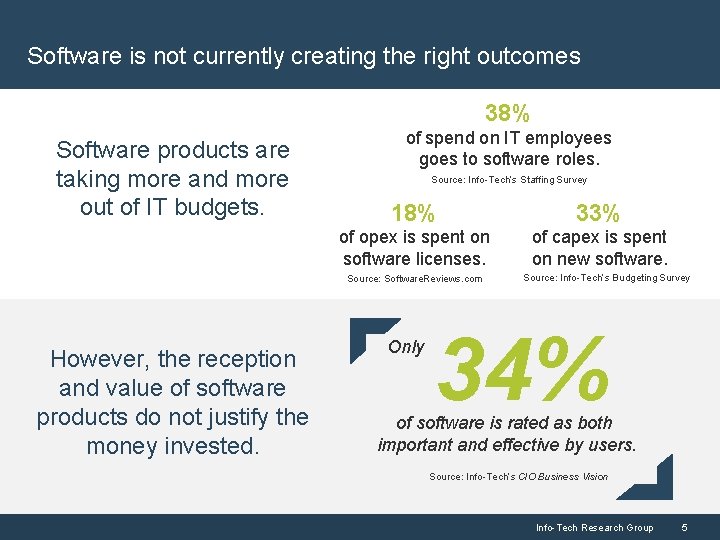
Software is not currently creating the right outcomes 38% Software products are taking more and more out of IT budgets. of spend on IT employees goes to software roles. Source: Info-Tech’s Staffing Survey 18% 33% of opex is spent on software licenses. of capex is spent on new software. Source: Software. Reviews. com However, the reception and value of software products do not justify the money invested. Only Source: Info-Tech’s Budgeting Survey 34% of software is rated as both important and effective by users. Source: Info-Tech’s CIO Business Vision Info-Tech Research Group 5
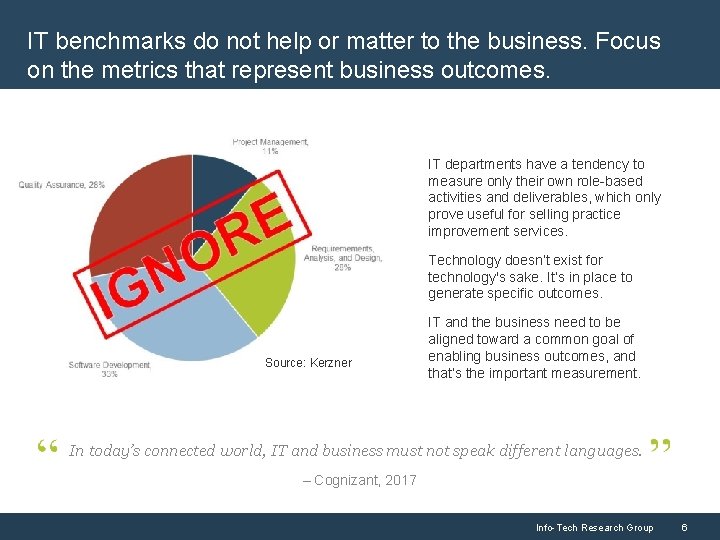
IT benchmarks do not help or matter to the business. Focus on the metrics that represent business outcomes. IT departments have a tendency to measure only their own role-based activities and deliverables, which only prove useful for selling practice improvement services. Technology doesn’t exist for technology's sake. It’s in place to generate specific outcomes. Source: Kerzner IT and the business need to be aligned toward a common goal of enabling business outcomes, and that’s the important measurement. In today’s connected world, IT and business must not speak different languages. – Cognizant, 2017 Info-Tech Research Group 6
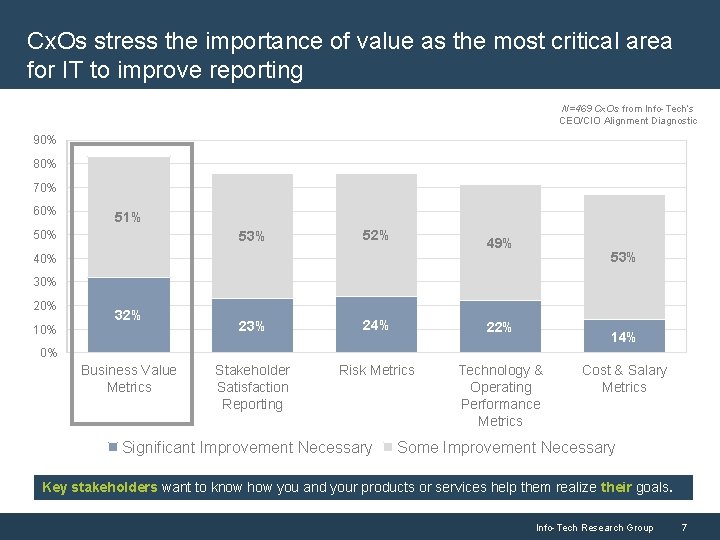
Cx. Os stress the importance of value as the most critical area for IT to improve reporting N=469 Cx. Os from Info-Tech’s CEO/CIO Alignment Diagnostic 90% 80% 70% 60% 51% 50% 53% 52% 49% 53% 40% 30% 20% 10% 32% 23% 24% 22% Stakeholder Satisfaction Reporting Risk Metrics Technology & Operating Performance Metrics 14% 0% Business Value Metrics Significant Improvement Necessary Cost & Salary Metrics Some Improvement Necessary Key stakeholders want to know how you and your products or services help them realize their goals. Info-Tech Research Group 7
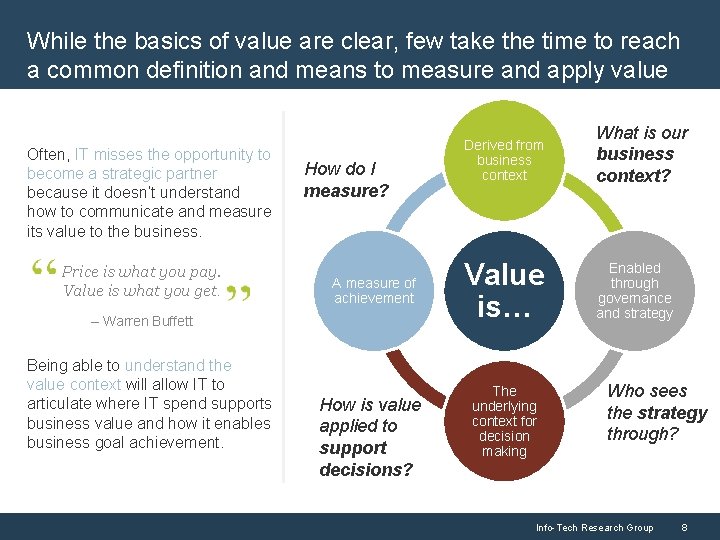
While the basics of value are clear, few take the time to reach a common definition and means to measure and apply value Often, IT misses the opportunity to become a strategic partner because it doesn’t understand how to communicate and measure its value to the business. Price is what you pay. Value is what you get. How do I measure? A measure of achievement – Warren Buffett Being able to understand the value context will allow IT to articulate where IT spend supports business value and how it enables business goal achievement. How is value applied to support decisions? Derived from business context What is our business context? Value is… Enabled through governance and strategy The underlying context for decision making Who sees the strategy through? Info-Tech Research Group 8
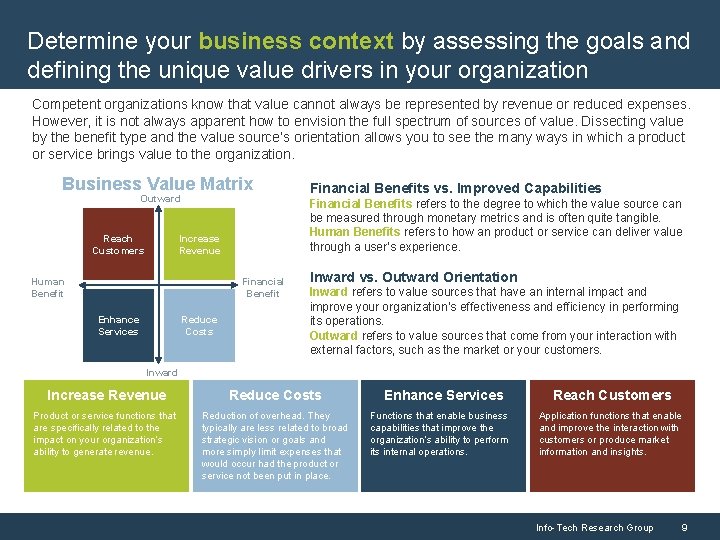
Determine your business context by assessing the goals and defining the unique value drivers in your organization Competent organizations know that value cannot always be represented by revenue or reduced expenses. However, it is not always apparent how to envision the full spectrum of sources of value. Dissecting value by the benefit type and the value source’s orientation allows you to see the many ways in which a product or service brings value to the organization. Business Value Matrix Outward Reach Customers Financial Benefits refers to the degree to which the value source can be measured through monetary metrics and is often quite tangible. Human Benefits refers to how an product or service can deliver value through a user’s experience. Increase Revenue Human Benefit Financial Benefit Enhance Services Reduce Costs Financial Benefits vs. Improved Capabilities Inward vs. Outward Orientation Inward refers to value sources that have an internal impact and improve your organization’s effectiveness and efficiency in performing its operations. Outward refers to value sources that come from your interaction with external factors, such as the market or your customers. Inward Increase Revenue Reduce Costs Product or service functions that are specifically related to the impact on your organization’s ability to generate revenue. Reduction of overhead. They typically are less related to broad strategic vision or goals and more simply limit expenses that would occur had the product or service not been put in place. Enhance Services Functions that enable business capabilities that improve the organization’s ability to perform its internal operations. Reach Customers Application functions that enable and improve the interaction with customers or produce market information and insights. Info-Tech Research Group 9
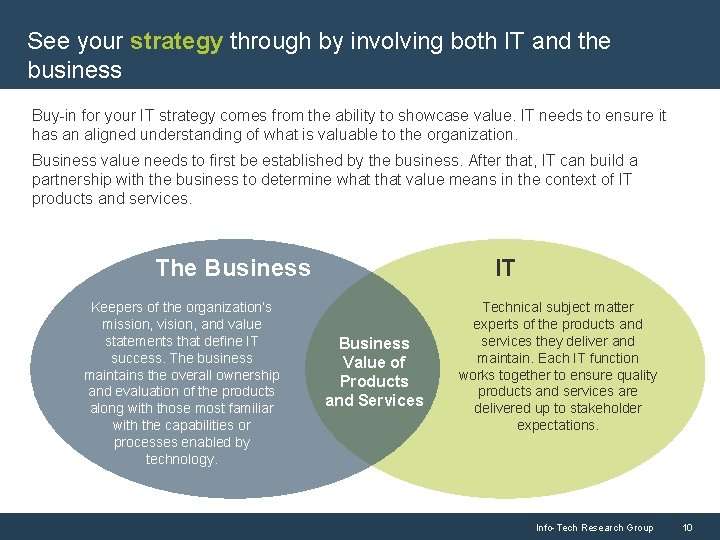
See your strategy through by involving both IT and the business Buy-in for your IT strategy comes from the ability to showcase value. IT needs to ensure it has an aligned understanding of what is valuable to the organization. Business value needs to first be established by the business. After that, IT can build a partnership with the business to determine what that value means in the context of IT products and services. The Business Keepers of the organization’s mission, vision, and value statements that define IT success. The business maintains the overall ownership and evaluation of the products along with those most familiar with the capabilities or processes enabled by technology. IT Business Value of Products and Services Technical subject matter experts of the products and services they deliver and maintain. Each IT function works together to ensure quality products and services are delivered up to stakeholder expectations. Info-Tech Research Group 10
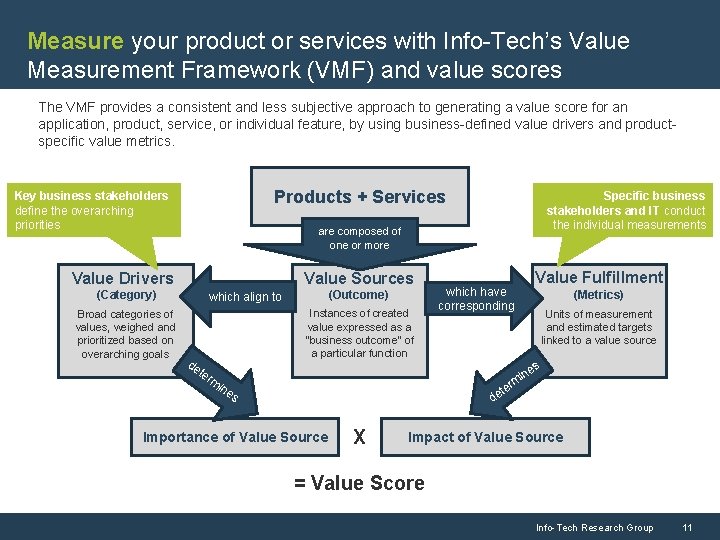
Measure your product or services with Info-Tech’s Value Measurement Framework (VMF) and value scores The VMF provides a consistent and less subjective approach to generating a value score for an application, product, service, or individual feature, by using business-defined value drivers and productspecific value metrics. Products + Services Key business stakeholders define the overarching priorities are composed of one or more Value Drivers (Category) Broad categories of values, weighed and prioritized based on overarching goals Specific business stakeholders and IT conduct the individual measurements Value Sources (Outcome) which align to de ter m Instances of created value expressed as a “business outcome” of a particular function Value Fulfillment which have corresponding (Metrics) Units of measurement and estimated targets linked to a value source s m er ine s t de Importance of Value Source X ine Impact of Value Source = Value Score Info-Tech Research Group 11
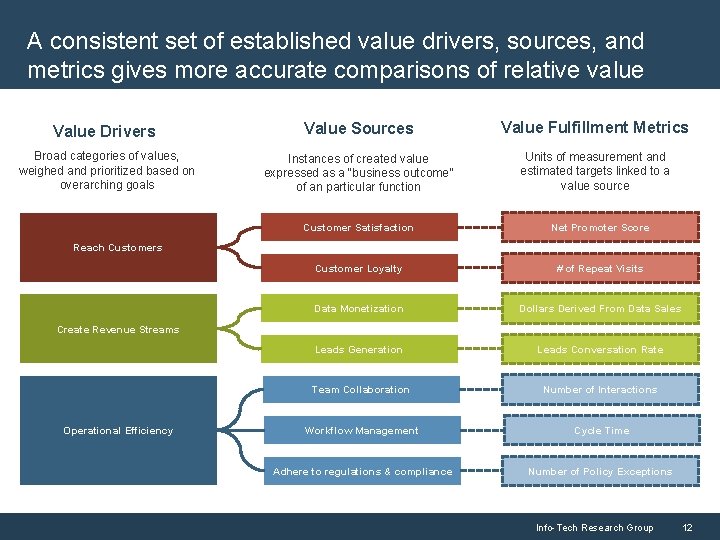
A consistent set of established value drivers, sources, and metrics gives more accurate comparisons of relative value Value Drivers Value Sources Value Fulfillment Metrics Broad categories of values, weighed and prioritized based on overarching goals Instances of created value expressed as a “business outcome” of an particular function Units of measurement and estimated targets linked to a value source Customer Satisfaction Net Promoter Score Customer Loyalty # of Repeat Visits Data Monetization Dollars Derived From Data Sales Leads Generation Leads Conversation Rate Team Collaboration Number of Interactions Workflow Management Cycle Time Adhere to regulations & compliance Number of Policy Exceptions Reach Customers Create Revenue Streams Operational Efficiency Info-Tech Research Group 12
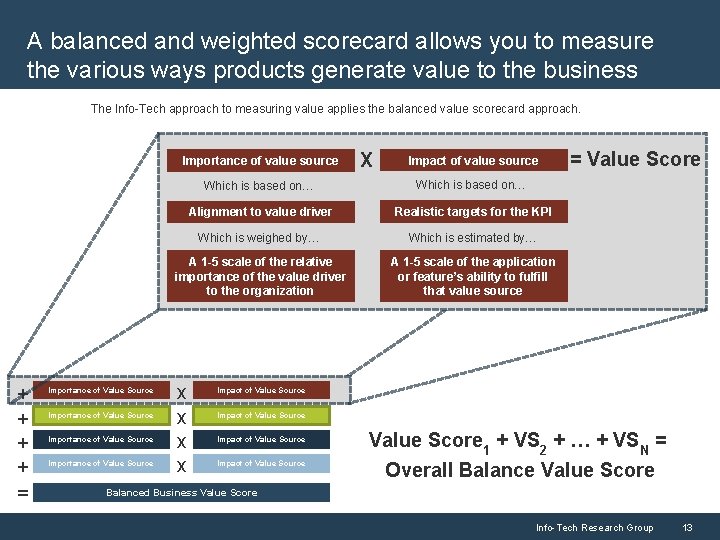
A balanced and weighted scorecard allows you to measure the various ways products generate value to the business The Info-Tech approach to measuring value applies the balanced value scorecard approach. Importance of value source + + = Importance of Value Source X Impact of value source Which is based on… Alignment to value driver Realistic targets for the KPI Which is weighed by… Which is estimated by… A 1 -5 scale of the relative importance of the value driver to the organization A 1 -5 scale of the application or feature’s ability to fulfill that value source x x = Value Score Impact of Value Source Value Score 1 + VS 2 + … + VSN = Overall Balance Value Score Balanced Business Value Score Info-Tech Research Group 13
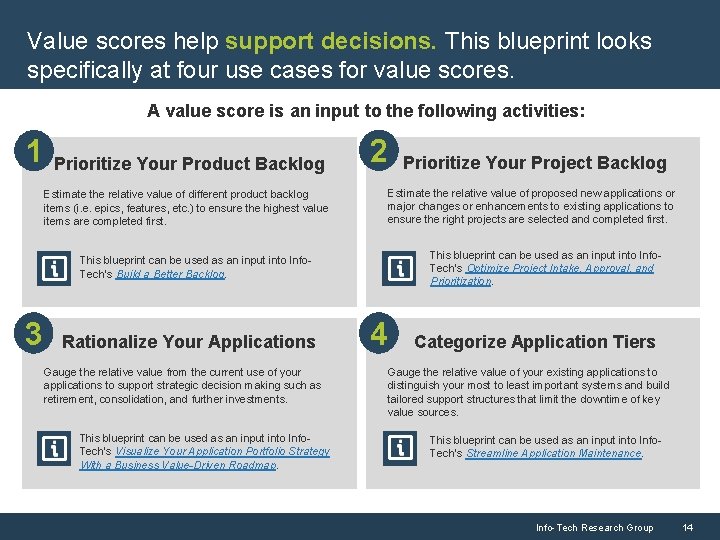
Value scores help support decisions. This blueprint looks specifically at four use cases for value scores. A value score is an input to the following activities: 1 Prioritize Your Product Backlog 2 Estimate the relative value of proposed new applications or major changes or enhancements to existing applications to ensure the right projects are selected and completed first. Estimate the relative value of different product backlog items (i. e. epics, features, etc. ) to ensure the highest value items are completed first. This blueprint can be used as an input into Info. Tech’s Optimize Project Intake, Approval, and Prioritization. This blueprint can be used as an input into Info. Tech’s Build a Better Backlog. 3 Rationalize Your Applications Gauge the relative value from the current use of your applications to support strategic decision making such as retirement, consolidation, and further investments. This blueprint can be used as an input into Info. Tech’s Visualize Your Application Portfolio Strategy With a Business Value-Driven Roadmap. Prioritize Your Project Backlog 4 Categorize Application Tiers Gauge the relative value of your existing applications to distinguish your most to least important systems and build tailored support structures that limit the downtime of key value sources. This blueprint can be used as an input into Info. Tech’s Streamline Application Maintenance. Info-Tech Research Group 14
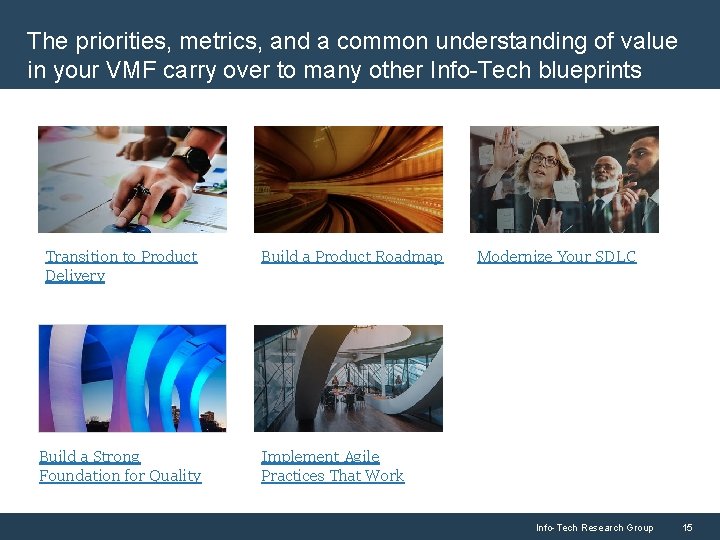
The priorities, metrics, and a common understanding of value in your VMF carry over to many other Info-Tech blueprints Transition to Product Delivery Build a Strong Foundation for Quality Build a Product Roadmap Modernize Your SDLC Implement Agile Practices That Work Info-Tech Research Group 15
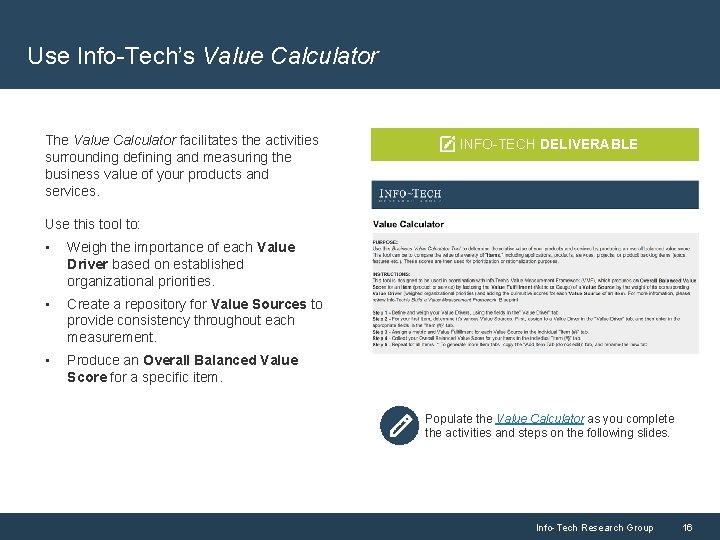
Use Info-Tech’s Value Calculator The Value Calculator facilitates the activities surrounding defining and measuring the business value of your products and services. INFO-TECH DELIVERABLE Use this tool to: • Weigh the importance of each Value Driver based on established organizational priorities. • Create a repository for Value Sources to provide consistency throughout each measurement. • Produce an Overall Balanced Value Score for a specific item. Populate the Value Calculator as you complete the activities and steps on the following slides. Info-Tech Research Group 16
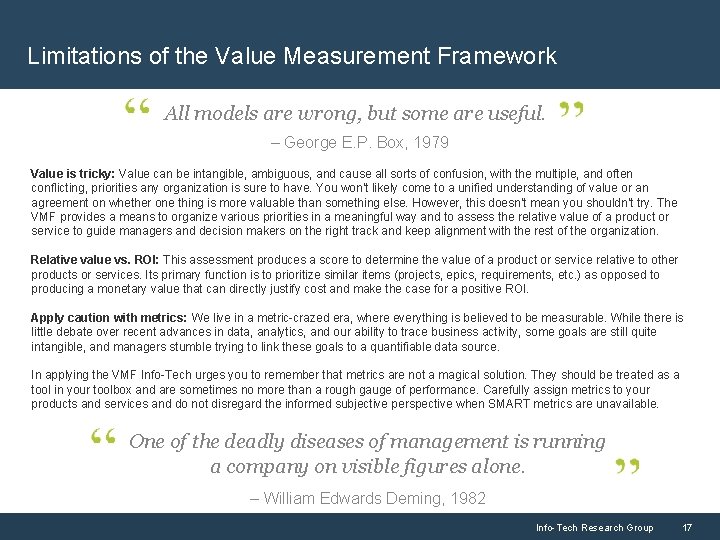
Limitations of the Value Measurement Framework All models are wrong, but some are useful. – George E. P. Box, 1979 Value is tricky: Value can be intangible, ambiguous, and cause all sorts of confusion, with the multiple, and often conflicting, priorities any organization is sure to have. You won’t likely come to a unified understanding of value or an agreement on whether one thing is more valuable than something else. However, this doesn’t mean you shouldn’t try. The VMF provides a means to organize various priorities in a meaningful way and to assess the relative value of a product or service to guide managers and decision makers on the right track and keep alignment with the rest of the organization. Relative value vs. ROI: This assessment produces a score to determine the value of a product or service relative to other products or services. Its primary function is to prioritize similar items (projects, epics, requirements, etc. ) as opposed to producing a monetary value that can directly justify cost and make the case for a positive ROI. Apply caution with metrics: We live in a metric-crazed era, where everything is believed to be measurable. While there is little debate over recent advances in data, analytics, and our ability to trace business activity, some goals are still quite intangible, and managers stumble trying to link these goals to a quantifiable data source. In applying the VMF Info-Tech urges you to remember that metrics are not a magical solution. They should be treated as a tool in your toolbox and are sometimes no more than a rough gauge of performance. Carefully assign metrics to your products and services and do not disregard the informed subjective perspective when SMART metrics are unavailable. One of the deadly diseases of management is running a company on visible figures alone. – William Edwards Deming, 1982 Info-Tech Research Group 17
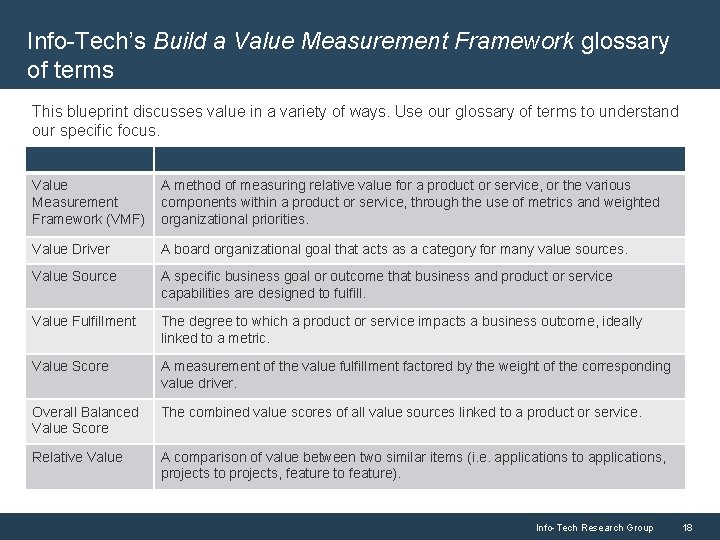
Info-Tech’s Build a Value Measurement Framework glossary of terms This blueprint discusses value in a variety of ways. Use our glossary of terms to understand our specific focus. Value Measurement Framework (VMF) A method of measuring relative value for a product or service, or the various components within a product or service, through the use of metrics and weighted organizational priorities. Value Driver A board organizational goal that acts as a category for many value sources. Value Source A specific business goal or outcome that business and product or service capabilities are designed to fulfill. Value Fulfillment The degree to which a product or service impacts a business outcome, ideally linked to a metric. Value Score A measurement of the value fulfillment factored by the weight of the corresponding value driver. Overall Balanced Value Score The combined value scores of all value sources linked to a product or service. Relative Value A comparison of value between two similar items (i. e. applications to applications, projects to projects, feature to feature). Info-Tech Research Group 18
Use these icons to help direct you as you navigate this research Use these icons to help guide you through each step of the blueprint and direct you to content related to the recommended activities. This icon denotes a slide where a supporting Info-Tech tool or template will help you perform the activity or step associated with the slide. Refer to the supporting tool or template to get the best results and proceed to the next step of the project. This icon denotes a slide with an associated activity. The activity can be performed either as part of your project or with the support of Info-Tech team members, who will come onsite to facilitate a workshop for your organization. Info-Tech Research Group 19
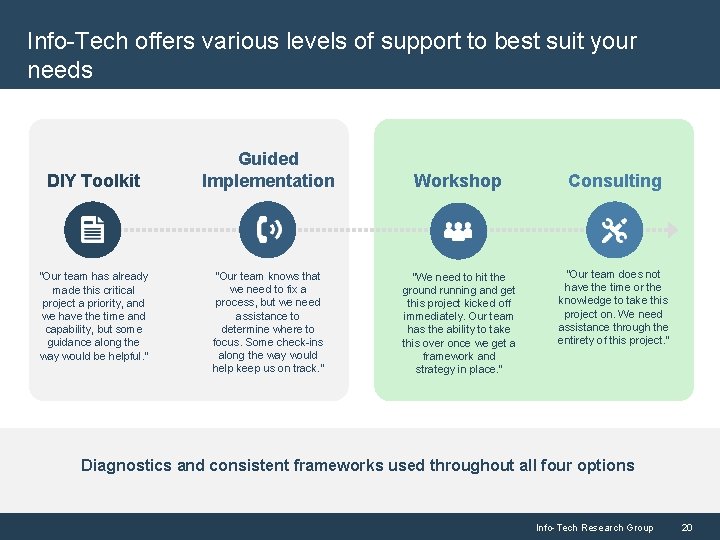
Info-Tech offers various levels of support to best suit your needs DIY Toolkit “Our team has already made this critical project a priority, and we have the time and capability, but some guidance along the way would be helpful. ” Guided Implementation Workshop Consulting “Our team knows that we need to fix a process, but we need assistance to determine where to focus. Some check-ins along the way would help keep us on track. ” “We need to hit the ground running and get this project kicked off immediately. Our team has the ability to take this over once we get a framework and strategy in place. ” “Our team does not have the time or the knowledge to take this project on. We need assistance through the entirety of this project. ” Diagnostics and consistent frameworks used throughout all four options Info-Tech Research Group 20
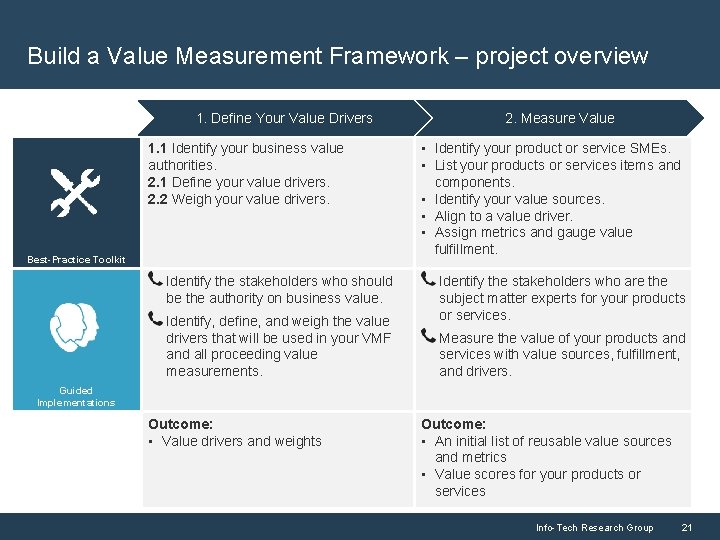
Build a Value Measurement Framework – project overview 1. Define Your Value Drivers 1. 1 Identify your business value authorities. 2. 1 Define your value drivers. 2. 2 Weigh your value drivers. Best-Practice Toolkit Identify the stakeholders who should be the authority on business value. Identify, define, and weigh the value drivers that will be used in your VMF and all proceeding value measurements. 2. Measure Value • Identify your product or service SMEs. • List your products or services items and components. • Identify your value sources. • Align to a value driver. • Assign metrics and gauge value fulfillment. Identify the stakeholders who are the subject matter experts for your products or services. Measure the value of your products and services with value sources, fulfillment, and drivers. Guided Implementations Outcome: • Value drivers and weights Outcome: • An initial list of reusable value sources and metrics • Value scores for your products or services Info-Tech Research Group 21
- Slides: 21