
Build a Strategic Workforce Plan Have the right
Build a Strategic Workforce Plan Have the right people, in the right place, at the right time. Info-Tech Research Group, Inc. is a global leader in providing IT research and advice. Info-Tech’s products and services combine actionable insight and relevant advice with Info-Tech's products and services combine actionable insight advice ready-to-use tools and templates that cover theand fullrelevant spectrum of IT with concerns. and templates that cover the full spectrum©of 1997 -2015 IT concerns. © 1997 -Research 2015 Info-Tech Group Research Inc. Info-Tech Research Group 1
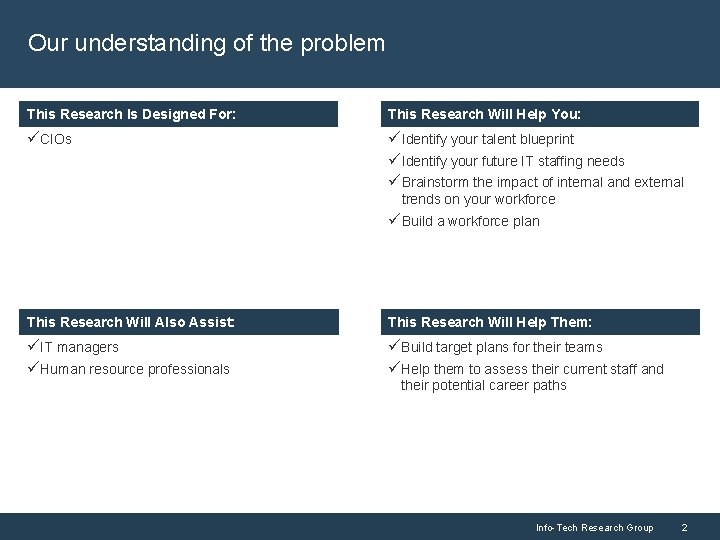
Our understanding of the problem This Research is Is Designed For: This Research Will Help You: üCIOs üIdentify your talent blueprint üIdentify your future IT staffing needs üBrainstorm the impact of internal and external trends on your workforce üBuild a workforce plan This Research Will Also Assist: This Research Will Help You: Them: üIT managers üHuman resource professionals üBuild target plans for their teams üHelp them to assess their current staff and their potential career paths Info-Tech Research Group 2
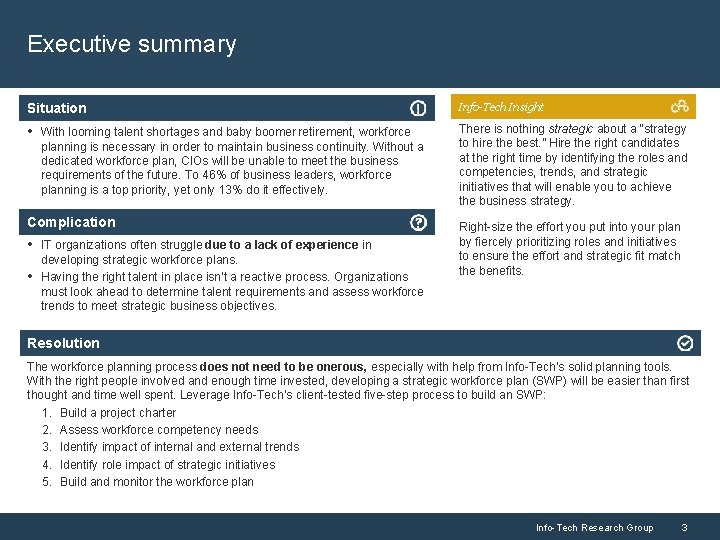
Executive summary Situation Info-Tech Insight • With looming talent shortages and baby boomer retirement, workforce There is nothing strategic about a “strategy to hire the best. ” Hire the right candidates at the right time by identifying the roles and competencies, trends, and strategic initiatives that will enable you to achieve the business strategy. planning is necessary in order to maintain business continuity. Without a dedicated workforce plan, CIOs will be unable to meet the business requirements of the future. To 46% of business leaders, workforce planning is a top priority, yet only 13% do it effectively. Complication • IT organizations often struggle due to a lack of experience in • developing strategic workforce plans. Having the right talent in place isn’t a reactive process. Organizations must look ahead to determine talent requirements and assess workforce trends to meet strategic business objectives. Right-size the effort you put into your plan by fiercely prioritizing roles and initiatives to ensure the effort and strategic fit match the benefits. Resolution The workforce planning process does not need to be onerous, especially with help from Info-Tech’s solid planning tools. With the right people involved and enough time invested, developing a strategic workforce plan (SWP) will be easier than first thought and time well spent. Leverage Info-Tech’s client-tested five-step process to build an SWP: 1. Build a project charter 2. Assess workforce competency needs 3. Identify impact of internal and external trends 4. Identify role impact of strategic initiatives 5. Build and monitor the workforce plan Info-Tech Research Group 3
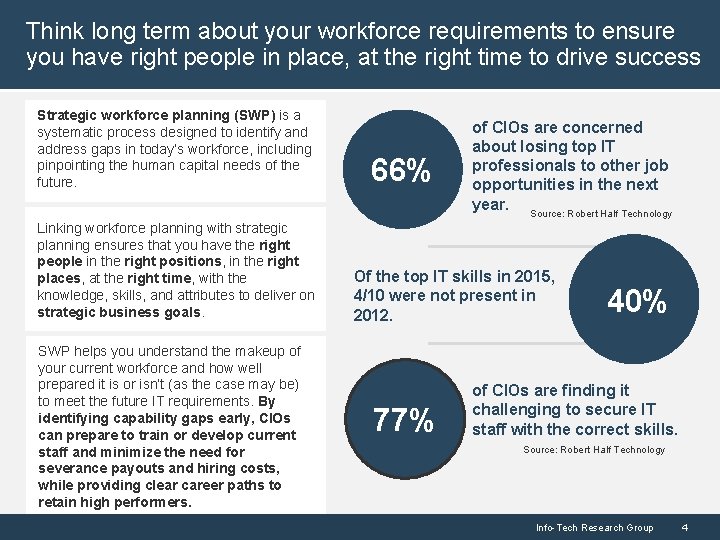
Think long term about your workforce requirements to ensure you have right people in place, at the right time to drive success Strategic workforce planning (SWP) is a systematic process designed to identify and address gaps in today’s workforce, including pinpointing the human capital needs of the future. Linking workforce planning with strategic planning ensures that you have the right people in the right positions, in the right places, at the right time, with the knowledge, skills, and attributes to deliver on strategic business goals. SWP helps you understand the makeup of your current workforce and how well prepared it is or isn’t (as the case may be) to meet the future IT requirements. By identifying capability gaps early, CIOs can prepare to train or develop current staff and minimize the need for severance payouts and hiring costs, while providing clear career paths to retain high performers. 66% of CIOs are concerned about losing top IT professionals to other job opportunities in the next year. Source: Robert Half Technology Of the top IT skills in 2015, 4/10 were not present in 2012. 77% 40% of CIOs are finding it challenging to secure IT staff with the correct skills. Source: Robert Half Technology Info-Tech Research Group 4
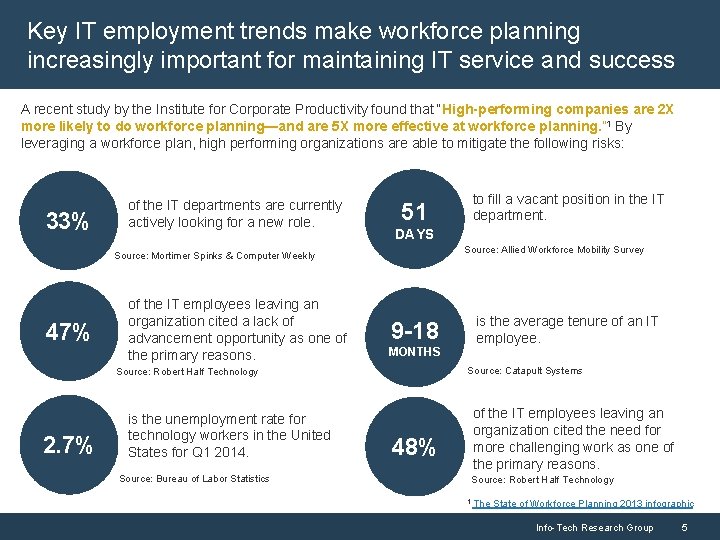
Key IT employment trends make workforce planning increasingly important for maintaining IT service and success A recent study by the Institute for Corporate Productivity found that “High-performing companies are 2 X more likely to do workforce planning—and are 5 X more effective at workforce planning. ” 1 By leveraging a workforce plan, high performing organizations are able to mitigate the following risks: 33% of the IT departments are currently actively looking for a new role. 51 DAYS Source: Allied Workforce Mobility Survey Source: Mortimer Spinks & Computer Weekly 47% of the IT employees leaving an organization cited a lack of advancement opportunity as one of the primary reasons. 9 -18 MONTHS 2. 7% Source: Bureau of Labor Statistics is the average tenure of an IT employee. Source: Catapult Systems Source: Robert Half Technology is the unemployment rate for technology workers in the United States for Q 1 2014. to fill a vacant position in the IT department. 48% of the IT employees leaving an organization cited the need for more challenging work as one of the primary reasons. Source: Robert Half Technology 1 The State of Workforce Planning 2013 infographic Info-Tech Research Group 5
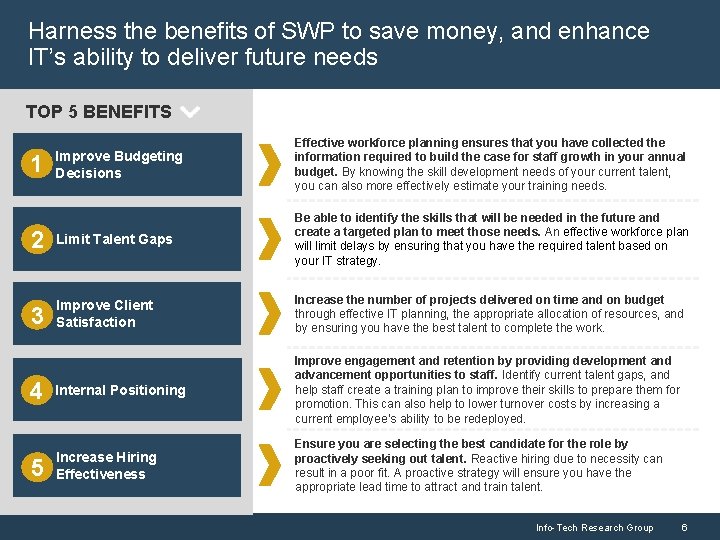
Harness the benefits of SWP to save money, and enhance IT’s ability to deliver future needs TOP 5 BENEFITS Improve Budgeting Decisions Effective workforce planning ensures that you have collected the information required to build the case for staff growth in your annual budget. By knowing the skill development needs of your current talent, you can also more effectively estimate your training needs. 2 Limit Talent Gaps Be able to identify the skills that will be needed in the future and create a targeted plan to meet those needs. An effective workforce plan will limit delays by ensuring that you have the required talent based on your IT strategy. 3 Improve Client Satisfaction Increase the number of projects delivered on time and on budget through effective IT planning, the appropriate allocation of resources, and by ensuring you have the best talent to complete the work. 4 Internal Positioning Improve engagement and retention by providing development and advancement opportunities to staff. Identify current talent gaps, and help staff create a training plan to improve their skills to prepare them for promotion. This can also help to lower turnover costs by increasing a current employee’s ability to be redeployed. 5 Increase Hiring Effectiveness Ensure you are selecting the best candidate for the role by proactively seeking out talent. Reactive hiring due to necessity can result in a poor fit. A proactive strategy will ensure you have the appropriate lead time to attract and train talent. 1 Info-Tech Research Group 6
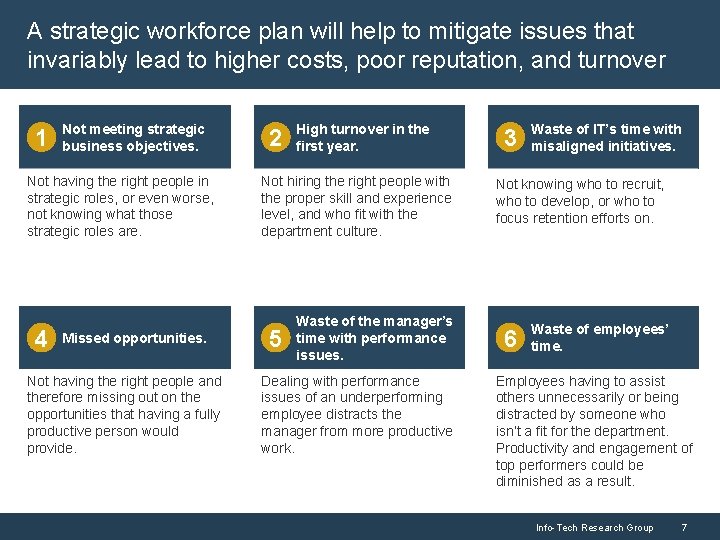
A strategic workforce plan will help to mitigate issues that invariably lead to higher costs, poor reputation, and turnover 1 Not meeting strategic business objectives. Not having the right people in strategic roles, or even worse, not knowing what those strategic roles are. 4 Missed opportunities. Not having the right people and therefore missing out on the opportunities that having a fully productive person would provide. 2 High turnover in the first year. Not hiring the right people with the proper skill and experience level, and who fit with the department culture. 5 Waste of the manager’s time with performance issues. Dealing with performance issues of an underperforming employee distracts the manager from more productive work. 3 Waste of IT’s time with misaligned initiatives. Not knowing who to recruit, who to develop, or who to focus retention efforts on. 6 Waste of employees’ time. Employees having to assist others unnecessarily or being distracted by someone who isn’t a fit for the department. Productivity and engagement of top performers could be diminished as a result. Info-Tech Research Group 7
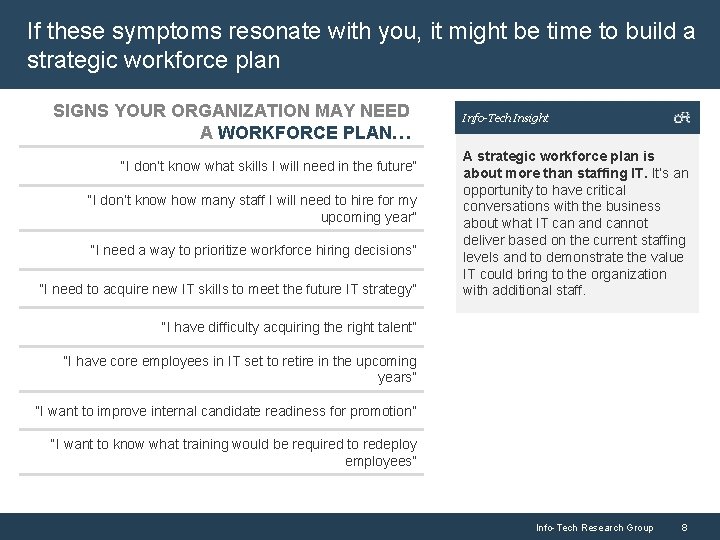
If these symptoms resonate with you, it might be time to build a strategic workforce plan SIGNS YOUR ORGANIZATION MAY NEED A WORKFORCE PLAN… “I don’t know what skills I will need in the future” “I don’t know how many staff I will need to hire for my upcoming year” “I need a way to prioritize workforce hiring decisions” “I need to acquire new IT skills to meet the future IT strategy” Info-Tech Insight A strategic workforce plan is about more than staffing IT. It’s an opportunity to have critical conversations with the business about what IT can and cannot deliver based on the current staffing levels and to demonstrate the value IT could bring to the organization with additional staff. “I have difficulty acquiring the right talent” “I have core employees in IT set to retire in the upcoming years” “I want to improve internal candidate readiness for promotion” “I want to know what training would be required to redeploy employees” Info-Tech Research Group 8
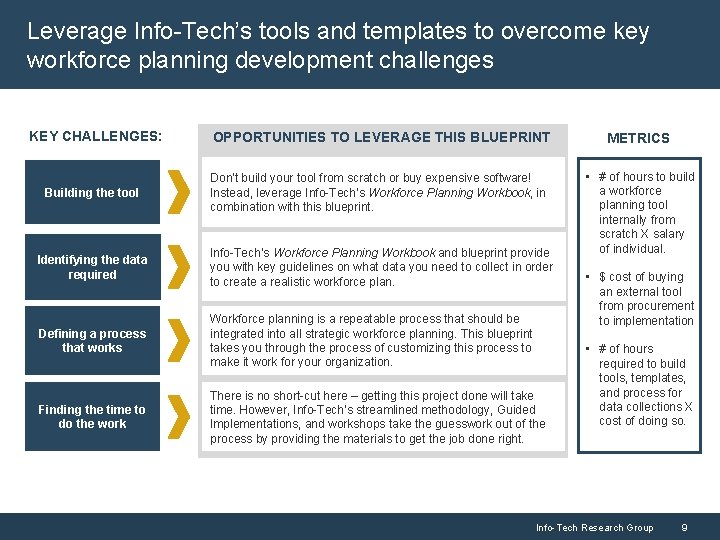
Leverage Info-Tech’s tools and templates to overcome key workforce planning development challenges KEY CHALLENGES: Building the tool OPPORTUNITIES TO LEVERAGE THIS BLUEPRINT Don’t build your tool from scratch or buy expensive software! Instead, leverage Info-Tech’s Workforce Planning Workbook, in combination with this blueprint. Identifying the data required Info-Tech’s Workforce Planning Workbook and blueprint provide you with key guidelines on what data you need to collect in order to create a realistic workforce plan. Defining a process that works Workforce planning is a repeatable process that should be integrated into all strategic workforce planning. This blueprint takes you through the process of customizing this process to make it work for your organization. Finding the time to do the work There is no short-cut here – getting this project done will take time. However, Info-Tech’s streamlined methodology, Guided Implementations, and workshops take the guesswork out of the process by providing the materials to get the job done right. METRICS • # of hours to build a workforce planning tool internally from scratch X salary of individual. • $ cost of buying an external tool from procurement to implementation • # of hours required to build tools, templates, and process for data collections X cost of doing so. Info-Tech Research Group 9
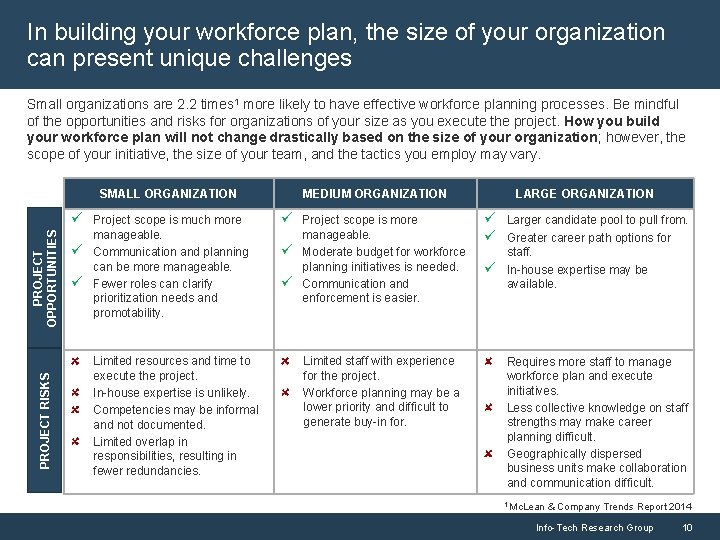
In building your workforce plan, the size of your organization can present unique challenges Small organizations are 2. 2 times 1 more likely to have effective workforce planning processes. Be mindful of the opportunities and risks for organizations of your size as you execute the project. How you build your workforce plan will not change drastically based on the size of your organization; however, the scope of your initiative, the size of your team, and the tactics you employ may vary. SMALL ORGANIZATION PROJECT RISKS PROJECT OPPORTUNITIES ü Project scope is much more ü ü manageable. Communication and planning can be more manageable. Fewer roles can clarify prioritization needs and promotability. Limited resources and time to execute the project. In-house expertise is unlikely. Competencies may be informal and not documented. Limited overlap in responsibilities, resulting in fewer redundancies. MEDIUM ORGANIZATION ü Project scope is more ü ü manageable. Moderate budget for workforce planning initiatives is needed. Communication and enforcement is easier. Limited staff with experience for the project. Workforce planning may be a lower priority and difficult to generate buy-in for. LARGE ORGANIZATION ü Larger candidate pool to pull from. ü Greater career path options for ü staff. In-house expertise may be available. Requires more staff to manage workforce plan and execute initiatives. Less collective knowledge on staff strengths may make career planning difficult. Geographically dispersed business units make collaboration and communication difficult. 1 Mc. Lean & Company Trends Report 2014 Info-Tech Research Group 10
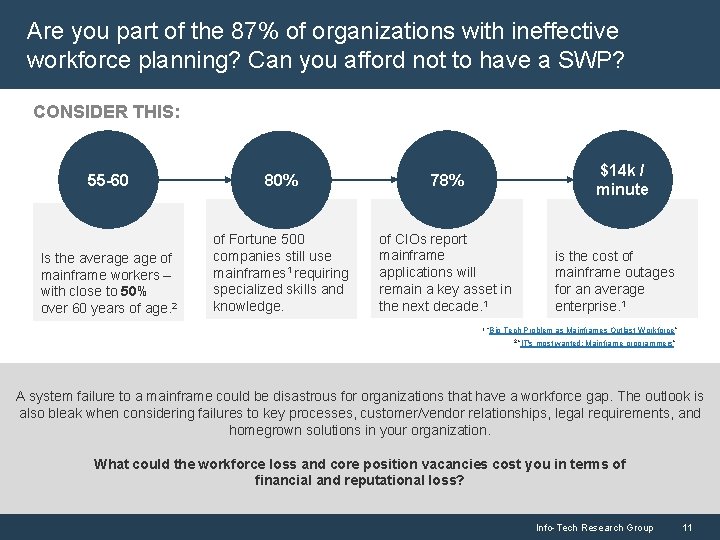
Are you part of the 87% of organizations with ineffective workforce planning? Can you afford not to have a SWP? CONSIDER THIS: $14 k / minute 55 -60 80% 78% Is the average of mainframe workers – with close to 50% over 60 years of age. 2 of Fortune 500 companies still use mainframes 1 requiring specialized skills and knowledge. of CIOs report mainframe applications will remain a key asset in the next decade. 1 1 is the cost of mainframe outages for an average enterprise. 1 “Big Tech Problem as Mainframes Outlast Workforce” 2 ”IT's most wanted: Mainframe programmers” A system failure to a mainframe could be disastrous for organizations that have a workforce gap. The outlook is also bleak when considering failures to key processes, customer/vendor relationships, legal requirements, and homegrown solutions in your organization. What could the workforce loss and core position vacancies cost you in terms of financial and reputational loss? Info-Tech Research Group 11
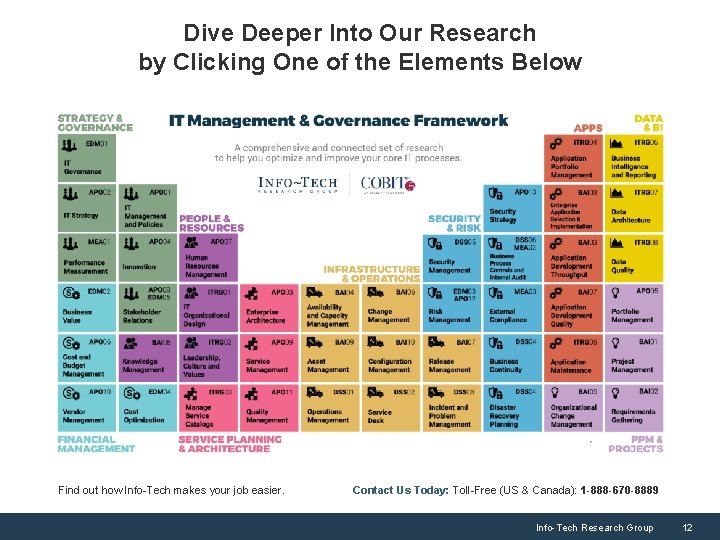
Dive Deeper Into Our Research by Clicking One of the Elements Below Find out how Info-Tech makes your job easier. Contact Us Today: Toll-Free (US & Canada): 1 -888 -670 -8889 Info-Tech Research Group 12
- Slides: 12