
BUGI Project WP 2 Curriculum modules and LLL
BUGI Project WP 2 Curriculum modules and LLL center programs development Francesco Orsini, Giuseppina Pennisi, Svenja Pokorny, Pier Giacomo Sola (UNIBO)
Objectives WP 2 includes the activities necessary for the design and implementation of new master study curriculum and LLL programs at partners HEIs.
General Description • 2 years study program with 120 ECTS (basic obligatory modules and other optional modules for specialization) of which 60 ECTS will be for real life experience and thesis preparation • New study contents to be defined accordingly to the reports delivered in WP 1
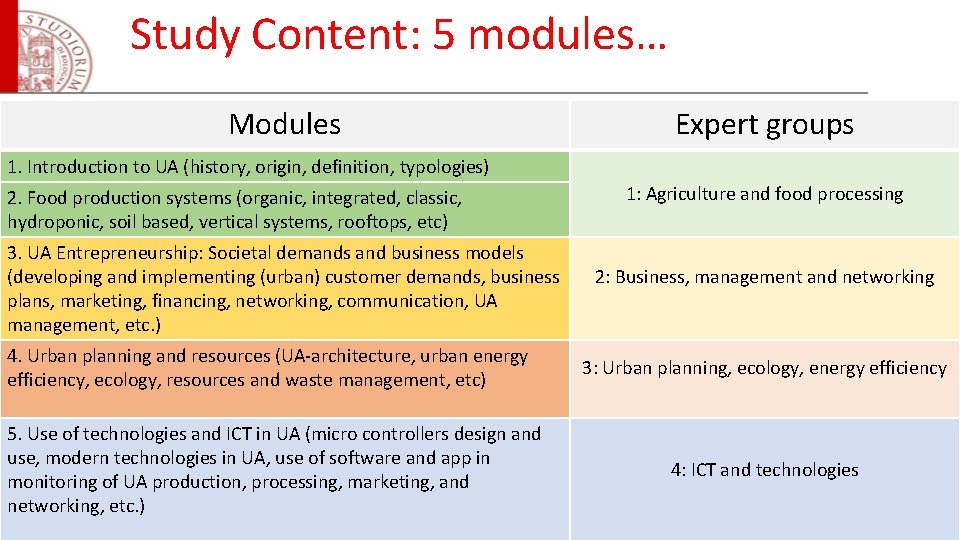
Study Content: 5 modules… Modules Expert groups 1. Introduction to UA (history, origin, definition, typologies) 2. Food production systems (organic, integrated, classic, hydroponic, soil based, vertical systems, rooftops, etc) 3. UA Entrepreneurship: Societal demands and business models (developing and implementing (urban) customer demands, business plans, marketing, financing, networking, communication, UA management, etc. ) 4. Urban planning and resources (UA-architecture, urban energy efficiency, ecology, resources and waste management, etc) 5. Use of technologies and ICT in UA (micro controllers design and use, modern technologies in UA, use of software and app in monitoring of UA production, processing, marketing, and networking, etc. ) 1: Agriculture and food processing 2: Business, management and networking 3: Urban planning, ecology, energy efficiency 4: ICT and technologies
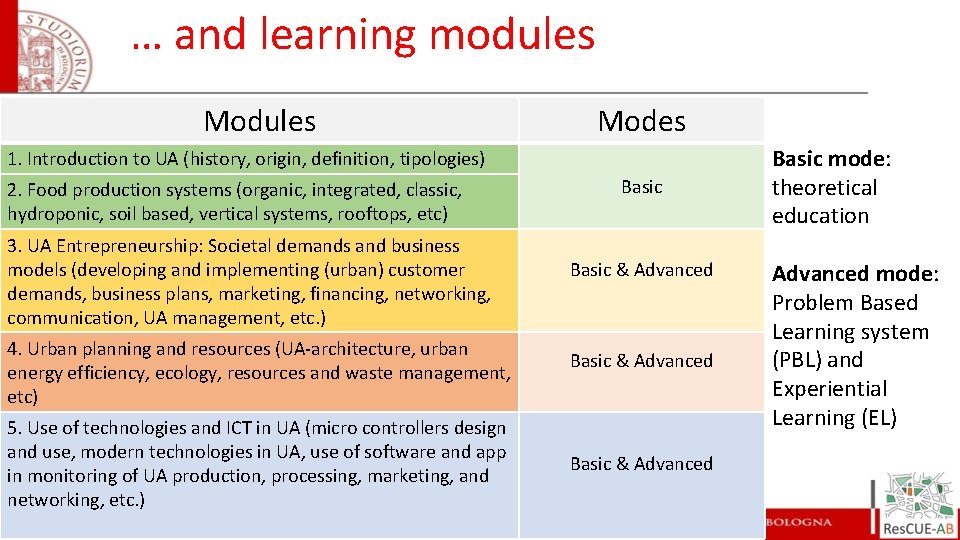
… and learning modules Modes 1. Introduction to UA (history, origin, definition, tipologies) 2. Food production systems (organic, integrated, classic, hydroponic, soil based, vertical systems, rooftops, etc) 3. UA Entrepreneurship: Societal demands and business models (developing and implementing (urban) customer demands, business plans, marketing, financing, networking, communication, UA management, etc. ) 4. Urban planning and resources (UA-architecture, urban energy efficiency, ecology, resources and waste management, etc) 5. Use of technologies and ICT in UA (micro controllers design and use, modern technologies in UA, use of software and app in monitoring of UA production, processing, marketing, and networking, etc. ) Basic & Advanced Basic mode: theoretical education Advanced mode: Problem Based Learning system (PBL) and Experiential Learning (EL)
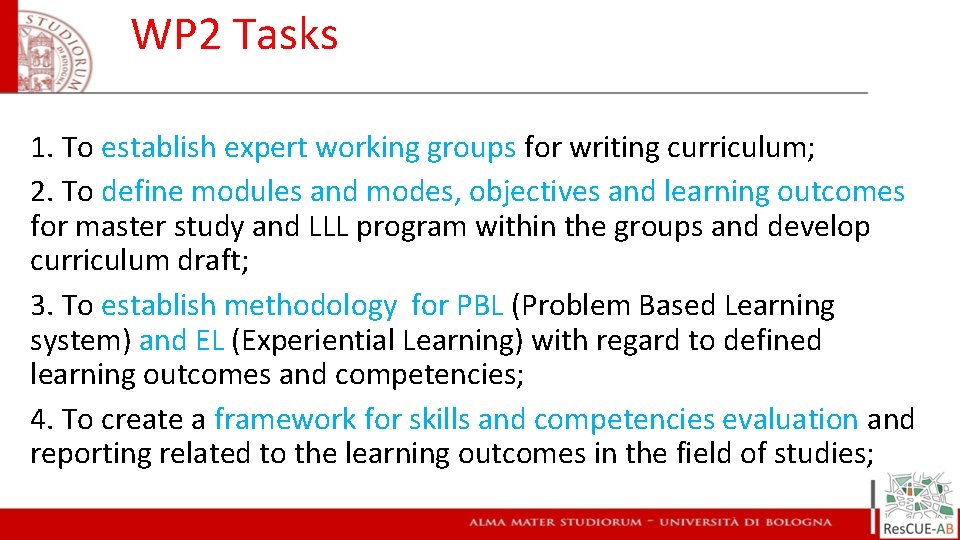
WP 2 Tasks 1. To establish expert working groups for writing curriculum; 2. To define modules and modes, objectives and learning outcomes for master study and LLL program within the groups and develop curriculum draft; 3. To establish methodology for PBL (Problem Based Learning system) and EL (Experiential Learning) with regard to defined learning outcomes and competencies; 4. To create a framework for skills and competencies evaluation and reporting related to the learning outcomes in the field of studies;
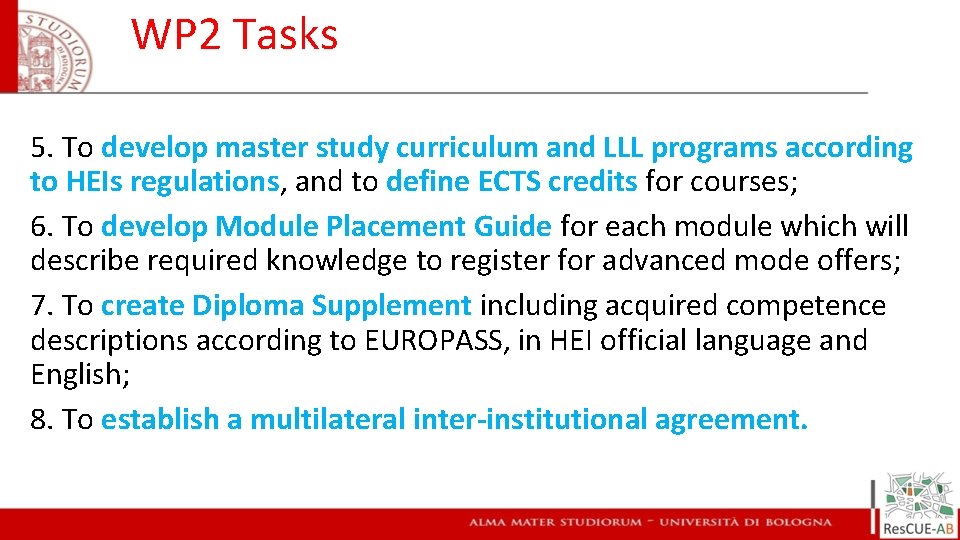
WP 2 Tasks 5. To develop master study curriculum and LLL programs according to HEIs regulations, and to define ECTS credits for courses; 6. To develop Module Placement Guide for each module which will describe required knowledge to register for advanced mode offers; 7. To create Diploma Supplement including acquired competence descriptions according to EUROPASS, in HEI official language and English; 8. To establish a multilateral inter-institutional agreement.
D 2. 1 – Curriculum Draft 1 common curriculum draft, including courses and modes within modules, describing the study contents. Modules meet objectives and priorities for each country’s needs based on results of WP 1 Proposal for a some module courses to be offered for distance and blended learning programs Language: English Status: Complete
D 2. 2 – Learning projects design guide Framework for design of PBL and EL in specific learning projects targeting desired learning outcomes within the modules. A guide that assures applicability for each module. The guide enables teachers to implement PBL and EL scenarios with the possibility to evaluate students’ performance. It gives flexibility in designing PBL and EL topics for requested key competences and skills. Languages: English, Partner languages Status: English version complete
D 2. 3 – Skills and competence evaluation guide A competence inventory with links to the skills. Reference systems for learning outcomes and the level of competence It defines methodology used to evaluate, describe and document skills and competences. Self-evaluation and teachers reports will be put in students’ electronic index, to monitor progress and describe competences in Diploma Supplement Languages: English, Partner languages Status: English version complete
D 2. 4 – Master study and LLL program elaborate New curriculums and LLL programs. WB HEIs elaboration + revision by UNIBO, SWUAS and Lubiana). WB HEIs select modules and modes (basic/advance) according to national and HEI strategies. WB HEIs will try to develop the same curriculum content and structure according to national regulations. WB HEIs define ECTS credits for common modules and courses. Languages: English, Partner languages Due date: 1 May 2019 - in Prishtina partners agreed to issue a first draft on 1 March, to be approved on 1 May, and a second step on 1 August to be approved by 1 October.
D 2. 5 – Module Placement Guide assess student’s current readiness to register for advance mode courses within the modules. Registration procedure will be transparent and well organized. Interdisciplinary nature of curriculum is nourished, while international teaching staff can plan learning projects targeting specific skills/outcomes, including cross-cultural communication skills. Languages: English, Partner languages Status: Complete
D 2. 6 – Diploma Supplement A standardized description of nature, level, context, content and status of the studies for WB HEIs. It describes acquired competencies according to the EUROPASS cluster: social and organizational competences described in the field of study. The DS will enrich formalized ECTS system providing students with the evidence of their potential regarding the selected key competence. Languages: English, Partner languages Status: Complete
D 2. 7 – Multilateral inter-institutional agreement WB HEIs will sign inter-institutional agreement. They will work on common ECTS credits design and transfer system thus allowing credit mobility, virtual and physical students and staff mobility. Virtual mobility will be enhanced since partner HEIs will develop common UA Distance learning platform for distance and blended learning. Languages: Partner languages Due date: 1 November 2018 In Prishtina partners agreed that on 15 December draft has to be ready, to be revised by 31 January 2019.
Many thanks for your attention
- Slides: 15