
Bug Repellant Friend or Foe Jaclyn Gilman Chemistry
Bug Repellant: Friend or Foe? Jaclyn Gilman Chemistry 112 December 15, 2001
A good repellant should be: § § Nontoxic Nonirritant Non-allergenic Harmless to clothing § Have a nonoffensive odor § Easily applied § Effective against multiple insects § Offer protection for several hours under variable weather conditions
What is DEET? § Chemical Name: diethyl-meta-toluamide § 1954 - United States Army § 1957 -Registered for use by the general public § Consumers buy about $100 million worth of products that contain DEET
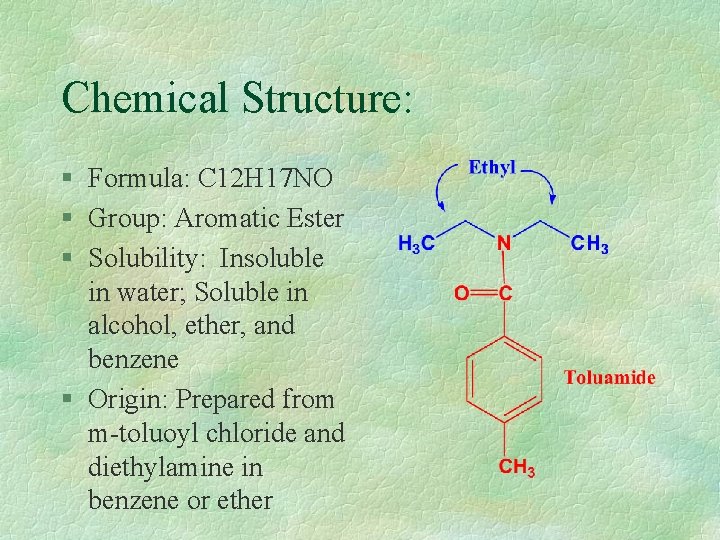
Chemical Structure: § Formula: C 12 H 17 NO § Group: Aromatic Ester § Solubility: Insoluble in water; Soluble in alcohol, ether, and benzene § Origin: Prepared from m-toluoyl chloride and diethylamine in benzene or ether

How Does DEET Work? § May make skin repugnant to a bug § DEET can jam the cells in the insects antennas that are sensitive to lactic acid

Advantages to DEET: § DEET offers hours of protection § Not greasy § Dries rapidly § Resistant to being washed off

Disadvantages to DEET: § Can cause toxic effects § 56% penetrates intact human skin § 17% absorbed into bloodstream § Children are most vulnerable to accidental misapplication
Harmful side effects of DEET: § § § § Rash Swelling Itching Eye-irritation Slurred Speech Confusion Seizures § § § § Headaches Disorientation Agitation Anxiety Behavioral Changes Abnormal movements Lethargy Coma
Precautions: § Avoid application under clothing § Avoid application near the eyes or mouth § Do not use on cuts, irritated skin, or on people with chronic skin condition § Wash treated skin and clothing § Use sparingly on children in concentrations of no more than 10% and 34% for adults

Other Alternatives: § All Natural Repellants such as Buzz Away, Nutrapel, and Avon’s Skin-so-Soft § Skeeter-Defense Patch
- Slides: 10