
Buffer Solution Presentation Why do we need a

Buffer Solution Presentation.

Why do we need a buffer? § If we added 0. 060 mol of Na. OH to 1. 00 L of pure water the change in p. H would be from 7. 00 to 12. 78 § p. H of 0. 060 M Na. OH [OH–] = 0. 060 M p. OH = –log(0. 060) = 1. 22 p. H = 14. 00 – 1. 22 = 12. 78 p. H = 12. 78 – 7. 00 = 5. 78 § An enormous difference! § Buffers prevent wide swings in p. H unless a huge excess of strong acid or base are added Jespersen/Hyslop, Chemistry 7 E, Copyright © 2015 John Wiley & Sons, Inc. All Rights Reserved. 2
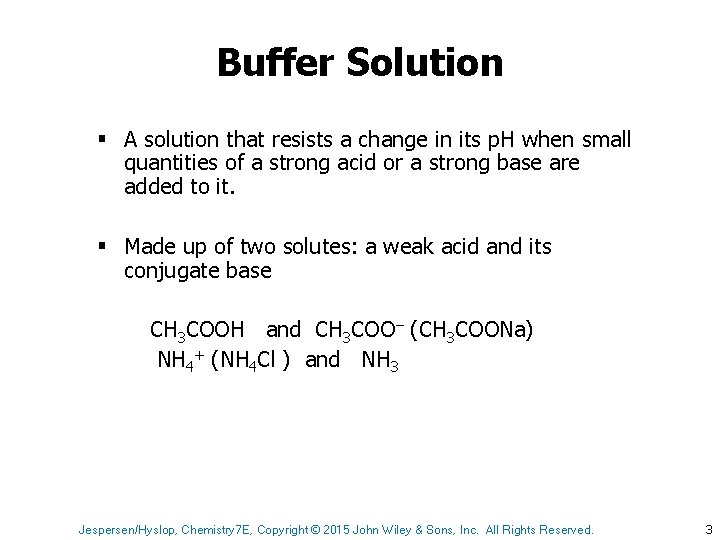
Buffer Solution § A solution that resists a change in its p. H when small quantities of a strong acid or a strong base are added to it. § Made up of two solutes: a weak acid and its conjugate base CH 3 COOH and CH 3 COO– (CH 3 COONa) NH 4+ (NH 4 Cl ) and NH 3 Jespersen/Hyslop, Chemistry 7 E, Copyright © 2015 John Wiley & Sons, Inc. All Rights Reserved. 3
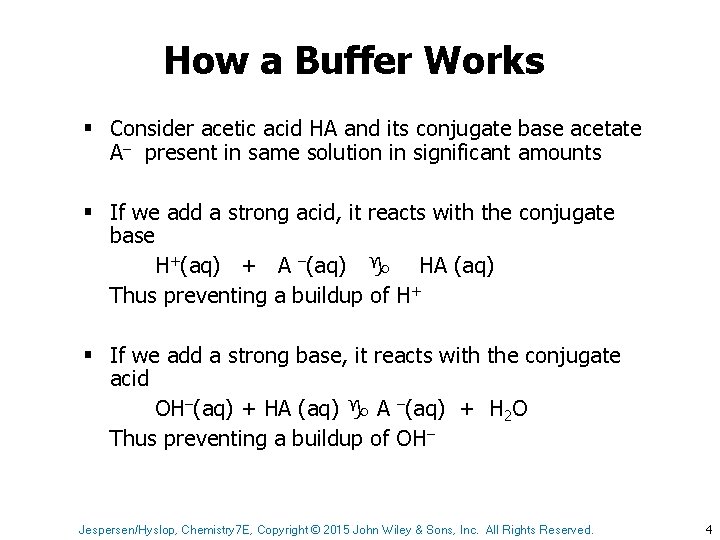
How a Buffer Works § Consider acetic acid HA and its conjugate base acetate A– present in same solution in significant amounts § If we add a strong acid, it reacts with the conjugate base H+(aq) + A –(aq) HA (aq) Thus preventing a buildup of H+ § If we add a strong base, it reacts with the conjugate acid OH–(aq) + HA (aq) A –(aq) + H 2 O Thus preventing a buildup of OH– Jespersen/Hyslop, Chemistry 7 E, Copyright © 2015 John Wiley & Sons, Inc. All Rights Reserved. 4
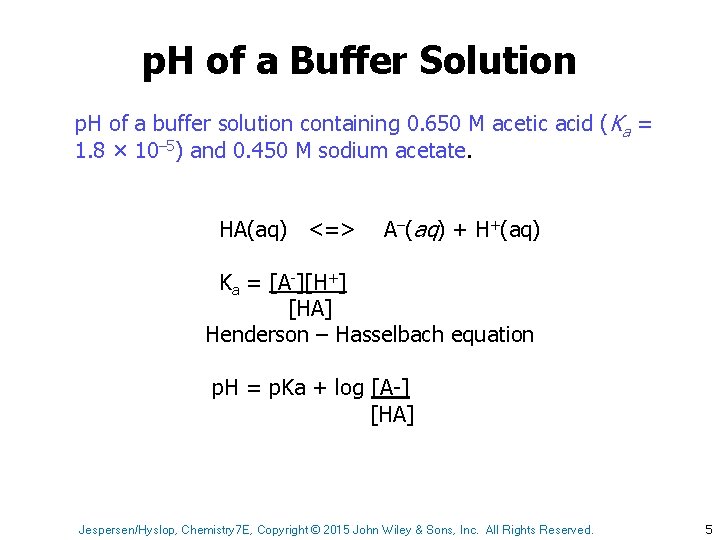
p. H of a Buffer Solution p. H of a buffer solution containing 0. 650 M acetic acid ( Ka = 1. 8 × 10– 5) and 0. 450 M sodium acetate. HA(aq) <=> A–(aq) + H+(aq) Ka = [A-][H+] [HA] Henderson – Hasselbach equation p. H = p. Ka + log [A-] [HA] Jespersen/Hyslop, Chemistry 7 E, Copyright © 2015 John Wiley & Sons, Inc. All Rights Reserved. 5
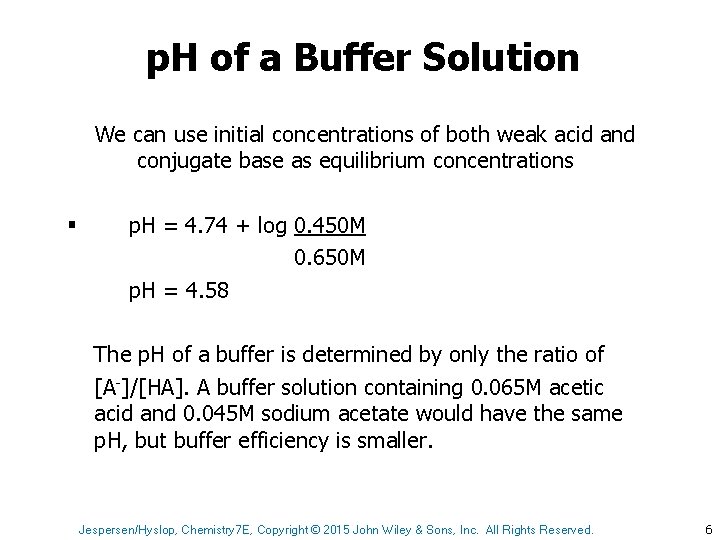
p. H of a Buffer Solution We can use initial concentrations of both weak acid and conjugate base as equilibrium concentrations § p. H = 4. 74 + log 0. 450 M 0. 650 M p. H = 4. 58 The p. H of a buffer is determined by only the ratio of [A-]/[HA]. A buffer solution containing 0. 065 M acetic acid and 0. 045 M sodium acetate would have the same p. H, but buffer efficiency is smaller. Jespersen/Hyslop, Chemistry 7 E, Copyright © 2015 John Wiley & Sons, Inc. All Rights Reserved. 6
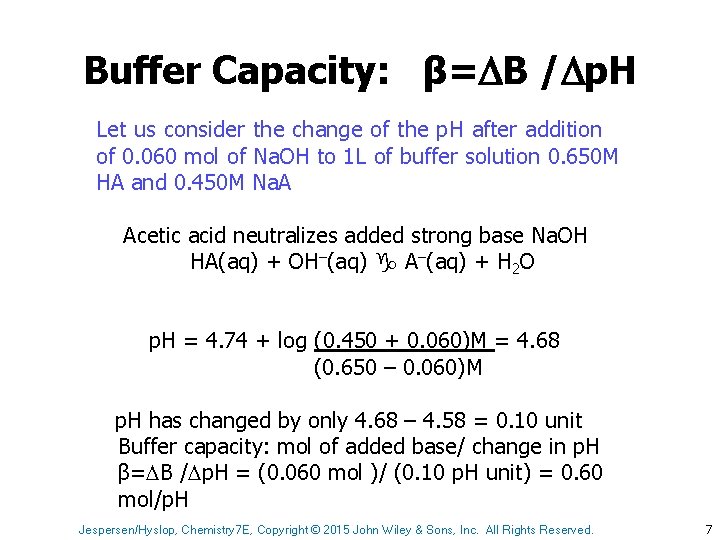
Buffer Capacity: β= B / p. H Let us consider the change of the p. H after addition of 0. 060 mol of Na. OH to 1 L of buffer solution 0. 650 M HA and 0. 450 M Na. A Acetic acid neutralizes added strong base Na. OH HA(aq) + OH–(aq) A–(aq) + H 2 O p. H = 4. 74 + log (0. 450 + 0. 060)M = 4. 68 (0. 650 – 0. 060)M p. H has changed by only 4. 68 – 4. 58 = 0. 10 unit Buffer capacity: mol of added base/ change in p. H β= B / p. H = (0. 060 mol )/ (0. 10 p. H unit) = 0. 60 mol/p. H Jespersen/Hyslop, Chemistry 7 E, Copyright © 2015 John Wiley & Sons, Inc. All Rights Reserved. 7
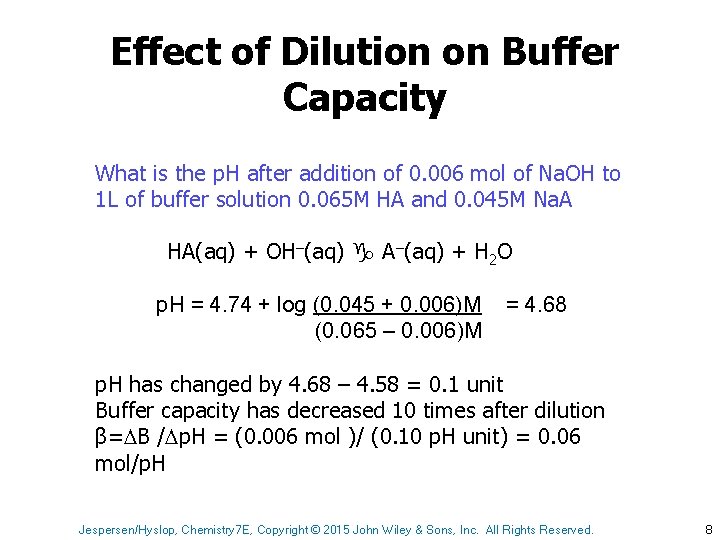
Effect of Dilution on Buffer Capacity What is the p. H after addition of 0. 006 mol of Na. OH to 1 L of buffer solution 0. 065 M HA and 0. 045 M Na. A HA(aq) + OH–(aq) A–(aq) + H 2 O p. H = 4. 74 + log (0. 045 + 0. 006)M (0. 065 – 0. 006)M = 4. 68 p. H has changed by 4. 68 – 4. 58 = 0. 1 unit Buffer capacity has decreased 10 times after dilution β= B / p. H = (0. 006 mol )/ (0. 10 p. H unit) = 0. 06 mol/p. H Jespersen/Hyslop, Chemistry 7 E, Copyright © 2015 John Wiley & Sons, Inc. All Rights Reserved. 8
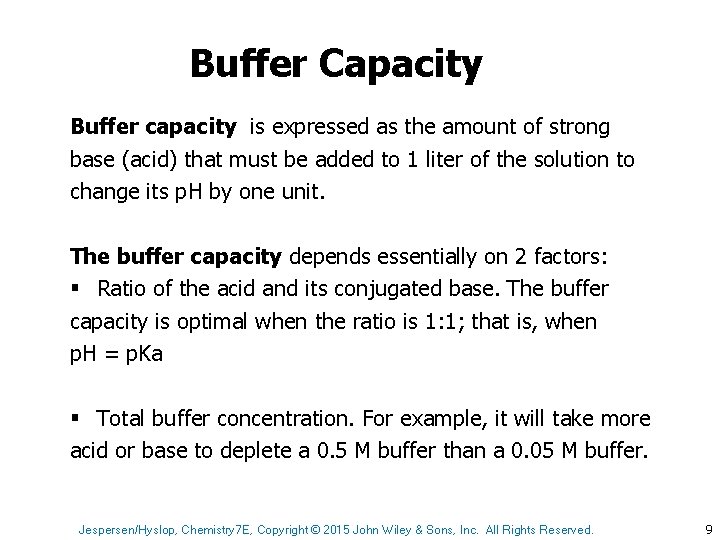
Buffer Capacity Buffer capacity is expressed as the amount of strong base (acid) that must be added to 1 liter of the solution to change its p. H by one unit. The buffer capacity depends essentially on 2 factors: § Ratio of the acid and its conjugated base. The buffer capacity is optimal when the ratio is 1: 1; that is, when p. H = p. Ka § Total buffer concentration. For example, it will take more acid or base to deplete a 0. 5 M buffer than a 0. 05 M buffer. Jespersen/Hyslop, Chemistry 7 E, Copyright © 2015 John Wiley & Sons, Inc. All Rights Reserved. 9
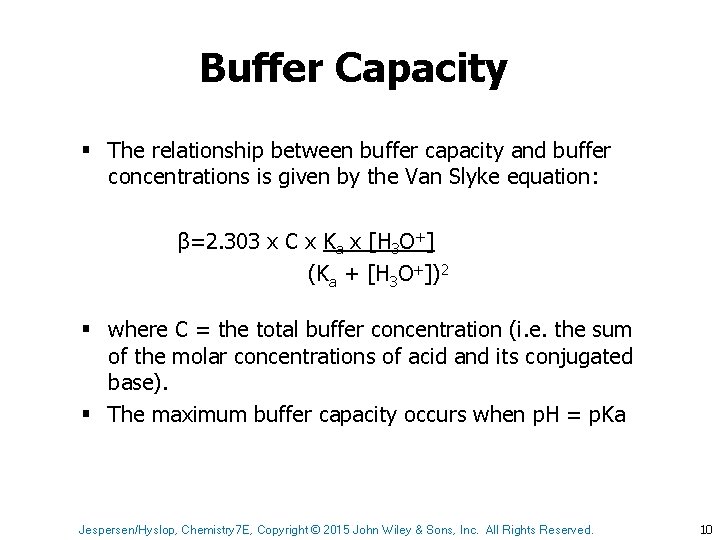
Buffer Capacity § The relationship between buffer capacity and buffer concentrations is given by the Van Slyke equation: β=2. 303 x C x Ka x [H 3 O+] (Ka + [H 3 O+])2 § where C = the total buffer concentration (i. e. the sum of the molar concentrations of acid and its conjugated base). § The maximum buffer capacity occurs when p. H = p. Ka Jespersen/Hyslop, Chemistry 7 E, Copyright © 2015 John Wiley & Sons, Inc. All Rights Reserved. 10
Effectiveness of a Buffer The buffer effectiveness refers to the maximum amount of either strong acid or strong base that can be added before a significant change in the p. H will occur. The maximum amount of base that can be added is equal to the amount of weak acid present in the buffer. The maximum amount of strong acid that can be added is equal to the amount of conjugate base present in the buffer Jespersen/Hyslop, Chemistry 7 E, Copyright © 2015 John Wiley & Sons, Inc. All Rights Reserved. 11
Importance of Buffers The concepts of buffer and buffer capacity appear in varied disciplines, including analytical chemistry, and environmental chemistry, biology, physiology, medicine, dentistry, and agriculture. For example buffer in blood: HCO 3– and H 2 CO 3 § Absorb acids and bases produced by metabolism § Maintains a remarkably constant p. H (7. 4) Jespersen/Hyslop, Chemistry 7 E, Copyright © 2015 John Wiley & Sons, Inc. All Rights Reserved. 12
Buffers Important as cells live only in a very narrow p. H range. A decrease of blood p. H is called acidosis, an increase is called alkalosis. Respiratory and metabolic disorders occur when the body’s acid-base is out of balance. One of the treatments for an acid-base imbalance involves intravenously injecting sodium lactate to restore acid balance and electrolytes to the body. Jespersen/Hyslop, Chemistry 7 E, Copyright © 2015 John Wiley & Sons, Inc. All Rights Reserved. 13

Thank you.
- Slides: 14