
Buffer Overflow Attacks Heap and Stack Memory Vulnerabilities
Buffer Overflow Attacks Heap and Stack
Memory Vulnerabilities • Memory plays a key part in many computer system functions. • It’s a critical component to many internal operations. • From mother board operations, to monitor and I/O devices. • If the software that manages these systems can be corrupted. • If could give the attacker key access to many computer functions.
Conditions for Buffer Overflows • Using unsafe C functions without any protection code. • The program does not validate the input. • The return address is adjacent to the program’s code and data. • There is a suitable program to exploit the vulnerability.
Using Unsafe Functions • Unsafe C functions are functions that do not check for bounds when copying or moving data • Will not explicitly terminate a string in memory where it should be terminated • This problem is mostly related to string and character manipulation such as gets() and strcpy(). • Programmers need to check boundaries to have effective garbage collection in code.
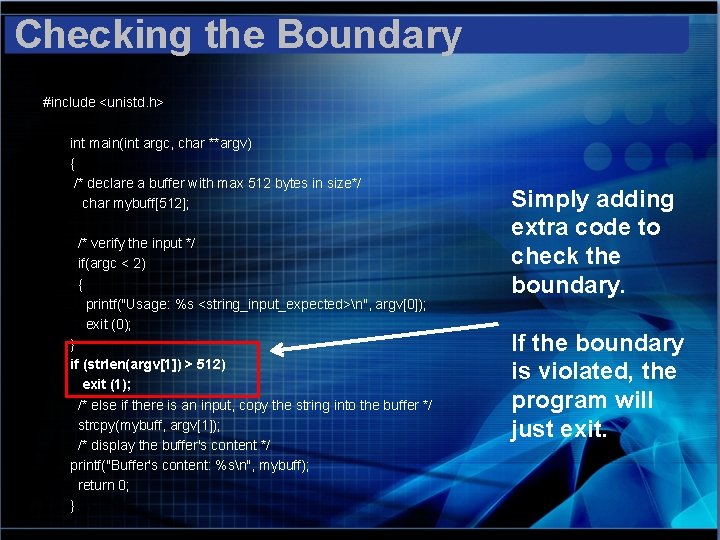
Checking the Boundary #include <unistd. h> int main(int argc, char **argv) { /* declare a buffer with max 512 bytes in size*/ char mybuff[512]; /* verify the input */ if(argc < 2) { printf("Usage: %s <string_input_expected>n", argv[0]); exit (0); } if (strlen(argv[1]) > 512) exit (1); /* else if there is an input, copy the string into the buffer */ strcpy(mybuff, argv[1]); /* display the buffer's content */ printf("Buffer's content: %sn", mybuff); return 0; } Simply adding extra code to check the boundary. If the boundary is violated, the program will just exit.
Input Validation • Input validation also can be implemented in the program to stop the buffer overflows • Problem is, not all the input combinations can be tested • Based on the types of interfaces the application will use? • Enhancing validating inputs with something like this shown on the next page.
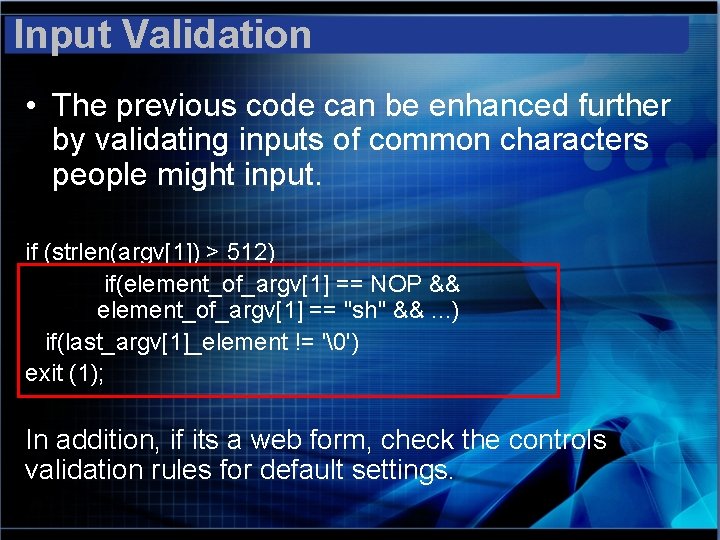
Input Validation • The previous code can be enhanced further by validating inputs of common characters people might input. if (strlen(argv[1]) > 512) if(element_of_argv[1] == NOP && element_of_argv[1] == "sh" &&. . . ) if(last_argv[1]_element != '') exit (1); In addition, if its a web form, check the controls validation rules for default settings.
Return Address Adjacent to Code and Data • Depending how you compile your code some compliers will place return address adjacent to the program’s data and code. • Moreover, based on what environment your program will run in. Unix, Window…. etc. • Each environment will have setup options that will help you stop Buffer Overflow problems. • So during the analysis phase of development, know what you can and cannot do based on the environment your program will live in.
Suitable Exploit Code Availability • Test your code for suitable exploits and have built in termination protocols. • Know what types of shell-scripts one might create to start a Buffer Overflow incident within your environment. • In addition, how might these scripts be used to overwrite return addresses? • What tools does the environment offer to protect your software, and what might you have to built into your program.
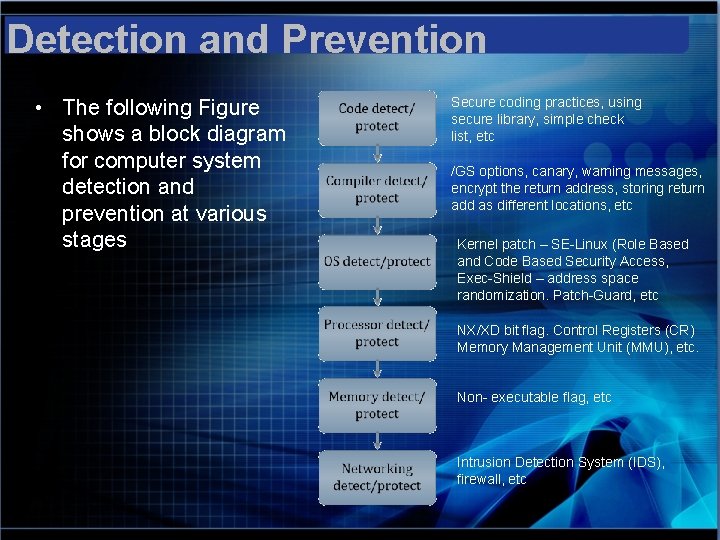
Detection and Prevention • The following Figure shows a block diagram for computer system detection and prevention at various stages Secure coding practices, using secure library, simple check list, etc /GS options, canary, warning messages, encrypt the return address, storing return add as different locations, etc Kernel patch – SE-Linux (Role Based and Code Based Security Access, Exec-Shield – address space randomization. Patch-Guard, etc NX/XD bit flag. Control Registers (CR) Memory Management Unit (MMU), etc. Non- executable flag, etc Intrusion Detection System (IDS), firewall, etc
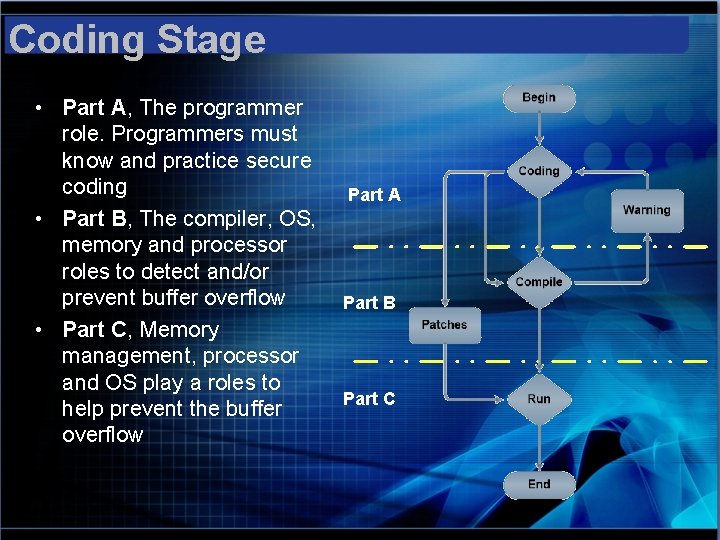
Coding Stage • Part A, The programmer role. Programmers must know and practice secure coding • Part B, The compiler, OS, memory and processor roles to detect and/or prevent buffer overflow • Part C, Memory management, processor and OS play a roles to help prevent the buffer overflow Part A Part B Part C
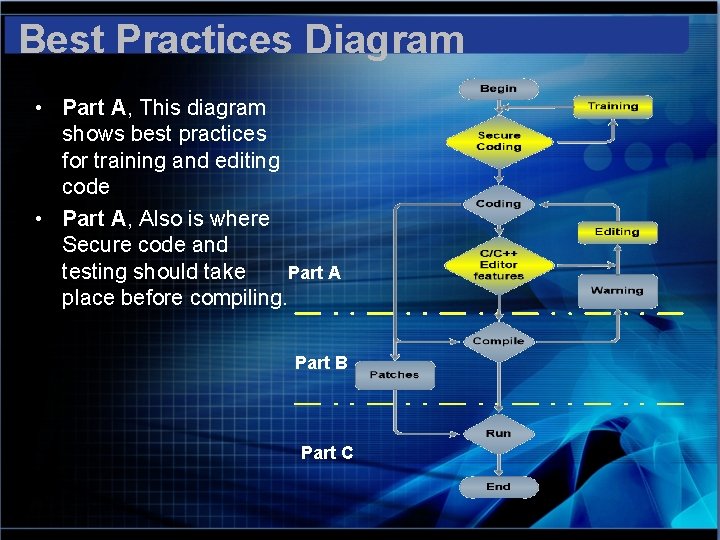
Best Practices Diagram • Part A, This diagram shows best practices for training and editing code • Part A, Also is where Secure code and testing should take Part A place before compiling. Part B Part C
Conclusion • The last diagram incorporates secure coding knowledge and enhancing the editor for best practices. • The buffer overflow vulnerability and exploit are best taught by example using unsafe C code. • Some of the newer compliers like Visual Studio have intellisense installed and will point out coding problems relating to Buffer Overflows. • Others will not have advance features like this, so training will be key for programmers.
The End
- Slides: 14