
Budgeting Public Sector Importance of developing capacity within

Budgeting – Public Sector
Importance of developing capacity within the Public Sector to improve the quality of Financial Reporting Budgets – the start of the process Presented by: Rashied Small 2
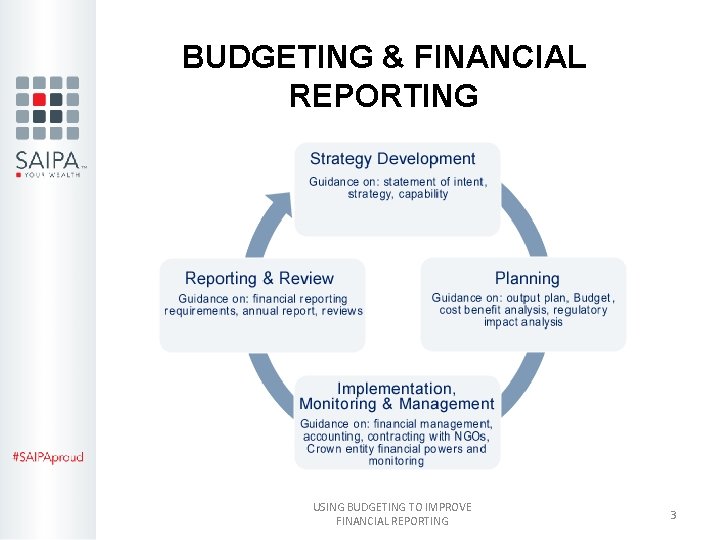
BUDGETING & FINANCIAL REPORTING USING BUDGETING TO IMPROVE FINANCIAL REPORTING 3
BUDGETING – STANDARD CONCEPT PURPOSE OF BUDGETING: § Vehicle for financial forecasting § Resource planning & allocation § Vehicle forecasting § Co-ordinating & control activities of business § Communication of management’s goals § Addressing operational conflict USING BUDGETING TO IMPROVE FINANCIAL REPORTING 4
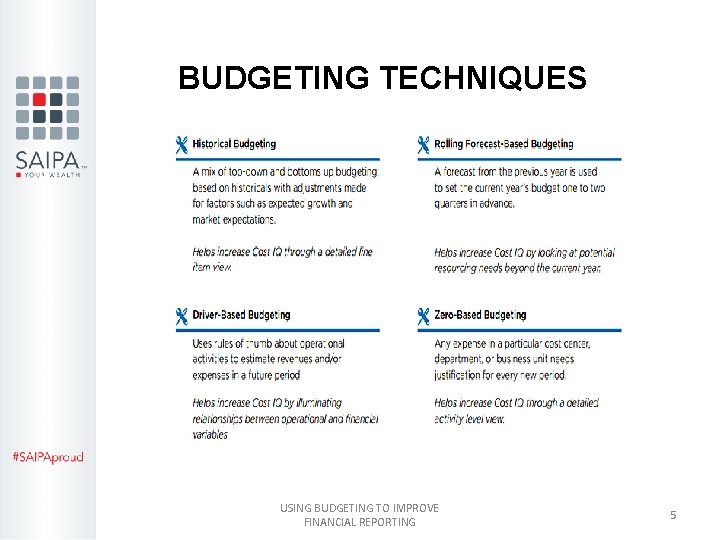
BUDGETING TECHNIQUES USING BUDGETING TO IMPROVE FINANCIAL REPORTING 5
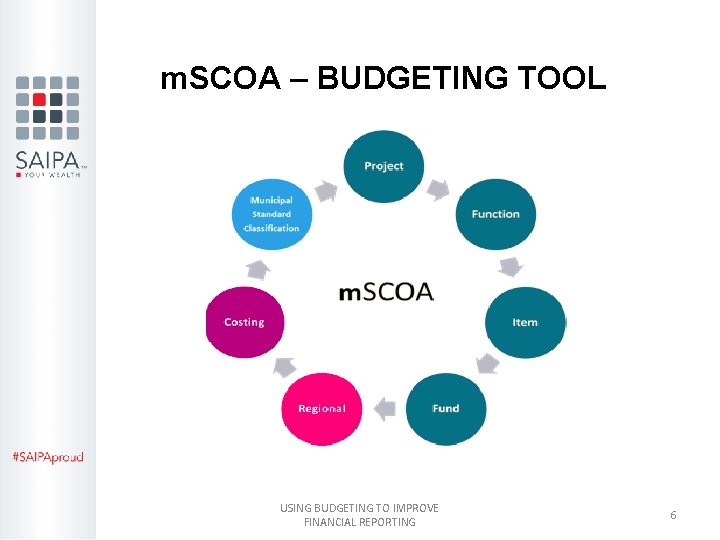
m. SCOA – BUDGETING TOOL USING BUDGETING TO IMPROVE FINANCIAL REPORTING 6
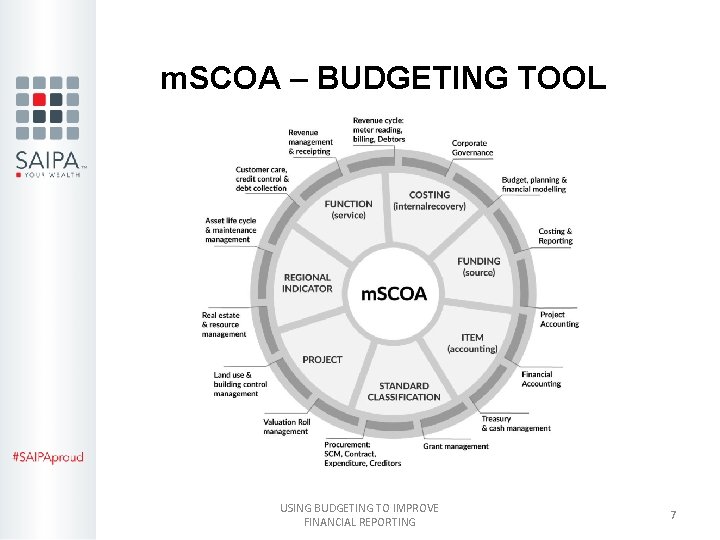
m. SCOA – BUDGETING TOOL USING BUDGETING TO IMPROVE FINANCIAL REPORTING 7
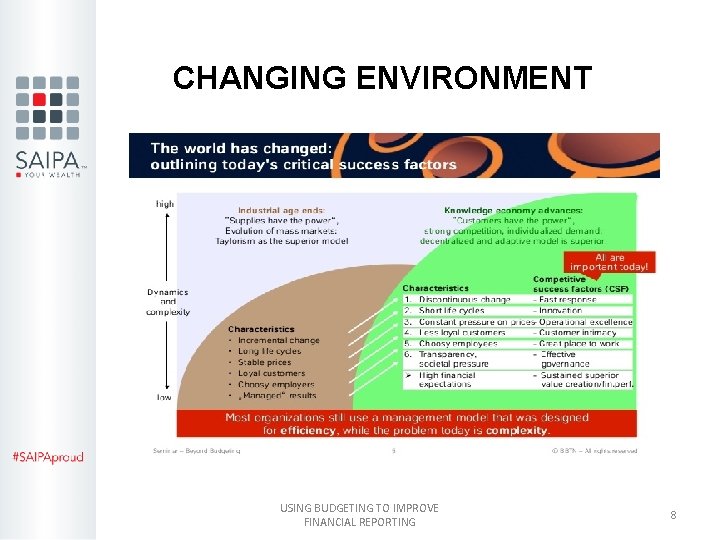
CHANGING ENVIRONMENT USING BUDGETING TO IMPROVE FINANCIAL REPORTING 8
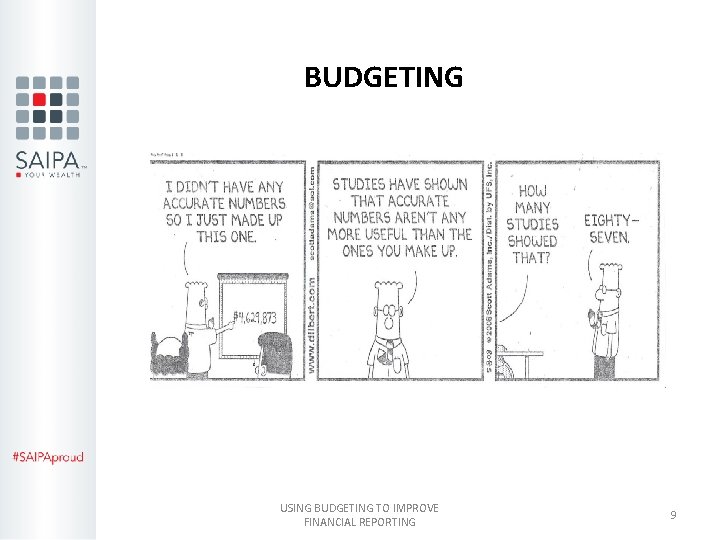
BUDGETING USING BUDGETING TO IMPROVE FINANCIAL REPORTING 9
BUDGETING § “Wrong the day after we create it” § “We’re just not really using them to manage anymore” § “Spend all your budget or you’re going to lose it” § “Cost us a million dollars to create it. . . and it was wrong” USING BUDGETING TO IMPROVE FINANCIAL REPORTING 10
BUDGETING § § § Overall dis-satisfaction of current budget process Consumes too many resources Takes to long to prepare (out of date when done) Undermines ethical foundation of organisation Illusion of control by robbing potential (Hope & Fraser 2000) However, finance management continue to believe budgets are indispensable (Rickards, 2008) USING BUDGETING TO IMPROVE FINANCIAL REPORTING 11
USING BUDGETING TO IMPROVE FINANCIAL REPORTING 12
USING BUDGETING TO IMPROVE FINANCIAL REPORTING 13
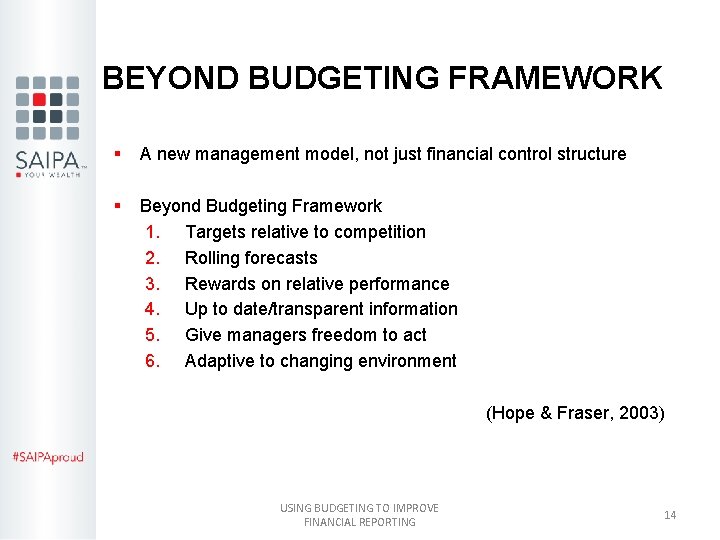
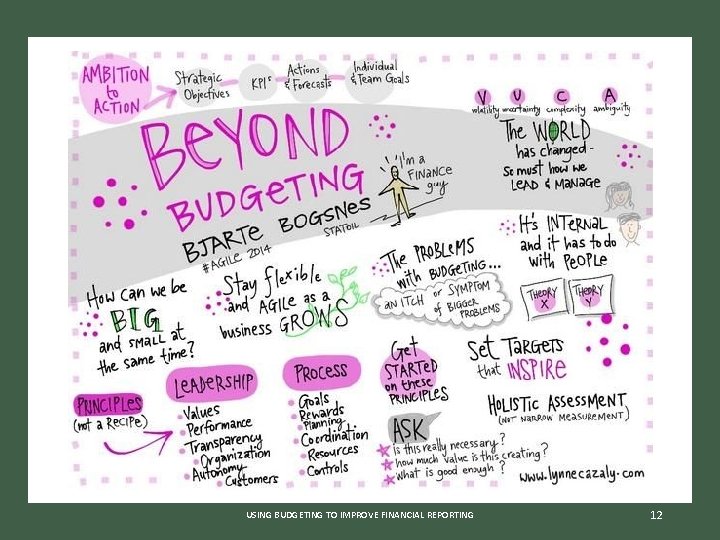
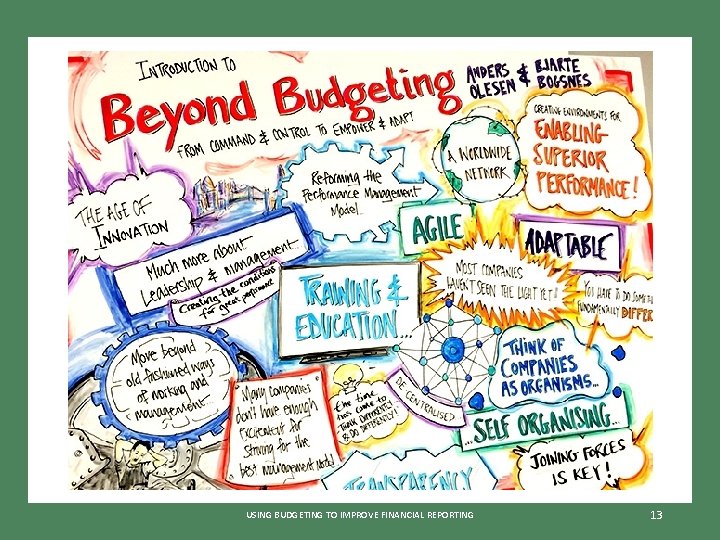
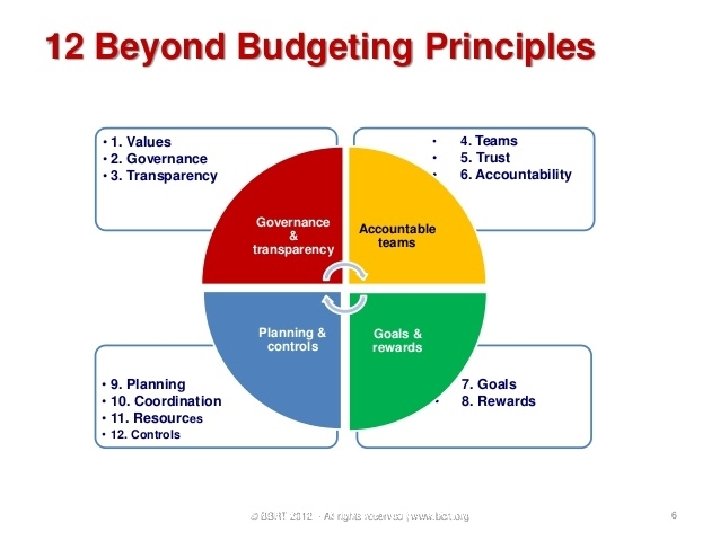
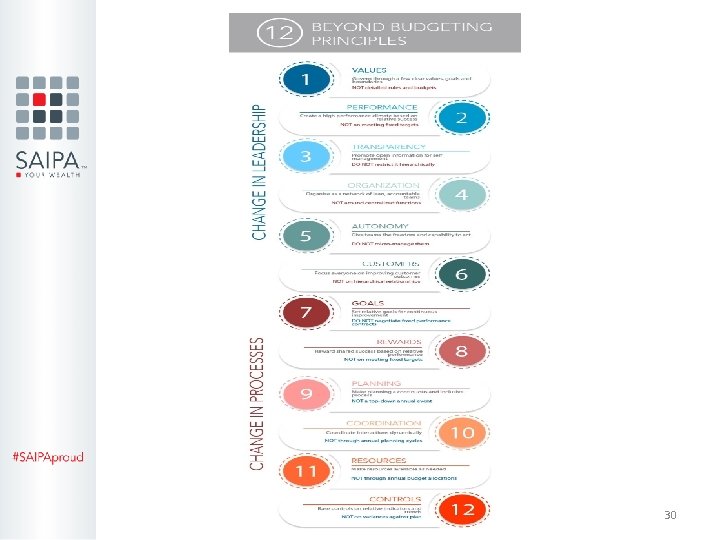
BEYOND BUDGETING FRAMEWORK § A new management model, not just financial control structure § Beyond Budgeting Framework 1. Targets relative to competition 2. Rolling forecasts 3. Rewards on relative performance 4. Up to date/transparent information 5. Give managers freedom to act 6. Adaptive to changing environment (Hope & Fraser, 2003) USING BUDGETING TO IMPROVE FINANCIAL REPORTING 14
BEYOND BUDGETING § Eliminated a “waste” of resources § Emphasised performance improvement § Clear accountability § Better communication across functional teams § Empowered front-line managers to run the business § Facilitated organisational nimbleness to changing business climate USING BUDGETING TO IMPROVE FINANCIAL REPORTING 15

USING BUDGETING TO IMPROVE FINANCIAL REPORTING 16
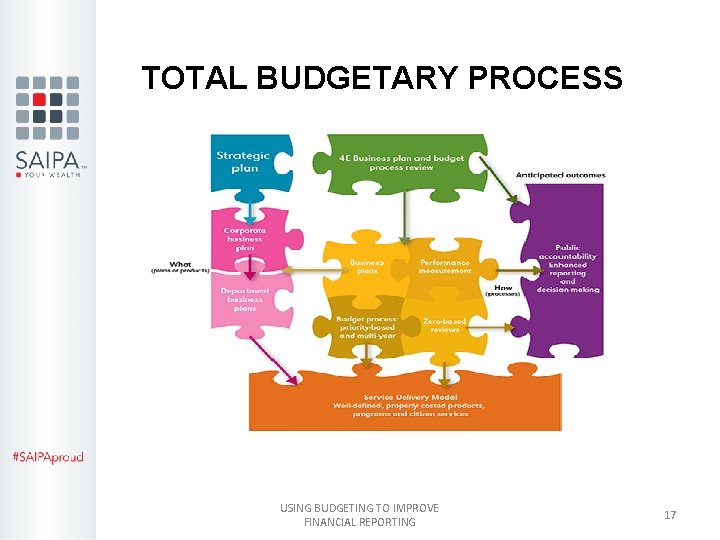
TOTAL BUDGETARY PROCESS USING BUDGETING TO IMPROVE FINANCIAL REPORTING 17
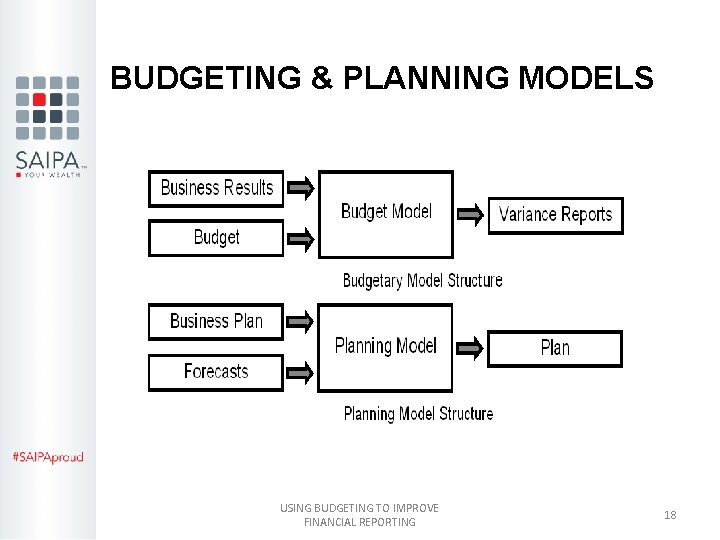
BUDGETING & PLANNING MODELS USING BUDGETING TO IMPROVE FINANCIAL REPORTING 18
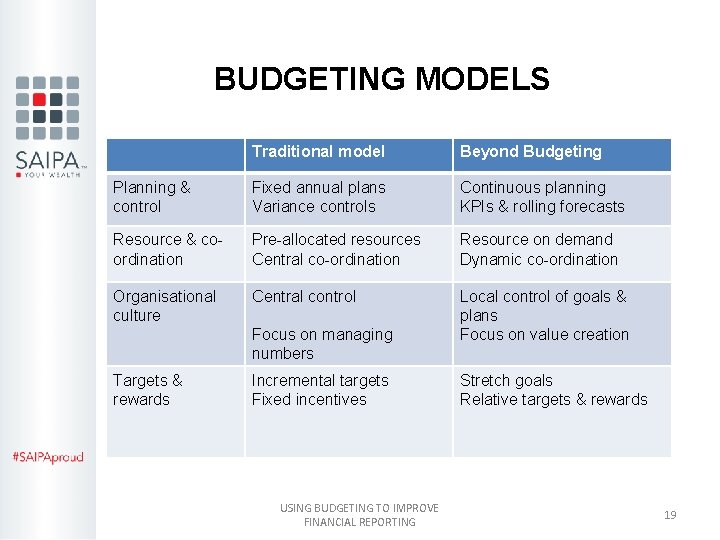
BUDGETING MODELS Traditional model Beyond Budgeting Planning & control Fixed annual plans Variance controls Continuous planning KPIs & rolling forecasts Resource & coordination Pre-allocated resources Central co-ordination Resource on demand Dynamic co-ordination Organisational culture Central control Local control of goals & plans Focus on value creation Focus on managing numbers Targets & rewards Incremental targets Fixed incentives USING BUDGETING TO IMPROVE FINANCIAL REPORTING Stretch goals Relative targets & rewards 19
USING BUDGETING TO IMPROVE FINANCIAL REPORTING 20
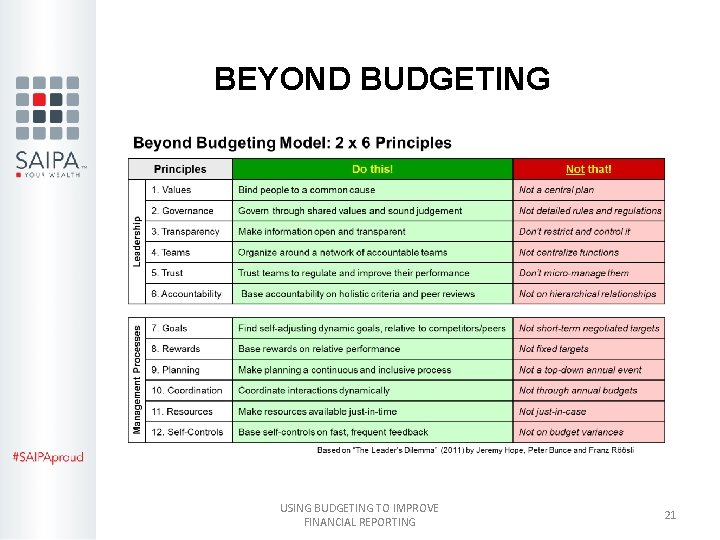
BEYOND BUDGETING USING BUDGETING TO IMPROVE FINANCIAL REPORTING 21

BEYOND BUDGETING USING BUDGETING TO IMPROVE FINANCIAL REPORTING 22
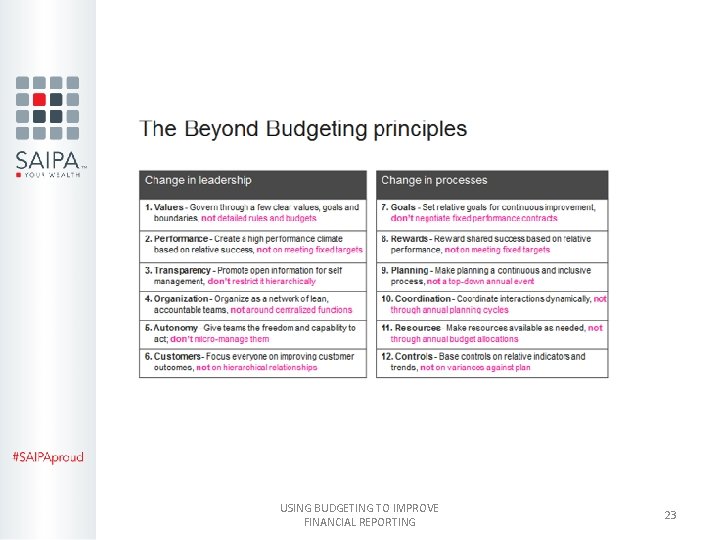
USING BUDGETING TO IMPROVE FINANCIAL REPORTING 23
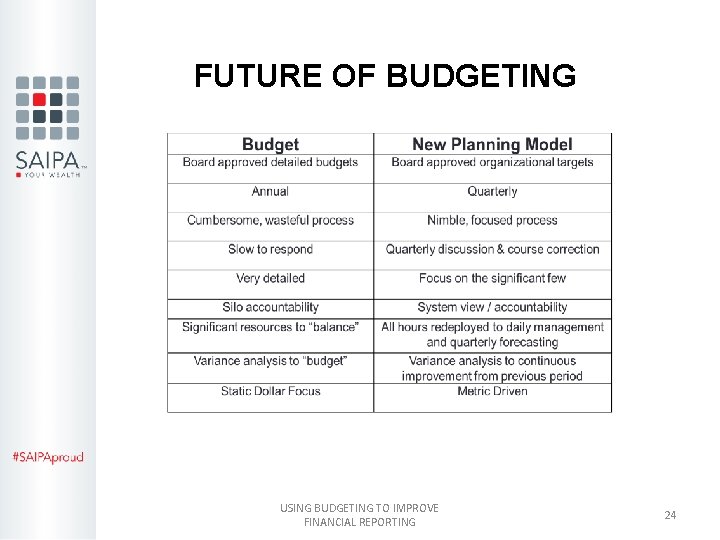
FUTURE OF BUDGETING USING BUDGETING TO IMPROVE FINANCIAL REPORTING 24
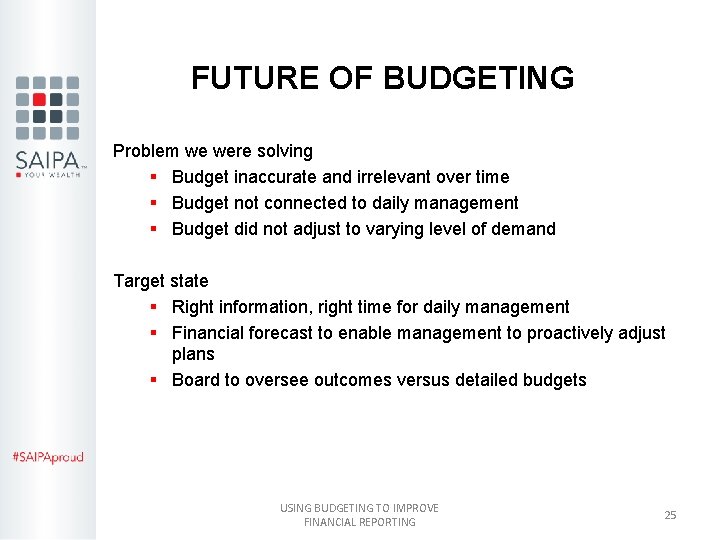
FUTURE OF BUDGETING Problem we were solving § Budget inaccurate and irrelevant over time § Budget not connected to daily management § Budget did not adjust to varying level of demand Target state § Right information, right time for daily management § Financial forecast to enable management to proactively adjust plans § Board to oversee outcomes versus detailed budgets USING BUDGETING TO IMPROVE FINANCIAL REPORTING 25
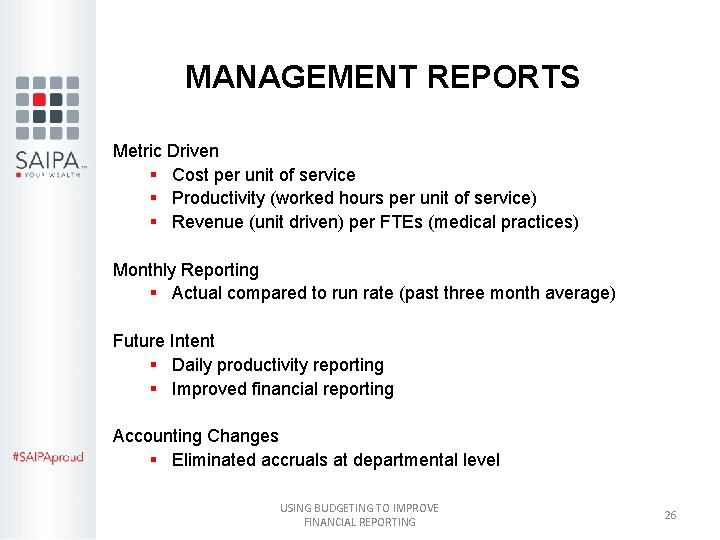
MANAGEMENT REPORTS Metric Driven § Cost per unit of service § Productivity (worked hours per unit of service) § Revenue (unit driven) per FTEs (medical practices) Monthly Reporting § Actual compared to run rate (past three month average) Future Intent § Daily productivity reporting § Improved financial reporting Accounting Changes § Eliminated accruals at departmental level USING BUDGETING TO IMPROVE FINANCIAL REPORTING 26
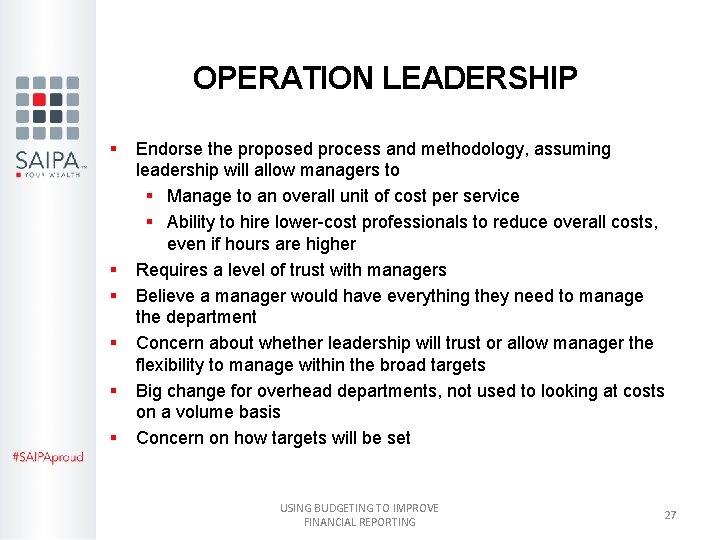
OPERATION LEADERSHIP § § § Endorse the proposed process and methodology, assuming leadership will allow managers to § Manage to an overall unit of cost per service § Ability to hire lower-cost professionals to reduce overall costs, even if hours are higher Requires a level of trust with managers Believe a manager would have everything they need to manage the department Concern about whether leadership will trust or allow manager the flexibility to manage within the broad targets Big change for overhead departments, not used to looking at costs on a volume basis Concern on how targets will be set USING BUDGETING TO IMPROVE FINANCIAL REPORTING 27
FUTURE OF BUDGETING - RISK § Lack of plan to achieve results § Revisited quarterly through forecast § Clear improvement plans based on current performance § Lack of accountability § Every manager will have a clear target on performance § Targets linked to productivity § Lack of understanding § Consistent with Lean rollout this year and quality improvements USING BUDGETING TO IMPROVE FINANCIAL REPORTING 28
IMPACT BEYOND BUDGETING § Faster and better decisions – more agility § Higher productivity – less waste § More simple processes – less bureaucracy § More innovative workplace § Happier customers § More competitive company § Better and more sustainable financial performance § Higher degree of motivation and engagement USING BUDGETING TO IMPROVE FINANCIAL REPORTING 29
30

JOIN THE CONVERSATION AND BE #SAIPAproud @SAIPAcomms South African Institute of Professional Accountants SAIPA-South African Institute of Professional Accountants 31
- Slides: 31