
BUDGETING IN AN ERA OF AUSTERITY AND STATE
BUDGETING IN AN ERA OF AUSTERITY AND STATE CAPTURE: A FIVE-YEAR REVIEW OF BUDGET POLICIES AND OUTCOMES SUB MISSIO N BY BUD GET JUS TICE COALI TI ON TO THE SELECT AND STAND ING COMMIT TEES ON F INANCE 26 February 2019
The Budget Justice Coalition Alternative Information and Development Centre (AIDC), the Children’s Institute at UCT, the Dullah Omar Institute (DOI), Equal Education (EE), Equal Education Law Centre (EELC), the Institute for Economic Justice (IEJ), the National Shelter Movement, Oxfam. SA, Pietermaritzburg Economic Justice and Dignity (PMEJD), the Public Service Accountability Monitor (PSAM), the Rural Health Advocacy Project (RHAP), SECTION 27 and the Studies in Poverty and Inequality Institute (SPII)
BJC 5 -year review One Step Forward, Two Steps Back Three arguments: 1. Austerity has been implemented over the past five years 2. This had regressive, discriminatory and counter-productive impacts 3. There alternative ways of raising revenue and managing debt that need to be explored
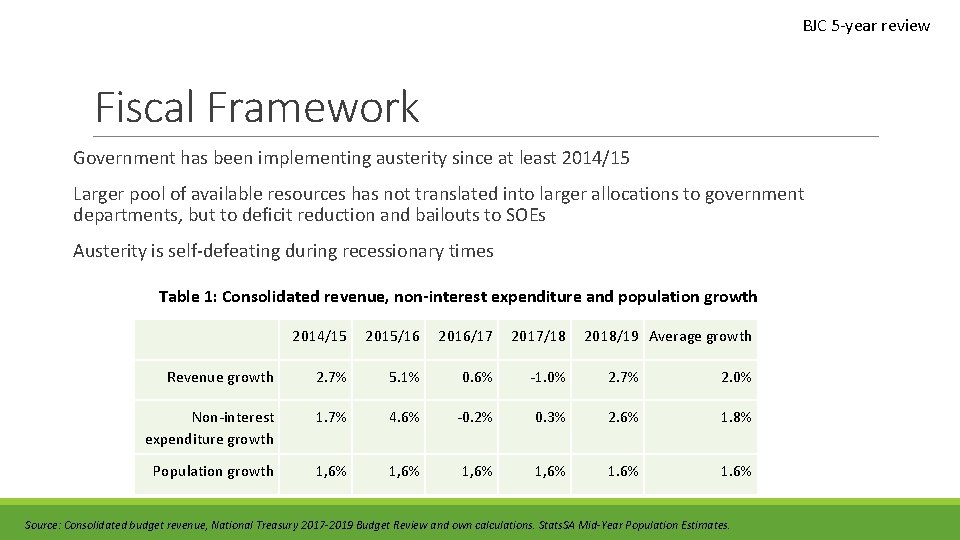
BJC 5 -year review Fiscal Framework Government has been implementing austerity since at least 2014/15 Larger pool of available resources has not translated into larger allocations to government departments, but to deficit reduction and bailouts to SOEs Austerity is self-defeating during recessionary times Table 1: Consolidated revenue, non-interest expenditure and population growth 2014/15 2015/16 2016/17 2017/18 2018/19 Average growth Revenue growth 2. 7% 5. 1% 0. 6% -1. 0% 2. 7% 2. 0% Non-interest expenditure growth 1. 7% 4. 6% -0. 2% 0. 3% 2. 6% 1. 8% Population growth 1, 6% 1. 6% Source: Consolidated budget revenue, National Treasury 2017 -2019 Budget Review and own calculations. Stats. SA Mid-Year Population Estimates.
BJC 5 -year review One Step Forward, Two Steps Back Per capita GDP has fallen for four years in a row Public debt has grown as a share of total GDP Widening socio-economic inequality Rise of precarious work 1/3 labour force out of work Among the most unequal countries in the world
BJC 5 -year review Impacts of Austerity on: Capacity of the state ◦ Worsened the performance of government ◦ “Austere expenditure ceilings are affecting local, provincial and national government departments across the country, and every service area from water to electricity to housing and social development’’ Tax policy ◦ Increase in the VAT rate from 14% to 15% ◦ Retrogressive and discriminatory impacts
BJC 5 -year review Departmental Impacts of Austerity on: Health ◦ Real per capita decline in health care funding ◦ R 700 million less will be spent on health in 2019/20* ◦ Critical staff shortages ◦ Increase in medico legal claims Education ◦ Per learner spending has actually declined by 10% since 2010 ◦ Disproportionately impacts on poor schools with infrastructure backlogs *compared to the 2018 MTBPS estimate
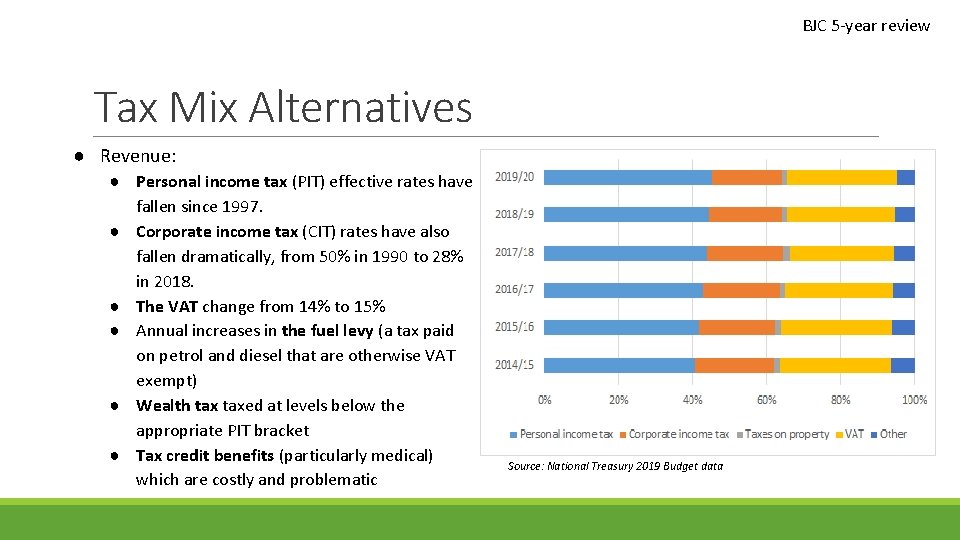
BJC 5 -year review Tax Mix Alternatives ● Revenue: ● Personal income tax (PIT) effective rates have fallen since 1997. ● Corporate income tax (CIT) rates have also fallen dramatically, from 50% in 1990 to 28% in 2018. ● The VAT change from 14% to 15% ● Annual increases in the fuel levy (a tax paid on petrol and diesel that are otherwise VAT exempt) ● Wealth taxed at levels below the appropriate PIT bracket ● Tax credit benefits (particularly medical) which are costly and problematic Source: National Treasury 2019 Budget data
BJC 5 -year review Alternatives to Managing Debt Eskom is the only real debt crisis in the country Increasing the debt threshold ◦ that debt (at moderate levels) can have substantially positive benefits. The redrafting of the mandate of the Government Employee Pension Fund The modification of private pension and provident funds investment obligations The mobilisation of the Government Employee Pension Fund Public audit of debt
BJC 5 -year review Impacts of Corruption & Mismanagement Threaten the progressive realisation of constitutional rights High costs ◦ South Africa no less than R 27 billion per year, while 76, 000 jobs which could have been created are being lost through corruption** Rising number of adverse audits Bailouts for mismanaged and corrupt SOEs **Department of Economic Development , 2017
BJC 5 -year review Ensuring a credible budgeting process There have been six changes of Finance Minister since 2014 During the 5 th term, budget proposals and policy statements have become less and less convincing – Treasury needs re-strengthening Money Bills Amendment Procedure and Related Matters Amendment Act amendments have made it even more difficult for the public to participate
BJC 5 -year review Recommendations Macroeconomic Policy ◦ More awareness of the ‘quality’ of the economic growth that is aimed for ◦ Greater focus on employment and economic growth in monetary policy ◦ Better policy coherence and collaboration between the National Treasury with the Departments of Trade and Industry, Economic Development, Labour, Social Development and the Reserve Bank. Fiscal Policy ◦ Adoption of UN Committee Recommendations to the Government of South Africa on fiscal policy ◦ Take action to end austerity by: ◦ Ensuring real per capita annual increases in non-interest government ◦ Measure the impact of previous and existing budget cuts on rights enjoyment ◦ Institute, where necessary, cost-containment measures that comply with the human rights standards
BJC 5 -year review Recommendations Revenue and Debt Management Policy ◦ Increase tax rates on PIT, CIT and wealth ◦ Institute a permanent annual net wealth tax ◦ Raise the capital gains tax inclusion rate to 100% ◦ Significantly raise the estate duty tax and close loopholes ◦ Reduce the rate of increase for the fuel and road accident fund levies ◦ Reverse the VAT hike ◦ Explore heterodox strategies of public debt management ◦ Reduce tax breaks for higher-income households
BJC 5 -year review Recommendations State Capacity Transparency on policy directive for reducing the size of the state Undertake public service employment rationalisation (not simple headcount reductions) Put an end to corruption and State Capture, by: ◦ Provide full budgetary support to the SAPS, SIU, NPA, Hawks and other crime fighting units ◦ Upgrade procurement policy and publish all contracts entered into by the state The Budget Process Co-construction of budgets with social movements and community organisations Strengthen capacity within the Parliamentary Budget Office (PBO) Support the vulekamali. gov. za budget portal project
- Slides: 14