
Budget support training Module 8 The disbursement file
Budget support training Module 8 The disbursement file Version February 2017
Outline 1. The disbursement file 2. ECA audits of BS disbursements 3. The decision process for tranche release 2
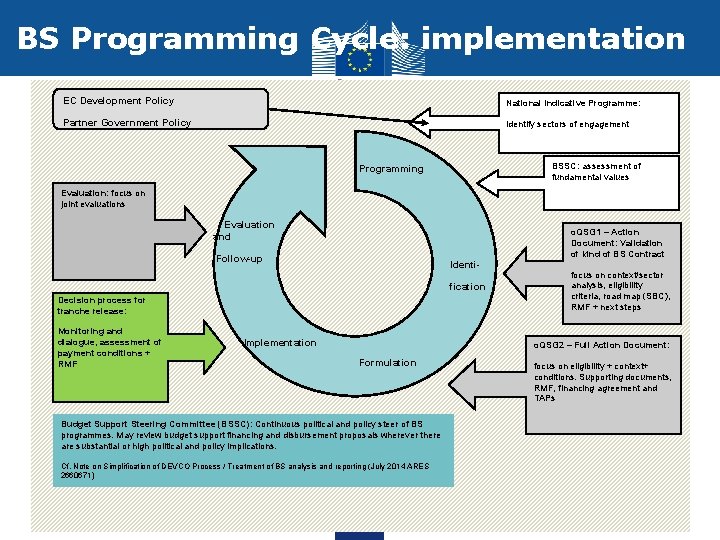
BS Programming Cycle: implementation EC Development Policy National Indicative Programme: Partner Government Policy identify sectors of engagement BSSC: assessment of fundamental values Programming Evaluation: focus on joint evaluations Evaluation and Follow-up Identification Decision process for tranche release: Monitoring and dialogue, assessment of payment conditions + RMF Implementation o. QSG 1 – Action Document: Validation of kind of BS Contract focus on context/sector analysis, eligibility criteria, road map (SBC), RMF + next steps o. QSG 2 – Full Action Document: Formulation focus on eligibility + context+ conditions. Supporting documents, RMF, financing agreement and TAPs Budget Support Steering Committee (BSSC): Continuous political and policy steer of BS programmes. May review budget support financing and disbursement proposals wherever there are substantial or high political and policy implications. Cf. Note on Simplification of DEVCO Process / Treatment of BS analysis and reporting (July 2014 ARES 2660671) 3
Disbursement file: the legal basis? Ø Financing Agreement – including its amendments, riders Ø In particular in the annexes of the Technical and Administrative Provisions Ø Annexes contain the set of indicators for the variable tranches (‘performance assessment framework’) Ø Consult: budget support guidelines 4
WHO is involved in the process (partner) (1) • Ministry of Finance (Budget preparation and execution – Treasury, macroeconomic and • fiscal policies and PFM reforms) • National Authorising Officer • Line Ministries (in particular in case of SRC) • Agencies and other stakeholders (if relevant) 5
WHO is involved in the process? EC (2) • EU Delegation • Economic Section (dialogue with the Ministry of Finance, macro/fiscal policies analysis, PFM reforms dialogue and analysis, sector specific economic analysis) • Sector Sections (sector policy analysis, targets for sector indicators) • Contract & Finance (account for the transfer, contract, invoice, forecasts) • Head of Co-operation, Political officer (RMF) • Head of Delegation 6
WHO is involved in the process? EC (3) European Commission / DG DEVCO Geographic directorate (desk and budget support officer) • Thematic units such as • B 1 (Fundamental values) • A 4 (Budget support – Macro/fiscal policies and PFM issues) • Thematic units (i. e. C 1 for agriculture and nutrition; C 5 for energy) • Budget Support Steering Committee with the participation of EEAS 7

WHO is involved in the process? EC (4) After the payment or indirectly • European Court of Auditors and European Parliament • External audit in partner country (Supreme Audit Institute) • Member States • Civil society (both in the EU and partner country) 8
WHEN to prepare a disbursement file? (1) • See Financing Agreement • Continuously (BS is not just a cash transfer – there are general and specific objectives, activities to be implemented, policy dialogue) • During implementation unforeseen issues may arise: one or more indicator(s) and/or target(s) need adjustment: time for a rider? • Working on several disbursements at the same time 9
WHEN to prepare a disbursement file? (2) • Implementation of activities (for instance annual action plan of sector strategy) • Assessment stage • Preparation of the request (possible several exchanges between PC, the Delegation and HQ) • Analysis of the request from PC by the Delegation • Analysis of the request by HQ See indicative timetable in Financing Agreement, TAPs and Annexes 10
WHEN to prepare a disbursement file? (2) • Deadlines: • Check carefully and regularly the time each stakeholder requires in the preparation process of a disbursement file. • Can the expected time-table be matched with the partner country’s budget cycle? • The time required for the process may vary according to the time of the year, the kind of tranche, external factors etc. See indicative timetable in Financing Agreement, TAPs and Annexes 11
HOW to prepare a disbursement file? (1) • Partner country - monitoring and evaluation and coordination frameworks and structures within Government • EU Delegation – policy dialogue with the Partner Country and other parties (such as other development partners) and sector coordination groups at technical and political level (division of labour) • DEVCO HQ – exchanges with the Delegation, with other parties such as the IMF, consultations of thematic units and discussions in BSSC with the participation of EEAS 12
HOW to prepare a disbursement file? (2) • Assessment of General Conditions • Collect evidence to establish relevance, credibility and progress • Sources of verification as indicated in the Financing Agreement • Assessment of targets for variable tranches • Sources of verification • Calculations 13
WHICH documents to insert in a disbursement file (1) • In a disbursement file one should find: • facts and evidence • the analysis based in these facts and evidence • the underpinning documentation 14
WHICH documents to insert in a disbursement file (2) Partner Country: • Formal request from the Government: • Cover Letter • Analysis and evidence of achievement of general criteria and targets for the indicators of the variable tranche • Amount requested • Proof of transfer previous disbursement (exchange rate) (if not done before) • Validity of bank account 15
WHICH documents to insert in a disbursement file (3) EU Delegation Cover letter by the Head of Delegation Note by the Head of Delegation • Summary of the analysis and the eligibility with regard to the General Conditions/criteria • Summary of the analysis of the targets achieved of the indicators for the variable tranche • Recommendations concerning the amount to 16 be disbursed
WHICH documents to insert in a disbursement file (4) EU Delegation • Analysis by the Delegation – Note to the file • Analysis of the 4 General Conditions/criteria (Refer to annexes provided to Action Fiche of the BS operation) • Analysis of achievement of targets for the indicators for the variable tranche • Exceptions: See simplification note ARES (2014)2429988 22/07/2014 (always check with HQ) • Annual PFM report • RMF (updated if substantial changes occurred) 17
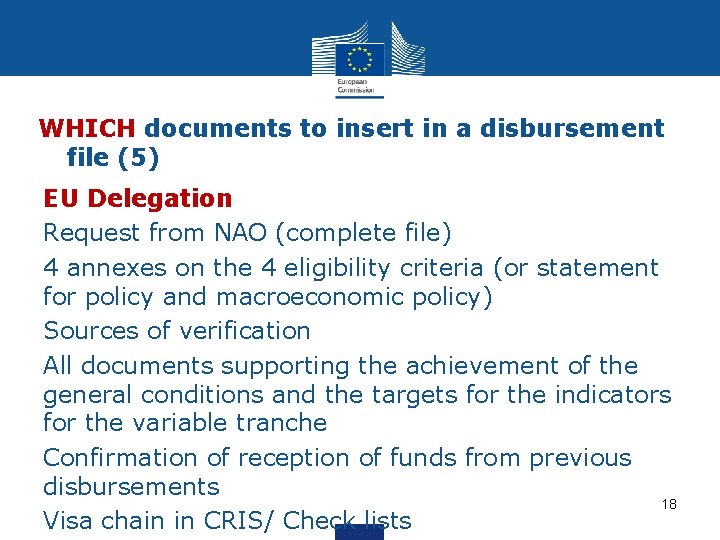
WHICH documents to insert in a disbursement file (5) EU Delegation Request from NAO (complete file) 4 annexes on the 4 eligibility criteria (or statement for policy and macroeconomic policy) Sources of verification All documents supporting the achievement of the general conditions and the targets for the indicators for the variable tranche Confirmation of reception of funds from previous disbursements 18 Visa chain in CRIS/ Check lists
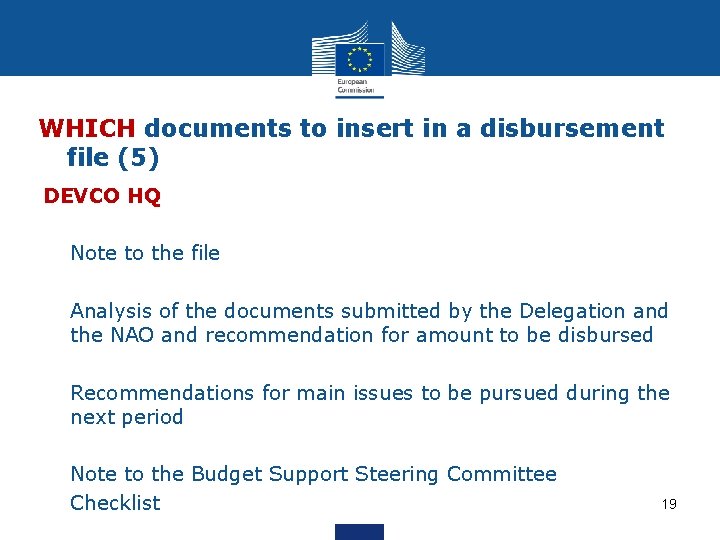
WHICH documents to insert in a disbursement file (5) DEVCO HQ • Note to the file • Analysis of the documents submitted by the Delegation and the NAO and recommendation for amount to be disbursed • Recommendations for main issues to be pursued during the next period • Note to the Budget Support Steering Committee • Checklist 19
Outline 1. The disbursement file 2. ECA audits of BS disbursements 3. The decision process for tranche release 20
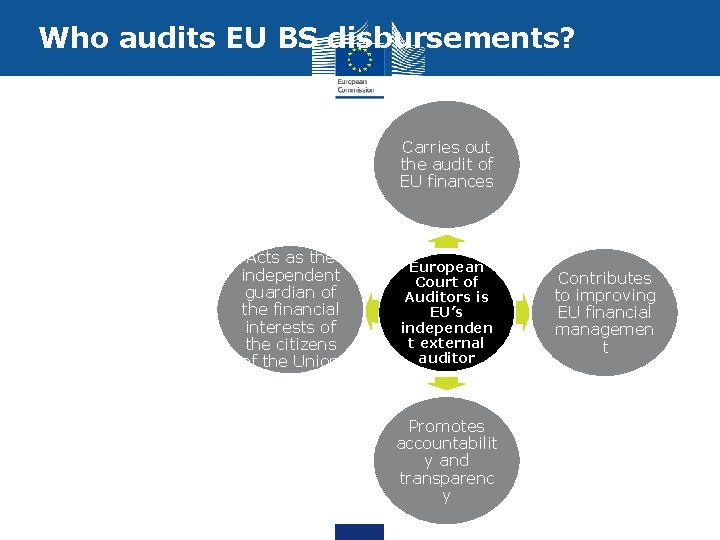
Who audits EU BS disbursements? Carries out the audit of EU finances Acts as the independent guardian of the financial interests of the citizens of the Union European Court of Auditors is EU’s independen t external auditor Promotes accountabilit y and transparenc y Contributes to improving EU financial managemen t
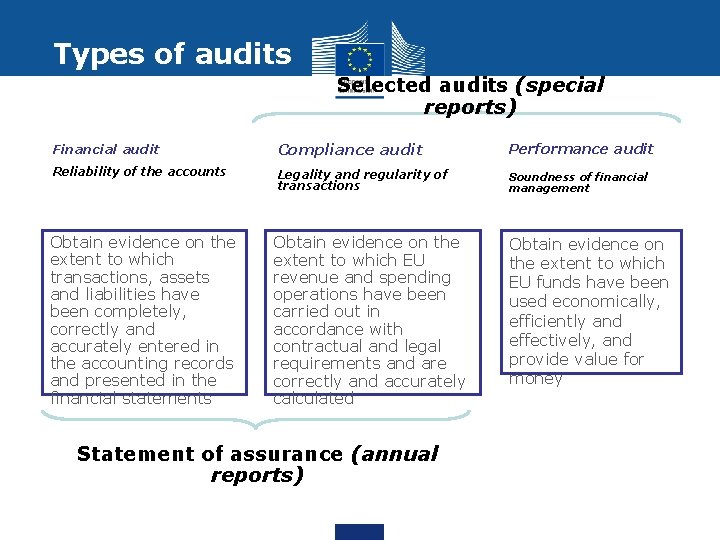
Types of audits Selected audits (special reports) Financial audit Compliance audit Performance audit Reliability of the accounts Legality and regularity of transactions Soundness of financial management Obtain evidence on the extent to which transactions, assets and liabilities have been completely, correctly and accurately entered in the accounting records and presented in the financial statements Obtain evidence on the extent to which EU revenue and spending operations have been carried out in accordance with contractual and legal requirements and are correctly and accurately calculated Statement of assurance (annual reports) Obtain evidence on the extent to which EU funds have been used economically, efficiently and effectively, and provide value for money
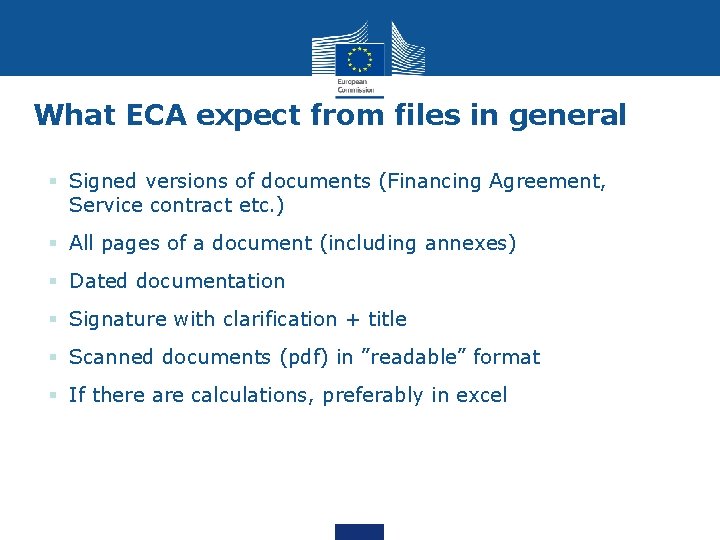
What ECA expect from files in general § Signed versions of documents (Financing Agreement, Service contract etc. ) § All pages of a document (including annexes) § Dated documentation § Signature with clarification + title § Scanned documents (pdf) in ”readable” format § If there are calculations, preferably in excel

What ECA expects from Budget support disbursement files § Check on legality and regularity of transactions § In order for the file to be considered legal and regular, it must follow the rules and regulations (including Budget support guidelines) § Key document is the Budget support Financing Agreement. § -amounts and timing of disbursements § -conditions/indicators § -exchange rate to be used §
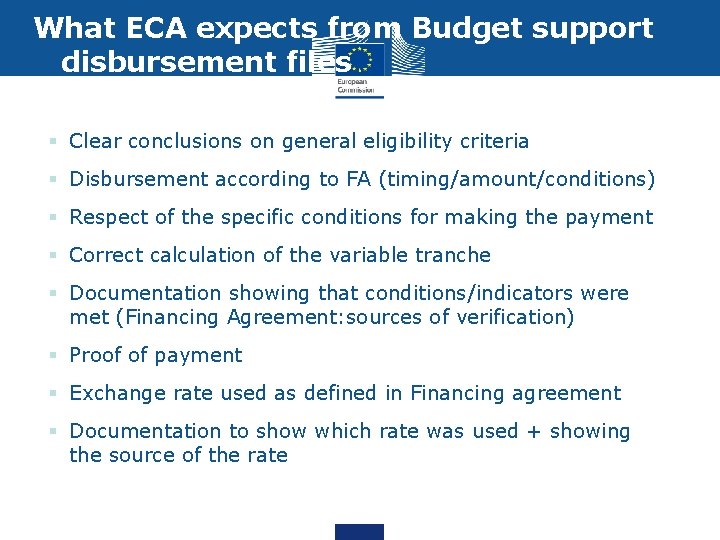
What ECA expects from Budget support disbursement files § Clear conclusions on general eligibility criteria § Disbursement according to FA (timing/amount/conditions) § Respect of the specific conditions for making the payment § Correct calculation of the variable tranche § Documentation showing that conditions/indicators were met (Financing Agreement: sources of verification) § Proof of payment § Exchange rate used as defined in Financing agreement § Documentation to show which rate was used + showing the source of the rate
Outline 1. The disbursement file 2. ECA audits of BS disbursements 3. The decision process for tranche release 26
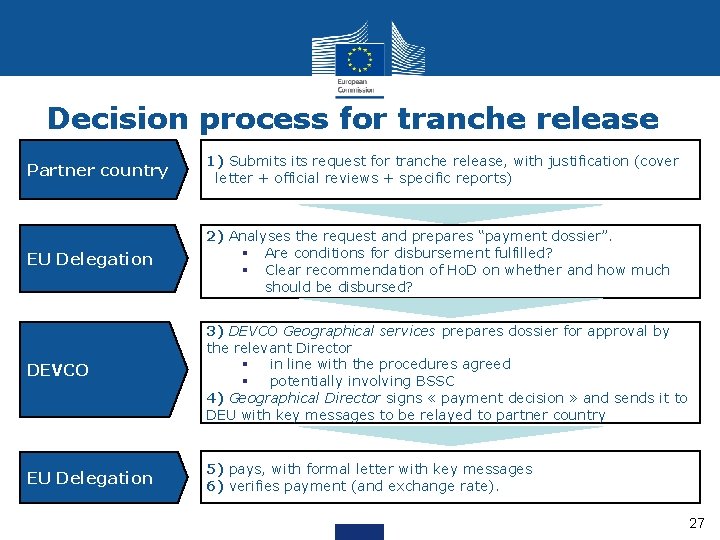
Running Head 12 -Point Plain, Title Case Decision process for tranche release Partner country 1) Submits request for tranche release, with justification (cover letter + official reviews + specific reports) EU Delegation 2) Analyses the request and prepares “payment dossier”. § Are conditions for disbursement fulfilled? § Clear recommendation of Ho. D on whether and how much should be disbursed? DEVCO 3) DEVCO Geographical services prepares dossier for approval by the relevant Director § in line with the procedures agreed § potentially involving BSSC 4) Geographical Director signs « payment decision » and sends it to DEU with key messages to be relayed to partner country EU Delegation 5) pays, with formal letter with key messages 6) verifies payment (and exchange rate). 27
Progress dialogue • - Moment of coodination about progress • - Be aware of – and be prepared for- a dialogue based on the indicators. • - Both backward and forward looking • - Involvement of third parties (other donors, civil society) 28

Thank you very much for your attention 29
- Slides: 29