
Budget Support Module 5 Design Indicators and tranches
Budget Support Module 5 Design (Indicators and tranches)
Outline Module 5 1. Budget support design considerations 2. Fixed and variable tranches 3. Disbursement indicators 4. Complementary measures 5. Coordination mechanisms 6. Communication and visibility 2
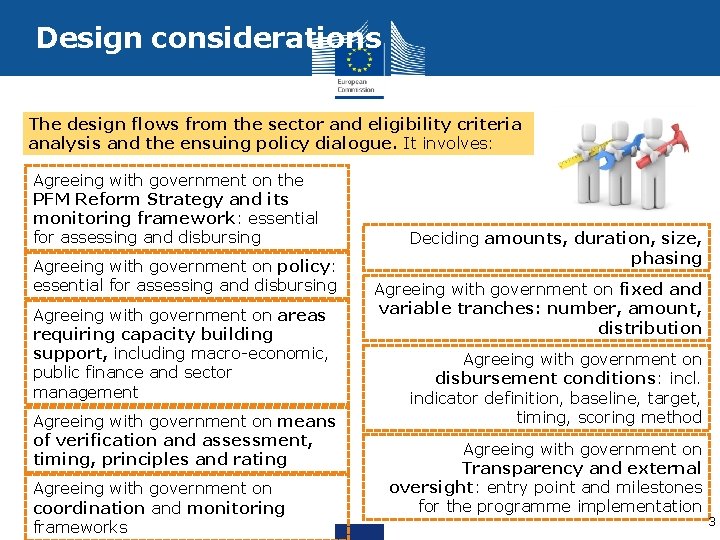
Design considerations The design flows from the sector and eligibility criteria analysis and the ensuing policy dialogue. It involves: Agreeing with government on the PFM Reform Strategy and its monitoring framework: essential for assessing and disbursing Agreeing with government on policy: essential for assessing and disbursing Agreeing with government on areas requiring capacity building support, including macro-economic, public finance and sector management Agreeing with government on means of verification and assessment, timing, principles and rating Agreeing with government on coordination and monitoring frameworks Deciding amounts, duration, size, phasing Agreeing with government on fixed and variable tranches: number, amount, distribution Agreeing with government on disbursement conditions: incl. indicator definition, baseline, target, timing, scoring method Agreeing with government on Transparency and external oversight: entry point and milestones for the programme implementation 3
Funding arrangements Considerations for the decision between financing additionality/earmarking of funds and total fungibility: • All funds are additional to domestic revenues • When considering additionality of BS: Ø Agree an increase in sector allocations and expenditure during sector policy discussions (eligibility criterion) Ø Consider effects on the MTFF and strategic resource allocations according to overall policy priorities Ø Consider recurrent cost implications and sustainability • Additionality targeting • No additionality at sector level but additional space at macro level: focus on dialogue, incentives and conditions on results • Emphasis on effectiveness and efficiency of sector policies and expenditure 4
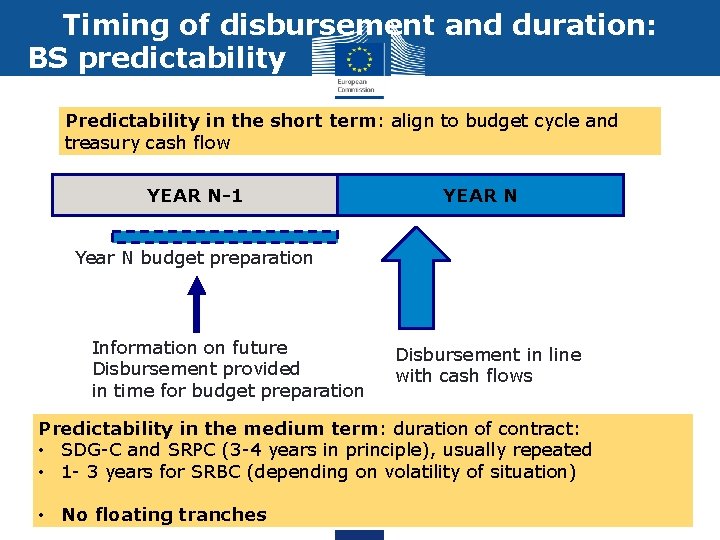
Timing of disbursement and duration: BS predictability Predictability in the short term: align to budget cycle and treasury cash flow YEAR N-1 YEAR N Year N budget preparation Information on future Disbursement provided in time for budget preparation Disbursement in line with cash flows Predictability in the medium term: duration of contract: • SDG-C and SRPC (3 -4 years in principle), usually repeated • 1 - 3 years for SRBC (depending on volatility of situation) • No floating tranches 5
Outline Module 5 1. Budget support design considerations 2. Fixed and variable tranches 3. Disbursement indicators 4. Complementary measures 5. Coordination mechanisms 6. Communication and visibility 6
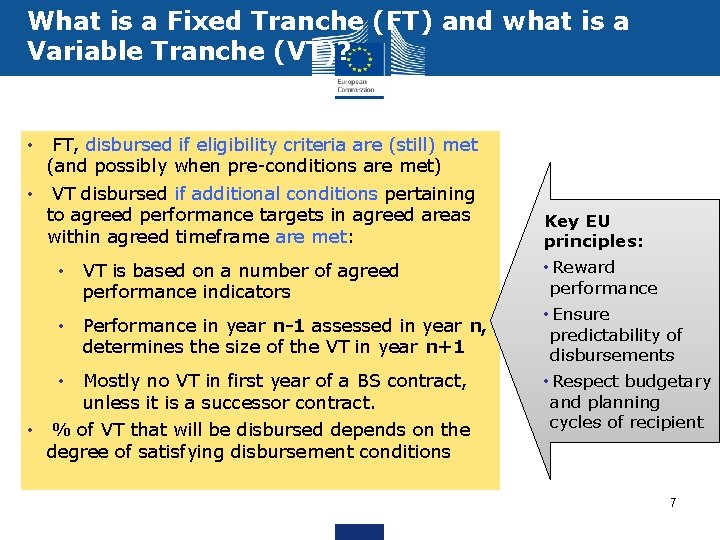
What is a Fixed Tranche (FT) and what is a Variable Tranche (VT)? • FT, disbursed if eligibility criteria are (still) met (and possibly when pre-conditions are met) • VT disbursed if additional conditions pertaining to agreed performance targets in agreed areas within agreed timeframe are met: Key EU principles: • VT is based on a number of agreed performance indicators • Reward performance • Performance in year n-1 assessed in year n, determines the size of the VT in year n+1 • Ensure predictability of disbursements • Mostly no VT in first year of a BS contract, unless it is a successor contract. • % of VT that will be disbursed depends on the degree of satisfying disbursement conditions • Respect budgetary and planning cycles of recipient 7

Size and phasing of variable tranches § VT meant to have incentive effects and to signal specific performance issues: larger VT may have stronger incentive effect but the PC is taking higher risks Maximise the benefits Minimise Ø Balance needed between creating the risks incentives and avoiding unpredictability and volatility of disbursements (on average 60% FT and 40% VT) § Countries with good track record and low risk profile can get contracts with longer duration and low VT share 8

Examples of Variable Tranche distribution Typical profile for a first SDGC or SRPC Typical profile for a renewed SDGC or SRPC 100% 90% 80% 70% 60% 50% 40% 30% 20% 10% 0% 1 2 3 Typical profile for a one-year SRBC 100% 90% 80% 70% 60% 50% 40% 30% 20% 10% 0% 1 Fixed tranche Variable tranche 2 3 Typical profile for a two-year SRBC 100% 80% 60% 40% 20% 0% 1 1 2 9
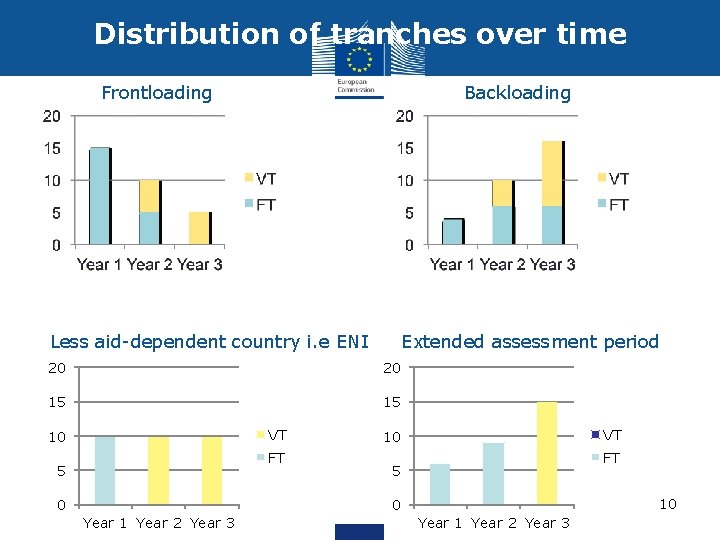
Distribution of tranches over time Frontloading Backloading Less aid-dependent country i. e ENI Extended assessment period 20 20 15 15 VT 10 FT 5 10 0 0 Year 1 Year 2 Year 3
Calculating the VT disbursement § Method 1: Assess individual indicators: » 0 = no progress; 0. 5 = significant progress; 1 = target met » Pro rata payment: aggregate amounts for each indicator § Method 2: Assess aggregated performance of indicators by policy objective: » 0 = unsatisfactory (aggregated score below 35% of maximum); 0. 5 = satisfactory (score 36 -70%); 1 = strong (71 -100%) » Pro rata payment: 0 → no disbursement, 0. 5 → 50% disbursement; 1 → full disbursement § Method 3: Asses all indicators together for overall performance with total score: » below 30% of maximum= unsatisfactory → no disbursement; » 31%-45% = limited → disbursement 35%; » 46 -75% = satisfactory → disbursement 65%; and » 76 -100% = strong → full disbursement. § In principle undisbursed funds will not be recycled to next tranches (decommitted or used for complementary support actions) § In exceptional cases, an indicator can be neutralised or waived and the amount can be reallocated to the other indicators or to the next year and/or reassessed following year if positive trend See section 3 of annex 8 and bibliography 11
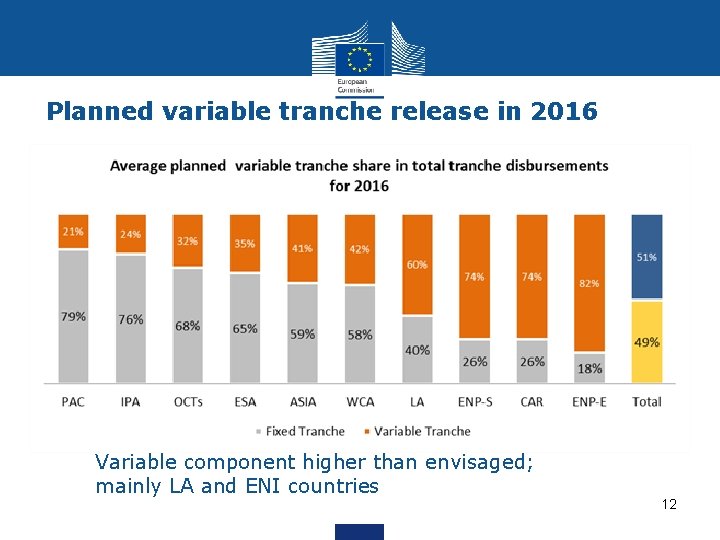
Planned variable tranche release in 2016 Variable component higher than envisaged; mainly LA and ENI countries 12
Outline Module 5 1. Budget support design considerations 2. Fixed and variable tranches 3. Disbursement indicators 4. Complementary measures 5. Coordination mechanisms 6. Communication and visibility 13
VT disbursement indicators (1) § VT disbursement indicators and targets should be selected from the country’s M&E matrix or from the sector M&E matrix and agreed upon during formulation phase § If no M&E matrix exists, select according to policy priorities whilst ensuring coherence between contract objectives, problem diagnosed and selected indicators and targets § Well defined indicators (SMART), which change annually, where timely information is available, for which sources are identified § Select indicators over which (the sector) has a reasonable control: preference given to induced output or outcome indicators § Number of indicators : 3 – 10 (indicative) § Indicators and targets may be disaggregated by gender, region or population group 14
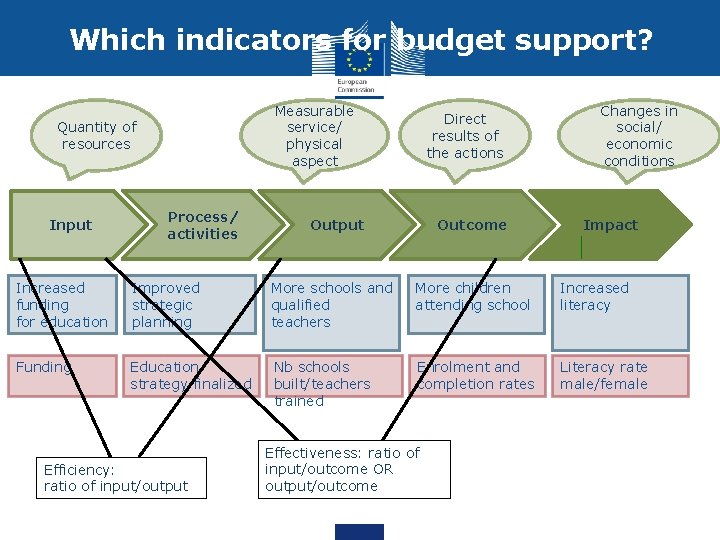
Which indicators for budget support? Measurable service/ physical aspect Quantity of resources Input Process/ activities Direct results of the actions Output Outcome Changes in social/ economic conditions Impact Increased funding for education Improved strategic planning More schools and qualified teachers More children attending school Increased literacy Funding Education strategy finalized Nb schools built/teachers trained Enrolment and completion rates Literacy rate male/female Efficiency: ratio of input/output Effectiveness: ratio of input/outcome OR output/outcome
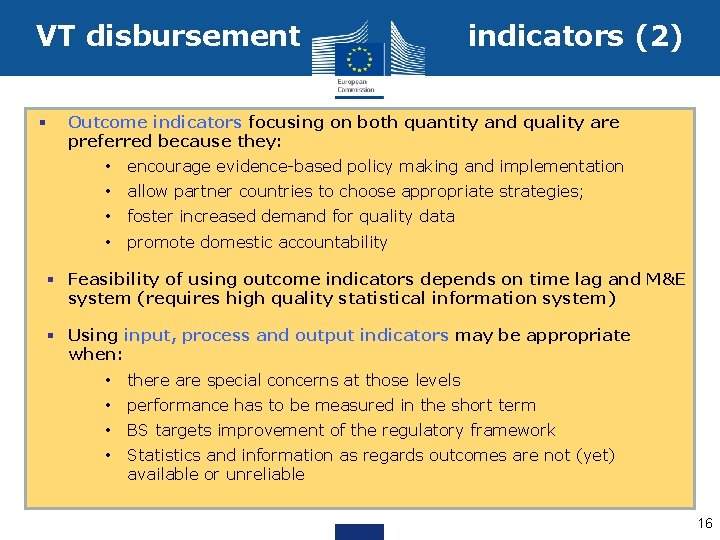
VT disbursement § indicators (2) Outcome indicators focusing on both quantity and quality are preferred because they: • encourage evidence-based policy making and implementation • allow partner countries to choose appropriate strategies; • foster increased demand for quality data • promote domestic accountability § Feasibility of using outcome indicators depends on time lag and M&E system (requires high quality statistical information system) § Using input, process and output indicators may be appropriate when: • there are special concerns at those levels • performance has to be measured in the short term • BS targets improvement of the regulatory framework • Statistics and information as regards outcomes are not (yet) available or unreliable 16
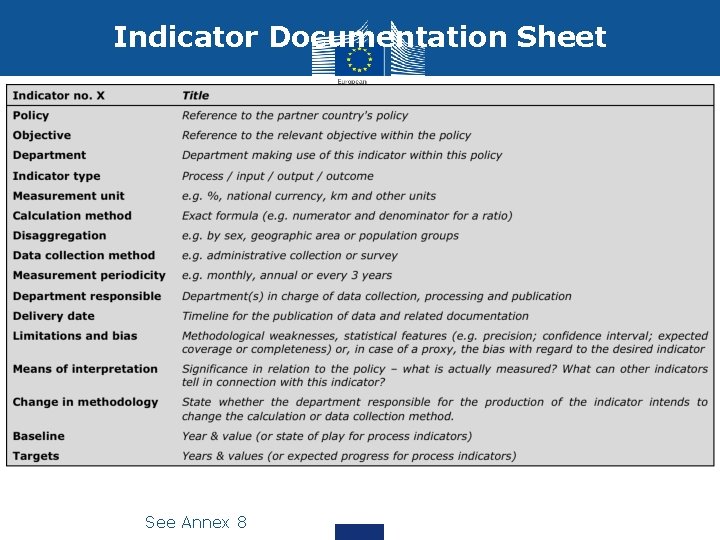
Indicator Documentation Sheet See Annex 8
Outline Module 5 1. Budget support design considerations 2. Fixed and variable tranches 3. Disbursement indicators 4. Complementary measures 5. Coordination mechanisms 6. Communication and visibility 18
Examples of complementary support activities Reminder u Capacity development measures: TA and other forms of capacity building, to strengthen public institutions or civil society organisations u TA to support M&E of the EU contract; or to support the design and implementation of a government-led visibility and communication strategy u Strengthening of national statistical systems and monitoring frameworks should be a critical component of policy dialogue and CD plus u Promotion of the active engagement of all stakeholders in policy design, implementation and monitoring u Integration of gender equality in planning, budgeting 19
Two options Capacity Development • 1 - Either as part of the BS operation to be managed by the partner government • 2 - Or as complementary activity, (largely) managed by EU, either within the BS Finance Agreement or as separate activity in project modality
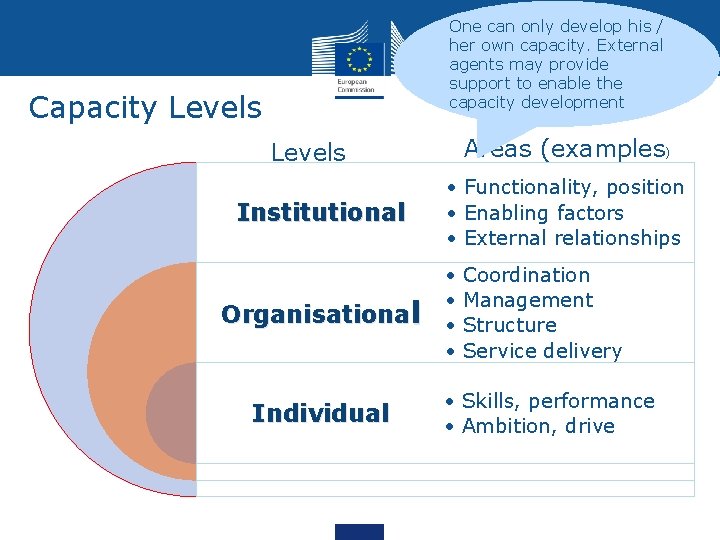
One can only develop his / her own capacity. External agents may provide support to enable the capacity development Capacity Levels Areas (examples) Levels Institutional Organisational Individual • Functionality, position • Enabling factors • External relationships • • Coordination Management Structure Service delivery • Skills, performance • Ambition, drive
Good practices for complementary support § Understand the context § Help defining realistic capacity development targets § Assess capacity development needs systematically: § Absorption capacity § Demand, ownership and commitment towards CB § Take a long term perspective Outputs of capacity development activities cannot be used as VT indicators!!! 22
Outline Module 5 1. Budget support design considerations 2. Fixed and variable tranches 3. Disbursement indicators 4. Complementary measures 5. Coordination mechanisms 6. Communication and visibility 23
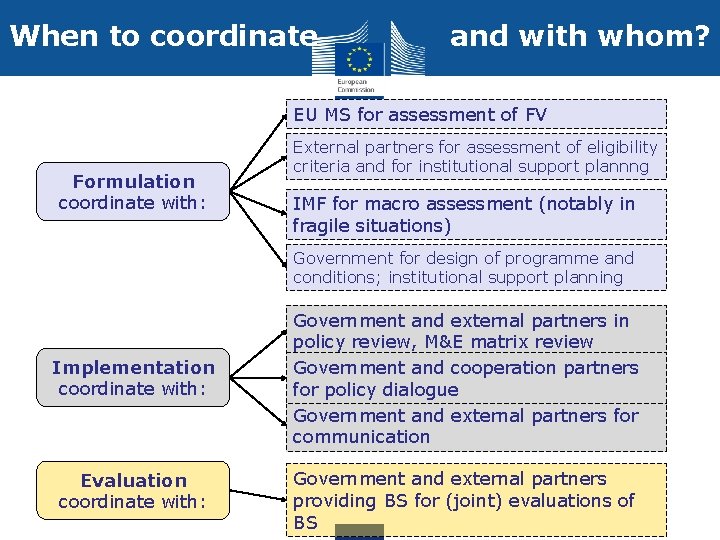
When to coordinate and with whom? EU MS for assessment of FV Formulation coordinate with: External partners for assessment of eligibility criteria and for institutional support plannng IMF for macro assessment (notably in fragile situations) Government for design of programme and conditions; institutional support planning Implementation coordinate with: Evaluation coordinate with: Government and external partners in policy review, M&E matrix review Government and cooperation partners for policy dialogue Government and external partners for communication Government and external partners providing BS for (joint) evaluations of BS
Outline Module 5 1. Budget support design considerations 2. Fixed and variable tranches 3. Disbursement indicators 4. Complementary measures 5. Coordination mechanisms and Monitoring framework 6. Communication and visibility 25
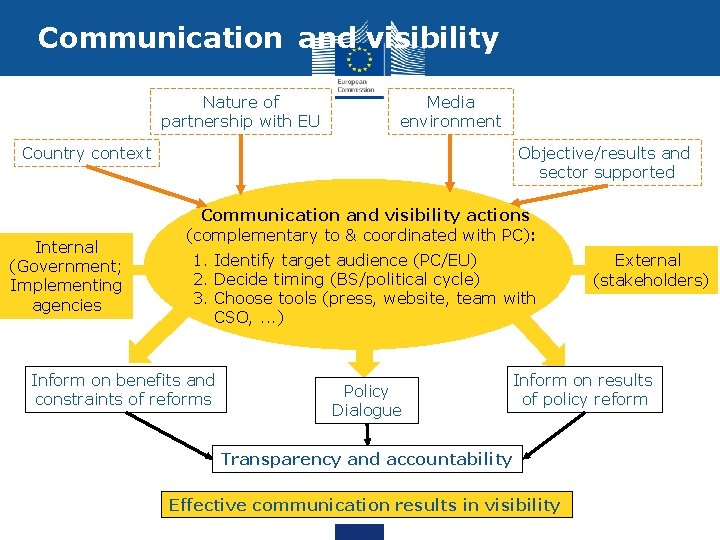
Communication and visibility Nature of partnership with EU Media environment Country context Internal (Government; Implementing agencies Objective/results and sector supported Communication and visibility actions (complementary to & coordinated with PC): 1. Identify target audience (PC/EU) 2. Decide timing (BS/political cycle) 3. Choose tools (press, website, team with CSO, . . . ) Inform on benefits and constraints of reforms Policy Dialogue External (stakeholders) Inform on results of policy reform Transparency and accountability Effective communication results in visibility
Traps to be avoided with Budget Support ØOver-asking (more than reasonably can be achieved) ØMultiplicity of conditions ØConditionalities beyond Government’s control ØLack of clarity in the FA, in particular related to the monitoring / measurement of indicators Ø‘the battle among consultants’ in relation to the indicators ØTaking over government’s responsibilities (e. g. TA elaborates the new sector policy) ØMicro-management (as opposed to government ownership) ØAny reporting and auditing over and above what is agreed upon ØOverloading the BS because of perceived fears of risks 27
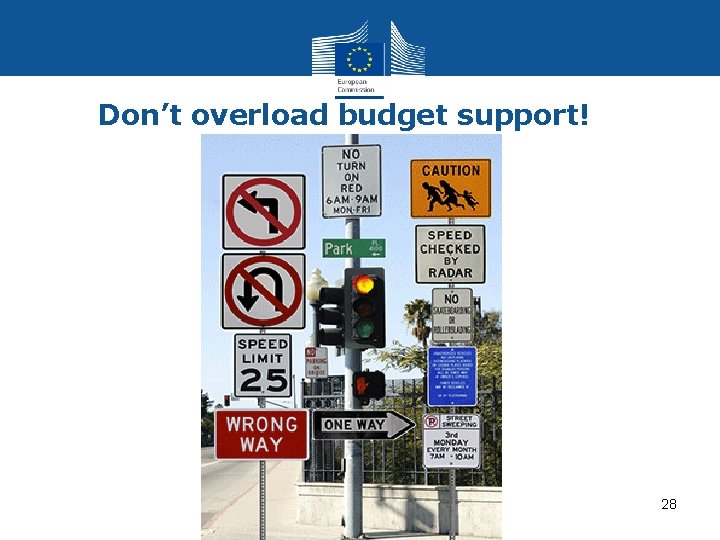
Don’t overload budget support! 28

Thank you for your attention 29
- Slides: 29