
Budget Support Module 3 Risk Management Framework Outline
Budget Support Module 3 Risk Management Framework
Outline Module 3 1. Risk Management 2. Risk Management Framework 2
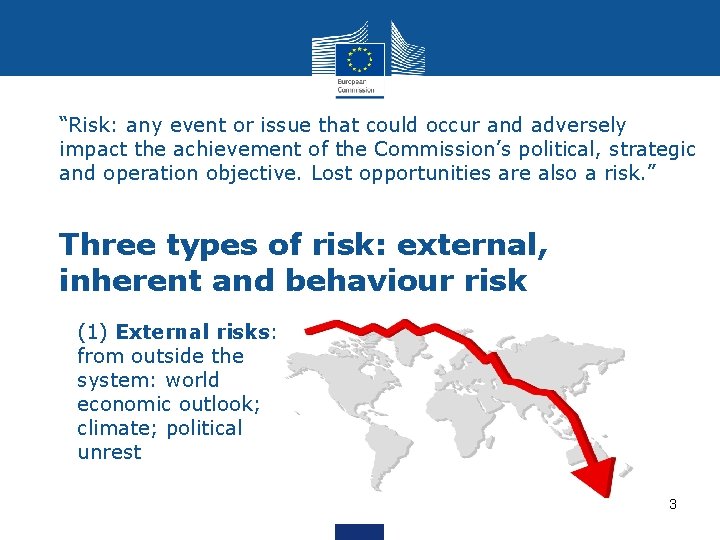
“Risk: any event or issue that could occur and adversely impact the achievement of the Commission’s political, strategic and operation objective. Lost opportunities are also a risk. ” Three types of risk: external, inherent and behaviour risk (1) External risks: from outside the system: world economic outlook; climate; political unrest 3

External, inherent and behaviour risk (2) Inherent risks: risks from within the system (omissions in oversight, weaknesses in control, lack of credibility) (3) Behavioural risks: deliberate misappropriation, fraud, abuse of power (social appreciation, adherence to the rule of law) 4
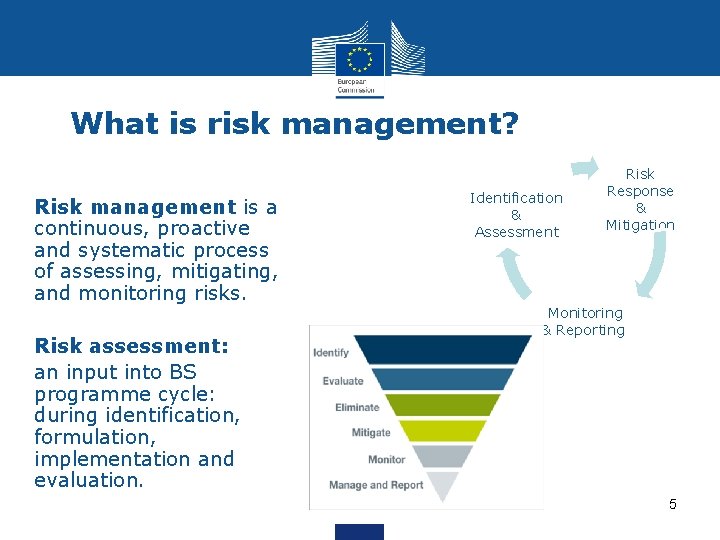
What is risk management? Risk management is a continuous, proactive and systematic process of assessing, mitigating, and monitoring risks. Risk assessment: an input into BS programme cycle: during identification, formulation, implementation and evaluation. Identification & Assessment Risk Response & Mitigation Monitoring & Reporting 5
Outline Module 3 1. Risk Management 2. Risk Management Framework 6
Main functions of the RMF provides basis for decision making process by: 1. Identifying specific risks (risk level) linked to the provision of BS (or cost of non-intervention) 2. Identifying mitigating measures and risk responses (risk strategy) 3. Informing Budget Support policy dialogue 4. Monitoring the identified risk and mitigating measures during implementation 5. Identification of changes over time: improvement / deterioration 7
How to assess risks 8
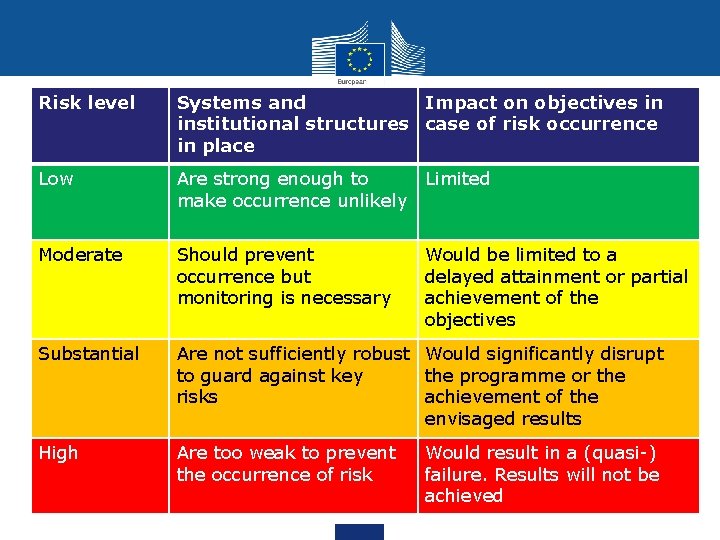
Risk level Systems and Impact on objectives in institutional structures case of risk occurrence in place Risk levels and acceptance Low Are strong enough to Limited make occurrence unlikely Moderate Should prevent occurrence but monitoring is necessary Substantial Are not sufficiently robust Would significantly disrupt to guard against key the programme or the risks achievement of the envisaged results High Are too weak to prevent the occurrence of risk Would be limited to a delayed attainment or partial achievement of the objectives Would result in a (quasi-) failure. Results will not be achieved

RMF components The RMF (2017 version) is composed of: • A Risk Questionnaire: Risk identification, and mitigating measures. Questionnaire consist of 44 questions • A Risk Profile: Summary for decision-makers One RMF for all contracts; sector specific risks can be differentiated 10
2017: update • Differentiation for developmental risks per sector (for SRPCs) • PFM: adapted to new 2016 PEFA Measurement Framework (both old and new PEFA-indicators) • Simplification of the RMF questionnaire for some selected SIDS (14 questions only covering each dimension); and OCT (10 dimensions). Simplified RMF Excel sheet available 11
Annual update RMF • End of year update: presentation January: one RMF for all BS operations • Update during the year in case of change to substantial or high • Internal EU tool; concerns are shared (i. e. with MS); the assessment is not public • Joint (government, DPs) search for mitigation factors • Mitigation activities can be performed by anyone (Government, DPs, EU) At the end: decision of risk acceptance or risk avoidance 12
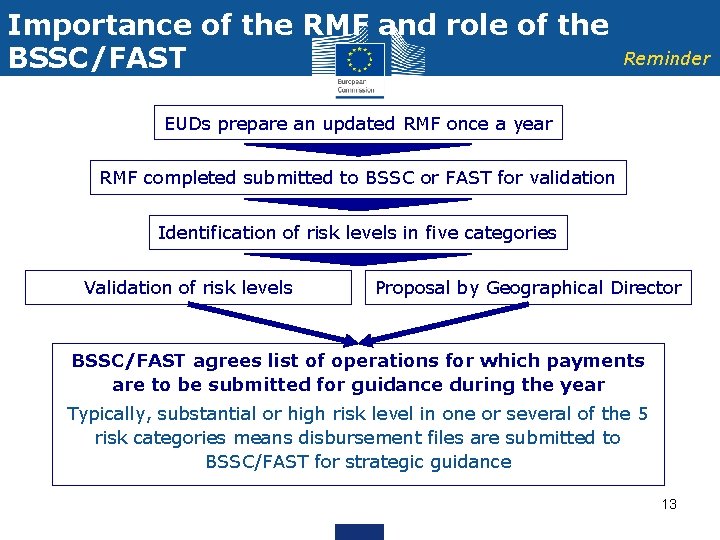
Importance of the RMF and role of the BSSC/FAST Reminder EUDs prepare an updated RMF once a year RMF completed submitted to BSSC or FAST for validation Identification of risk levels in five categories Validation of risk levels Proposal by Geographical Director BSSC/FAST agrees list of operations for which payments are to be submitted for guidance during the year Typically, substantial or high risk level in one or several of the 5 risk categories means disbursement files are submitted to BSSC/FAST for strategic guidance 13
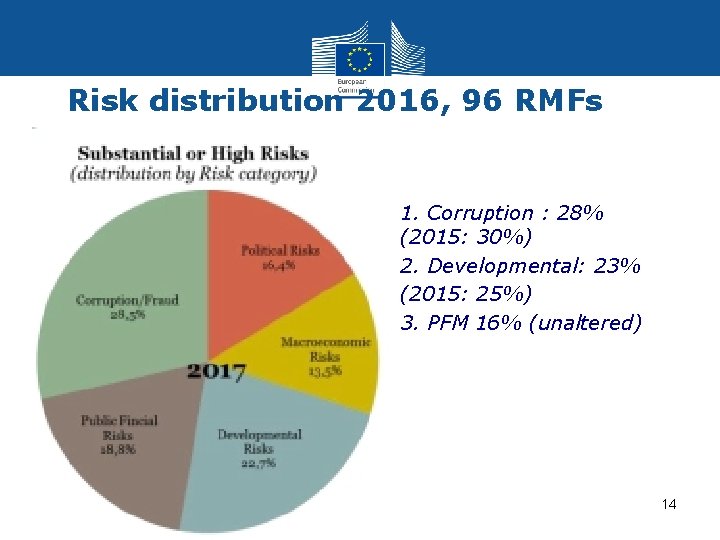
Risk distribution 2016, 96 RMFs • 1. Corruption : 28% (2015: 30%) • 2. Developmental: 23% • (2015: 25%) • 3. PFM 16% (unaltered) 14
Risk level implications § If the risk level for a risk dimension is substantial or high : Ø definition and implementation of clear and comprehensive action plan Ø Satisfactory progress is required during implementation § If the political risk is substantial or high in case of a SGD-C: Ø Comprehensive action plan and policy dialogue (gradual and proportional) 15
Examples of mitigation measures § Analyses and surveys (e. g. PEFA, PETS, PER…; political economy or drivers of change analysis) § Capacity development and technical cooperation § Enhancing transparency, accountability, participation in budget process § Policy dialogue § Performance indicators of the variable tranches (but without jeopardizing predictability) § Requirements: specific controls, legislation changes § Further adaptations regarding the design of a budget support programme § Proactive communication strategies (i. e. public acceptance of reforms) 16
Thank you for your attention 17
- Slides: 17