
Budget Finance Basics September 20 2019 Brent Johnston
Budget & Finance Basics September 20, 2019 Brent Johnston University Budget Officer & Director Office of Budget, Planning, and Analysis Office of Planning and Budgets 1
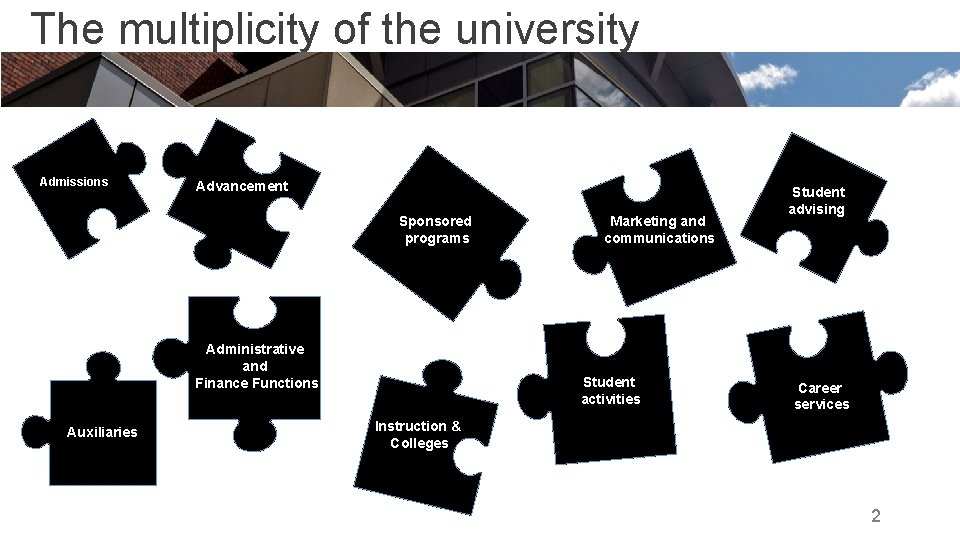
The multiplicity of the university Admissions Advancement Sponsored programs Administrative and Finance Functions Auxiliaries Marketing and communications Student activities Student advising Career services Instruction & Colleges 2
Purpose & Agenda To provide an overview of the financial structure, policies, processes, and language as you assume financial responsibility for your unit 1) 2) 3) 4) 5) 6) 7) Fund account structure Sub-funds/object codes Some specifics on the general fund Object codes Budget and planning Endowment spending Resources and contacts Administrative and Finance Functions 3
Contacts David Byelich Associate Vice President and Director Office of Planning and Budgets 517 -355 -9271 Byelich@msu. edu Brent Johnston University Budget Officer & Director Budget Planning and Analysis Office of Planning and Budgets 517 -353 -5519 john 1096@msu. edu Barbara Kranz Director Facilities Planning and Space Management Office of Planning and Budgets 517 -355 -9271 kranzb@opb. msu. edu Bethan Cantwell Director Institutional Research Office of Planning and Budgets 517 -355 -9273 cantwellb@msu. edu Lee Hunter Chief Accountant & Manager of Financial Reporting Office of the Controller 517 -355 -9271 hunerti@msu. edu Greg Deppong University Controller Office of the Controller 517 -355 -5020 deppong@msu. edu Debbie Gulliver University Travel Manager Officer of the Controller 517 -355 -5000 gullive 5@cltr. msu. edu Katie Cook Director Office of Sponsored Programs 517 -884 -4237 farrkat 1@osp. msu. edu Kara Yermak Assistant Director AP/AVP for Academic Human Resources 517 -884 -0185 burtkara@provost. msu. edu HR Solutions Center 517 -353 -4434 Solutionscenter@hr. msu. edu Evo Pedawi Director Contracts and Grants Post Award 517 -884 -4234 pedawi@cga. msu. edu 4

Financial Structure 5
Fund Accounting Concepts • Follows Governmental Accounting Standards Board (GASB) • Separates funds by source and restriction • Helps ensure funds are used for intended/defined purposes • Maintains separation of restricted (endowments, gifts, grants) from unrestricted (auxiliary services, general fund, fee-forservice) funds 6
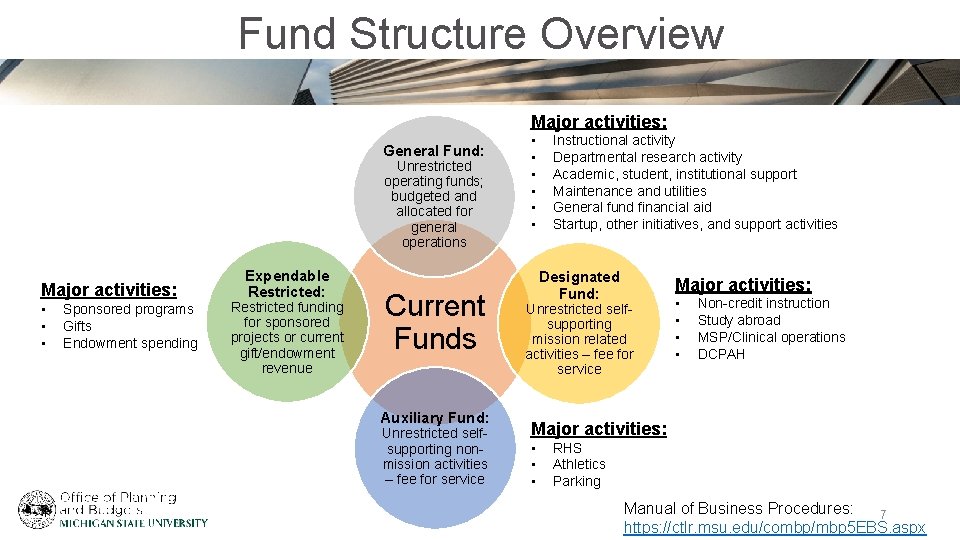
Fund Structure Overview Major activities: General Fund: Unrestricted operating funds; budgeted and allocated for general operations Major activities: • • • Sponsored programs Gifts Endowment spending Expendable Restricted: Restricted funding for sponsored projects or current gift/endowment revenue Current Funds Auxiliary Fund: Unrestricted selfsupporting nonmission activities – fee for service • • • Instructional activity Departmental research activity Academic, student, institutional support Maintenance and utilities General fund financial aid Startup, other initiatives, and support activities Designated Fund: Major activities: Unrestricted selfsupporting mission related activities – fee for service • • Non-credit instruction Study abroad MSP/Clinical operations DCPAH Major activities: • • • RHS Athletics Parking Manual of Business Procedures: 7 https: //ctlr. msu. edu/combp/mbp 5 EBS. aspx
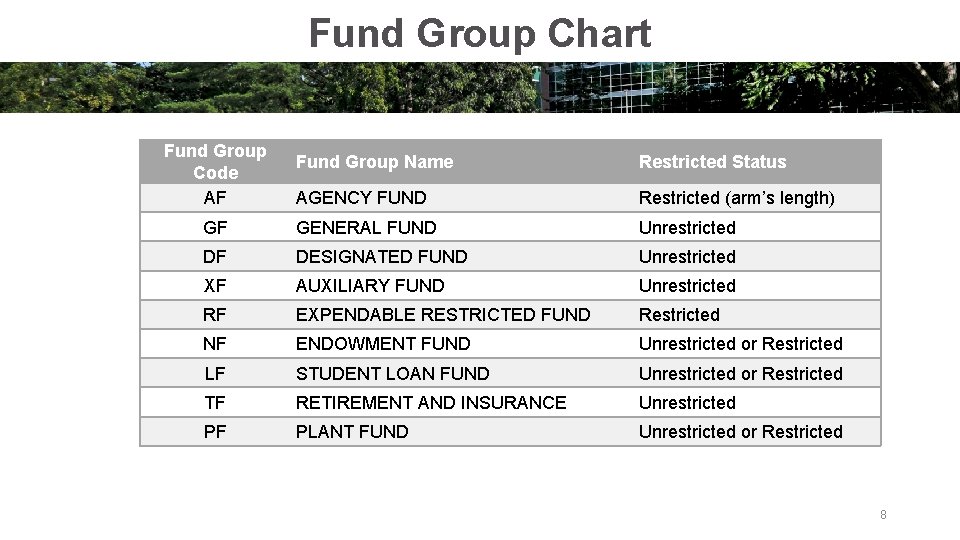
Fund Group Chart Fund Group Code AF Fund Group Name Restricted Status AGENCY FUND Restricted (arm’s length) GF GENERAL FUND Unrestricted DF DESIGNATED FUND Unrestricted XF AUXILIARY FUND Unrestricted RF EXPENDABLE RESTRICTED FUND Restricted NF ENDOWMENT FUND Unrestricted or Restricted LF STUDENT LOAN FUND Unrestricted or Restricted TF RETIREMENT AND INSURANCE Unrestricted PF PLANT FUND Unrestricted or Restricted 8
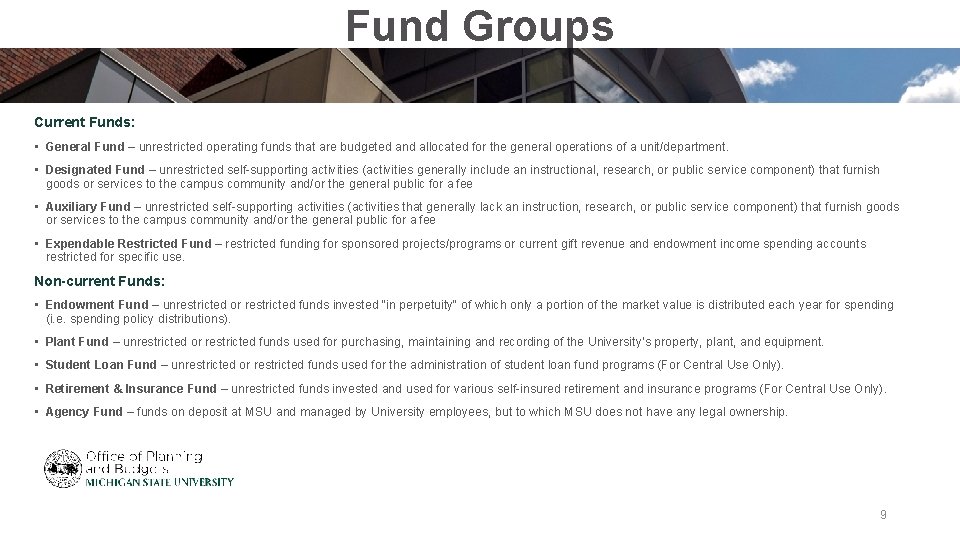
Fund Groups Current Funds: • General Fund – unrestricted operating funds that are budgeted and allocated for the general operations of a unit/department. • Designated Fund – unrestricted self-supporting activities (activities generally include an instructional, research, or public service component) that furnish goods or services to the campus community and/or the general public for a fee • Auxiliary Fund – unrestricted self-supporting activities (activities that generally lack an instruction, research, or public service component) that furnish goods or services to the campus community and/or the general public for a fee • Expendable Restricted Fund – restricted funding for sponsored projects/programs or current gift revenue and endowment income spending accounts restricted for specific use. Non-current Funds: • Endowment Fund – unrestricted or restricted funds invested "in perpetuity" of which only a portion of the market value is distributed each year for spending (i. e. spending policy distributions). • Plant Fund – unrestricted or restricted funds used for purchasing, maintaining and recording of the University’s property, plant, and equipment. • Student Loan Fund – unrestricted or restricted funds used for the administration of student loan fund programs (For Central Use Only). • Retirement & Insurance Fund – unrestricted funds invested and used for various self-insured retirement and insurance programs (For Central Use Only). • Agency Fund – funds on deposit at MSU and managed by University employees, but to which MSU does not have any legal ownership. 9
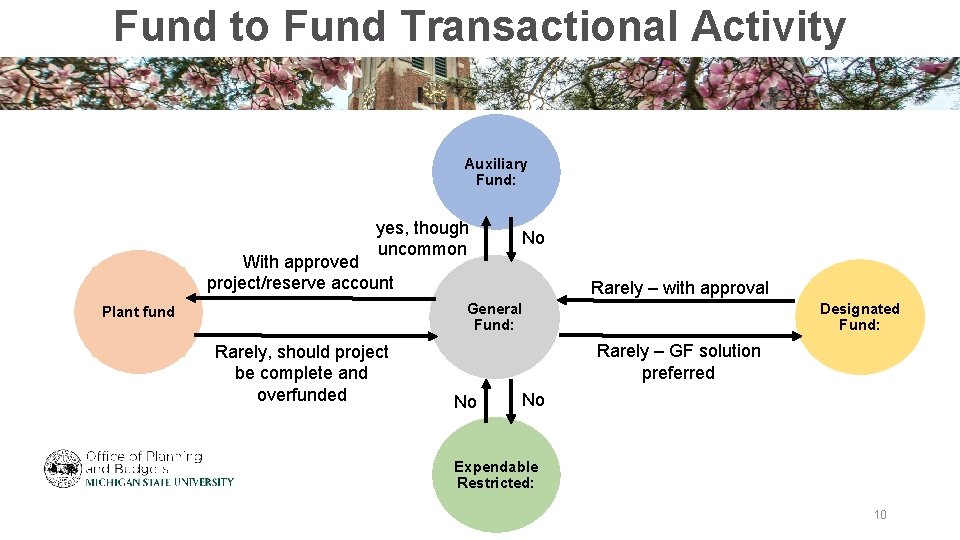
Fund to Fund Transactional Activity Auxiliary Fund: yes, though uncommon No With approved project/reserve account Rarely – with approval Designated Fund: General Fund: Plant fund Rarely, should project be complete and overfunded Rarely – GF solution preferred No No Expendable Restricted: 10
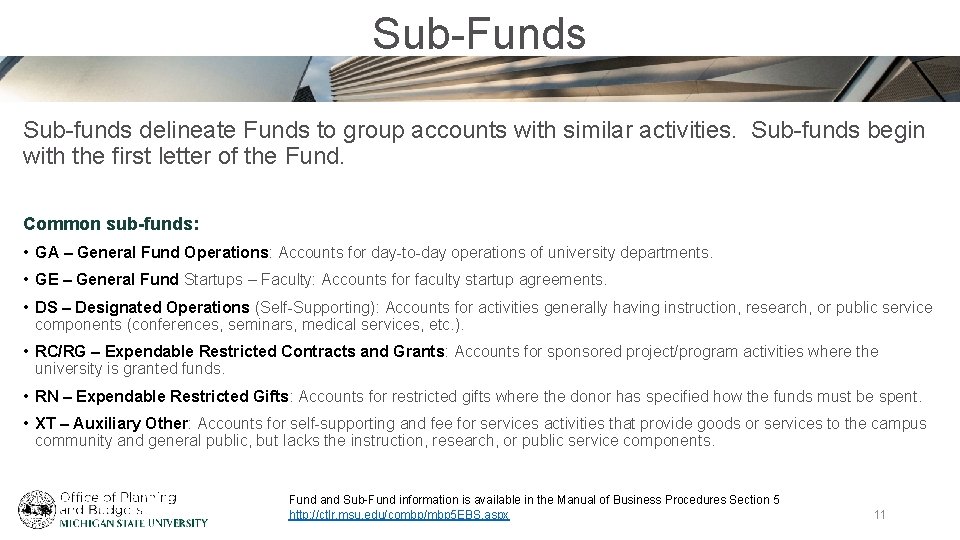
Sub-Funds Sub-funds delineate Funds to group accounts with similar activities. Sub-funds begin with the first letter of the Fund. Common sub-funds: • GA – General Fund Operations: Accounts for day-to-day operations of university departments. • GE – General Fund Startups – Faculty: Accounts for faculty startup agreements. • DS – Designated Operations (Self-Supporting): Accounts for activities generally having instruction, research, or public service components (conferences, seminars, medical services, etc. ). • RC/RG – Expendable Restricted Contracts and Grants: Accounts for sponsored project/program activities where the university is granted funds. • RN – Expendable Restricted Gifts: Accounts for restricted gifts where the donor has specified how the funds must be spent. • XT – Auxiliary Other: Accounts for self-supporting and fee for services activities that provide goods or services to the campus community and general public, but lacks the instruction, research, or public service components. Fund and Sub-Fund information is available in the Manual of Business Procedures Section 5 http: //ctlr. msu. edu/combp/mbp 5 EBS. aspx 11
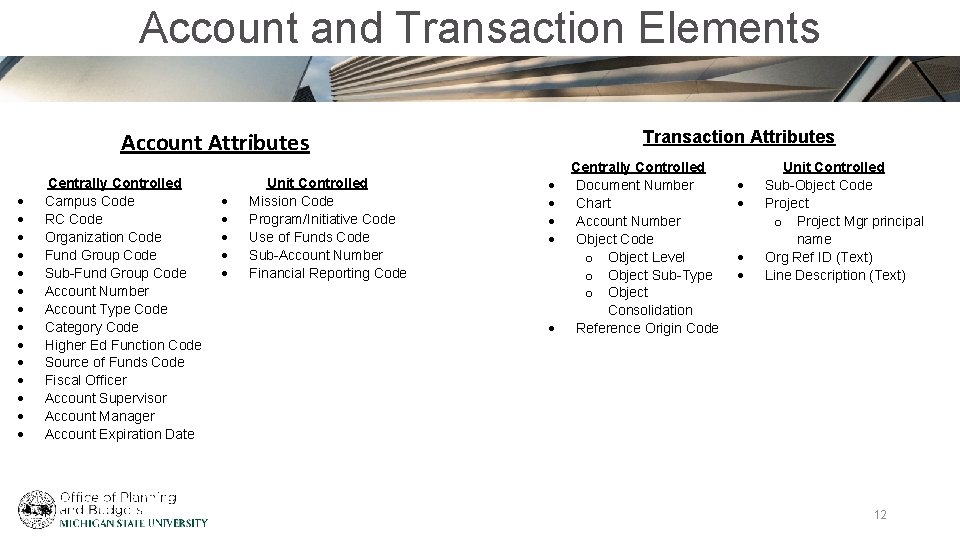
Account and Transaction Elements Account Attributes Centrally Controlled Campus Code RC Code Organization Code Fund Group Code Sub-Fund Group Code Account Number Account Type Code Category Code Higher Ed Function Code Source of Funds Code Fiscal Officer Account Supervisor Account Manager Account Expiration Date Unit Controlled Mission Code Program/Initiative Code Use of Funds Code Sub-Account Number Financial Reporting Code Transaction Attributes Centrally Controlled Document Number Chart Account Number Object Code o Object Level o Object Sub-Type o Object Consolidation Reference Origin Code Unit Controlled Sub-Object Code Project o Project Mgr principal name Org Ref ID (Text) Line Description (Text) 12
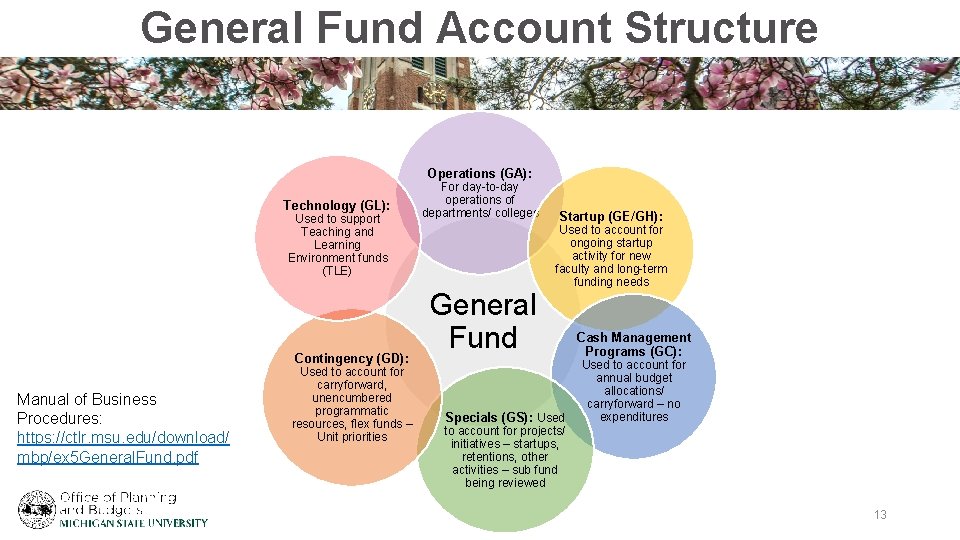
General Fund Account Structure Operations (GA): Technology (GL): Used to support Teaching and Learning Environment funds (TLE) Contingency (GD): Manual of Business Procedures: https: //ctlr. msu. edu/download/ mbp/ex 5 General. Fund. pdf Used to account for carryforward, unencumbered programmatic resources, flex funds – Unit priorities For day-to-day operations of departments/ colleges Startup (GE/GH): Used to account for ongoing startup activity for new faculty and long-term funding needs General Fund Specials (GS): Used to account for projects/ initiatives – startups, retentions, other activities – sub fund being reviewed Cash Management Programs (GC): Used to account for annual budget allocations/ carryforward – no expenditures 13
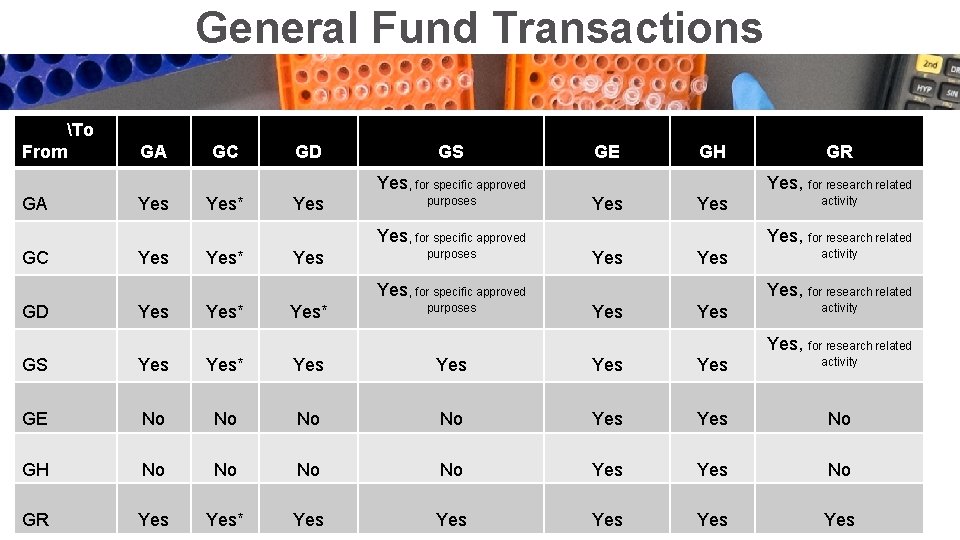
General Fund Transactions To From GA GC GD GS GE GH Yes, for specific approved GA Yes* Yes purposes Yes, for research related Yes Yes, for specific approved GC Yes* Yes purposes GD Yes* activity Yes, for research related Yes Yes, for specific approved purposes GR activity Yes, for research related Yes activity Yes, for research related GS Yes* Yes Yes activity GE No No Yes No GH No No Yes No GR Yes* Yes Yes Yes 14
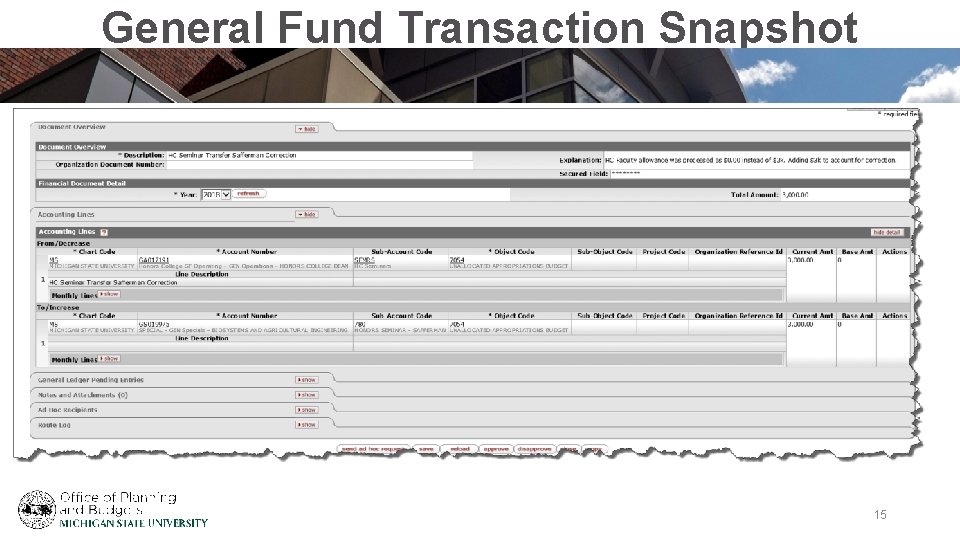
General Fund Transaction Snapshot 15
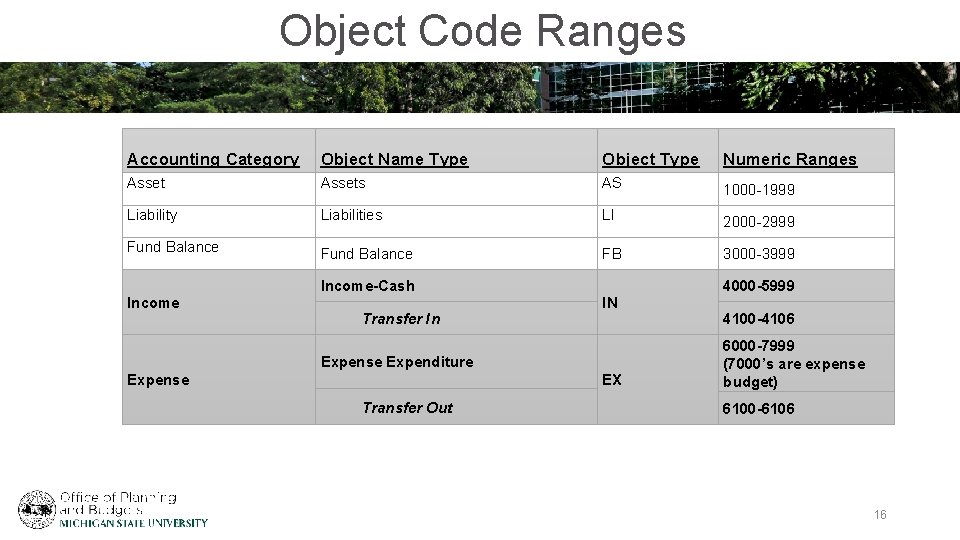
Object Code Ranges Accounting Category Object Name Type Object Type Numeric Ranges Assets AS 1000 -1999 Liability Liabilities LI 2000 -2999 Fund Balance FB 3000 -3999 Income-Cash Transfer In IN Expense Expenditure Expense EX Transfer Out 4000 -5999 4100 -4106 6000 -7999 (7000’s are expense budget) 6100 -6106 16
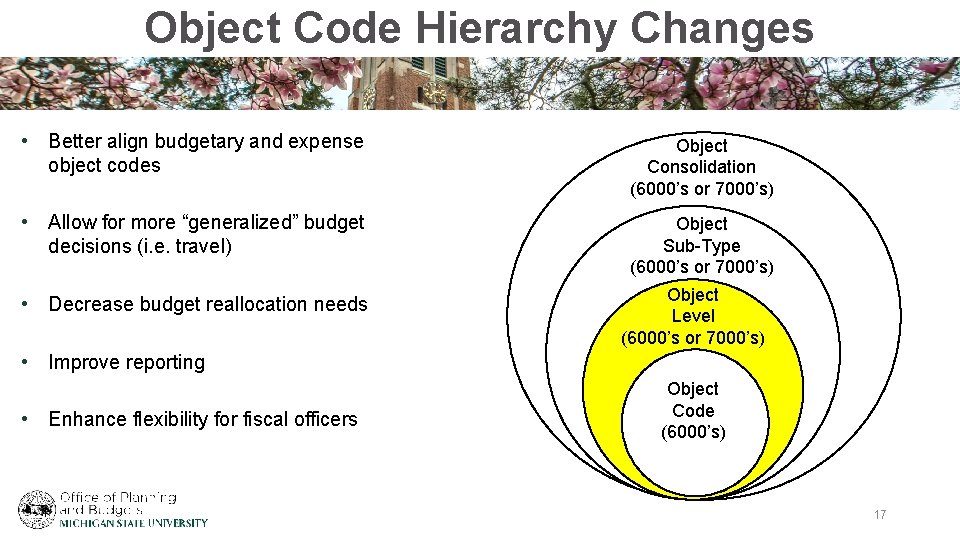
Object Code Hierarchy Changes • Better align budgetary and expense object codes Object Consolidation (6000’s or 7000’s) • Allow for more “generalized” budget decisions (i. e. travel) Object Sub-Type (6000’s or 7000’s) • Decrease budget reallocation needs Object Level (6000’s or 7000’s) • Improve reporting • Enhance flexibility for fiscal officers Object Code (6000’s) 17

Budget and Planning 18
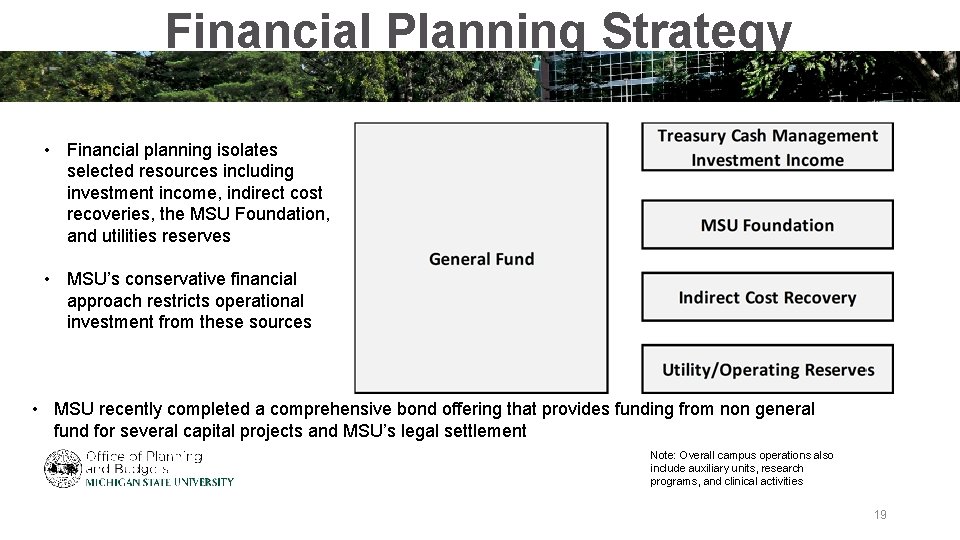
Financial Planning Strategy • Financial planning isolates selected resources including investment income, indirect cost recoveries, the MSU Foundation, and utilities reserves • MSU’s conservative financial approach restricts operational investment from these sources • MSU recently completed a comprehensive bond offering that provides funding from non general fund for several capital projects and MSU’s legal settlement Note: Overall campus operations also include auxiliary units, research programs, and clinical activities 19
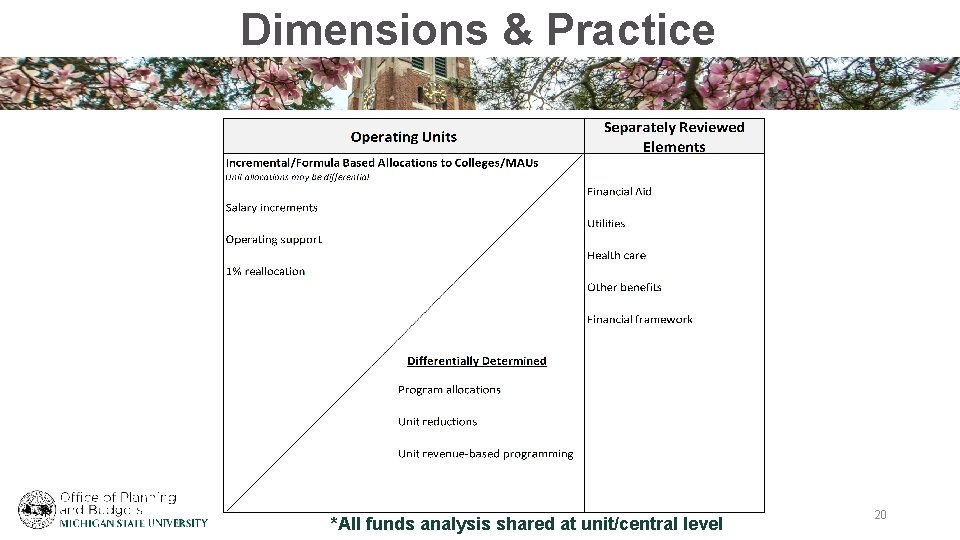
Dimensions & Practice *All funds analysis shared at unit/central level 20
Budget Planning Structure • Incremental budget framework for most units • Utilizes an ongoing budget that includes both recurring and non-recurring components Recurring elements include: • Programmatic investments • Annual reallocations • Salary increments • Supplies and services increments • • • Significant institutional activities separately planned for, including: • Financial aid • Fringe benefits • Utilities • Differential programmatic investments • Financial framework provides a planning mechanism for leadership to identify priorities and estimate funding over a multi-year horizon Activity-based allocations provided for revenue generating activity and include: • Off-campus/online credit instruction • Indirect cost recovery 21
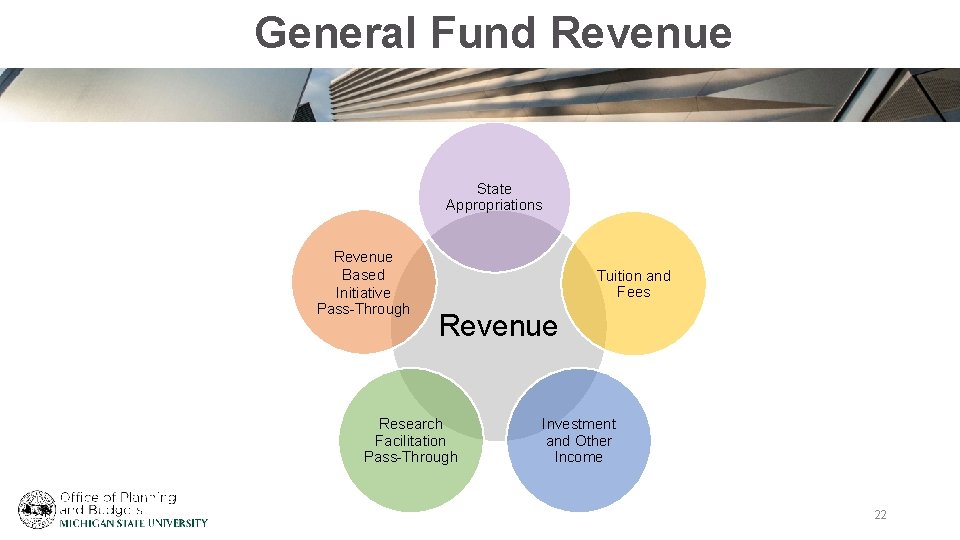
General Fund Revenue State Appropriations Revenue Based Initiative Pass-Through Tuition and Fees Revenue Research Facilitation Pass-Through Investment and Other Income 22
General Fund Revenue State Appropriations • Monitor state actions Tuition • Size and composition of entering class • Core and professional college tuition rates • Monitor debt levels Investment and Other Income • Monitor market performance for sustainability and adjustment Research Facilitation Pass-Through • Federal budget impact on indirect cost realization • Ability to sustain 3% growth projection for research facilitation pass-through Revenue-Based Initiatives Pass-Through • Review pass-through revenue projections 23
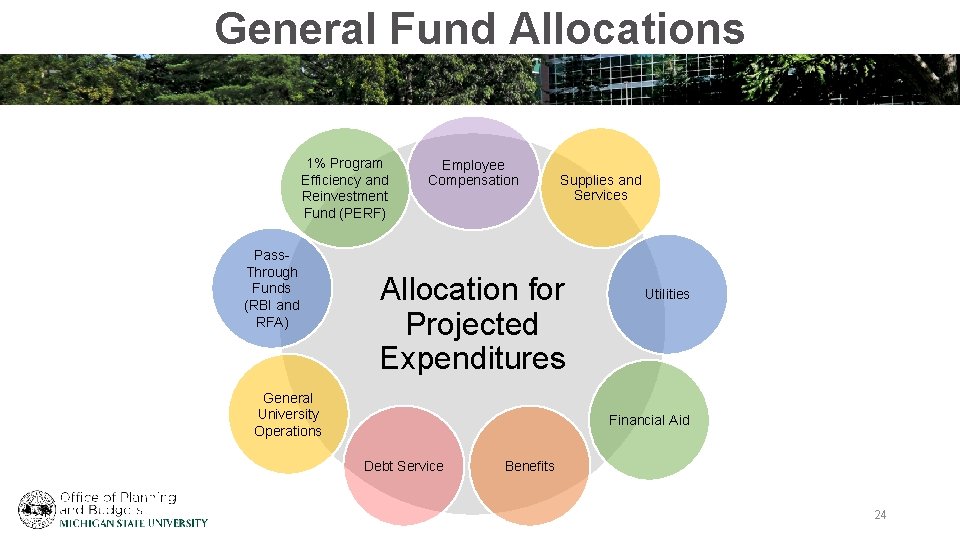
General Fund Allocations 1% Program Efficiency and Reinvestment Fund (PERF) Pass. Through Funds (RBI and RFA) Employee Compensation Supplies and Services Allocation for Projected Expenditures General University Operations Utilities Financial Aid Debt Service Benefits 24
General Fund Allocations Employee Compensation • Fund faculty salary components – shifting balance salary to compensation • Monitor peer group – target median • Fund increases per bargaining agreements • Assess health care and salary increment trade-off Supplies and Services • Approximate inflation Financial Aid • Allocations to build/sustain non-resident student population • Assess aid needs as policy changes – need-based, merit-based, etc Benefits • Transition of health care plan design, market and legislative environment 25
General Fund Allocations General University Operations • Analysis of planning profiles submissions • Strategic priorities • Critical space and capital projects Revenue Based Initiatives and Research Facilitation Pass-Through • Monitor evolving policy changes • Fund annual performance amounts One percent Program Efficiency and Reinvestment Funds (PERF) • Each unit is assessed a one-percent efficiency factor annually. • The funds generated through this process are reallocated across the university for initiatives identified through the planning process. 26
Fringe Benefits • MSU recovers costs related to fringe benefits through Specific Identification • Covers four significant fringe cost categories 1) Retirement – 10% of salary (if participating, mandatory after five years, age 35) 2) FICA – 7. 65% (portion capped at specific salary) 3) Healthcare, dental, prescription drugs - $15, 480 4) Other/misc - 1. 4% - life insurance, workers comp, other misc benefits • Graduate assistant fringe benefits charged where incurred • GA specific identification varies from above – assessed bi-weekly https: //www. cga. msu. edu/PL/Portal/95/20192020 Fringe. Benefitsfor. Sponsored. Projects 27
Draft OCC/RBI Policy Update • For activity up to FY 18 allocation amount: • Allocation parameters honor existing practice • FY 18 allocation threshold modified for OCCI to RBI conversions • For activity beyond FY 18 allocation amount (interim): • Credit hour and revenue-share parameters unchanged for initial analysis • FY 18 OCCI allocation totals modified for total growth in undergraduate credit hours • Revised FY 18 totals create maximum allocation level for FY 20 • In instances of undergraduate credit hour decline, unmodified FY 18 totals remain for maximum allocation levels • FY 20 allocations lesser of actual OCCI allocation or FY 18 ceiling 28
General Fund Carryfoward • University policy for assessing year-end balances • Pertinent to the GF only, other funds roll-forward automatically • Most GF sub-funds now carryforward automatically • GF operational funds (GA, GC, GD sub-funds) assessed against a percentage of GF budget (4% in FY 18) • Operational balances in excess of threshold require written memo to OPB/CFO for carryforward • Most requests approved as submitted 29
Emerging Environment • Programmatic stability and prominence – 32 programs in the top-25 nationally, top-100 in the world, AAU membership -- Increasing prominence and cost of active learning and STEM disciplines • Increased competition to recruit and retain top faculty including salary as well as start-up requirements • Growing accountability for student success, student safety, and Title IX objectives • MSU increasingly competitive for federal support. However, federal R&D spending lags inflation, longer term Federal outlook unclear • Intensifying focus on competitive tuition rates, financial hardship and related student debt and completion • Threats to non-resident enrollment targets and composition – falling State and regional demographics, increasing institutional competition – offset by rising college-going rates • Need to prioritize programmatic and capital improvements • Insurance and other operational cost pressures – focus on productivity and efficiency • Opportunities to reach different student markets – online education, Kaplan, etc 30
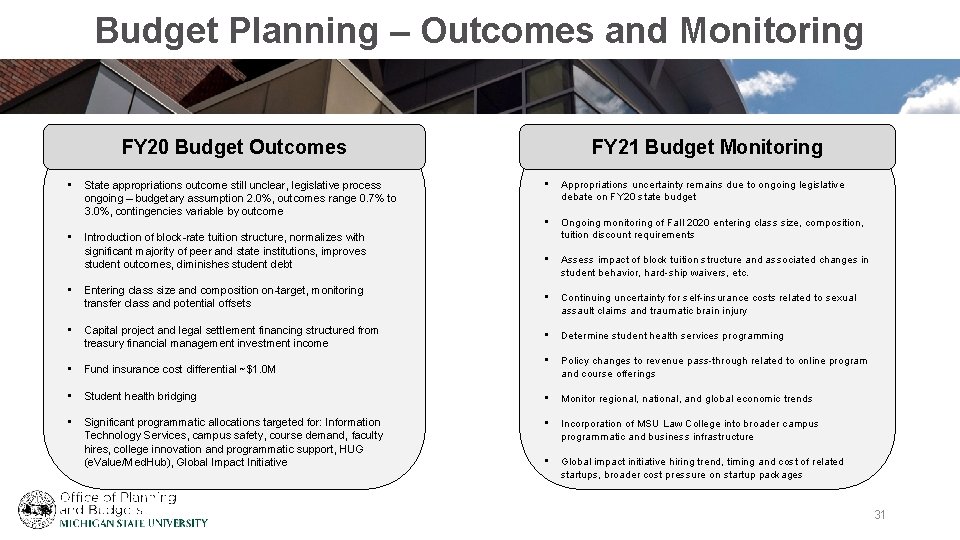
Budget Planning – Outcomes and Monitoring FY 21 Budget Monitoring FY 20 Budget Outcomes • • State appropriations outcome still unclear, legislative process ongoing – budgetary assumption 2. 0%, outcomes range 0. 7% to 3. 0%, contingencies variable by outcome Introduction of block-rate tuition structure, normalizes with significant majority of peer and state institutions, improves student outcomes, diminishes student debt • Appropriations uncertainty remains due to ongoing legislative debate on FY 20 state budget • Ongoing monitoring of Fall 2020 entering class size, composition, tuition discount requirements • Assess impact of block tuition structure and associated changes in student behavior, hard-ship waivers, etc. • Entering class size and composition on-target, monitoring transfer class and potential offsets • Continuing uncertainty for self-insurance costs related to sexual assault claims and traumatic brain injury • Capital project and legal settlement financing structured from treasury financial management investment income • Determine student health services programming • Fund insurance cost differential ~$1. 0 M • Policy changes to revenue pass-through related to online program and course offerings • Student health bridging • Monitor regional, national, and global economic trends • Significant programmatic allocations targeted for: Information Technology Services, campus safety, course demand, faculty hires, college innovation and programmatic support, HUG (e. Value/Med. Hub), Global Impact Initiative • Incorporation of MSU Law College into broader campus programmatic and business infrastructure • Global impact initiative hiring trend, timing and cost of related startups, broader cost pressure on startup packages 31
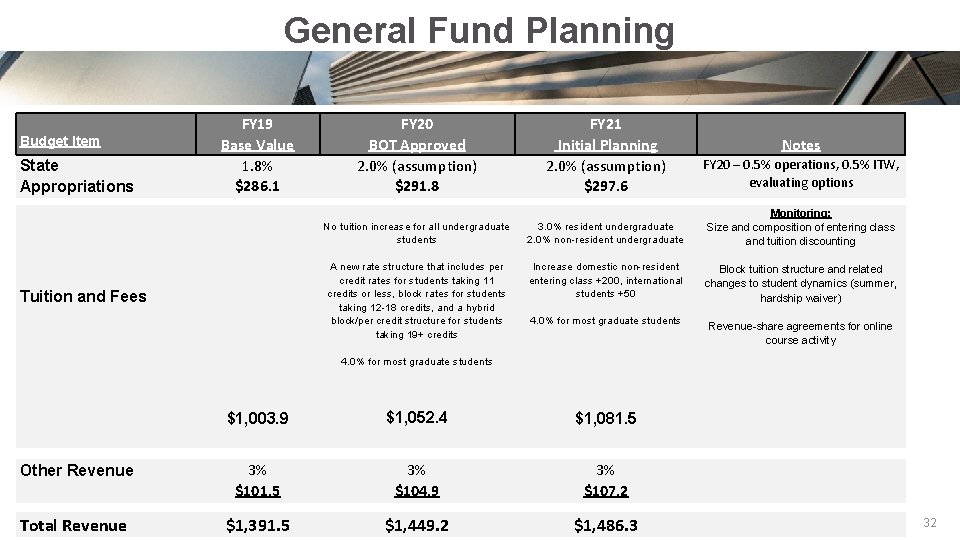
General Fund Planning Budget Item State Appropriations FY 19 Base Value 1. 8% $286. 1 Tuition and Fees FY 20 BOT Approved 2. 0% (assumption) $291. 8 FY 21 Initial Planning 2. 0% (assumption) $297. 6 FY 20 – 0. 5% operations, 0. 5% ITW, evaluating options No tuition increase for all undergraduate students 3. 0% resident undergraduate 2. 0% non-resident undergraduate Monitoring: Size and composition of entering class and tuition discounting A new rate structure that includes per credit rates for students taking 11 credits or less, block rates for students taking 12 -18 credits, and a hybrid block/per credit structure for students taking 19+ credits Increase domestic non-resident entering class +200, international students +50 Block tuition structure and related changes to student dynamics (summer, hardship waiver) 4. 0% for most graduate students Revenue-share agreements for online course activity Notes 4. 0% for most graduate students $1, 003. 9 $1, 052. 4 $1, 081. 5 Other Revenue 3% $101. 5 3% $104. 9 3% $107. 2 Total Revenue $1, 391. 5 $1, 449. 2 $1, 486. 3 32
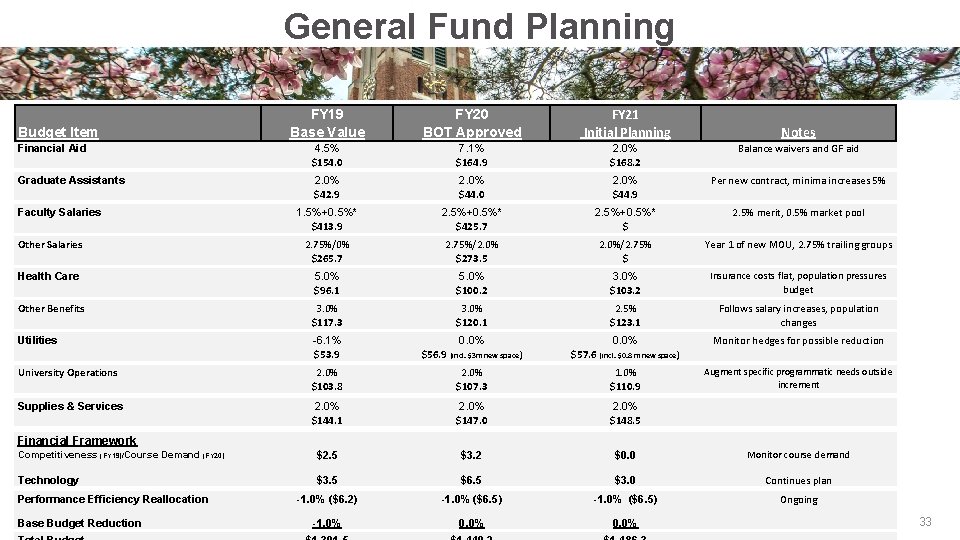
General Fund Planning Budget Item FY 19 Base Value FY 20 BOT Approved FY 21 Initial Planning Notes Financial Aid 4. 5% $154. 0 7. 1% $164. 9 2. 0% $168. 2 Balance waivers and GF aid Graduate Assistants 2. 0% $42. 9 2. 0% $44. 0 2. 0% $44. 9 Per new contract, minima increases 5% 1. 5%+0. 5%* $413. 9 2. 5%+0. 5%* $425. 7 2. 5%+0. 5%* $ 2. 5% merit, 0. 5% market pool Other Salaries 2. 75%/0% $265. 7 2. 75%/2. 0% $273. 5 2. 0%/2. 75% $ Year 1 of new MOU, 2. 75% trailing groups Health Care 5. 0% $96. 1 5. 0% $100. 2 3. 0% $103. 2 Insurance costs flat, population pressures budget Other Benefits 3. 0% $117. 3 3. 0% $120. 1 2. 5% $123. 1 Follows salary increases, population changes Utilities -6. 1% $53. 9 0. 0% Monitor hedges for possible reduction $56. 9 (incl. $3 m new space) $57. 6 (incl. $0. 8 m new space) University Operations 2. 0% $103. 8 2. 0% $107. 3 1. 0% $110. 9 Supplies & Services 2. 0% $144. 1 2. 0% $147. 0 2. 0% $148. 5 Competitiveness (FY 19)/Course Demand (FY 20) $2. 5 $3. 2 $0. 0 Monitor course demand Technology $3. 5 $6. 5 $3. 0 Continues plan -1. 0% ($6. 2) -1. 0% ($6. 5) Ongoing -1. 0% 0. 0% Faculty Salaries Augment specific programmatic needs outside increment Financial Framework Performance Efficiency Reallocation Base Budget Reduction 33
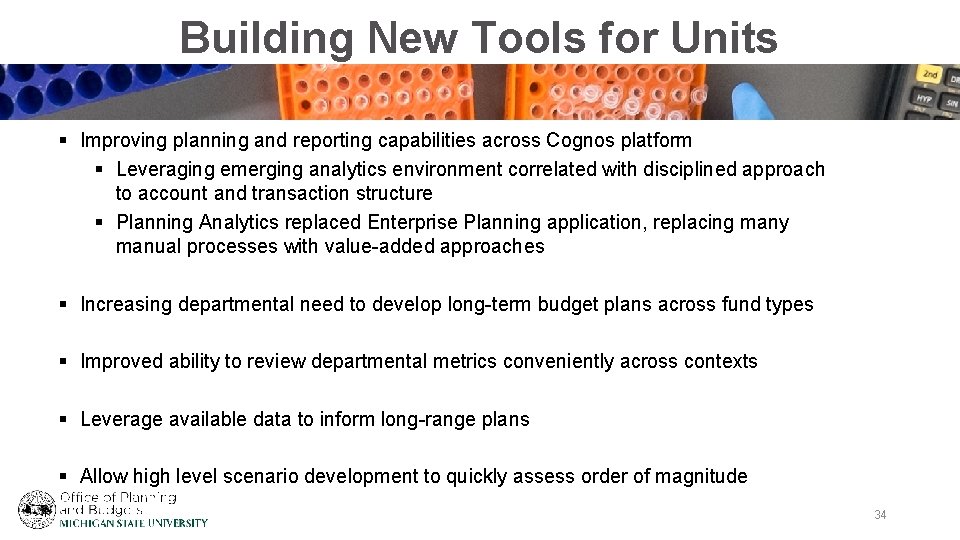
Building New Tools for Units § Improving planning and reporting capabilities across Cognos platform § Leveraging emerging analytics environment correlated with disciplined approach to account and transaction structure § Planning Analytics replaced Enterprise Planning application, replacing many manual processes with value-added approaches § Increasing departmental need to develop long-term budget plans across fund types § Improved ability to review departmental metrics conveniently across contexts § Leverage available data to inform long-range plans § Allow high level scenario development to quickly assess order of magnitude 34
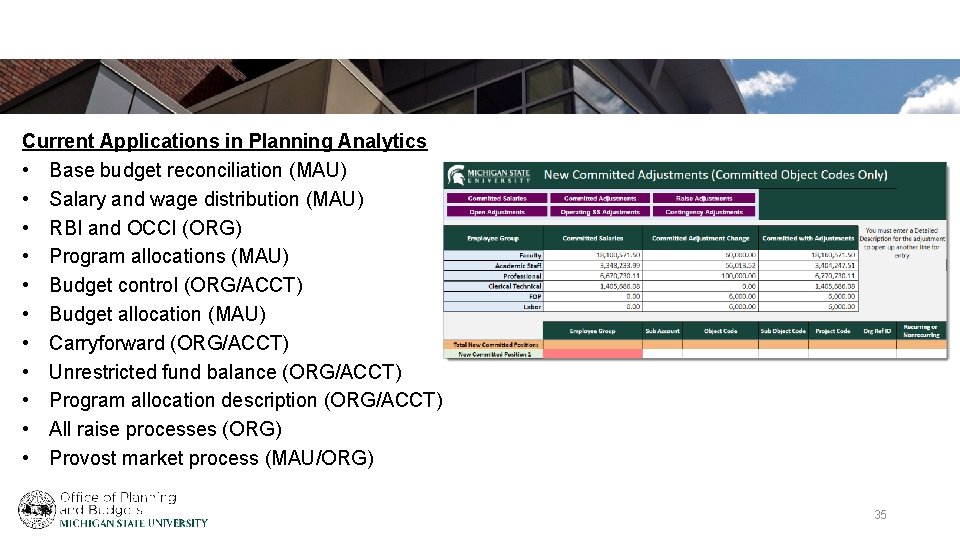
Planning Analytics Current Applications in Planning Analytics • Base budget reconciliation (MAU) • Salary and wage distribution (MAU) • RBI and OCCI (ORG) • Program allocations (MAU) • Budget control (ORG/ACCT) • Budget allocation (MAU) • Carryforward (ORG/ACCT) • Unrestricted fund balance (ORG/ACCT) • Program allocation description (ORG/ACCT) • All raise processes (ORG) • Provost market process (MAU/ORG) 35
Endowment and Endowment Spending 36
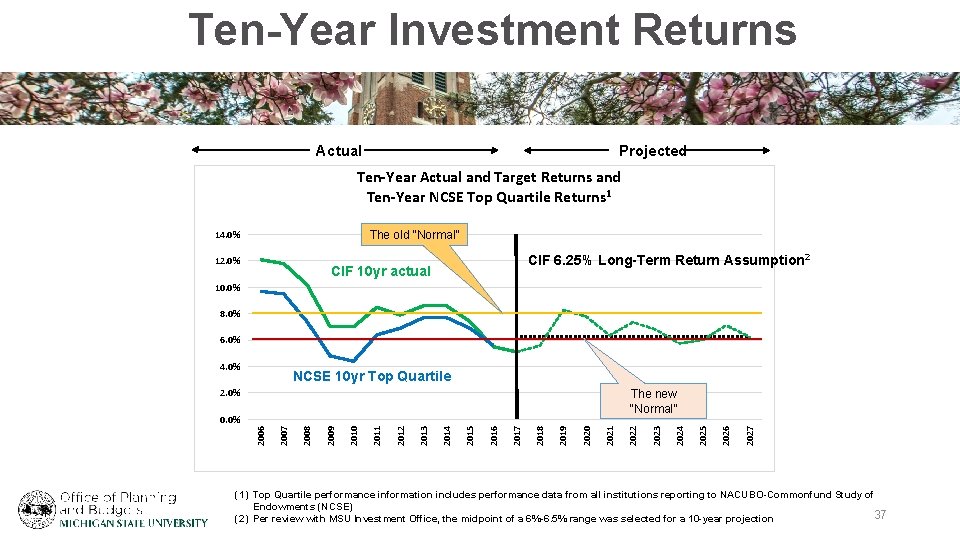
Ten-Year Investment Returns Actual Projected Ten-Year Actual and Target Returns and Ten-Year NCSE Top Quartile Returns 1 The old “Normal” 14. 0% 12. 0% CIF 6. 25% Long-Term Return Assumption 2 CIF 10 yr actual 10. 0% 8. 0% 6. 0% 4. 0% NCSE 10 yr Top Quartile 2. 0% 2027 2026 2025 2024 2023 2021 2020 2019 2018 2017 2016 2015 2014 2013 2012 2011 2010 2009 2008 2007 2006 0. 0% 2022 The new “Normal” (1) Top Quartile performance information includes performance data from all institutions reporting to NACUBO-Commonfund Study of Endowments (NCSE) 37 (2) Per review with MSU Investment Office, the midpoint of a 6%-6. 5% range was selected for a 10 -year projection
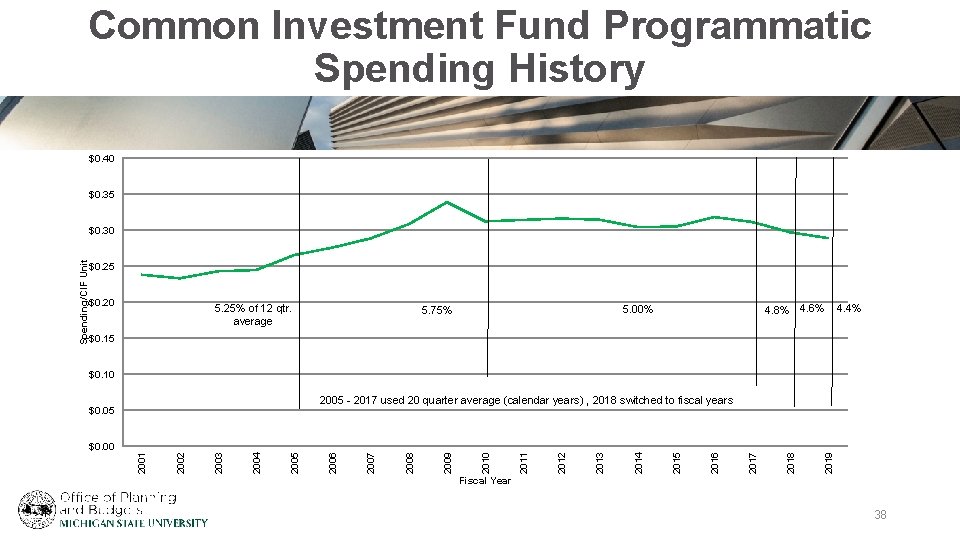
Common Investment Fund Programmatic Spending History $0. 40 $0. 35 $0. 20 5. 25% of 12 qtr. average 4. 8% 4. 6% 5. 00% 5. 75% 4. 4% $0. 15 $0. 10 2019 2018 2017 2016 2015 2014 2013 2012 2011 2010 2009 2008 2007 2005 2004 2003 2002 $0. 00 2006 2005 - 2017 used 20 quarter average (calendar years) , 2018 switched to fiscal years $0. 05 2001 Spending/CIF Unit $0. 30 Fiscal Year 38
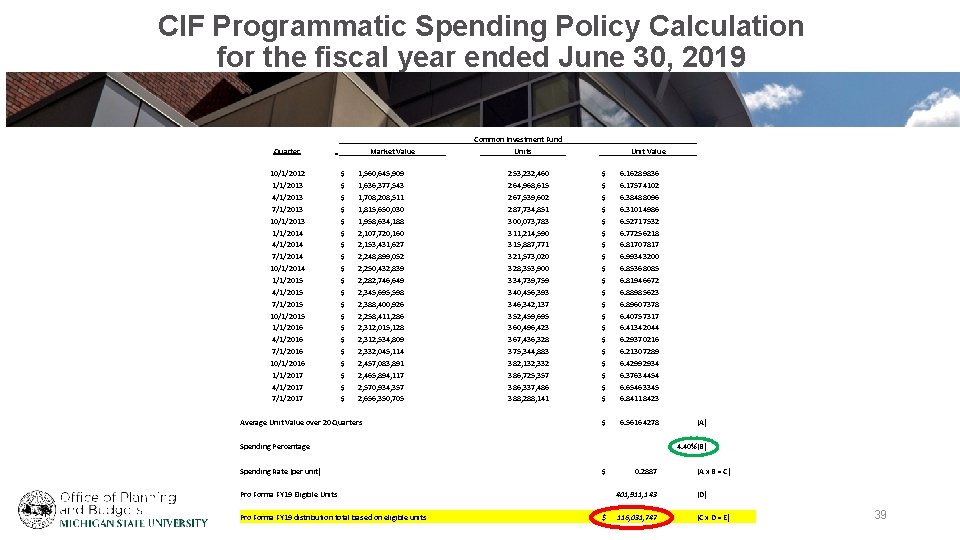
CIF Programmatic Spending Policy Calculation for the fiscal year ended June 30, 2019 Quarter 10/1/2012 1/1/2013 4/1/2013 7/1/2013 10/1/2013 1/1/2014 4/1/2014 7/1/2014 10/1/2014 1/1/2015 4/1/2015 7/1/2015 10/1/2015 1/1/2016 4/1/2016 7/1/2016 10/1/2016 1/1/2017 4/1/2017 7/1/2017 Market Value $ $ $ $ $ 1, 560, 645, 909 1, 636, 377, 543 1, 708, 208, 511 1, 815, 650, 030 1, 958, 634, 188 2, 107, 720, 160 2, 153, 431, 627 2, 248, 899, 052 2, 250, 432, 839 2, 282, 746, 649 2, 345, 695, 598 2, 388, 400, 926 2, 258, 411, 286 2, 312, 015, 128 2, 312, 534, 809 2, 332, 045, 114 2, 457, 083, 891 2, 465, 894, 117 2, 570, 934, 357 2, 656, 350, 705 Average Unit Value over 20 Quarters Common Investment Fund Units 253, 232, 460 264, 968, 615 267, 539, 602 287, 734, 851 300, 073, 783 311, 214, 590 315, 887, 771 321, 573, 020 328, 353, 900 334, 739, 759 340, 456, 393 346, 342, 137 352, 459, 695 360, 496, 423 367, 436, 328 375, 344, 883 382, 132, 332 386, 725, 357 386, 337, 486 388, 288, 141 Unit Value $ $ $ $ $ 6. 16289836 6. 17574102 6. 38488096 6. 31014986 6. 52717532 6. 77256218 6. 81707817 6. 99343200 6. 85368085 6. 81946672 6. 88985623 6. 89607378 6. 40757317 6. 41342044 6. 29370216 6. 21307289 6. 42992934 6. 37634454 6. 65463345 6. 84118423 $ 6. 56164278 Spending Percentage Spending Rate (per unit) 4. 40%(B) $ Pro Forma FY 19 Eligible Units Pro Forma FY 19 distribution total based on eligible units (A) $ 0. 2887 (A x B = C) 401, 911, 143 (D) 116, 031, 747 (C x D = E) 39

Resources and Contacts 40
Policy and Procedure References Manual of Business Procedures: http: //ctlr. msu. edu/combp/ Budget Resource Guide: https: //opb. msu. edu/budget. App/download/2017 -18 Instructions. For. Completing. Unit. Budgets. pdf Other technical budget process resource guides: https: //opb. msu. edu/functions/budget/cognos. html Raise Process Guides: https: //opb. msu. edu/functions/budget/cognos. html Research Facilitation Policy (IDC): to be distributed Planning Profile Summary: https: //opb. msu. edu/functions/institution/pps. html 41
Contacts David Byelich Associate Vice President and Director Office of Planning and Budgets 517 -355 -9271 Byelich@msu. edu Brent Johnston University Budget Officer & Director Budget Planning and Analysis Office of Planning and Budgets 517 -353 -5519 john 1096@msu. edu Barbara Kranz Director Facilities Planning and Space Management Office of Planning and Budgets 517 -355 -9271 kranzb@opb. msu. edu Bethan Cantwell Director Institutional Research Office of Planning and Budgets 517 -355 -9273 cantwellb@msu. edu Lee Hunter Chief Accountant & Manager of Financial Reporting Office of the Controller 517 -355 -9271 hunerti@msu. edu Greg Deppong University Controller Office of the Controller 517 -355 -5020 deppong@msu. edu Debbie Gulliver University Travel Manager Officer of the Controller 517 -355 -5000 gullive 5@cltr. msu. edu Katie Cook Director Office of Sponsored Programs 517 -884 -4237 farrkat 1@osp. msu. edu Kara Yermak Assistant Director AP/AVP for Academic Human Resources 517 -884 -0185 burtkara@provost. msu. edu HR Solutions Center 517 -353 -4434 Solutionscenter@hr. msu. edu Evo Pedawi Director Contracts and Grants Post Award 517 -884 -4234 pedawi@cga. msu. edu 42

Questions & Follow Up 43
- Slides: 43