
Budget Building Blocks for Investigators NIH Virtual Seminar

Budget Building Blocks for Investigators NIH Virtual Seminar on Program Funding & Grants Administration October 2020 MICHAEL A SESMA, PHD NATIONAL INSTITUTE OF GENERAL MEDICAL SCIENCES (NIGMS) GABRIEL HIDALGO, MBA NATIONAL INSTITUTE OF DENTAL AND CRANIOFACIAL RESEARCH (NIDCR)
Budget Basics • • • Getting Started Types of Budgets Budget Components Other Considerations Award Policy Issues Preparing A Budget (Case Study)

Getting Started
Getting Started: NIH Cost Principles Costs charged to NIH awards must be allowable, and: • Reasonable/Necessary for the grant research • Allocable (incurred solely to advance work under the grant) • Consistently applied • Conform to NIH terms and conditions
Tips for Getting Started • Applications submitted to the NIH must be in response to a Funding Opportunity Announcement (FOA) • Carefully Read the FOA: • Period of support (number of years) • Dollar limit of support (for example $100 K total cost (TC) or $100 K direct cost (DC)) • Type of budget submission (modular or detailed) • Prior approval to submit may be required for larger research projects (>$500 K DC in any year) Questions: Contact Program Staff listed in the FOA
Tips for Getting Started • Know your limits! FOAs may have overall funding limits, spending caps and/or expense limits Some expenses are “unallowable” (e. g. lobbying, entertainment) Related Notices section of FOA provide updates/clarifications • • Identify what is necessary and reasonable • • Provide clear rationale for requested budget Pitfalls to avoid, e. g. • • • Over or underestimating costs of proposed work Large requests for new equipment suggests an insufficient environment to do the work Lack of rationale for grant supported personnel Reviewers will comment on the budget but not consider it in scoring NIH Grant Application Budget Basics: http: //grants. nih. gov/grants/developing_budget. htm

Types of Budgets
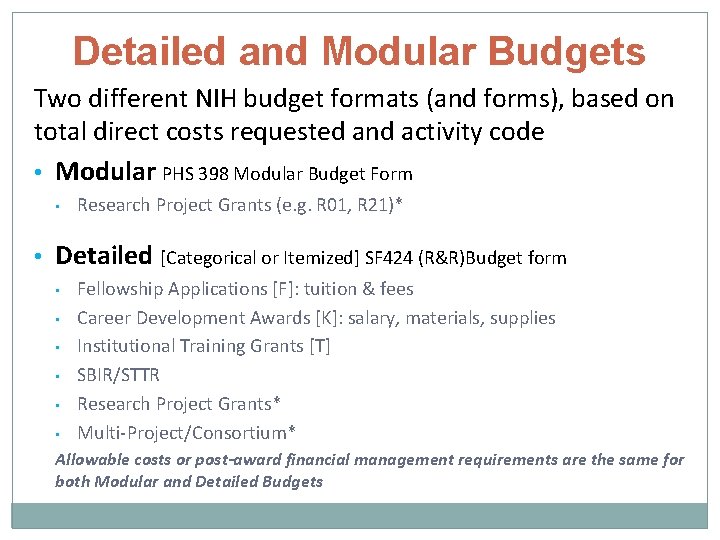
Detailed and Modular Budgets Two different NIH budget formats (and forms), based on total direct costs requested and activity code • Modular PHS 398 Modular Budget Form • Research Project Grants (e. g. R 01, R 21)* • Detailed [Categorical or Itemized] SF 424 (R&R)Budget form • • • Fellowship Applications [F]: tuition & fees Career Development Awards [K]: salary, materials, supplies Institutional Training Grants [T] SBIR/STTR Research Project Grants* Multi-Project/Consortium* Allowable costs or post-award financial management requirements are the same for both Modular and Detailed Budgets
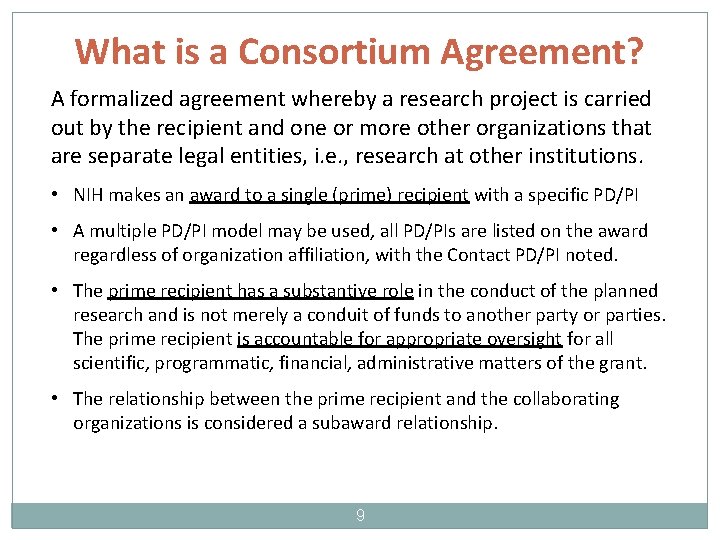
What is a Consortium Agreement? A formalized agreement whereby a research project is carried out by the recipient and one or more other organizations that are separate legal entities, i. e. , research at other institutions. • NIH makes an award to a single (prime) recipient with a specific PD/PI • A multiple PD/PI model may be used, all PD/PIs are listed on the award regardless of organization affiliation, with the Contact PD/PI noted. • The prime recipient has a substantive role in the conduct of the planned research and is not merely a conduit of funds to another party or parties. The prime recipient is accountable for appropriate oversight for all scientific, programmatic, financial, administrative matters of the grant. • The relationship between the prime recipient and the collaborating organizations is considered a subaward relationship. 9
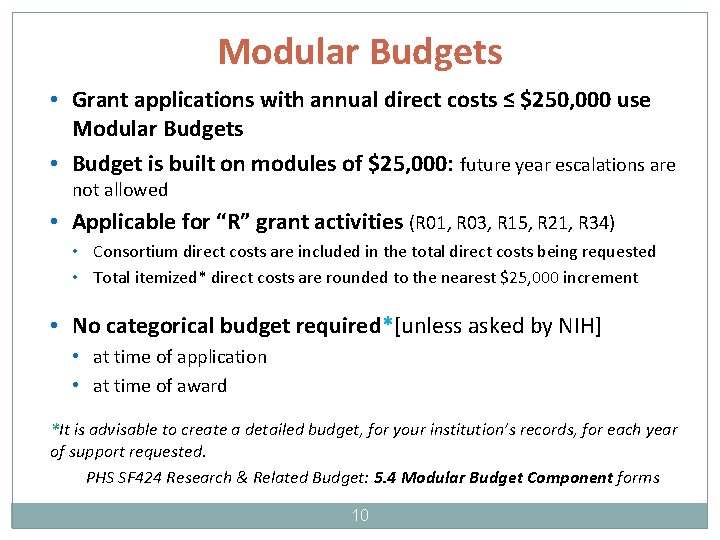
Modular Budgets • Grant applications with annual direct costs ≤ $250, 000 use Modular Budgets • Budget is built on modules of $25, 000: future year escalations are not allowed • Applicable for “R” grant activities (R 01, R 03, R 15, R 21, R 34) • Consortium direct costs are included in the total direct costs being requested • Total itemized* direct costs are rounded to the nearest $25, 000 increment • No categorical budget required*[unless asked by NIH] • at time of application • at time of award *It is advisable to create a detailed budget, for your institution’s records, for each year of support requested. PHS SF 424 Research & Related Budget: 5. 4 Modular Budget Component forms 10

Modular Budget Flow Chart Do your direct costs NO (minus any consortium/subcontract F&A costs) equal less than $250, 000 per year? Use Detailed Budget YES (SF 424(R&R) Budget Form) Are you applying for an R 01, R 03, R 15, R 21 or R 34 grant? NO YES NO Is the applicant organization based in the United States? Use Modular Budget (PHS 398 Modular Budget Form) YES https: //grants. nih. gov/grants/how-to-apply-application-guide/format-and-write/develop-your-budget. htm#modbud 11

Modular Budget Justification • List all personnel involved at Applicant Organization • Name, role and number of person-months for all personnel • Do not include salary, fringe benefits • Consortia Justification • List all personnel associated with Consortia/Contractual arrangements • Include total costs (DC + F&A) rounded to the nearest $1000 for each consortium/subcontract • Additional Narrative Justification • explanations for any variations in the number of modules requested annually • any direct costs excluded from F&A calculation (e. g. equipment, tuition remission) NIH may request detailed budget to address specific issues Additional information on modular budgets: http: //grants. nih. gov/grants/funding/modular. htm
Budget Components

Costs: An NIH Primer • Direct costs: directly attributable to the project and allowable • salaries w/ fringe benefits, student fees/tuition, consultants, equipment, supplies, travel, publication, shared facility fees… • Modified Total Direct Costs (MTDC): DC – costs excluded from F&A = MTDC • F&A (Indirect) costs: Facilities & Administrative costs, or “overhead” shared by all cost centers • Specific rate is negotiated by the institution with the government • Total Costs: Allowable Direct Costs + applicable F&A or “fee” for SBIR/STTR) • Fee (SBIR/STTR only): reasonable profit factor available to for- profit organizations, consistent with normal profit margins; not to exceed 7% of total costs NIH Grant Application Budget Basics: http: //grants. nih. gov/grants/developing_budget. htm
Sections A & B: Personnel EFFORT: Person-Months �Amount of time (effort) committed to project by PI(s). § Calendar vs. Academic/Summer months (https: //grants. nih. gov/faqs#/person-months. htm) �The number, qualifications and amount of time needed for other personnel § § Co-investigators Technicians Postdoctoral Fellows Undergraduate & Graduate Students Calculating “person months”: https: //grants. nih. gov/grants/policy/person_months_faqs. htm 15
Sections A & B: Personnel • SALARY REQUESTS • Percent SALARY ≤ Percent EFFORT • Example: • You devote 9 person-months [75%] effort • You can request between 0% to 75% of your salary* * up to legislated salary cap
Personnel (continued) �Each individual listed in the budget should have a specific role on the project �Be realistic about what each individual can accomplish and the time necessary for the work. �There is no magic algorithm regarding the qualifications and/or number of individuals needed for each aim. � Explain any fluctuations in effort levels and/or staffing levels in out years (in the budget justification).
Salary Cap • Salary Limitation (NOT-OD-20 -065) is one of the congressional mandates in the NIH Appropriation • Restricts the amount of direct salary that can be paid with federal funds under a grant or contract to Executive Level II of the Federal Executive Pay Scale ($197, 300) • However, the participant’s actual base salary (even if exceeding the cap) should be used on the budget page. • Helps NIH know the current pay scales and justify increases • Grants Specialists will adjust to meet the cap at the time of award https: //grants. nih. gov/grants/guide/notice-files/NOT-OD-20 -065. html
Section C: Equipment • Equipment: defined as having an acquisition cost > $5, 000 service life > 1 yr (otherwise, “supplies” category) • Use is primarily allocated to proposed research project • Excluded from F&A base • Related Considerations • Most equipment is requested during the first year of the grant • For a modular budget an extra module(s) may be requested to cover equipment • Justification is required (especially if similar equipment is already available) • Consider including price quote for new equipment within application to aid in the evaluation of equipment cost
Section D: Travel • Generally supports travel for presenting the results of the grant • 1 -2 meetings per year • 2 -3 personnel • Request is usually relatively small: • $1, 000 - 2, 000 per scientific meeting per individual per year • Travel for data collection, to access resources or unique instrumentation or tools may be requested • Justification should clearly state how travel is related to completing the aims and goals of the proposed research
Section E: Participant/Trainee Support Costs �Unless stated in the FOA, this section should be left blank for NIH applications �Tuition remission should be in Section F: Other Direct Costs
Section F: Other Direct Costs • Estimate the materials and supplies needed for the personnel involved. • • • Usually ~$12, 000– 15, 000/year per FTE Animal intensive studies, studies involving human subjects, or extensive bioinformatics, nanofabrication/foundary expenses tend to be more costly. In silico or in vitro studies may have lower supply costs • Publication costs • Equipment maintenance • Tuition remission [excluded from F&A base] • Shared facility fees • Consortium/subcontracts
Budget Justification �Reviewers and Administrator use this to determine if the scope of work matches the request �Explain the specific responsibilities for each team member �Justify unusual/large expenses �Show the value of subcontracts/consortia Provide a separate budget request and justification for any subcontract/consortium �Significant over- or under-estimation of budget suggests a lack of investigator understanding of scope of work The reviewers are investigators like you, with more experience about costs of research
Other Considerations
How is the Budget used by Reviewers and Program Officials? Budget considerations are administrative • Budget is not used by reviewers to assess scientific merit • The Budget is discussed/reviewed after the scientific merit is assessed and application is scored • But …. • Budget presentation and justification reveals to reviewers the applicant’s understanding of what it takes to accomplish the proposed research Reviewers’ recommendations on the budget are usually followed by program staff
More Money? • Applications requesting ≥ $500, 000 DC in any single year – applicant must seek permission to submit from Institute staff at least 6 weeks before submission. • Multiple Principal Investigator R 01 is intended for projects that clearly require a “team science” approach. The Multiple PI option should not be used as a means to justify a large budget request. • Well-funded investigators should consult with Institute staff regarding policies for support of new research projects in well-funded laboratories.
Didn’t Receive the Amount Requested? • Study section may recommend reductions in amount and time • Applicants may discuss with Program Officer if IRG-recommended reductions can be restored • Funding institute may reduce budget further and limit years of support • Funding Strategy for many NIH ICs includes an administrative cut • Funding decisions cannot be appealed • Discuss with Program Officer if reduction causes hardship A grantee seeking to revise the project aims because of reductions in time or budget may do so only with prior approval from the program officer.
Other Considerations • Ideally, the science drives the budget and justification • Budgets must be consistent with grantee institutional policies and practice • Request reasonable amounts based on current conditions and need • Don’t request contingencies or uncommitted promotions • Justify everything, especially the unusual large ticket items, and year to year variations
Common Budget Errors • Exceeding FOA budget amount • Used a modular budget when a detailed budget is needed • Budget exceeds $500 K and did not request permission to submit • Modular budget request did not request F&A for consortia • Costs in budget differ from justification • Salaries exceed the NIH salary cap • Calendar months effort does not equate to the requested salary • Miscalculation of F&A • Not contacting NIH Staff!
Award Policy Issues
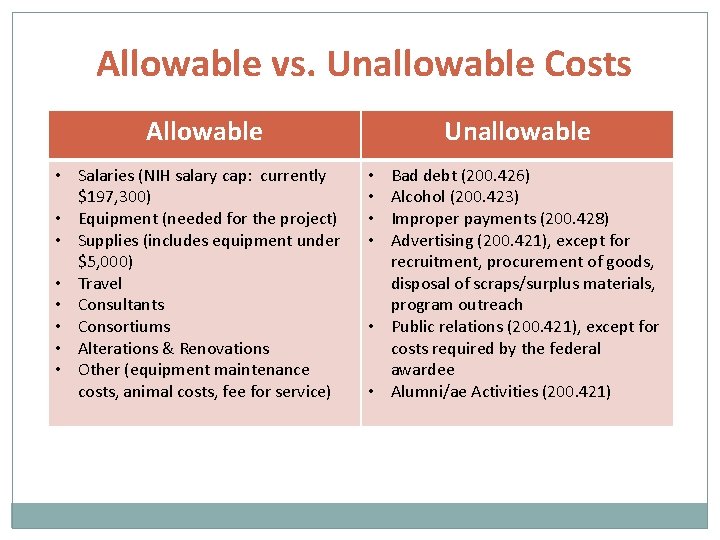
Allowable vs. Unallowable Costs Allowable • Salaries (NIH salary cap: currently $197, 300) • Equipment (needed for the project) • Supplies (includes equipment under $5, 000) • Travel • Consultants • Consortiums • Alterations & Renovations • Other (equipment maintenance costs, animal costs, fee for service) Unallowable Bad debt (200. 426) Alcohol (200. 423) Improper payments (200. 428) Advertising (200. 421), except for recruitment, procurement of goods, disposal of scraps/surplus materials, program outreach • Public relations (200. 421), except for costs required by the federal awardee • Alumni/ae Activities (200. 421) • •
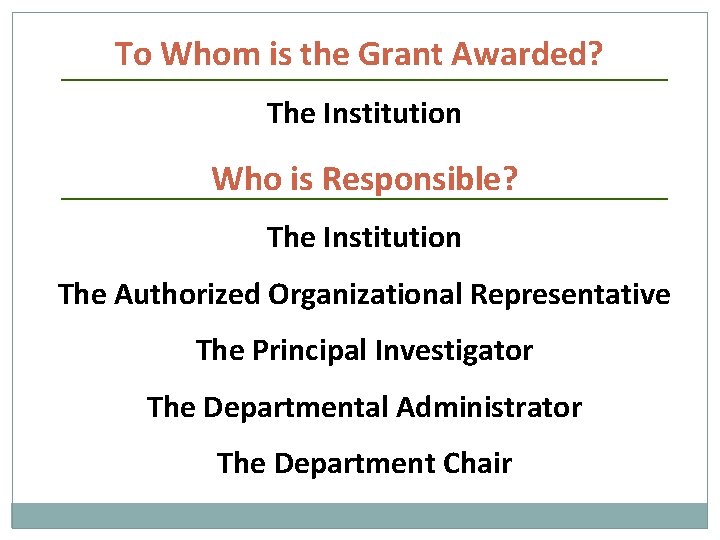
To Whom is the Grant Awarded? The Institution Who is Responsible? The Institution The Authorized Organizational Representative The Principal Investigator The Departmental Administrator The Department Chair
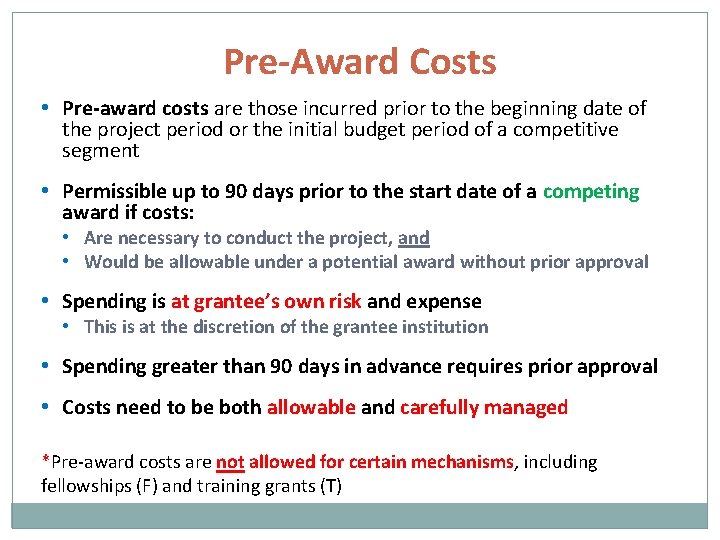
Pre-Award Costs • Pre-award costs are those incurred prior to the beginning date of the project period or the initial budget period of a competitive segment • Permissible up to 90 days prior to the start date of a competing award if costs: • Are necessary to conduct the project, and • Would be allowable under a potential award without prior approval • Spending is at grantee’s own risk and expense • This is at the discretion of the grantee institution • Spending greater than 90 days in advance requires prior approval • Costs need to be both allowable and carefully managed *Pre-award costs are not allowed for certain mechanisms, including fellowships (F) and training grants (T)
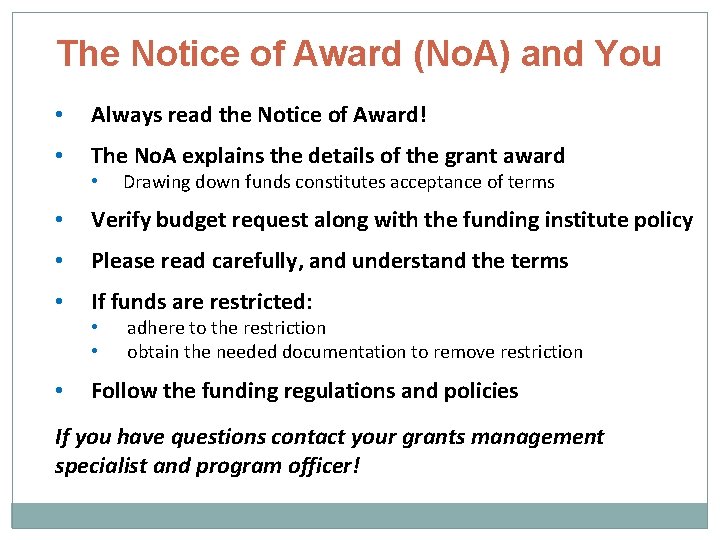
The Notice of Award (No. A) and You • Always read the Notice of Award! • The No. A explains the details of the grant award • Drawing down funds constitutes acceptance of terms • Verify budget request along with the funding institute policy • Please read carefully, and understand the terms • If funds are restricted: • • • adhere to the restriction obtain the needed documentation to remove restriction Follow the funding regulations and policies If you have questions contact your grants management specialist and program officer!
Award Restrictions • Any spending restrictions will be listed in the Notice of Award (No. A), Section IV • Restricted funds must be tracked by grantee to ensure compliance • Only applied to a particular grant for cause • Examples: • Restrict equipment funds pending receipt of current price quote • Prohibit human subjects research pending IRB review • ASK NIH first if you have questions! Always read your Notice of Award!
Other Terms of Award • Program regulations: 42 CFR Part 52 - Grants for Research Projects • Program and appropriation legislation • 45 CFR Part 75 - HHS rules and requirements that govern the administration of grants • NIH Grants Policy Statement - compendium of several regulatory requirements applicable to grants and cooperative agreements
Research Based on Award Budget • Build a budget for the dollars and years that are indicated in the Notice of Award • For modular grants, build in any increases in spending over duration of grant • Prioritize research work and get started • Changes? Ask Grants Management/Program Staff BEFORE you implement • Delays? Unspent funds may be carried forward if appropriately justified/explained
Additional Thoughts • Most taxpayers think a $1 M+ award is a lot of money. Spend it wisely. • Contact Program or Grants Management Staff with Budget problems or questions EARLY!
Resources • NIH OER Grants and Funding Information • http: //grants. nih. gov/grants/about_grants. htm • SF 424 R&R guides and FAQs • • • http: //grants. nih. gov/grants/funding/424/index. htm#inst http: //grants. nih. gov/grants/Electronic. Receipt/faq_full. htm http: //grants. nih. gov/grants/funding/modular. htm NIH Program and Grants Management staff • Your institutional Sponsored Programs Office • Other experienced individuals at your institution •
Thank you for your attention. Questions? ? Michael Sesma: msesma@nigms. nih. gov Gabriel Hidalgo: Gabriel. Hidalgo@nih. gov
- Slides: 40