
Buddhism Review Life of Siddhartha Gautama Born in
Buddhism Review
Life of Siddhartha Gautama
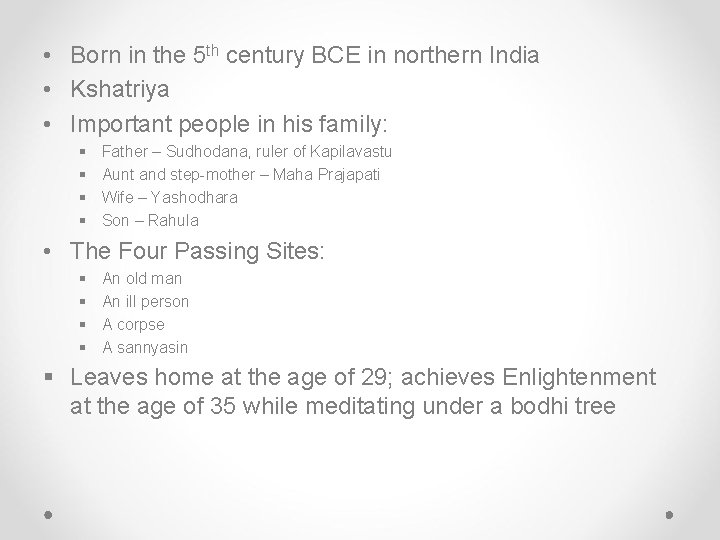
• Born in the 5 th century BCE in northern India • Kshatriya • Important people in his family: § § Father – Sudhodana, ruler of Kapilavastu Aunt and step-mother – Maha Prajapati Wife – Yashodhara Son – Rahula • The Four Passing Sites: § § An old man An ill person A corpse A sannyasin § Leaves home at the age of 29; achieves Enlightenment at the age of 35 while meditating under a bodhi tree
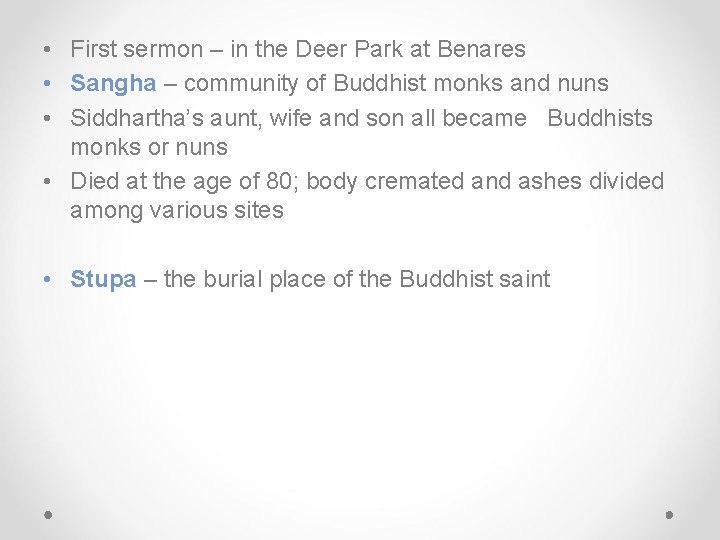
• First sermon – in the Deer Park at Benares • Sangha – community of Buddhist monks and nuns • Siddhartha’s aunt, wife and son all became Buddhists monks or nuns • Died at the age of 80; body cremated and ashes divided among various sites • Stupa – the burial place of the Buddhist saint
Buddhist Teachings

Three Marks of Existence 1. Anatta – “no self”; there is nothing that makes me uniquely “me” 2. Anicca – impermanence; nothing remains the same 3. Dukkha – suffering; we suffer because we do not understand anatta and anicca
The Four Noble Truths 1. 2. 3. 4. Life is suffering Suffering is caused by selfish desire Suffering can be brought to an end It can be ended by following the Eight Fold Path See your handout and the article on Buddhist teachings for an explanation of the 8 -Fold Path
The Five Precepts 1. 2. 3. 4. 5. Do not take life Do not take what is not given Do not engage in sensuous misconduct Do not use false speech Do not drink intoxicants
Other Buddhist Teachings: • Samsara – Buddhists do not believe in the Atman (soul) – what is reincarnated is karmic energy (analogy of a flame – if you light one candle from another, then blow out the first, is the second candle flame the same as the first? ) • Karma – same as in Hinduism • Nirvana – awakening or enlightenment; final Nirvana happens at the death of an Enlightened One but Buddhism does not describe what it is like • Compassion – one of Buddhism’s most important teachings
Divisions in Buddhism
Theravada Buddhism • • The original “Doctrine of the Elders” or “The Lesser Way” Smaller Found mostly in Mayanmar (Burma), Thailand, Laos and Cambodia • Emphasizes monasticism • Not much emphasis on The Divine • Sacred texts include are found in the Tripitaka o Vianaya Pitaka – monastic regulation o Dhamapada – teachings of Siddhartha o Adhidamma Pitaka – ethical discussions
Mahayana Buddhism • “The Greater Ways” – because it is larger • Found mostly in Tibet, Nepal, China, Korea and Japan • Belief in bodhisattvas who can help us attain Enlightenment • Establishment of a priesthood with temples • Worship of The Divine • Sacred texts include: o The Lotus Sutra – o The Diamond Sutra o The Heart Sutra
Tibetan Buddhism • A form of Mahayana • Led by the Dalai Lama – a reincarnation of the bodhisattva of compassion, Avalokiteshvara • Sacred books include the Bardo Thodol – The Tibetan Book of the Dead • Use of mandalas and prayer wheels • Strong emphasis on monasticism
- Slides: 13