
Buddhism Beliefs and Practices Knowledge Organizer 1 Key
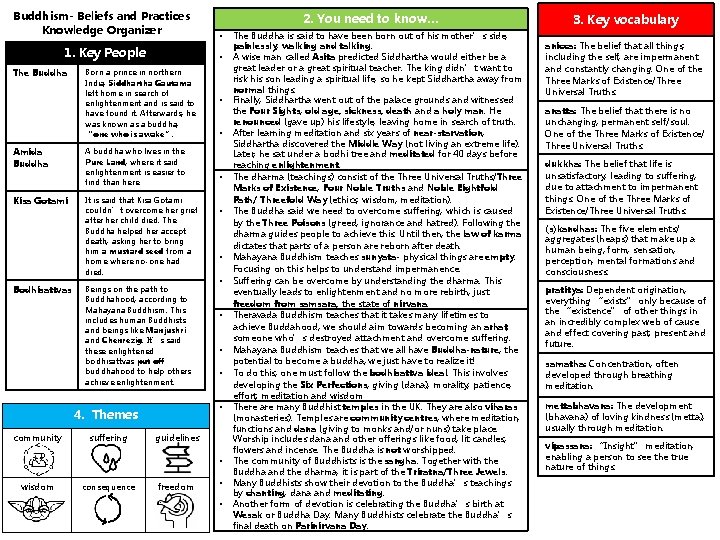
Buddhism- Beliefs and Practices Knowledge Organizer 1. Key People The Buddha Amida Buddha Kisa Gotami Bodhisattvas Born a prince in northern India, Siddhartha Gautama left home in search of enlightenment and is said to have found it. Afterwards, he was known as a buddha, “one who is awake”. A buddha who lives in the Pure Land, where it said enlightenment is easier to find than here. It is said that Kisa Gotami couldn’t overcome her grief after her child died. The Buddha helped her accept death, asking her to bring him a mustard seed from a home where no-one had died. Beings on the path to Buddhahood, according to Mahayana Buddhism. This includes human Buddhists and beings like Manjushri and Chenrezig. It’s said these enlightened bodhisattvas put off buddhahood to help others achieve enlightenment. suffering • • • 4. Themes community 2. You need to know… guidelines • wisdom consequence freedom • • The Buddha is said to have been born out of his mother’s side, painlessly, walking and talking. A wise man called Asita predicted Siddhartha would either be a great leader or a great spiritual teacher. The king didn’t want to risk his son leading a spiritual life, so he kept Siddhartha away from normal things. Finally, Siddhartha went out of the palace grounds and witnessed the Four Sights; old age, sickness, death and a holy man. He renounced (gave up) his lifestyle, leaving home in search of truth. After learning meditation and six years of near-starvation, Siddhartha discovered the Middle Way (not living an extreme life). Later, he sat under a bodhi tree and meditated for 40 days before reaching enlightenment. The dharma (teachings) consist of the Three Universal Truths/Three Marks of Existence, Four Noble Truths and Noble Eightfold Path/ Threefold Way (ethics, wisdom, meditation). The Buddha said we need to overcome suffering, which is caused by the Three Poisons (greed, ignorance and hatred). Following the dharma guides people to achieve this. Until then, the law of karma dictates that parts of a person are reborn after death. Mahayana Buddhism teaches sunyata- physical things are empty. Focusing on this helps to understand impermanence. Suffering can be overcome by understanding the dharma. This eventually leads to enlightenment and no more rebirth, just freedom from samsara, the state of nirvana. Theravada Buddhism teaches that it takes many lifetimes to achieve Buddahood; we should aim towards becoming an arhat, someone who’s destroyed attachment and overcome suffering. Mahayana Buddhism teaches that we all have Buddha-nature, the potential to become a buddha; we just have to realize it! To do this, one must follow the bodhisattva ideal. This involves developing the Six Perfections; giving (dana), morality, patience, effort, meditation and wisdom There are many Buddhist temples in the UK. They are also viharas (monasteries). Temples are community centres, where meditation, functions and dana (giving to monks and/or nuns) take place. Worship includes dana and other offerings like food, lit candles, flowers and incense. The Buddha is not worshipped. The community of Buddhists is the sangha. Together with the Buddha and the dharma, it is part of the Triratna/Three Jewels. Many Buddhists show their devotion to the Buddha’s teachings by chanting, dana and meditating. Another form of devotion is celebrating the Buddha’s birth at Wesak or Buddha Day. Many Buddhists celebrate the Buddha’s final death on Parinirvana Day. 3. Key vocabulary anicca: The belief that all things, including the self, are impermanent and constantly changing. One of the Three Marks of Existence/Three Universal Truths. anatta: The belief that there is no unchanging, permanent self/soul. One of the Three Marks of Existence/ Three Universal Truths. dukkha: The belief that life is unsatisfactory, leading to suffering, due to attachment to impermanent things. One of the Three Marks of Existence/Three Universal Truths. (s)kandhas: The five elements/ aggregates (heaps) that make up a human being; form, sensation, perception, mental formations and consciousness. pratitya: Dependent origination; everything “exists” only because of the “existence” of other things in an incredibly complex web of cause and effect covering past, present and future. samatha: Concentration, often developed through breathing meditation. mettabhavana: The development (bhavana) of loving kindness (metta), usually through meditation. vipassana: “Insight” meditation, enabling a person to see the true nature of things.
- Slides: 1