
Bucket Elimination A unifying framework for Probabilistic inference
Bucket Elimination: A unifying framework for Probabilistic inference Rina Dechter presented by Anton Bezuglov, Hrishikesh Goradia CSCE 582 Fall 02 Instructor: Dr. Marco Valtorta
Contributions • For a Bayesian network, the paper presents algorithms for – Belief Assessment – Most Probable Explanation (MPE) – Maximum Aposteriori Hypothesis (MAP) • All of the above are bucket elimination algorithms.
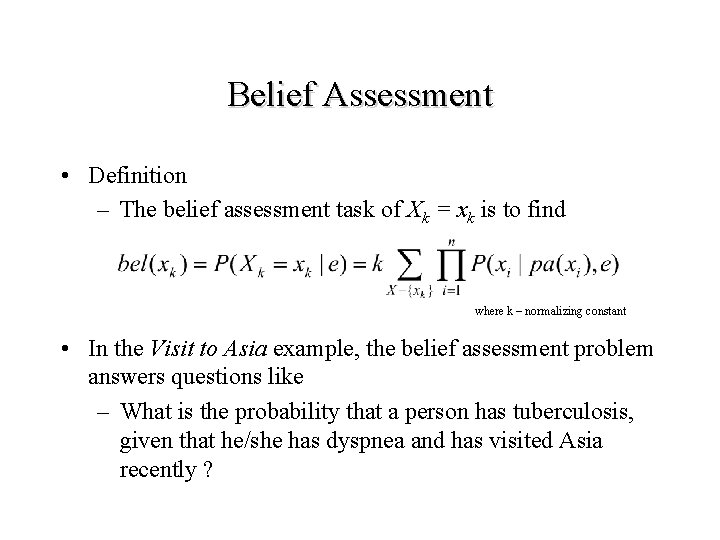
Belief Assessment • Definition – The belief assessment task of Xk = xk is to find where k – normalizing constant • In the Visit to Asia example, the belief assessment problem answers questions like – What is the probability that a person has tuberculosis, given that he/she has dyspnea and has visited Asia recently ?
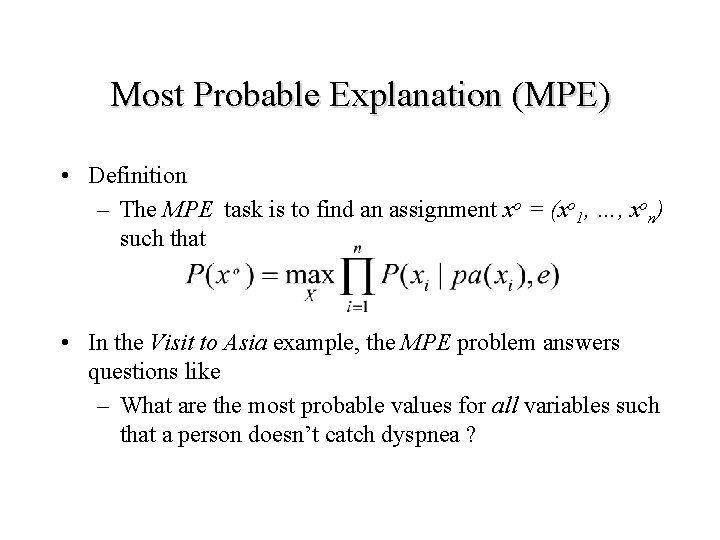
Most Probable Explanation (MPE) • Definition – The MPE task is to find an assignment xo = (xo 1, …, xon) such that • In the Visit to Asia example, the MPE problem answers questions like – What are the most probable values for all variables such that a person doesn’t catch dyspnea ?
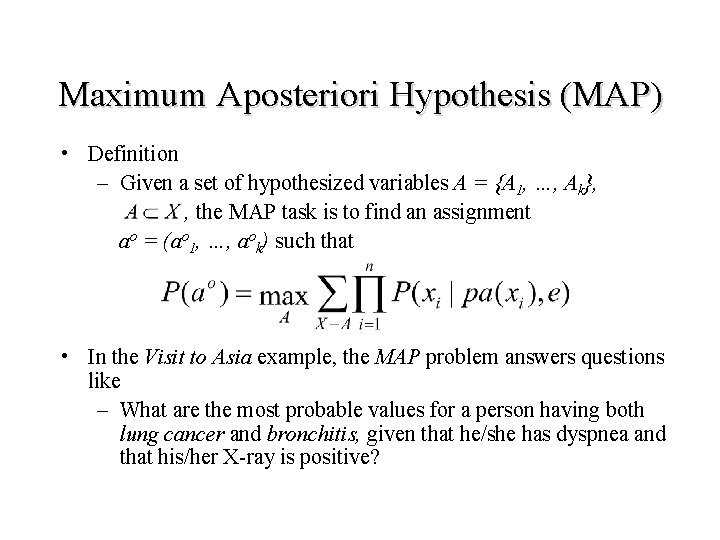
Maximum Aposteriori Hypothesis (MAP) • Definition – Given a set of hypothesized variables A = {A 1, …, Ak}, , the MAP task is to find an assignment ao = (ao 1, …, aok) such that • In the Visit to Asia example, the MAP problem answers questions like – What are the most probable values for a person having both lung cancer and bronchitis, given that he/she has dyspnea and that his/her X-ray is positive?
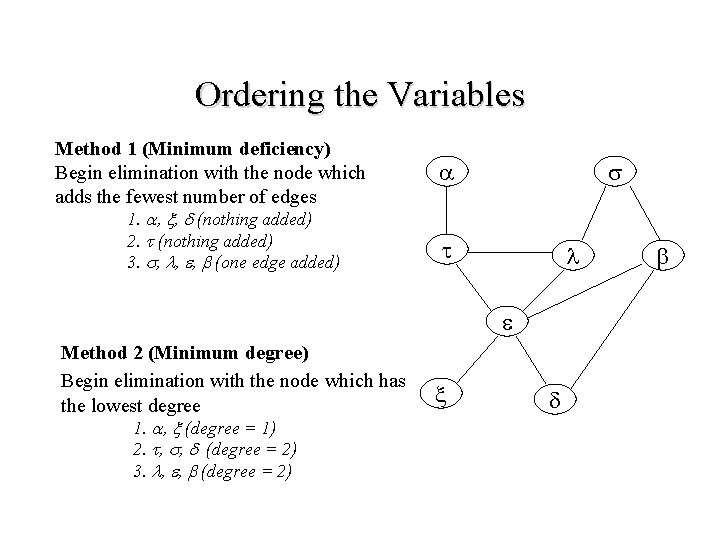
Ordering the Variables Method 1 (Minimum deficiency) Begin elimination with the node which adds the fewest number of edges 1. , , (nothing added) 2. (nothing added) 3. , , , (one edge added) Method 2 (Minimum degree) Begin elimination with the node which has the lowest degree 1. , (degree = 1) 2. , , (degree = 2) 3. , , (degree = 2)
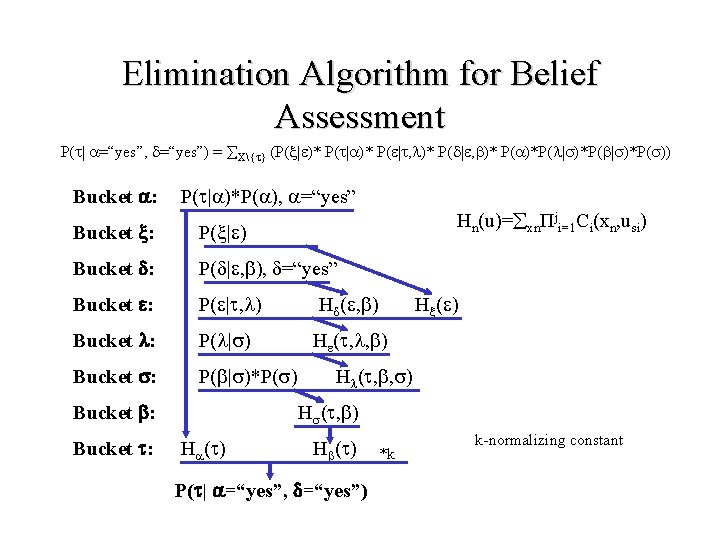
Elimination Algorithm for Belief Assessment P( | =“yes”, =“yes”) = X { } (P( | )* P( | , )* P( )*P( | )*P( )) Bucket : P( | )*P( ), =“yes” Hn(u)= xn. Пji=1 Ci(xn, usi) Bucket : P( | , ), =“yes” Bucket : P( | , ) H ( , ) Bucket : P( | ) H ( , , ) Bucket : P( | )*P( ) Bucket : H ( ) H ( , , ) H ( ) P( | =“yes”, =“yes”) *k k-normalizing constant
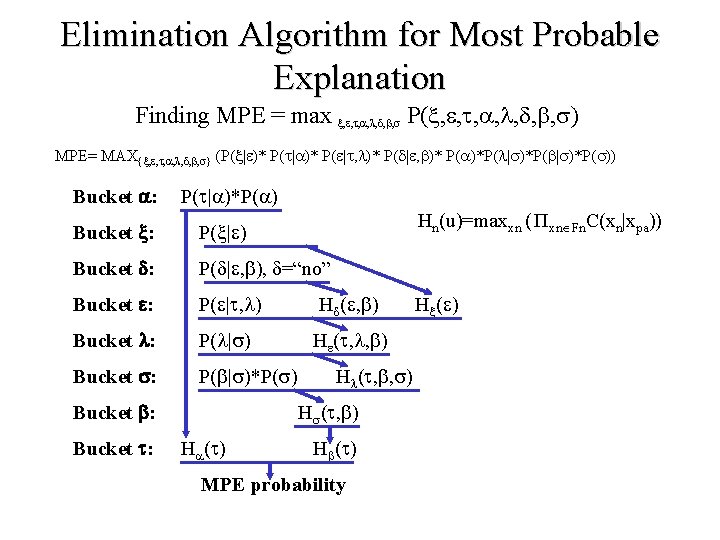
Elimination Algorithm for Most Probable Explanation Finding MPE = max , , , , P( , , , , ) MPE= MAX{ , , , , } (P( | )* P( | , )* P( )*P( | )*P( )) Bucket : P( | )*P( ) Hn(u)=maxxn ( Пxn Fn. C(xn|xpa)) Bucket : P( | , ), =“no” Bucket : P( | , ) H ( , ) Bucket : P( | ) H ( , , ) Bucket : P( | )*P( ) Bucket : H ( , , ) H ( ) MPE probability H ( )
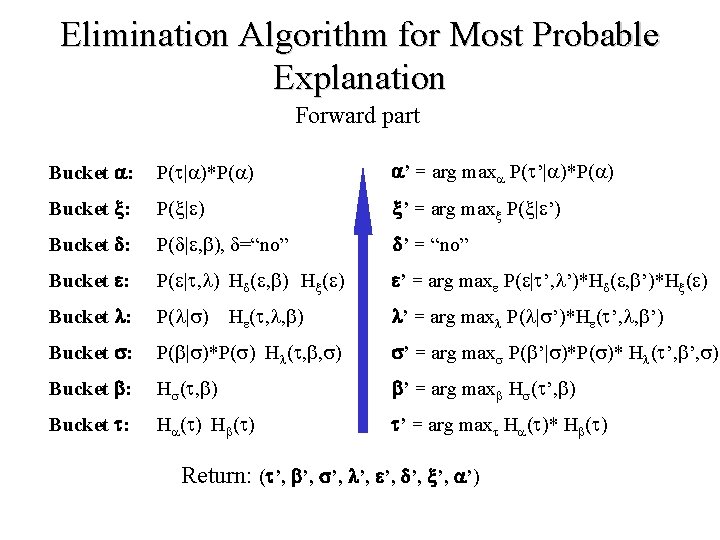
Elimination Algorithm for Most Probable Explanation Forward part Bucket : P( | )*P( ) ’ = arg max P( ’| )*P( ) Bucket : P( | ) ’ = arg max P( | ’) Bucket : P( | , ), =“no” ’ = “no” Bucket : P( | , ) H ( ) ’ = arg max P( | ’, ’)*H ( ) Bucket : P( | ) ’ = arg max P( | ’)*H ( ’, , ’) Bucket : P( | )*P( ) H ( , , ) ’ = arg max P( ’| )*P( )* H ( ’, ’, ) Bucket : H ( , ) ’ = arg max H ( ’, ) Bucket : H ( ) ’ = arg max H ( )* H ( ) H ( , , ) Return: ( ’, ’, ’)
- Slides: 9