
BUA 111 Chp 7 Inventory Dr K Moon
BUA 111 Chp. 7: Inventory Dr. K. Moon 1
Inventory Theory Effect on financial statements: flow of goods Actual v. hypothetical flow of goods Methods: Specific ID, Ave. Cost, FIFO, LIFO Dr. K. Moon 2
The Calculations We will (initially) use 2 “Practice Problems” to illustrate the calculations for the various methods. Dr. K. Moon 3
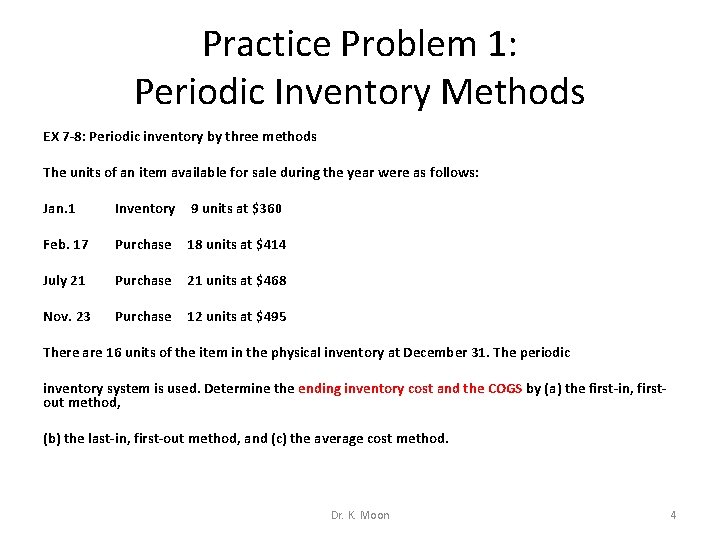
Practice Problem 1: Periodic Inventory Methods EX 7 -8: Periodic inventory by three methods The units of an item available for sale during the year were as follows: Jan. 1 Inventory 9 units at $360 Feb. 17 Purchase 18 units at $414 July 21 Purchase 21 units at $468 Nov. 23 Purchase 12 units at $495 There are 16 units of the item in the physical inventory at December 31. The periodic inventory system is used. Determine the ending inventory cost and the COGS by (a) the first-in, firstout method, (b) the last-in, first-out method, and (c) the average cost method. Dr. K. Moon 4
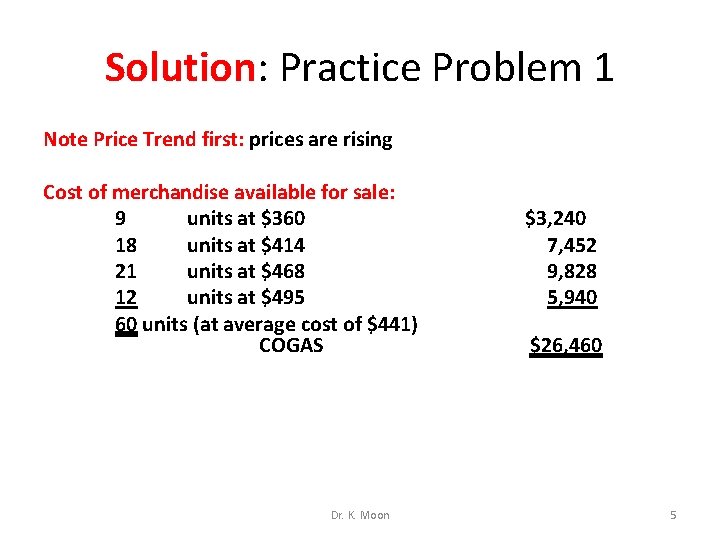
Solution: Practice Problem 1 Note Price Trend first: prices are rising Cost of merchandise available for sale: 9 units at $360 18 units at $414 21 units at $468 12 units at $495 60 units (at average cost of $441) COGAS Dr. K. Moon $3, 240 7, 452 9, 828 5, 940 $26, 460 5
Methods Do Part (C) Average Cost first and set up your answer summary table with labels as to which COGS is highest, lowest, and in the middle Dr. K. Moon 6
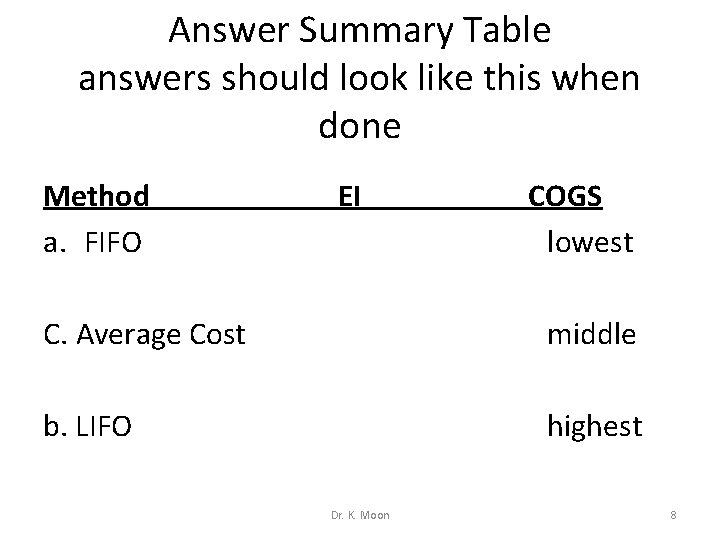
Answer Summary Table answers should look like this when done Method EI COGS a. FIFO lowest C. Average Cost middle b. LIFO highest Dr. K. Moon 8
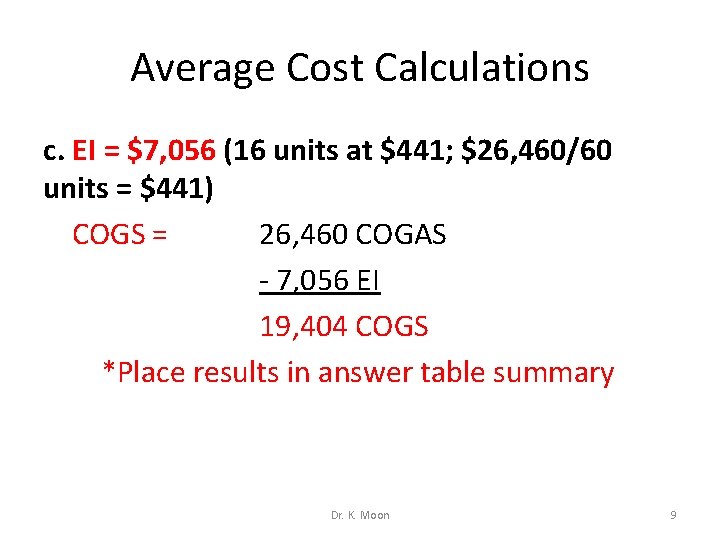
Average Cost Calculations c. EI = $7, 056 (16 units at $441; $26, 460/60 units = $441) COGS = 26, 460 COGAS - 7, 056 EI 19, 404 COGS *Place results in answer table summary Dr. K. Moon 9
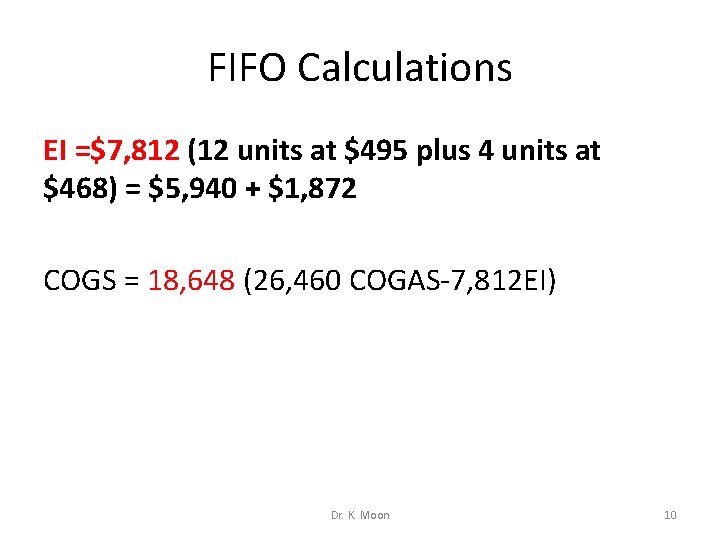
FIFO Calculations EI =$7, 812 (12 units at $495 plus 4 units at $468) = $5, 940 + $1, 872 COGS = 18, 648 (26, 460 COGAS-7, 812 EI) Dr. K. Moon 10
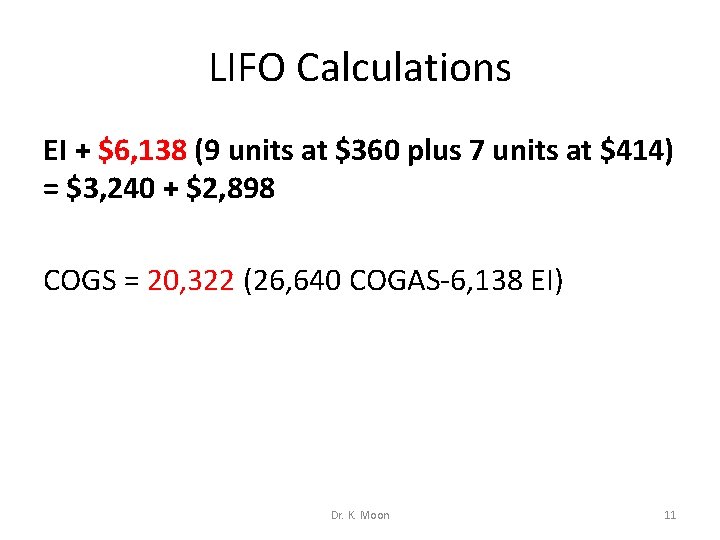
LIFO Calculations EI + $6, 138 (9 units at $360 plus 7 units at $414) = $3, 240 + $2, 898 COGS = 20, 322 (26, 640 COGAS-6, 138 EI) Dr. K. Moon 11
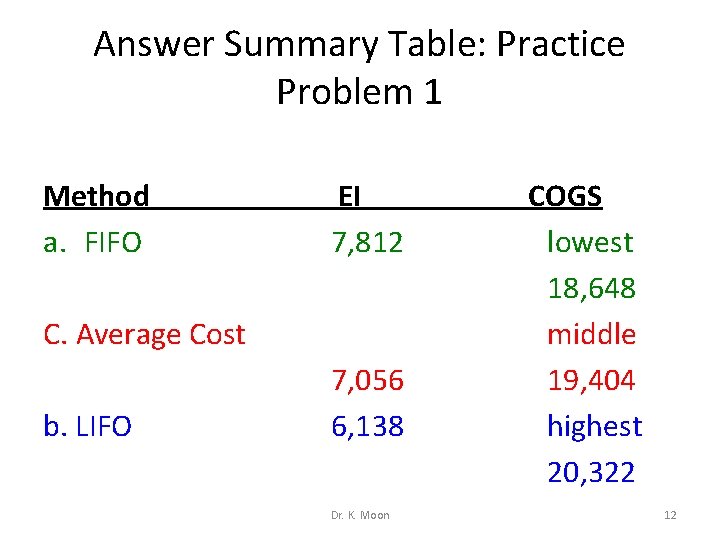
Answer Summary Table: Practice Problem 1 Method EI COGS a. FIFO 7, 812 lowest 18, 648 C. Average Cost middle 7, 056 19, 404 b. LIFO 6, 138 highest 20, 322 Dr. K. Moon 12
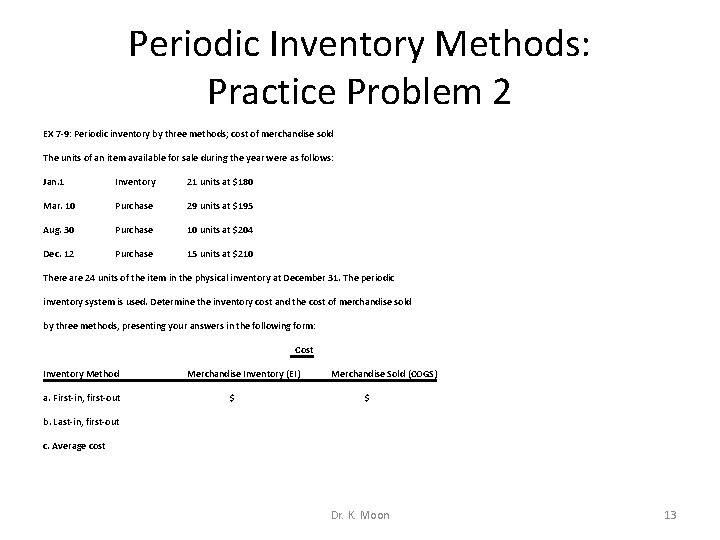
Periodic Inventory Methods: Practice Problem 2 EX 7 -9: Periodic inventory by three methods; cost of merchandise sold The units of an item available for sale during the year were as follows: Jan. 1 Inventory 21 units at $180 Mar. 10 Purchase 29 units at $195 Aug. 30 Purchase 10 units at $204 Dec. 12 Purchase 15 units at $210 There are 24 units of the item in the physical inventory at December 31. The periodic inventory system is used. Determine the inventory cost and the cost of merchandise sold by three methods, presenting your answers in the following form: Cost Inventory Method Merchandise Inventory (EI) Merchandise Sold (COGS) a. First-in, first-out $ b. Last-in, first-out c. Average cost Dr. K. Moon 13
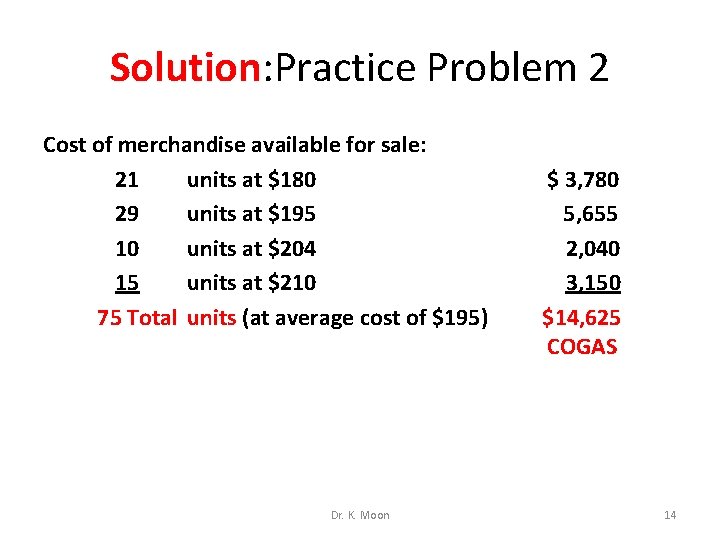
Solution: Practice Problem 2 Cost of merchandise available for sale: 21 units at $180 $ 3, 780 29 units at $195 5, 655 10 units at $204 2, 040 15 units at $210 3, 150 75 Total units (at average cost of $195) $14, 625 COGAS Dr. K. Moon 14
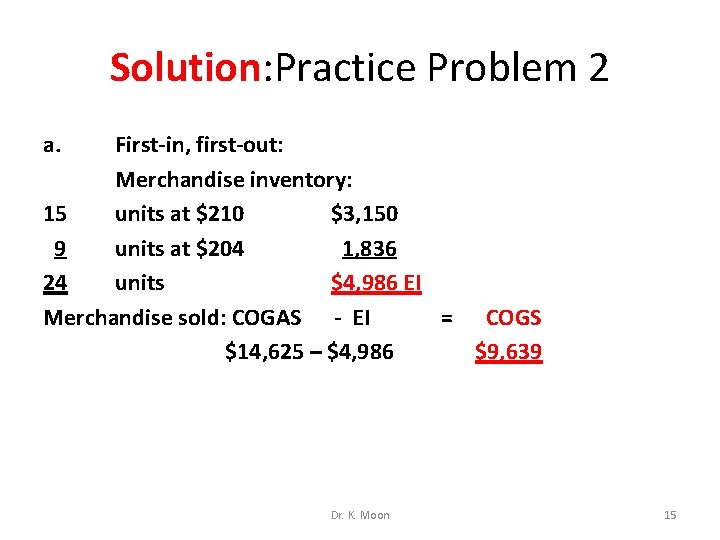
Solution: Practice Problem 2 a. First-in, first-out: Merchandise inventory: 15 units at $210 $3, 150 9 units at $204 1, 836 24 units $4, 986 EI Merchandise sold: COGAS - EI = COGS $14, 625 – $4, 986 $9, 639 Dr. K. Moon 15
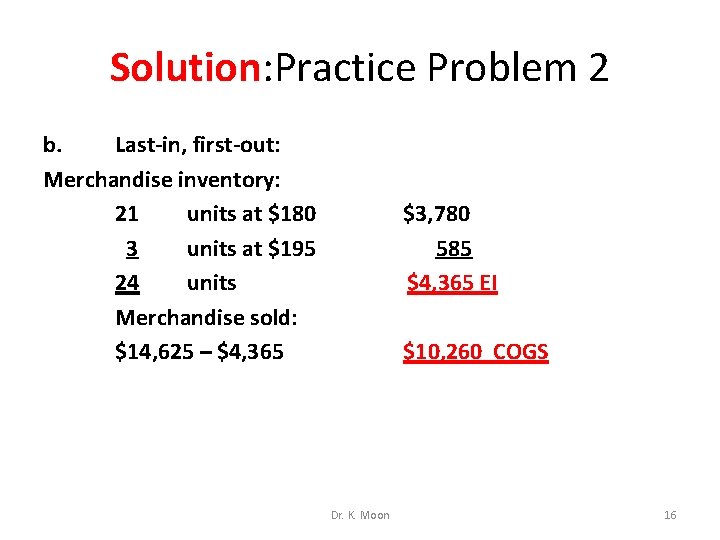
Solution: Practice Problem 2 b. Last-in, first-out: Merchandise inventory: 21 units at $180 $3, 780 3 units at $195 585 24 units $4, 365 EI Merchandise sold: $14, 625 – $4, 365 $10, 260 COGS Dr. K. Moon 16
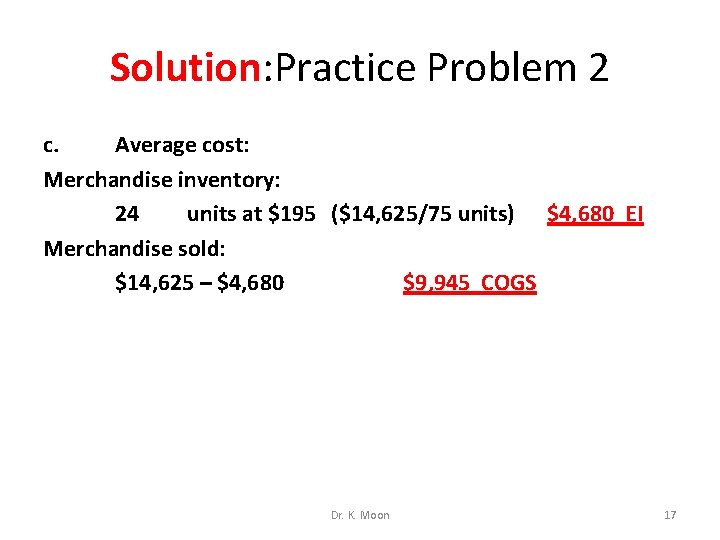
Solution: Practice Problem 2 c. Average cost: Merchandise inventory: 24 units at $195 ($14, 625/75 units) $4, 680 EI Merchandise sold: $14, 625 – $4, 680 $9, 945 COGS Dr. K. Moon 17
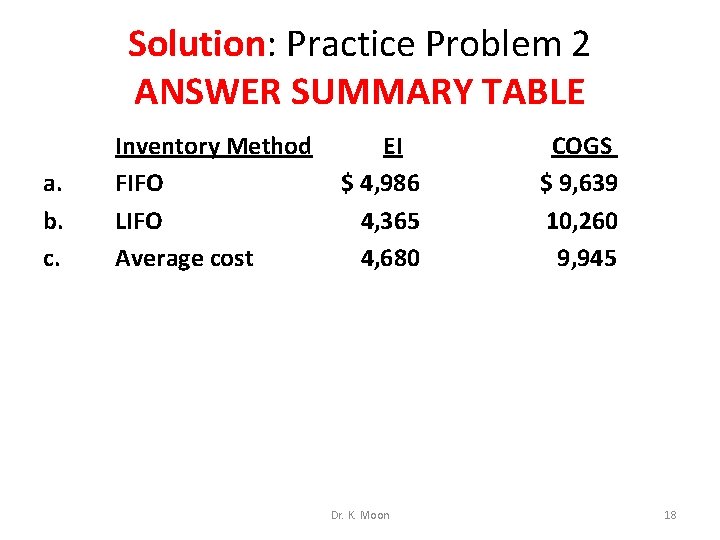
Solution: Practice Problem 2 ANSWER SUMMARY TABLE a. b. c. Inventory Method EI FIFO $ 4, 986 LIFO 4, 365 Average cost 4, 680 Dr. K. Moon COGS $ 9, 639 10, 260 9, 945 18
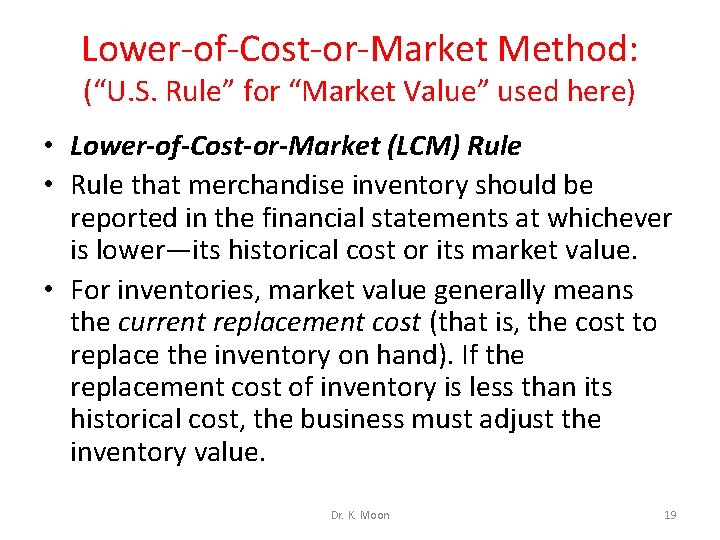
Lower-of-Cost-or-Market Method: (“U. S. Rule” for “Market Value” used here) • Lower-of-Cost-or-Market (LCM) Rule • Rule that merchandise inventory should be reported in the financial statements at whichever is lower—its historical cost or its market value. • For inventories, market value generally means the current replacement cost (that is, the cost to replace the inventory on hand). If the replacement cost of inventory is less than its historical cost, the business must adjust the inventory value. Dr. K. Moon 19
Next Topic Inventory Turnover and Number of Days Sales in Inventory Dr. K. Moon 20
Next (Final) Topic Financial Statement Effects/Comparisons using the Various Inventory Methods Dr. K. Moon 21
- Slides: 20