
BTY 100 Lec1 1 Origin of Life BTY
BTY 100 -Lec#1. 1 Origin of Life © BTY 100 -LPU © Lovely Professional University
Outline • • Understanding LIFE Origin of Life Spontaneous Generation and its Examples Challenging Spontaneous Generation: Theories © BTY 100 -LPU
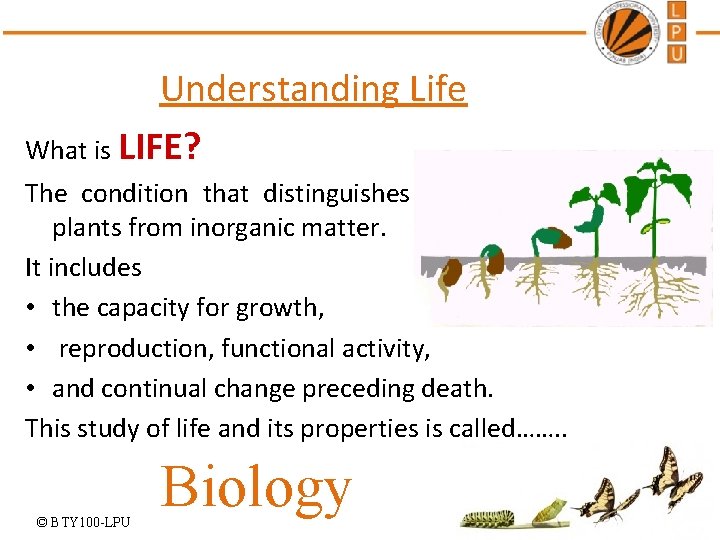
Understanding Life What is LIFE? The condition that distinguishes animals and plants from inorganic matter. It includes • the capacity for growth, • reproduction, functional activity, • and continual change preceding death. This study of life and its properties is called……. . © BTY 100 -LPU Biology
Understanding biology…. . why? ? ? © BTY 100 -LPU
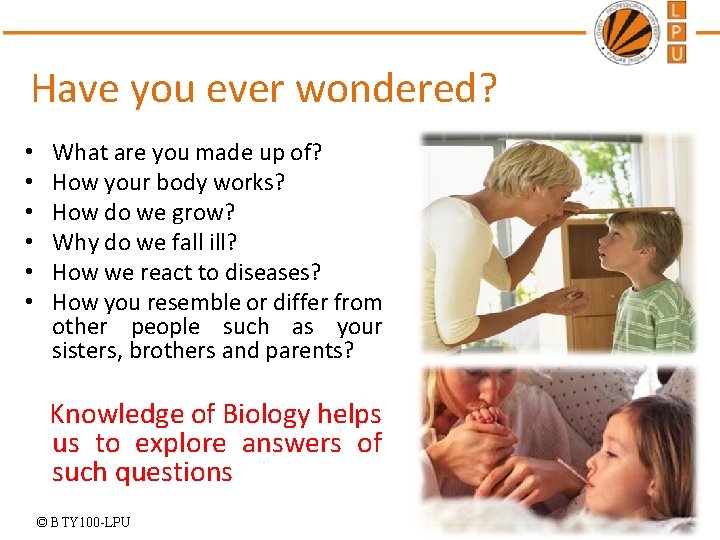
Have you ever wondered? • • • What are you made up of? How your body works? How do we grow? Why do we fall ill? How we react to diseases? How you resemble or differ from other people such as your sisters, brothers and parents? Knowledge of Biology helps us to explore answers of such questions © BTY 100 -LPU
Lets check the pitch before we actually start answering all those questions!!! © BTY 100 -LPU
Origin of Life The theory of Spontaneous Generation Also called Abiogenesis Idea that living things can arise from nonliving matter Idea lasted almost 2000 years Conclusions based on untested observations © BTY 100 -LPU
Examples of Spontaneous Generation © BTY 100 -LPU
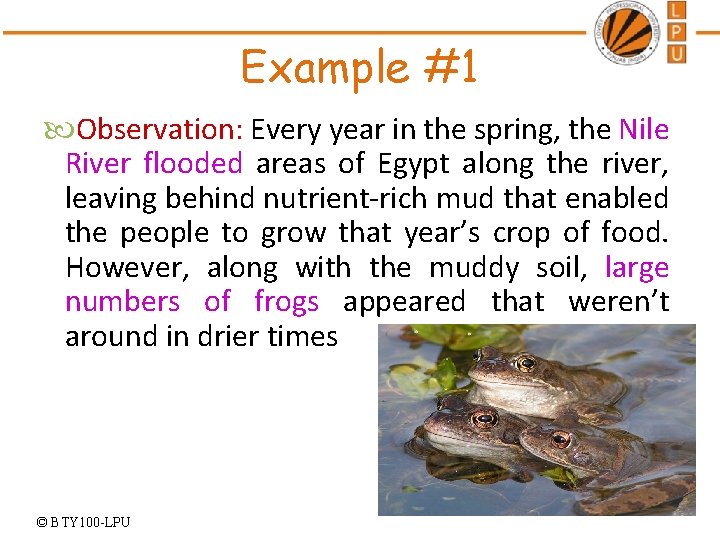
Example #1 Observation: Every year in the spring, the Nile River flooded areas of Egypt along the river, leaving behind nutrient-rich mud that enabled the people to grow that year’s crop of food. However, along with the muddy soil, large numbers of frogs appeared that weren’t around in drier times © BTY 100 -LPU
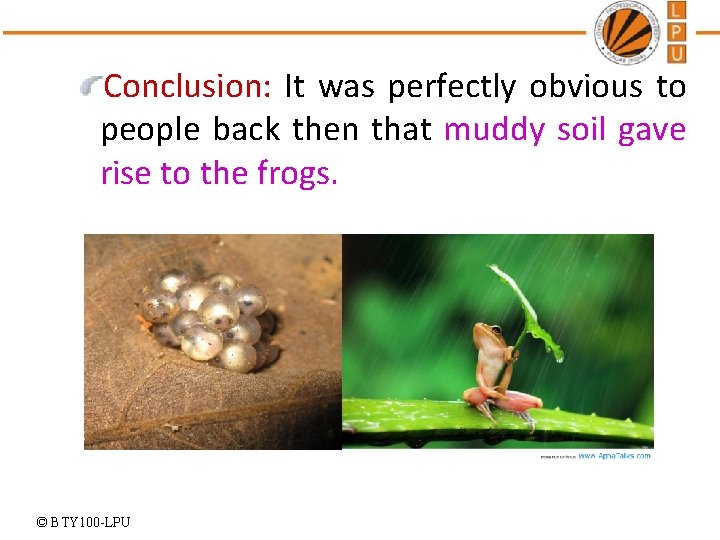
Conclusion: It was perfectly obvious to people back then that muddy soil gave rise to the frogs. © BTY 100 -LPU
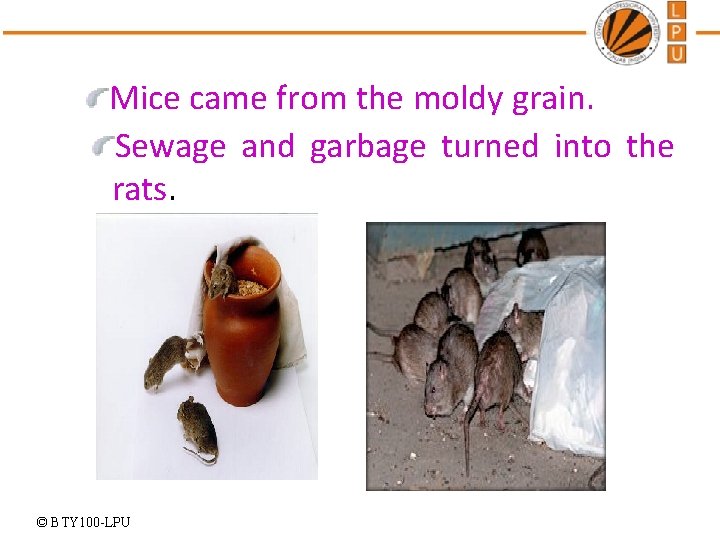
Mice came from the moldy grain. Sewage and garbage turned into the rats. © BTY 100 -LPU
Challenging Spontaneous Generation © BTY 100 -LPU
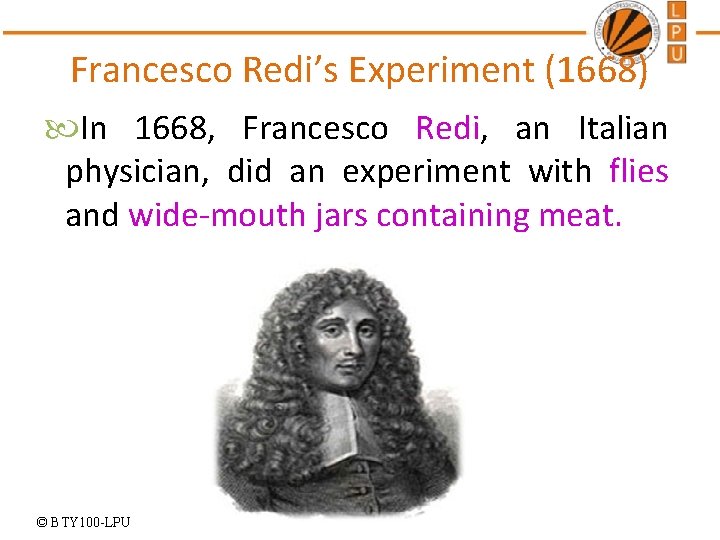
Francesco Redi’s Experiment (1668) In 1668, Francesco Redi, an Italian physician, did an experiment with flies and wide-mouth jars containing meat. © BTY 100 -LPU
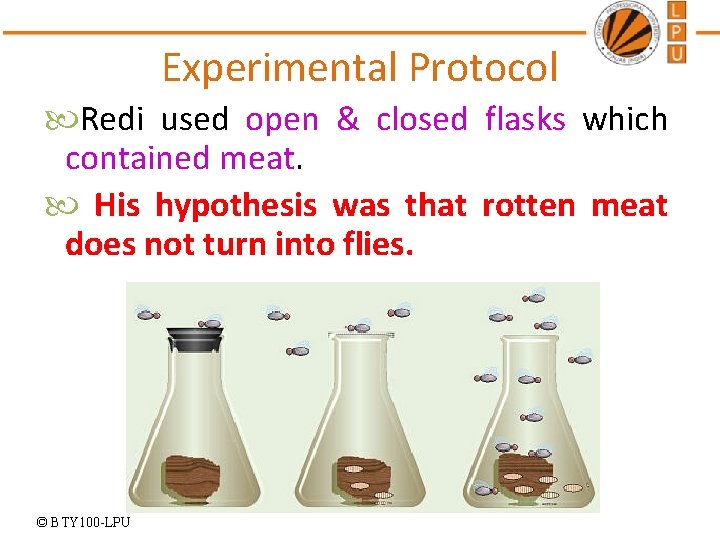
Experimental Protocol Redi used open & closed flasks which contained meat. His hypothesis was that rotten meat does not turn into flies. © BTY 100 -LPU
Redi’s (1626 -1697) Observations and Evidences He observed these flasks to see in which one(s) maggots would develop. He found that if a flask was closed with a lid so adult flies could not get in, no maggots developed on the rotting meat within. In a flask without a lid, maggots soon were seen in the meat because adult flies had laid eggs and more adult flies soon appeared. Evidence against spontaneous generation: 1. Unsealed – maggots on meat 2. Sealed – no maggots on meat 3. Gauze – few maggots on gauze, none on meat © BTY 100 -LPU
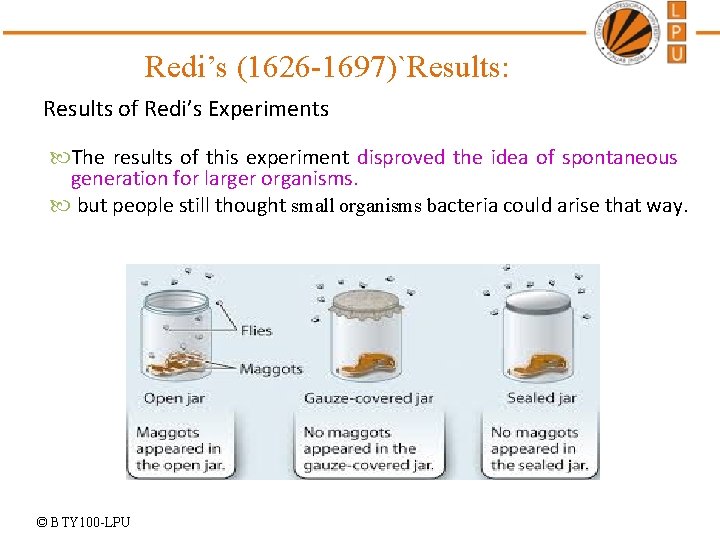
Redi’s (1626 -1697)`Results: Results of Redi’s Experiments The results of this experiment disproved the idea of spontaneous generation for larger organisms. but people still thought small organisms bacteria could arise that way. © BTY 100 -LPU
Challenging Abiogenesis: John Needham © BTY 100 -LPU
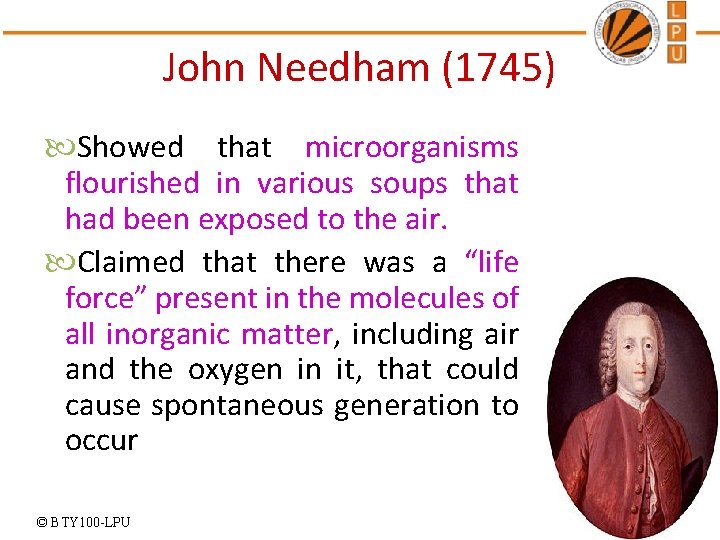
John Needham (1745) Showed that microorganisms flourished in various soups that had been exposed to the air. Claimed that there was a “life force” present in the molecules of all inorganic matter, including air and the oxygen in it, that could cause spontaneous generation to occur © BTY 100 -LPU
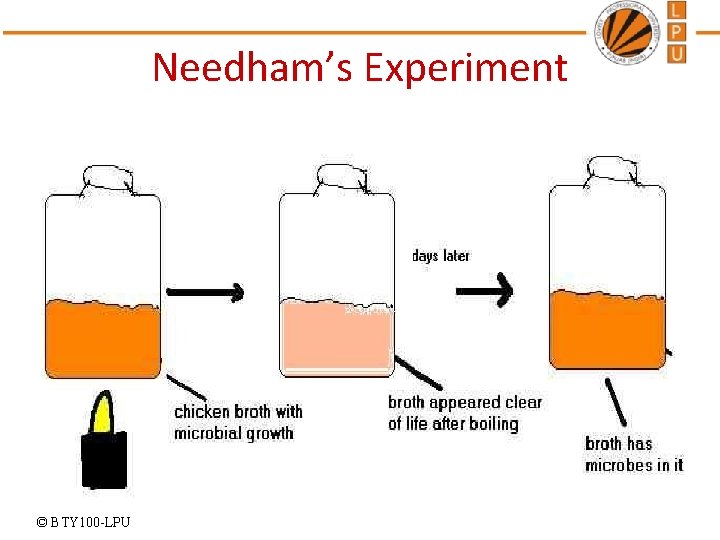
Needham’s Experiment © BTY 100 -LPU
Needham’s Results Needham’s experiments seemed to support the idea of spontaneous generation People didn’t realize bacteria were already present in Needham’s soups Needham didn’t boil long enough to kill the microbes. © BTY 100 -LPU
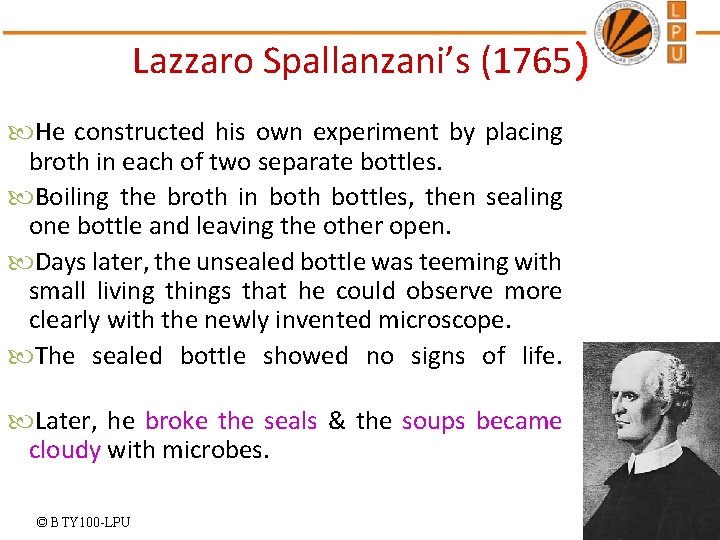
Lazzaro Spallanzani’s (1765) He constructed his own experiment by placing broth in each of two separate bottles. Boiling the broth in both bottles, then sealing one bottle and leaving the other open. Days later, the unsealed bottle was teeming with small living things that he could observe more clearly with the newly invented microscope. The sealed bottle showed no signs of life. Later, he broke the seals & the soups became cloudy with microbes. © BTY 100 -LPU
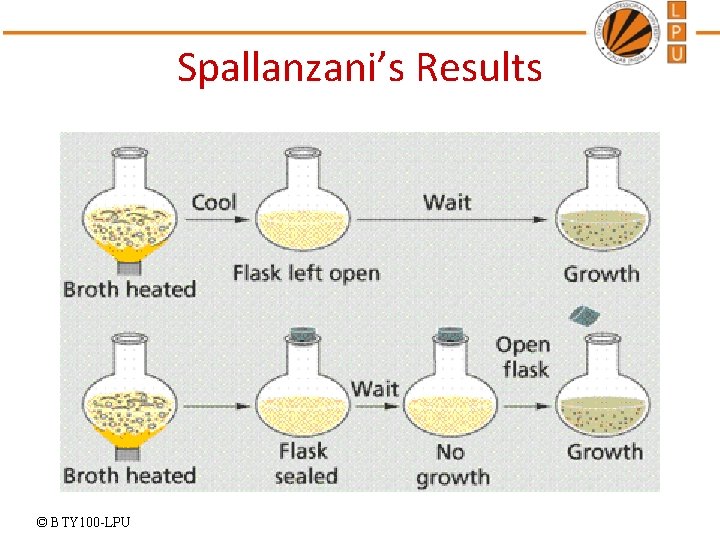
Spallanzani’s Results © BTY 100 -LPU
Critics said sealed vials did not allow enough air for organisms to survive and that prolonged heating destroyed “life force” Therefore, spontaneous generation remained theory of the time © BTY 100 -LPU
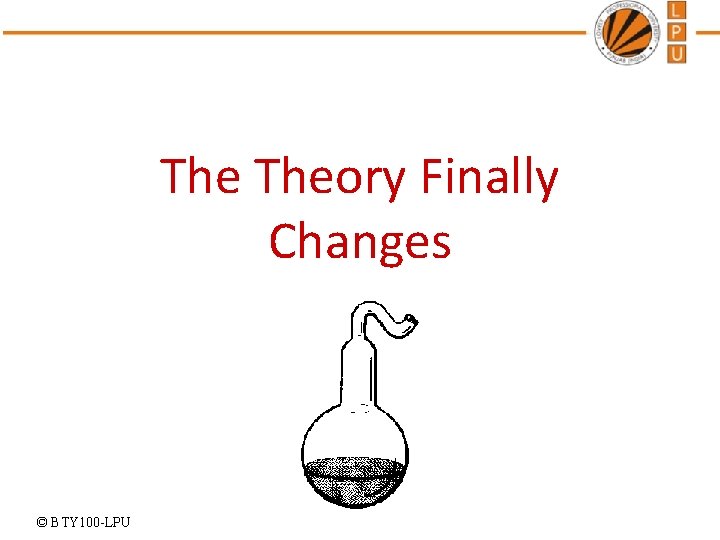
The Theory Finally Changes © BTY 100 -LPU
The Final Blow!! By 1860, the debate had become so heated that the Paris Academy of Sciences offered a prize for any experiments that would help resolve this conflict The prize was claimed in 1864 by Louis Pasteur, as he published the results of an experiment he did to disprove spontaneous generation in microscopic organisms. © BTY 100 -LPU
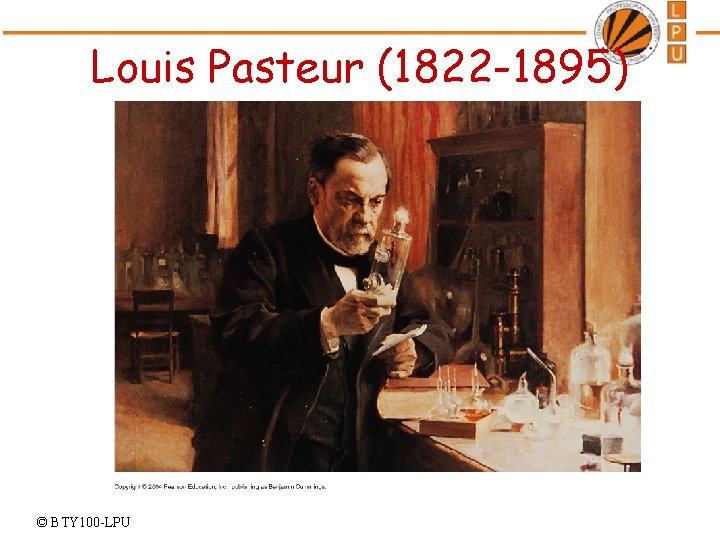
Louis Pasteur (1822 -1895) © BTY 100 -LPU
Pasteur's Experiment Hypothesis: Dust particles in the air contains microbes; they are not formed from air itself. Pasteur put broth into several special Sshaped flasks Each flask was boiled and placed at various locations. © BTY 100 -LPU
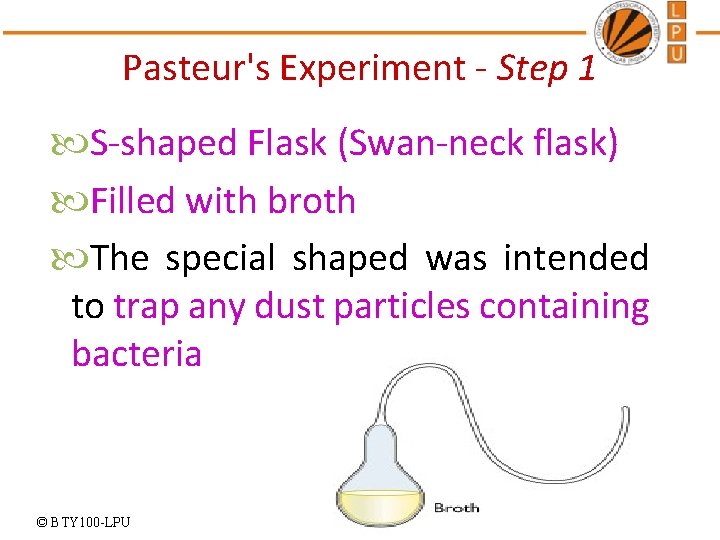
Pasteur's Experiment - Step 1 S-shaped Flask (Swan-neck flask) Filled with broth The special shaped was intended to trap any dust particles containing bacteria © BTY 100 -LPU
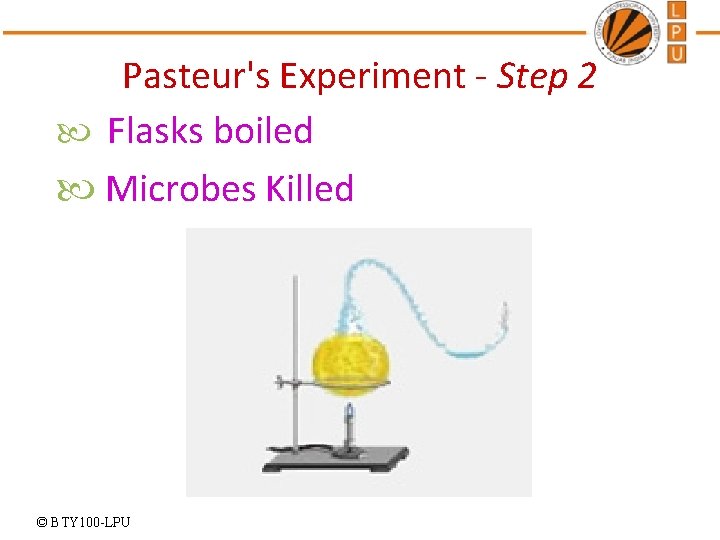
Pasteur's Experiment - Step 2 Flasks boiled Microbes Killed © BTY 100 -LPU
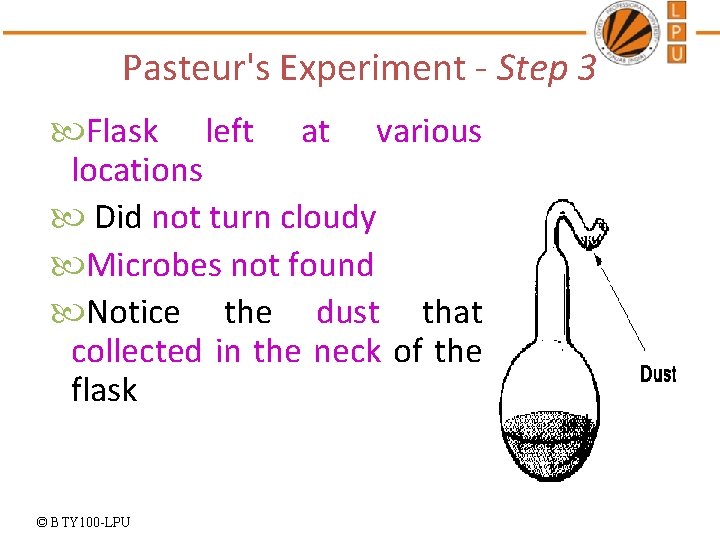
Pasteur's Experiment - Step 3 Flask left at various locations Did not turn cloudy Microbes not found Notice the dust that collected in the neck of the flask © BTY 100 -LPU
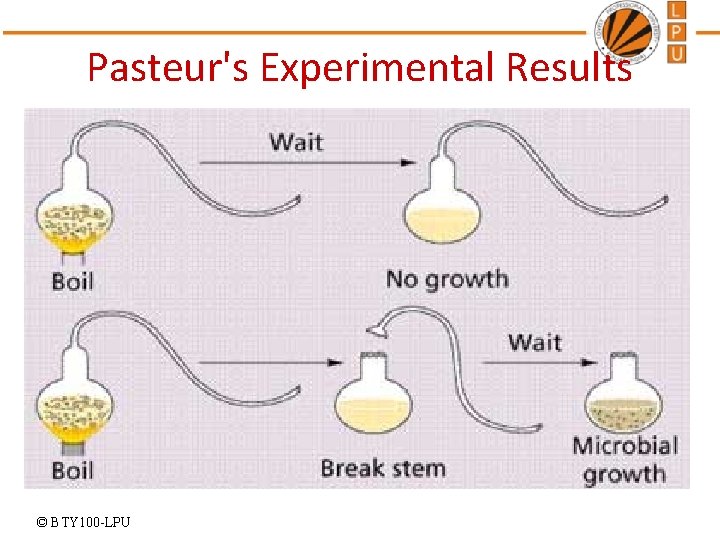
Pasteur's Experimental Results © BTY 100 -LPU
CONCLUSION • There is something(life form) in the air to which when the broth was exposed, it turned cloudy. • The broth itself did not convert into microorganisms. © BTY 100 -LPU
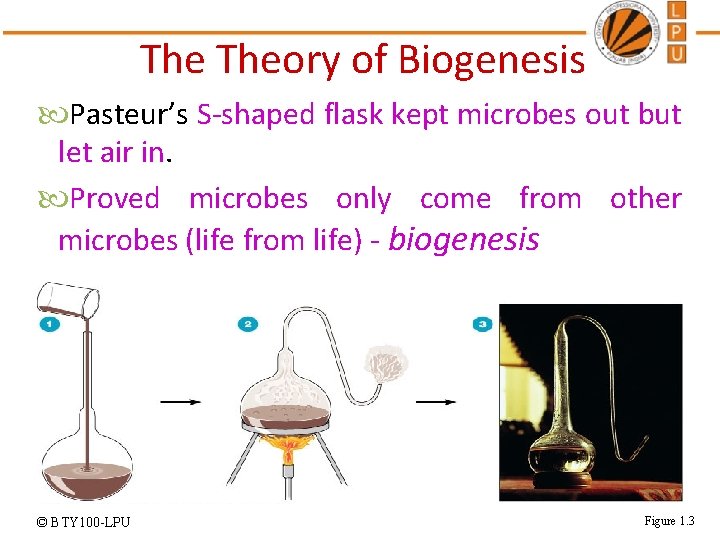
The Theory of Biogenesis Pasteur’s S-shaped flask kept microbes out but let air in. Proved microbes only come from other microbes (life from life) - biogenesis © BTY 100 -LPU Figure 1. 3
Current Thinking about Origin of Life • Extra-terrestrial origin: given by Arrhenius • His concept Panspermia hypothesized that life arose outside the Earth and the living things were transported to earth to seed the planet. • Chemical evolution: life originated from natural chemical processes which can be observed and evaluated experimentally. • Inorganic matter-> living forms • Role of meteorites © BTY 100 -LPU
Origin of life on Earth • Proper temp for water in liquid state. • Earlier Earth lacked oxygen: necessary for generation of organic molecules. • High atmospheric temperature of early Earth. © BTY 100 -LPU
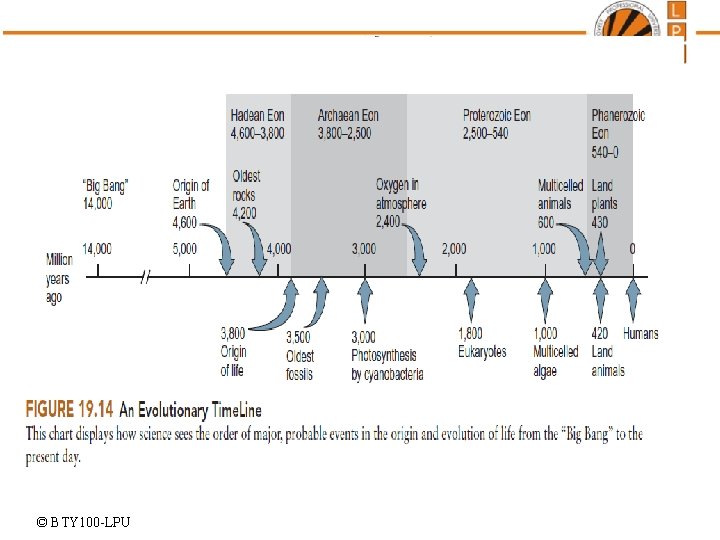
The “Big Bang” and Origin of Earth Universe began as a very dense mass of matter. Exploded in a big bang about 13 billion years ago. Original Universe consisted of atoms of H and He. Gravitation led to formation of stars and solar system Earth formed about 4. 6 billion years ago: Hadean Eon (Hellish!!!) • Reducing Environment: no Oxygen was present initially. • Cooling led to condensation. • • • © BTY 100 -LPU
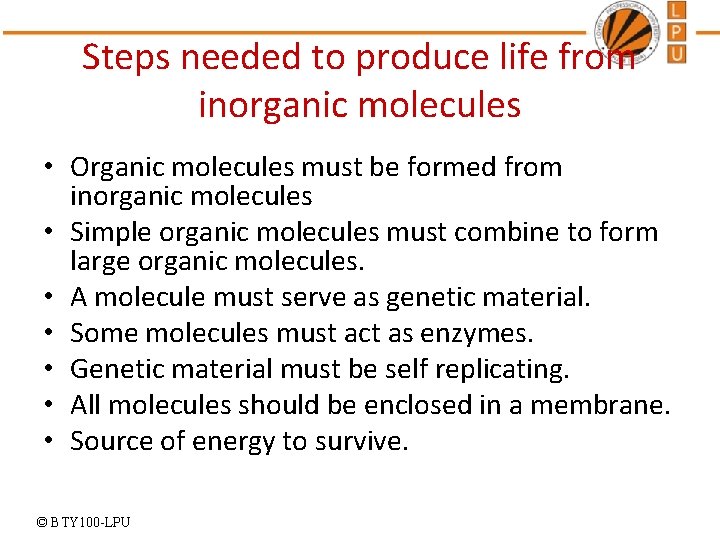
Steps needed to produce life from inorganic molecules • Organic molecules must be formed from inorganic molecules • Simple organic molecules must combine to form large organic molecules. • A molecule must serve as genetic material. • Some molecules must act as enzymes. • Genetic material must be self replicating. • All molecules should be enclosed in a membrane. • Source of energy to survive. © BTY 100 -LPU
Formation of first organic molecule © BTY 100 -LPU
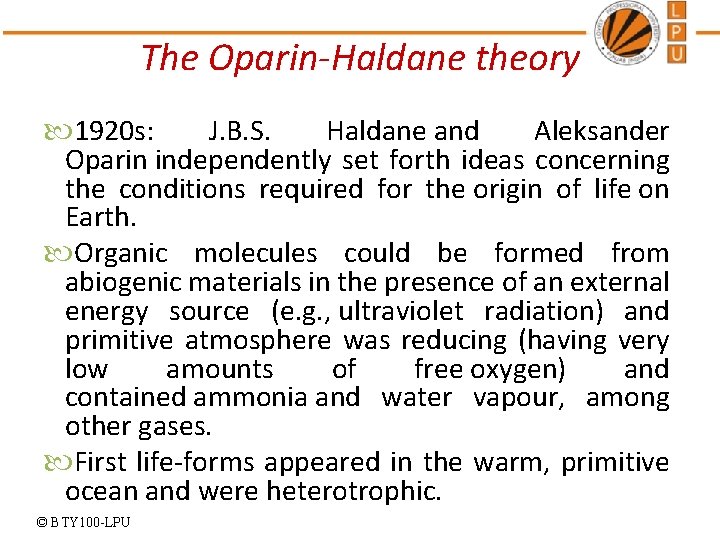
The Oparin-Haldane theory 1920 s: J. B. S. Haldane and Aleksander Oparin independently set forth ideas concerning the conditions required for the origin of life on Earth. Organic molecules could be formed from abiogenic materials in the presence of an external energy source (e. g. , ultraviolet radiation) and primitive atmosphere was reducing (having very low amounts of free oxygen) and contained ammonia and water vapour, among other gases. First life-forms appeared in the warm, primitive ocean and were heterotrophic. © BTY 100 -LPU
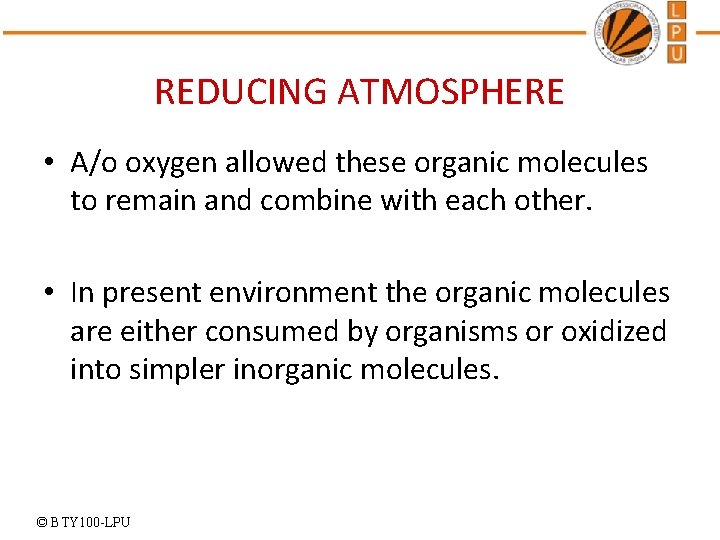
REDUCING ATMOSPHERE • A/o oxygen allowed these organic molecules to remain and combine with each other. • In present environment the organic molecules are either consumed by organisms or oxidized into simpler inorganic molecules. © BTY 100 -LPU
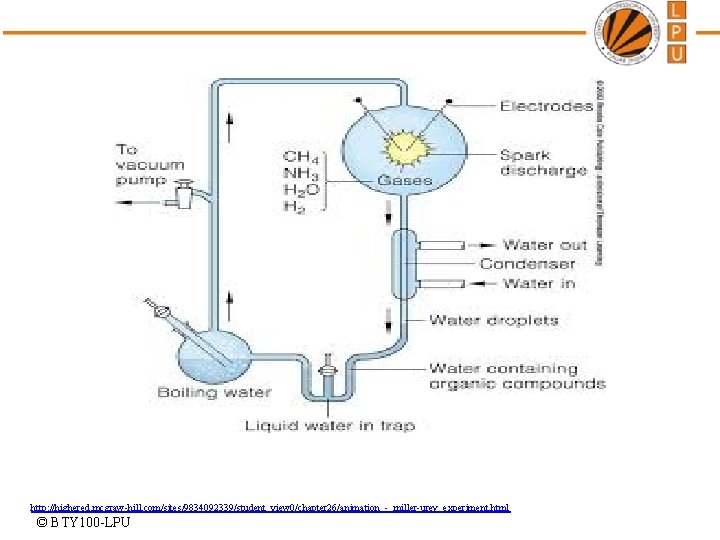
Urey-Miller Experiment 1953 American chemists Harold C. Urey and Stanley Miller tested the Oparin-Haldane theory. Successfully produced organic molecules from some of the inorganic components thought to have been present on prebiotic Earth. Combined warm water with a mixture of four gases—water vapour, methane, ammonia, and molecular hydrogen—and pulsed the “atmosphere” with electrical discharges. The different components were meant to simulate the primitive ocean, the prebiotic atmosphere, and heat (in the form of lightning), respectively. One week later Miller and Urey found that simple organic molecules, including amino acids (the building blocks of proteins), had formed under the simulated conditions of early Earth. © BTY 100 -LPU
http: //highered. mcgraw-hill. com/sites/9834092339/student_view 0/chapter 26/animation_-_miller-urey_experiment. html © BTY 100 -LPU
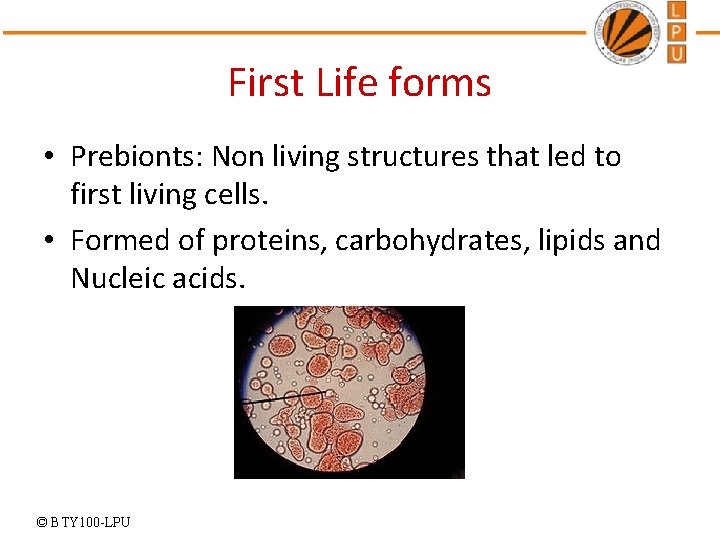
First Life forms • Prebionts: Non living structures that led to first living cells. • Formed of proteins, carbohydrates, lipids and Nucleic acids. © BTY 100 -LPU
Towards Complexity • • Additional steps required: Proteins must become catalysts of cells Development of genetic material Must have away to obtain energy. © BTY 100 -LPU
© BTY 100 -LPU
• http: //evolution. berkeley. edu/evosite/evo 101 /IIE 2 b. Detailsoforigin. shtml © BTY 100 -LPU
Next Class: Evolution © BTY 100 -LPU
- Slides: 47