
BTM 382 Database Management Chapter 2 Data models
BTM 382 Database Management Chapter 2: Data models Chapter 12 -12: CAP Chapter 14 -2 a: Hadoop Chitu Okoli Associate Professor in Business Technology Management John Molson School of Business, Concordia University, Montréal
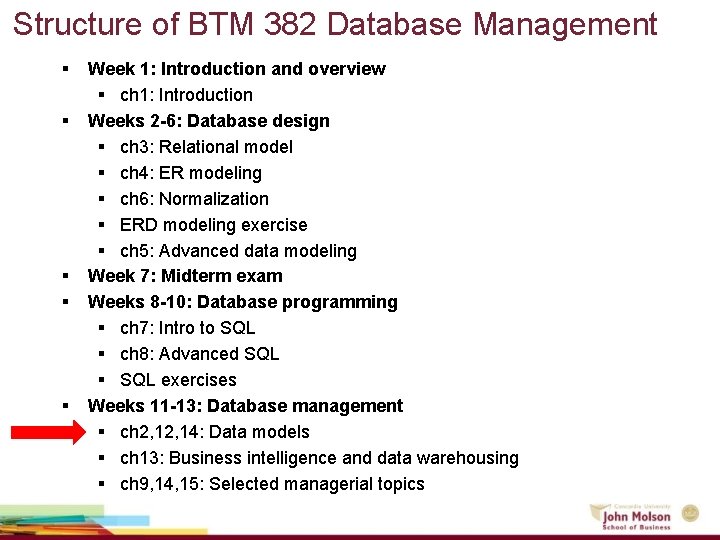
Structure of BTM 382 Database Management § § § Week 1: Introduction and overview § ch 1: Introduction Weeks 2 -6: Database design § ch 3: Relational model § ch 4: ER modeling § ch 6: Normalization § ERD modeling exercise § ch 5: Advanced data modeling Week 7: Midterm exam Weeks 8 -10: Database programming § ch 7: Intro to SQL § ch 8: Advanced SQL § SQL exercises Weeks 11 -13: Database management § ch 2, 14: Data models § ch 13: Business intelligence and data warehousing § ch 9, 14, 15: Selected managerial topics
Review of Chapters 2, 14: Data models § What is a data model? § How have data models developed over the years? § What is the Object-Oriented Data Model (OODM), and when is it useful? § What is Big Data, and how does No. SQL resolve the major Big Data challenges? § Which data models should we use for which situations?
Models and data models
What is a model? § A model is a simplified way to describe or explain a complex reality § A model helps people communicate and work simply yet effectively when talking about and manipulating complex real-world phenomena
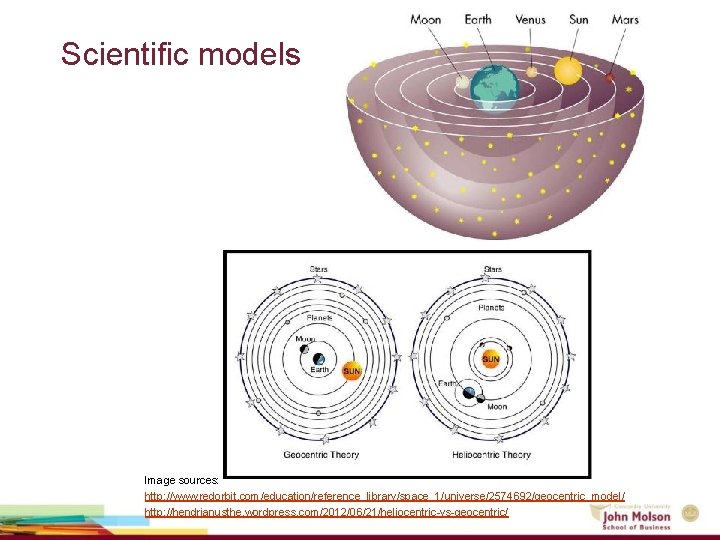
Scientific models Image sources: http: //www. redorbit. com/education/reference_library/space_1/universe/2574692/geocentric_model/ http: //hendrianusthe. wordpress. com/2012/06/21/heliocentric-vs-geocentric/
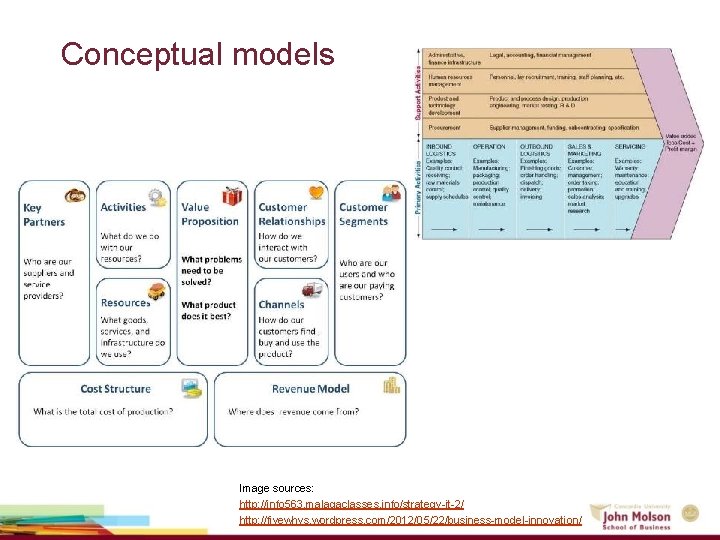
Conceptual models Image sources: http: //info 563. malagaclasses. info/strategy-it-2/ http: //fivewhys. wordpress. com/2012/05/22/business-model-innovation/
Importance of Data Models l. Communication l. Give an overall view of the database l. Organize l. Are tool data for various users an abstraction for the creation of welldesigned good database
The Evolution of Data Models
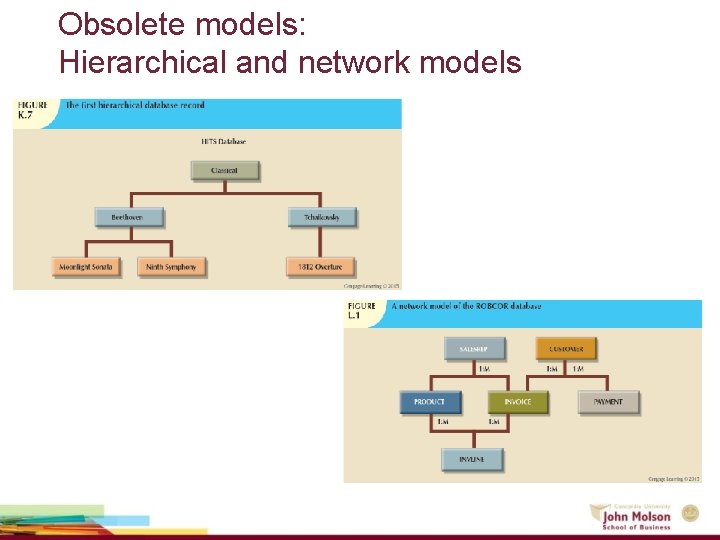
Obsolete models: Hierarchical and network models
The Relational Model § Uses key concepts from mathematical relations (tables) § “Relational” in “relational model” means “tables” (mathematical relations), not “relationships” § Table (relations) § Intersections of § rows (various data types) and § columns (same data type) § Relations have well defined methods (queries) for combining their data members § Selecting (reading) and joining (combining) data is defined based on mathematical principles § Relational data management system (RDBMS) § Relations were originally too advanced for 1970 s computing power § As computing power increased, simplicity of the model prevailed
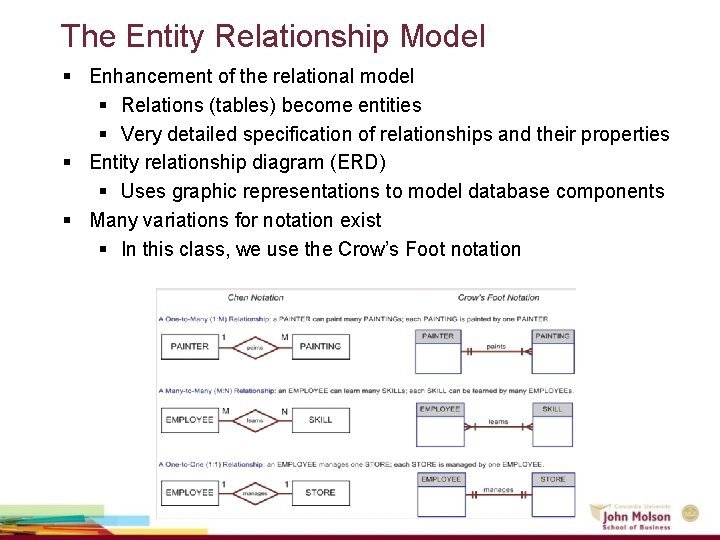
The Entity Relationship Model § Enhancement of the relational model § Relations (tables) become entities § Very detailed specification of relationships and their properties § Entity relationship diagram (ERD) § Uses graphic representations to model database components § Many variations for notation exist § In this class, we use the Crow’s Foot notation
The Object-Oriented Data Model (OODM)
The Object-Oriented Data Model (OODM) § Tries to reconcile the ER model with object-oriented programming (OOP) § The ER model’s view of data (tables) and programmers’ view of data (objects in OOP), is completely different § This mismatch can sometimes make database programming painful, especially for very complex data structures § An OODM uses OOP concepts to store data § § Objects represent nouns (entities or records) Objects have attributes (properties or fields) with values (data) Objects have methods (operations or functions) Classes group similar objects using a hierarchy and inheritance § In an OODBMS, the data retrieval and storage closely mirrors the data structures that programmers use, and so programming complex objects is much easier than with the ER model § More advanced forms support the Extended Relational Data Model, Object/Relational DBMS, and XML data structures
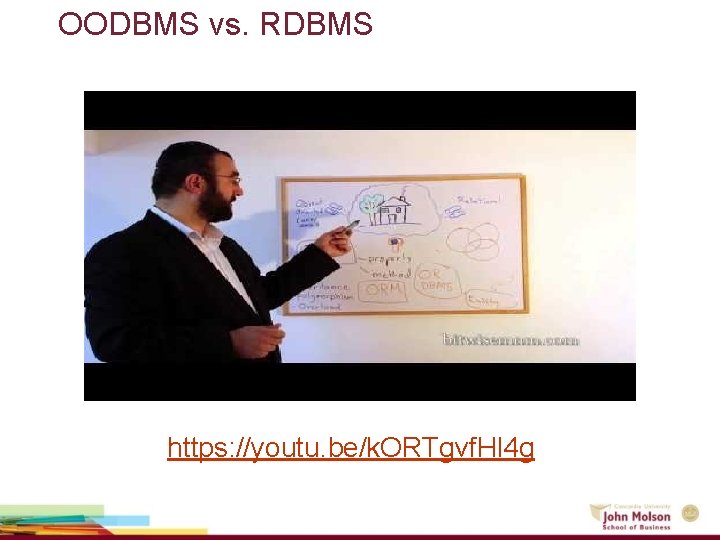
OODBMS vs. RDBMS https: //youtu. be/k. ORTgvf. Hl 4 g


Big Data and No. SQL
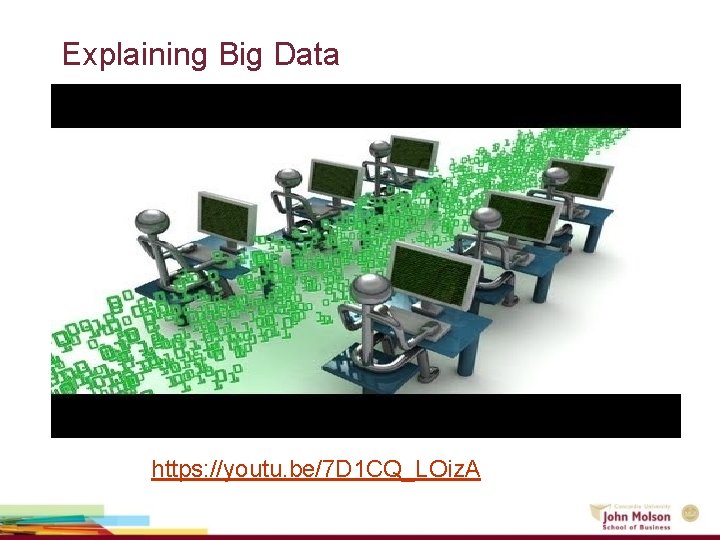
Explaining Big Data https: //youtu. be/7 D 1 CQ_LOiz. A
Big Data § Volume § Huge amounts of data (terabytes and petabytes), especially from the Internet § Velocity § Organizations need to process the huge amounts of data rapidly, just as fast as with smaller databases § Variety § Many different types of data, much of it unstructured and even changing in structure
How do you handle Big Data? Where RDBMSs run into trouble 1. Solution: Scale up § Use more powerful, expensive servers § But RDBMSs are very computing intensive § Big data would require much faster, more capable, more expensive computers, and even that’s not good enough for big data 2. Solution: Scale out § Use many cheap distributed servers § But RDBMS is slow with distributed processing § Consistency is the biggest problem: guaranteeing consistency (which RDBMS is great at) is slow § Slow infrastructure isn’t good enough for big data
What is No. SQL? https: //youtu. be/q. UV 2 j 3 XBRHc
No. SQL databases to the Big Data rescue § “No. SQL” means: § Non-relational or non-RDBMS § Also “Not only SQL”—a few in fact do support SQL § It is not one model; it is many different models that are not relational data models § Scale out (many cheap distributed servers) instead of scale up § High scalability § Support distributed database architectures § High availability § Rapid performance for big data, including unstructured and sparse data § Fault tolerance § Continue to work even if some servers in the cluster fail § Emphasis is high performance speed, rather than transaction consistency
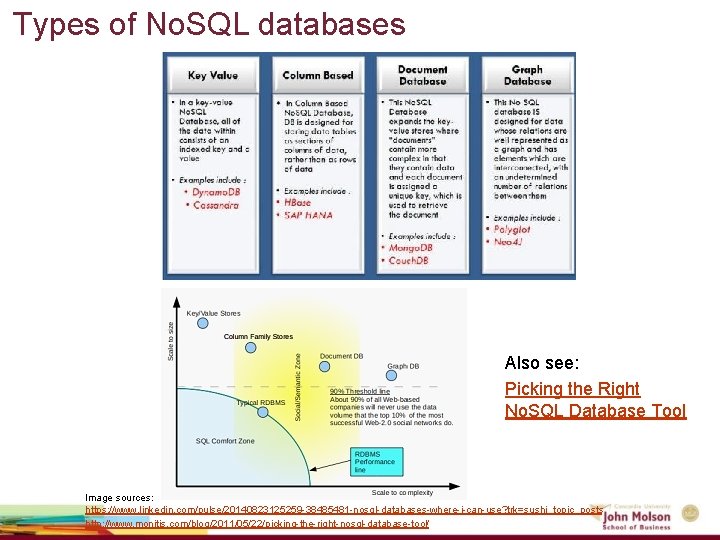
Types of No. SQL databases Also see: Picking the Right No. SQL Database Tool Image sources: https: //www. linkedin. com/pulse/20140823125259 -38485481 -nosql-databases-where-i-can-use? trk=sushi_topic_posts http: //www. monitis. com/blog/2011/05/22/picking-the-right-nosql-database-tool/
Disadvantages of No. SQL § Complex programming is often required § “No. SQL” means you lose the ease-of-use and structural independence of SQL § There is often no built-in implementation of relationships in the database—you might have to program relationships yourself in code § Data might be sometimes inconsistent § No guarantee of transaction integrity § Entity integrity and referential integrity not guaranteed § The data you retrieve at any given moment might be inaccurate… but it will eventually become OK § This is the price to pay for rapid performance in a distributed database
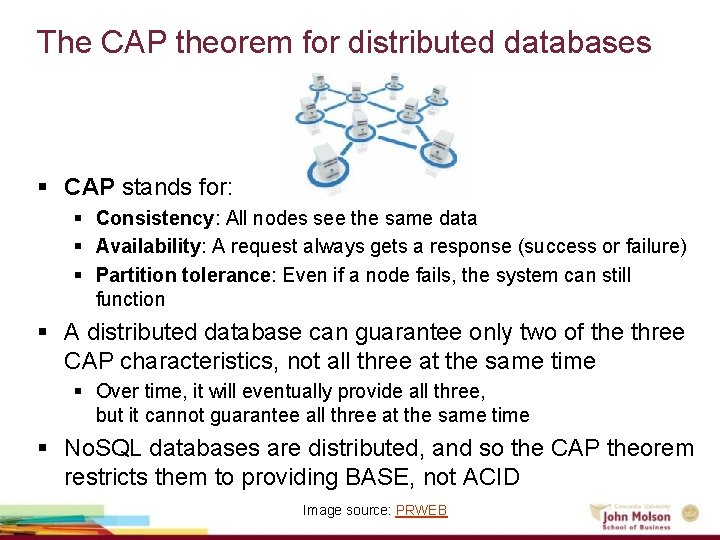
The CAP theorem for distributed databases § CAP stands for: § Consistency: All nodes see the same data § Availability: A request always gets a response (success or failure) § Partition tolerance: Even if a node fails, the system can still function § A distributed database can guarantee only two of the three CAP characteristics, not all three at the same time § Over time, it will eventually provide all three, but it cannot guarantee all three at the same time § No. SQL databases are distributed, and so the CAP theorem restricts them to providing BASE, not ACID Image source: PRWEB
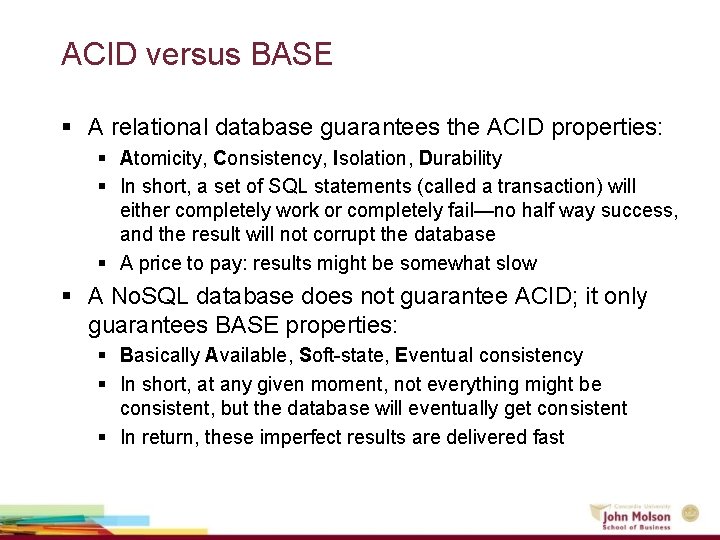
ACID versus BASE § A relational database guarantees the ACID properties: § Atomicity, Consistency, Isolation, Durability § In short, a set of SQL statements (called a transaction) will either completely work or completely fail—no half way success, and the result will not corrupt the database § A price to pay: results might be somewhat slow § A No. SQL database does not guarantee ACID; it only guarantees BASE properties: § Basically Available, Soft-state, Eventual consistency § In short, at any given moment, not everything might be consistent, but the database will eventually get consistent § In return, these imperfect results are delivered fast


Summary of data models
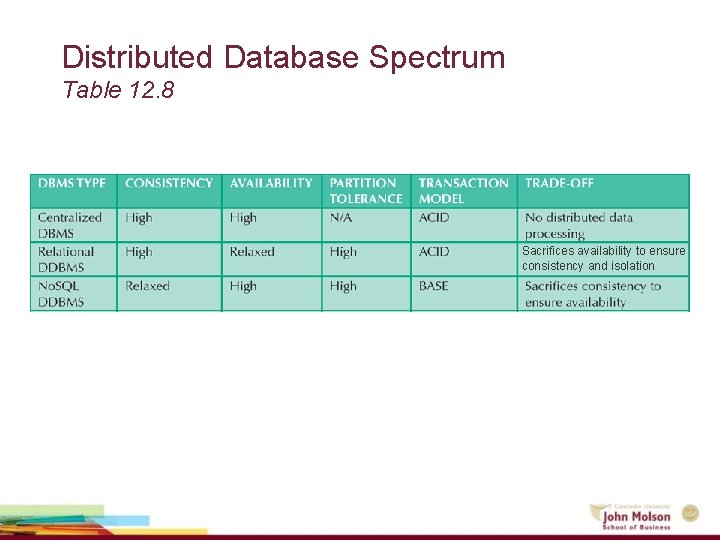
Distributed Database Spectrum Table 12. 8 Sacrifices availability to ensure consistency and isolation
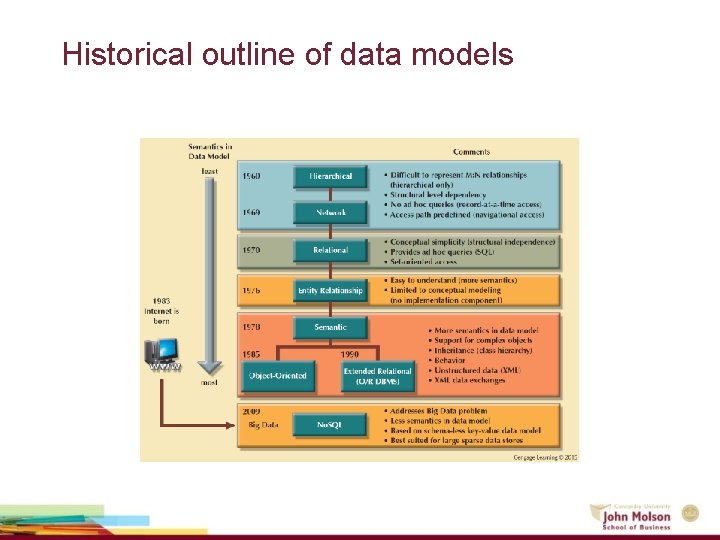
Historical outline of data models
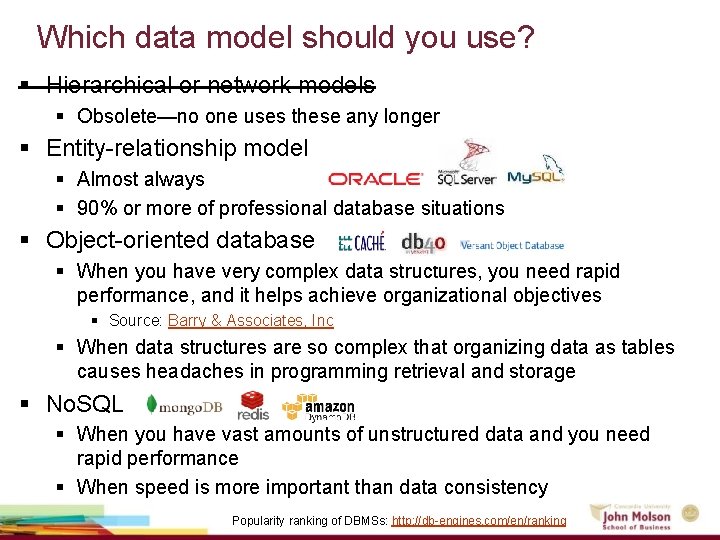
Which data model should you use? § Hierarchical or network models § Obsolete—no one uses these any longer § Entity-relationship model § Almost always § 90% or more of professional database situations § Object-oriented database § When you have very complex data structures, you need rapid performance, and it helps achieve organizational objectives § Source: Barry & Associates, Inc § When data structures are so complex that organizing data as tables causes headaches in programming retrieval and storage § No. SQL § When you have vast amounts of unstructured data and you need rapid performance § When speed is more important than data consistency Popularity ranking of DBMSs: http: //db-engines. com/en/ranking
Summary of Chapters 2, 14: Data models § A data model is an abstract way of thinking about how data is organized § Although the relational model has become the dominant data model, it cannot solve all database challenges § The Object-Oriented Data Model is useful for complex data coupled with object-oriented programming § Big Data is data with high volume, velocity and variety § No. SQL generally handles big data better than relational databases, but it sacrifices consistency for speed § No single data model is the best for all situations, so we should understand the pros and cons of each model

Sources § Most of the slides are adapted from Database Systems: Design, Implementation and Management by Carlos Coronel and Steven Morris. 11 th edition (2015) published by Cengage Learning. ISBN 13: 978 -1 -285 -19614 -5 § Other sources are noted on the slides themselves
- Slides: 36