
BTEC Enterprise Component 3 LA B 26 February
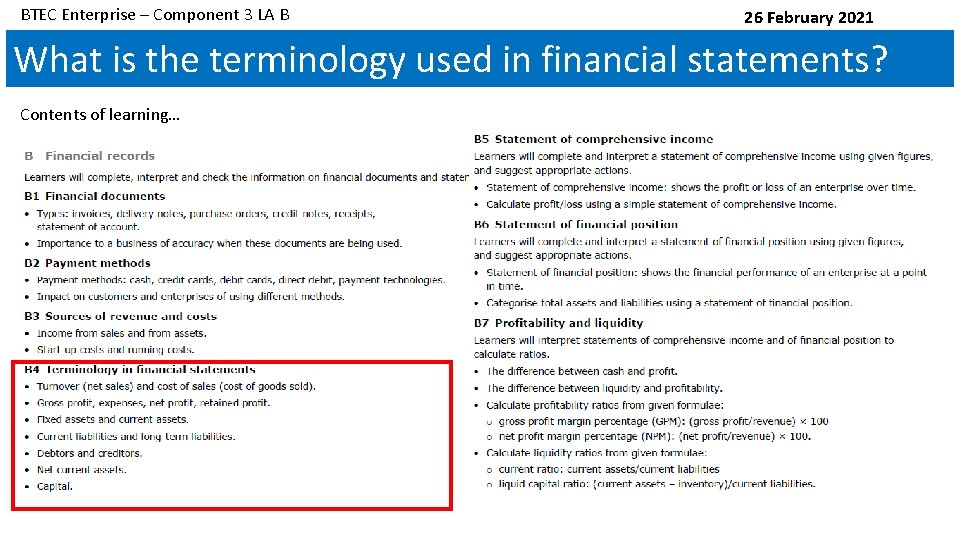
BTEC Enterprise – Component 3 LA B 26 February 2021 What is the terminology used in financial statements? Contents of learning…
BTEC Enterprise – Component 3 LA B 26 February 2021 What is the terminology used in financial statements? Do Now: Define the following key terms: Turnover Cost of sales Gross profit Expenses Net profit
BTEC Enterprise – Component 3 LA B 26 February 2021 What is the terminology used in financial statements? Turnover – the total revenue an enterprise receives. Cost of sales – the cost of producing a product. Gross profit – money made from selling a product after cost of sales has been deducted. Expenses – indirect costs of a business (e. g. wages, bills, advertising, etc. ) Net profit – money made from selling a product after all costs have been deducted from gross profit.
BTEC Enterprise – Component 3 LA B 26 February 2021 What is the terminology used in financial statements? Define the following key terms: Owner’s capital Debtors (trade receivables) Creditors (trade payables) Retained profit
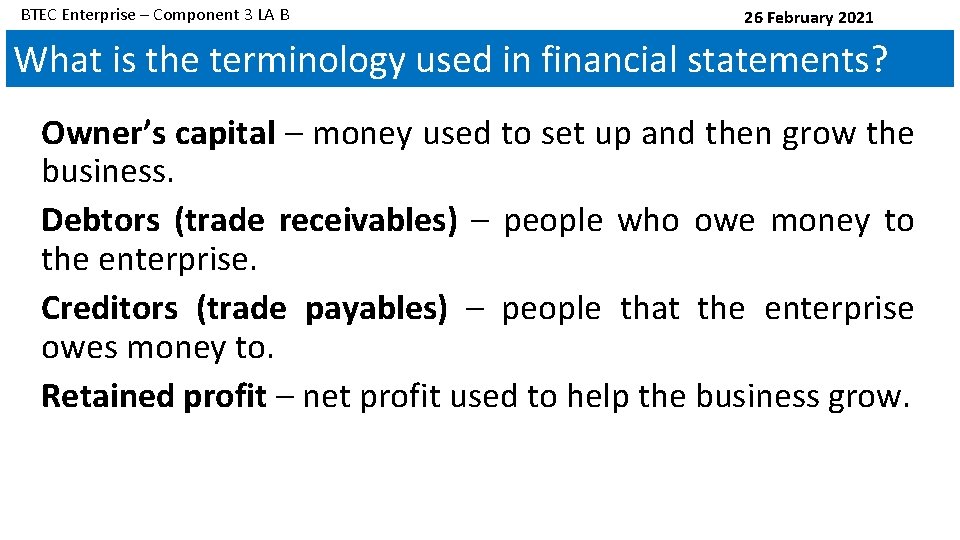
BTEC Enterprise – Component 3 LA B 26 February 2021 What is the terminology used in financial statements? Owner’s capital – money used to set up and then grow the business. Debtors (trade receivables) – people who owe money to the enterprise. Creditors (trade payables) – people that the enterprise owes money to. Retained profit – net profit used to help the business grow.
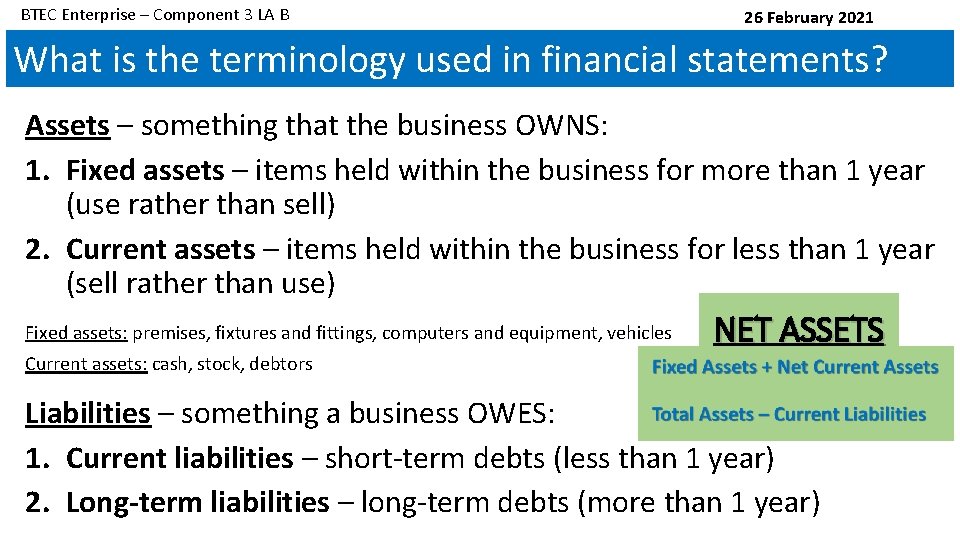
BTEC Enterprise – Component 3 LA B 26 February 2021 What is the terminology used in financial statements? Assets – something that the business OWNS: 1. Fixed assets – items held within the business for more than 1 year (use rather than sell) 2. Current assets – items held within the business for less than 1 year (sell rather than use) Fixed assets: premises, fixtures and fittings, computers and equipment, vehicles Current assets: cash, stock, debtors NET ASSETS Liabilities – something a business OWES: 1. Current liabilities – short-term debts (less than 1 year) 2. Long-term liabilities – long-term debts (more than 1 year)
BTEC Enterprise – Component 3 LA B 26 February 2021 What is the terminology used in financial statements? PROFITABILITY Refers to an enterprise’s ability to turn revenue into profit. WHY? Imagine Firm A and B both make £ 750, 000 profit – how would you be able to tell which firm was performing better? If, however, you were told Firm A had a revenue of £ 3 million and Firm B had a revenue of £ 1. 5 million. It would be clear that Firm B was performing better.
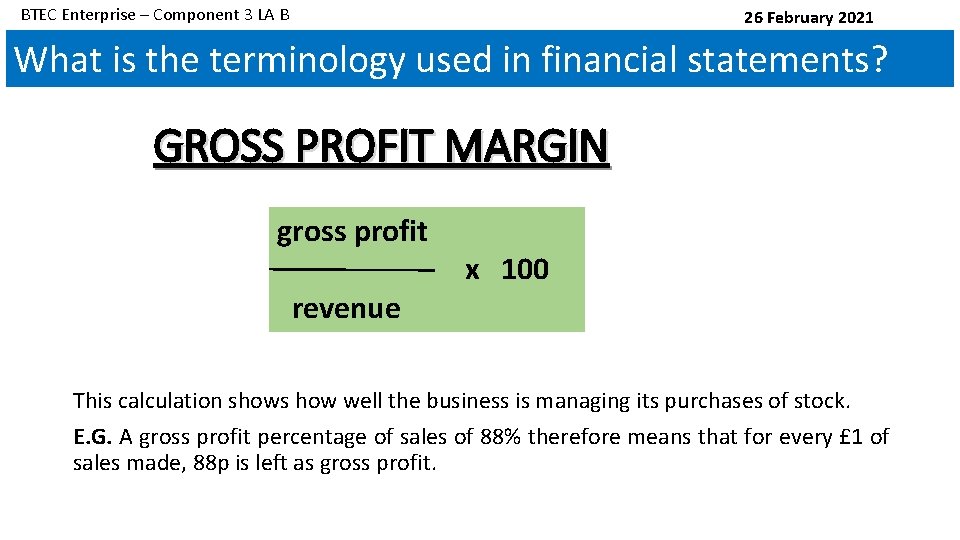
BTEC Enterprise – Component 3 LA B 26 February 2021 What is the terminology used in financial statements? GROSS PROFIT MARGIN gross profit revenue x 100 This calculation shows how well the business is managing its purchases of stock. E. G. A gross profit percentage of sales of 88% therefore means that for every £ 1 of sales made, 88 p is left as gross profit.
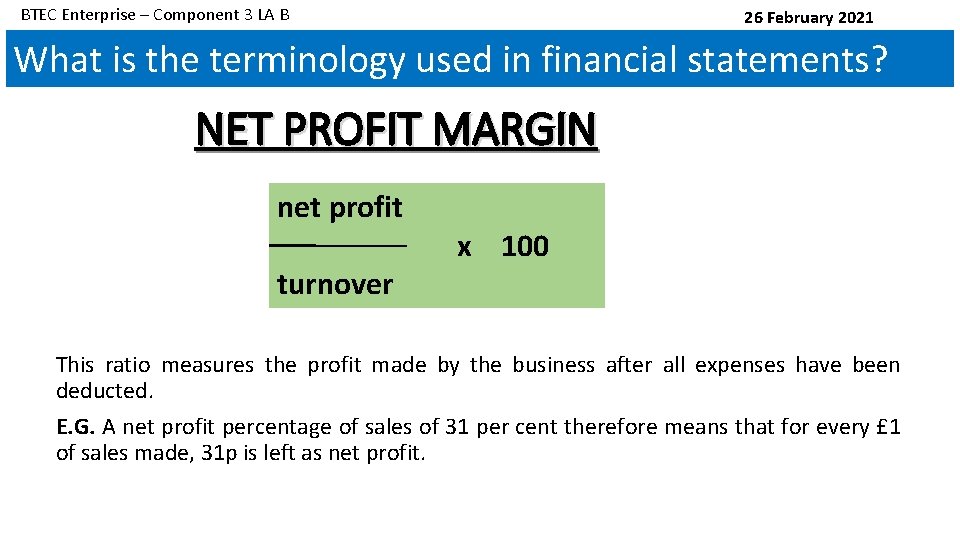
BTEC Enterprise – Component 3 LA B 26 February 2021 What is the terminology used in financial statements? NET PROFIT MARGIN net profit turnover x 100 This ratio measures the profit made by the business after all expenses have been deducted. E. G. A net profit percentage of sales of 31 per cent therefore means that for every £ 1 of sales made, 31 p is left as net profit.
BTEC Enterprise – Component 3 LA B 26 February 2021 What is the terminology used in financial statements? LIQUIDITY A measure of the ability of a business to meet its short-term debts. There are 2 liquidity ratios: Current ratio Liquid capital ratio
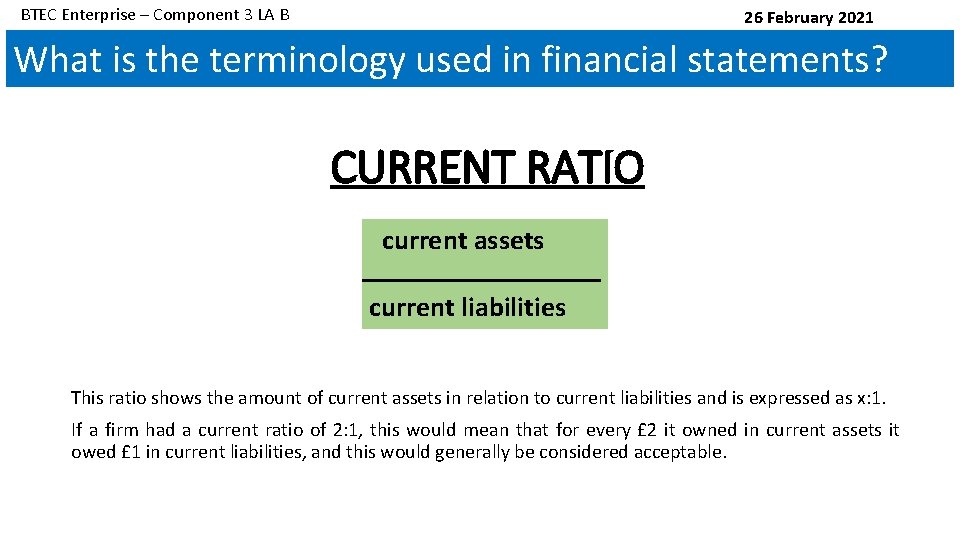
BTEC Enterprise – Component 3 LA B 26 February 2021 What is the terminology used in financial statements? CURRENT RATIO current assets current liabilities This ratio shows the amount of current assets in relation to current liabilities and is expressed as x: 1. If a firm had a current ratio of 2: 1, this would mean that for every £ 2 it owned in current assets it owed £ 1 in current liabilities, and this would generally be considered acceptable.
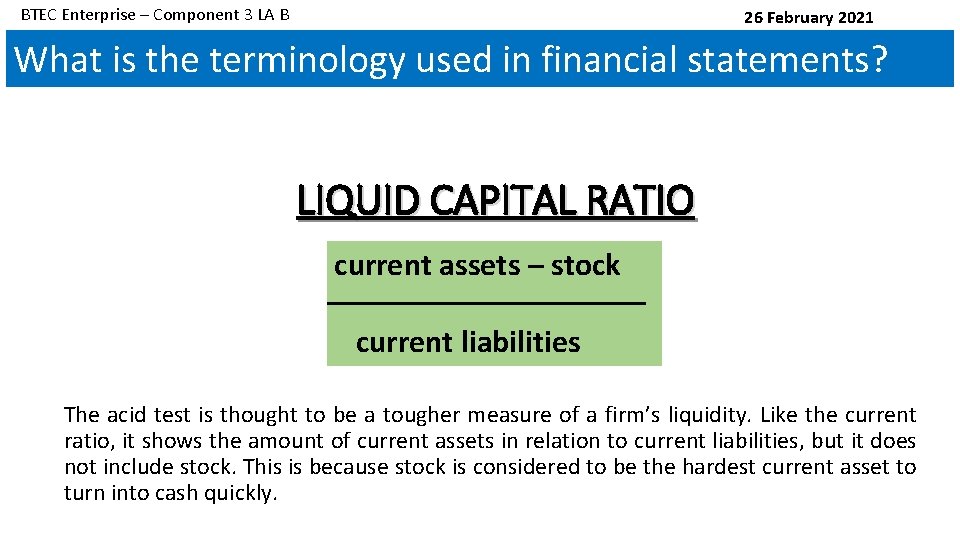
BTEC Enterprise – Component 3 LA B 26 February 2021 What is the terminology used in financial statements? LIQUID CAPITAL RATIO current assets – stock current liabilities The acid test is thought to be a tougher measure of a firm’s liquidity. Like the current ratio, it shows the amount of current assets in relation to current liabilities, but it does not include stock. This is because stock is considered to be the hardest current asset to turn into cash quickly.
- Slides: 12