
BSA Emergency Preparedness 1 Earn the First Aid
BSA Emergency Preparedness
1. Earn the First Aid Merit Badge.
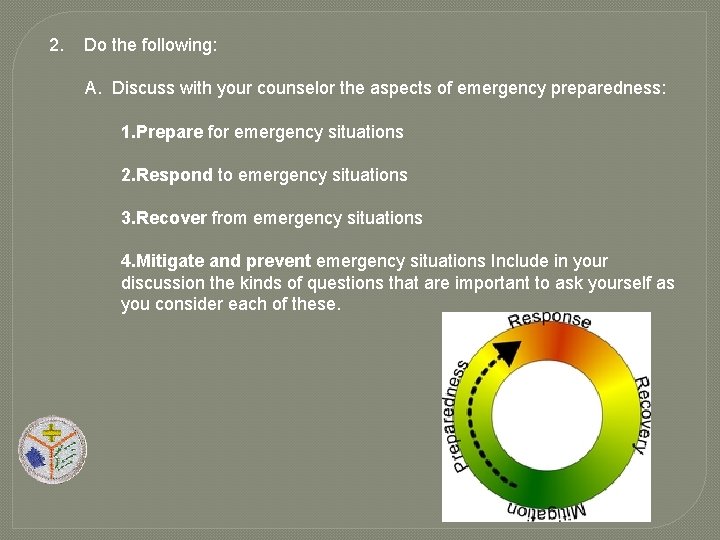
2. Do the following: A. Discuss with your counselor the aspects of emergency preparedness: 1. Prepare for emergency situations 2. Respond to emergency situations 3. Recover from emergency situations 4. Mitigate and prevent emergency situations Include in your discussion the kinds of questions that are important to ask yourself as you consider each of these.
2. A. : Emergency management (or disaster management) is the discipline of dealing with and avoiding risks. It is a discipline that involves preparing for disaster before it occurs Preparedness In the preparedness phase, emergency managers develop plans of action for when the disaster strikes. Response The response phase includes the mobilization of the necessary emergency services and first responders in the disaster area. Recovery The aim of the recovery phase is to restore the affected area to its previous state. Mitigation Personal mitigation is mainly about knowing and avoiding unnecessary risks. This includes an assessment of possible risks to personal/family health and to personal property.
2. A : 4. Mitigate and prevent emergency situations Include in your discussion the kinds of questions that are important to ask yourself as you consider each of these. One example of mitigation would be to avoid buying property that is exposed to hazards, e. g. in a flood plain, in areas of subsidence or landslides. In areas prone to prolonged electricity black-outs installation of a generator would be an example of an optimal structural mitigation measure. The construction of storm cellars and fallout shelters are further examples of personal mitigative actions. Mitigation involves Structural and Non-structural measures taken to limit the impact of disasters.
2. B : Make a chart that demonstrates your understanding of each of the three aspects of emergency preparedness in requirement 2 a (prepare, respond, recover, mitigate and prevent) with regard to 10 of the situations listed below. You must use situations 1, 2, 3, 4, and 5 below in boldface but you may choose any other five listed here for a total of 10 situations. Discuss this chart with your counselor. 1. Home kitchen fire 2. Home basement/storage room/garage fire 3. Explosion in the home 4. Automobile accident 5. Food-borne disease (food poisoning) 6. Fire or explosion in a public place 7. Vehicle stalled in the desert 8. Vehicle trapped in a blizzard 9. Flash flooding in town or in the country 10. Mountain/backcountry accident 11. Boating accident 12. Gas leak in a home or a building 13. Tornado or hurricane 14. Major flood 15. Nuclear power plant emergency 16. Avalanche (snowslide or rockslide) 17. Violence in a public place
2. B : 1. Home kitchen fire A fire extinguisher can be the single-most important tool you will need if you have a kitchen fire. A small kitchen fire can quickly escalate if you don’t respond immediately. If you have a fire when cooking on your stove, make sure you turn off your stove immediately. You can throw baking soda on the fire, but never throw water on a grease fire. That will only fuel the fire. You can also put the lid onto your pan to kill a grease fire. Make sure that you don’t wear loose clothing when you are cooking. If you wear loose clothing, your sleeve can come in contact with the stove and catch on fire. In order to reduce the chance of a fire in your kitchen, clean all your appliances immediately after using. Accumulated debris in your oven can be a fire source. Make sure that you don’t store items on top of or near your microwave. This is a fire hazard.
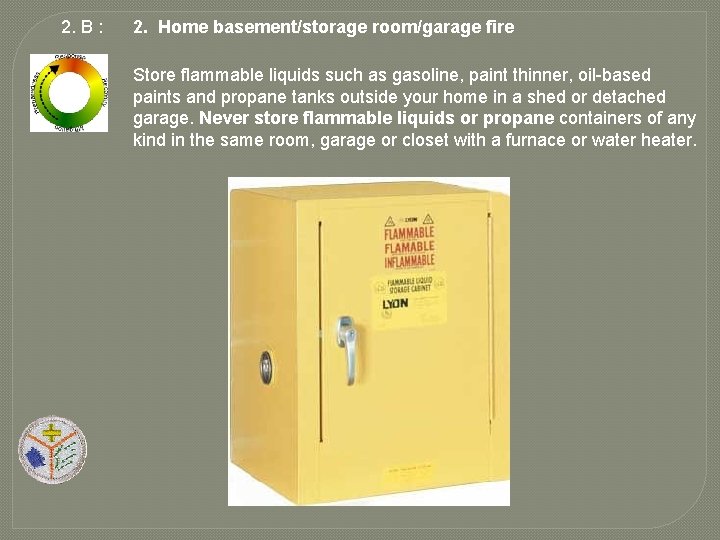
2. B : 2. Home basement/storage room/garage fire Store flammable liquids such as gasoline, paint thinner, oil-based paints and propane tanks outside your home in a shed or detached garage. Never store flammable liquids or propane containers of any kind in the same room, garage or closet with a furnace or water heater.
2. B : 3. Explosion in the home Avoid using gas or charcoal grills on enclosed porches or balconies. Have a fire extinguisher in your home and make sure all household members know how to use it. Store gasoline for lawn movers in approved containers. Store combustible liquids outdoors in a cool place If There Is An Explosion Take shelter against your desk or a sturdy table. Exit the building ASAP. Check for fire and other hazards. Take your emergency supply kit if time allows.
2. B : 4. Automobile accident Drive Safely Being a cautious and defensive driver is the best way to avoid an auto accident. Always obey posted speed limits and traffic signals. Be prepared to react to other drivers. If you cannot avoid a crash, remain calm and choose the least dangerous situation. For example, running into a ditch is less dangerous than hitting another vehicle. Avoid distractions, such as cell phones, while driving. Keep a safe distance between you and other vehicles on the road. Increase this distance when there is severe weather, or visibility is reduced. Stay Calm and Assist Injured Passengers– Survey the scene for injuries. Immediately call an ambulance for any injured individuals. Do not move injured passengers unless it is necessary to avoid further injury.
2. B : 5. Food-borne disease (food poisoning) The most commonly recognized foodborne infections are those caused by the bacteria Campylobacter, Salmonella, and E. coli O 157: H 7, and by a group of viruses called calicivirus, also known as the Norwalk and Norwalk-like viruses. There are many different kinds of foodborne diseases and they may require different treatments, depending on the symptoms they cause. Illnesses that are primarily diarrhea or vomiting can lead to dehydration if the person loses more body fluids and salts (electrolytes) than they take in. Replacing the lost fluids and electrolytes and keeping up with fluid intake are important. Investigation into its ingredients and preparation, and microbiologic culture of leftover ingredients or the food itself (if available) may provide additional information about the nature of contamination.
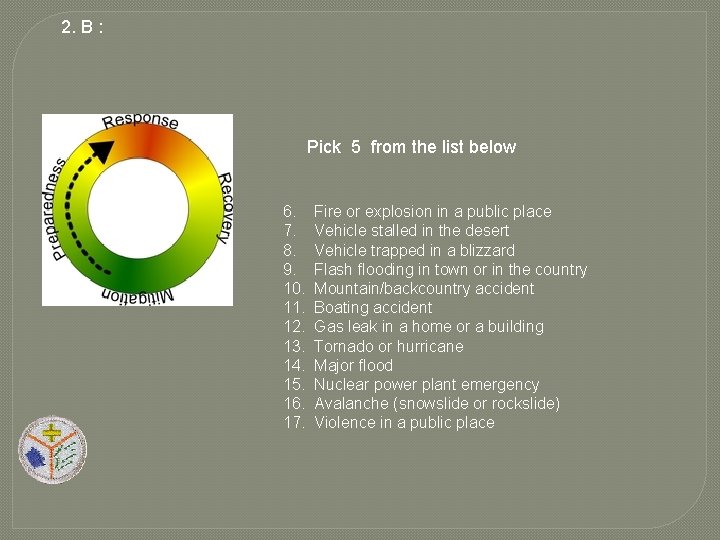
2. B : Pick 5 from the list below 6. Fire or explosion in a public place 7. Vehicle stalled in the desert 8. Vehicle trapped in a blizzard 9. Flash flooding in town or in the country 10. Mountain/backcountry accident 11. Boating accident 12. Gas leak in a home or a building 13. Tornado or hurricane 14. Major flood 15. Nuclear power plant emergency 16. Avalanche (snowslide or rockslide) 17. Violence in a public place
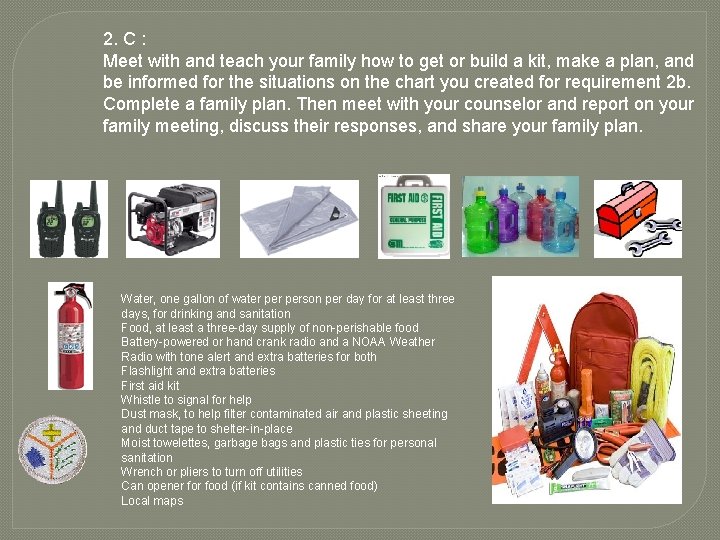
2. C : Meet with and teach your family how to get or build a kit, make a plan, and be informed for the situations on the chart you created for requirement 2 b. Complete a family plan. Then meet with your counselor and report on your family meeting, discuss their responses, and share your family plan. Water, one gallon of water person per day for at least three days, for drinking and sanitation Food, at least a three-day supply of non-perishable food Battery-powered or hand crank radio and a NOAA Weather Radio with tone alert and extra batteries for both Flashlight and extra batteries First aid kit Whistle to signal for help Dust mask, to help filter contaminated air and plastic sheeting and duct tape to shelter-in-place Moist towelettes, garbage bags and plastic ties for personal sanitation Wrench or pliers to turn off utilities Can opener food (if kit contains canned food) Local maps
3. Show you could safely save a person from the following: A. Touching a live household electric wire. B. A room filled with carbon monoxide C. Clothes on fire. Drowning using nonswimming rescues (including accidents on ice).
3. A. : Touching a live household electric wire. First, do not touch a person who comes into contact with a live electric wire. If you do, the electricity will also flow through your body, and there will be two victims instead of one. Instead, if you can quickly turn off the power source, do so immediately. If it cannot be turned off quickly, try to knock the wire off with something that does not conduct electricity, such as a shoe (take it off first), a wooden broom handle, or a wooden chair. Once the victim has been separated from the electric power source, check for breathing. If the victim is not breathing, begin artificial respiration (mouth-to-mouth). 3. B. : A room filled with carbon monoxide In a fire, a person is far more likely to die from smoke inhalation than from exposure to flames. There are two things to remember about smoke: it rises, and if you inhale enough of it, it will kill you. Therefore, if you find yourself in a smoke filled room, get down and crawl. If you can, cover your mouth and nose with a wet cloth to help filter the smoke and keep it from entering your lungs.
3. C. : Clothes on fire. Get the person to the ground and roll him over and over on the ground. Another option is to wrap the victim with a blanket, coat, or jacket if one is handy. If your own clothes catch on fire, stop, drop, and roll - do the same thing to yourself as you would to someone else. 3. D. : Drowning using nonswimming rescues (including accidents on ice). Unless you have been trained to properly do so, avoid swimming to the assistance of a person who is drowning. A drowning non-swimmer is typically in a panic, and may grab onto anyone or anything he can reach in an effort to support their airway above the surface of the water. If the victim submerges the rescuer, the rescuer's life is endangered and the original victim has nobody to assist them. The first rule of performing an ice rescue is to not run out to the victim. Remember, the ice was not strong enough to hold one person, so it is very unlikely that it will hold you.
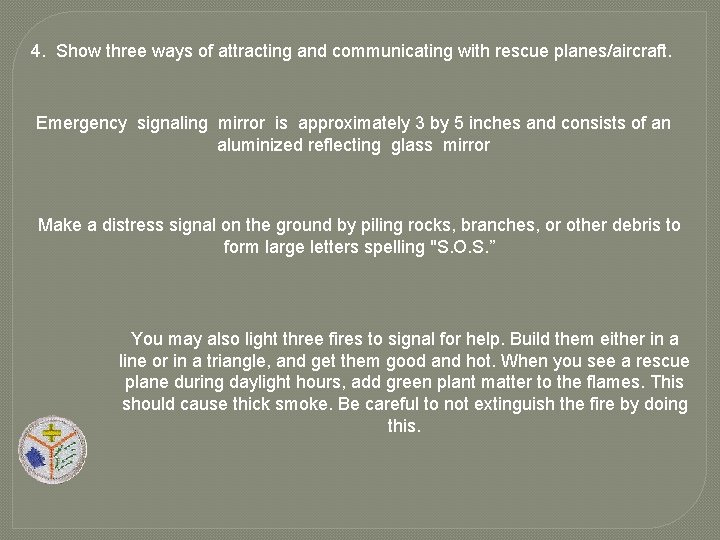
4. Show three ways of attracting and communicating with rescue planes/aircraft. Emergency signaling mirror is approximately 3 by 5 inches and consists of an aluminized reflecting glass mirror Make a distress signal on the ground by piling rocks, branches, or other debris to form large letters spelling "S. O. S. ” You may also light three fires to signal for help. Build them either in a line or in a triangle, and get them good and hot. When you see a rescue plane during daylight hours, add green plant matter to the flames. This should cause thick smoke. Be careful to not extinguish the fire by doing this.
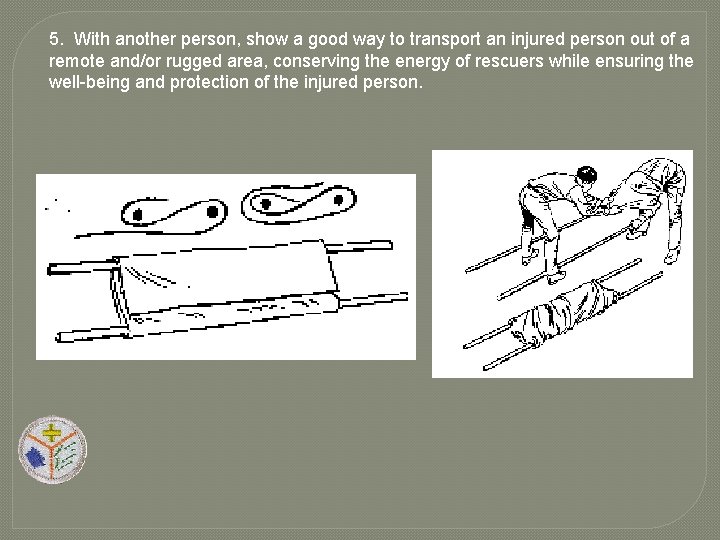
5. With another person, show a good way to transport an injured person out of a remote and/or rugged area, conserving the energy of rescuers while ensuring the well-being and protection of the injured person.
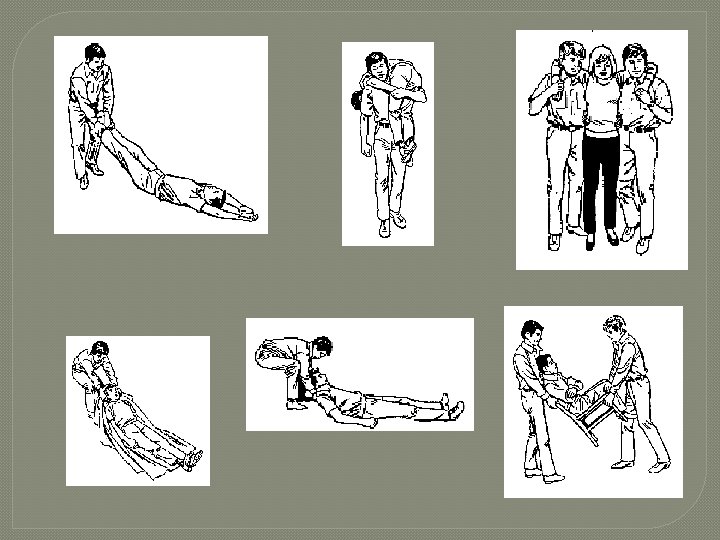
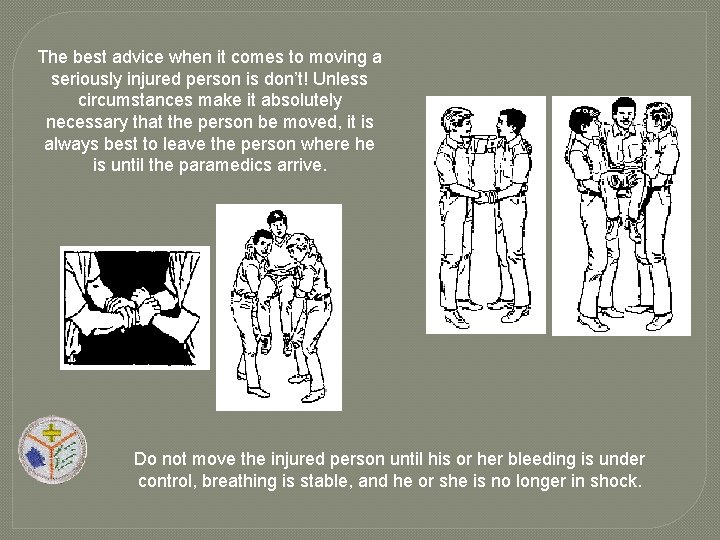
The best advice when it comes to moving a seriously injured person is don’t! Unless circumstances make it absolutely necessary that the person be moved, it is always best to leave the person where he is until the paramedics arrive. Do not move the injured person until his or her bleeding is under control, breathing is stable, and he or she is no longer in shock.
6. Do the following: A. Tell the things a group of Scouts should be prepared to do, the training they need , and the safety precautions they should take for the following emergency services: 1. Crowd and traffic control 2. Messenger service and communication. 3. Collection and distribution services. 4. Group feeding, shelter, and sanitation. B. Identify the government or community agencies that normally handle and prepare for the emergency services listed under 6 a, and explain to your counselor how a group of Scouts could volunteer to help in the event of these types of emergencies. C. Find out who is your community's emergency management director and learn what this person does to prepare, respond to, recover from, and mitigate and prevent emergency situations in your community. Discuss this information with your counselor and apply what you discover to the chart you created for requirement 2 b.
6. Do the following: A. Tell the things a group of Scouts should be prepared to do, the training they need , and the safety precautions they should take for the following emergency services: 1. Crowd and traffic control 2. Messenger service and communication. 3. Collection and distribution services. 4. Group feeding, shelter, and sanitation. 1. Police & Boy Scouts: help direct people 2. Messenger service and communication: relay info to Police & Fire, Shelters, Red Cross, Salvation Army, National Guard 3. Collection and distribution services: food, water, blankets, etc. 4. Red Cross & Boy Scouts: do laundry, wash dishes, cook & serve food,
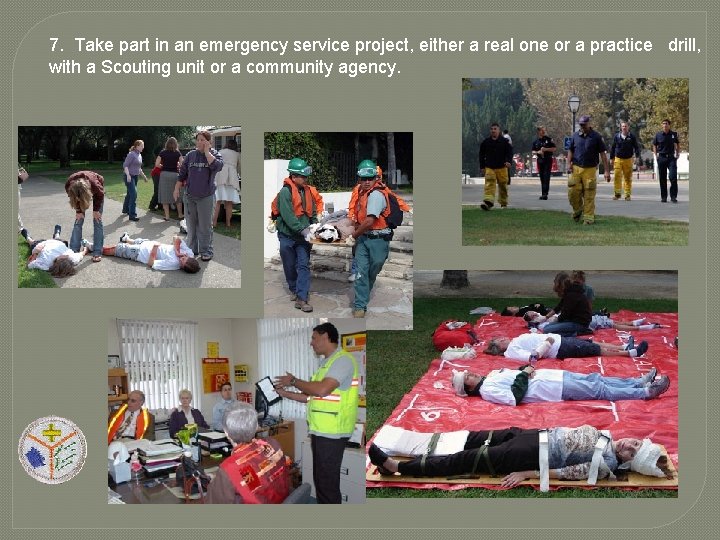
7. Take part in an emergency service project, either a real one or a practice drill, with a Scouting unit or a community agency.
8. Do the following: A. Prepare a written plan for mobilizing your troop when needed to do emergency service. If there is already a plan, explain it. Tell your part in making it work. B. Take part in at least one troop mobilization. Before the exercise, describe your part to your counselor. Afterward, conduct an "afteraction" lesson, discussing what you learned during the exercise that required changes or adjustments to the plan. C. Prepare a personal emergency service pack for a mobilization call. Prepare a family kit (suitcase or waterproof box) for use by your family in case an emergency evacuation is needed. Explain the needs and uses of the contents.
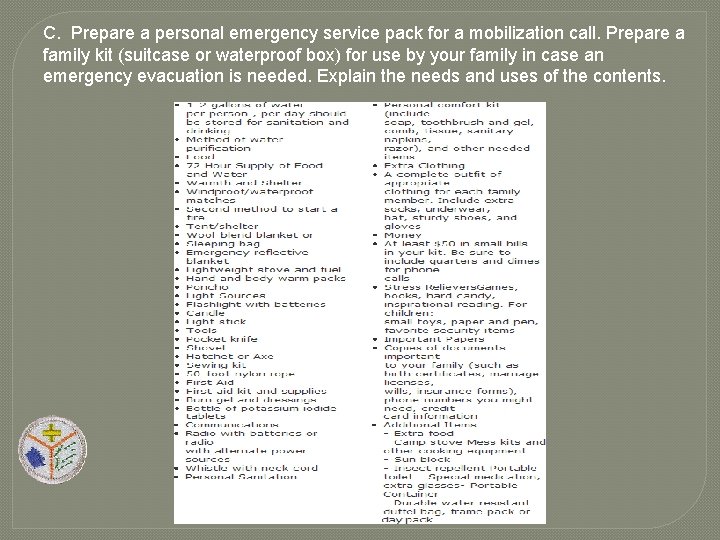
C. Prepare a personal emergency service pack for a mobilization call. Prepare a family kit (suitcase or waterproof box) for use by your family in case an emergency evacuation is needed. Explain the needs and uses of the contents.
9. Do ONE of the following: A. Using a safety checklist approved by your counselor, inspect your home for potential hazards. Explain the hazards you find and how they can be corrected. B. Review or develop a plan of escape for your family in case of fire in your home. C. Develop an accident prevention program for five family activities outside the home (such as taking a picnic or seeing a movie) that includes an analysis of possible hazards, a proposed plan to correct those hazards, and the reasons for the corrections you propose.
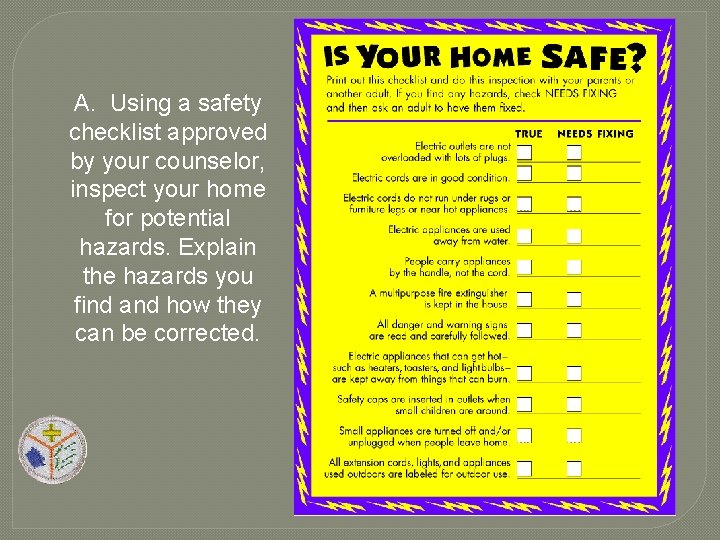
A. Using a safety checklist approved by your counselor, inspect your home for potential hazards. Explain the hazards you find and how they can be corrected.
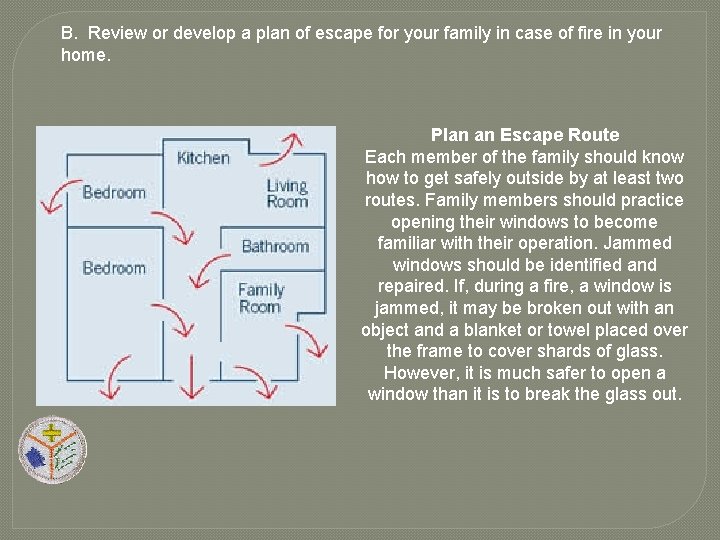
B. Review or develop a plan of escape for your family in case of fire in your home. Plan an Escape Route Each member of the family should know how to get safely outside by at least two routes. Family members should practice opening their windows to become familiar with their operation. Jammed windows should be identified and repaired. If, during a fire, a window is jammed, it may be broken out with an object and a blanket or towel placed over the frame to cover shards of glass. However, it is much safer to open a window than it is to break the glass out.
C. Develop an accident prevention program for five family activities outside the home (such as taking a picnic or seeing a movie) that includes an analysis of possible hazards, a proposed plan to correct those hazards, and the reasons for the corrections you propose.
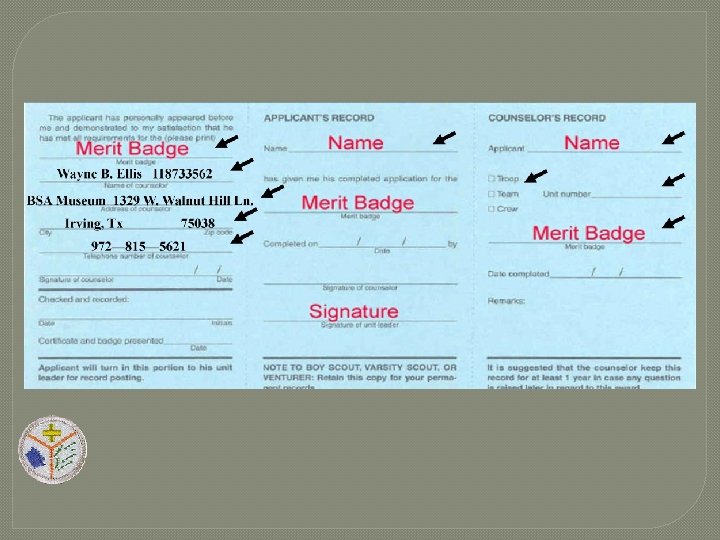
Do requirements : 2. b & c 6. b & c 8. a, b, & c 9. When you have finish check back with your counselor to sign off your blue card.
Circle 10
www. wikipedia. org/wiki/Emergency_management www. michiganautolaw. com/auto-lawyers www. emergency. unl. edu/explosion Wayne Elis bsagptx@yaho. com
- Slides: 33