
Brunnstroms Clinical Kinesiology Sixth Edition CHAPTER 2 Mechanical
Brunnstrom’s Clinical Kinesiology Sixth Edition CHAPTER 2 Mechanical Principles: Kinetics Copyright © 2012 F. A. Davis Company
Brunnstrom’s Clinical Kinesiology Sixth Edition Introduction § Kinetics § All about forces (as opposed to kinematics) § What is force? § Conceptual definition § Properties of force § Magnitude, direction, & point of application Copyright © 2012 F. A. Davis Company
Brunnstrom’s Clinical Kinesiology Sixth Edition Forces § Four types of forces that affect body motion: § Gravity § Muscles § Externally applied resistances § Friction Copyright © 2012 F. A. Davis Company

Brunnstrom’s Clinical Kinesiology Sixth Edition Gravity § What is it? § What affects it? § What is the acceleration of gravity on earth? Copyright © 2012 F. A. Davis Company
Brunnstrom’s Clinical Kinesiology Sixth Edition Forces § Forces act on a mass § Mass = amount of matter in an object § Mass versus weight Copyright © 2012 F. A. Davis Company
Brunnstrom’s Clinical Kinesiology Sixth Edition Newton’s Laws § 1 st § 2 nd § 3 rd Copyright © 2012 F. A. Davis Company
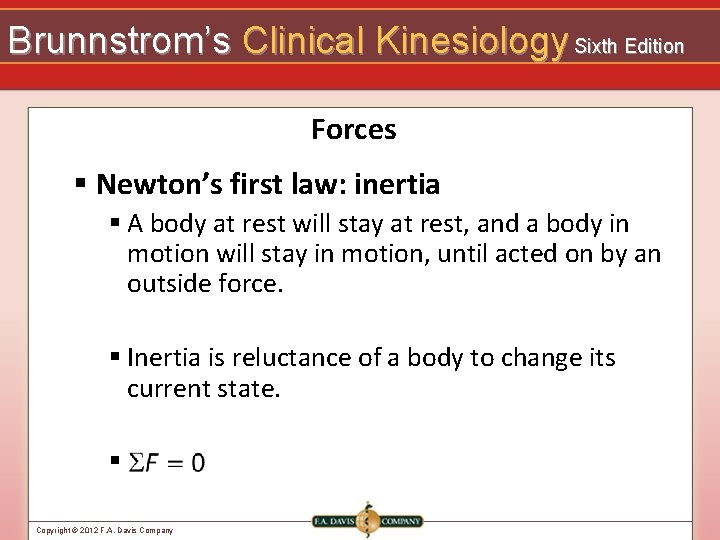
Brunnstrom’s Clinical Kinesiology Sixth Edition Forces § Newton’s first law: inertia § A body at rest will stay at rest, and a body in motion will stay in motion, until acted on by an outside force. § Inertia is reluctance of a body to change its current state. § Copyright © 2012 F. A. Davis Company
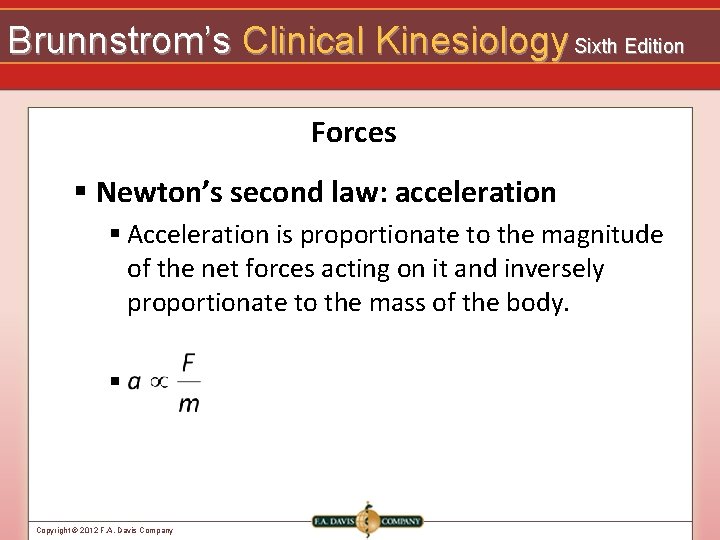
Brunnstrom’s Clinical Kinesiology Sixth Edition Forces § Newton’s second law: acceleration § Acceleration is proportionate to the magnitude of the net forces acting on it and inversely proportionate to the mass of the body. § Copyright © 2012 F. A. Davis Company
Brunnstrom’s Clinical Kinesiology Sixth Edition Forces § Newton’s third law: action-reaction § For every action force there is an equal and opposite reaction force. § Example: basketball player jumping Copyright © 2012 F. A. Davis Company

Brunnstrom’s Clinical Kinesiology Sixth Edition How we work with forces § Forces can be represented graphically with vectors § The direction is indicated by the arrow § The magnitude is represented by the length of the line Copyright © 2012 F. A. Davis Company

Brunnstrom’s Clinical Kinesiology Sixth Edition Vector combination § Vectors can be combined/added/multiplied graphically § Must be connected head to tail § Resultant must be drawn from start to finish and pointed correctly § Resultant represents “net force” Copyright © 2012 F. A. Davis Company
Brunnstrom’s Clinical Kinesiology Sixth Edition Free body diagram § Model of a system of interest (such as a body or body part) showing all of the forces acting on the body Copyright © 2012 F. A. Davis Company
Brunnstrom’s Clinical Kinesiology Sixth Edition Vector Resolution § Start with a resultant and create component vectors § Use 2 component vectors that are perpendicular to each other § In anatomical examples one component will be parallel to the bony lever and one will be perpendicular Copyright © 2012 F. A. Davis Company
Brunnstrom’s Clinical Kinesiology Sixth Edition Anatomical vector resolution § Perpendicular component (normal force) will be the rotary component that will contribute to torque § Parallel component will either by stabilizing (acting toward joint center) or dislocating (acting away from joint center) Copyright © 2012 F. A. Davis Company
Brunnstrom’s Clinical Kinesiology Sixth Edition levers § § What is a lever? 3 classes Characteristics Anatomical examples Copyright © 2012 F. A. Davis Company
Brunnstrom’s Clinical Kinesiology Sixth Edition Levers § Resistance arm = distance from axis to line of action of resistance § Force arm = distance from axis to “moving force” § In the human body § Axis = joint § Body segments act as levers Copyright © 2012 F. A. Davis Company
Brunnstrom’s Clinical Kinesiology Sixth Edition Levers § First-class lever § Axis of rotation located between force and resistance arm § Similar in appearance to a seesaw § Length of force and resistance arms vary Copyright © 2012 F. A. Davis Company
Brunnstrom’s Clinical Kinesiology Sixth Edition Levers § Second-class lever § Axis of rotation at end; force arm is larger than resistance arm. § Wheelbarrow exemplifies a second-class lever. § Long force arm makes it possible to move large resistances with little force. Copyright © 2012 F. A. Davis Company
Brunnstrom’s Clinical Kinesiology Sixth Edition Levers § Third-class lever § Axis of rotation at end; force arm smaller than resistance arm § Most common in human body § Designed to produce speed of distal segment § Able to move small weights a long distance § Occurs frequently in an open kinematic chain (OKC) Copyright © 2012 F. A. Davis Company
Brunnstrom’s Clinical Kinesiology Sixth Edition Force Applications to the Body § Levers and muscle activity § Majority of lever systems in body are third class. § Muscles must exert large forces to overcome external resistance due to lever arm lengths. § However, small changes in muscle length create large angular displacements. § Design suggests body’s levers are designed for speed rather than for strength. Copyright © 2012 F. A. Davis Company
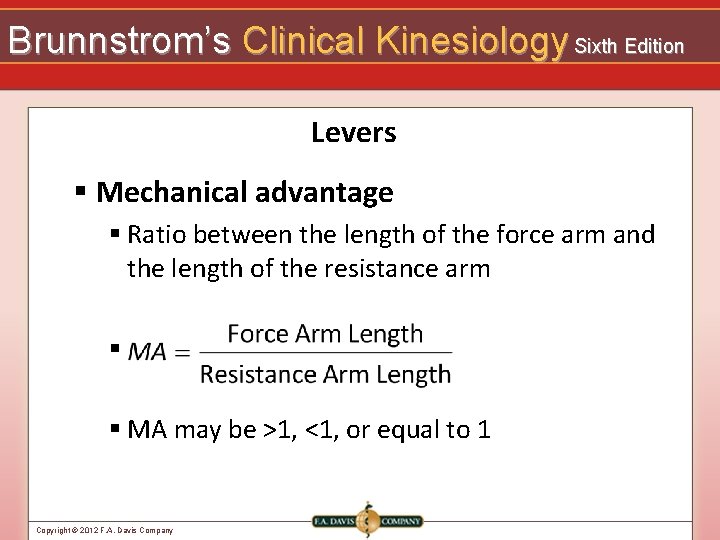
Brunnstrom’s Clinical Kinesiology Sixth Edition Levers § Mechanical advantage § Ratio between the length of the force arm and the length of the resistance arm § § MA may be >1, <1, or equal to 1 Copyright © 2012 F. A. Davis Company
Brunnstrom’s Clinical Kinesiology Sixth Edition torque § § Conceptual definition Mathematical definition Right hand rule Finding moment arm Copyright © 2012 F. A. Davis Company
Brunnstrom’s Clinical Kinesiology Sixth Edition Torque (τ) § Product of a force times the perpendicular distance from its line of action to the axis of motion §τ=F·d § d = distance from location of force on body segment to the joint (axis) Copyright © 2012 F. A. Davis Company

Brunnstrom’s Clinical Kinesiology Sixth Edition Clinical Application of Concepts § Pressure § Defined as force per unit of area. § Optimal applications of pressure facilitate growth and hypertrophy. § Excessive force may cause tissue injury. Copyright © 2012 F. A. Davis Company

Brunnstrom’s Clinical Kinesiology Sixth Edition Clinical Application of Concepts § Pressure may be reduced by: § Decreasing the magnitude of the force § Increasing the area of application § Decreasing the time of application Copyright © 2012 F. A. Davis Company

Brunnstrom’s Clinical Kinesiology Sixth Edition Equilibrium § Forces sum to zero § Torques sum to zero § What happens when these things do not sum to zero? Copyright © 2012 F. A. Davis Company
Brunnstrom’s Clinical Kinesiology Sixth Edition Force Applications to the Body § Weight and center of mass (COM) § COM § Point about which an object is balanced § Origin of gravity’s force vector § Symmetrical objects—center of object § Asymmetrical objects—challenging to identify § In adults, located anterior to S 2 Copyright © 2012 F. A. Davis Company
Brunnstrom’s Clinical Kinesiology Sixth Edition Force Applications to the Body § Base of support (BOS) § Line of gravity is the vertical line downward from the center of mass. § The body is stable when the line of gravity passes through the center of BOS. § Larger the BOS, more stable an object is. Copyright © 2012 F. A. Davis Company
Brunnstrom’s Clinical Kinesiology Sixth Edition Force Applications to the Body § Stable, unstable, and neutral equilibrium § Degree of stability depends on: § Height of center of gravity above base of support § Size of base of support § Location of “gravity line” within base of support § Weight of the body Copyright © 2012 F. A. Davis Company

Brunnstrom’s Clinical Kinesiology Sixth Edition Force Applications to the Body § Stable, unstable, and neutral equilibrium § Stable equilibrium—body returns to former position after light perturbation § Unstable equilibrium—body seeks a new position after light perturbation § Neutral equilibrium—center of gravity displaced but remains at same level § Rolling ball Copyright © 2012 F. A. Davis Company
Brunnstrom’s Clinical Kinesiology Sixth Edition Balance § In biomechanics, balance is the control of equilibrium but it is not synonymous with equilibrium Copyright © 2012 F. A. Davis Company

Brunnstrom’s Clinical Kinesiology Sixth Edition Fluid Forces § Archimedes’ Principle § Buoyant force is equal to the weight of the displaced fluid Copyright © 2012 F. A. Davis Company

Brunnstrom’s Clinical Kinesiology Sixth Edition Bernoulli’s Principle § Explains lift § Inverse relationship between flow velocity ad pressure § Magnus effect is special case Copyright © 2012 F. A. Davis Company

Brunnstrom’s Clinical Kinesiology Sixth Edition Projectile motion § § § Trajectory is parabola Factors that determine trajectory Vertical and horizontal components of velocity Effects of drag friction Sports applications § Various goals Copyright © 2012 F. A. Davis Company
- Slides: 34