
Brown v Board of Education 1954 Black children
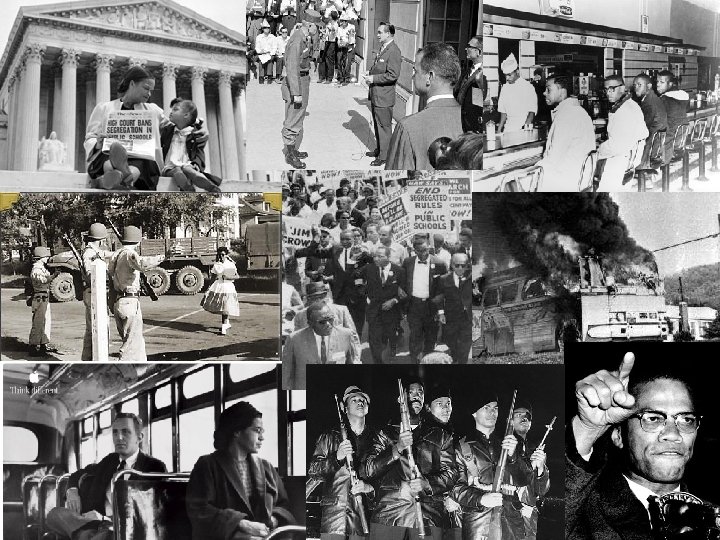
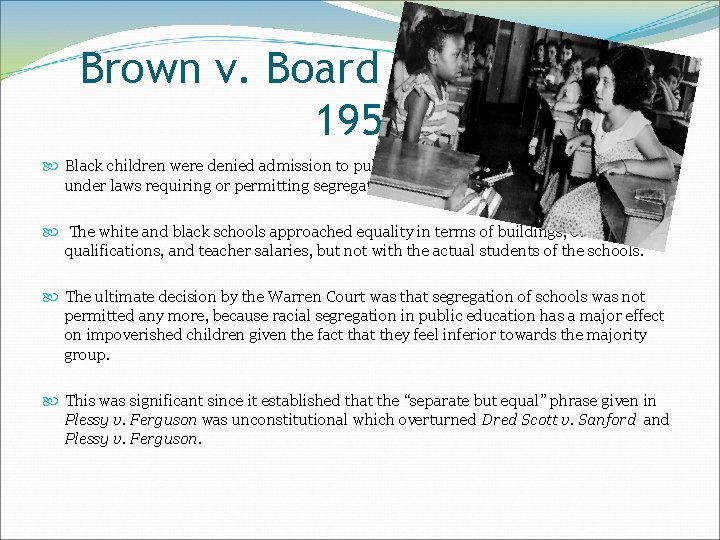
Brown v. Board of Education 1954 Black children were denied admission to public schools attended by white children under laws requiring or permitting segregation according to the races. The white and black schools approached equality in terms of buildings, curricula, qualifications, and teacher salaries, but not with the actual students of the schools. The ultimate decision by the Warren Court was that segregation of schools was not permitted any more, because racial segregation in public education has a major effect on impoverished children given the fact that they feel inferior towards the majority group. This was significant since it established that the “separate but equal” phrase given in Plessy v. Ferguson was unconstitutional which overturned Dred Scott v. Sanford and Plessy v. Ferguson.
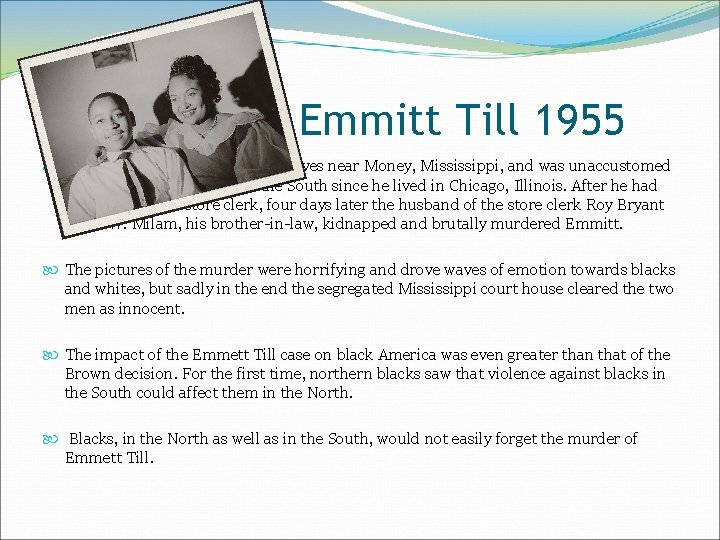
Murder of Emmitt Till 1955 Emmett Till was visiting his relatives near Money, Mississippi, and was unaccustomed to the severe segregation of the South since he lived in Chicago, Illinois. After he had talked to a white store clerk, four days later the husband of the store clerk Roy Bryant and J. W. Milam, his brother-in-law, kidnapped and brutally murdered Emmitt. The pictures of the murder were horrifying and drove waves of emotion towards blacks and whites, but sadly in the end the segregated Mississippi court house cleared the two men as innocent. The impact of the Emmett Till case on black America was even greater than that of the Brown decision. For the first time, northern blacks saw that violence against blacks in the South could affect them in the North. Blacks, in the North as well as in the South, would not easily forget the murder of Emmett Till.
Rosa Parks and the Montgomery Bus Boycott o Dec. 1, 1955: African American Rosa Parks was arrested after violating bus segregation laws by not surrendering her seat to a white man o She was charged with disorderly conduct. o Dec. 5, 1955: First Day of the boycott which lasted until Dec. 21, 1956. o African Americans realized they had economic power which could be used to promote Civil Rights
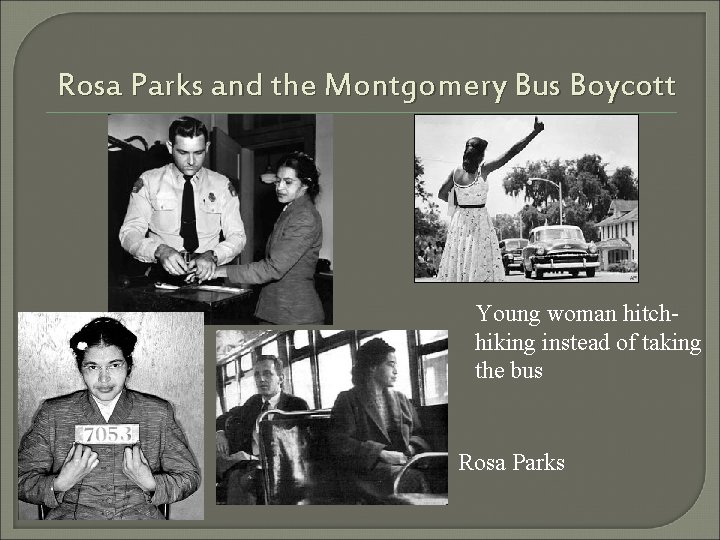
Rosa Parks and the Montgomery Bus Boycott Young woman hitchhiking instead of taking the bus Rosa Parks
Southern Christian Leadership Conference 1957 n Formed to carry on nonviolent crusades against the evils of second class citizenship. n Formed by Martin Luther King Jr. n This was significant because it allowed the leaders of the Black community to collaborate and protest as one in order to overcome white supremacy.
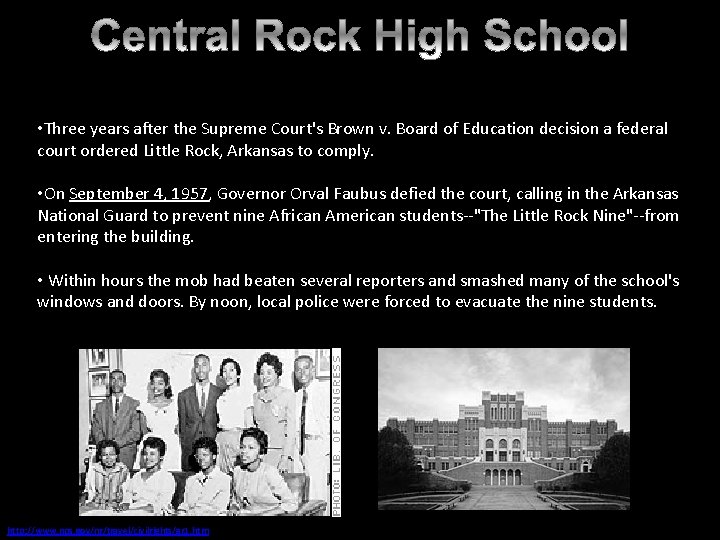
• Three years after the Supreme Court's Brown v. Board of Education decision a federal court ordered Little Rock, Arkansas to comply. • On September 4, 1957, Governor Orval Faubus defied the court, calling in the Arkansas National Guard to prevent nine African American students--"The Little Rock Nine"--from entering the building. • Within hours the mob had beaten several reporters and smashed many of the school's windows and doors. By noon, local police were forced to evacuate the nine students. http: //www. nps. gov/nr/travel/civilrights/ar 1. htm
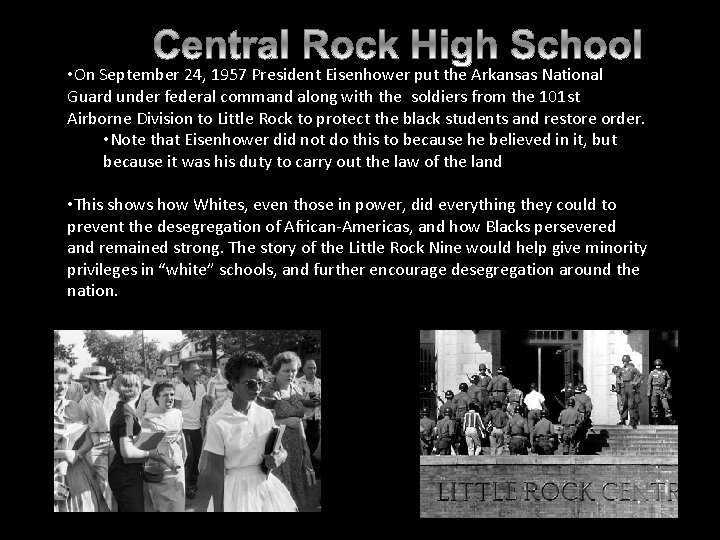
• On September 24, 1957 President Eisenhower put the Arkansas National Guard under federal command along with the soldiers from the 101 st Airborne Division to Little Rock to protect the black students and restore order. • Note that Eisenhower did not do this to because he believed in it, but because it was his duty to carry out the law of the land • This shows how Whites, even those in power, did everything they could to prevent the desegregation of African-Americas, and how Blacks persevered and remained strong. The story of the Little Rock Nine would help give minority privileges in “white” schools, and further encourage desegregation around the nation.
Lorraine Hansberry’s Raisin in the sun Written in 1959 by a black women, Raisin in the Sun was a play that showed the struggles of blacks in America. It was nominated for four Tony Awards and was performed on Broadway. Premiered on march 11, 1959
Fun Facts Received mixed reviews but was one of the most critically acclaimed and popular plays on Broadway for a few years. First play written by a black woman to be on Broadway, as well as first play to be directed by a black man on Broadway.
Motown • Motown is a type of music that is a fusion of blues and pop as well as gospel rhythms and ballad harmonies. • This kind of music was associated with Black artists, and was flourishing during this time period. • Motown Records was a record company formed by Berry Gordy Jr. in Detroit. • This was a big step in Black culture becoming public and even to a certain extent, respected by society in general.

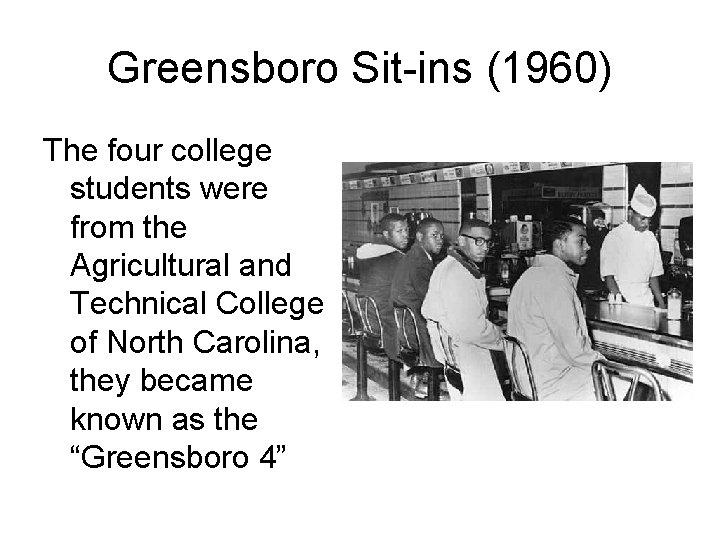
Greensboro Sit-ins (1960) The four college students were from the Agricultural and Technical College of North Carolina, they became known as the “Greensboro 4”
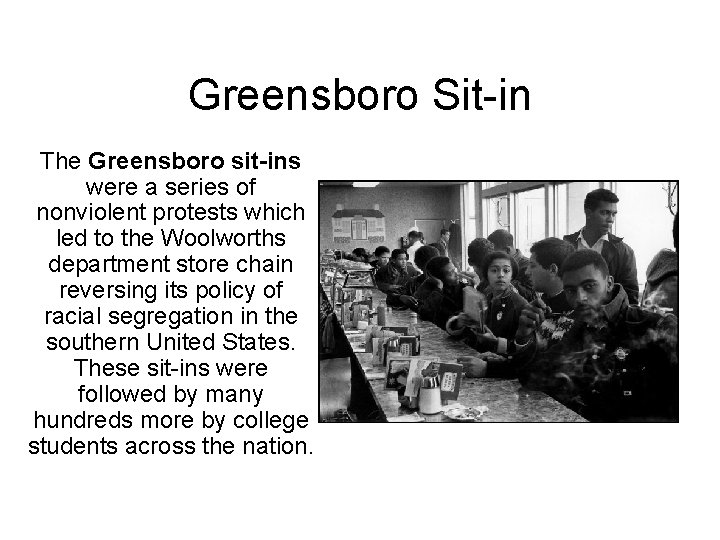
Greensboro Sit-in The Greensboro sit-ins were a series of nonviolent protests which led to the Woolworths department store chain reversing its policy of racial segregation in the southern United States. These sit-ins were followed by many hundreds more by college students across the nation.
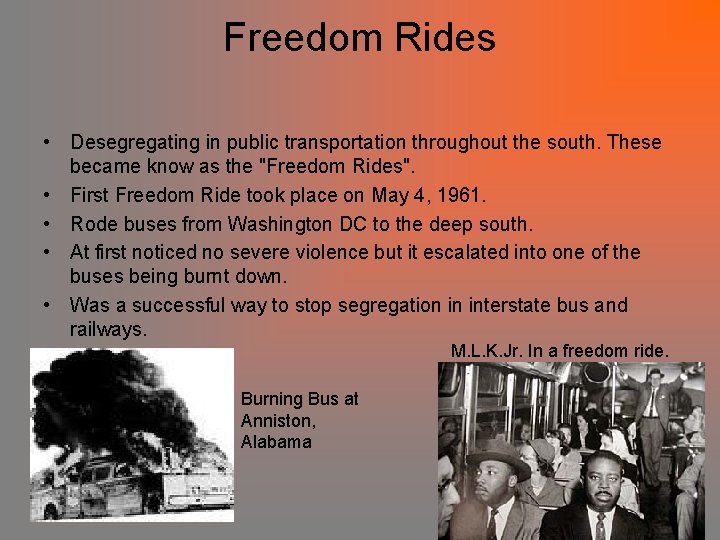
Freedom Rides • Desegregating in public transportation throughout the south. These became know as the "Freedom Rides". • First Freedom Ride took place on May 4, 1961. • Rode buses from Washington DC to the deep south. • At first noticed no severe violence but it escalated into one of the buses being burnt down. • Was a successful way to stop segregation in interstate bus and railways. M. L. K. Jr. In a freedom ride. Burning Bus at Anniston, Alabama
James Meredith • He was born in 1933 and attempted to get into the University of Mississippi in 1961 but was denied access twice. He made a lawsuit against the University and the court ruled in his favor. After threats from fellow students he got the Attorney General, Robert Kennedy, to send federal marshals to protect him. There was conflict between the marshals and protestors that resulted in the injury of 160 marshals and the death of 2 protestors. He graduated in 1964 and became a civil rights activists. After participating in a march for civil rights he was shot by a sniper. People such as MLK Jr. marched for him and he recovered.
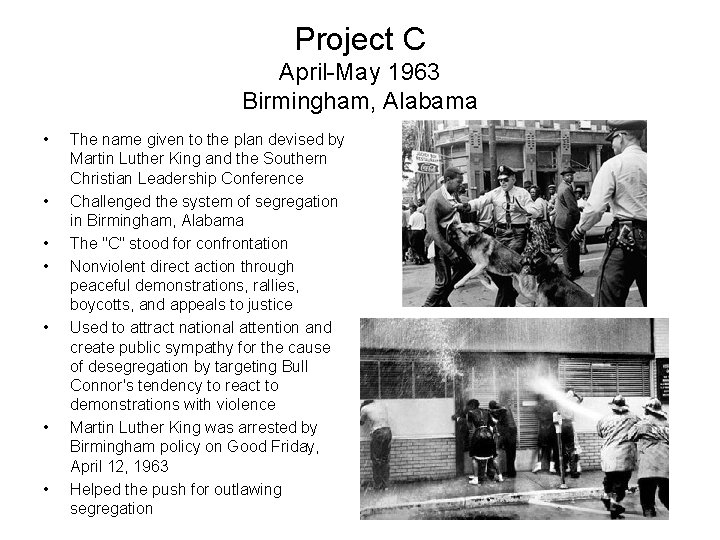
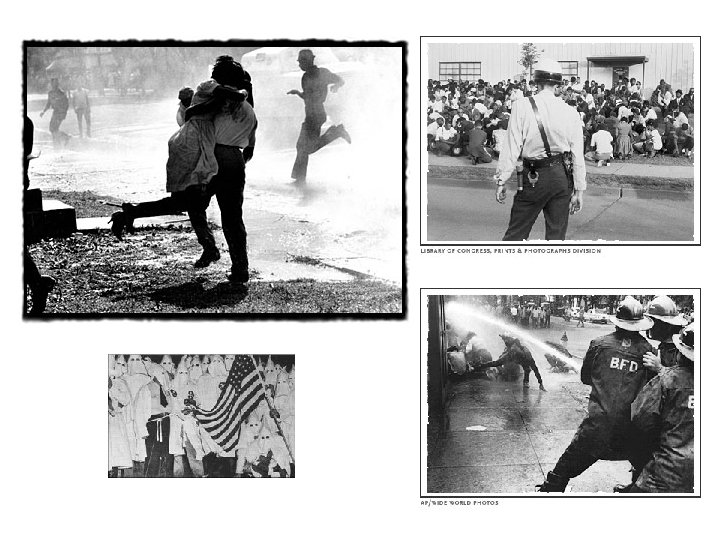
Project C April-May 1963 Birmingham, Alabama • • The name given to the plan devised by Martin Luther King and the Southern Christian Leadership Conference Challenged the system of segregation in Birmingham, Alabama The "C" stood for confrontation Nonviolent direct action through peaceful demonstrations, rallies, boycotts, and appeals to justice Used to attract national attention and create public sympathy for the cause of desegregation by targeting Bull Connor's tendency to react to demonstrations with violence Martin Luther King was arrested by Birmingham policy on Good Friday, April 12, 1963 Helped the push for outlawing segregation
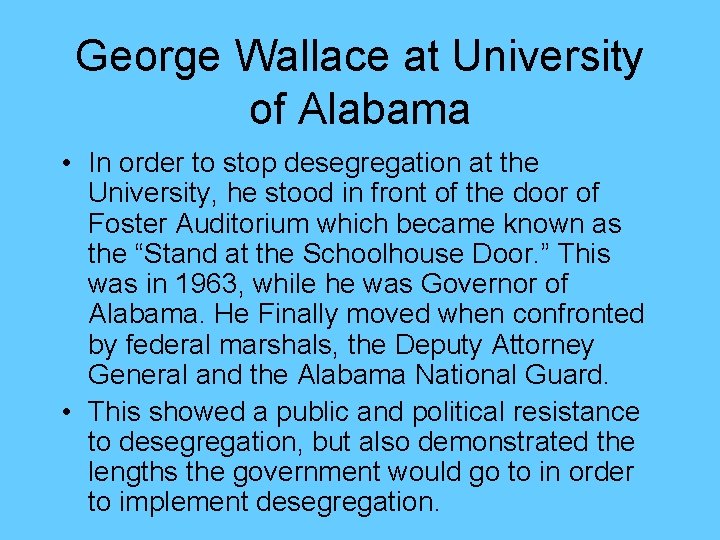
George Wallace at University of Alabama • In order to stop desegregation at the University, he stood in front of the door of Foster Auditorium which became known as the “Stand at the Schoolhouse Door. ” This was in 1963, while he was Governor of Alabama. He Finally moved when confronted by federal marshals, the Deputy Attorney General and the Alabama National Guard. • This showed a public and political resistance to desegregation, but also demonstrated the lengths the government would go to in order to implement desegregation.

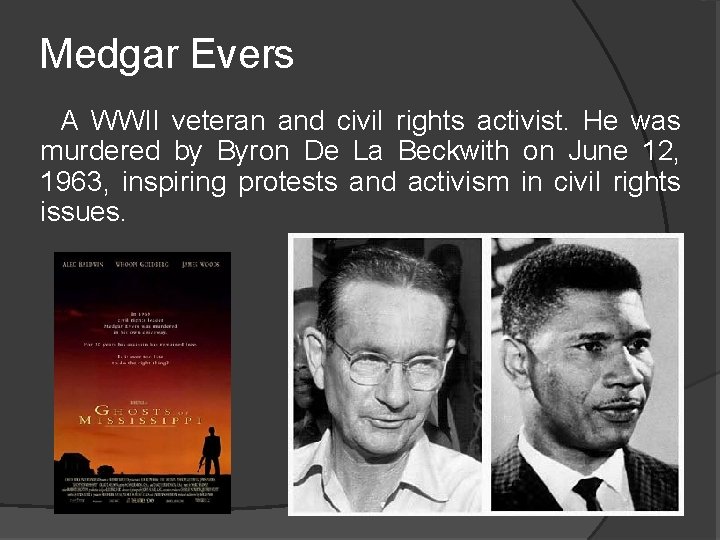
Medgar Evers A WWII veteran and civil rights activist. He was murdered by Byron De La Beckwith on June 12, 1963, inspiring protests and activism in civil rights issues.
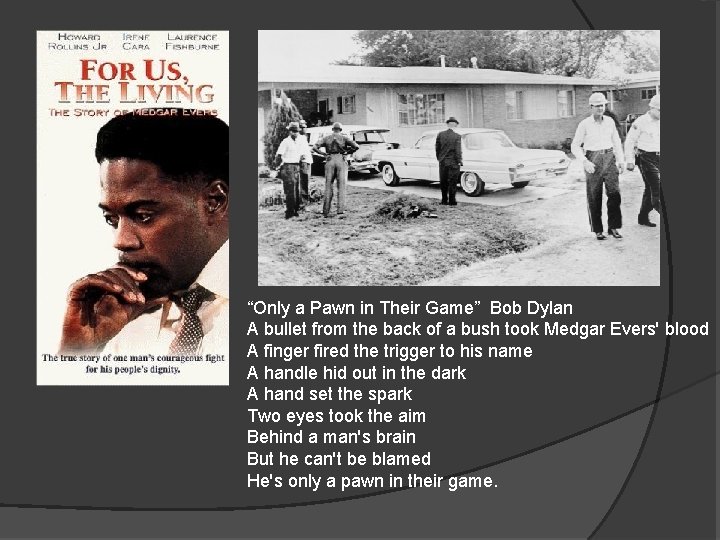
“Only a Pawn in Their Game” Bob Dylan A bullet from the back of a bush took Medgar Evers' blood A finger fired the trigger to his name A handle hid out in the dark A hand set the spark Two eyes took the aim Behind a man's brain But he can't be blamed He's only a pawn in their game.
The March on Washington August 28, 1963 • One Hundred years after the signing of the Emancipation Proclamation, Philip A. Randolph, a prominent civil rights leader of the time initiated the march. 250, 000 people attended. • Martin Luther King Jr. also made his “I Have A Dream” Speech during this march. • This event is significant because it was the largest demonstration to ever march on Washington dc and impacted the passage of civil rights legislation as well as giving a precedent for later anti-war, feminist, and environmental movements.
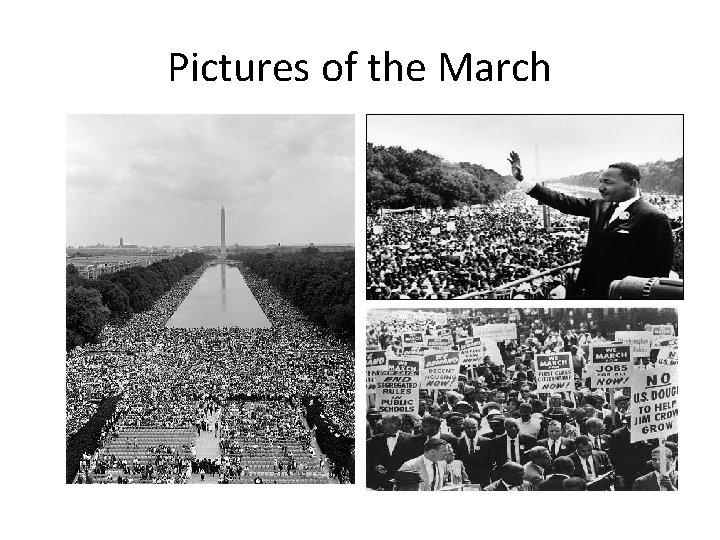
Pictures of the March
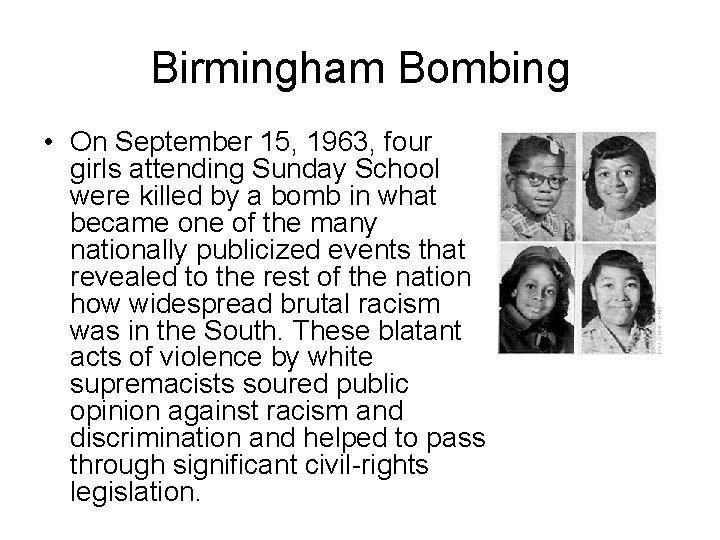
Birmingham Bombing • On September 15, 1963, four girls attending Sunday School were killed by a bomb in what became one of the many nationally publicized events that revealed to the rest of the nation how widespread brutal racism was in the South. These blatant acts of violence by white supremacists soured public opinion against racism and discrimination and helped to pass through significant civil-rights legislation.
Sidney Poitier Born in 1927 he became the fist black man to win an Academy Award. He was a very famous actor and he was well know for his movies that displayed the horrors of the apartheid in South Africa. He also stared in “A Raisin in the Sun. ” He was a very inspirational man during a rough time for the black community.
A letter from a Birmingham Jail Written by Martin Luther King Jr. on April 16, 1963 It eloquently defended the Civil Rights movement that was sweeping through America in the 1960’s, as well as the methods of nonviolence and the coordinated demonstrations that were utilized by the African-Americans. It described the injustices of segregation and how the black community yearned for equality
Student Nonviolent Coordinating Committee Founded in April 1960, by young people who were inspired by the sit-in in Greensboro to promoted nonviolence, acceptance, peace, and hope Opposed the Vietnam War Helped bring about the Feminist movement Eventually incorporated the philosophy of Black Power
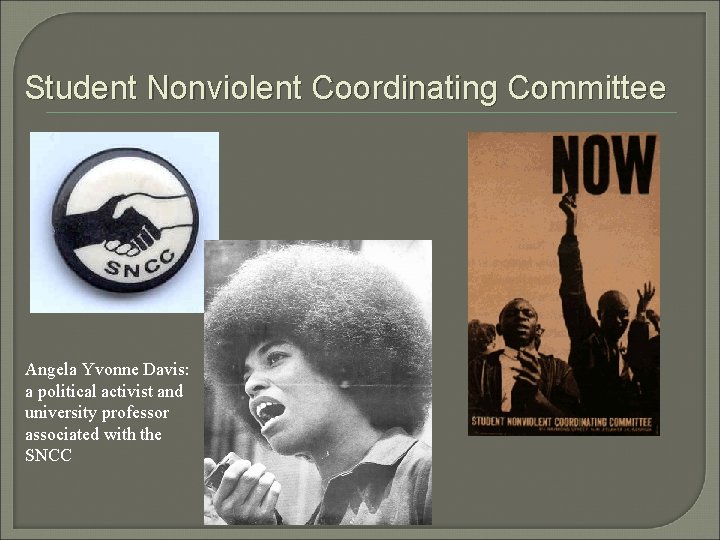
Student Nonviolent Coordinating Committee Angela Yvonne Davis: a political activist and university professor associated with the SNCC
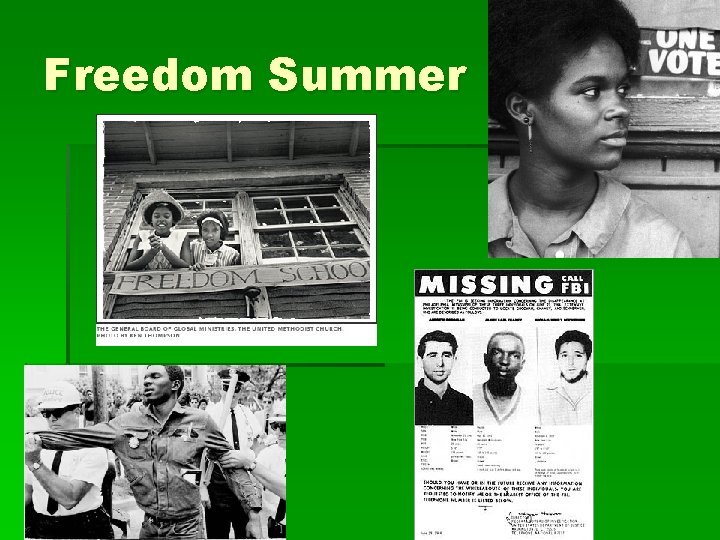
Freedom Summer § The summer of 1964 thousands of civil rights activists, many of them white college students from the North, went to Mississippi and other Southern states to try to end the long-time suppression of black voting rights § was organized by the Mississippi Council of Federated Organizations, which was led by the CORE, NAACP, and SNCC.
Freedom Summer § The organization of the Mississippi Freedom Party (MFDP) was a major focus of this movement, which challenged the seating of the all white delegates of Mississippi's Democratic Party § The most infamous act of violence was the murder of three young civil rights workers on June 21, a black volunteer, James Chaney, and his white coworkers, Andrew Goodman and Michael Schwerner
Freedom Summer § Established 30 "Freedom Schools" in Mississippi to address the racial inequalities in Mississippi's educational system. § They had hoped to draw at least 1000 students that first summer, and ended up with 3000. They became a model for future social programs like Head Start
Freedom Summer
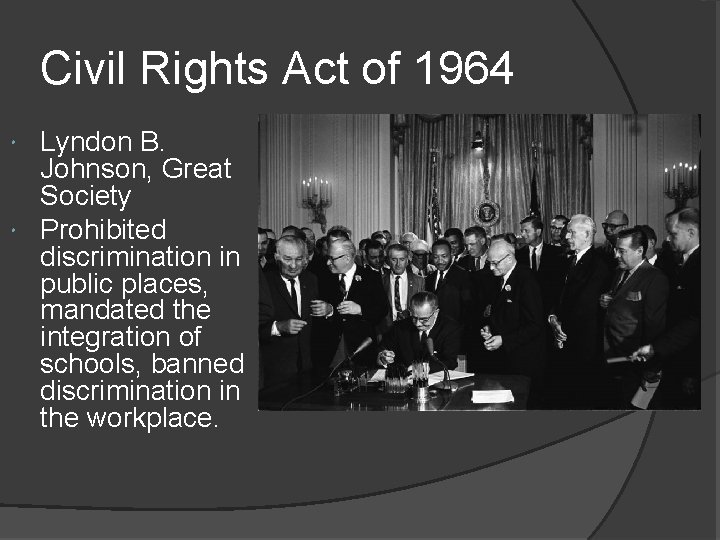
Civil Rights Act of 1964 Lyndon B. Johnson, Great Society Prohibited discrimination in public places, mandated the integration of schools, banned discrimination in the workplace.
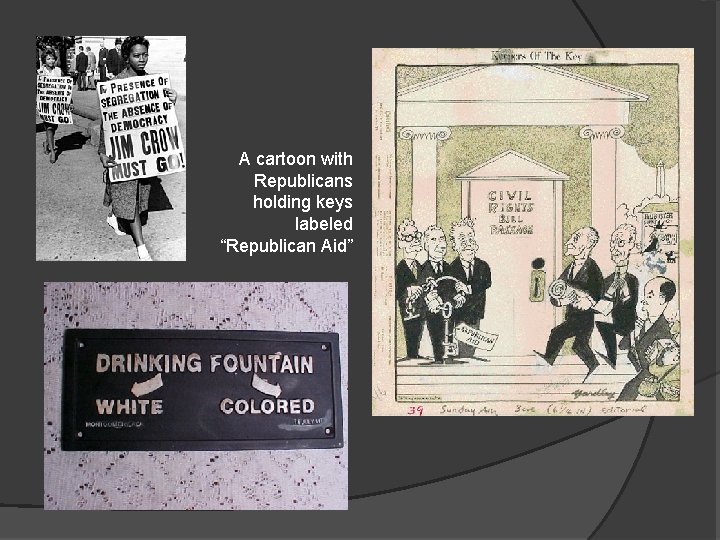
A cartoon with Republicans holding keys labeled “Republican Aid”
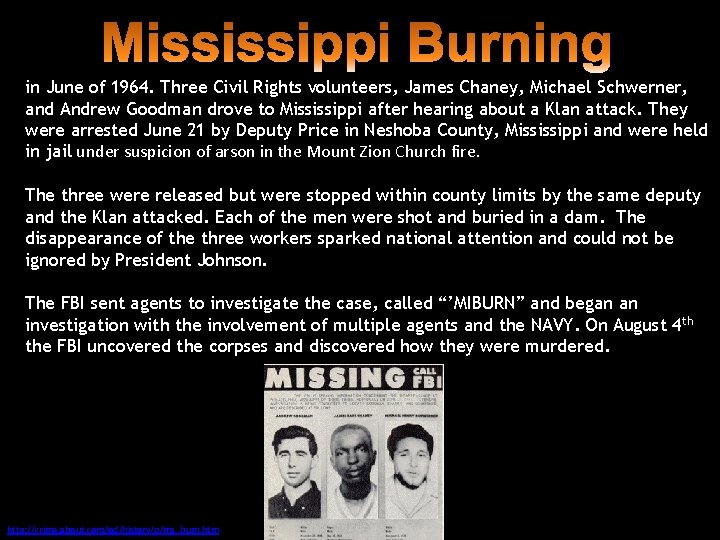
in June of 1964. Three Civil Rights volunteers, James Chaney, Michael Schwerner, and Andrew Goodman drove to Mississippi after hearing about a Klan attack. They were arrested June 21 by Deputy Price in Neshoba County, Mississippi and were held in jail under suspicion of arson in the Mount Zion Church fire. The three were released but were stopped within county limits by the same deputy and the Klan attacked. Each of the men were shot and buried in a dam. The disappearance of the three workers sparked national attention and could not be ignored by President Johnson. The FBI sent agents to investigate the case, called “’MIBURN” and began an investigation with the involvement of multiple agents and the NAVY. On August 4 th the FBI uncovered the corpses and discovered how they were murdered. http: //crime. about. com/od/history/p/ms_burn. htm
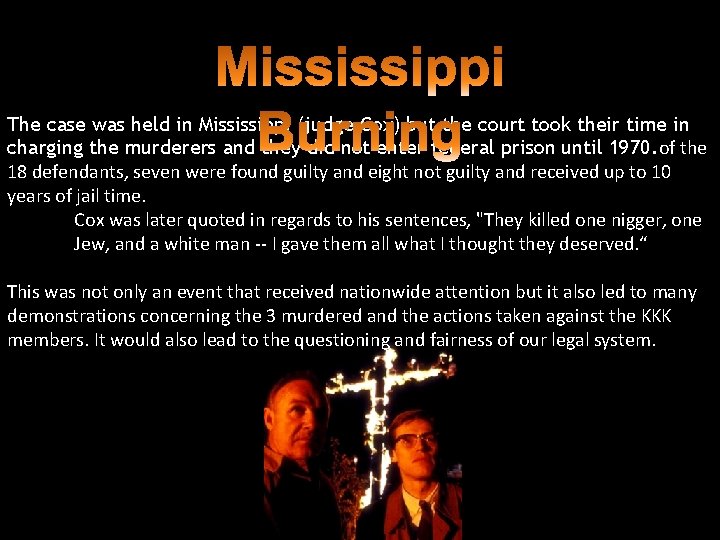
The case was held in Mississippi (judge Cox) but the court took their time in charging the murderers and they did not enter federal prison until 1970. of the 18 defendants, seven were found guilty and eight not guilty and received up to 10 years of jail time. Cox was later quoted in regards to his sentences, "They killed one nigger, one Jew, and a white man -- I gave them all what I thought they deserved. “ This was not only an event that received nationwide attention but it also led to many demonstrations concerning the 3 murdered and the actions taken against the KKK members. It would also lead to the questioning and fairness of our legal system.
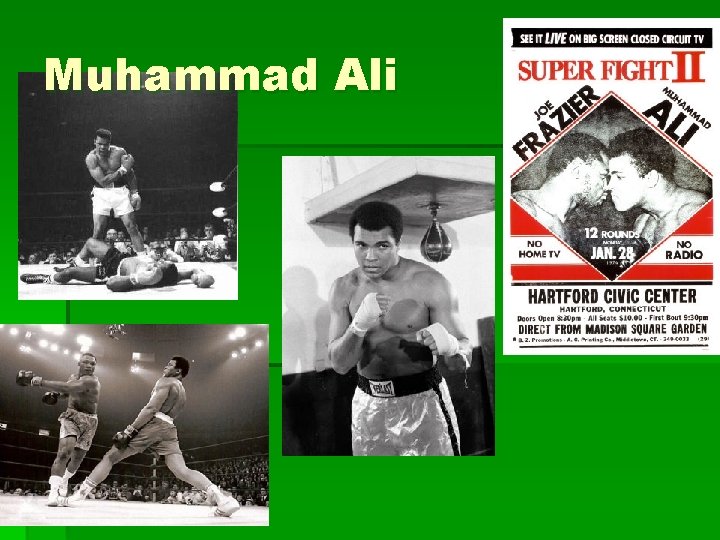
Muhammad Ali § When he was in his teens he won six Kentucky Golden Gloves titles, two national Golden Gloves titles, an Amateur Athletic Union National Title, and the Light Heavywieght gold medal in the 1960 Summer Olympics, after which he became a professional § His first title fight he fought Sonny Liston and became the youngest boxer (age 22) ever to take the title from a reigning heavyweight champion
Muhammad Ali § Ali was originally born Cassius Marcellus Clay, Jr. he was given his new name by the Nation of Islam about a month after he announced his membership he won his first title § Ali had secretly been attending meetings for about three year and knew Malcolm X and Elijah Muhammad § He also openly supported separatism
Muhammad Ali § Ali declared that he would refuse to serve in the U. S. Army when he was drafted. Ali said he wasn’t trying to dodge the draft. He also said in 1966 "I ain't got no quarrel with them Viet Cong. . . They never called me n*****. " § on April 28, 1967 in Houston, he refused three times to step forward at the call of his name. He was arrested and on the same day the New York State Athletic Commission suspended his boxing license and stripped him of his title. Other boxing commissions followed suit. § At the trial on June 20, 1967 the jury found Ali guilty. After a Court of Appeals upheld the conviction, the case went to the U. S. Supreme Court. During this time, the public began turning against the war and support for Ali began to grow. Ali supported himself by speaking at colleges and universities across the country, where opposition to the war was especially strong. On June 28, 1971, the Supreme Court reversed his conviction for refusing induction by unanimous decision in Clay v. U. S.
The Fight of the Century § Ali and Frazier met in the ring on March 8, 1971, at Madison Square Garden. The fight, known as '"The Fight of the Century, " was one of the most eagerly anticipated bouts of all time and remains one of the most famous. It featured two skilled, undefeated fighters, both of whom had legitimate claims to the heavyweight crown. The fight lived up to the hype, and Frazier punctuated his victory by flooring Ali with a hard, leaping left hook in the 15 th and final round. Frazier retained the title on a unanimous decision, dealing Ali his first professional loss.
The Rumble in The Jungle § Almost no one, not even Ali's long-time supporter Howard Cosell, gave the former champion a chance of winning. During the bout, Ali employed an unexpected strategy. In the second round, the challenger retreated to the ropes—inviting Foreman to hit him, while counterpunching and verbally taunting the younger man. Ali's plan was to enrage Foreman and absorb his best blows to exhaust him mentally and physically. While Foreman threw wide shots to Ali's body, Ali countered with stinging straight punches to Foreman's head. Ali's tactic of leaning on the ropes, covering up, and absorbing ineffective body shots was later termed “The Rope-A-Dope". § By the end of the seventh round, Foreman was exhausted. In the eighth round, Ali dropped Foreman with a combination at center ring and Foreman failed to make the count. Against the odds, Ali had regained the title.
Muhammad Ali
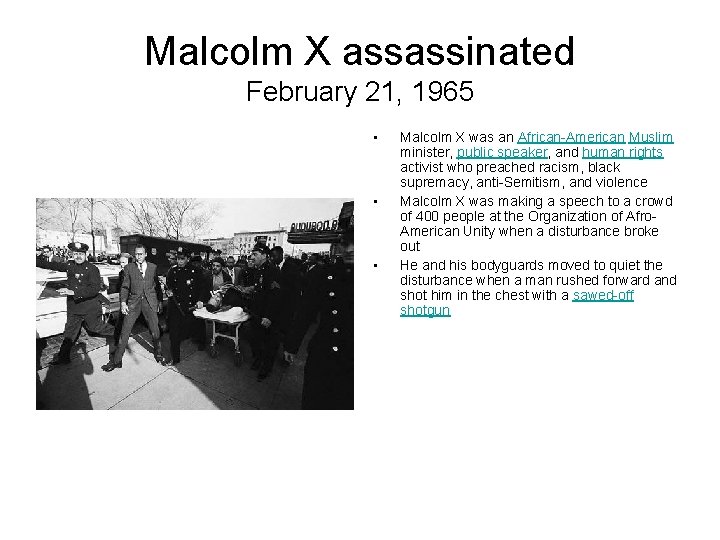
Malcolm X assassinated February 21, 1965 • • • Malcolm X was an African-American Muslim minister, public speaker, and human rights activist who preached racism, black supremacy, anti-Semitism, and violence Malcolm X was making a speech to a crowd of 400 people at the Organization of Afro. American Unity when a disturbance broke out He and his bodyguards moved to quiet the disturbance when a man rushed forward and shot him in the chest with a sawed-off shotgun
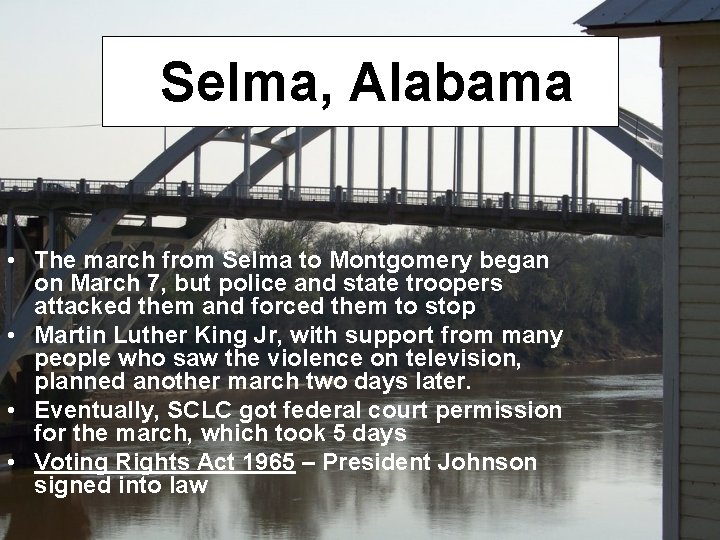
Selma, Alabama • The march from Selma to Montgomery began on March 7, but police and state troopers attacked them and forced them to stop • Martin Luther King Jr, with support from many people who saw the violence on television, planned another march two days later. • Eventually, SCLC got federal court permission for the march, which took 5 days • Voting Rights Act 1965 – President Johnson signed into law
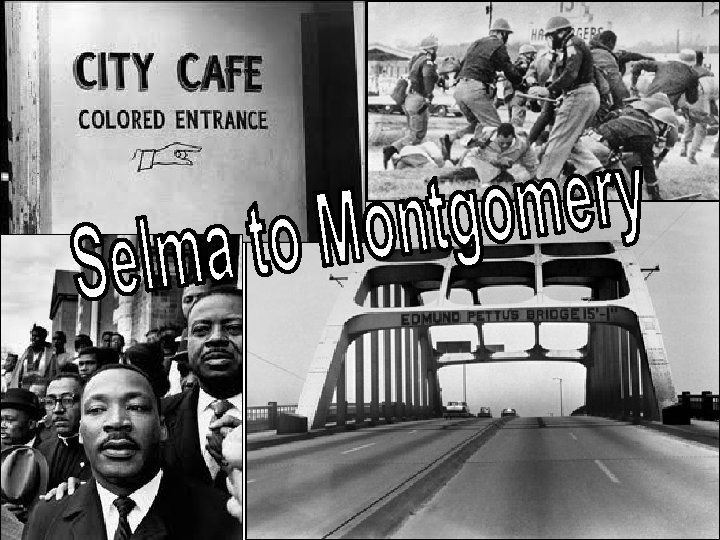
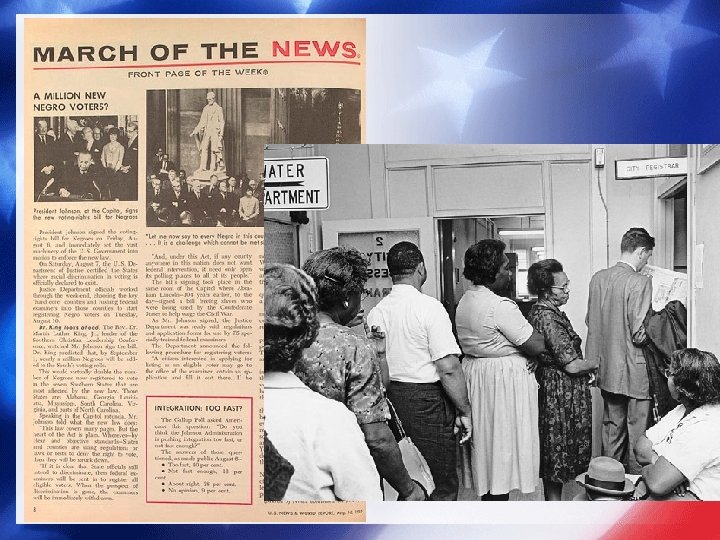
Voting Rights Act (August 6 1965) • The 1965 Voting Rights Act followed the 1964 Civil Rights Act. • The brutality in Alabama against voting rights marches led by MLK moved Congress to pass the Voting Rights Act of 1965. • The act outlawed literacy tests and poll taxes as a way of assessing whether anyone was fit or unfit to vote • By the end of 1966, only 4 out of the traditional 13 Southern states, had less than 50% of African Americans registered to vote. By 1968, even hard-line Mississippi had 59% of African Americans registered. In the longer term, far more African Americans were elected into public office. The Act was the boost that the civil rights cause needed.
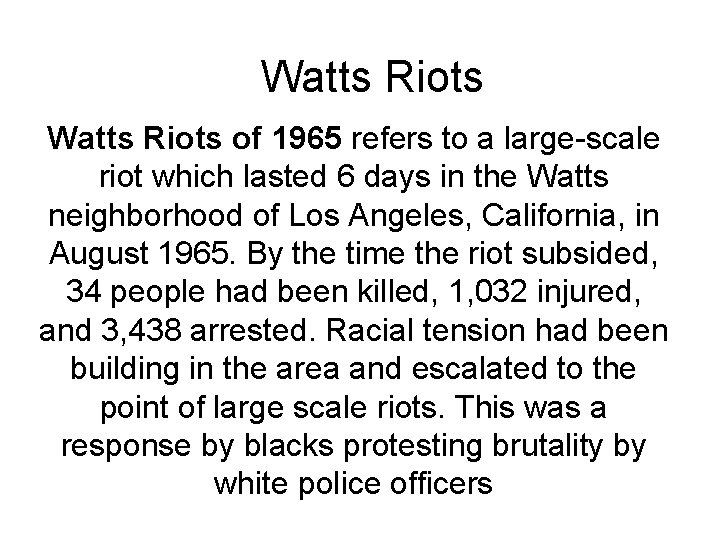
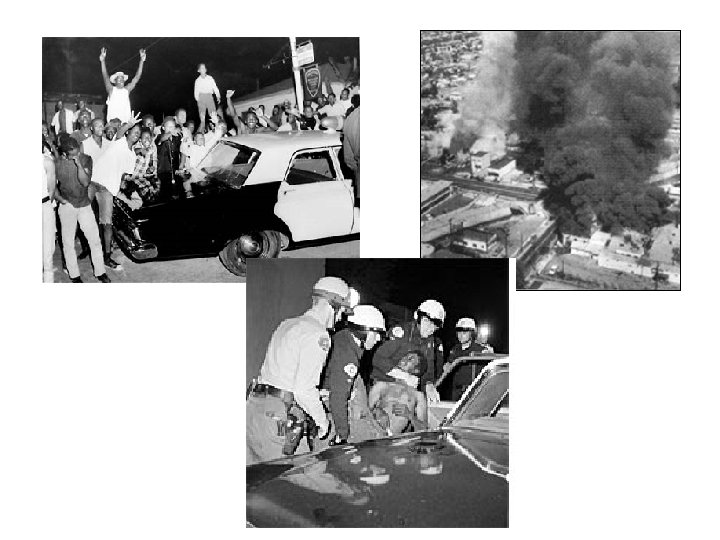
Watts Riots of 1965 refers to a large-scale riot which lasted 6 days in the Watts neighborhood of Los Angeles, California, in August 1965. By the time the riot subsided, 34 people had been killed, 1, 032 injured, and 3, 438 arrested. Racial tension had been building in the area and escalated to the point of large scale riots. This was a response by blacks protesting brutality by white police officers
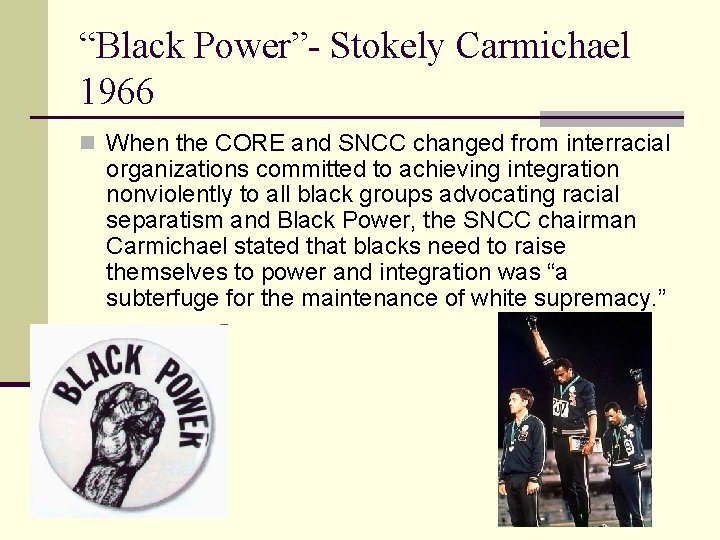
“Black Power”- Stokely Carmichael 1966 n When the CORE and SNCC changed from interracial organizations committed to achieving integration nonviolently to all black groups advocating racial separatism and Black Power, the SNCC chairman Carmichael stated that blacks need to raise themselves to power and integration was “a subterfuge for the maintenance of white supremacy. ”
“Black Power”- Stokely Carmichael 1966 n This is significant because it called for black people in the United States to unite, recognize their heritage, and to build a sense of community.
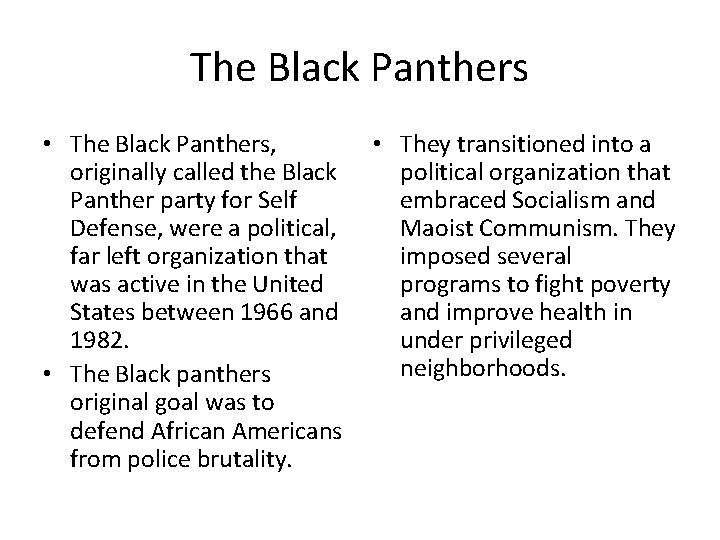
The Black Panthers • The Black Panthers, originally called the Black Panther party for Self Defense, were a political, far left organization that was active in the United States between 1966 and 1982. • The Black panthers original goal was to defend African Americans from police brutality. • They transitioned into a political organization that embraced Socialism and Maoist Communism. They imposed several programs to fight poverty and improve health in under privileged neighborhoods.
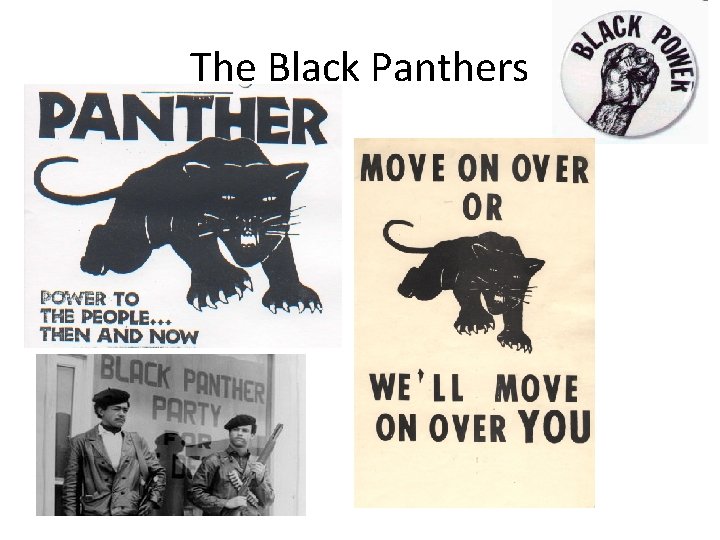
The Black Panthers
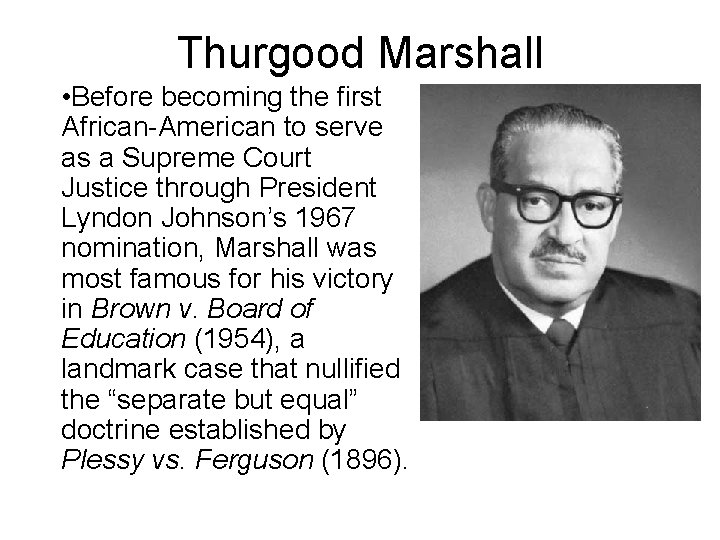
Thurgood Marshall • Before becoming the first African-American to serve as a Supreme Court Justice through President Lyndon Johnson’s 1967 nomination, Marshall was most famous for his victory in Brown v. Board of Education (1954), a landmark case that nullified the “separate but equal” doctrine established by Plessy vs. Ferguson (1896).
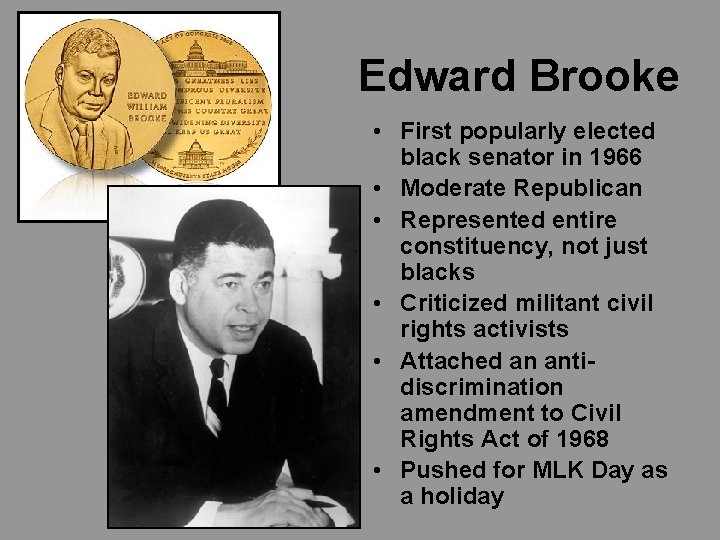
Edward Brooke • First popularly elected black senator in 1966 • Moderate Republican • Represented entire constituency, not just blacks • Criticized militant civil rights activists • Attached an antidiscrimination amendment to Civil Rights Act of 1968 • Pushed for MLK Day as a holiday
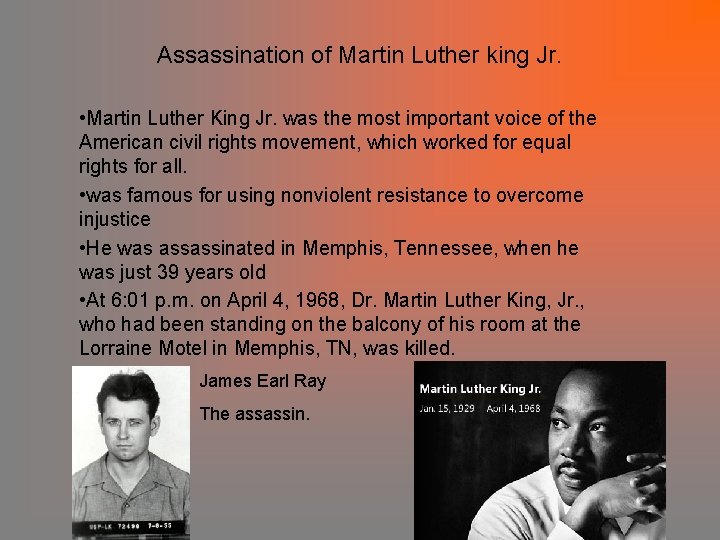
Assassination of Martin Luther king Jr. • Martin Luther King Jr. was the most important voice of the American civil rights movement, which worked for equal rights for all. • was famous for using nonviolent resistance to overcome injustice • He was assassinated in Memphis, Tennessee, when he was just 39 years old • At 6: 01 p. m. on April 4, 1968, Dr. Martin Luther King, Jr. , who had been standing on the balcony of his room at the Lorraine Motel in Memphis, TN, was killed. James Earl Ray The assassin.
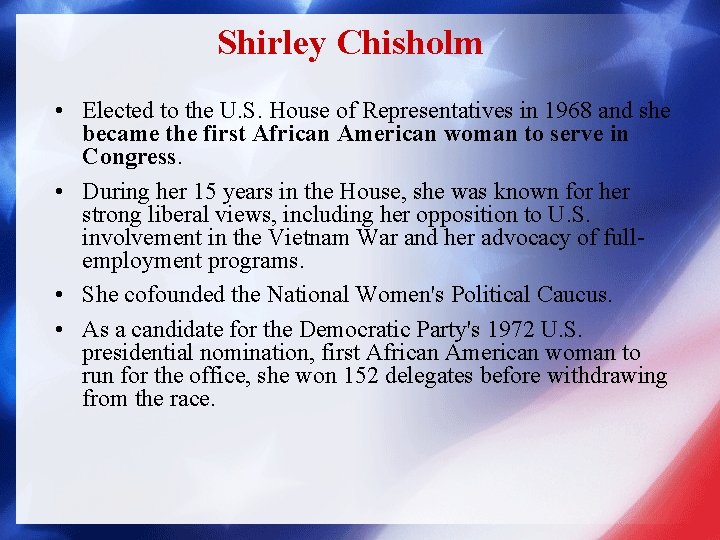
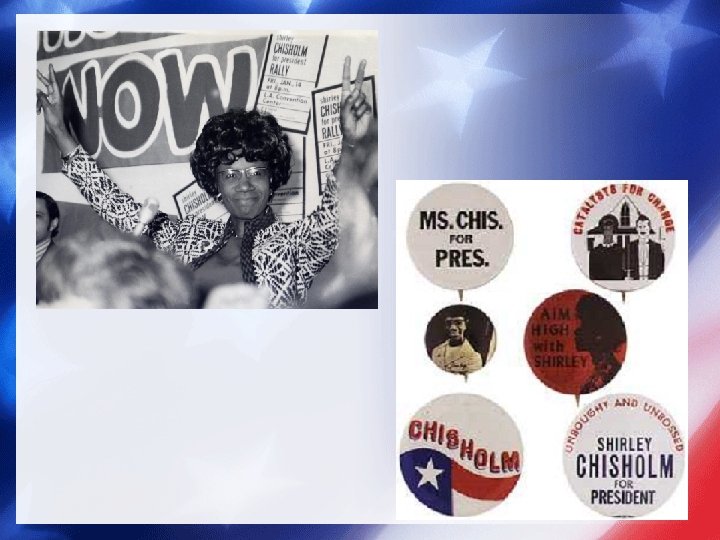
Shirley Chisholm • Elected to the U. S. House of Representatives in 1968 and she became the first African American woman to serve in Congress. • During her 15 years in the House, she was known for her strong liberal views, including her opposition to U. S. involvement in the Vietnam War and her advocacy of fullemployment programs. • She cofounded the National Women's Political Caucus. • As a candidate for the Democratic Party's 1972 U. S. presidential nomination, first African American woman to run for the office, she won 152 delegates before withdrawing from the race.
- Slides: 59