
Brown Dwarfs and Dark Matters L dwarfs binaries
Brown Dwarfs and Dark Matters L dwarfs, binaries and the mass function Neill Reid, STSc. I in association with 2 MASS Core project: Davy Kirkpatrick, Jim Liebert, Conard Dahn, Dave Monet, Adam Burgasser

Outline • Finding ultracool dwarfs • The L dwarf sequence extending calibration to near-infrared wavelengths • L-dwarf binaries Separations and mass ratios • The mass function below the hydrogen-burning limit brown dwarfs and dark matter Some results and a conundrum • Heavy halo white dwarfs?
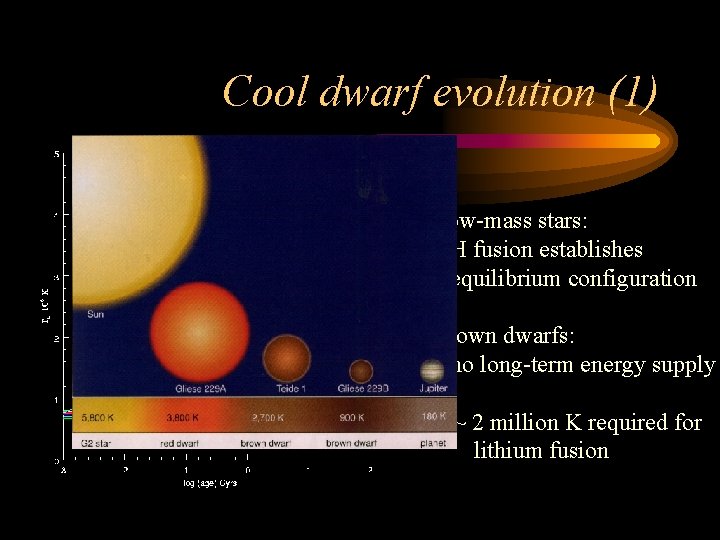
Cool dwarf evolution (1) Low-mass stars: H fusion establishes equilibrium configuration Brown dwarfs: no long-term energy supply T ~ 2 million K required for lithium fusion
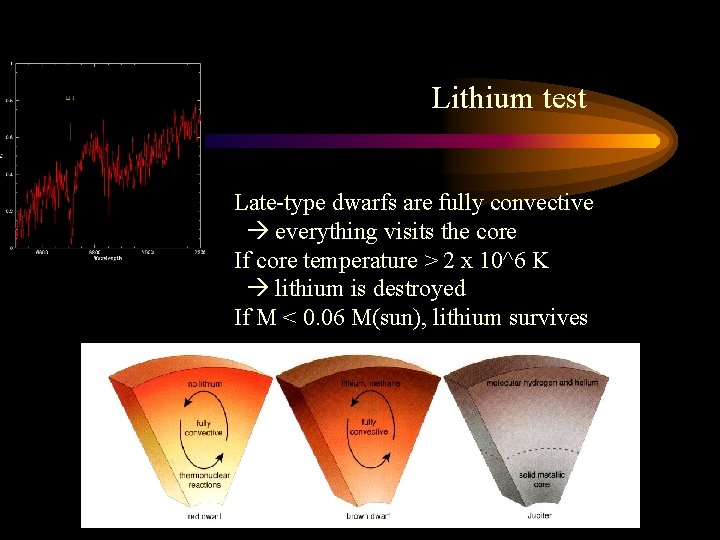
Lithium test Late-type dwarfs are fully convective everything visits the core If core temperature > 2 x 10^6 K lithium is destroyed If M < 0. 06 M(sun), lithium survives
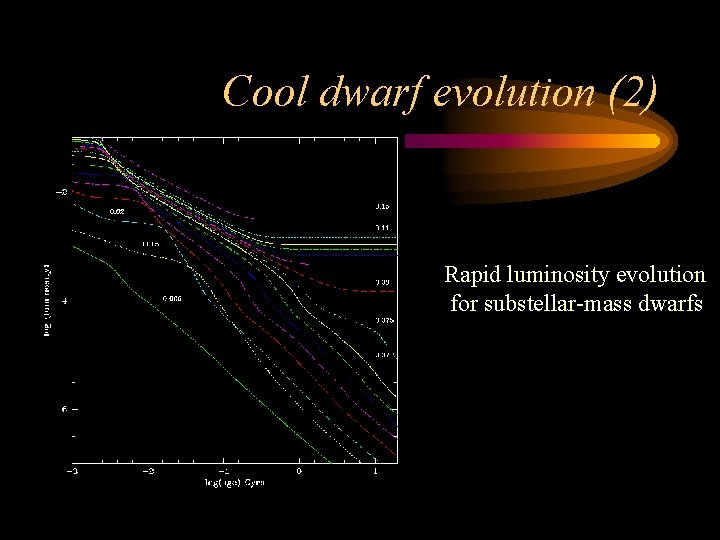
Cool dwarf evolution (2) Rapid luminosity evolution for substellar-mass dwarfs
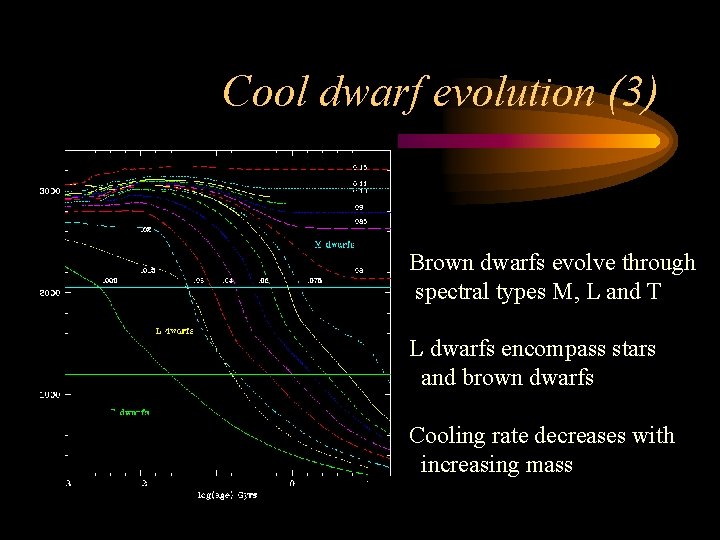
Cool dwarf evolution (3) Brown dwarfs evolve through spectral types M, L and T L dwarfs encompass stars and brown dwarfs Cooling rate decreases with increasing mass
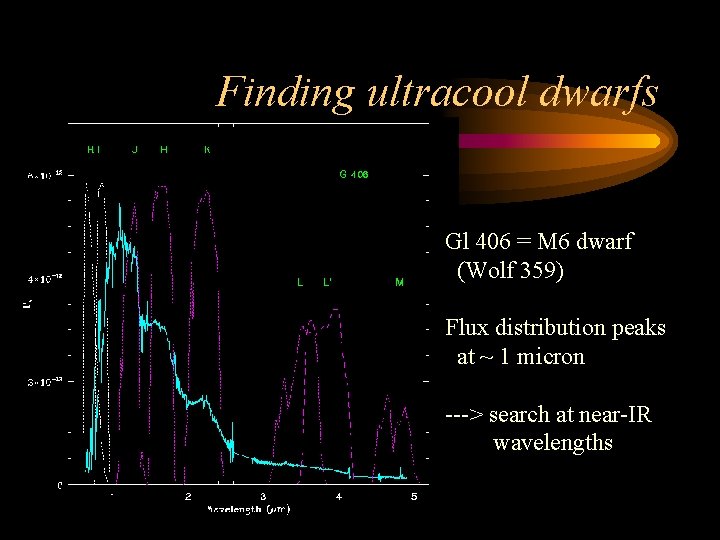
Finding ultracool dwarfs Gl 406 = M 6 dwarf (Wolf 359) Flux distribution peaks at ~ 1 micron ---> search at near-IR wavelengths
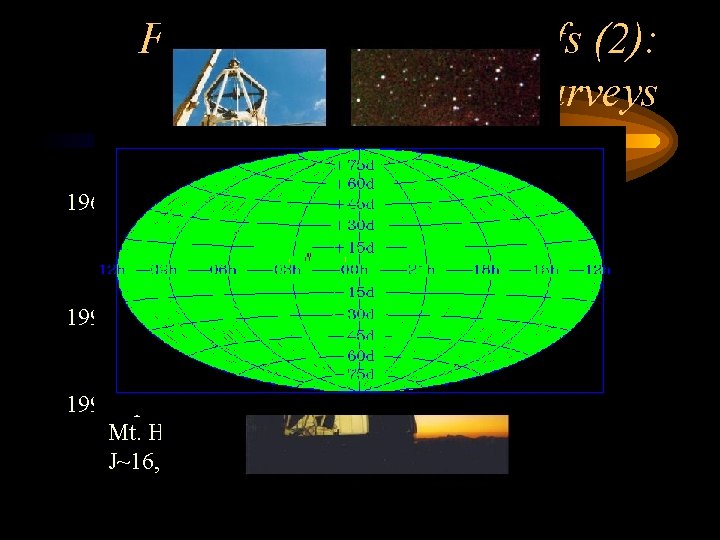
Finding ultracool dwarfs (2): Near-infrared sky surveys 1969 - Neugebauer & Leyton - Mt. Wilson TMSS custom built 60 -inch plastic mirror arc-minute resolution, K < 3 rd magnitude 1996 - 2000 DENIS … southern sky ESO 1. 3 metre, IJK to J~15, K~13. 5 1997 - present 2 MASS all-sky Mt. Hopkins/CTIO 1. 5 metres, JHK J~16, K~14. 5 (10 -sigma)
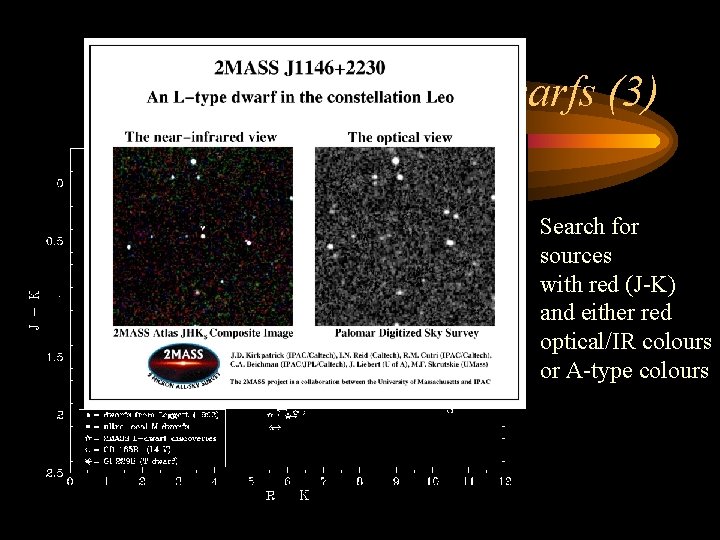
Finding ultracool dwarfs (3) Search for sources with red (J-K) and either red optical/IR colours or A-type colours
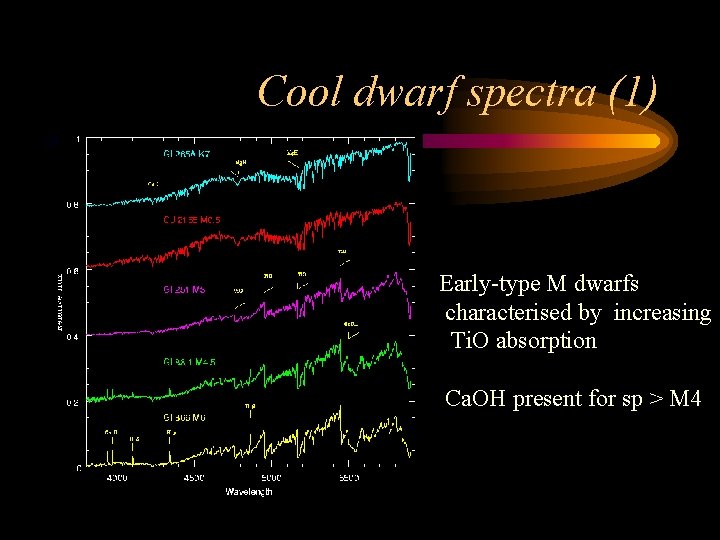
Cool dwarf spectra (1) Early-type M dwarfs characterised by increasing Ti. O absorption Ca. OH present for sp > M 4
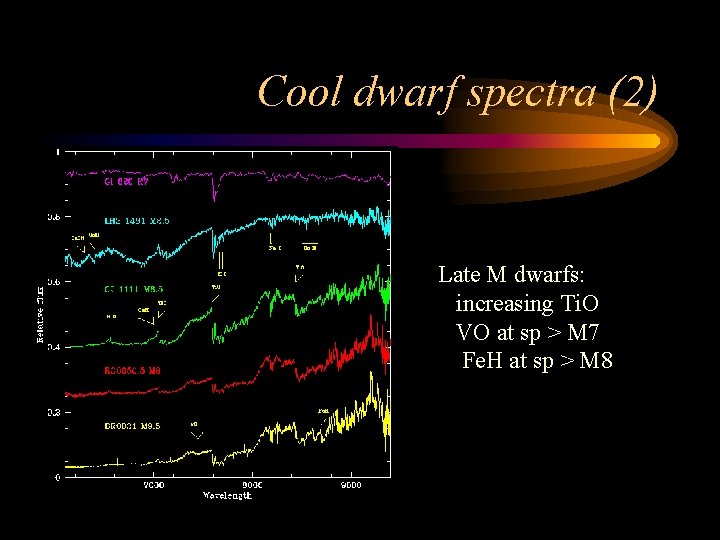
Cool dwarf spectra (2) Late M dwarfs: increasing Ti. O VO at sp > M 7 Fe. H at sp > M 8
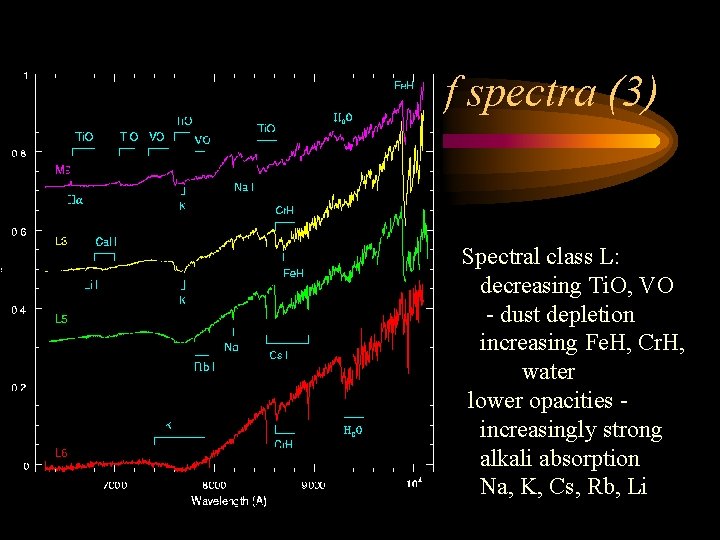
Cool dwarf spectra (3) Spectral class L: decreasing Ti. O, VO - dust depletion increasing Fe. H, Cr. H, water lower opacities increasingly strong alkali absorption Na, K, Cs, Rb, Li
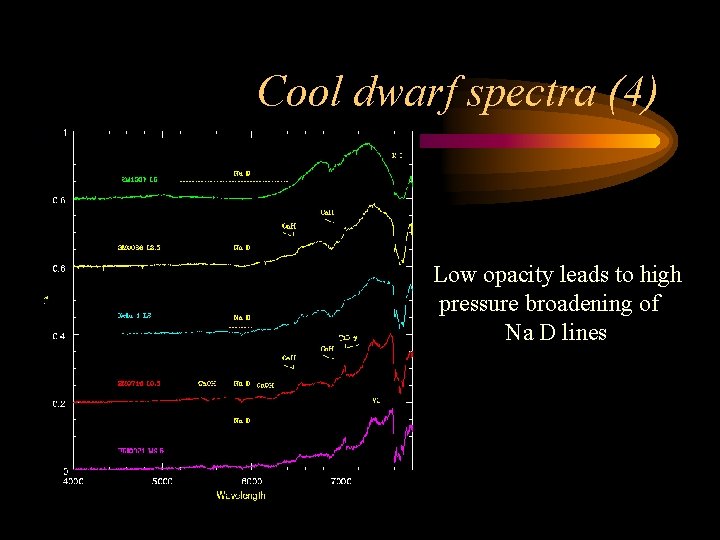
Cool dwarf spectra (4) Low opacity leads to high pressure broadening of Na D lines
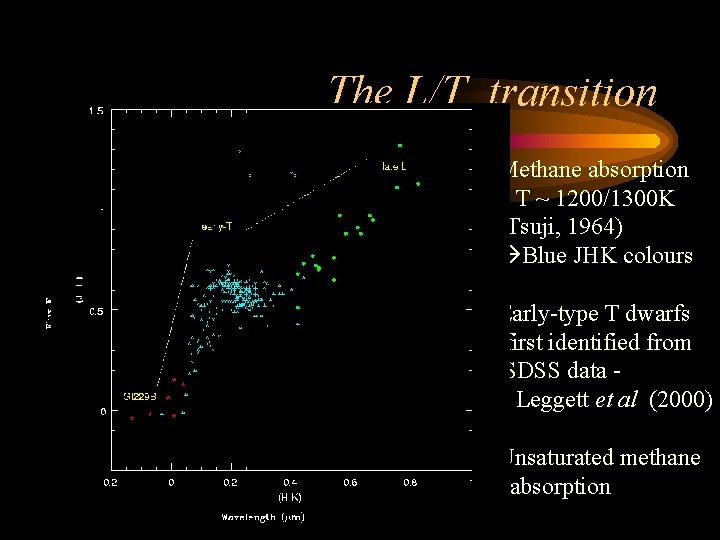
The L/T transition Methane absorption T ~ 1200/1300 K (Tsuji, 1964) Blue JHK colours Early-type T dwarfs first identified from SDSS data Leggett et al (2000) Unsaturated methane absorption
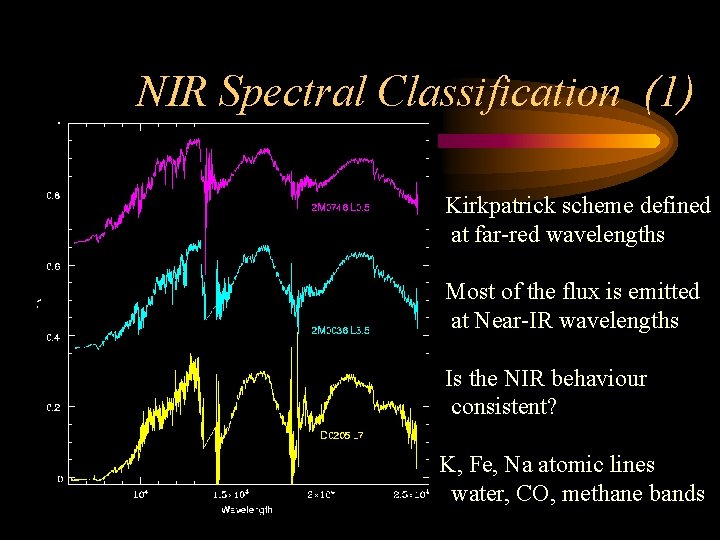
NIR Spectral Classification (1) Kirkpatrick scheme defined at far-red wavelengths Most of the flux is emitted at Near-IR wavelengths Is the NIR behaviour consistent? K, Fe, Na atomic lines water, CO, methane bands
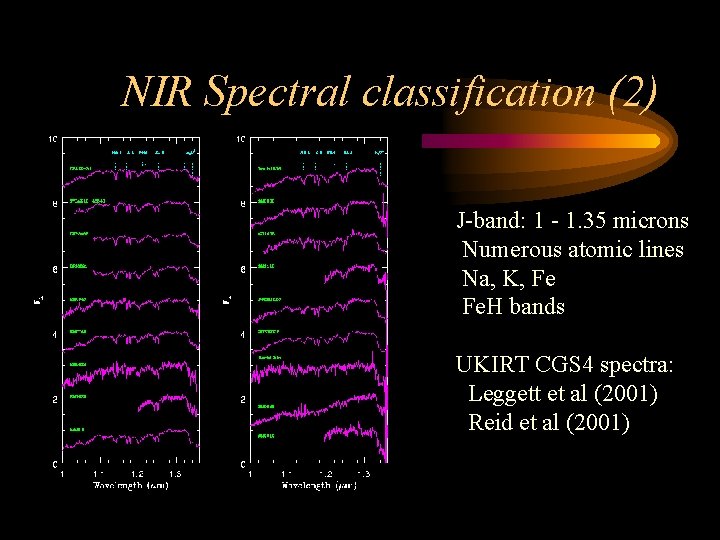
NIR Spectral classification (2) J-band: 1 - 1. 35 microns Numerous atomic lines Na, K, Fe Fe. H bands UKIRT CGS 4 spectra: Leggett et al (2001) Reid et al (2001)
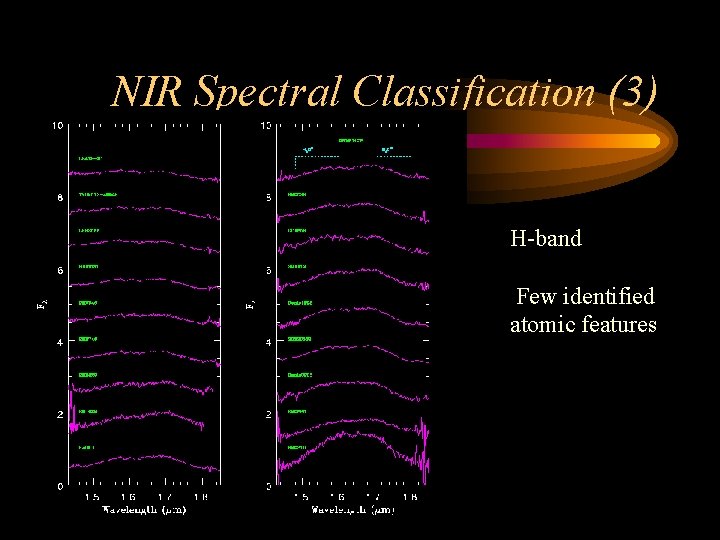
NIR Spectral Classification (3) H-band Few identified atomic features
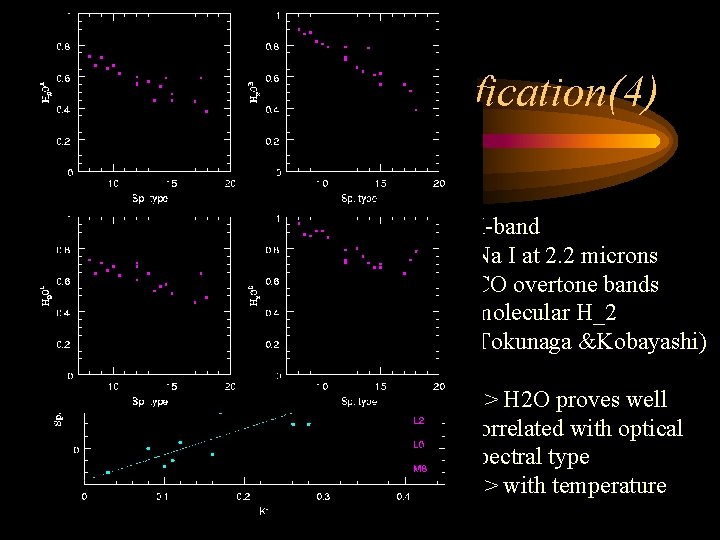
NIR Spectral Classification(4) K-band Na I at 2. 2 microns CO overtone bands molecular H_2 (Tokunaga &Kobayashi) --> H 2 O proves well correlated with optical spectral type --> with temperature
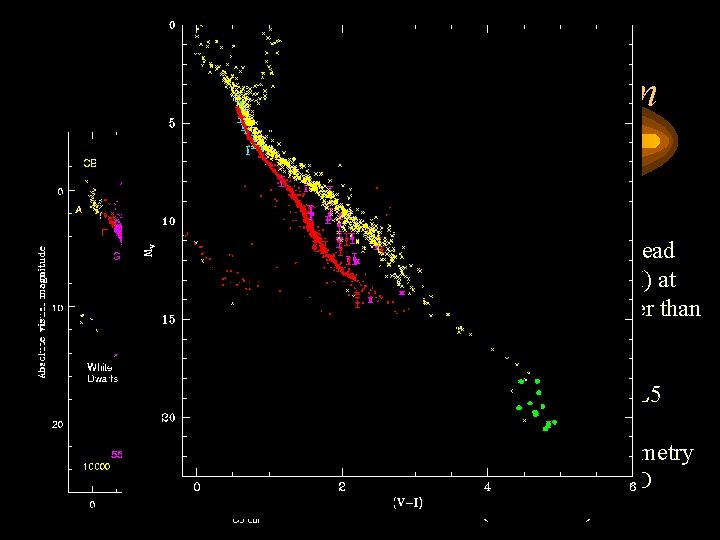
The HR diagram Broad Na D lines lead to increasing (V-I) at spectral types later than L 3. 5/L 4 Latest dwarf 2 M 1507 -1627 L 5 Astrometry/photometry courtesy of USNO (Dahn et al)
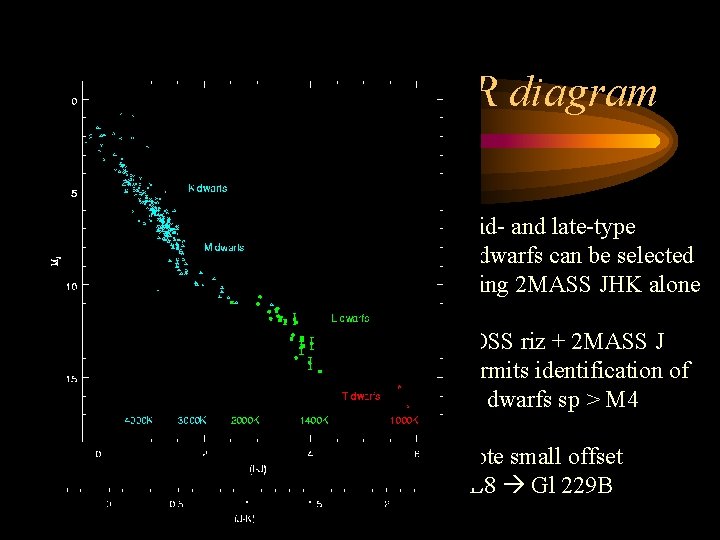
The near-infrared HR diagram Mid- and late-type L dwarfs can be selected using 2 MASS JHK alone SDSS riz + 2 MASS J permits identification of all dwarfs sp > M 4 Note small offset L 8 Gl 229 B
Searching for brown dwarf binaries The alternative model for brown dwarfs
Binary surveys: L dwarfs (2) Why do we care about L dwarf binaries? 1. Measure dynamical masses constrain models 2. Star formation and, perhaps, planet formation HST imaging survey of 160 ultracool dwarfs (>M 8) over cycles 8 & 9 (Reid + 2 MASS/SDSS consortium) Successful WFPC 2 observations of 60 targets to date --> only 11 binaries detected
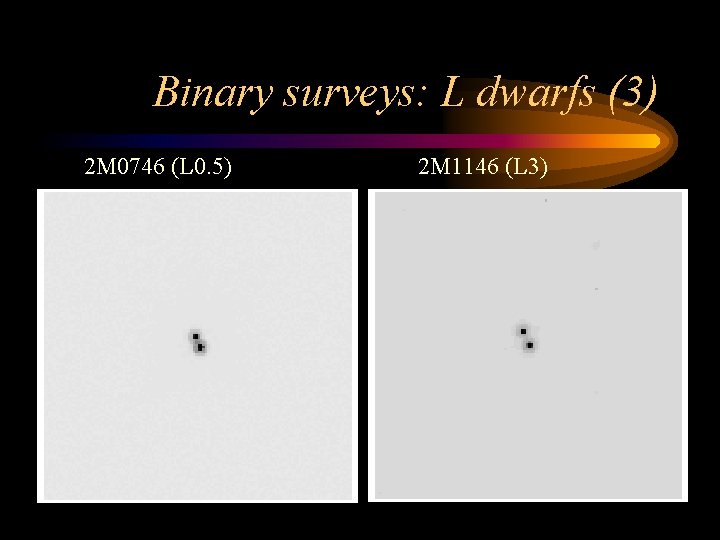
Binary surveys: L dwarfs (3) 2 M 0746 (L 0. 5) 2 M 1146 (L 3)
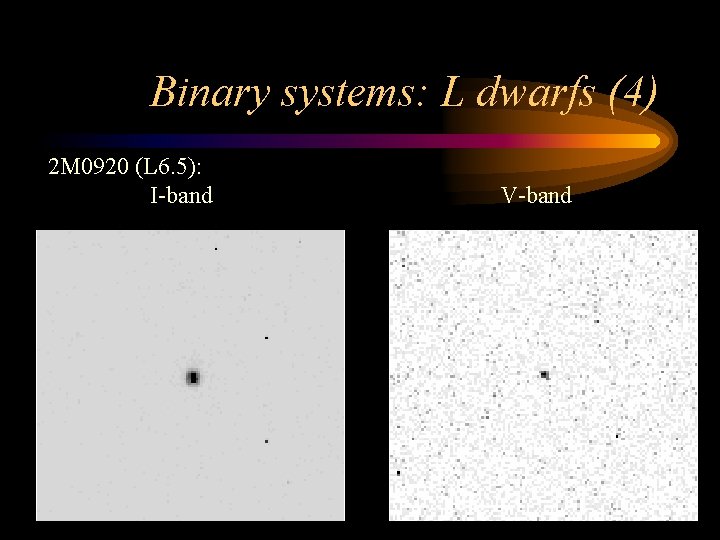
Binary systems: L dwarfs (4) 2 M 0920 (L 6. 5): I-band V-band
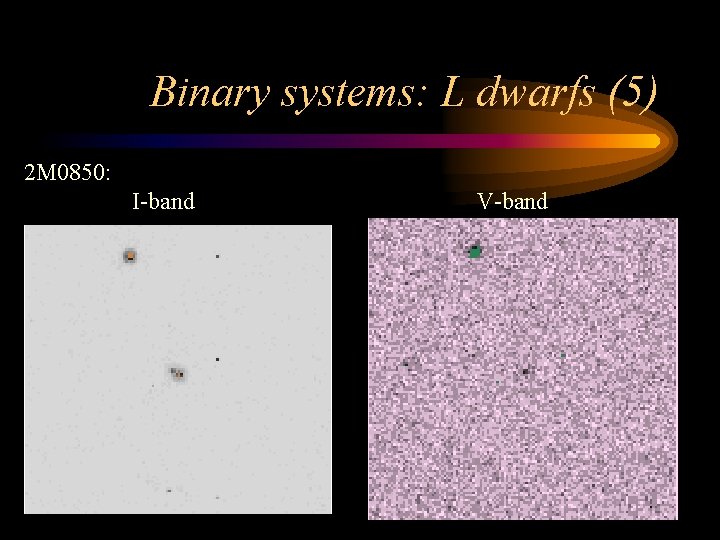
Binary systems: L dwarfs (5) 2 M 0850: I-band V-band
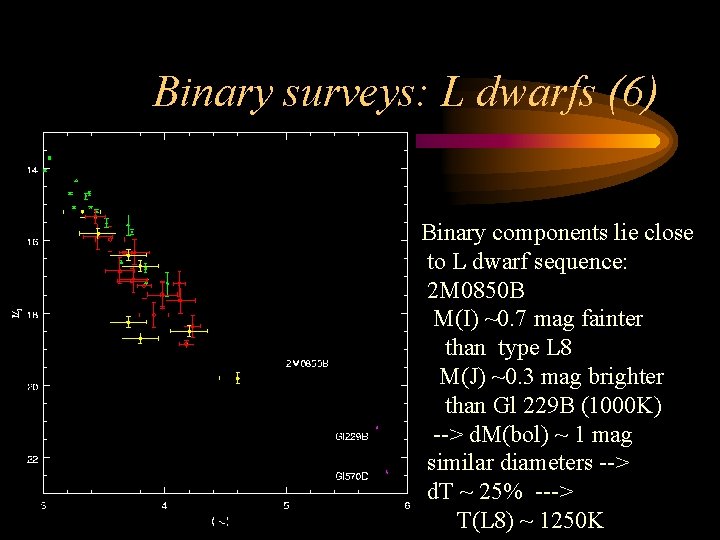
Binary surveys: L dwarfs (6) Binary components lie close to L dwarf sequence: 2 M 0850 B M(I) ~0. 7 mag fainter than type L 8 M(J) ~0. 3 mag brighter than Gl 229 B (1000 K) --> d. M(bol) ~ 1 mag similar diameters --> d. T ~ 25% ---> T(L 8) ~ 1250 K
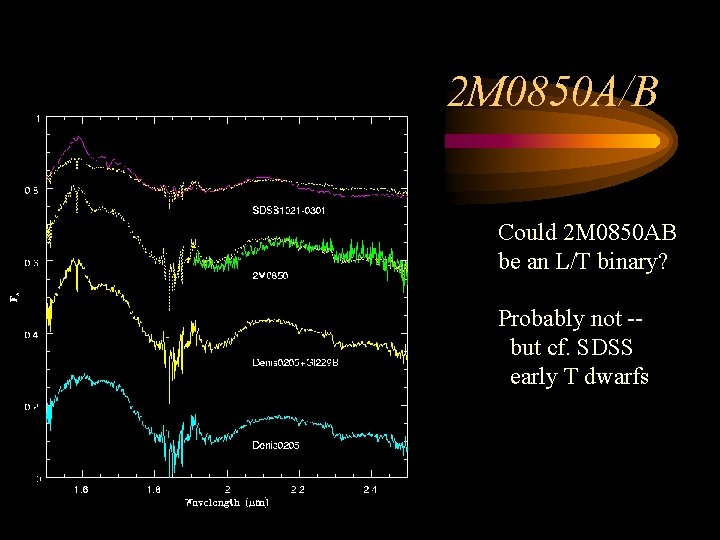
2 M 0850 A/B Could 2 M 0850 AB be an L/T binary? Probably not -but cf. SDSS early T dwarfs
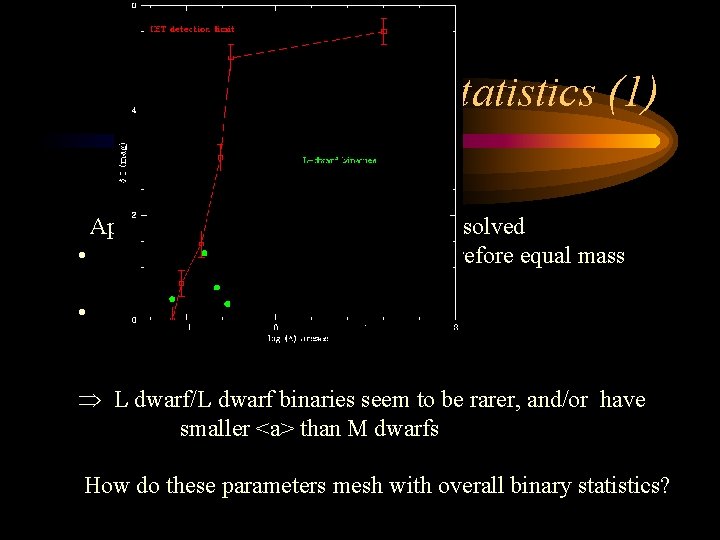
L dwarf binary statistics (1) Approximately 20% of L dwarfs are resolved • almost all are equal luminosity, therefore equal mass 2 M 0850 AB – mass ratio ~ 0. 8 • none have separations > 10 AU Þ L dwarf/L dwarf binaries seem to be rarer, and/or have smaller <a> than M dwarfs How do these parameters mesh with overall binary statistics?
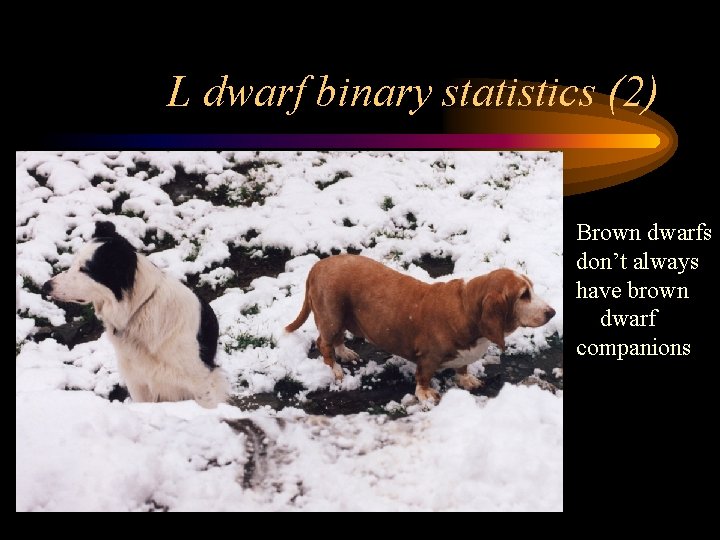
L dwarf binary statistics (2) Brown dwarfs don’t always have brown dwarf companions
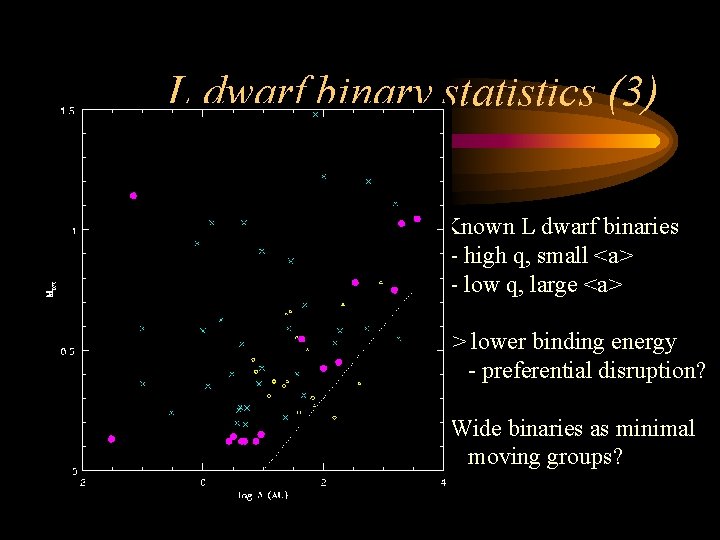
L dwarf binary statistics (3) Known L dwarf binaries - high q, small <a> - low q, large <a> -> lower binding energy - preferential disruption? Wide binaries as minimal moving groups?
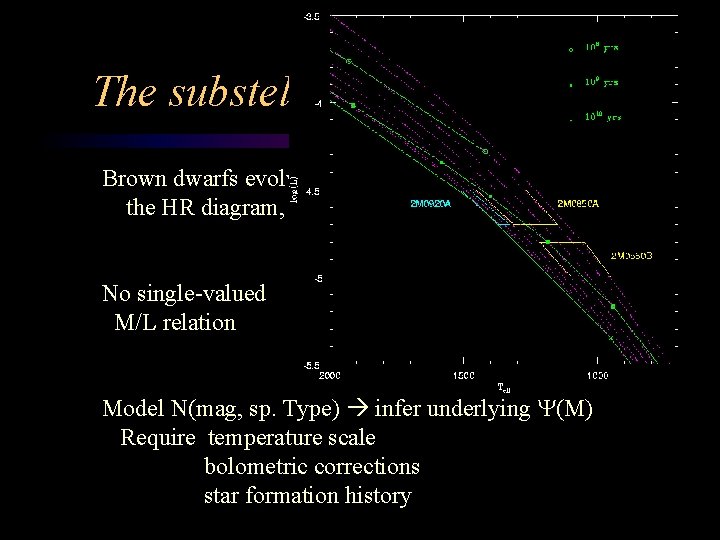
The substellar mass function (1) Brown dwarfs evolve along nearly identical tracks in the HR diagram, at mass-dependent rates No single-valued M/L relation Model N(mag, sp. Type) infer underlying Y(M) Require temperature scale bolometric corrections star formation history
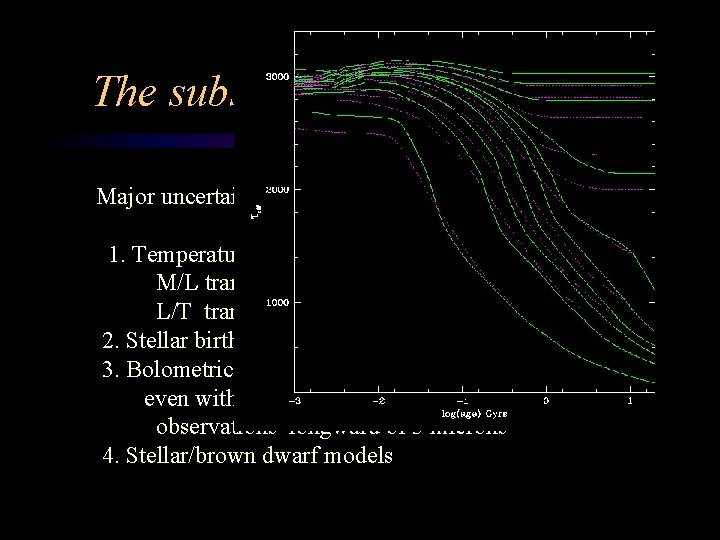
The substellar mass function (2) Major uncertainties: 1. Temperature scale M/L transition --> 2200 to 2000 K L/T transition --> 1350 to 1200 K 2. Stellar birthrate --> assume constant on average 3. Bolometric corrections: even with CGS 4 data, few cool dwarfs have observations longward of 3 microns 4. Stellar/brown dwarf models
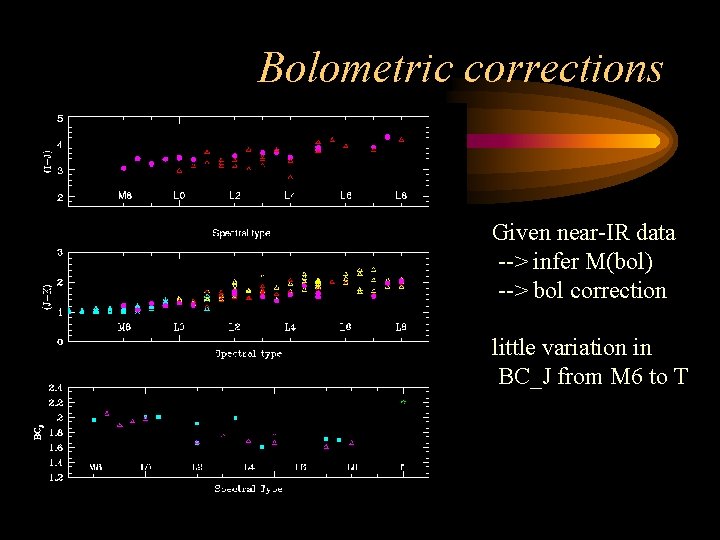
Bolometric corrections Given near-IR data --> infer M(bol) --> bol correction little variation in BC_J from M 6 to T
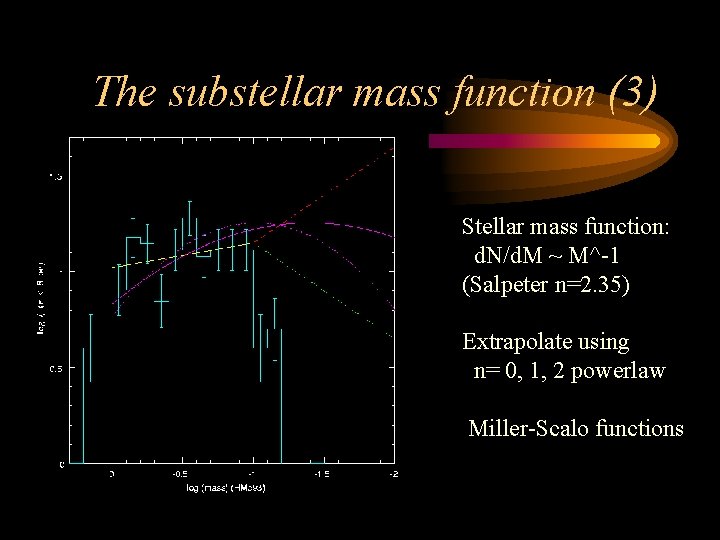
The substellar mass function (3) Stellar mass function: d. N/d. M ~ M^-1 (Salpeter n=2. 35) Extrapolate using n= 0, 1, 2 powerlaw Miller-Scalo functions
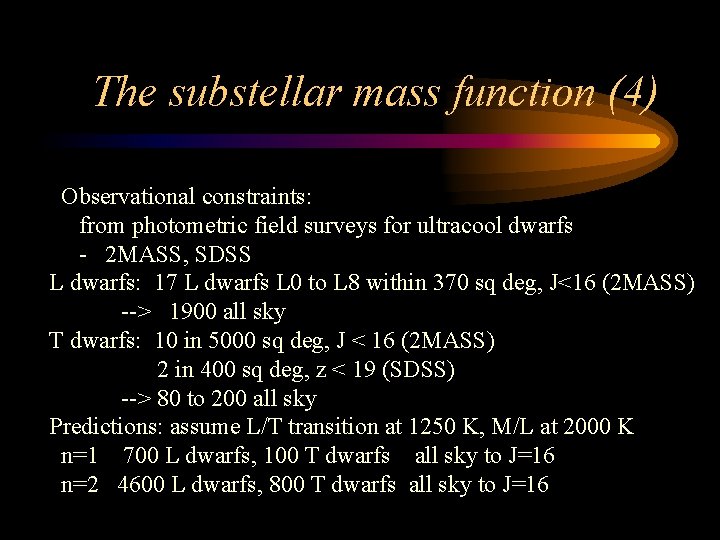
The substellar mass function (4) Observational constraints: from photometric field surveys for ultracool dwarfs - 2 MASS, SDSS L dwarfs: 17 L dwarfs L 0 to L 8 within 370 sq deg, J<16 (2 MASS) --> 1900 all sky T dwarfs: 10 in 5000 sq deg, J < 16 (2 MASS) 2 in 400 sq deg, z < 19 (SDSS) --> 80 to 200 all sky Predictions: assume L/T transition at 1250 K, M/L at 2000 K n=1 700 L dwarfs, 100 T dwarfs all sky to J=16 n=2 4600 L dwarfs, 800 T dwarfs all sky to J=16
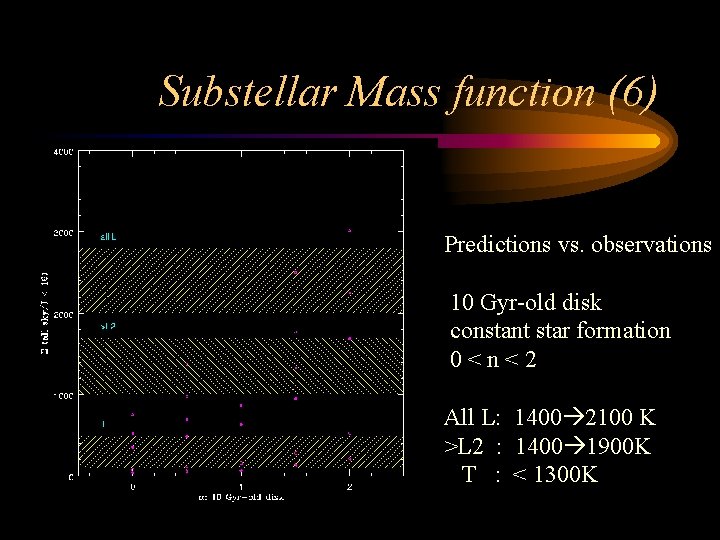
Substellar Mass function (6) Predictions vs. observations 10 Gyr-old disk constant star formation 0<n<2 All L: 1400 2100 K >L 2 : 1400 1900 K T : < 1300 K
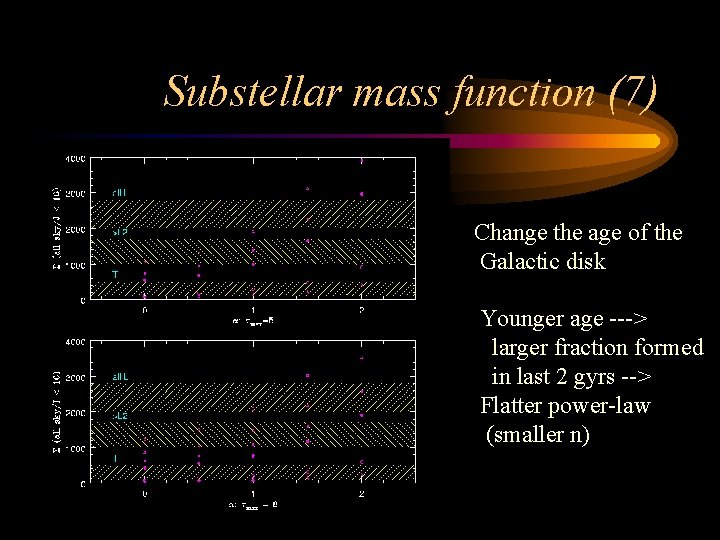
Substellar mass function (7) Change the age of the Galactic disk Younger age ---> larger fraction formed in last 2 gyrs --> Flatter power-law (smaller n)
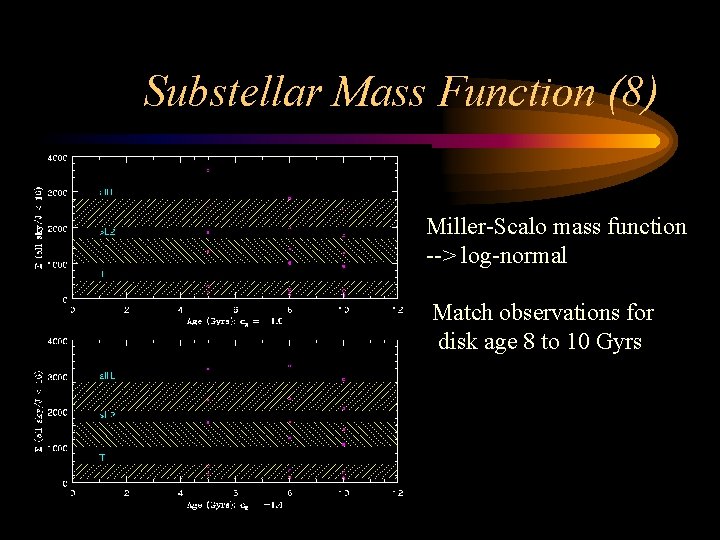
Substellar Mass Function (8) Miller-Scalo mass function --> log-normal Match observations for disk age 8 to 10 Gyrs
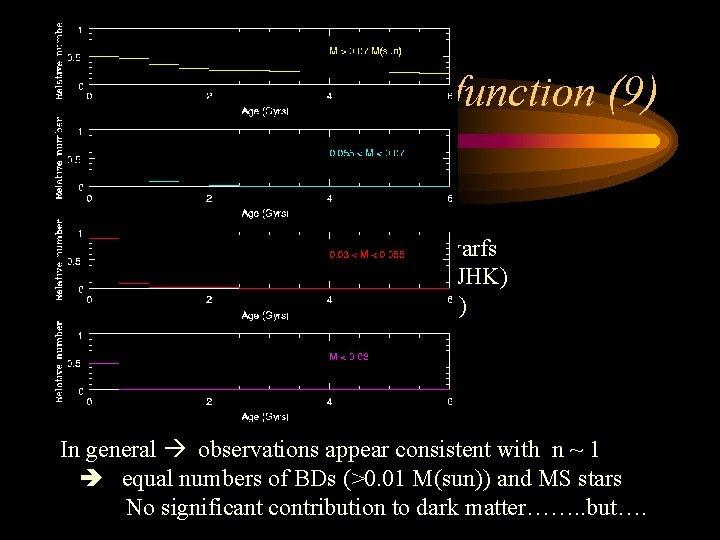
The substellar mass function (9) Caveats: 1. Completeness … 2 MASS - early L dwarfs - T dwarfs (JHK) SDSS - T dwarfs (iz) 2. Temperature limits … M/L transition 3. Age distribution we only detect young brown dwarfs In general observations appear consistent with n ~ 1 equal numbers of BDs (>0. 01 M(sun)) and MS stars No significant contribution to dark matter……. . but….
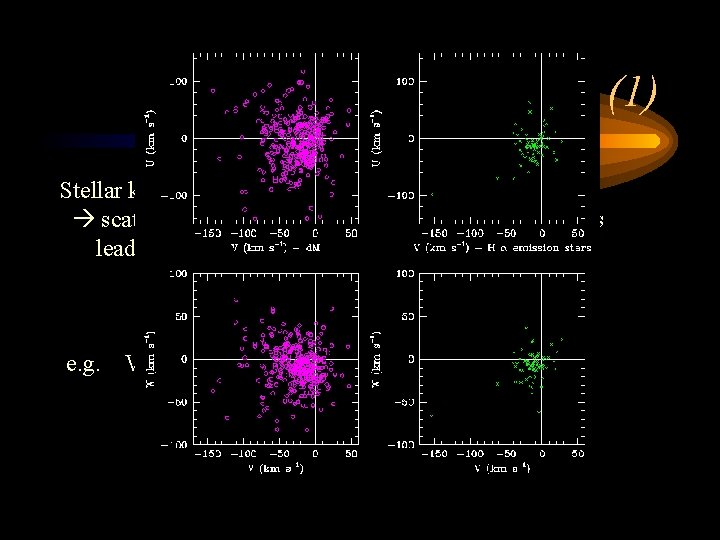
A kinematic conundrum (1) Stellar kinematics are correlated with age scattering through encounters with molecular clouds leads to 1. Higher velocity dispersions 2. Lower net rotational velocity, V e. g. Velocity distributions of d. M (inactive, older) and d. Me (active, younger)
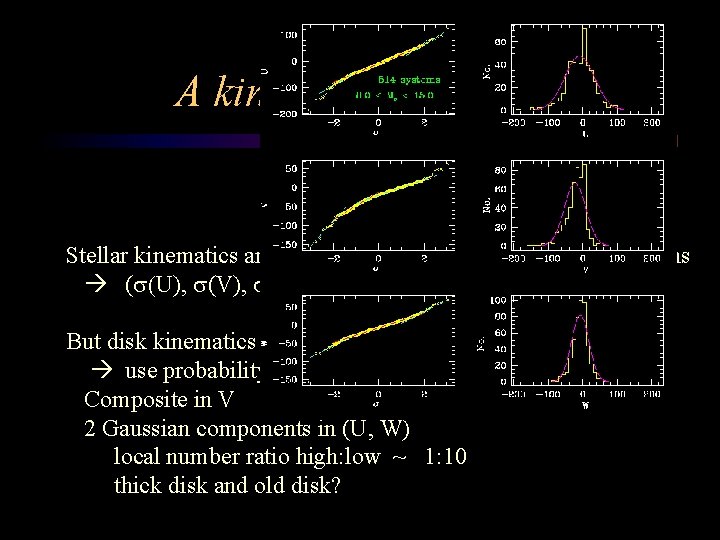
A kinematic conundrum (2) Stellar kinematics are usually modelled as Gaussian distributions (s(U), s(V), s(W) ) But disk kinematics are more complex: use probability plots Composite in V 2 Gaussian components in (U, W) local number ratio high: low ~ 1: 10 thick disk and old disk?
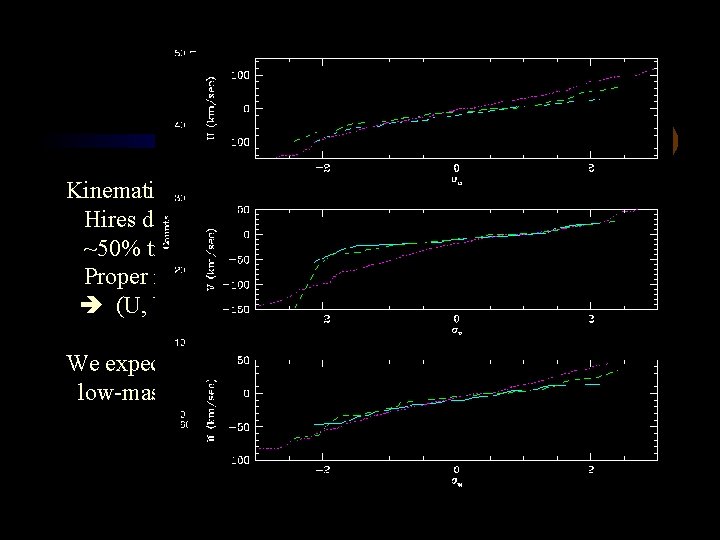
A kinematic conundrum (3) Kinematics of ultracool dwarfs (M 7 L 0) Hires data for 35 dwarfs ~50% trig/50% photo parallaxes Proper motions for all (U, V, W) velocities We expect the sample to be dominated by long-lived low-mass stars – although there is at least one BD
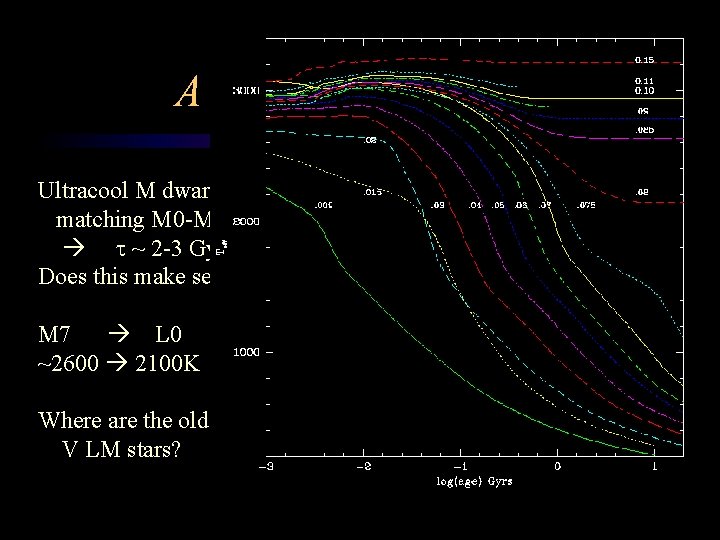
A kinematic conundrum (4) Ultracool M dwarfs have kinematic properties matching M 0 -M 5 d. Me dwarfs t ~ 2 -3 Gyrs Does this make sense? M 7 L 0 ~2600 2100 K Where are the old V LM stars?
A different kind of dark matter • Galaxy rotation curves at large radii are not Keplerian - heavy halos (Ostriker, Peebles & Yahil, 1974) - Milky Way M ~ 5 x 10^11 solar masses, R < 50 kpc visible material (disk + stellar halo) ~ 5 x 10^10 solar masses => 90% dark matter – particles? compact objects? • Microlensing surveys – MACHO, EROS, DUO, OGLE Given timescale, estimated velocity => mass MACHO: 13 -17 events, t ~ 34 -230 days, <V> ~ 200 -300 km/s => can account for ~20% of the missing 90% <M> = 0. 5+/- 0. 3 solar masses Halo white dwarfs?
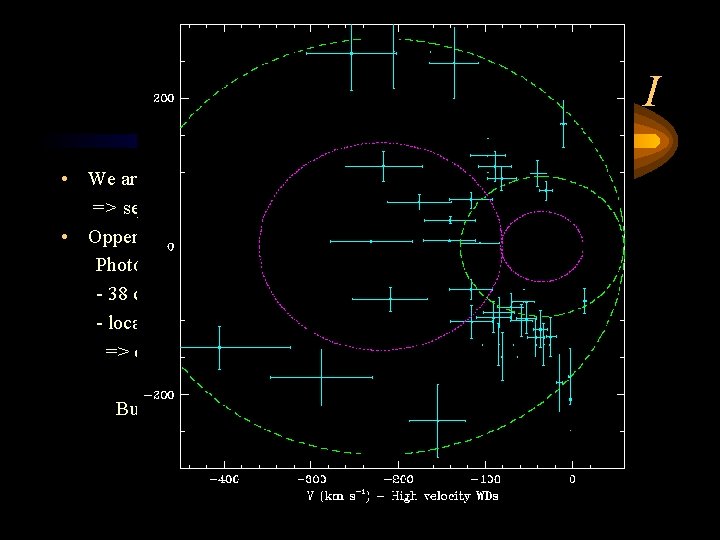
Heavy halo white dwarfs? I • We are in the dark halo – local density ~ 10^-2 M_sun/pc^3 => search for local representatives in proper motion surveys • Oppenheimer et al. (Science Express, March 23) Photographic survey of ~12% of the sky near the SGP - 38 cool, high-velocity white dwarfs – 4 x 10^-4 stars/pc^3 - local mass density of ~3 x 10^-4 M_sun/pc^3 => could account for 3% of dark matter if they’re in the heavy halo But are they?
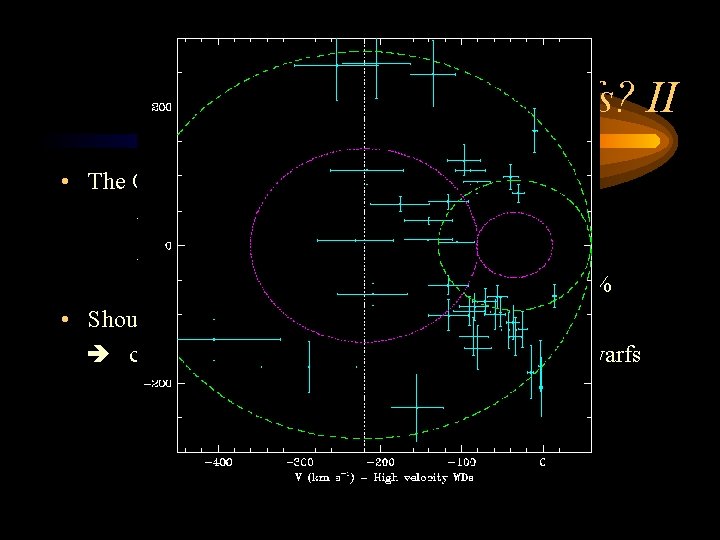
Heavy halo white dwarfs? II • The Galactic disk has a complex kinematic structure - thin/old disk: 300 pc scaleheight, 90% of local stars - thick/extended disk: 700 pc scaleheight, 10% • Should we expect any high-velocity disk stars consider a volume-complete sample of 514 M dwarfs (Reid, Hawley & Gizis, 1995)
Heavy halo white dwarfs? III • Thick disk stars can have high velocities - Reid, Hawley & Gizis (1995): PMSU M dwarf survey 4% of the sample would be classed as dark halo by Oppenheimer et al => ~2 x 10^-4 white dwarfs / pc^3 • Most of the Oppenheimer et al. white dwarfs are remnants of the first stars which formed in the thick disk • White dwarfs from the stellar halo account for the rest • There is no requirement for a dark matter contribution
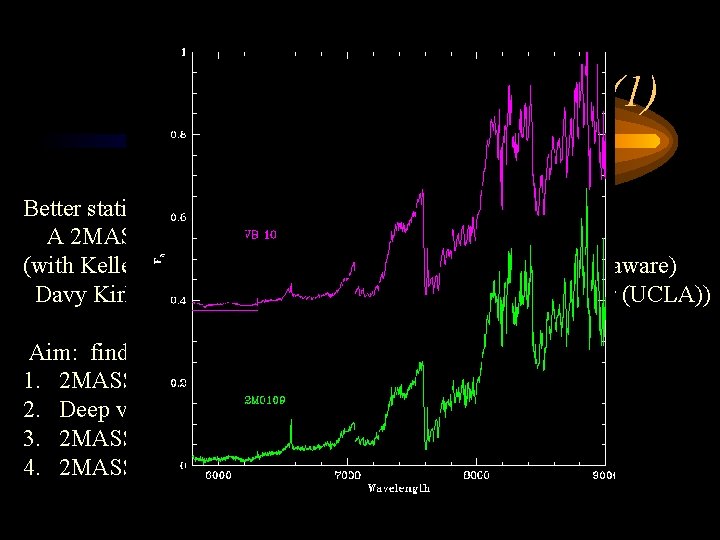
What next? (1) Better statistics for nearby stars F(M), Y(M) A 2 MASS NStars survey (with Kelle Cruz (Upenn), Jim Liebert (UA), John Gizis (Delaware) Davy Kirkpatrick & Pat Lowrance (IPAC), Adam Burgasser (UCLA)) Aim: find all dwarfs later than M 4 within 20 parsecs 1. 2 MASS/NLTT cross-referencing: (m(r) – K) p 2. Deep van Biesbroeck survey for wide cpm companions 3. 2 MASS-direct: (J-K) p 4. 2 MASS/POSS II: (I-J) p
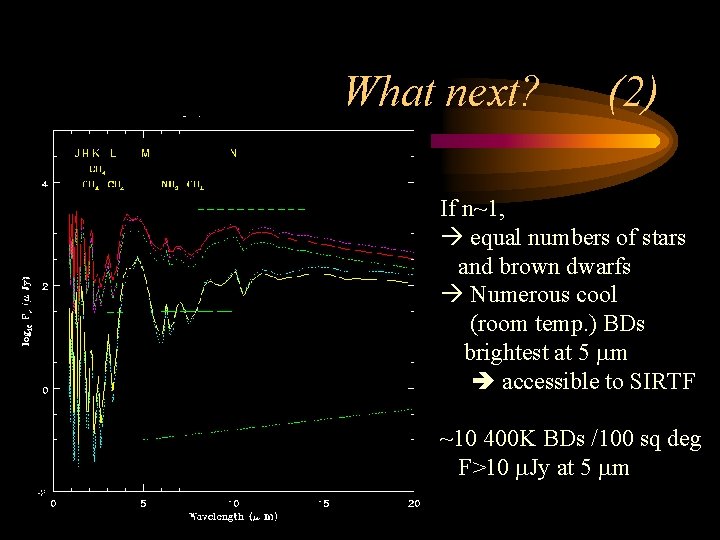
What next? (2) If n~1, equal numbers of stars and brown dwarfs Numerous cool (room temp. ) BDs brightest at 5 mm accessible to SIRTF ~10 400 K BDs /100 sq deg F>10 m. Jy at 5 mm
Summary 1. Brown dwarfs are now almost commonplace 2. Near-IR spectra show that the L dwarf sequence L 0…L 8 is consistent with near-infrared variations probably well correlated with temperature 3. First results from HST L dwarf binary survey - L dwarf/L dwarf binaries relatively rare - Maximum separation is correlated with total mass nature or nurture? 4. Current detection rates are inconsistent with a steep IMF brown dwarfs are poor dark matter candidates 4. Neither are cool white dwarfs

Shameless plug…. Now available from Amazon. com and in all the best bookstores
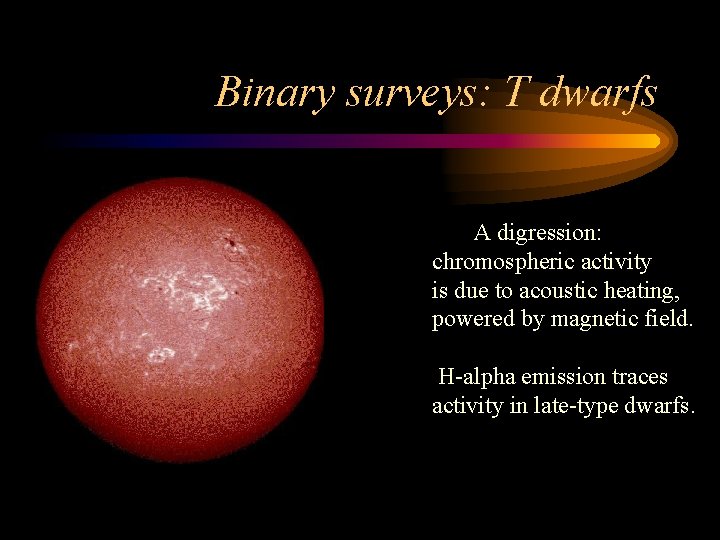
Binary surveys: T dwarfs A digression: chromospheric activity is due to acoustic heating, powered by magnetic field. H-alpha emission traces activity in late-type dwarfs.
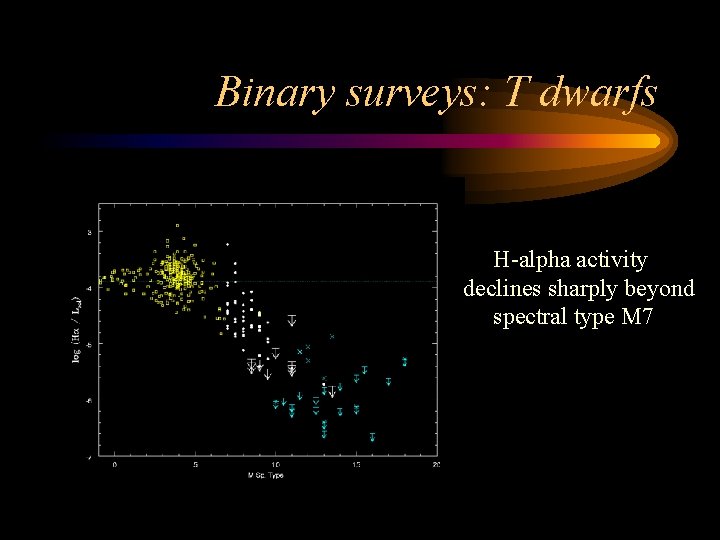
Binary surveys: T dwarfs H-alpha activity declines sharply beyond spectral type M 7
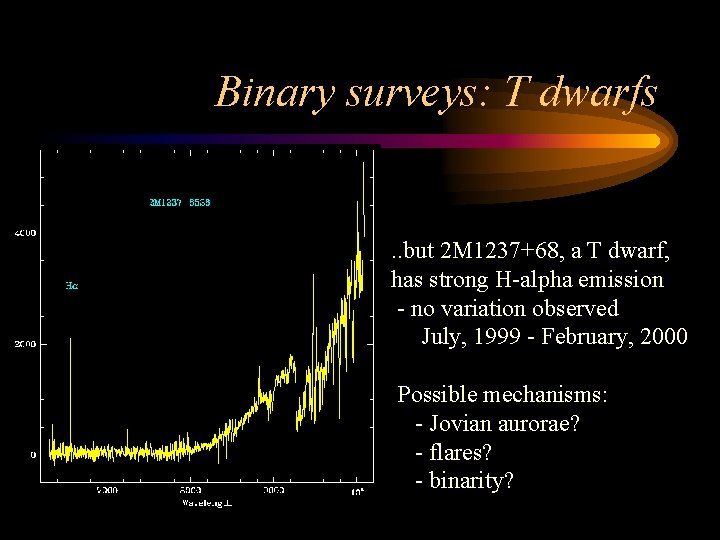
Binary surveys: T dwarfs . . but 2 M 1237+68, a T dwarf, has strong H-alpha emission - no variation observed July, 1999 - February, 2000 Possible mechanisms: - Jovian aurorae? - flares? - binarity?
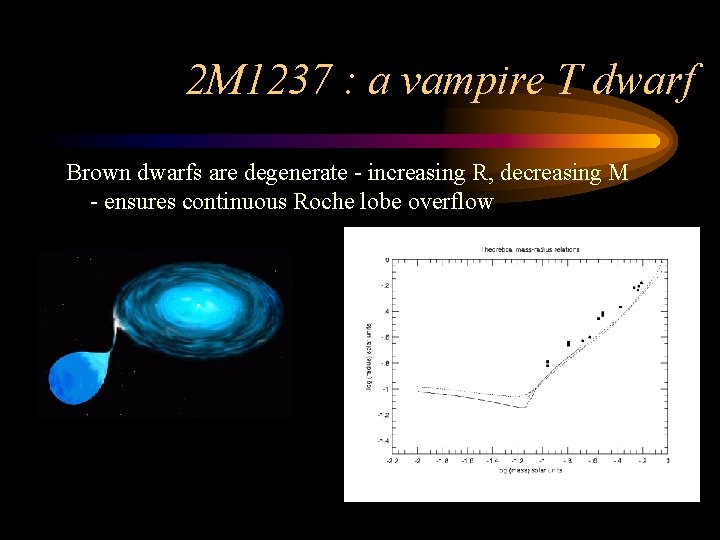
2 M 1237 : a vampire T dwarf Brown dwarfs are degenerate - increasing R, decreasing M - ensures continuous Roche lobe overflow
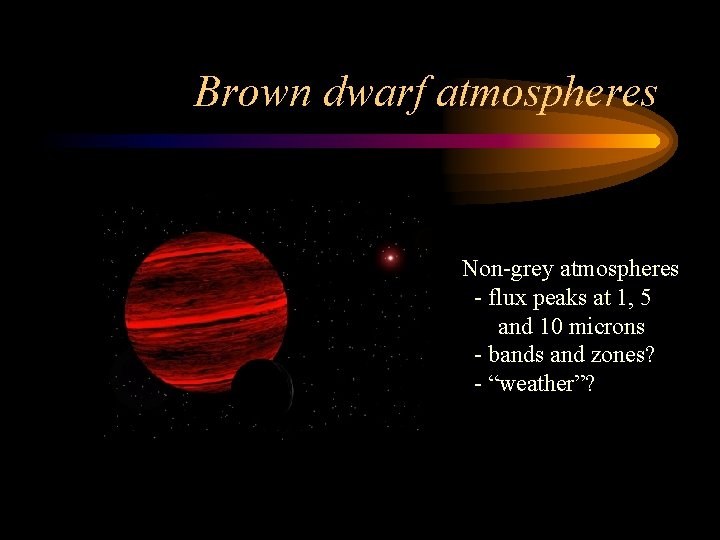
Brown dwarf atmospheres Non-grey atmospheres - flux peaks at 1, 5 and 10 microns - bands and zones? - “weather”?
Binary surveys: L dwarfs (1) Several L dwarfs are wide companions of MS stars: e. g. Gl 584 C, G 196 -3 B, GJ 1001 B (& Gl 229 B in the past). What about L-dwarf/L-dwarf systems? - initial results suggest a higher frequency >30% for a > 3 AU (Koerner et al, 1999) - all known systems have equal luminosity --> implies equal mass Are binary systems more common amongst L dwarfs? or are these initial results a selection effects?
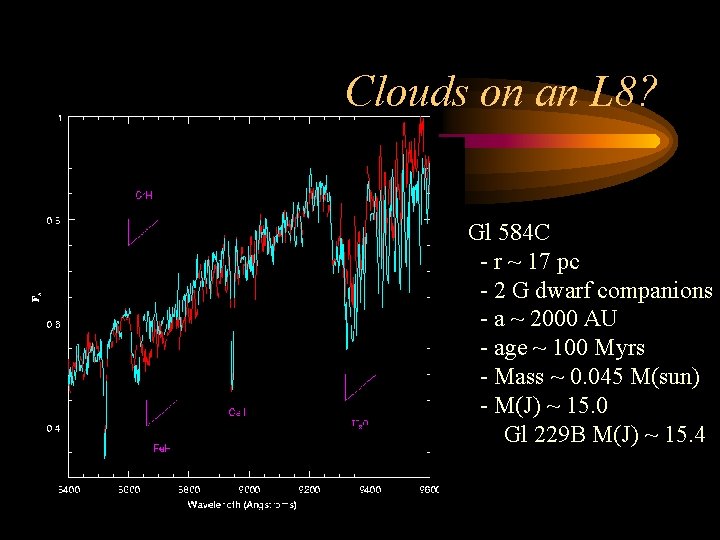
Clouds on an L 8? Gl 584 C - r ~ 17 pc - 2 G dwarf companions - a ~ 2000 AU - age ~ 100 Myrs - Mass ~ 0. 045 M(sun) - M(J) ~ 15. 0 Gl 229 B M(J) ~ 15. 4
- Slides: 58