
Brown and Livensons Politeness Theory Politeness and Face
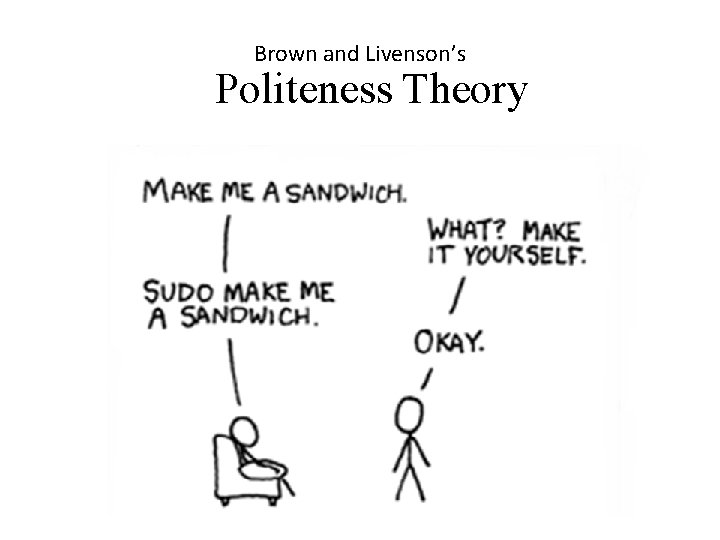
Brown and Livenson’s Politeness Theory
“Politeness” and “Face” “Politeness” is the word we use to talk about a speaker’s intention to threaten or save face of a hearer. Positive Face: “the want of every member that his wants be desirable to at least some others“ Face is our self imagine that we attempt to show the world. Negative Face: "the want of every 'competent adult member' that his actions be unimpeded by others", or "the basic claim to territories, personal preserves, rights to nondistraction--i. e. the freedom of action and freedom from imposition". [ Brown, Penelope and Stephen C. Levinson. 1987. Politeness: Some universals in language usage. Cambridge: Cambridge University Press.
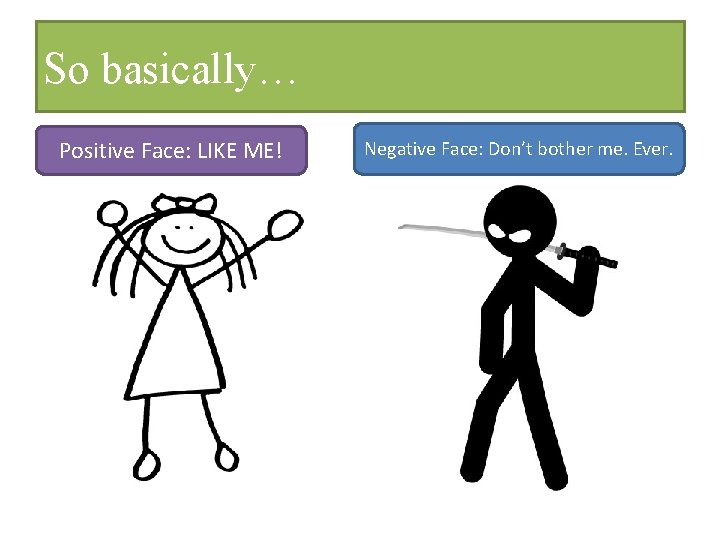
So basically… Positive Face: LIKE ME! Negative Face: Don’t bother me. Ever.
Face Threatening Acts FTAs • an utterance or tone that damages the face of the addressee or the speaker by acting in opposition to the wants and desires of the other. Positive FTAs Can be damaging to both the speaker and the hearer Negative FTAs Can be damaging to both the speaker and the hearer There are Politeness Strategies that speakers can employ to achieve different levels of FTAs. http: //en. wikipedia. org/wiki/Politeness_theory#cite_note-Band. L-2
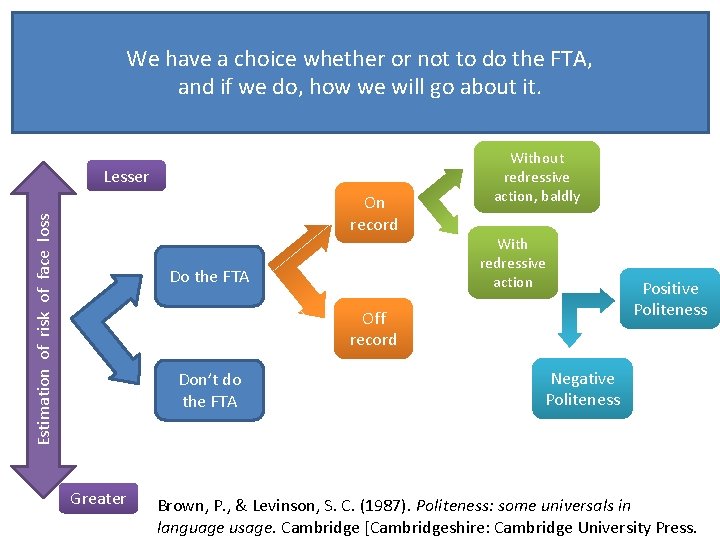
We have a choice whether or not to do the FTA, and if we do, how we will go about it. Lesser Estimation of risk of face loss On record Do the FTA Without redressive action, baldly With redressive action Off record Don’t do the FTA Greater Positive Politeness Negative Politeness Brown, P. , & Levinson, S. C. (1987). Politeness: some universals in language usage. Cambridge [Cambridgeshire: Cambridge University Press.

Positive Politeness ld rd a B eco R On Politeness Strategies Off-Record (indirect) Ne Po ga lit tiv en e es s
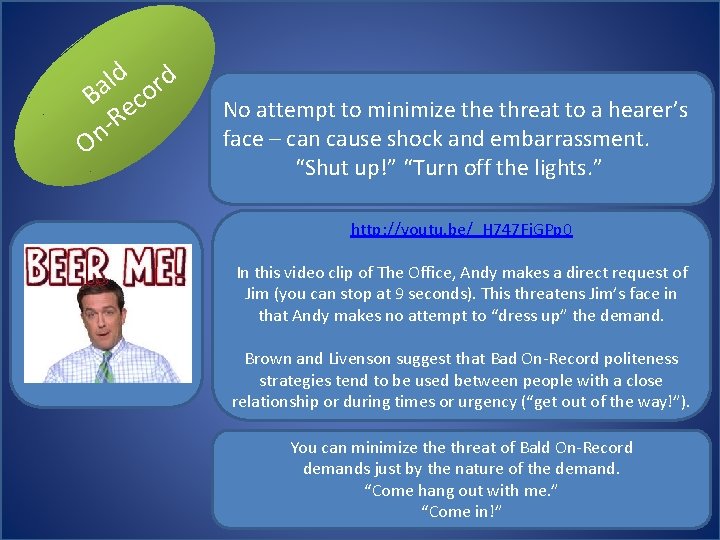
d d l r a B eco -R n O No attempt to minimize threat to a hearer’s face – can cause shock and embarrassment. “Shut up!” “Turn off the lights. ” http: //youtu. be/_H 747 Fi. GPp 0 In this video clip of The Office, Andy makes a direct request of Jim (you can stop at 9 seconds). This threatens Jim’s face in that Andy makes no attempt to “dress up” the demand. Brown and Livenson suggest that Bad On-Record politeness strategies tend to be used between people with a close relationship or during times or urgency (“get out of the way!”). You can minimize threat of Bald On-Record demands just by the nature of the demand. “Come hang out with me. ” “Come in!”

Positive Politeness The speaker attempts to reduce threat to the hearer’s face by dressing up the utterance. Strategies may include statements showing unity or belonging in some way. Example: So because we’re such great friends, would you mind driving me to the airport? Nope.
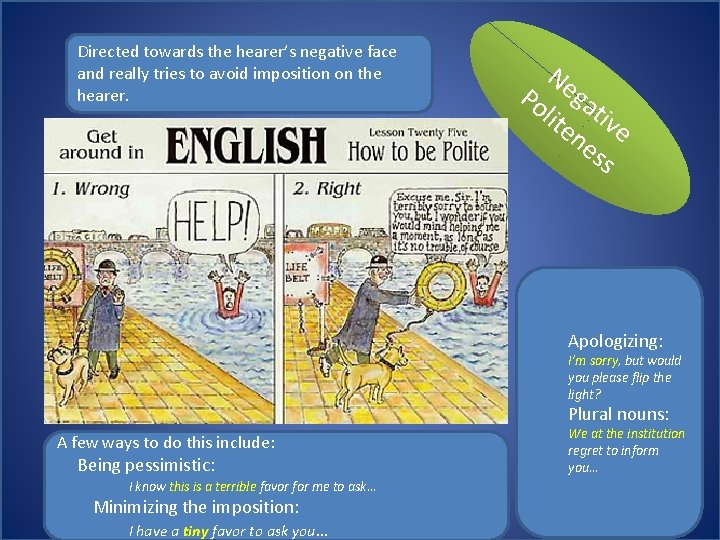
Directed towards the hearer’s negative face and really tries to avoid imposition on the hearer. Ne Po ga lit tiv en e es s Apologizing: I’m sorry, but would you please flip the light? Plural nouns: A few ways to do this include: Being pessimistic: I know this is a terrible favor for me to ask… Minimizing the imposition: I have a tiny favor to ask you… We at the institution regret to inform you…
Off-Record (indirect) Not actually saying what you mean, but implying it to avoid the hearer losing face http: //youtu. be/_H 747 Fi. GPp 0? t=30 s In this same clip from The Office (start at 30 seconds if it doesn’t automatically jump there), Jim asks if there is any music. What he means is, “Your’re terribly boring and awkward and I need a distraction. ” When Andy does his own special little thing, Jim clarifies his request at the end. Other examples include: “Boy, I’m hungry. ” Translation: Make me a sandwich ASAP, honey.
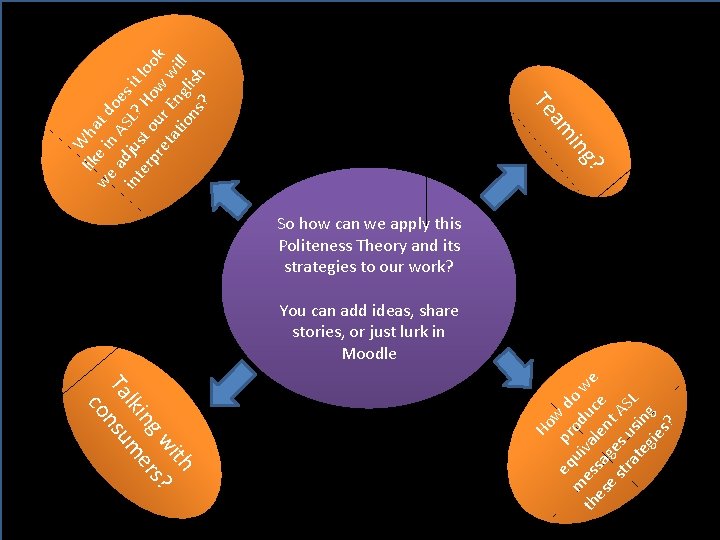
pr w d m uiv od o w th es al uc e es sa en e e ge t st s AS ra us L te in gie g s? eq ? th wi ? ng ers lki m Ta nsu co Ho W ing am h we e in at d ad AS oes in ju L? it te st rp ou Ho loo re r w k ta En wi tio g ll ns lish ? lik Te So how can we apply this Politeness Theory and its strategies to our work? You can add ideas, share stories, or just lurk in Moodle
- Slides: 11