
BROOME COUNTY 911 DISTRESSED CALLER DIVERSION PROGRAM WEBINAR
BROOME COUNTY 911 DISTRESSED CALLER DIVERSION PROGRAM WEBINAR SEPTEMBER 27, 2019

MICHAEL HATCH CIT COORDINATOR FOR BROOME COUNTY MENTAL HEALTH ASSOCIATION OF THE SOUTHERN TIER (607) 778 -8982 MICHAEL. HATCH@BROOMECOUNTY. US
JAMES BRYAN SENIOR DISPATCHER BROOME COUNTY EMERGENCY SERVICES (607) 778 -1266 JAMES. BRYAN@BROOMECOUNTY. US

THANK YOU FOR HOSTING

LOCATION & NUMBERS Southern Tier Demographics Population – 196, 124 Median Age – 39. 6 Median Household Income - $49, 064 Poverty Rate – 17. 1% Median Property Value - $113, 100 https: //datausa. io/profile/geo/broome-county-ny Calls for Service 2018 Total Calls – 515, 025 911 Calls – 94, 217 Mental Health 911 Calls – 1557 2% of all 911 calls Mental Health Crisis

911 DIVERSION COURSE OVERVIEW 911 Diversion Planning Implementation What is it? Identifying Stakeholders Training Roll Out Workflow Budgeting Go Live Risk Assessment Training Curriculum Creation Results Policy Modifications Improving the Process
WHAT IS 911 DIVERSION? To identify and refer qualifying non-emergency mental healthrelated calls for immediate connection to a counselor A better way to handle emotionally distressed callers. Enhance the communication skills of Dispatchers Reduce stigma and misunderstanding of Mental Illness Adds a service option to Dispatchers resources Fire Police Ambulance Mental Health Counselor WHEN POSSIBLE A MENTAL HEALTH CALL SHOULD RECEIVE A MENTAL HEALTH RESPONSE COMMUNITY COLLABORATION!
HOW DID WE SELL IT/ BUY IN Seeks to de-escalate situations and immediately connect consumers with Mental Health Professionals. Provide the best possible care for a person in crisis Help law enforcement remain available for priority assignments
BUY IN Houston Police Department has done some tremendous work in this area. We were lucky enough to have several conference calls with members of the Houston Police Department Mental Health Division to educate ourselves and build confidence of our stakeholders.
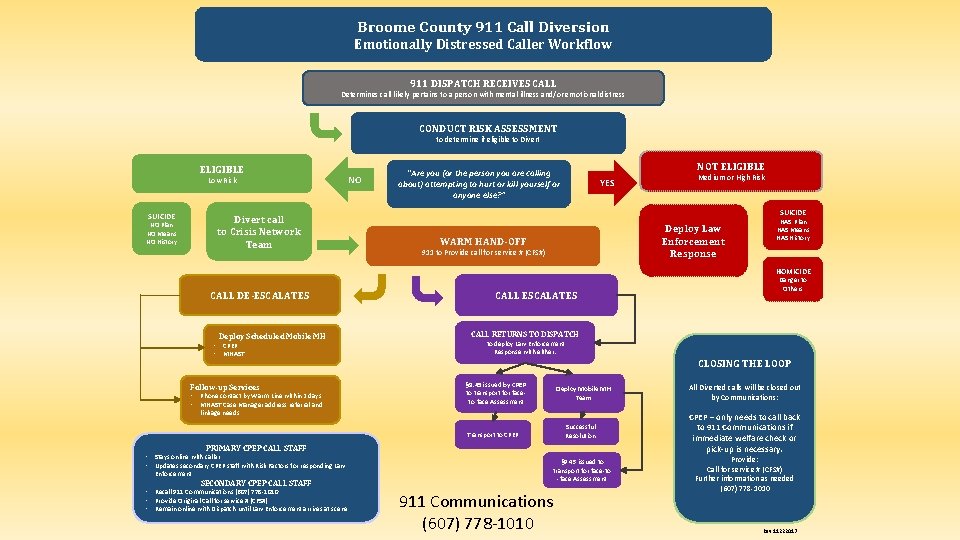
Broome County 911 Call Diversion Emotionally Distressed Caller Workflow 911 DISPATCH RECEIVES CALL Determines call likely pertains to a person with mental illness and/or emotional distress CONDUCT RISK ASSESSMENT to determine if eligible to Divert ELIGIBLE Low Risk SUICIDE NO Divert call to Crisis Network Team NO Plan NO Means NO History NOT ELIGIBLE “Are you (or the person you are calling about) attempting to hurt or kill yourself or anyone else? ” YES Medium or High Risk SUICIDE Deploy Law Enforcement Response WARM HAND-OFF 911 to Provide call for service # (CFS#) HAS Plan HAS Means HAS History HOMICIDE CALL DE-ESCALATES Deploy Scheduled Mobile MH • CPEP • MHAST Follow-up Services • Phone contact by Warm Line within 2 days • MHAST Case Manager address referral and CALL ESCALATES CALL RETURNS TO DISPATCH to deploy Law Enforcement Response with either: CLOSING THE LOOP § 9. 45 issued by CPEP to transport for faceto-face Assessment Deploy Mobile MH Team linkage needs Successful Resolution Transport to CPEP PRIMARY CPEP CALL STAFF • Stays online with caller • Updates secondary CPEP staff with Risk Factors for responding Law Enforcement SECONDARY CPEP CALL STAFF • Recall 911 Communications (607) 778 -1010 • Provide Original Call for service # (CFS#). • Remain online with Dispatch until Law Enforcement arrives at scene Danger to Others § 9. 45 issued to transport for face-to -face Assessment 911 Communications (607) 778 -1010 All Diverted calls will be closed out by Communications: CPEP – only needs to call back to 911 Communications if immediate welfare check or pick-up is necessary. Provide: Call for service # (CFS#) Further information as needed (607) 778 -1010 Rev 11222017

Broome County 911 Call Diversion Emotionally Distressed Caller Risk Assessment “Are you (or the person you are calling about) ATTEMPTING to hurt or kill yourself or anyone else RIGHT NOW? ” “YES” QUESTIONS “MAYBE” or “SILENCE” is considered a “YES” (DISPATCH LAW ENFORCEMENT) “NO” “Are you (or the person you are calling about) thinking about hurting or killing yourself or anyone else? ” “YES” “NO” Transfer “MAYBE” or “SILENCE” is considered a “YES” PLAN Do you have a plan? How would you do it? Does NOT have a specific plan Reports a specific plan MEANS Do you have the means (gun, pills, etc. ) to do it? Have you thought about how to get what you need? “NO” “YES” TIMEFRAME When would you do this? Has decided upon a specific time or is vague ACTION DISPATCH LAW Transfer REJECTED • • Provide CFS# Stay on line Introduce caller Provide brief summary call • Dispatch CIT 1 -9 to call • MHL Diversion disposition DISPATCH LAW ENFORCEMENT Continue to assess for immediate safety Has no definite time frame “It sounds like it would be helpful if you could talk to someone for a little longer to help sort through what the best option for you is at this point. I’M GOING TO CONNECT YOU WITH A MEMBER OF OUR CRISIS NETWORK TEAM TO HELP YOU. ” Transfer ACCEPTED Xfer to 762 -2302 or use one button in dial directory
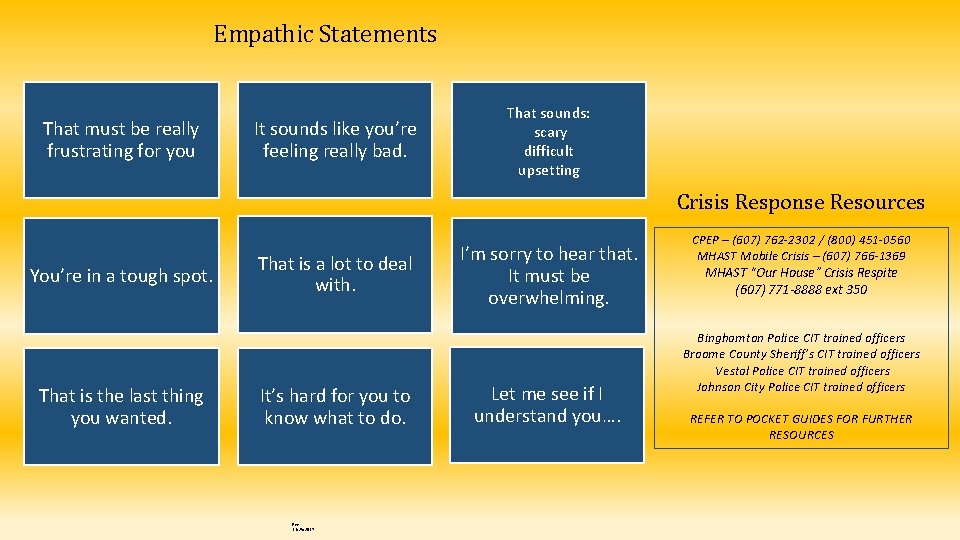
Empathic Statements That must be really frustrating for you It sounds like you’re feeling really bad. That sounds: scary difficult upsetting Crisis Response Resources You’re in a tough spot. That is the last thing you wanted. That is a lot to deal with. It’s hard for you to know what to do. Rev 11/29/2017 I’m sorry to hear that. It must be overwhelming. Let me see if I understand you…. CPEP – (607) 762 -2302 / (800) 451 -0560 MHAST Mobile Crisis – (607) 766 -1369 MHAST “Our House” Crisis Respite (607) 771 -8888 ext 350 Binghamton Police CIT trained officers Broome County Sheriff’s CIT trained officers Vestal Police CIT trained officers Johnson City Police CIT trained officers REFER TO POCKET GUIDES FOR FURTHER RESOURCES
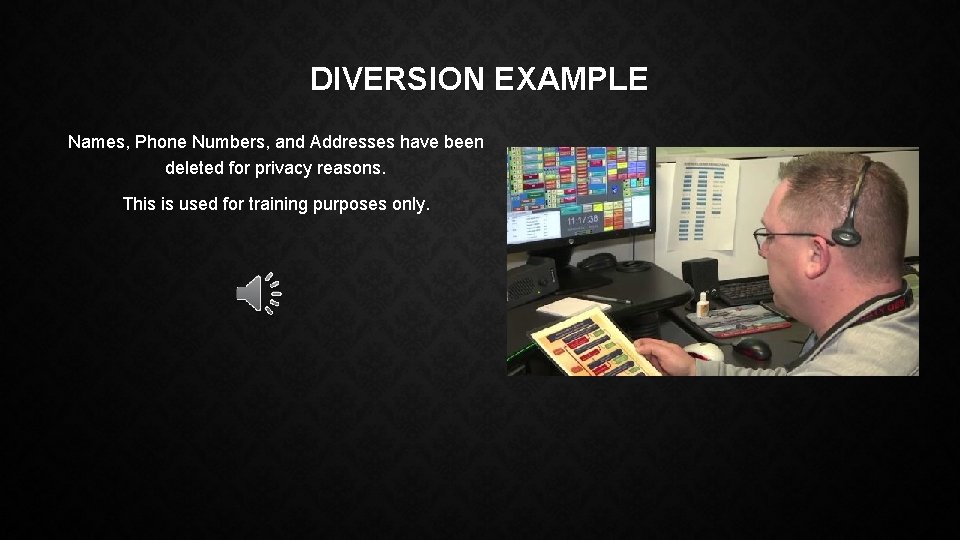
DIVERSION EXAMPLE Names, Phone Numbers, and Addresses have been deleted for privacy reasons. This is used for training purposes only.
PLANNING Who are the stakeholders? 911 Police / Local Government Units (LGU) Mental Health Providers / Mobile Crisis Teams Receiving Hospitals Anyone in the intersection of a Mental Health Crisis Police Responses to Persons With Mental Illness: Going Beyond CIT Training By: Henry Steadman https: //ps. psychiatryonline. org/doi/pdf/10. 1176/appi. ps. 201600348
BUDGETING SHOW ME THE MONEY!!!!! DSRIP – Delivery System Reform Incentive Payment 3 aii Projects - Behavioral health community crisis stabilization services Materials Food Instructors Overtime – 53 Dispatchers (8 Hours) Broome County’s Budget was $21, 000 Who is my (PPS) Performing Provider System (DSRIP)? https: //www. health. ny. gov/health_care/medicaid/redesign/dsrip/pps_map/index. htm
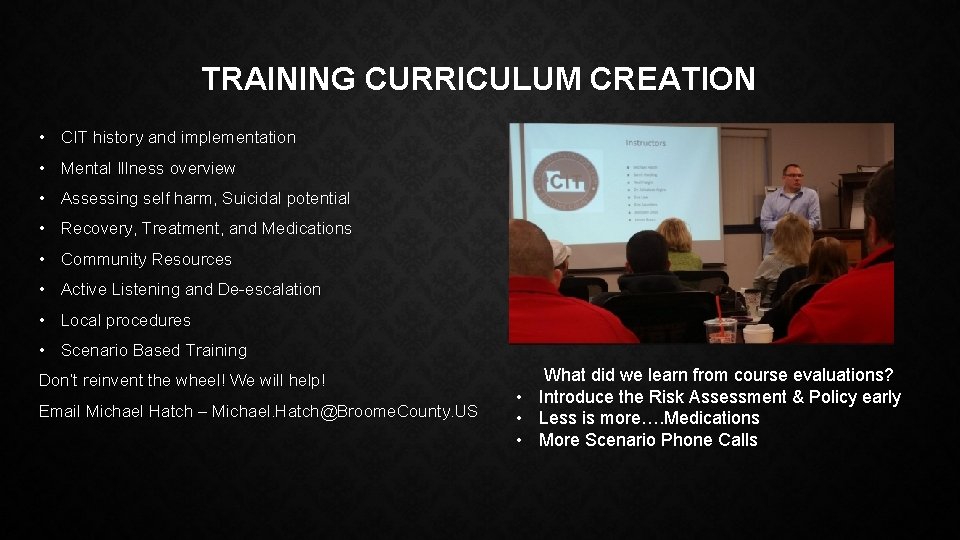
TRAINING CURRICULUM CREATION • CIT history and implementation • Mental Illness overview • Assessing self harm, Suicidal potential • Recovery, Treatment, and Medications • Community Resources • Active Listening and De-escalation • Local procedures • Scenario Based Training Don’t reinvent the wheel! We will help! Email Michael Hatch – Michael. Hatch@Broome. County. US What did we learn from course evaluations? • Introduce the Risk Assessment & Policy early • Less is more…. Medications • More Scenario Phone Calls

POLICY MODIFICATIONS Broome County Emergency Management incorporated the Risk Assessment into their new Policy We carved out time in the 8 hour training block to thoroughly go over the policy (Local Procedures) With permission from Broome County 911 we could share a copy of the policy with requesting agencies.
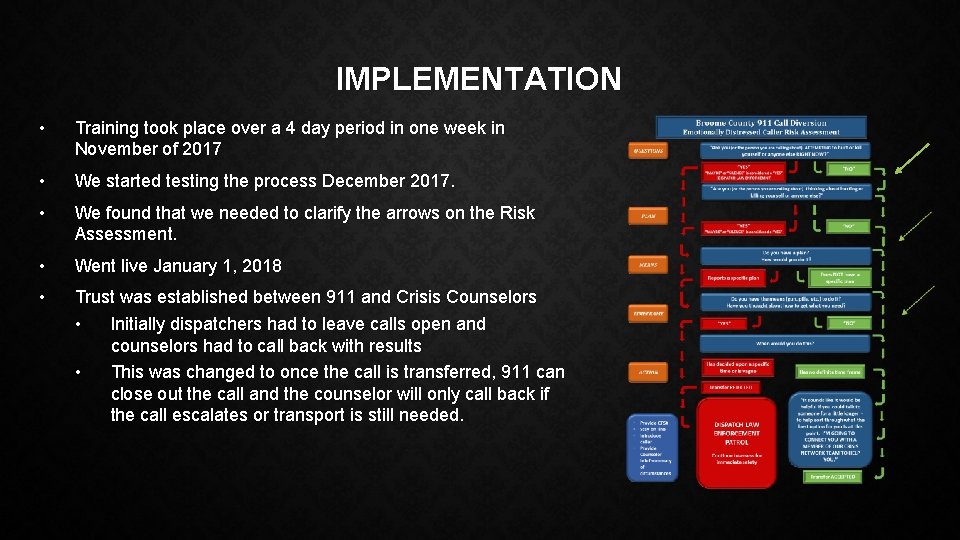
IMPLEMENTATION • Training took place over a 4 day period in one week in November of 2017 • We started testing the process December 2017. • We found that we needed to clarify the arrows on the Risk Assessment. • Went live January 1, 2018 • Trust was established between 911 and Crisis Counselors • Initially dispatchers had to leave calls open and counselors had to call back with results • This was changed to once the call is transferred, 911 can close out the call and the counselor will only call back if the call escalates or transport is still needed.
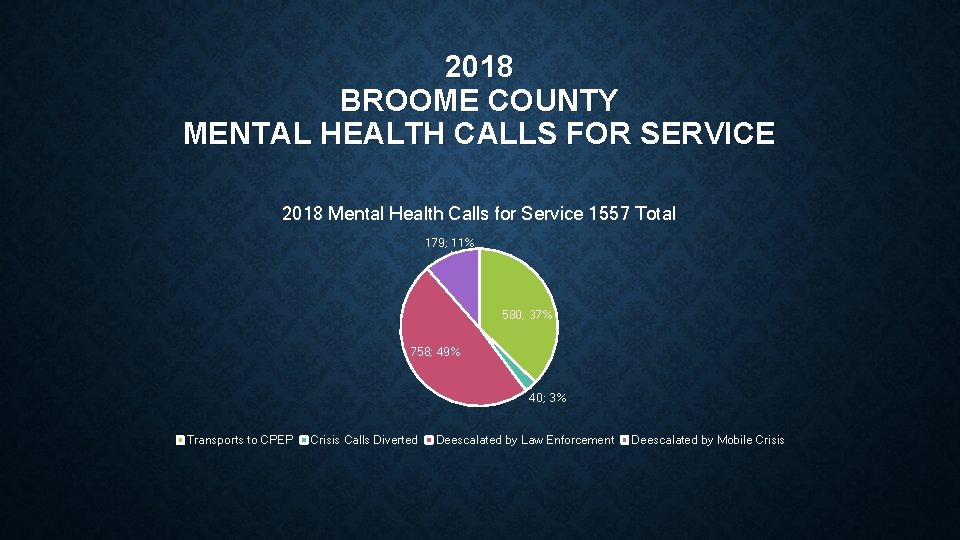
2018 BROOME COUNTY MENTAL HEALTH CALLS FOR SERVICE 2018 Mental Health Calls for Service 1557 Total 179; 11% 580; 37% 758; 49% 40; 3% Transports to CPEP Crisis Calls Diverted Deescalated by Law Enforcement Deescalated by Mobile Crisis
IMPROVING THE PROCESS • We are identifying high-utilizers and making efforts to connect them • Discussions are under way to • Divert calls from parents of children with behavioral issues (Parental Coaching) • 2 nd or 3 rd party check the welfare calls (Mobile Crisis) • Persons requesting transports to Crisis Center
CIT IS MORE THAN JUST A WEEK LONG TRAINING COLLABORATE!
QUESTIONS?
THANK YOU!
- Slides: 23