
Brooklyn Regional Group Meeting April 19 2017 9
Brooklyn Regional Group Meeting April 19, 2017 9. 30 am to 2. 30 pm Brooklyn Borough Hall, 209 Joralemon St, Brooklyn, NY 11201
Opening Remarks
Opening Remarks Brooklyn Borough President Eric L. Adams
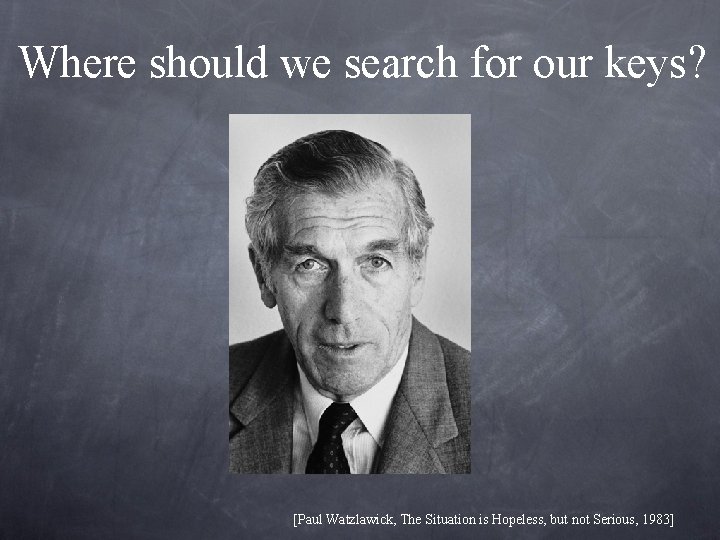
Where should we search for our keys? [Paul Watzlawick, The Situation is Hopeless, but not Serious, 1983]

Ikea effect and egg theory Instant baking mixes were introduced in the lat 40 s; piecrusts, biscuits were successful; resistance to adopt instant cake mixes (requiring just to add water) Egg theory - forces individuals to work on solution; Pillsbury required to add eggs, milk and oil Understand the basic recipe of ownership and pride [Laura Shapiro, Something From the Oven, 2004, Viking]
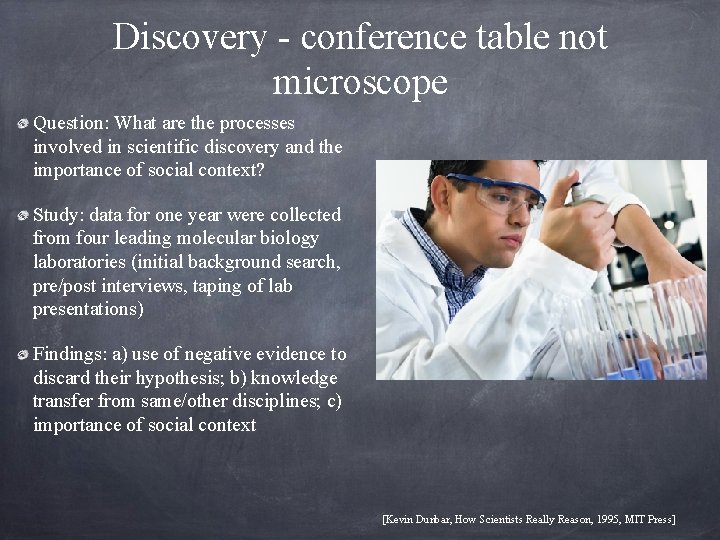
Discovery - conference table not microscope Question: What are the processes involved in scientific discovery and the importance of social context? Study: data for one year were collected from four leading molecular biology laboratories (initial background search, pre/post interviews, taping of lab presentations) Findings: a) use of negative evidence to discard their hypothesis; b) knowledge transfer from same/other disciplines; c) importance of social context [Kevin Dunbar, How Scientists Really Reason, 1995, MIT Press]
Overview
Meeting Overview • Brooklyn Co-Chairs: Clemens Steinbock, Zeenath Rehana • Meeting Purpose – Strengthen the Brooklyn Regional Group as a platform for peer learning and regional improvements – Learn from recent HIV Cascade submissions by Brooklyn providers – Provide context of other improvement initiatives in Brooklyn

Agenda Welcome, Introductions & Meeting Overview 9: 30 - 10: 00 Opening Remarks 10: 00 - 10: 15 Presentations from the Field: HIV Cascades + Breakout Session 10: 15 - 11: 30 Brooklyn Knows and Et. E Committee Updates 11: 30 - 11: 45 Consumer Involvement: Clients at the Gate 11: 45 - 12: 15 Working Lunch 12: 15 - 1: 00 Clinic Survey Introduction 1: 00 - 1: 15 Quality Improvement 101: Satisfaction Continuum 1: 15 - 1: 45 Team Action Planning and Report Back 1: 30 - 2: 00 Next Steps & Evaluation 2: 00 - 2: 30 Adjourn 2: 30
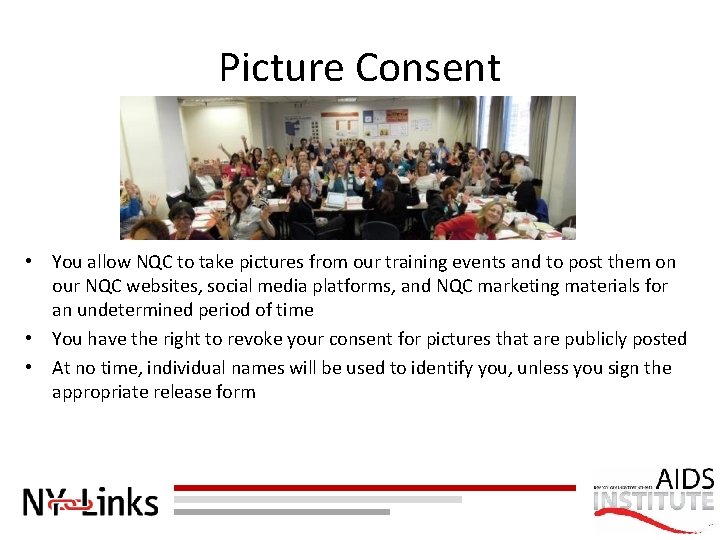
Picture Consent • You allow NQC to take pictures from our training events and to post them on our NQC websites, social media platforms, and NQC marketing materials for an undetermined period of time • You have the right to revoke your consent for pictures that are publicly posted • At no time, individual names will be used to identify you, unless you sign the appropriate release form
“Quality improvement is a journey of many small steps. ”
What is NY Links?
NYLinks Long Term Strategies Involve providers and consumers in planning and implementing regional networks that improve outcomes along the cascade of care (HIV care continuum) Make NYS and NYC surveillance and other data accessible to frontline providers Increase the use of Quality Improvement on an organizational and regional level Enhance understanding of how facility and local data have regional and statewide impact Strengthen partnerships and peer learning End the Epidemic
Public Release of the Blueprint April 29, 2015 We must add AIDS to the list of diseases conquered by our society, and today we are saying we can, we must and we will end this epidemic. ~Governor Cuomo
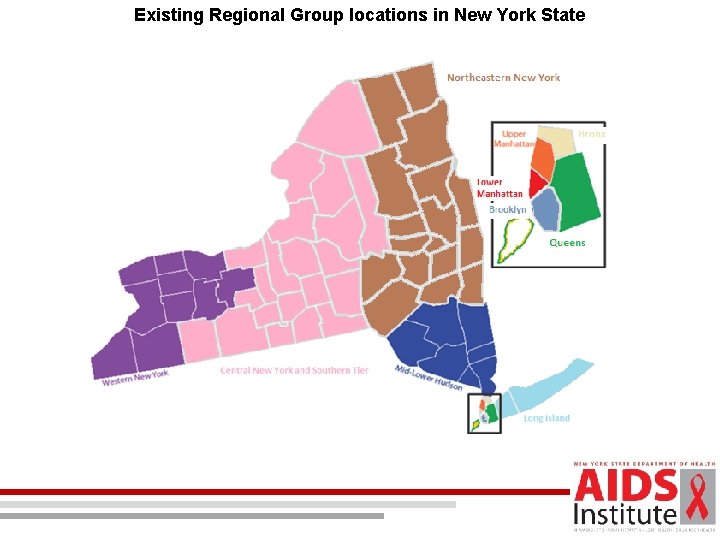
Existing Regional Group locations in New York State
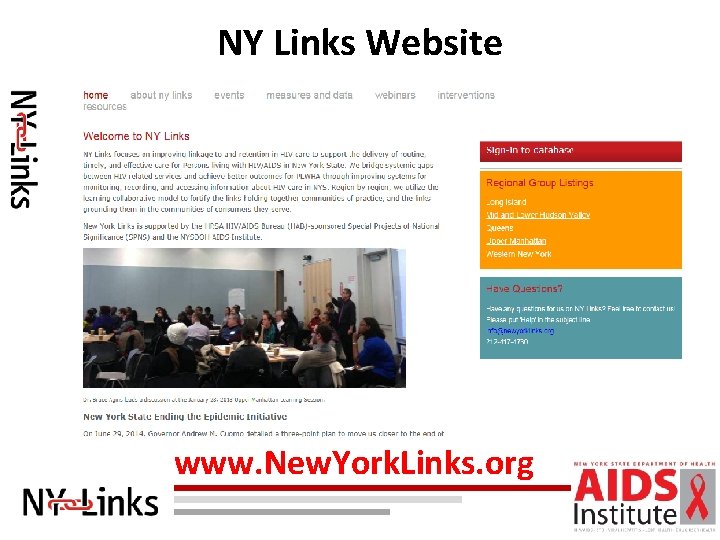
NY Links Website www. New. York. Links. org
Brooklyn Regional Group • Engage all medical and non-medical organizations within a geographic area to improve linkage to care, retention in care, and viral suppression • Involve all types of organizations—hospitals, community health centers, CBOs, local health departments, NYS staff • Involve all levels of individuals—consumers, front line staff, administrators, data staff, QI staff, CEOs, medical directors, medical providers • Develop both an organizational and a regional approach to improvement • Use data to improve performance • Use QI strategies to design and assess performance • Use peer learning to spread innovation
Presentations from the Field: HIV Cascades
Presentation • Share the results of your recent HIV Cascade submission • • • How did you collect the necessary data to develop the HIV Cascade? What barriers did you face, if any? What were the data key findings? What were the take home messages? How will you use the HIV Cascade to initiate improvement efforts?
• Bedford Stuyvesant
• Bedford Stuyvesant
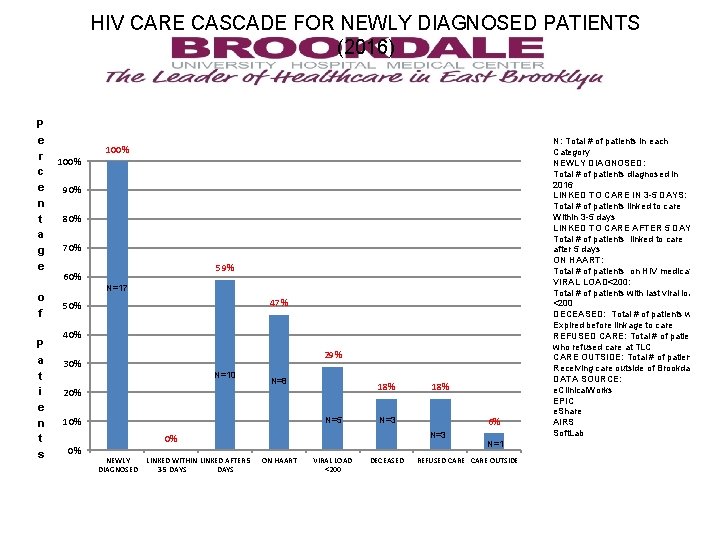
HIV CARE CASCADE FOR NEWLY DIAGNOSED PATIENTS (2016) P e r c e n t a g e o f P a t i e n t s 100% 90% 80% 70% 60% 59% N=17 47% 50% 40% 29% 30% N=10 20% N=8 N=5 10% 0% 18% N=3 LINKED WITHIN LINKED AFTER 5 3 -5 DAYS 6% N=3 0% NEWLY DIAGNOSED 18% ON HAART VIRAL LOAD <200 DECEASED N=1 REFUSED CARE OUTSIDE N: Total # of patients in each Category NEWLY DIAGNOSED: Total # of patients diagnosed in 2016 LINKED TO CARE IN 3 -5 DAYS: Total # of patients linked to care Within 3 -5 days LINKED TO CARE AFTER 5 DAYS: Total # of patients linked to care after 5 days ON HAART: Total # of patients on HIV medication VIRAL LOAD<200: Total # of patients with last viral load <200 DECEASED: Total # of patients who Expired before linkage to care REFUSED CARE: Total # of patients who refused care at TLC CARE OUTSIDE: Total # of patients Receiving care outside of Brookdale DATA SOURCE: e. Clinical. Works EPIC e. Share AIRS Soft. Lab
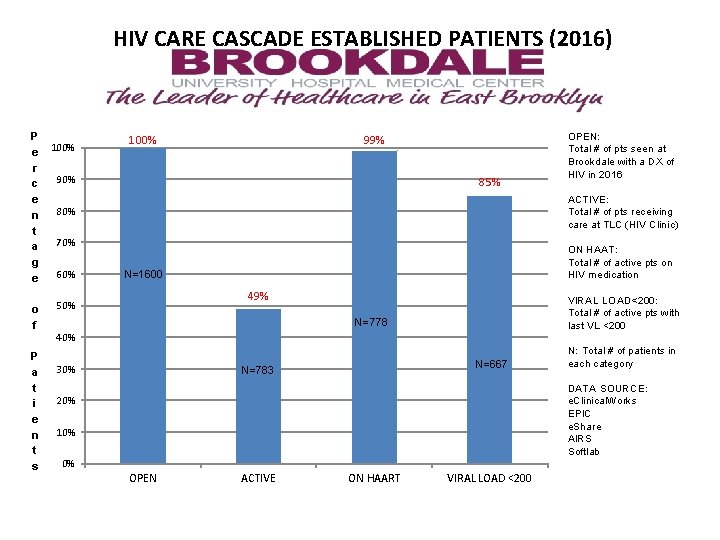
HIV CARE CASCADE ESTABLISHED PATIENTS (2016) P e r c e n t a g e o f P a t i e n t s 100% 99% 90% 85% ACTIVE: Total # of pts receiving care at TLC (HIV Clinic) 80% 70% 60% OPEN: Total # of pts seen at Brookdale with a DX of HIV in 2016 ON HAAT: Total # of active pts on HIV medication N=1600 49% 50% VIRAL LOAD<200: Total # of active pts with last VL <200 N=778 40% 30% N=667 N=783 N: Total # of patients in each category DATA SOURCE: e. Clinical. Works EPIC e. Share AIRS Softlab 20% 10% 0% OPEN ACTIVE ON HAART VIRAL LOAD <200
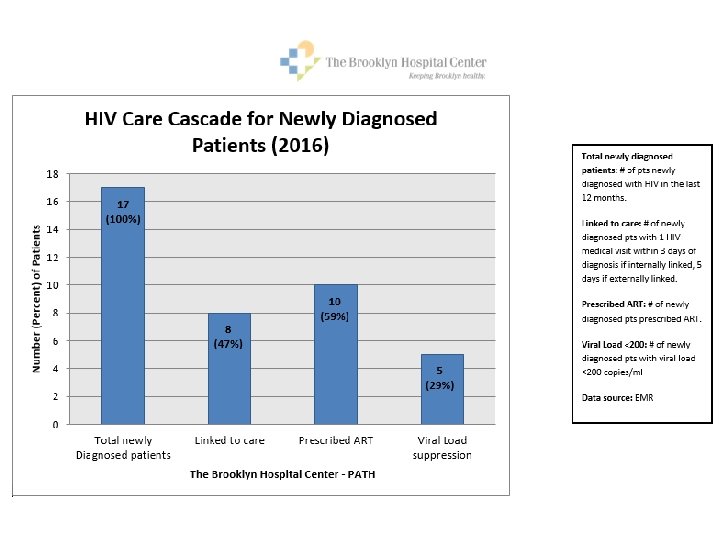
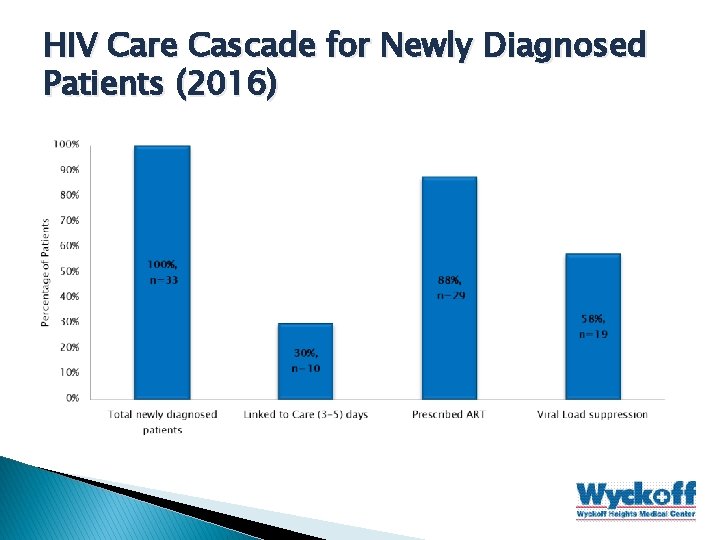
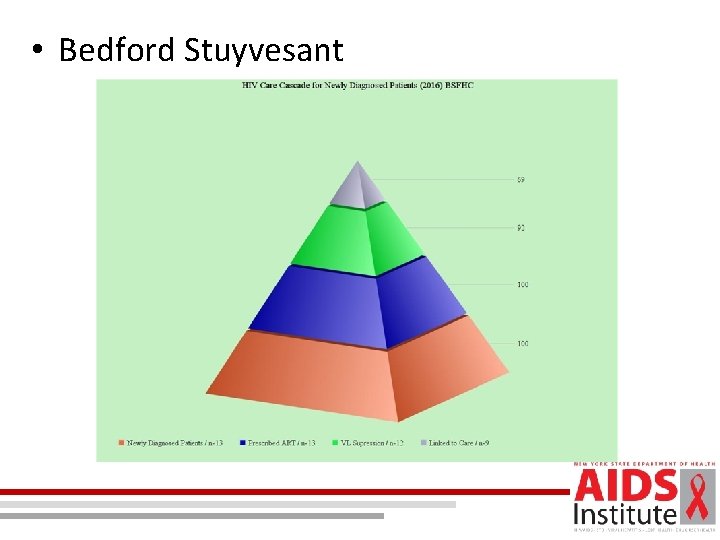
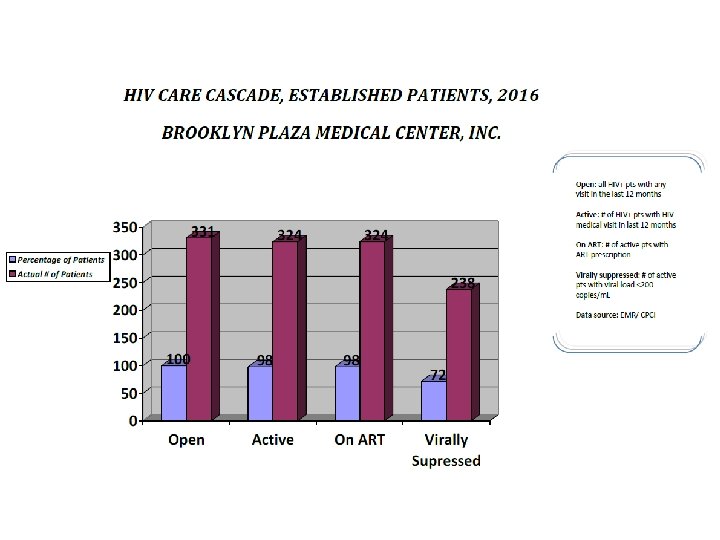
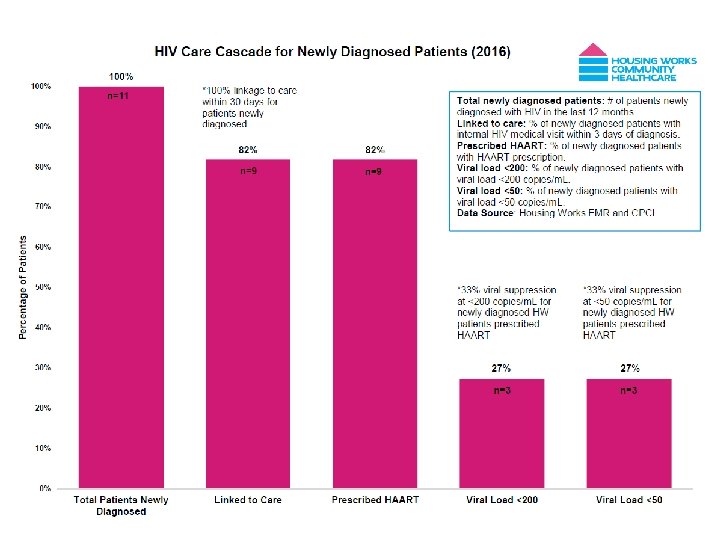
HIV Care Cascade for Newly Diagnosed Patients (2016)
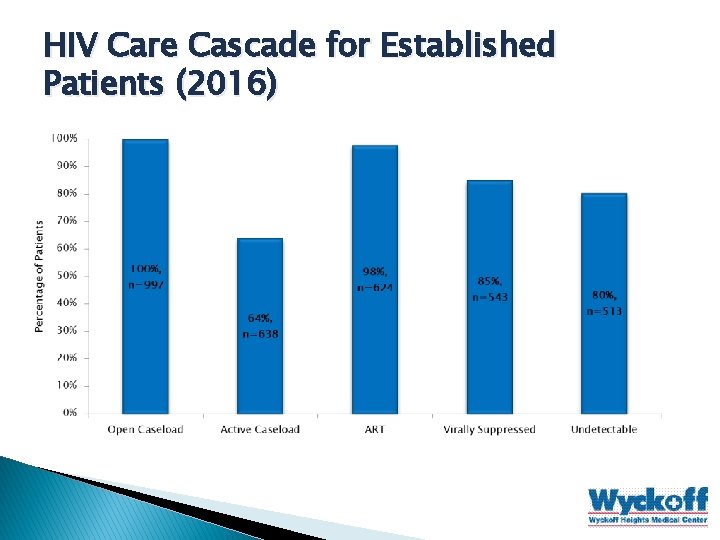
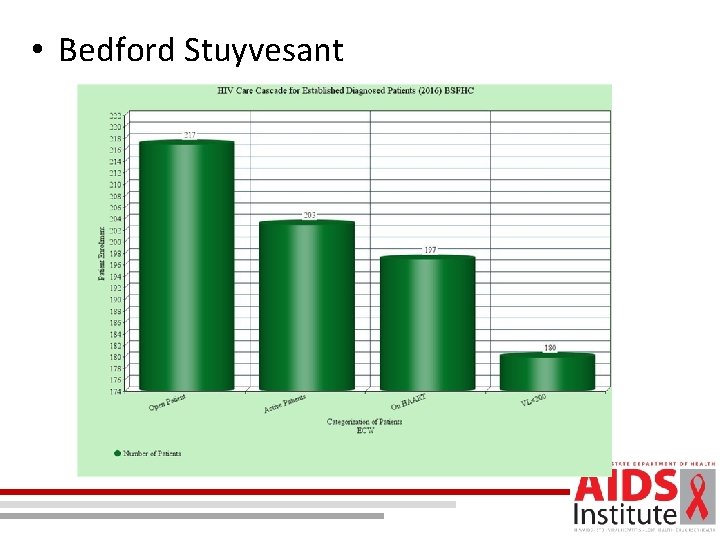
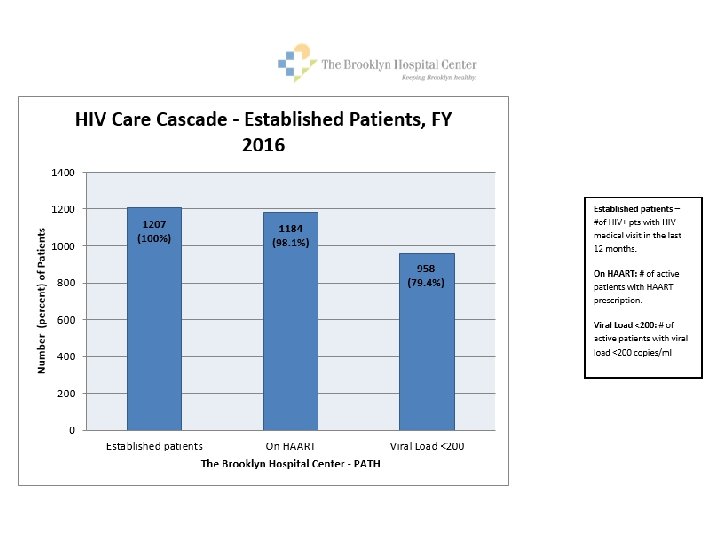
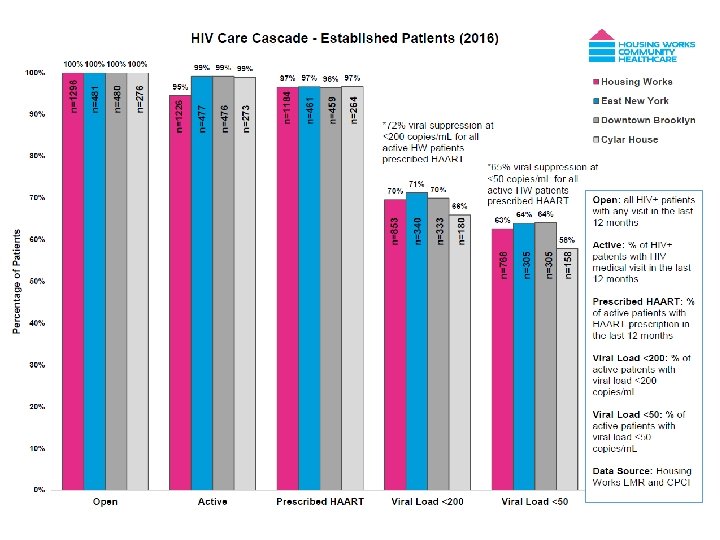
HIV Care Cascade for Established Patients (2016)
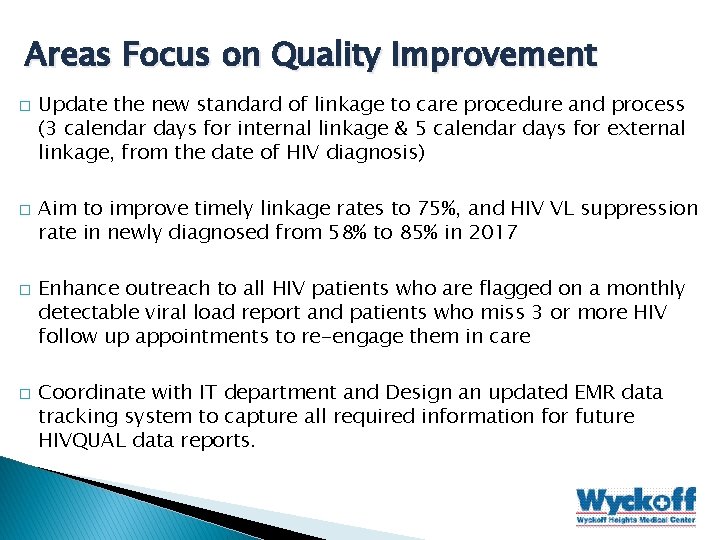
Areas Focus on Quality Improvement � � Update the new standard of linkage to care procedure and process (3 calendar days for internal linkage & 5 calendar days for external linkage, from the date of HIV diagnosis) Aim to improve timely linkage rates to 75%, and HIV VL suppression rate in newly diagnosed from 58% to 85% in 2017 Enhance outreach to all HIV patients who are flagged on a monthly detectable viral load report and patients who miss 3 or more HIV follow up appointments to re-engage them in care Coordinate with IT department and Design an updated EMR data tracking system to capture all required information for future HIVQUAL data reports.
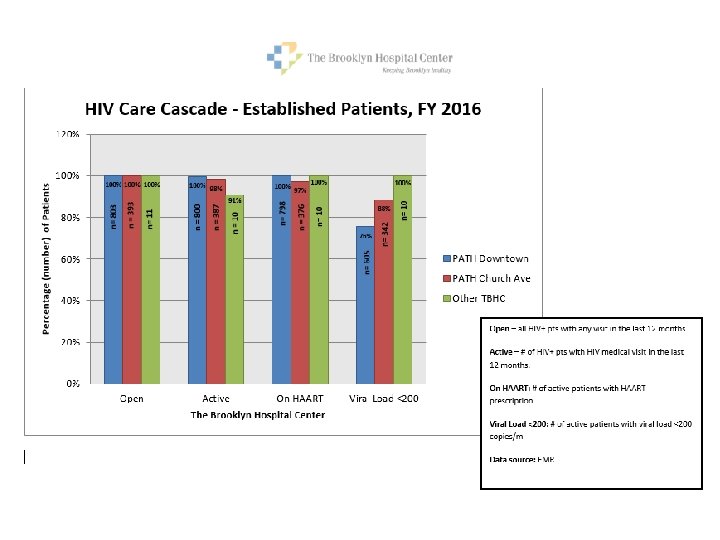
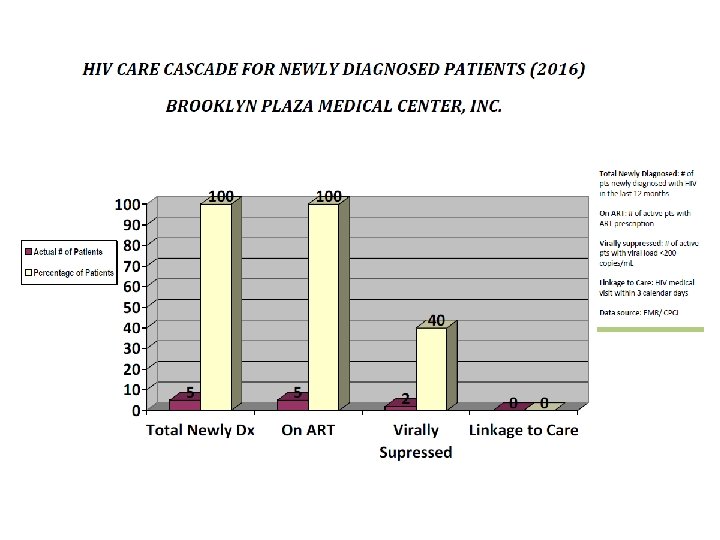
Brooklyn Updates Robert Jones, New York Knows Project Officer – Brooklyn, Bureau of HIV/AIDS Prevention and Control, NYCDOHMH David Matthew Co-Chairs, Brooklyn ETE Regional Steering Committee: Brooklyn ETE
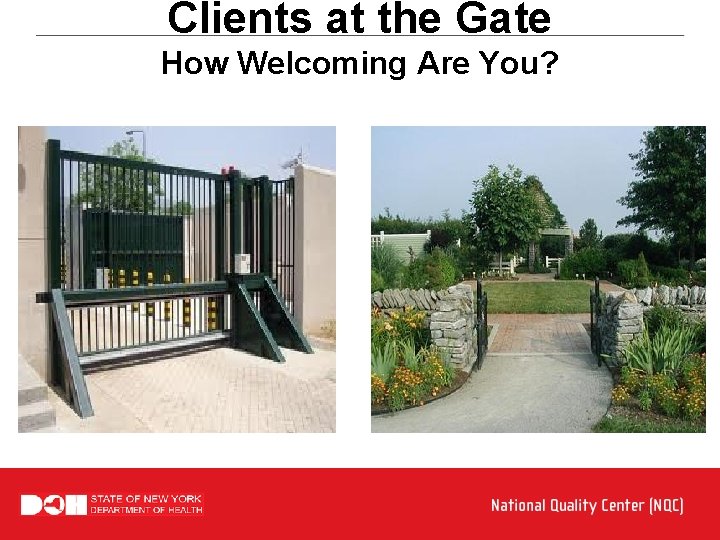
Clients at the Gate How Welcoming Are You?
Learning Objectives • Explain how first encounters relate to patient engagement, linkage, and retention • Identify methods to determine primary engagement points for patients • Improve knowledge on how to incorporate patient feedback into engagement improvement strategies • Explore goal setting for engagement efforts
Agenda • • • Overview and Introductions Initial Patient Encounter Tools for Encounter Improvement Rethinking Feedback Questions Closing
Initial Patient Encounter
What is the Definition of Patient Engagement? • Patient Engagement is a hot topic amorphous and appealing enough to mean many things • According to Kaiser, Patient Engagement includes things like decreased mortality rates and fewer emergencies • From the literature, Patient Engagement fosters a fruitful collaboration in which patients and clinicians work together to help the patient progress towards mutually agreed-upon health goals. http: //thehealthcareblog. com/blog/2013/09/12/patient-engagement-on-metrics-and-meaning/
What is Patient Engagement • Patient engagement is a process in which patients become invested in their own care. • Engagement develops naturally when there is regular, focused communication between patient and provider. • It can lead to behaviors that meet or more closely approach treatment guidelines. • Patients engaged in their own care may make fewer demands on the health care system and more importantly, they enjoy improved health. • Research shows that informed and engaged patients take a more active role in their own care. • Healthcare organizations are discovering how patient engagement contributes to their financial and quality objectives.
Fostering Patient Engagement • Determine what patient engagement really means and develop metrics or outcomes to demonstrate it • Foster collaboration between patients and clinical staff • Establish with patients mutually agreed-upon health goals based on their needs, priorities, and preferences • Develop strategies to measure the quality patient/provider collaborative processes.
Engagement Interventions to Link Patients to Healthcare • Peers (Patient Navigators) • Appointment Reminder Procedures • Case Management • Case Conferencing/Consistent Messaging • Outreach/Returning to Care • Marketing and Engagement Efforts
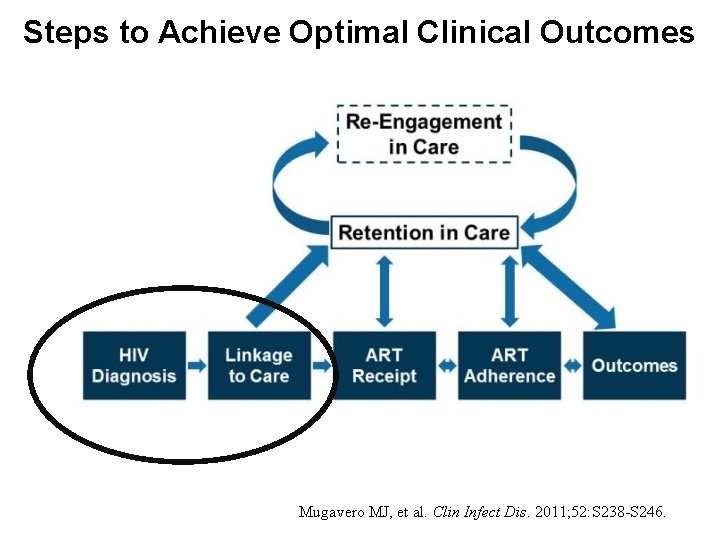
Steps to Achieve Optimal Clinical Outcomes Mugavero MJ, et al. Clin Infect Dis. 2011; 52: S 238 -S 246.
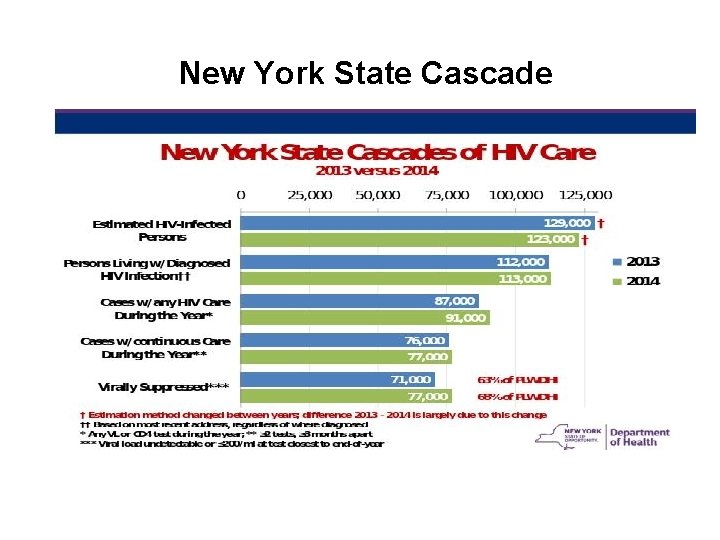
New York State Cascade
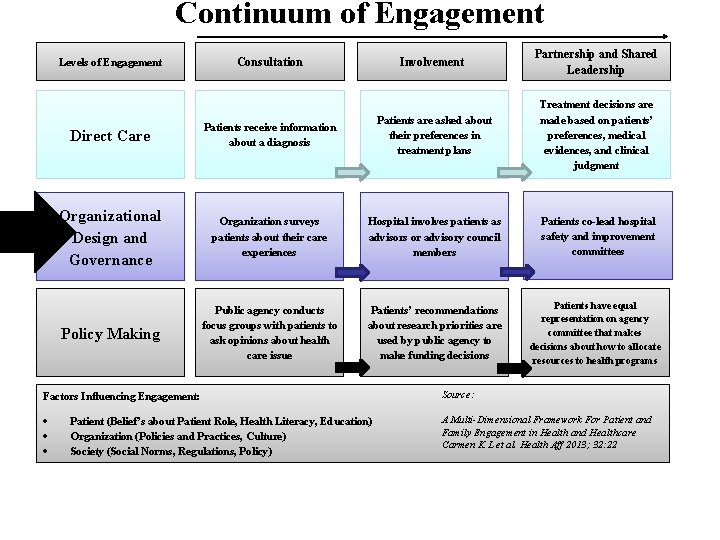
Continuum of Engagement Consultation Involvement Partnership and Shared Leadership Direct Care Patients receive information about a diagnosis Patients are asked about their preferences in treatment plans Treatment decisions are made based on patients’ preferences, medical evidences, and clinical judgment Organizational Design and Governance Organization surveys patients about their care experiences Hospital involves patients as advisors or advisory council members Patients co-lead hospital safety and improvement committees Policy Making Public agency conducts focus groups with patients to ask opinions about health care issue Patients’ recommendations about research priorities are used by public agency to make funding decisions Patients have equal representation on agency committee that makes decisions about how to allocate resources to health programs Levels of Engagement Factors Influencing Engagement: Source: A Multi-Dimensional Framework For Patient and Family Engagement in Health and Healthcare Carmen K L et al. Health Aff 2013; 32: 22 Patient (Belief’s about Patient Role, Health Literacy, Education) Organization (Policies and Practices, Culture) Society (Social Norms, Regulations, Policy)
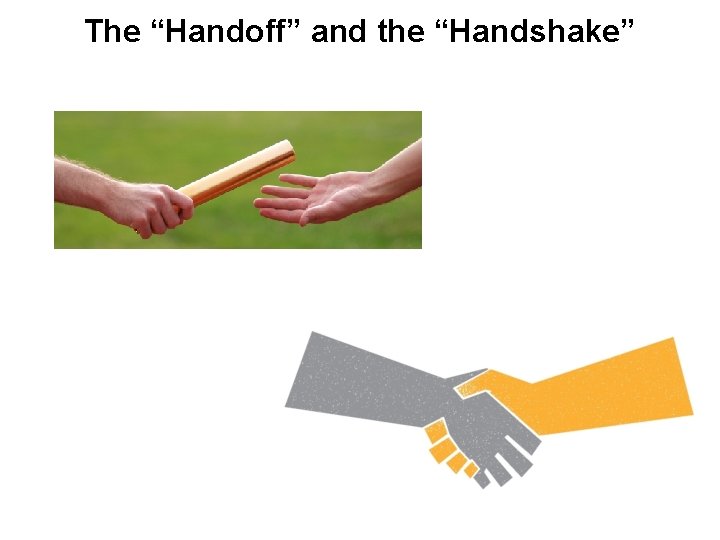
The “Handoff” and the “Handshake”
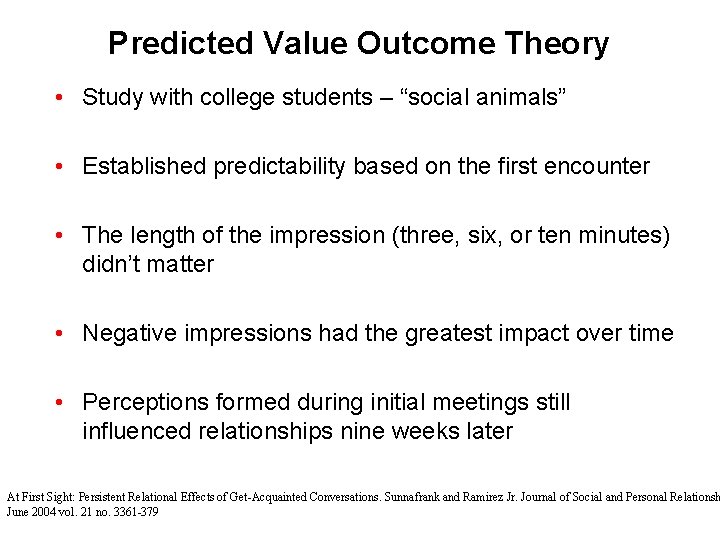
Predicted Value Outcome Theory • Study with college students – “social animals” • Established predictability based on the first encounter • The length of the impression (three, six, or ten minutes) didn’t matter • Negative impressions had the greatest impact over time • Perceptions formed during initial meetings still influenced relationships nine weeks later At First Sight: Persistent Relational Effects of Get-Acquainted Conversations. Sunnafrank and Ramirez Jr. Journal of Social and Personal Relationsh June 2004 vol. 21 no. 3361 -379
Question to Consider How can we ‘improve’ initial and ongoing encounters with patients?
Tools for Encounter Improvement
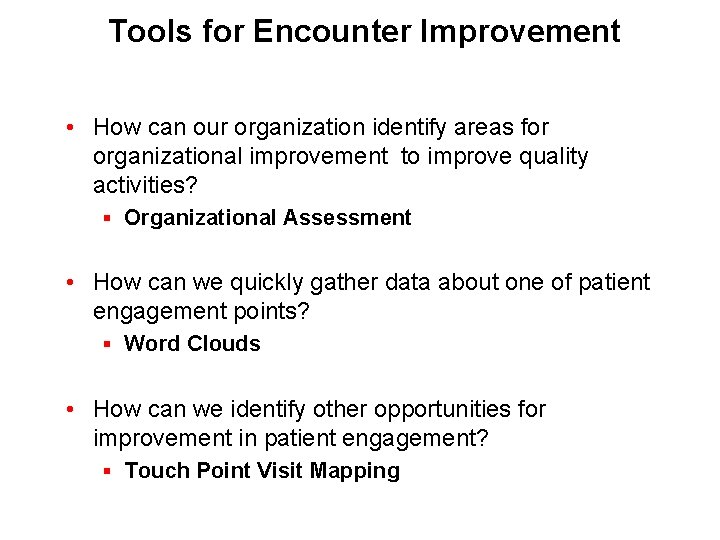
Tools for Encounter Improvement • How can our organization identify areas for organizational improvement to improve quality activities? § Organizational Assessment • How can we quickly gather data about one of patient engagement points? § Word Clouds • How can we identify other opportunities for improvement in patient engagement? § Touch Point Visit Mapping
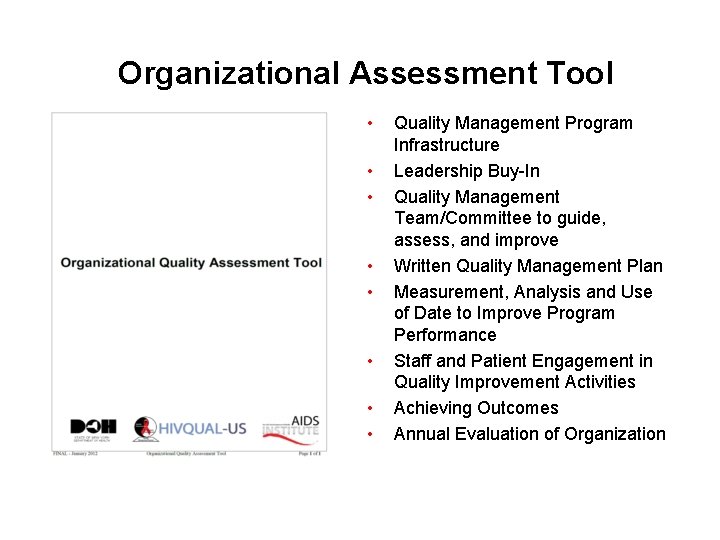
Organizational Assessment Tool • • Quality Management Program Infrastructure Leadership Buy-In Quality Management Team/Committee to guide, assess, and improve Written Quality Management Plan Measurement, Analysis and Use of Date to Improve Program Performance Staff and Patient Engagement in Quality Improvement Activities Achieving Outcomes Annual Evaluation of Organization
Word Clouds • Word clouds are graphical representations of word frequency • The larger the word in the visual, the more common the word was used • This type of visualization can assist with exploring and analyzing words • It can also be used to communicate the most salient points or themes http: //betterevaluation. org/evaluation-options/wordcloud
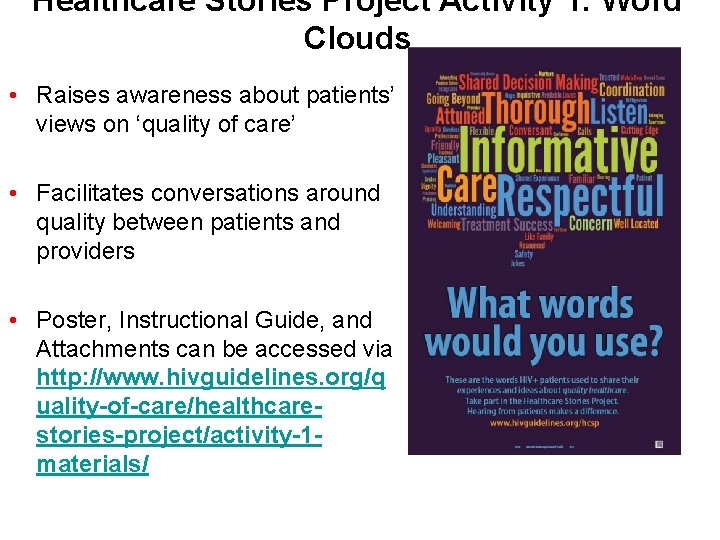
Healthcare Stories Project Activity 1: Word Clouds • Raises awareness about patients’ views on ‘quality of care’ • Facilitates conversations around quality between patients and providers • Poster, Instructional Guide, and Attachments can be accessed via http: //www. hivguidelines. org/q uality-of-care/healthcarestories-project/activity-1 materials/
Touch Points • The key moments or events that stand out for those involved as crucial to their experience of receiving or delivering a service. • Touch points are the points of contact with a service and intensely personal “Big Moments” on the journey where one recalls being touched emotionally or cognitively that cause deep and lasting memories (Bate and Robert, 2007)
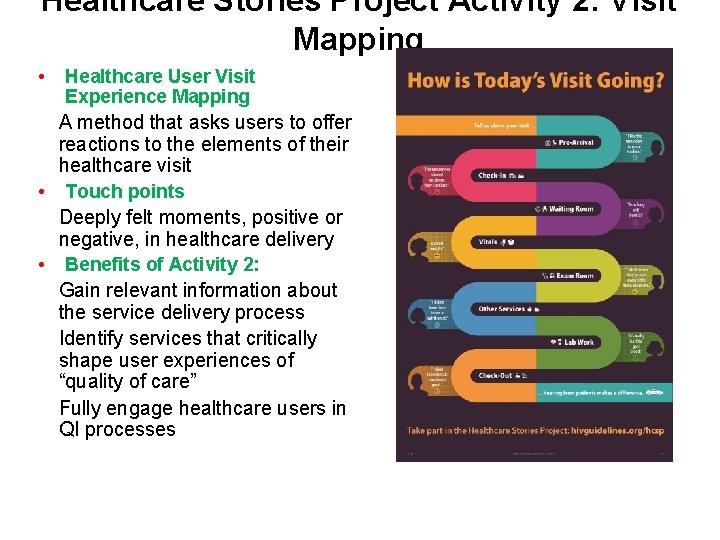
Healthcare Stories Project Activity 2: Visit Mapping • Healthcare User Visit Experience Mapping A method that asks users to offer reactions to the elements of their healthcare visit • Touch points Deeply felt moments, positive or negative, in healthcare delivery • Benefits of Activity 2: Gain relevant information about the service delivery process Identify services that critically shape user experiences of “quality of care” Fully engage healthcare users in QI processes
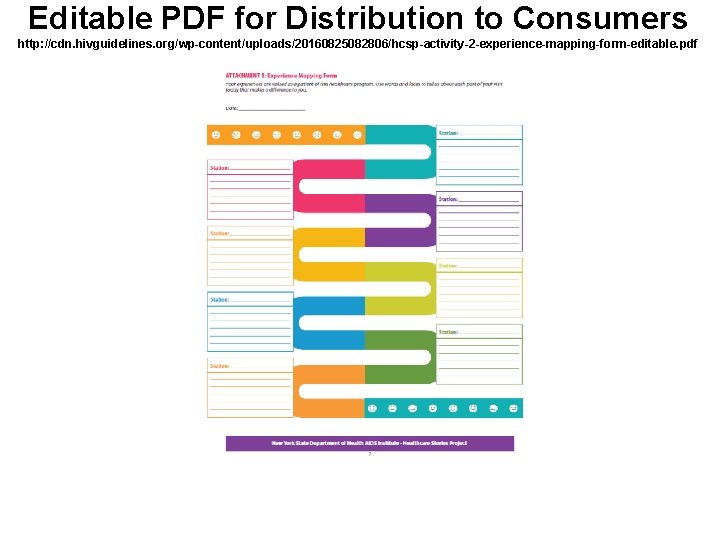
Editable PDF for Distribution to Consumers http: //cdn. hivguidelines. org/wp-content/uploads/20160825082806/hcsp-activity-2 -experience-mapping-form-editable. pdf
Touch Points/Visit Mapping and Word Clouds • Create a ‘touch point’ map for your organization or clinic to identify key moments in care § Brainstorm ‘touch points’ with your Consumer Advisory Board and compare with your version • Use the “touch point” map to solicit feedback on flow stations to identify what encounters might need improvement • Pair ‘touch points’ with ‘word clouds’ to further your data on patient experience in your clinic • Can help with “survey fatigue” – for providers and patients!

Where does it all begin?
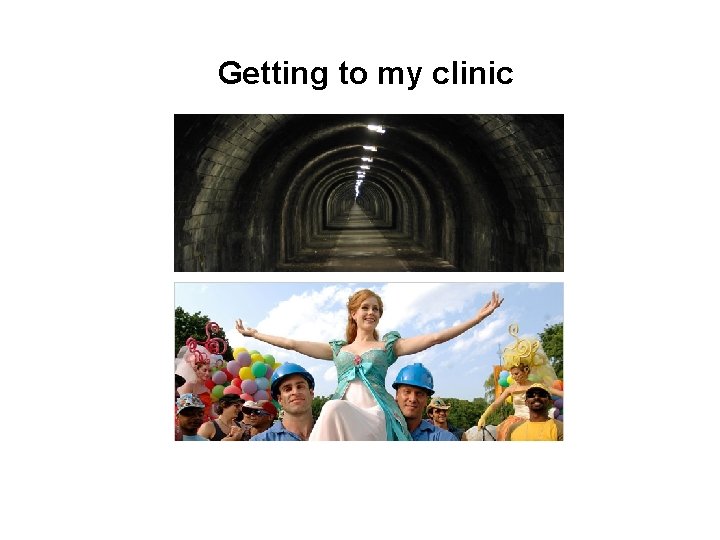
Getting to my clinic
A Walk Through My Clinic
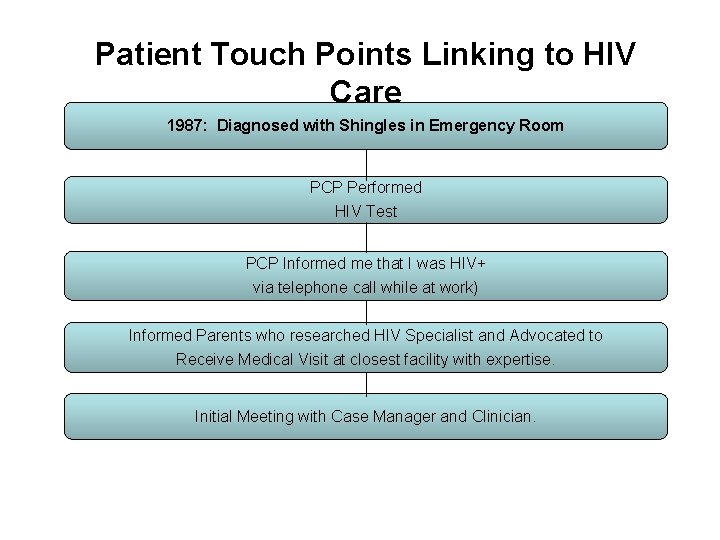
Patient Touch Points Linking to HIV Care 1987: Diagnosed with Shingles in Emergency Room PCP Performed HIV Test PCP Informed me that I was HIV+ via telephone call while at work) Informed Parents who researched HIV Specialist and Advocated to Receive Medical Visit at closest facility with expertise. Initial Meeting with Case Manager and Clinician.
Questions to Consider • How are your patients “introduced” to your clinic? • Is the moment of first contact the receptionist or perhaps it occurs during a separate registration process? • Was the patient’s first encounter with a provider or a visit to have blood drawn at a separate lab? • How does the “hand-off” occur between your clinic and external community-based organizations conducting HIV screening and/or referrals? • Is your clinic passive or active in shaping how patients are first introduced to your care?
The Secret Shopper • Commercially used to report on the quality of services to a corporate headquarters • The person doing the evaluation is unknown to the service provider • Useful to see what a potential patient may go through as they try to enroll or access services
Encounter improvement also requires … • Addressing Health Disparities § Using your selected measures, identify whether you have disparities present in your patient population • Collaborating versus Competing § Working together, sharing ideas, setting goals • Implementing Lessons Learned From the Field § Example: Engage your patients in the process of improving engagement!
Rethinking Feedback

What Ernesto Sirolli learned in Zambia
How do we avoid the Hippos? “What you do [to provide better aid is] you shut up. You never arrive in a community with any ideas. ” ~ Ernesto Sirolli
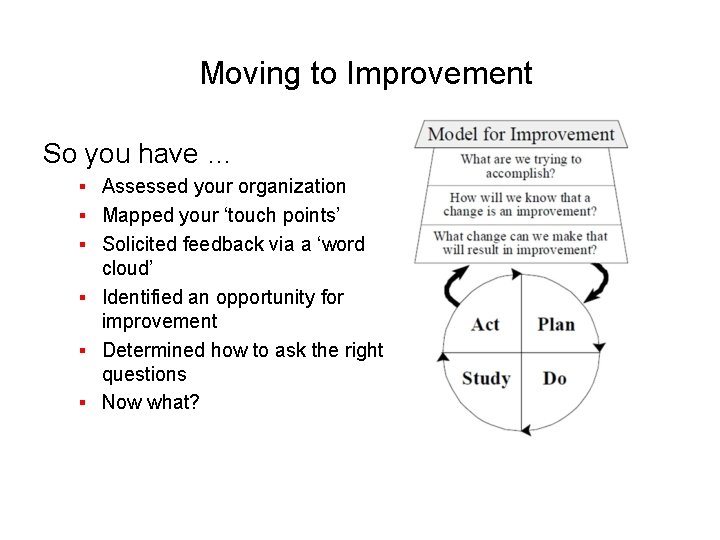
Moving to Improvement So you have … § Assessed your organization § Mapped your ‘touch points’ § Solicited feedback via a ‘word cloud’ § Identified an opportunity for improvement § Determined how to ask the right questions § Now what?
Comments/Questions?
Contact Information Katrina Balovlenkov, QOC Consumer Advisory Committee Katrina@alliance. nyc or Daniel Tietz, AIDS Institute Manager for Consumer Affairs daniel. tietz@health. ny. gov
Working Lunch
NYC/NYS HIV Clinic Survey Erica Crittendon, MS Preston Garnes, MPH Clinical Operations and Provider Communication (COPC) NYC DOHMH
Background • As New York City embarks on its mission to end the HIV epidemic, optimizing HIV-care and viral load suppression (VLS) is pertinent • The steps required for a HIV-infected patient to reach a primary care provider after diagnosis can be complex • Once a patient reaches the clinic, many factors can influence whether that patient achieves VLS
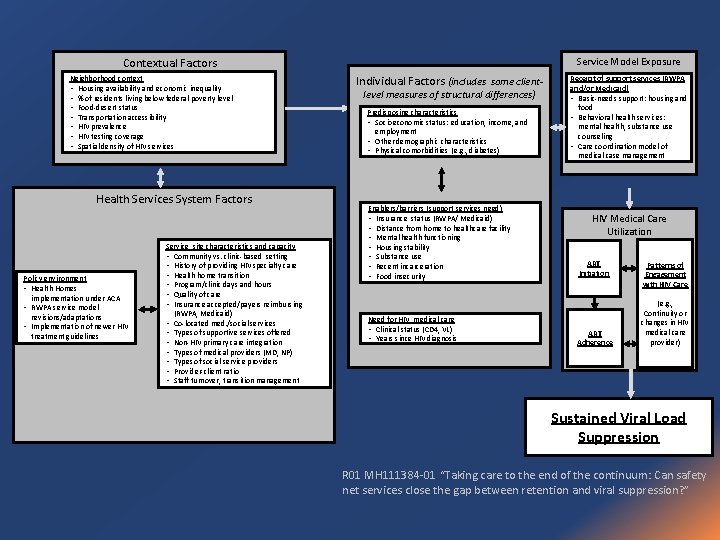
Contextual Factors Neighborhood context • Housing availability and economic inequality • % of residents living below federal poverty level • Food-desert status • Transportation accessibility • HIV prevalence • HIV testing coverage • Spatial density of HIV services Health Services System Factors Policy environment • Health Homes implementation under ACA • RWPA service model revisions/adaptations • Implementation of newer HIV treatment guidelines Service site characteristics and capacity • Community vs. clinic-based setting • History of providing HIV specialty care • Health home transition • Program/clinic days and hours • Quality of care • Insurance accepted/payers reimbursing (RWPA, Medicaid) • Co-located med. /social services • Types of supportive services offered • Non-HIV primary care integration • Types of medical providers (MD, NP) • Types of social service providers • Provider-client ratio • Staff turnover, transition management Service Model Exposure Individual Factors (includes some clientlevel measures of structural differences) Predisposing characteristics • Socioeconomic status: education, income, and employment • Other demographic characteristics • Physical comorbidities (e. g. , diabetes) Enablers/barriers (support services need) • Insurance status (RWPA/ Medicaid) • Distance from home to healthcare facility • Mental health functioning • Housing stability • Substance use • Recent incarceration • Food insecurity Need for HIV medical care • Clinical status (CD 4, VL) • Years since HIV diagnosis Receipt of support services (RWPA and/or Medicaid) • Basic-needs support: housing and food • Behavioral health services: mental health, substance use counseling • Care coordination model of medical case management HIV Medical Care Utilization ART Initiation ART Adherence Patterns of Engagement with HIV Care (e. g. , Continuity or changes in HIV medical care provider) Sustained Viral Load Suppression R 01 MH 111384 -01 “Taking care to the end of the continuum: Can safety net services close the gap between retention and viral suppression? ”
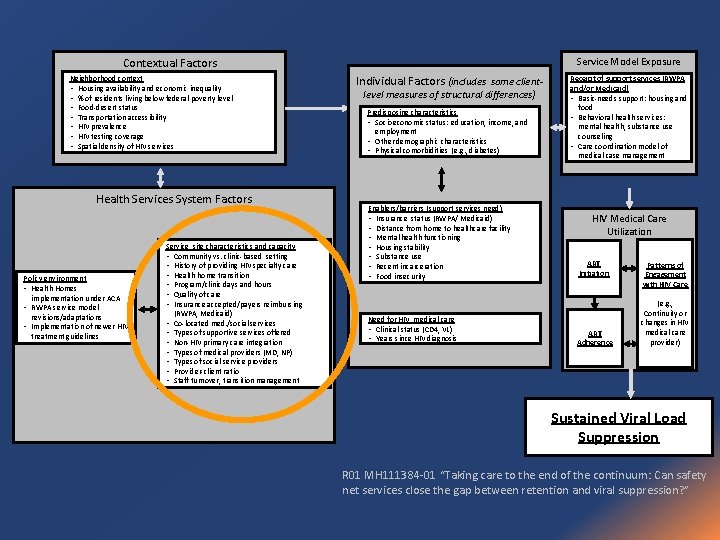
Contextual Factors Neighborhood context • Housing availability and economic inequality • % of residents living below federal poverty level • Food-desert status • Transportation accessibility • HIV prevalence • HIV testing coverage • Spatial density of HIV services Health Services System Factors Policy environment • Health Homes implementation under ACA • RWPA service model revisions/adaptations • Implementation of newer HIV treatment guidelines Service site characteristics and capacity • Community vs. clinic-based setting • History of providing HIV specialty care • Health home transition • Program/clinic days and hours • Quality of care • Insurance accepted/payers reimbursing (RWPA, Medicaid) • Co-located med. /social services • Types of supportive services offered • Non-HIV primary care integration • Types of medical providers (MD, NP) • Types of social service providers • Provider-client ratio • Staff turnover, transition management Service Model Exposure Individual Factors (includes some clientlevel measures of structural differences) Predisposing characteristics • Socioeconomic status: education, income, and employment • Other demographic characteristics • Physical comorbidities (e. g. , diabetes) Enablers/barriers (support services need) • Insurance status (RWPA/ Medicaid) • Distance from home to healthcare facility • Mental health functioning • Housing stability • Substance use • Recent incarceration • Food insecurity Need for HIV medical care • Clinical status (CD 4, VL) • Years since HIV diagnosis Receipt of support services (RWPA and/or Medicaid) • Basic-needs support: housing and food • Behavioral health services: mental health, substance use counseling • Care coordination model of medical case management HIV Medical Care Utilization ART Initiation ART Adherence Patterns of Engagement with HIV Care (e. g. , Continuity or changes in HIV medical care provider) Sustained Viral Load Suppression R 01 MH 111384 -01 “Taking care to the end of the continuum: Can safety net services close the gap between retention and viral suppression? ”
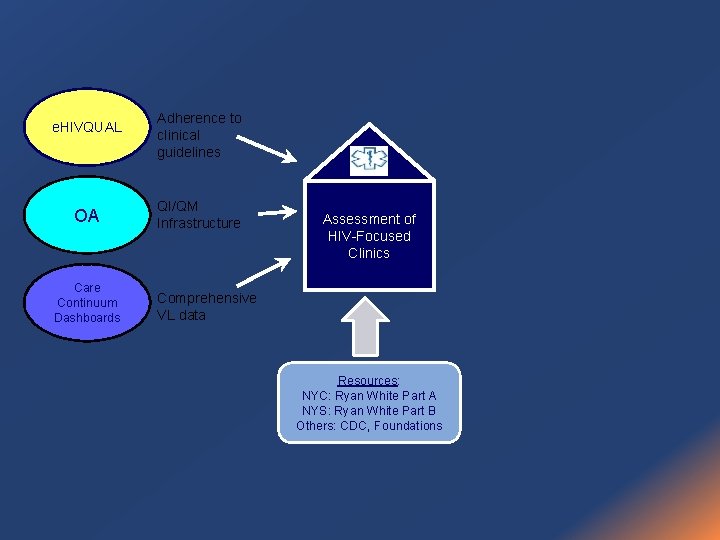
e. HIVQUAL OA Care Continuum Dashboards Adherence to clinical guidelines QI/QM Infrastructure Assessment of HIV-Focused Clinics Comprehensive VL data Resources: NYC: Ryan White Part A NYS: Ryan White Part B Others: CDC, Foundations
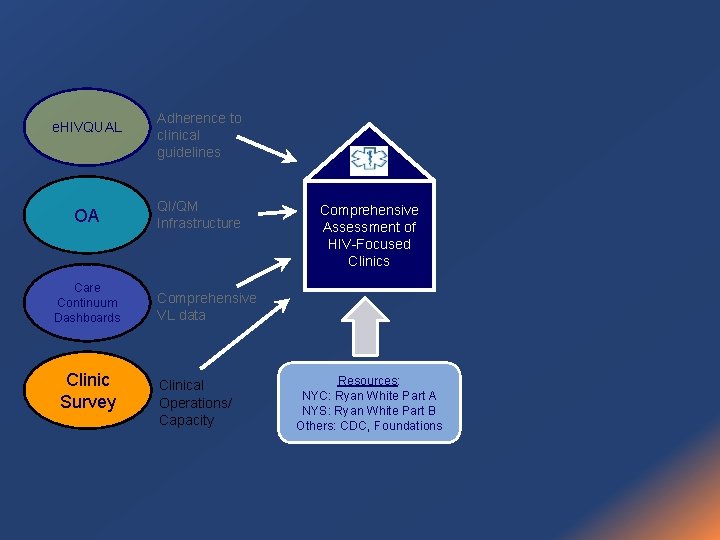
e. HIVQUAL OA Care Continuum Dashboards Clinic Survey Adherence to clinical guidelines QI/QM Infrastructure Comprehensive Assessment of HIV-Focused Clinics Comprehensive VL data Clinical Operations/ Capacity Resources: NYC: Ryan White Part A NYS: Ryan White Part B Others: CDC, Foundations
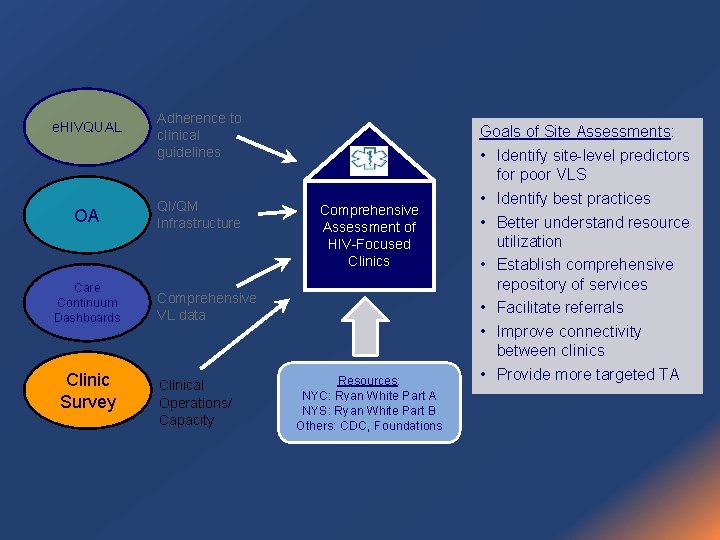
e. HIVQUAL OA Care Continuum Dashboards Clinic Survey Adherence to clinical guidelines QI/QM Infrastructure Comprehensive Assessment of HIV-Focused Clinics Comprehensive VL data Clinical Operations/ Capacity Resources: NYC: Ryan White Part A NYS: Ryan White Part B Others: CDC, Foundations Goals of Site Assessments: • Identify site-level predictors for poor VLS • Identify best practices • Better understand resource utilization • Establish comprehensive repository of services • Facilitate referrals • Improve connectivity between clinics • Provide more targeted TA
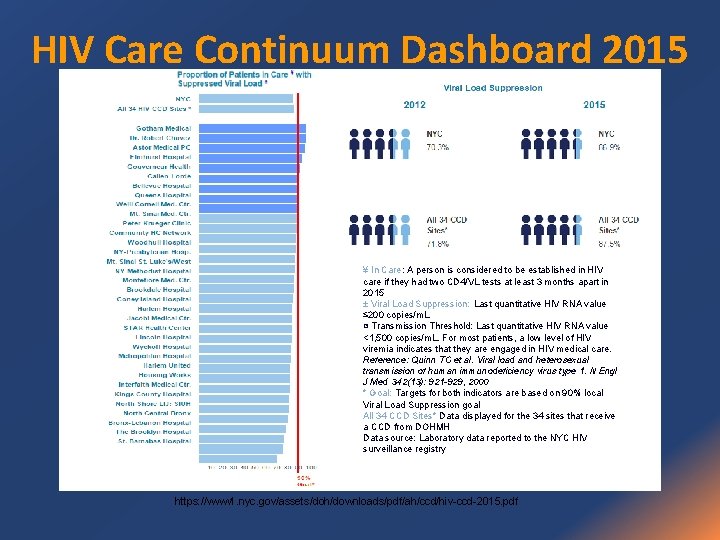
HIV Care Continuum Dashboard 2015 ¥ In Care: A person is considered to be established in HIV care if they had two CD 4/VL tests at least 3 months apart in 2015 ± Viral Load Suppression: Last quantitative HIV RNA value ≤ 200 copies/m. L ¤ Transmission Threshold: Last quantitative HIV RNA value <1, 500 copies/m. L. For most patients, a low level of HIV viremia indicates that they are engaged in HIV medical care. Reference: Quinn TC et al. Viral load and heterosexual transmission of human immunodeficiency virus type 1. N Engl J Med 342(13): 921 -929, 2000 * Goal: Targets for both indicators are based on 90% local Viral Load Suppression goal All 34 CCD Sites* Data displayed for the 34 sites that receive a CCD from DOHMH Data source: Laboratory data reported to the NYC HIV surveillance registry https: //www 1. nyc. gov/assets/doh/downloads/pdf/ah/ccd/hiv-ccd-2015. pdf
HIV Clinic Survey Objectives • 1. To identify clinic-level predictors as measured by viral load suppression Ø 1 b. Among clinics that serve a disproportionate number of underserved clients (e. g. , racial/ethnic minorities, Transgender, low income) • 2. To identify areas for public health supported interventions within the HIV clinics
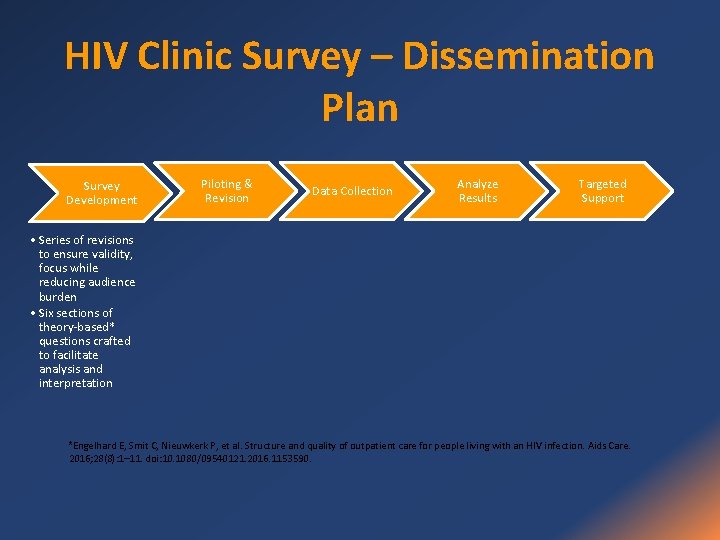
HIV Clinic Survey – Dissemination Plan Survey Development Piloting & Revision Data Collection Analyze Results Targeted Support • Series of revisions to ensure validity, focus while reducing audience burden • Six sections of theory-based* questions crafted to facilitate analysis and interpretation *Engelhard E, Smit C, Nieuwkerk P, et al. Structure and quality of outpatient care for people living with an HIV infection. Aids Care. 2016; 28(8): 1– 11. doi: 10. 1080/09540121. 2016. 1153590.
HIV Clinic Survey – Outline • Survey tool designed to assess clinical capacity on several realms ØFacility setting and services available ØClinic workflow ØStaffing and resources ØRetention and adherence strategies ØData management capacity ØPatient demographics and caseloads
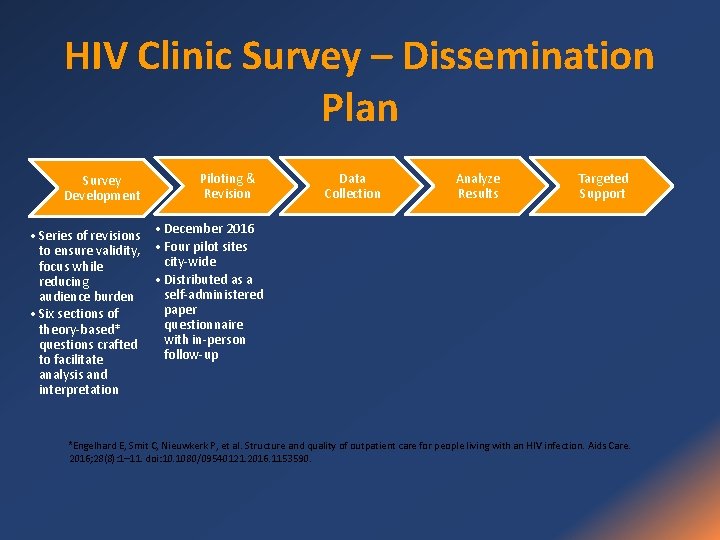
HIV Clinic Survey – Dissemination Plan Survey Development Piloting & Revision Data Collection Analyze Results Targeted Support • Series of revisions • December 2016 to ensure validity, • Four pilot sites city-wide focus while • Distributed as a reducing self-administered audience burden paper • Six sections of questionnaire theory-based* with in-person questions crafted follow-up to facilitate analysis and interpretation *Engelhard E, Smit C, Nieuwkerk P, et al. Structure and quality of outpatient care for people living with an HIV infection. Aids Care. 2016; 28(8): 1– 11. doi: 10. 1080/09540121. 2016. 1153590.
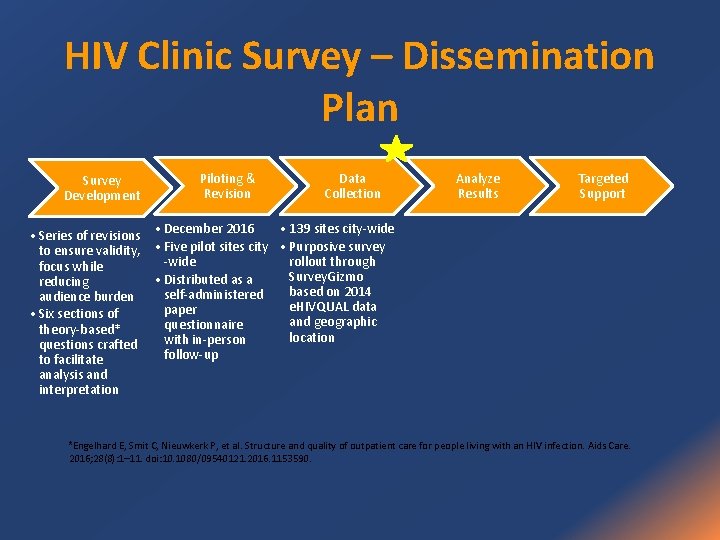
HIV Clinic Survey – Dissemination Plan Survey Development Piloting & Revision Data Collection Analyze Results Targeted Support • 139 sites city-wide • Series of revisions • December 2016 to ensure validity, • Five pilot sites city • Purposive survey -wide rollout through focus while Survey. Gizmo • Distributed as a reducing based on 2014 self-administered audience burden e. HIVQUAL data paper • Six sections of and geographic questionnaire theory-based* location with in-person questions crafted follow-up to facilitate analysis and interpretation *Engelhard E, Smit C, Nieuwkerk P, et al. Structure and quality of outpatient care for people living with an HIV infection. Aids Care. 2016; 28(8): 1– 11. doi: 10. 1080/09540121. 2016. 1153590.
Questions? Please contact: copc@health. nyc. gov
Quality Improvement 101: Satisfaction Continuum Clemens Steinbock, MBA
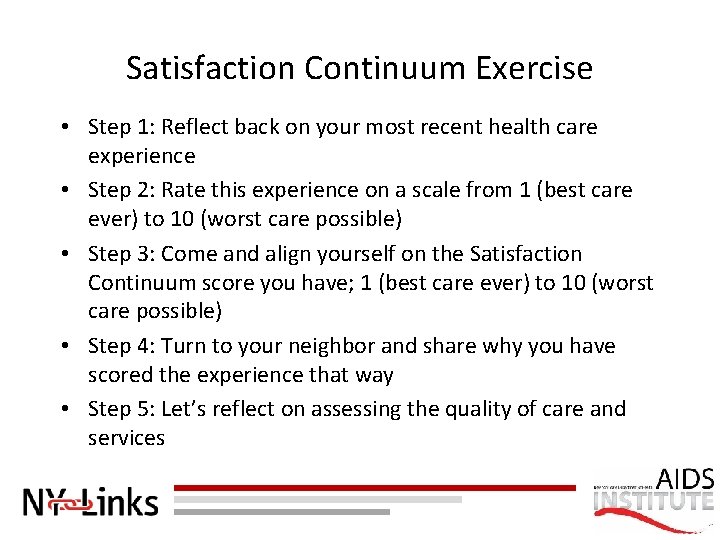
Satisfaction Continuum Exercise • Step 1: Reflect back on your most recent health care experience • Step 2: Rate this experience on a scale from 1 (best care ever) to 10 (worst care possible) • Step 3: Come and align yourself on the Satisfaction Continuum score you have; 1 (best care ever) to 10 (worst care possible) • Step 4: Turn to your neighbor and share why you have scored the experience that way • Step 5: Let’s reflect on assessing the quality of care and services
Team Action Planning and Report Back
Group Activity • Sit with your agency representatives • Develop an action plan going forward using the provided template
Moving Forward
Moving Forward • Ideas for our joint activities going forward – Face-to-face meetings 3 x times a year – every 4 months – Webinars to allow peer sharing around specific content areas 3 x times a year – every 4 months – Data reporting expectations - TBD
Evaluation
Evaluation • Please complete the session evaluation form • Complete our contact information sheet
Contact Information Steve Sawicki, NYLinks Lead, steven. sawicki@health. state. ny. us Regional Leads Upper Manhattan—Susan Weigl, sweigl@yahoo. com Lower Manhattan—Susan Weigl Western NY—Nanette Brey Magnani, breymagnan@aol. com Long Island—Steven Sawicki Central NY & Southern Tier—Steve Sawicki Mid & Lower Hudson—Steve Sawicki Queens—Nova West, nova. west@health. ny. gov Brooklyn—Clemens Steinbock, clemens. steinbock@health. ny. gov and Zeenath Rehana, zrehana@health. nyc. gov Bronx—Dan Belanger, dan. belanger@health. ny. gov Northeastern NY—Steve Sawicki If not sure, info@newyorklinks. org
- Slides: 94