
Brood Parasitism An Alternative Life History N B
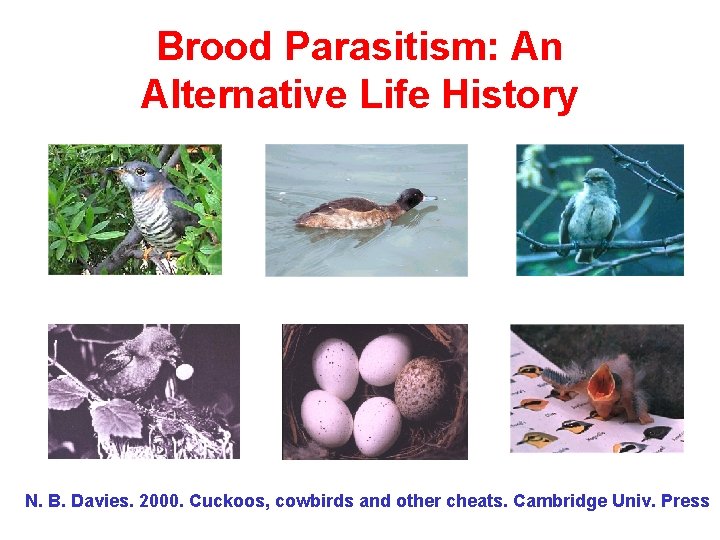
Brood Parasitism: An Alternative Life History N. B. Davies. 2000. Cuckoos, cowbirds and other cheats. Cambridge Univ. Press
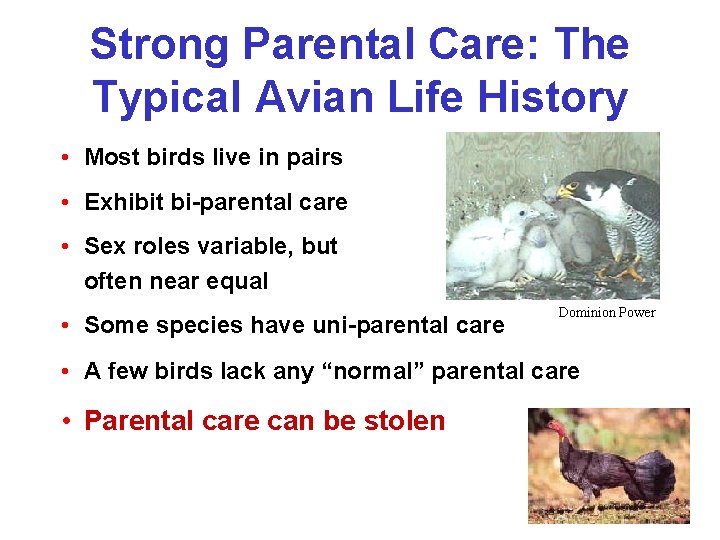
Strong Parental Care: The Typical Avian Life History • Most birds live in pairs • Exhibit bi-parental care • Sex roles variable, but often near equal • Some species have uni-parental care Dominion Power • A few birds lack any “normal” parental care • Parental care can be stolen
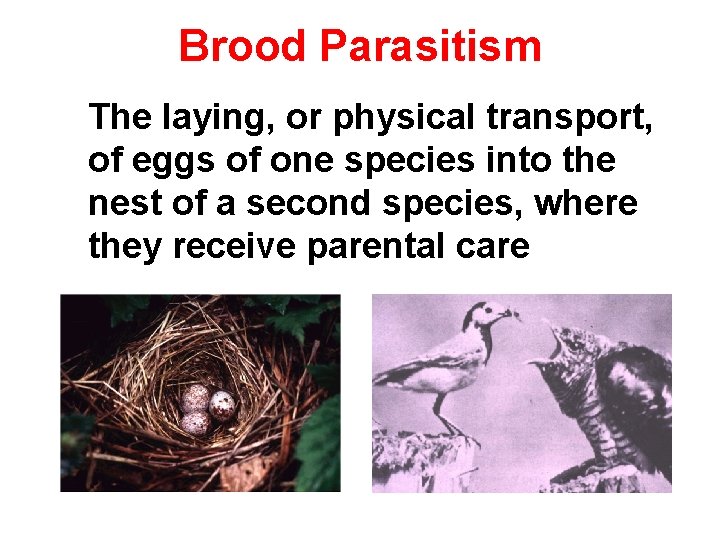
Brood Parasitism The laying, or physical transport, of eggs of one species into the nest of a second species, where they receive parental care
Two Kinds of Avian Brood Parasites Facultative • “Lay” in own nest and nests of conspecifics • A common trait, especially in colonial and cavity-nesting species (E. g. , starlings, snow geese, cliff swallows) Obligate • Lay only in nests of other species • 99 species in 5 families worldwide • 1% of all bird species
Obligate Avian Brood Parasites: 5 Taxa: 99 Species • Cuckoos - 57 of 130 Species – Probably evolved twice in the order • Honeyguides – all 17 species • Cowbirds – all 5 species • African parasitic finches – all 19 species • Black-necked Duck - 1 of 150 species
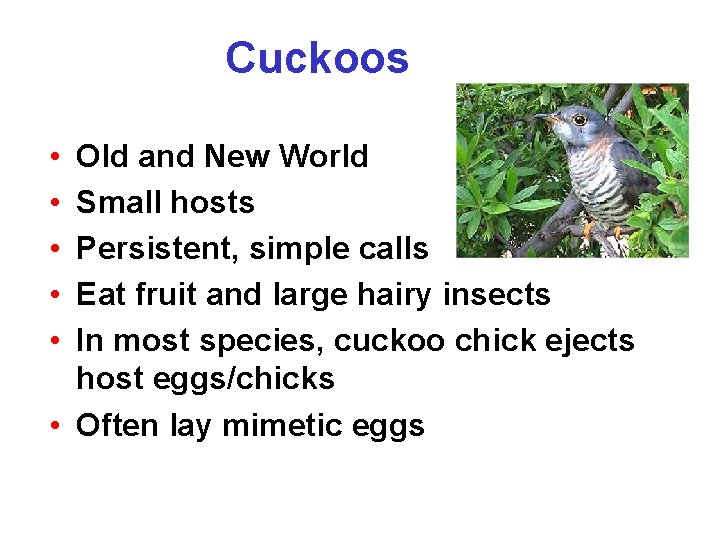
Cuckoos • • • Old and New World Small hosts Persistent, simple calls Eat fruit and large hairy insects In most species, cuckoo chick ejects host eggs/chicks • Often lay mimetic eggs
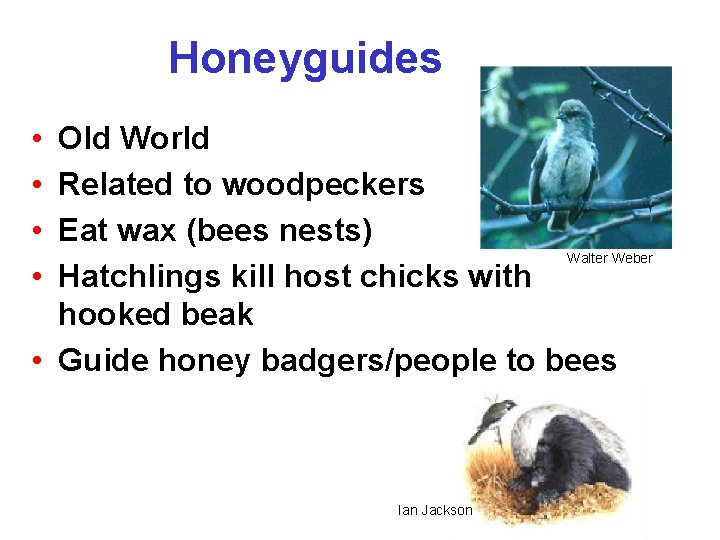
Honeyguides • • Old World Related to woodpeckers Eat wax (bees nests) Walter Weber Hatchlings kill host chicks with hooked beak • Guide honey badgers/people to bees Ian Jackson
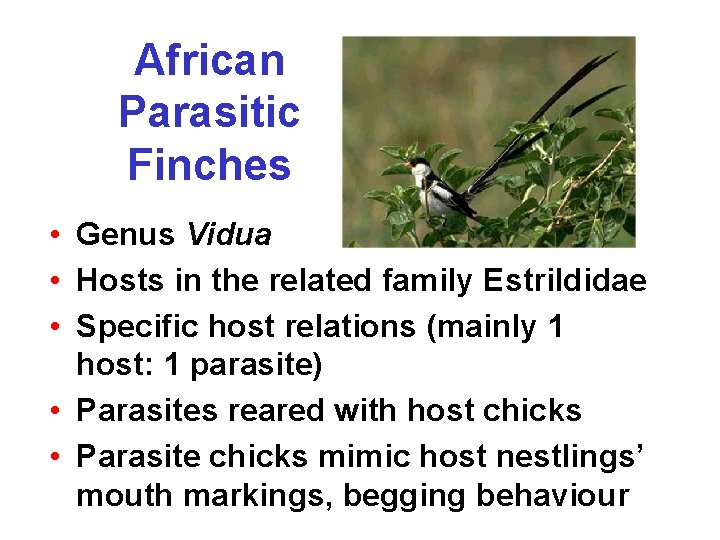
African Parasitic Finches • Genus Vidua • Hosts in the related family Estrildidae • Specific host relations (mainly 1 host: 1 parasite) • Parasites reared with host chicks • Parasite chicks mimic host nestlings’ mouth markings, begging behaviour
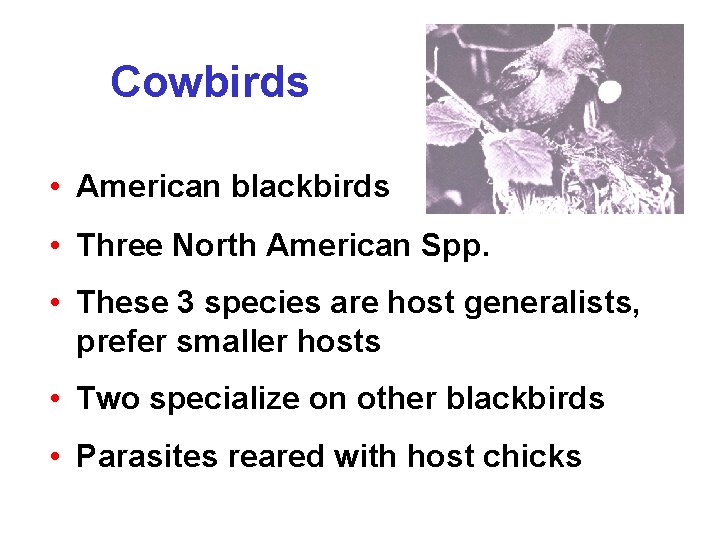
Cowbirds • American blackbirds • Three North American Spp. • These 3 species are host generalists, prefer smaller hosts • Two specialize on other blackbirds • Parasites reared with host chicks
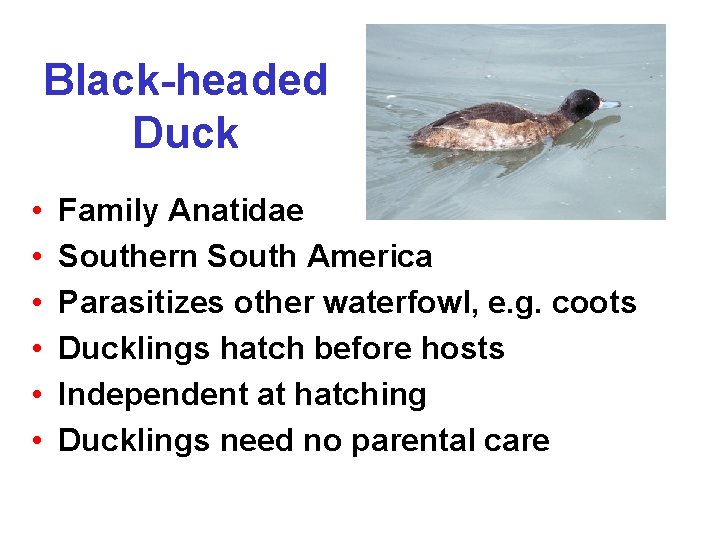
Black-headed Duck • • • Family Anatidae Southern South America Parasitizes other waterfowl, e. g. coots Ducklings hatch before hosts Independent at hatching Ducklings need no parental care
Questions about the Brood Parasitic Life History • How did it evolve? • What trade-offs are involved? • What adaptations make brood parasites successful? • How can brood parasitism be countered by hosts?
How Did Obligate Parasitism Evolve? • From facultative brood parasitism? • Selection pressure created by time consuming feeding habits (like eating wax, hairy bugs) • In species that steal nests from other species? – E. g. , Bay-winged “Cowbird” • Via communal nesting – E. g. , Anis, Guira Cuckoos • During relaxed food limitation – Yellow-billed Cuckoos, periodical cicadas
Adaptations of Brood Parasites - 1 • Rapid laying (often when host absent) • Short incubation period – Brown-headed cowbird eggs hatch in 10 -11 days vs. 12 -14 d in hosts • Noisy begging behaviour – One cuckoo chick makes as much noise as a whole brood of reed warblers R. Kilner et al. Nature 397: 667 -672 (1999) • Predatory behaviours by – Adult great-spotted cuckoos, cowbirds http: //biology. easternct. edu/People/elliott/htm – Nestling common cuckoos, honeyguides
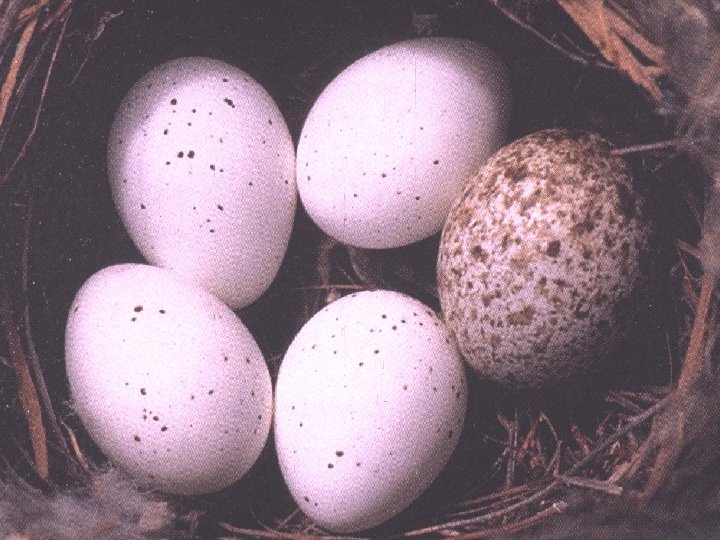
Adaptations of Brood Parasites - 2 • Thick-shelled eggs – Resist puncture ejection • Egg mimicry – Foils rejecter hosts – Sharpens their egg discrimination • Removing eggs from host clutches while host is laying – May enhance parasite hatching success, especially in nests of large hosts • Superior spatial memory? (in females) D. F. Sherry et al. Proc. Nat. Acad, Sci. USA 90: 7839 -7843 (1993)
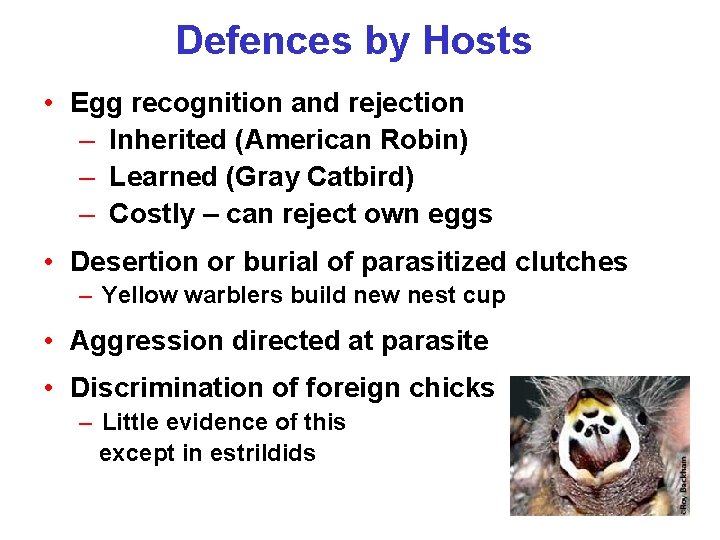
Defences by Hosts • Egg recognition and rejection – Inherited (American Robin) – Learned (Gray Catbird) – Costly – can reject own eggs • Desertion or burial of parasitized clutches – Yellow warblers build new nest cup • Aggression directed at parasite • Discrimination of foreign chicks – Little evidence of this except in estrildids
Why Prey on Host Nests? • The “Mafia” hypothesis Parasite “punishes” rejecting hosts: – Experimental evidence in magpies J. Soler et al. Evolution 49: 770 -775 (1995) • To synchronize host/parasite reproduction – Parasite benefits by “killing” unusable host clutches/broods – Host re-nests – Parasite then lays in new nesting attempt P. Arcese et al. Proc Nat. Acad. Sci. USA 93: 4608 -4611 (1996)
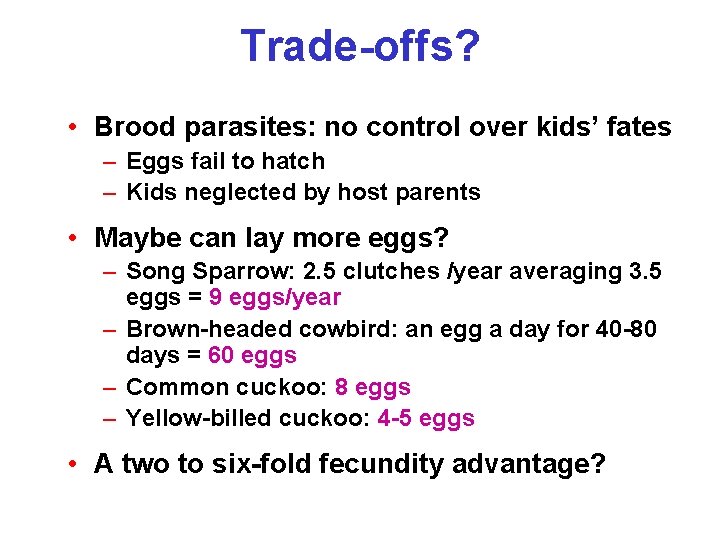
Trade-offs? • Brood parasites: no control over kids’ fates – Eggs fail to hatch – Kids neglected by host parents • Maybe can lay more eggs? – Song Sparrow: 2. 5 clutches /year averaging 3. 5 eggs = 9 eggs/year – Brown-headed cowbird: an egg a day for 40 -80 days = 60 eggs – Common cuckoo: 8 eggs – Yellow-billed cuckoo: 4 -5 eggs • A two to six-fold fecundity advantage?
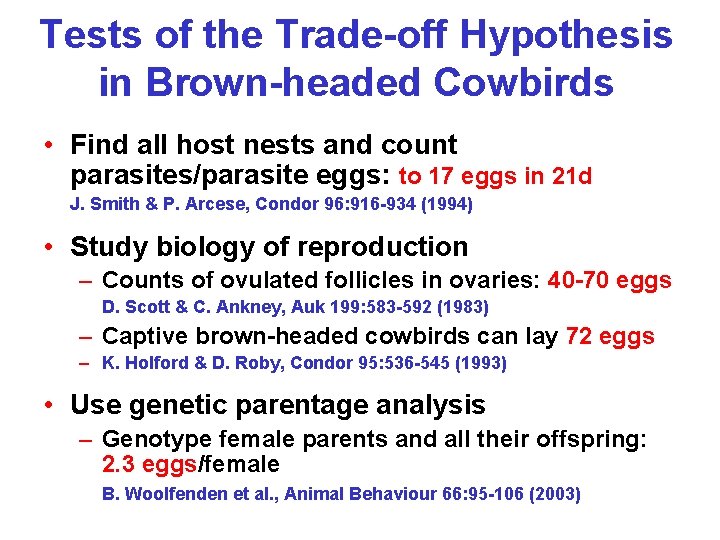
Tests of the Trade-off Hypothesis in Brown-headed Cowbirds • Find all host nests and count parasites/parasite eggs: to 17 eggs in 21 d J. Smith & P. Arcese, Condor 96: 916 -934 (1994) • Study biology of reproduction – Counts of ovulated follicles in ovaries: 40 -70 eggs D. Scott & C. Ankney, Auk 199: 583 -592 (1983) – Captive brown-headed cowbirds can lay 72 eggs – K. Holford & D. Roby, Condor 95: 536 -545 (1993) • Use genetic parentage analysis – Genotype female parents and all their offspring: 2. 3 eggs/female B. Woolfenden et al. , Animal Behaviour 66: 95 -106 (2003)
Status of Trade-off Hypothesis is Uncertain • According to the Woolfenden study, and a similar study by C. Hahn, brood parasites may lay fewer eggs than parental species • Biases in each type of study? • Need for further work
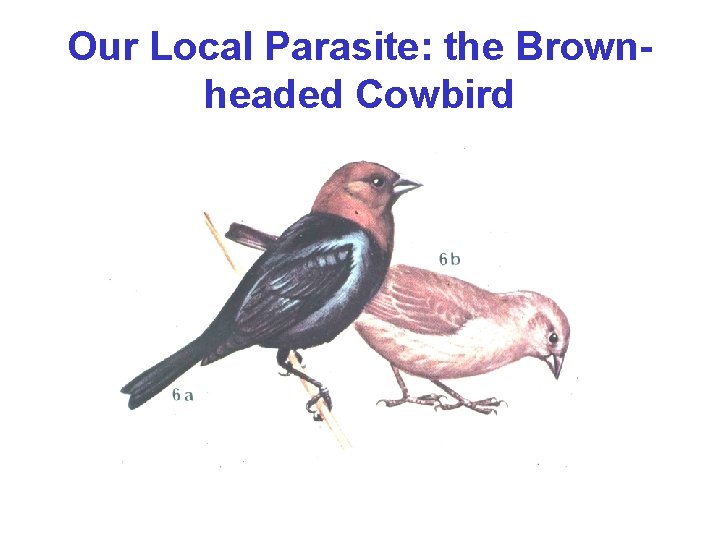
Our Local Parasite: the Brownheaded Cowbird
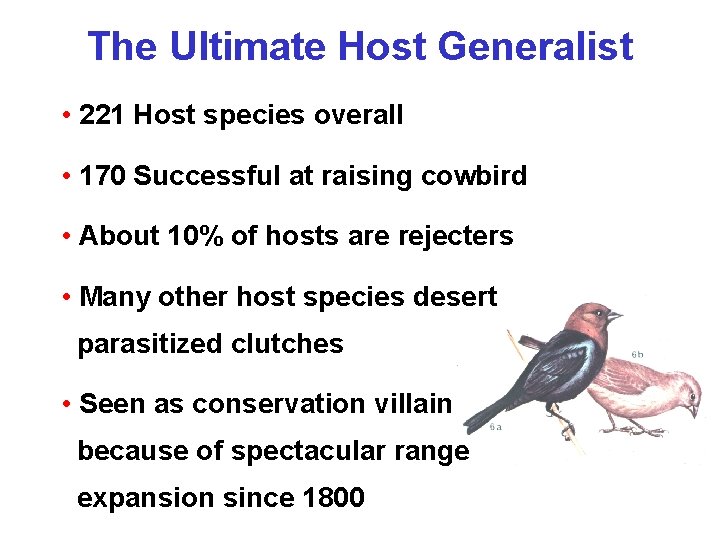
The Ultimate Host Generalist • 221 Host species overall • 170 Successful at raising cowbird • About 10% of hosts are rejecters • Many other host species desert parasitized clutches • Seen as conservation villain because of spectacular range expansion since 1800
People’s Attitudes to Cowbirds • General public dislikes parasitic lifestyle • Birders dislike cowbirds, because they see them as harming other birds • Biologists see the species as a conservation villain because of spectacular range expansion since 1800 and exposure to many new hosts
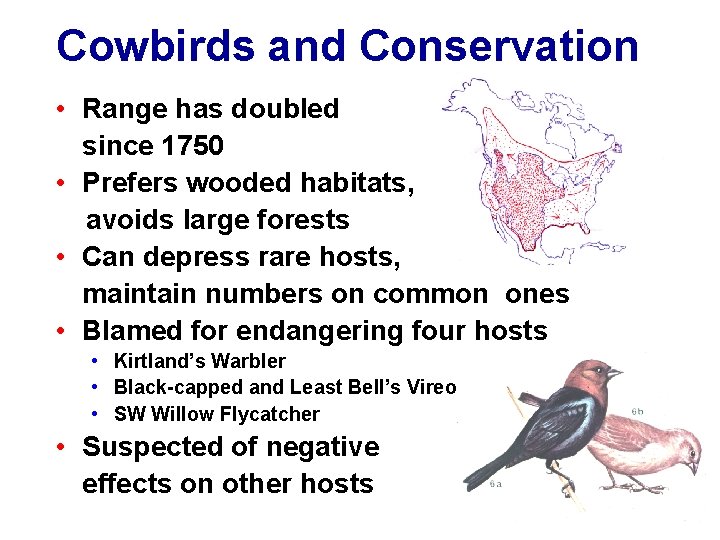
Cowbirds and Conservation • Range has doubled since 1750 • Prefers wooded habitats, avoids large forests • Can depress rare hosts, maintain numbers on common ones • Blamed for endangering four hosts • Kirtland’s Warbler • Black-capped and Least Bell’s Vireos • SW Willow Flycatcher • Suspected of negative effects on other hosts
Are Cowbirds Villains? • No hosts extirpated in range expansion • Most endangered hosts suffer from habitat loss/degradation • Long history of coexistence with many hosts HOWEVER, • Effect of cowbirds on host numbers are poorly known, with only one or two reliable estimates J. Smith et al. Ecology 83: 3037 -3047 (2002) • Managed more easily than other threats • Remain attractive “targets’ for managers
Unsolved Puzzles • How did obligate parasitism evolve? • Why are there so few obligate parasites? – 1% of birds – 2 % of ants – 1 Fish (Synodontis multipunctatus) High extinction rates in parasitic species? • Why is egg rejection so slow to evolve in cowbird hosts?
Summary • Obligately brood parasitic birds have a highly distinctive life history • Co-evolutionary “arms race” with hosts • Origin of obligate parasitism is uncertain • The local brood parasite, the Brown-headed cowbird, has a negative public profile with humans • Under some circumstances can be a severe conservation threat
- Slides: 27