
Bromine Recovery from Plastics containing brominated flame retardants
Bromine Recovery from Plastics containing brominated flame retardants option for Sustainable bromine production? Lein Tange, Dead Sea Bromine Group, Eurobrom B. V. Dieter Drohmann, Great Lakes Chemical Corporation R’ 2002 - Geneva R’ 2002 EBFRIP Thermal processes Bromine Recovery 1
Introduction End-of-life management EBFRIP/BSEF objectives for WEEE with BFRs: l Provide waste recovery solutions in addition to mechanical recycling l Evaluate incineration and pyrolysis/gasification processes including corrosion l Develop recovery options for HBr and optional Bromine l Review the feasibility and economics R’ 2002 EBFRIP Thermal processes Bromine Recovery 2
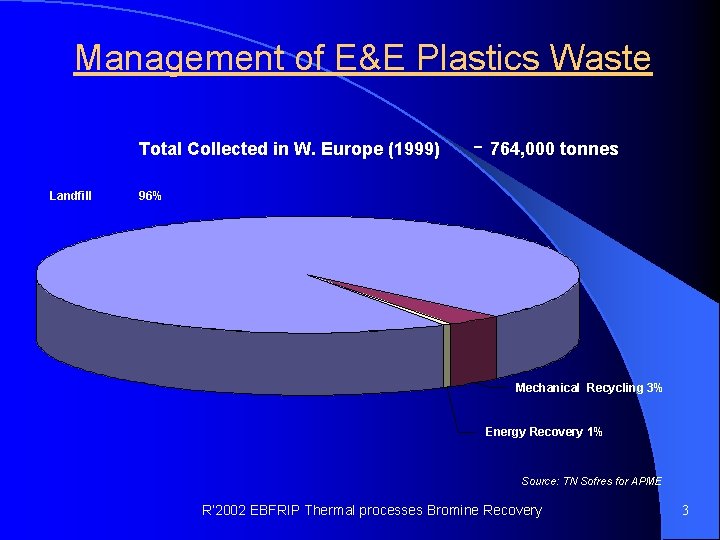
Management of E&E Plastics Waste Total Collected in W. Europe (1999) Landfill – 764, 000 tonnes 96% Mechanical Recycling 3% Energy Recovery 1% Source: TN Sofres for APME R’ 2002 EBFRIP Thermal processes Bromine Recovery 3
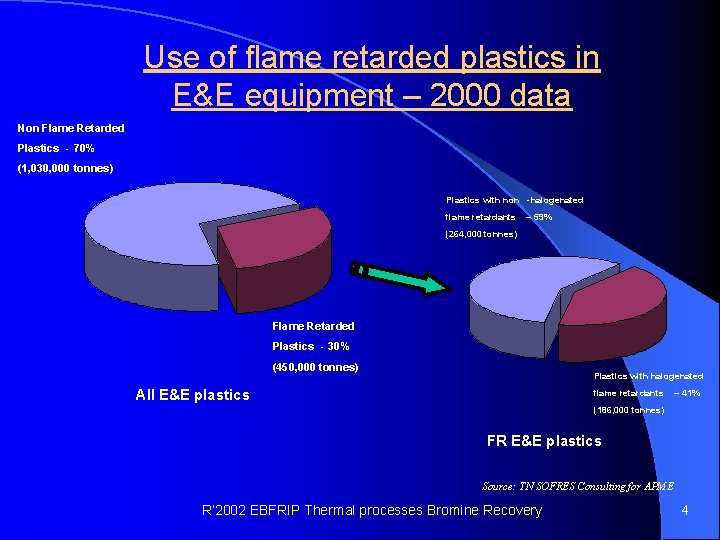
Use of flame retarded plastics in E&E equipment – 2000 data Non Flame Retarded Plastics - 70% (1, 030, 000 tonnes) Plastics with non -halogenated flame retardants – 59% (264, 000 tonnes) Flame Retarded Plastics - 30% (450, 000 tonnes) Plastics with halogenated All E&E plastics flame retardants – 41% (186, 000 tonnes) FR E&E plastics Source: TN SOFRES Consulting for APME R’ 2002 EBFRIP Thermal processes Bromine Recovery 4
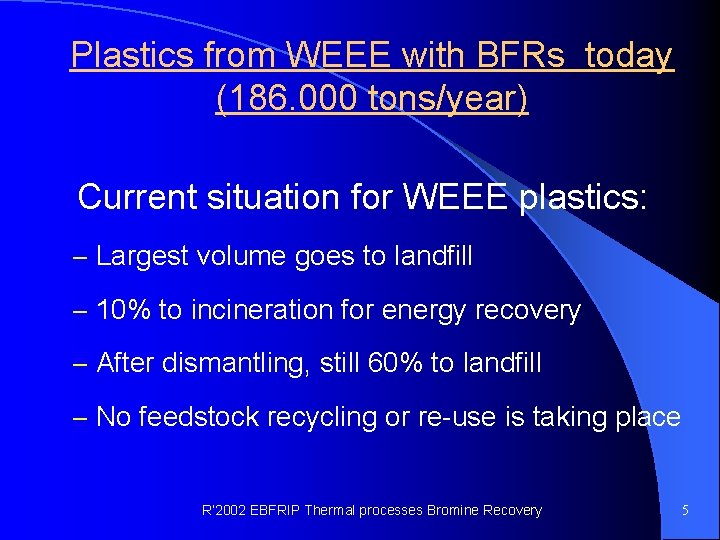
Plastics from WEEE with BFRs today (186. 000 tons/year) Current situation for WEEE plastics: – Largest volume goes to landfill – 10% to incineration for energy recovery – After dismantling, still 60% to landfill – No feedstock recycling or re-use is taking place R’ 2002 EBFRIP Thermal processes Bromine Recovery 5
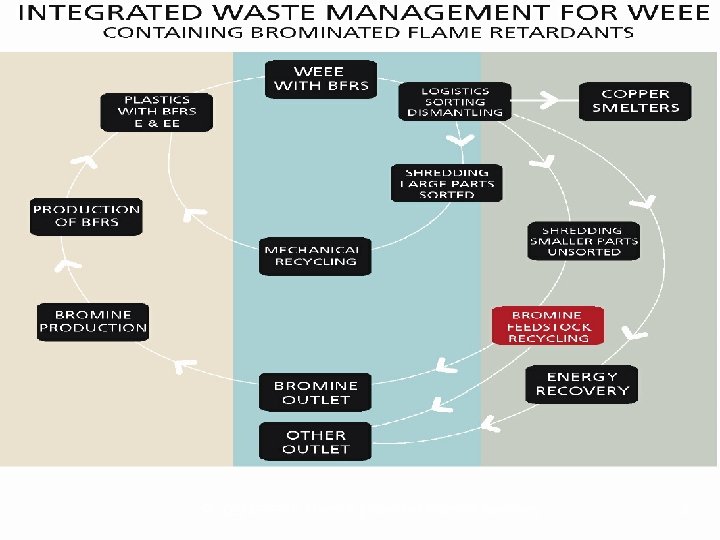
R’ 2002 EBFRIP Thermal processes Bromine Recovery 6
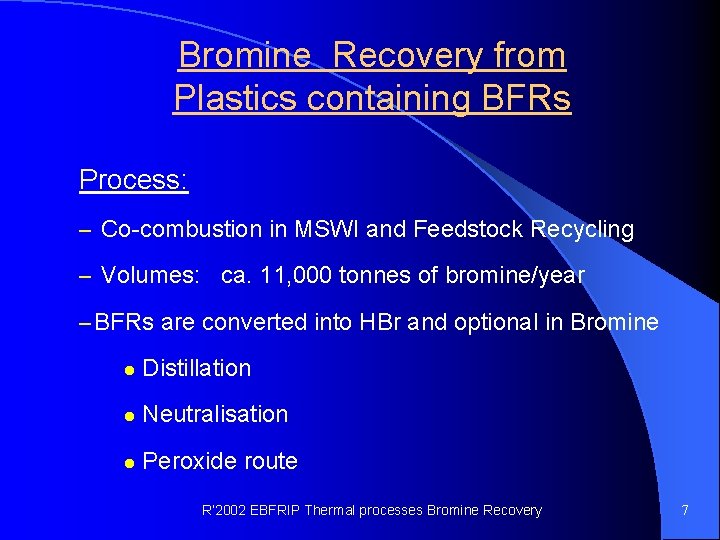
Bromine Recovery from Plastics containing BFRs Process: – Co-combustion in MSWI and Feedstock Recycling – Volumes: ca. 11, 000 tonnes of bromine/year – BFRs are converted into HBr and optional in Bromine l Distillation l Neutralisation l Peroxide route R’ 2002 EBFRIP Thermal processes Bromine Recovery 7
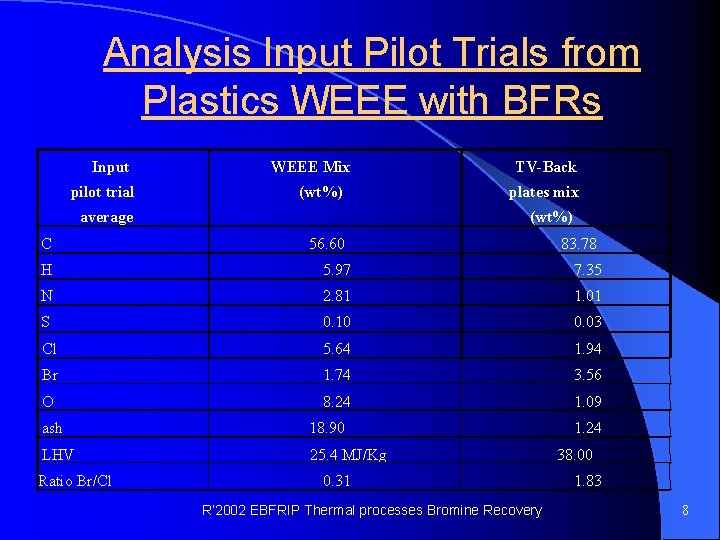
Analysis Input Pilot Trials from Plastics WEEE with BFRs Input pilot trial WEEE Mix (wt%) average C TV-Back plates mix (wt%) 56. 60 83. 78 H 5. 97 7. 35 N 2. 81 1. 01 S 0. 10 0. 03 Cl 5. 64 1. 94 Br 1. 74 3. 56 O 8. 24 1. 09 ash 18. 90 LHV 25. 4 MJ/Kg Ratio Br/Cl 0. 31 R’ 2002 EBFRIP Thermal processes Bromine Recovery 1. 24 38. 00 1. 83 8
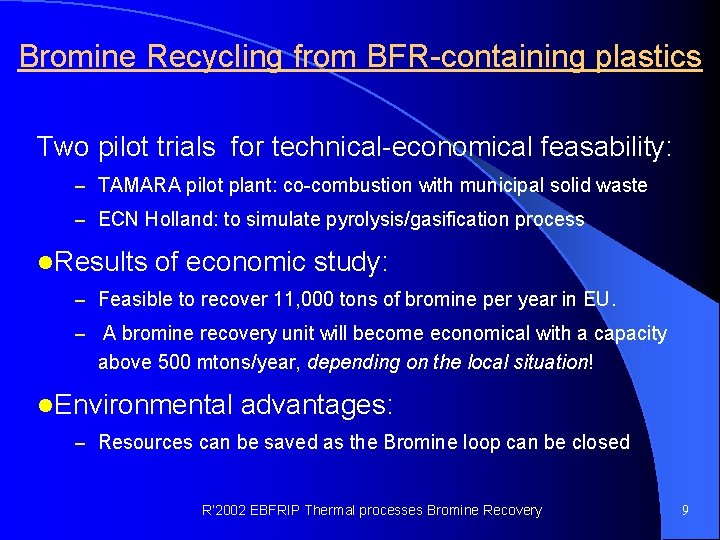
Bromine Recycling from BFR-containing plastics Two pilot trials for technical-economical feasability: – TAMARA pilot plant: co-combustion with municipal solid waste – ECN Holland: to simulate pyrolysis/gasification process l. Results of economic study: – Feasible to recover 11, 000 tons of bromine per year in EU. – A bromine recovery unit will become economical with a capacity above 500 mtons/year, depending on the local situation! l. Environmental advantages: – Resources can be saved as the Bromine loop can be closed R’ 2002 EBFRIP Thermal processes Bromine Recovery 9
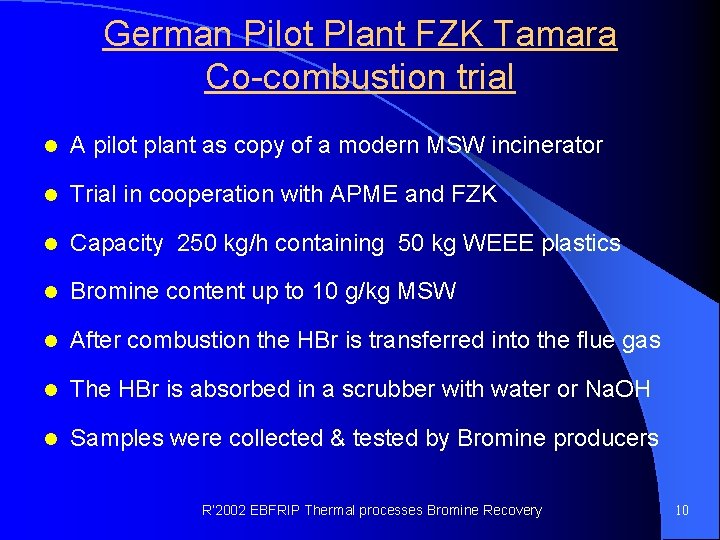
German Pilot Plant FZK Tamara Co-combustion trial l A pilot plant as copy of a modern MSW incinerator l Trial in cooperation with APME and FZK l Capacity 250 kg/h containing 50 kg WEEE plastics l Bromine content up to 10 g/kg MSW l After combustion the HBr is transferred into the flue gas l The HBr is absorbed in a scrubber with water or Na. OH l Samples were collected & tested by Bromine producers R’ 2002 EBFRIP Thermal processes Bromine Recovery 10

Recovery of HBr out of flue gasses from Pilot plant Tamara Scrubber with caustic (produce Na. Br) R’ 2002 EBFRIP Thermal processes Bromine Recovery 11
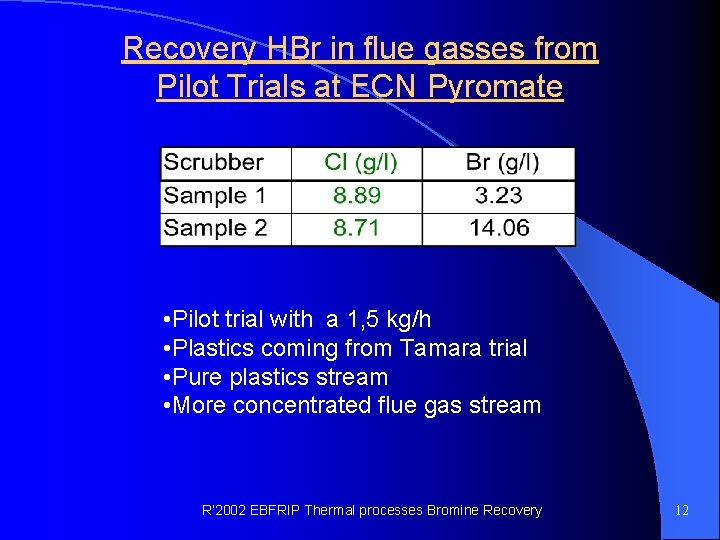
Recovery HBr in flue gasses from Pilot Trials at ECN Pyromate • Pilot trial with a 1, 5 kg/h • Plastics coming from Tamara trial • Pure plastics stream • More concentrated flue gas stream R’ 2002 EBFRIP Thermal processes Bromine Recovery 12
![[Cl] and [Br] recovered from Pilot trial compared to natural sources • Levels in](http://slidetodoc.com/presentation_image/f187c2c21f2062bf9e74cb9f59f913eb/image-13.jpg "[Cl] and [Br] recovered from Pilot trial compared to natural sources • Levels in")
[Cl] and [Br] recovered from Pilot trial compared to natural sources • Levels in co-combustion for Bromine will vary between 2 and 15 g/l • For Chlorine this is 20 -45 g/l • Seawater contains ca. 65 ppm Bromine • Dead Sea in Israel contains 10 -20 g Bromine/l • The Chlorine content is 35 g/l in seawater R’ 2002 EBFRIP Thermal processes Bromine Recovery 13
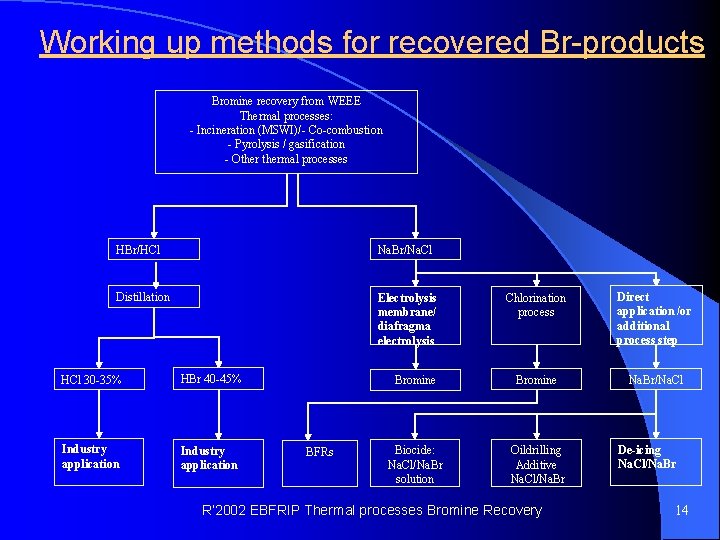
Working up methods for recovered Br-products Bromine recovery from WEEE Thermal processes: - Incineration (MSWI)/- Co-combustion - Pyrolysis / gasification - Othermal processes HBr/HCl Na. Br/Na. Cl Distillation Electrolysis membrane/ diafragma electrolysis HCl 30 -35% HBr 40 -45% Industry application BFRs Chlorination process Direct application /or additional process step Bromine Na. Br/Na. Cl Biocide: Na. Cl/Na. Br solution Oildrilling Additive Na. Cl/Na. Br R’ 2002 EBFRIP Thermal processes Bromine Recovery De-icing Na. Cl/Na. Br 14
Status: Bromine Recovery from WEEE l. Basic process study HBr recovery l. Evaluation to install an additional distillation column to a MSWI (or Therm. Process) for HBr l. The bromine recovery was tested with chlorine l Alternative option using peroxide to produce bromine out of HBr-stream l. Additional corrosion study by TNO Holland R’ 2002 EBFRIP Thermal processes Bromine Recovery 15
Bromine Recycling in MSWI l MSWI needs to have wet scrubbing systems l An eco-efficiency for Br recycling operation in MSWC facility will be based on several factors: è Availability and composition of suitable E&E waste streams (F) è Market conditions for: Br 2, HBr or Na. Br è Availability of Chlorine on the site Commercial and technical decision will be influenced by economics of the recycling operation plus the context of implementation of the proposed EU Directive on WEEE R’ 2002 EBFRIP Thermal processes Bromine Recovery 16
MSWC or othermal process Income streams Example of a dedicated or multipurpose facility: • (Co-)feed 4 tonnes per hour of WEEE plastics • A potential of recycling 83 kg/h of Br • 660 tonnes of Br or 1250 ton/y of HBr 47% The investment for HBr recovery will be between 2 -3 Million Euro depending on the local situation R’ 2002 EBFRIP Thermal processes Bromine Recovery 17
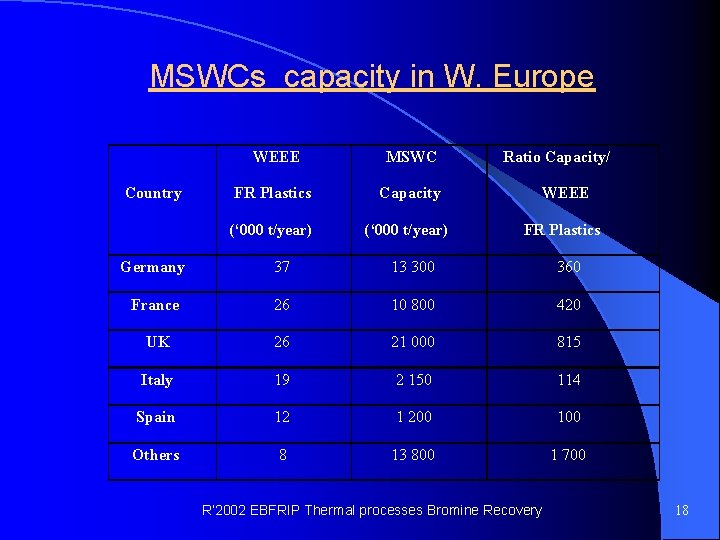
MSWCs capacity in W. Europe Country WEEE MSWC Ratio Capacity/ FR Plastics Capacity WEEE (‘ 000 t/year) FR Plastics Germany 37 13 300 360 France 26 10 800 420 UK 26 21 000 815 Italy 19 2 150 114 Spain 12 1 200 100 Others 8 13 800 1 700 R’ 2002 EBFRIP Thermal processes Bromine Recovery 18
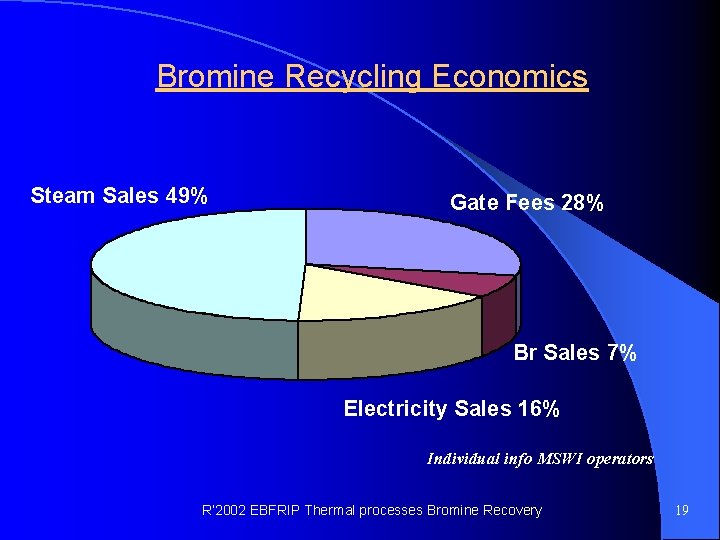
Bromine Recycling Economics Steam Sales 49% Gate Fees 28% Br Sales 7% Electricity Sales 16% Individual info MSWI operators R’ 2002 EBFRIP Thermal processes Bromine Recovery 19
Overall conclusion (1) l Br recovery from WEEE plastics with BFRs is technically, economically and ecologically feasible l Halogens in plastics are transformed mainly into HCl or HBr and can be recovered l The investment for an additional unit will be 2 -3 Million Euro depending the local situation R’ 2002 EBFRIP Thermal processes Bromine Recovery 20
Overall conclusions (2) l Energy recovery and feedstock recycling can play an important role in a waste management concept for plastics containing BFRs l EBFRIP continues to further technical understanding of BFRs containing of waste management processes via full scale trials and corrosion study in thermal processes Option for Sustainable bromine production? YES R’ 2002 EBFRIP Thermal processes Bromine Recovery 21
Acknowledgements The authors wish to thank l FZK, Tamara pilot plant: practical experiments to produce Br products - J. Vehlow and his group l European Plastics Council, APME: co-sponsored of TAMARA trial - F. Mark and H. Fish l Energy Research Centre of the Netherlands (ECN): pyromaat pilot trial - A. Oudhuis and H. Boerrigter l BSEF as co-sponsor of the practical experiments on bromine recovery R’ 2002 EBFRIP Thermal processes Bromine Recovery 22
For more information, visit: TAMARA report on E&E plastics containing BFRs: WWW. APME. ORG All studies will be published via: R’ 2002 EBFRIP Thermal processes Bromine Recovery 23
- Slides: 23