
Broken Symmetry First Observation CP Violation in b
Broken Symmetry: First Observation CP Violation in b Quark System Vivek Sharma University of California, San Diego UCSD Colloquium Vivek Sharma
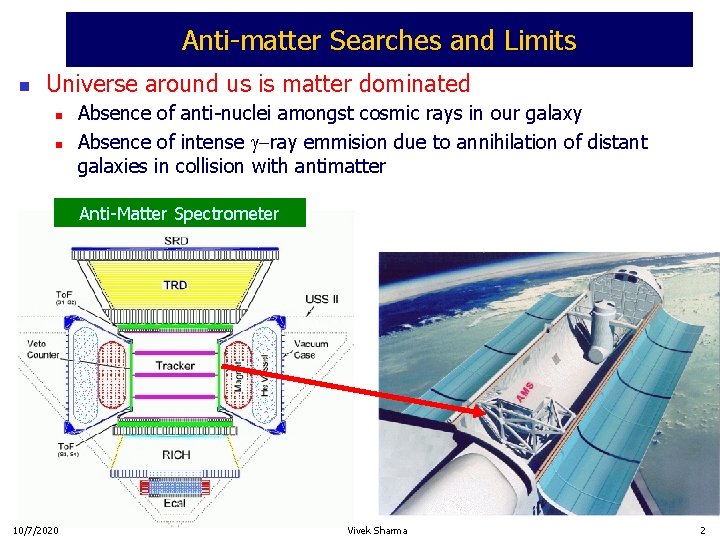
Anti-matter Searches and Limits n Universe around us is matter dominated n n Absence of anti-nuclei amongst cosmic rays in our galaxy Absence of intense g ray emmision due to annihilation of distant galaxies in collision with antimatter Anti-Matter Spectrometer 10/7/2020 Vivek Sharma 2
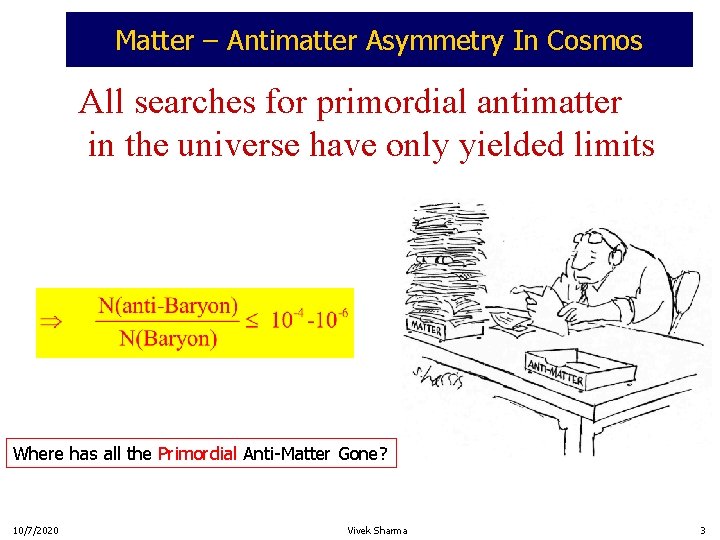
Matter – Antimatter Asymmetry In Cosmos All searches for primordial antimatter in the universe have only yielded limits Where has all the Primordial Anti-Matter Gone? 10/7/2020 Vivek Sharma 3
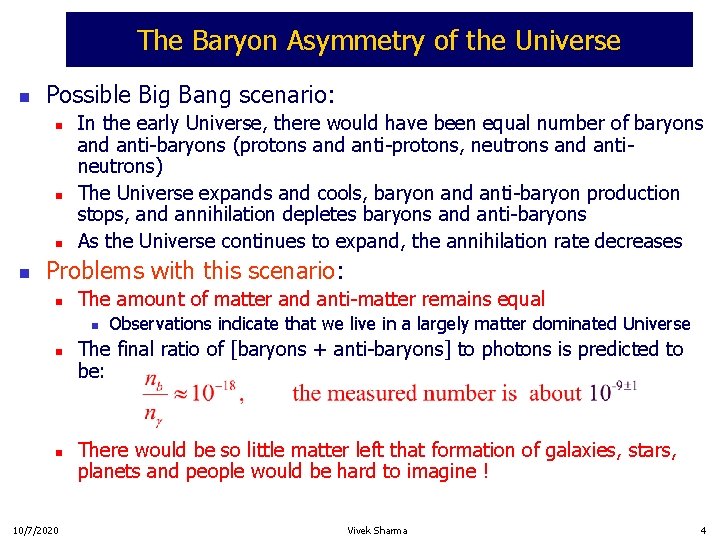
The Baryon Asymmetry of the Universe n Possible Big Bang scenario: n n In the early Universe, there would have been equal number of baryons and anti-baryons (protons and anti-protons, neutrons and antineutrons) The Universe expands and cools, baryon and anti-baryon production stops, and annihilation depletes baryons and anti-baryons As the Universe continues to expand, the annihilation rate decreases Problems with this scenario: n The amount of matter and anti-matter remains equal n n n 10/7/2020 Observations indicate that we live in a largely matter dominated Universe The final ratio of [baryons + anti-baryons] to photons is predicted to be: There would be so little matter left that formation of galaxies, stars, planets and people would be hard to imagine ! Vivek Sharma 4
Generating the Baryon Asymmetry n n n In 1967, Sakharov showed that the generation of net baryon number requires: 1. Baryon number violating processes (e. g. proton decay) 2. Non-equilibrium state during the expansion, therefore unequal number of particles and anti-particles 3. C and CP symmetry Violation Many theories of Baryogenesis have been constructed using plausible assumptions but none is satisfying/testable At the core of all this is the phenomenon of CP symmetry Violation What is CP Symmetry Violation and what evidence do we have for CPV in Nature ? 10/7/2020 Vivek Sharma 5
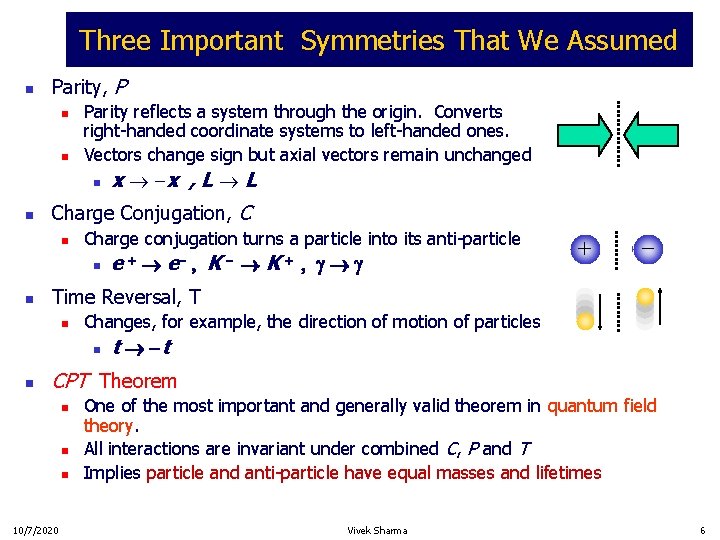
Three Important Symmetries That We Assumed n Parity, P n n Parity reflects a system through the origin. Converts right-handed coordinate systems to left-handed ones. Vectors change sign but axial vectors remain unchanged n n Charge Conjugation, C n Charge conjugation turns a particle into its anti-particle n n e e , K K + - - + , g g + Time Reversal, T n Changes, for example, the direction of motion of particles n n x x , L L t -t CPT Theorem n n n 10/7/2020 One of the most important and generally valid theorem in quantum field theory. All interactions are invariant under combined C, P and T Implies particle and anti-particle have equal masses and lifetimes Vivek Sharma 6
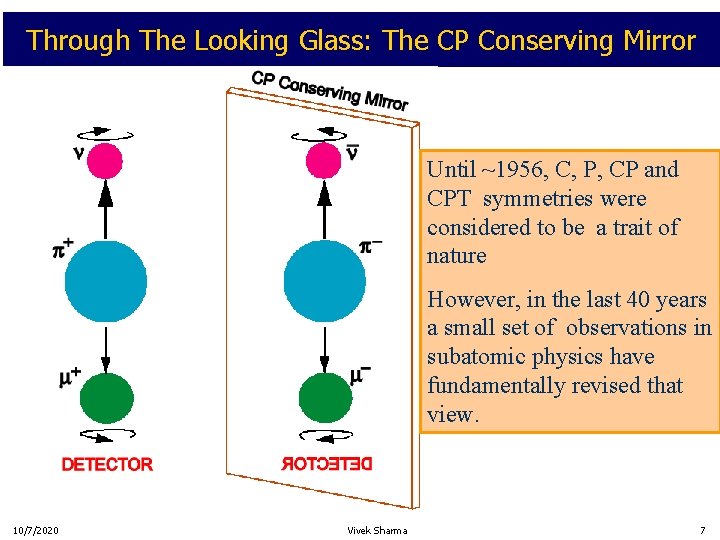
Through The Looking Glass: The CP Conserving Mirror Until ~1956, C, P, CP and CPT symmetries were considered to be a trait of nature However, in the last 40 years a small set of observations in subatomic physics have fundamentally revised that view. 10/7/2020 Vivek Sharma 7
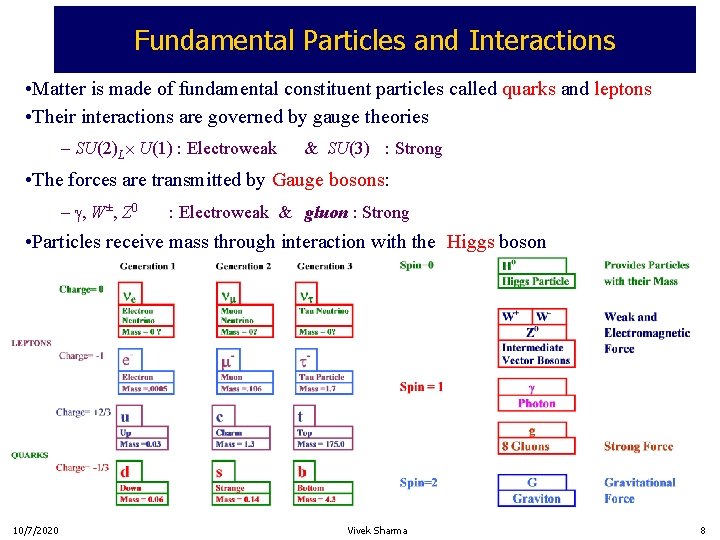
Fundamental Particles and Interactions • Matter is made of fundamental constituent particles called quarks and leptons • Their interactions are governed by gauge theories – SU(2)L U(1) : Electroweak & SU(3) : Strong • The forces are transmitted by Gauge bosons: – g, W±, Z 0 : Electroweak & gluon : Strong • Particles receive mass through interaction with the Higgs boson 10/7/2020 Vivek Sharma 8
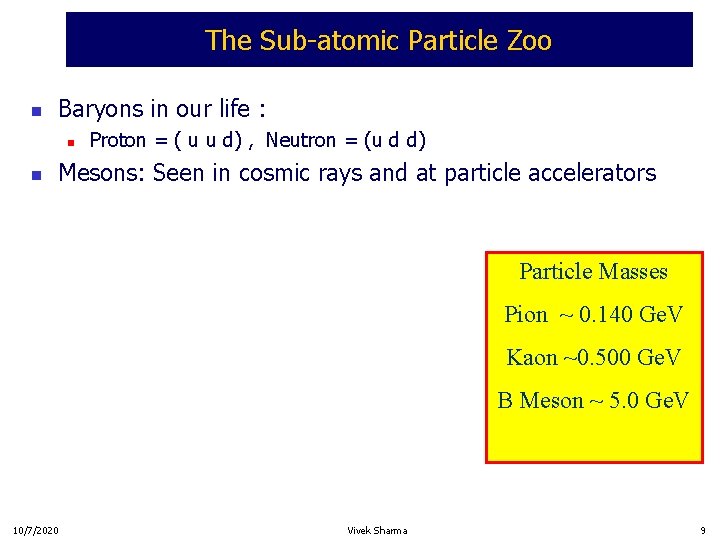
The Sub-atomic Particle Zoo n Baryons in our life : n n Proton = ( u u d) , Neutron = (u d d) Mesons: Seen in cosmic rays and at particle accelerators Particle Masses Pion ~ 0. 140 Ge. V Kaon ~0. 500 Ge. V B Meson ~ 5. 0 Ge. V 10/7/2020 Vivek Sharma 9
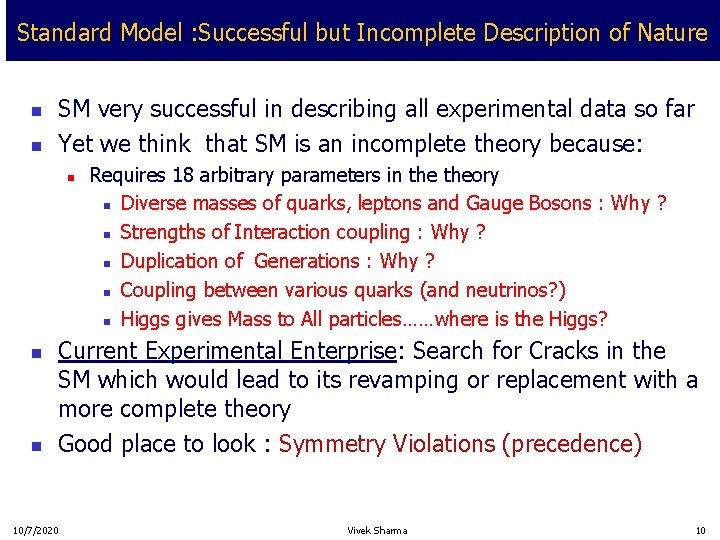
Standard Model : Successful but Incomplete Description of Nature n n SM very successful in describing all experimental data so far Yet we think that SM is an incomplete theory because: n n n Requires 18 arbitrary parameters in theory n Diverse masses of quarks, leptons and Gauge Bosons : Why ? n Strengths of Interaction coupling : Why ? n Duplication of Generations : Why ? n Coupling between various quarks (and neutrinos? ) n Higgs gives Mass to All particles……where is the Higgs? Current Experimental Enterprise: Search for Cracks in the SM which would lead to its revamping or replacement with a more complete theory Good place to look : Symmetry Violations (precedence) 10/7/2020 Vivek Sharma 10
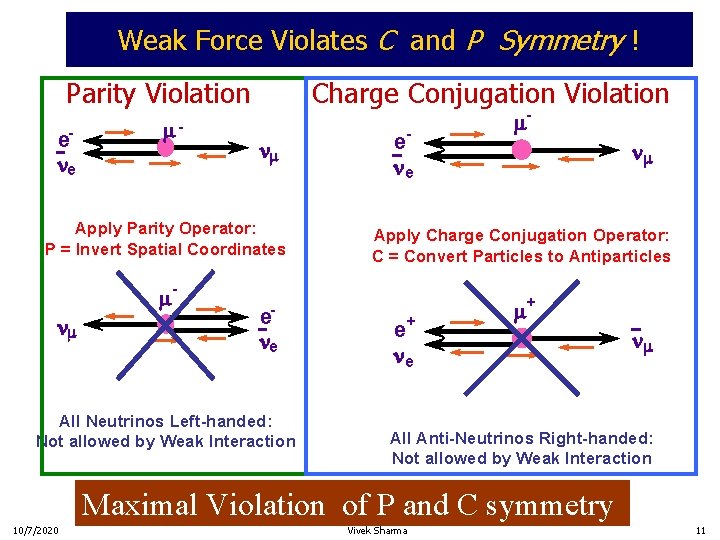
Weak Force Violates C and P Symmetry ! Parity Violation ene m- Charge Conjugation Violation nm Apply Parity Operator: P = Invert Spatial Coordinates ene nm - e ne All Neutrinos Left-handed: Not allowed by Weak Interaction nm Apply Charge Conjugation Operator: C = Convert Particles to Antiparticles - m m- e+ ne m+ nm All Anti-Neutrinos Right-handed: Not allowed by Weak Interaction Maximal Violation of P and C symmetry 10/7/2020 Vivek Sharma 11
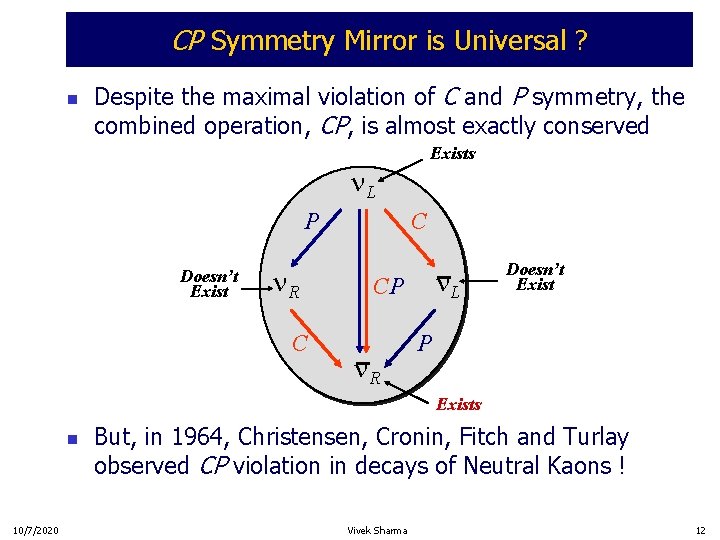
CP Symmetry Mirror is Universal ? n Despite the maximal violation of C and P symmetry, the combined operation, CP, is almost exactly conserved Exists n. L P Doesn’t Exist n. R C C n. L CP n. R Doesn’t Exist P Exists n 10/7/2020 But, in 1964, Christensen, Cronin, Fitch and Turlay observed CP violation in decays of Neutral Kaons ! Vivek Sharma 12
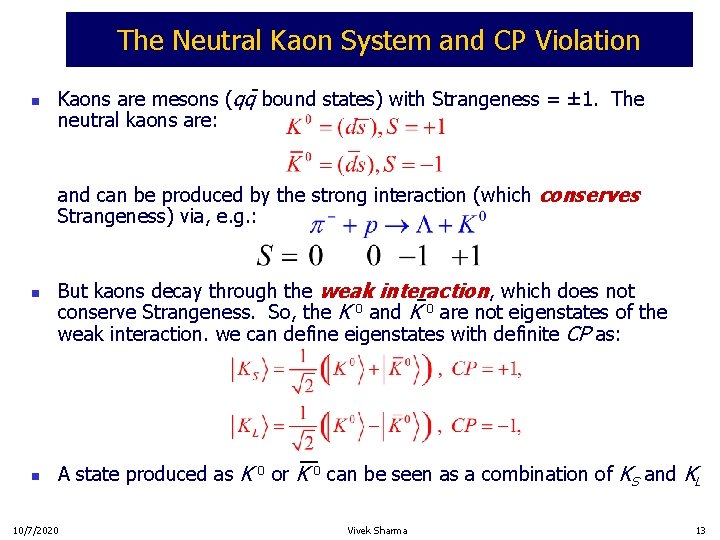
The Neutral Kaon System and CP Violation n Kaons are mesons (qq bound states) with Strangeness = ± 1. The neutral kaons are: and can be produced by the strong interaction (which conserves Strangeness) via, e. g. : n n But kaons decay through the weak interaction, which does not conserve Strangeness. So, the K 0 and K 0 are not eigenstates of the weak interaction. we can define eigenstates with definite CP as: A state produced as K 0 or K 0 can be seen as a combination of KS and KL 10/7/2020 Vivek Sharma 13
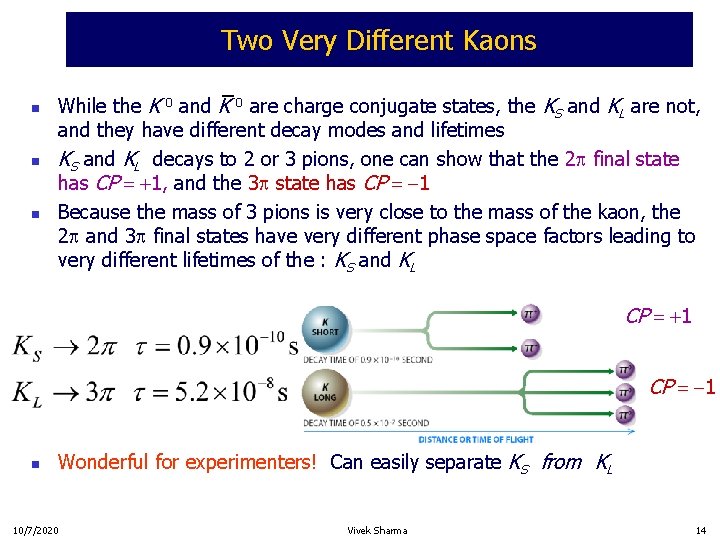
Two Very Different Kaons n n n While the K 0 and K 0 are charge conjugate states, the KS and KL are not, and they have different decay modes and lifetimes KS and KL decays to 2 or 3 pions, one can show that the 2 p final state has CP = +1, and the 3 p state has CP = 1 Because the mass of 3 pions is very close to the mass of the kaon, the 2 p and 3 p final states have very different phase space factors leading to very different lifetimes of the : KS and KL CP = +1 CP = 1 n Wonderful for experimenters! Can easily separate KS from KL 10/7/2020 Vivek Sharma 14
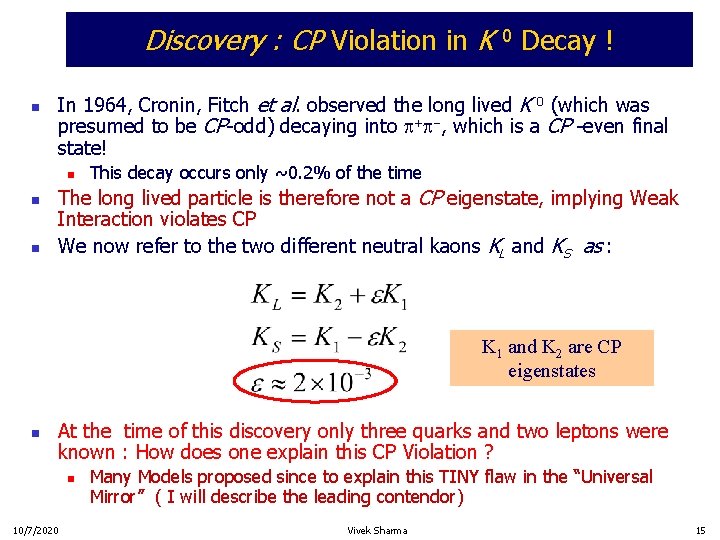
Discovery : CP Violation in K 0 Decay ! n In 1964, Cronin, Fitch et al. observed the long lived K 0 (which was presumed to be CP-odd) decaying into p+p , which is a CP -even final state! n n n This decay occurs only ~0. 2% of the time The long lived particle is therefore not a CP eigenstate, implying Weak Interaction violates CP We now refer to the two different neutral kaons KL and KS as : K 1 and K 2 are CP eigenstates n At the time of this discovery only three quarks and two leptons were known : How does one explain this CP Violation ? n 10/7/2020 Many Models proposed since to explain this TINY flaw in the “Universal Mirror” ( I will describe the leading contendor) Vivek Sharma 15
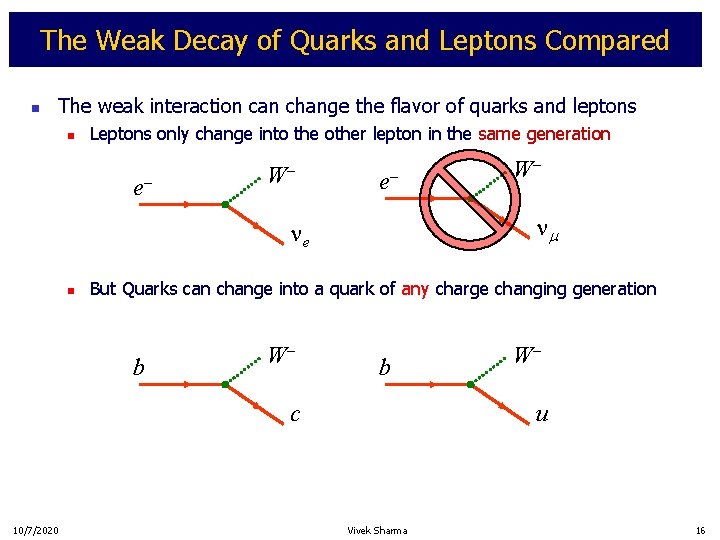
The Weak Decay of Quarks and Leptons Compared n The weak interaction can change the flavor of quarks and leptons n Leptons only change into the other lepton in the same generation e W e nm ne n But Quarks can change into a quark of any charge changing generation b W b c 10/7/2020 W W u Vivek Sharma 16
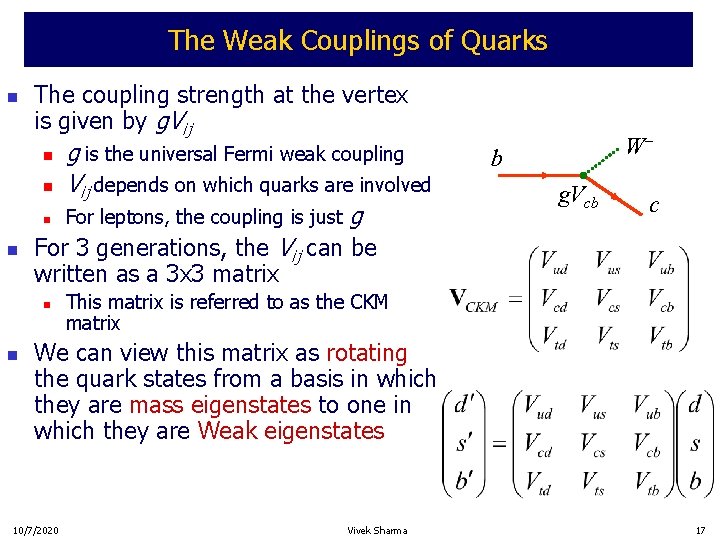
The Weak Couplings of Quarks n The coupling strength at the vertex is given by g. Vij g is the universal Fermi weak coupling n Vij depends on which quarks are involved n For leptons, the coupling is just g For 3 generations, the Vij can be n n b g. Vcb c written as a 3 x 3 matrix n n W This matrix is referred to as the CKM matrix We can view this matrix as rotating the quark states from a basis in which they are mass eigenstates to one in which they are Weak eigenstates 10/7/2020 Vivek Sharma 17
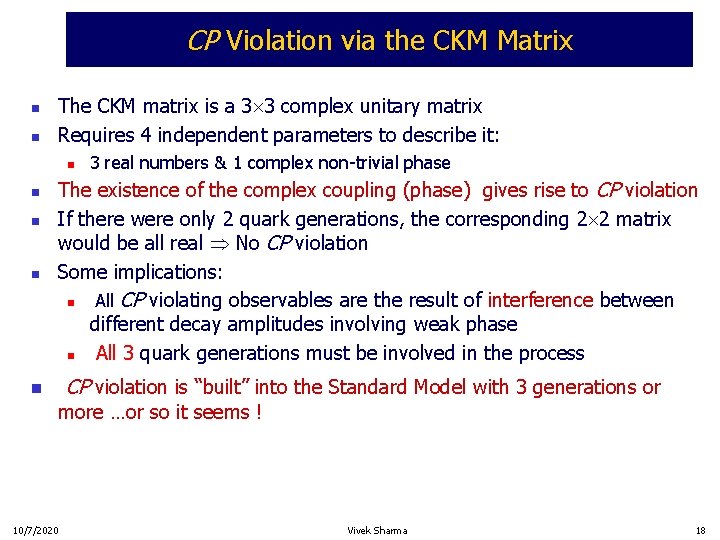
CP Violation via the CKM Matrix n n The CKM matrix is a 3 3 complex unitary matrix Requires 4 independent parameters to describe it: n n 3 real numbers & 1 complex non-trivial phase The existence of the complex coupling (phase) gives rise to CP violation If there were only 2 quark generations, the corresponding 2 2 matrix would be all real No CP violation Some implications: n All CP violating observables are the result of interference between different decay amplitudes involving weak phase n All 3 quark generations must be involved in the process CP violation is “built” into the Standard Model with 3 generations or n more …or so it seems ! 10/7/2020 Vivek Sharma 18
Standard Model and CP Violation How Did We Get Here ? A Quick Foray in History 10/7/2020 Vivek Sharma 19
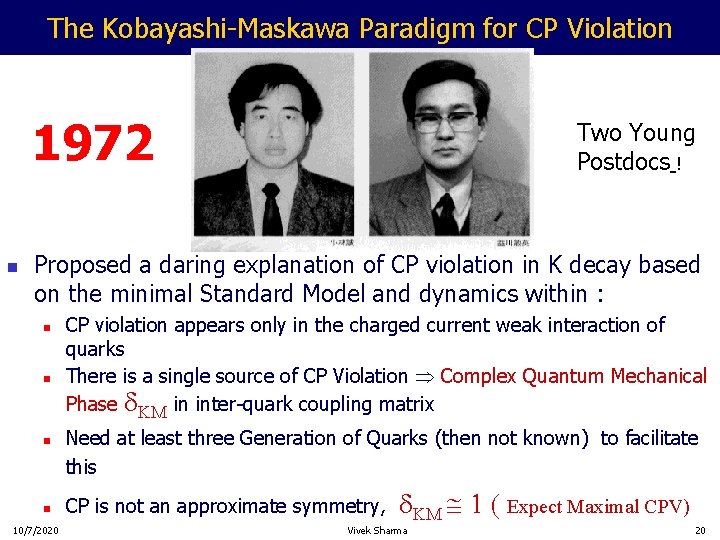
The Kobayashi-Maskawa Paradigm for CP Violation 1972 n Two Young Postdocs ! Proposed a daring explanation of CP violation in K decay based on the minimal Standard Model and dynamics within : n n 10/7/2020 CP violation appears only in the charged current weak interaction of quarks There is a single source of CP Violation Complex Quantum Mechanical Phase d M in inter-quark coupling matrix Need at least three Generation of Quarks (then not known) to facilitate this CP is not an approximate symmetry, d M 1 ( Expect Maximal CPV) Vivek Sharma 20
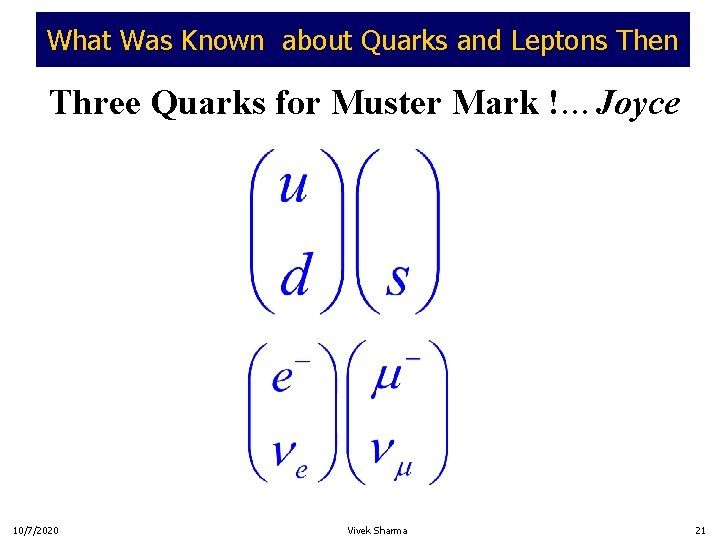
What Was Known about Quarks and Leptons Then Three Quarks for Muster Mark !…Joyce 10/7/2020 Vivek Sharma 21
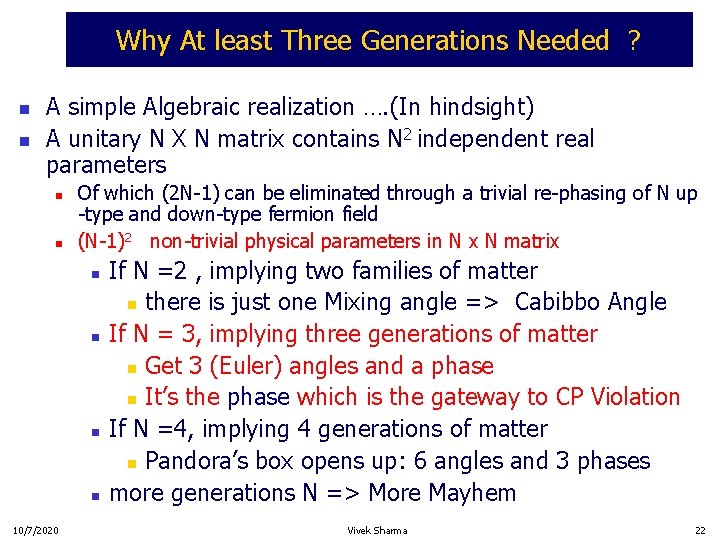
Why At least Three Generations Needed ? n n A simple Algebraic realization …. (In hindsight) A unitary N X N matrix contains N 2 independent real parameters n n Of which (2 N-1) can be eliminated through a trivial re-phasing of N up -type and down-type fermion field (N-1)2 non-trivial physical parameters in N x N matrix n n 10/7/2020 If N =2 , implying two families of matter n there is just one Mixing angle => Cabibbo Angle If N = 3, implying three generations of matter n Get 3 (Euler) angles and a phase n It’s the phase which is the gateway to CP Violation If N =4, implying 4 generations of matter n Pandora’s box opens up: 6 angles and 3 phases more generations N => More Mayhem Vivek Sharma 22
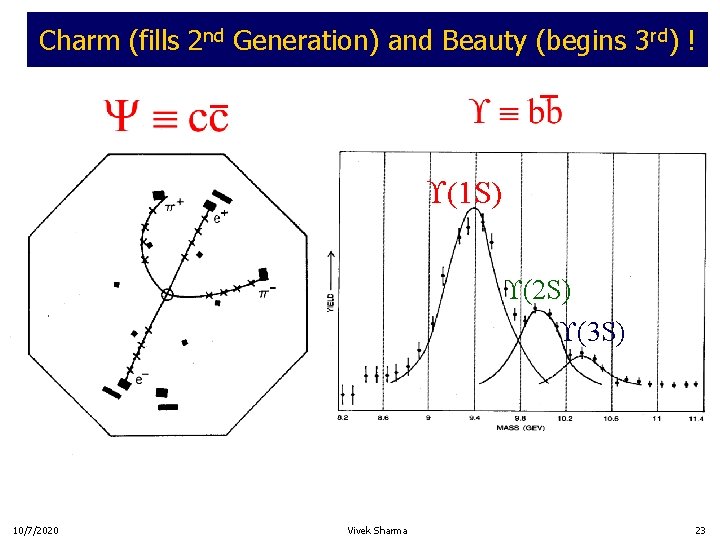
Charm (fills 2 nd Generation) and Beauty (begins 3 rd) ! (1 S) (2 S) (3 S) 10/7/2020 Vivek Sharma 23
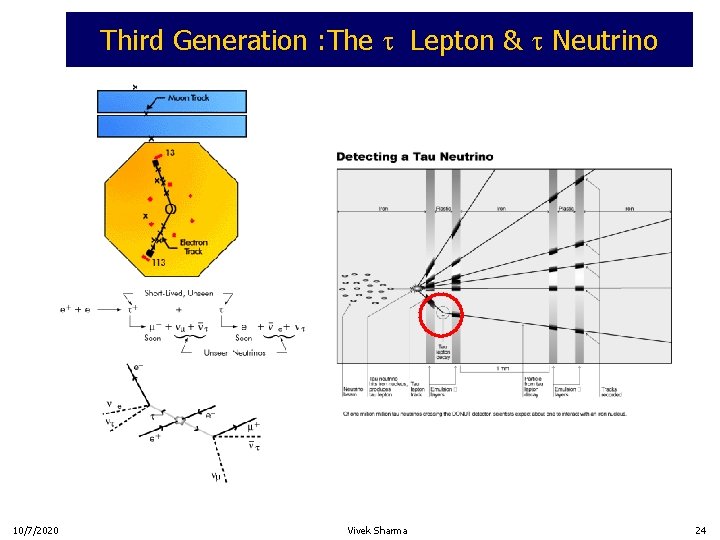
Third Generation : The t Lepton & t Neutrino 10/7/2020 Vivek Sharma 24
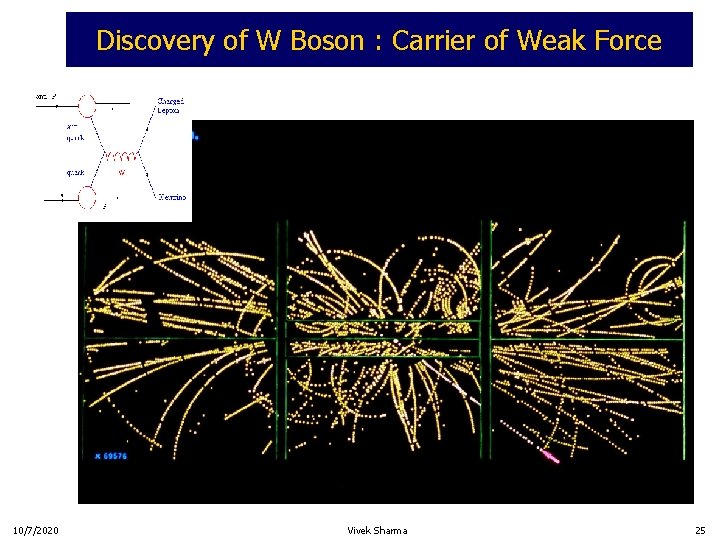
Discovery of W Boson : Carrier of Weak Force 10/7/2020 Vivek Sharma 25
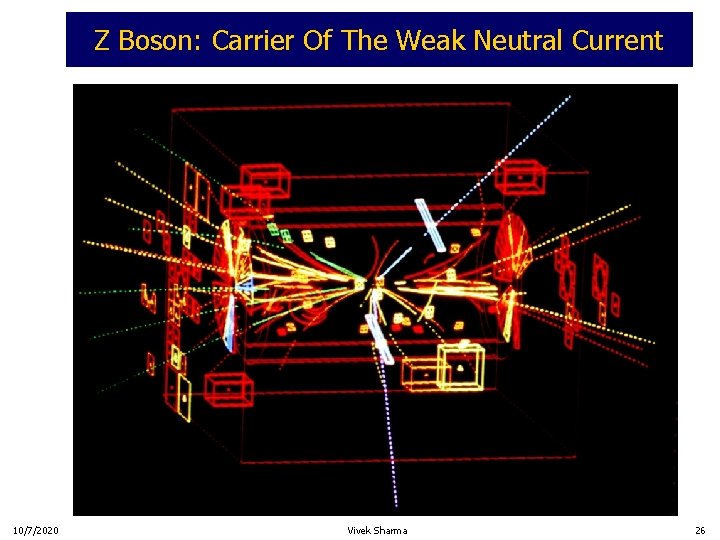
Z Boson: Carrier Of The Weak Neutral Current 10/7/2020 Vivek Sharma 26
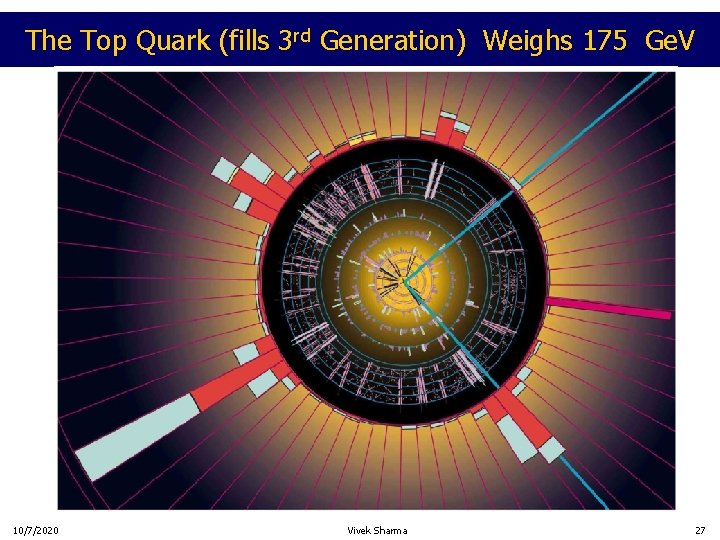
The Top Quark (fills 3 rd Generation) Weighs 175 Ge. V 10/7/2020 Vivek Sharma 27

Number of Light Neutrino Families: LEP@CERN There are only three generations of Light neutrinos 10/7/2020 Vivek Sharma 28
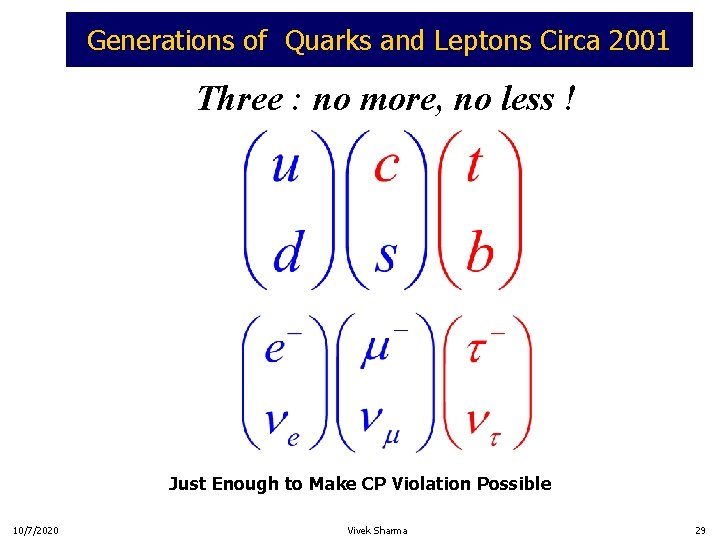
Generations of Quarks and Leptons Circa 2001 Three : no more, no less ! Just Enough to Make CP Violation Possible 10/7/2020 Vivek Sharma 29
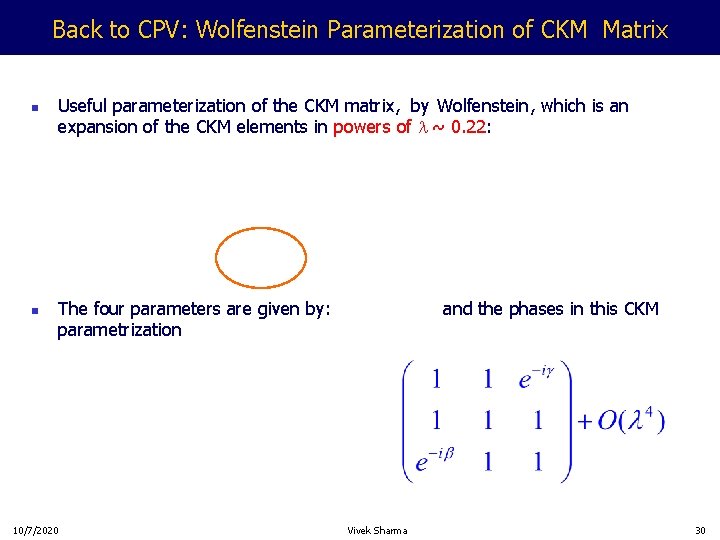
Back to CPV: Wolfenstein Parameterization of CKM Matrix n n Useful parameterization of the CKM matrix, by Wolfenstein, which is an expansion of the CKM elements in powers of l ~ 0. 22: The four parameters are given by: parametrization 10/7/2020 and the phases in this CKM Vivek Sharma 30
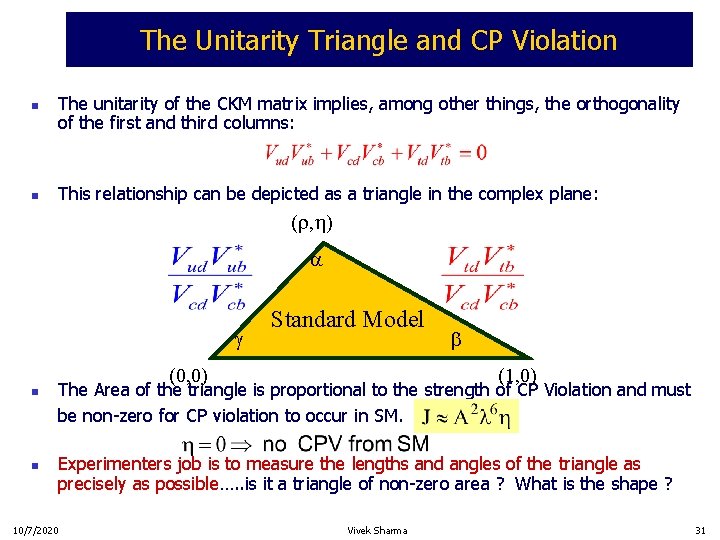
The Unitarity Triangle and CP Violation n n The unitarity of the CKM matrix implies, among other things, the orthogonality of the first and third columns: This relationship can be depicted as a triangle in the complex plane: (r, ) a g n n Standard Model (0, 0) (1, 0) The Area of the triangle is proportional to the strength of CP Violation and must be non-zero for CP violation to occur in SM. Experimenters job is to measure the lengths and angles of the triangle as precisely as possible…. . is it a triangle of non-zero area ? What is the shape ? 10/7/2020 Vivek Sharma 31
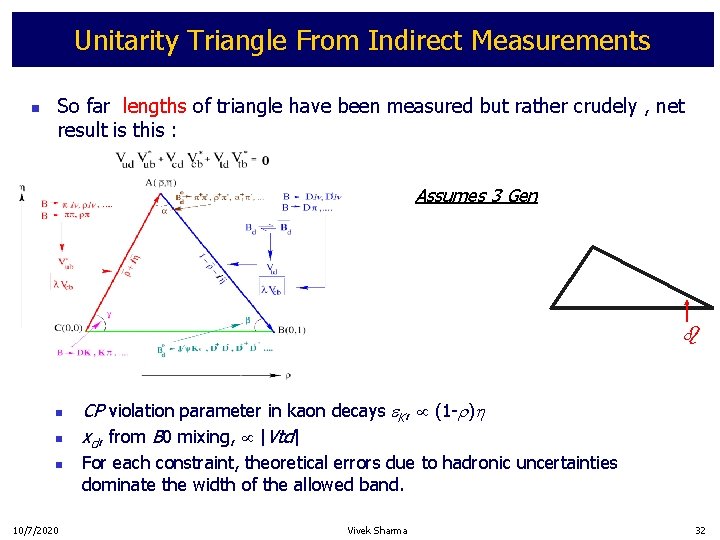
Unitarity Triangle From Indirect Measurements n So far lengths of triangle have been measured but rather crudely , net result is this : Assumes 3 Gen b n n n 10/7/2020 CP violation parameter in kaon decays e. K, (1 -r)h xd, from B 0 mixing, |Vtd| For each constraint, theoretical errors due to hadronic uncertainties dominate the width of the allowed band. Vivek Sharma 32
Is CKM Matrix the (only) Source of CP Violation? n The observed CP violation in Kaon decays is consistent with the CKM picture, but this is not a “test” ! n n Post-prediction ! But KM paradigm leads to large, predictable CP violating asymmetries in the decays of B mesons (Exptal. tests) Other sources of CP violation could give dramatically different results in the B meson system Why should we expect there to be other (new physics) mechanisms for CP violation? n It is difficult for CKM CP violation to generate the large observed matter/anti-matter asymmetry in the Universe (e. g. Electroweak Baryogenesis calculations) n 10/7/2020 There must be something else ! Can we see its manifestation in B Decay? Vivek Sharma 33
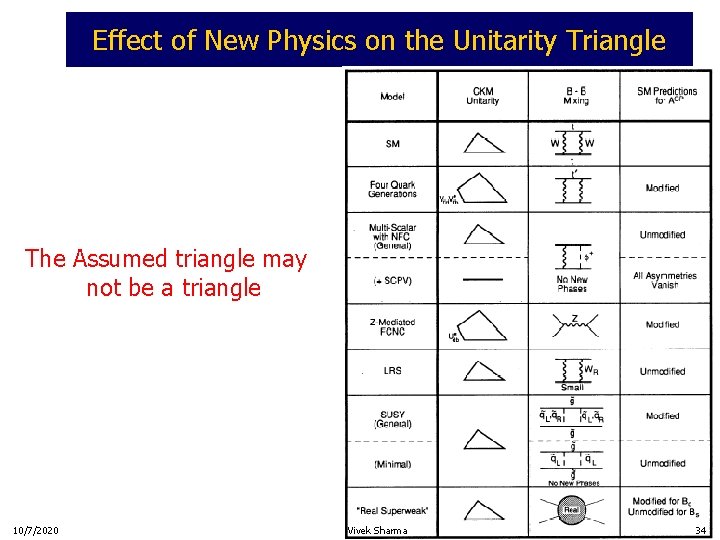
Effect of New Physics on the Unitarity Triangle The Assumed triangle may not be a triangle 10/7/2020 Vivek Sharma 34
The Definitive Experimental Test B Meson, a souped up version of Kaons, is the New, Theoretically Cleaner Laboratory for Tests of the Origin of CP Violation in Subatomic Decays 10/7/2020 Vivek Sharma 35
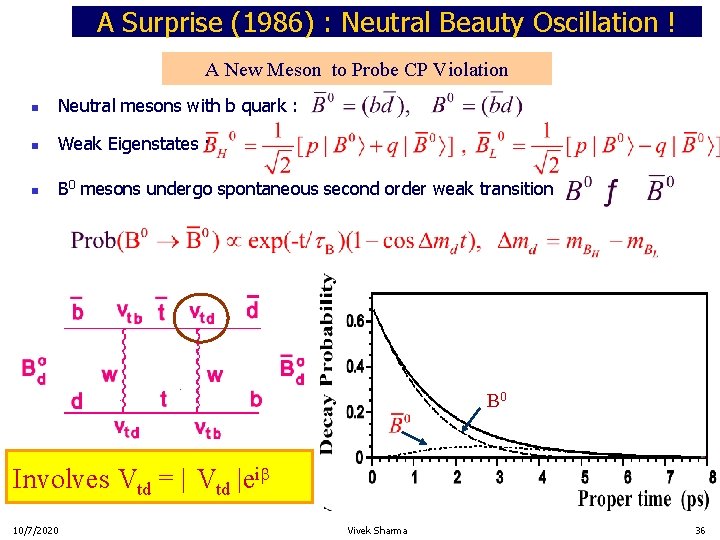
A Surprise (1986) : Neutral Beauty Oscillation ! A New Meson to Probe CP Violation n Neutral mesons with b quark : n Weak Eigenstates : n B 0 mesons undergo spontaneous second order weak transition B 0 Involves Vtd = | Vtd |ei 10/7/2020 Vivek Sharma 36
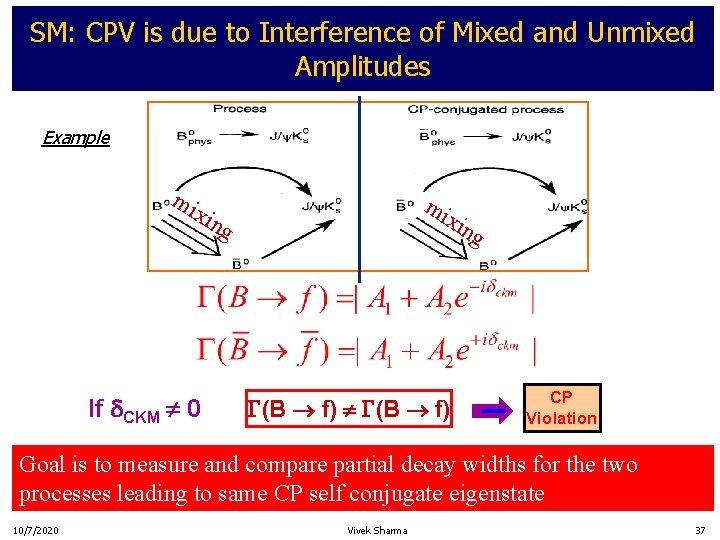
SM: CPV is due to Interference of Mixed and Unmixed Amplitudes Example mi mi xin If d. CKM ¹ 0 xin g G(B f) ¹ G(B f) g CP Violation Goal is to measure and compare partial decay widths for the two processes leading to same CP self conjugate eigenstate 10/7/2020 Vivek Sharma 37
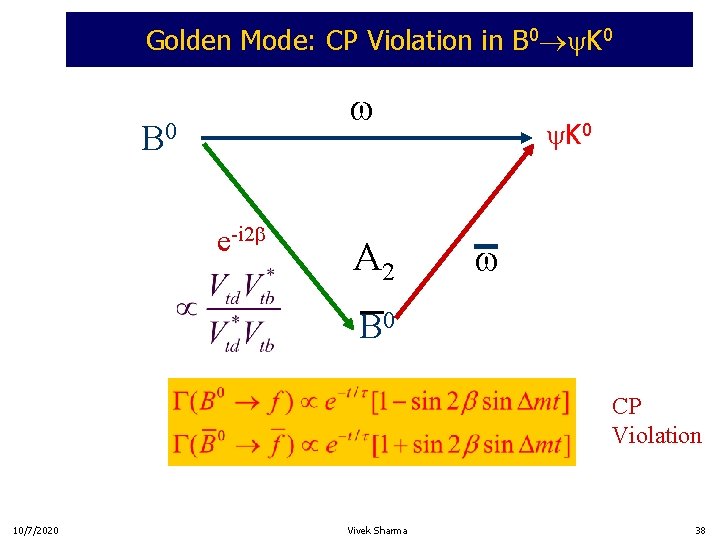
Golden Mode: CP Violation in B 0 K 0 w B 0 e-i 2 A 2 K 0 w B 0 CP Violation 10/7/2020 Vivek Sharma 38
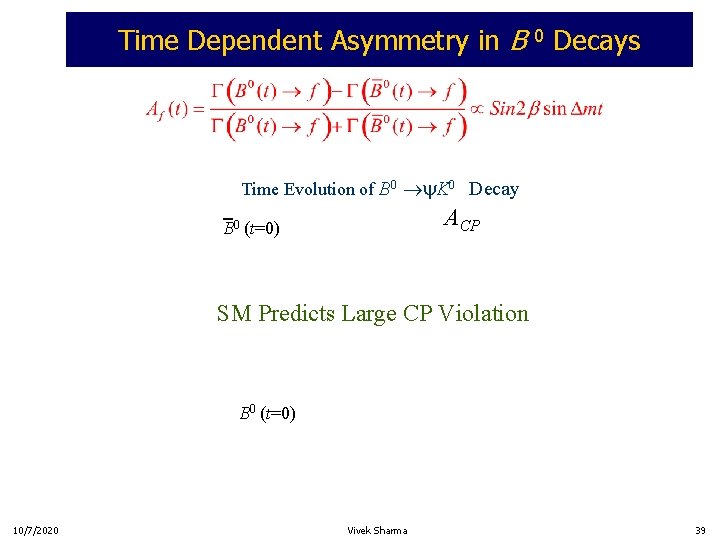
Time Dependent Asymmetry in B 0 Decays Time Evolution of B 0 K 0 Decay ACP B 0 (t=0) SM Predicts Large CP Violation B 0 (t=0) 10/7/2020 Vivek Sharma 39

How to Do The Experiment Collide Matter-Antimatter Beams (4 S) e+ e- Ebeam= 5. 29 Ge. V e+ g e“Large” Cross section , but there is a price to pay ( Quantum Entanglement) 10/7/2020 Vivek Sharma 40
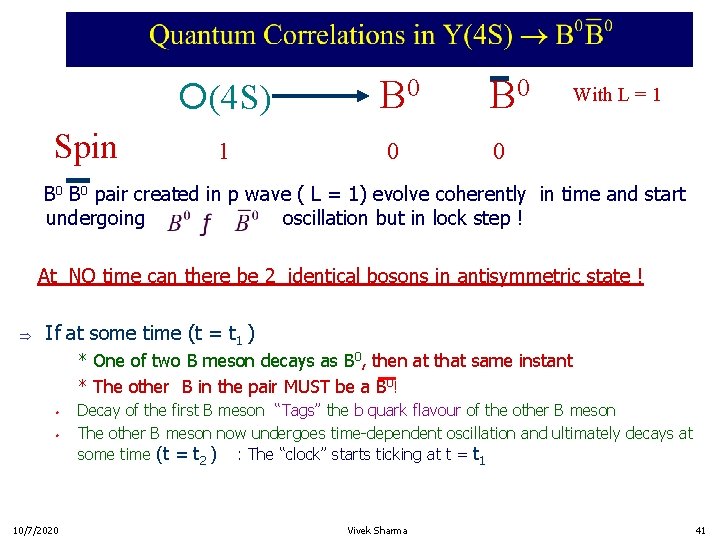
Spin (4 S) B 0 1 0 B 0 With L = 1 0 B 0 pair created in p wave ( L = 1) evolve coherently in time and start undergoing oscillation but in lock step ! At NO time can there be 2 identical bosons in antisymmetric state ! If at some time (t = t 1 ) * One of two B meson decays as B 0, then at that same instant * The other B in the pair MUST be a B 0! • • 10/7/2020 Decay of the first B meson “Tags” the b quark flavour of the other B meson The other B meson now undergoes time-dependent oscillation and ultimately decays at some time (t = t 2 ) : The “clock” starts ticking at t = t 1 Vivek Sharma 41
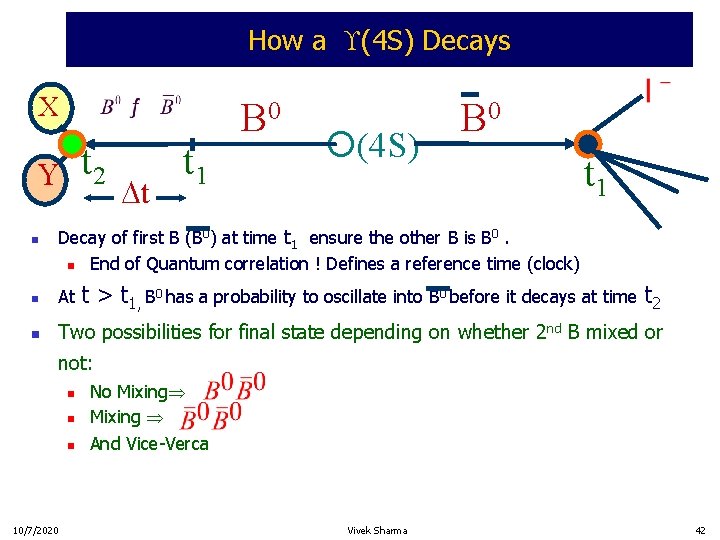
How a (4 S) Decays X t 2 Y n t t 1 B 0 (4 S) B 0 t 1 Decay of first B (B 0) at time t 1 ensure the other B is B 0. n End of Quantum correlation ! Defines a reference time (clock) t > t 1, B 0 has a probability to oscillate into B 0 before it decays at time t 2 n At n Two possibilities for final state depending on whether 2 nd B mixed or not: n n n 10/7/2020 No Mixing And Vice-Verca Vivek Sharma 42
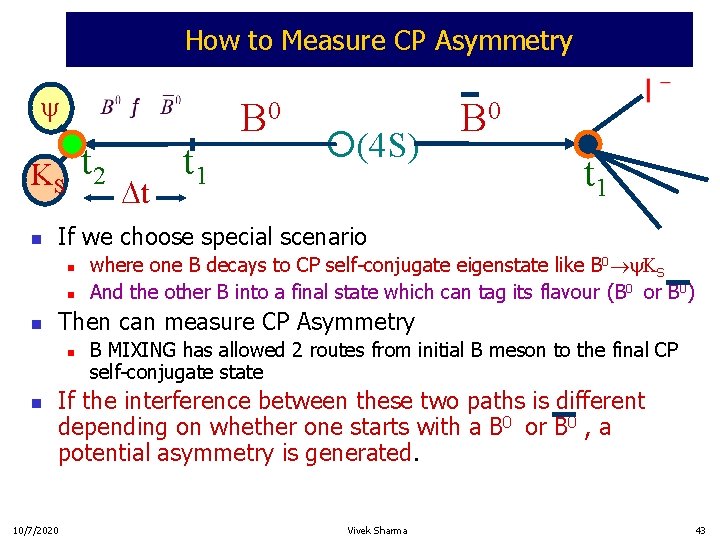
How to Measure CP Asymmetry KS t 2 n n t 1 where one B decays to CP self-conjugate eigenstate like B 0 S And the other B into a final state which can tag its flavour (B 0 or B 0) Then can measure CP Asymmetry n n (4 S) B 0 If we choose special scenario n n t t 1 B 0 B MIXING has allowed 2 routes from initial B meson to the final CP self-conjugate state If the interference between these two paths is different depending on whether one starts with a B 0 or B 0 , a potential asymmetry is generated. 10/7/2020 Vivek Sharma 43
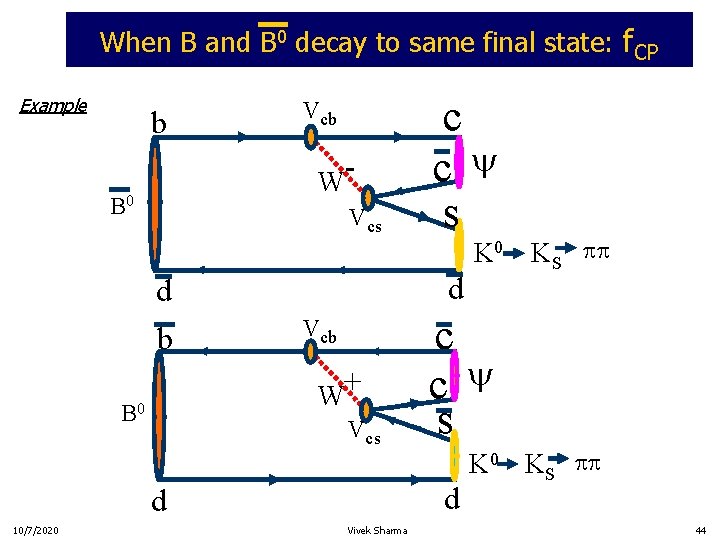
When B and B 0 decay to same final state: f. CP Example b Vcb W- B 0 Vcs d d b Vcb + W B 0 Vcs Vivek Sharma K 0 KS pp c c s d d 10/7/2020 c c s K 0 KS pp 44
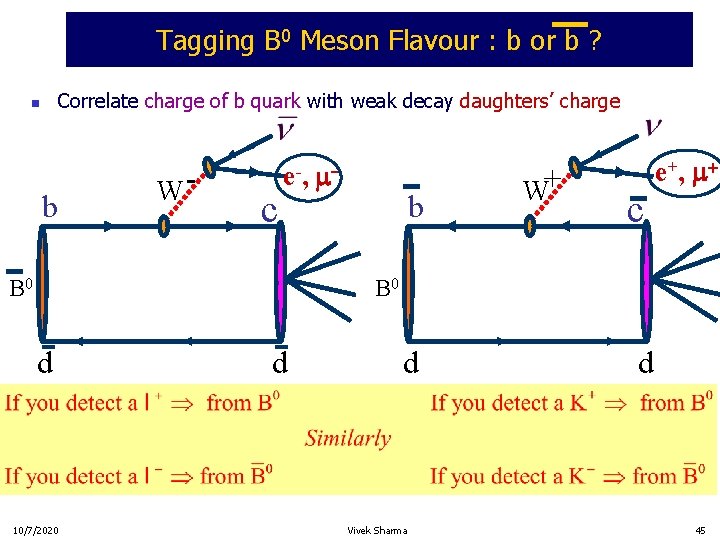
Tagging B 0 Meson Flavour : b or b ? Correlate charge of b quark with weak decay daughters’ charge n b W- c e -, m - b W+ c e + , m+ B 0 d 10/7/2020 d d Vivek Sharma d 45
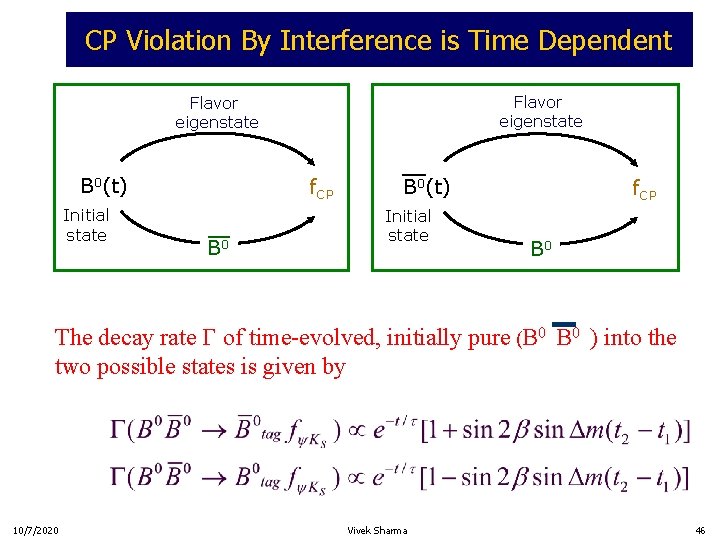
CP Violation By Interference is Time Dependent Flavor eigenstate B 0(t) Initial state f. CP B 0 The decay rate G of time-evolved, initially pure (B 0 ) into the two possible states is given by 10/7/2020 Vivek Sharma 46
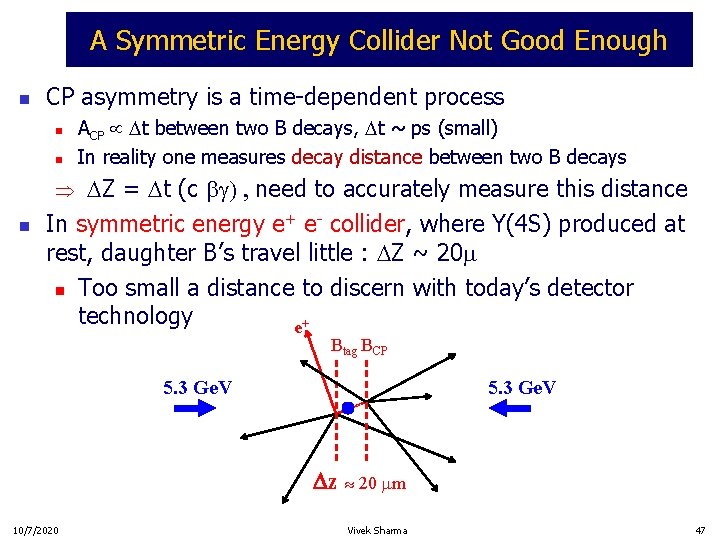
A Symmetric Energy Collider Not Good Enough n CP asymmetry is a time-dependent process n n ACP t between two B decays, t ~ ps (small) In reality one measures decay distance between two B decays Z = t (c g) , need to accurately measure this distance In symmetric energy e+ e- collider, where Y(4 S) produced at rest, daughter B’s travel little : Z ~ 20 m n Too small a distance to discern with today’s detector technology e+ n Btag BCP 5. 3 Ge. V Dz 20 mm 10/7/2020 Vivek Sharma 47
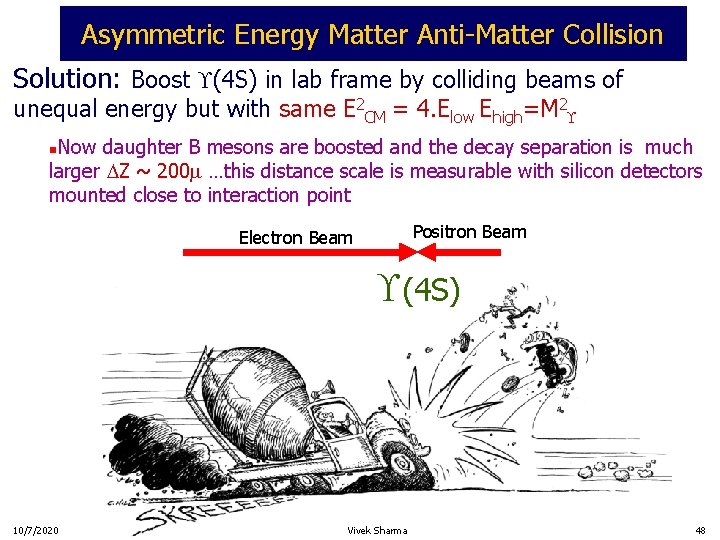
Asymmetric Energy Matter Anti-Matter Collision Solution: Boost (4 S) in lab frame by colliding beams of unequal energy but with same E 2 CM = 4. Elow Ehigh=M 2 Now daughter B mesons are boosted and the decay separation is much larger Z ~ 200 m …this distance scale is measurable with silicon detectors mounted close to interaction point n Positron Beam Electron Beam (4 S) 10/7/2020 Vivek Sharma 48
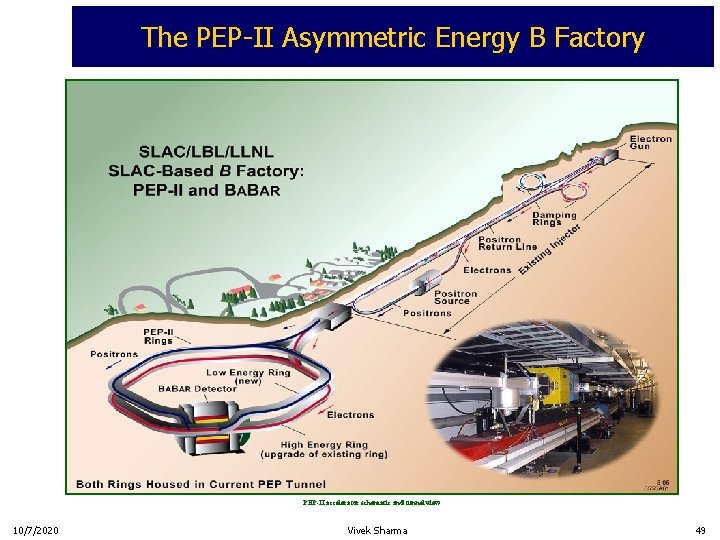
The PEP-II Asymmetric Energy B Factory PEP-II accelerator schematic and tunnel view 10/7/2020 Vivek Sharma 49
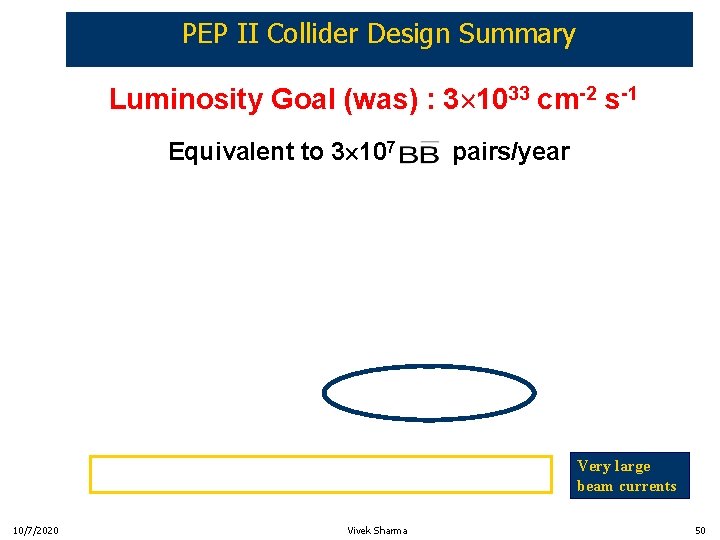
PEP II Collider Design Summary Luminosity Goal (was) : 3´ 1033 cm-2 s-1 Equivalent to 3´ 107 pairs/year Very large beam currents 10/7/2020 Vivek Sharma 50
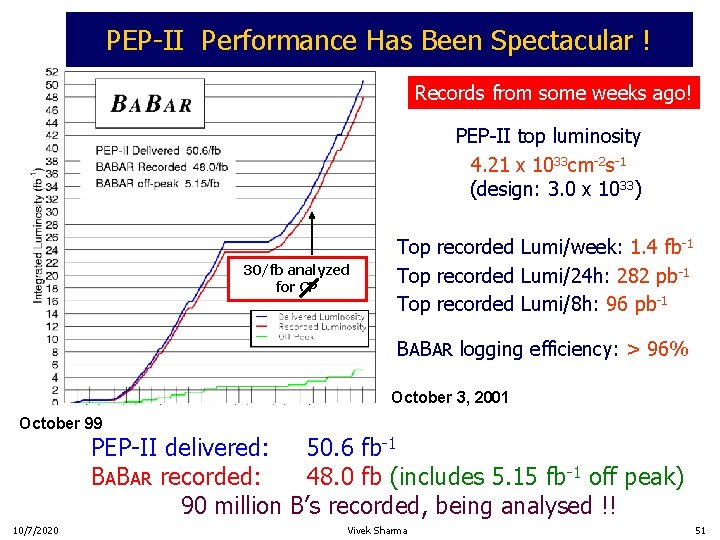
PEP-II Performance Has Been Spectacular ! Records from some weeks ago! PEP-II top luminosity 4. 21 x 1033 cm-2 s-1 (design: 3. 0 x 1033) 30/fb analyzed for CP Top recorded Lumi/week: 1. 4 fb-1 Top recorded Lumi/24 h: 282 pb-1 Top recorded Lumi/8 h: 96 pb-1 BABAR logging efficiency: > 96% October 3, 2001 October 99 PEP-II delivered: 50. 6 fb-1 BABAR recorded: 48. 0 fb (includes 5. 15 fb-1 off peak) 90 million B’s recorded, being analysed !! 10/7/2020 Vivek Sharma 51
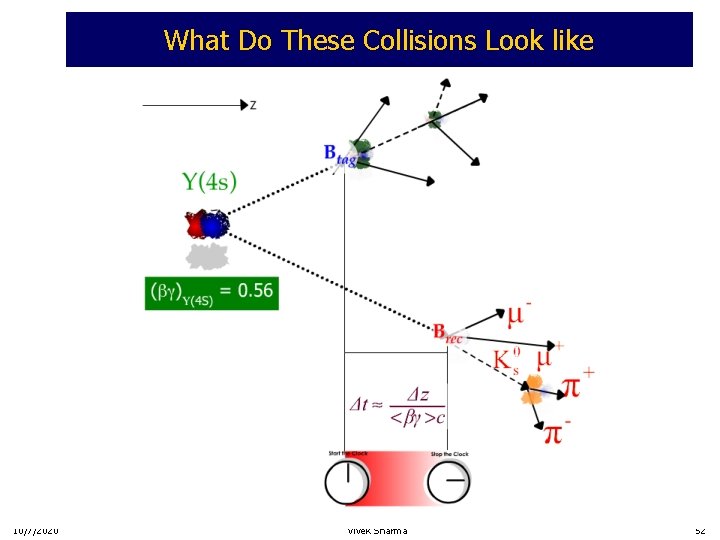
What Do These Collisions Look like 10/7/2020 Vivek Sharma 52
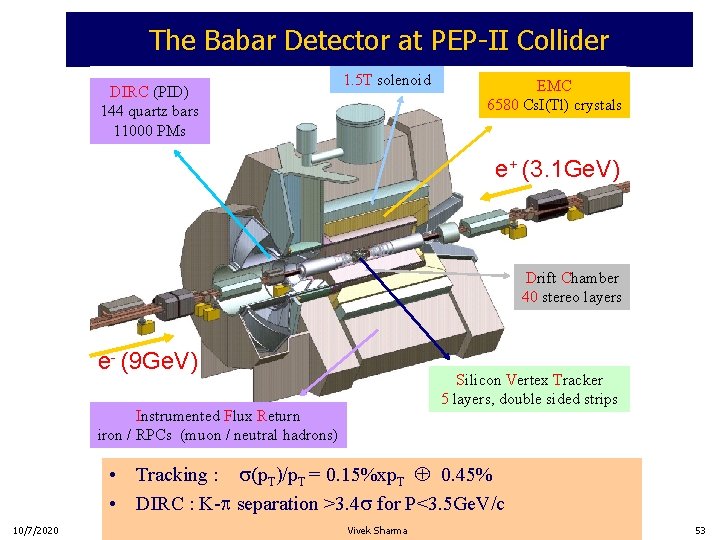
The Babar Detector at PEP-II Collider DIRC (PID) 144 quartz bars 11000 PMs 1. 5 T solenoid EMC 6580 Cs. I(Tl) crystals e+ (3. 1 Ge. V) Drift Chamber 40 stereo layers e- (9 Ge. V) Silicon Vertex Tracker 5 layers, double sided strips Instrumented Flux Return iron / RPCs (muon / neutral hadrons) • Tracking : s(p. T)/p. T = 0. 15%xp. T 0. 45% • DIRC : K-p separation >3. 4 s for P<3. 5 Ge. V/c 10/7/2020 Vivek Sharma 53
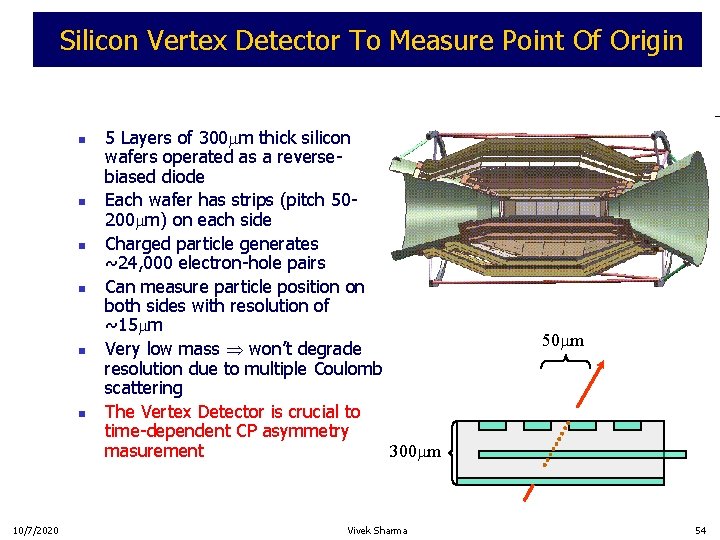
Silicon Vertex Detector To Measure Point Of Origin n n n 10/7/2020 5 Layers of 300 mm thick silicon wafers operated as a reversebiased diode Each wafer has strips (pitch 50200 mm) on each side Charged particle generates ~24, 000 electron-hole pairs Can measure particle position on both sides with resolution of ~15 mm Very low mass won’t degrade resolution due to multiple Coulomb scattering The Vertex Detector is crucial to time-dependent CP asymmetry masurement 300 mm Vivek Sharma 50 mm 54
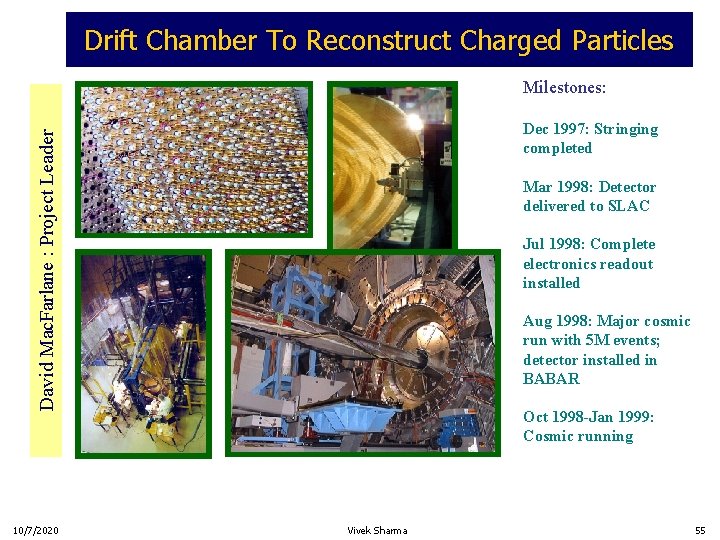
Drift Chamber To Reconstruct Charged Particles Milestones: David Mac. Farlane : Project Leader Dec 1997: Stringing completed 10/7/2020 Mar 1998: Detector delivered to SLAC Jul 1998: Complete electronics readout installed Aug 1998: Major cosmic run with 5 M events; detector installed in BABAR Oct 1998 -Jan 1999: Cosmic running Vivek Sharma 55
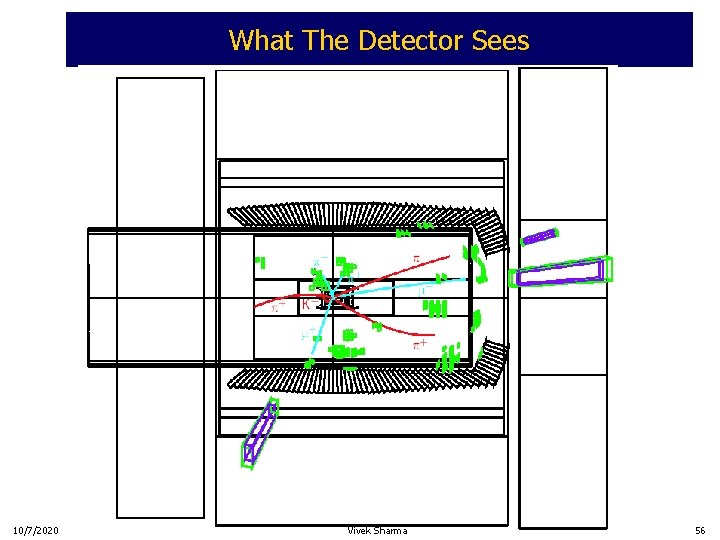
What The Detector Sees 10/7/2020 Vivek Sharma 56
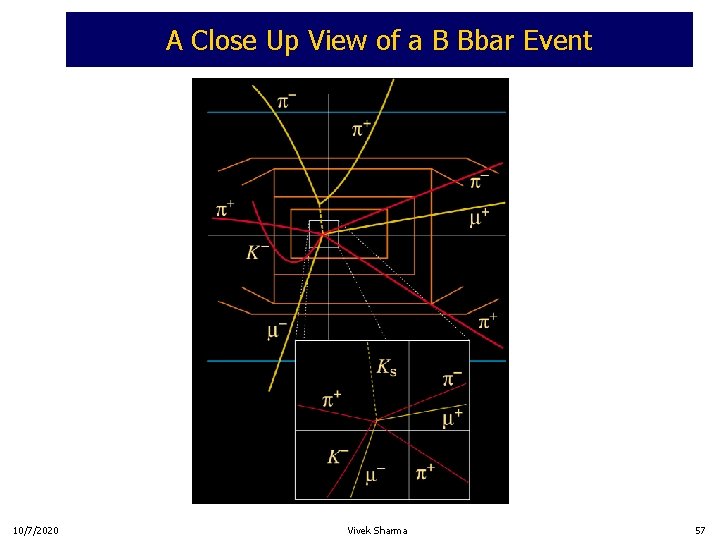
A Close Up View of a B Bbar Event 10/7/2020 Vivek Sharma 57
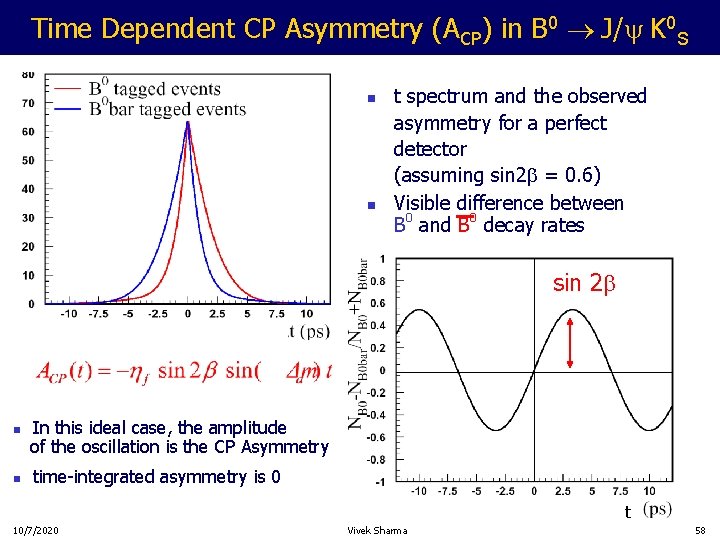
Time Dependent CP Asymmetry (ACP) in B 0 J/ K 0 S n n t spectrum and the observed asymmetry for a perfect detector (assuming sin 2 = 0. 6) Visible difference between B 0 and B 0 decay rates sin 2 n n In this ideal case, the amplitude of the oscillation is the CP Asymmetry time-integrated asymmetry is 0 t 10/7/2020 Vivek Sharma 58

Three Time-Dependent Measurement Needed to measure CP Asymmetry n CP Asymmetry measurement requires three time-dependent observations B lifetime t. B 0 ~ 1. 5 ps n B Oscillation Frequency m n CP Asymmetry : Sin 2 n 10/7/2020 Vivek Sharma 59
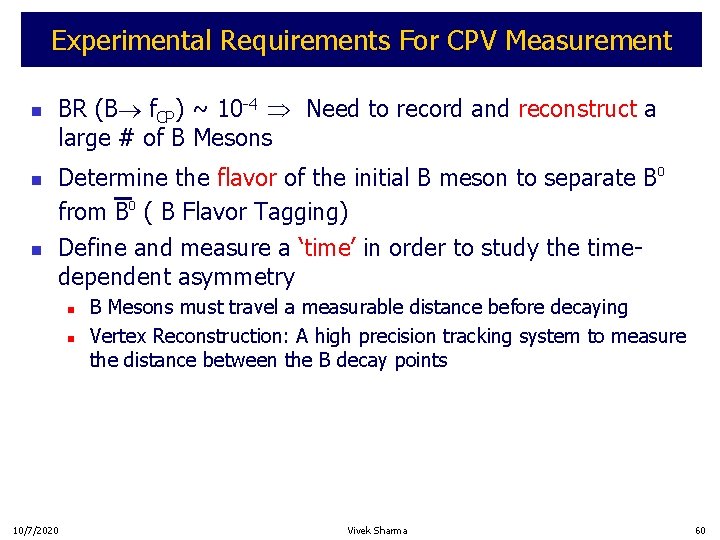
Experimental Requirements For CPV Measurement n n n BR (B f. CP) ~ 10 -4 Need to record and reconstruct a large # of B Mesons Determine the flavor of the initial B meson to separate B 0 from B 0 ( B Flavor Tagging) Define and measure a ‘time’ in order to study the timedependent asymmetry n n 10/7/2020 B Mesons must travel a measurable distance before decaying Vertex Reconstruction: A high precision tracking system to measure the distance between the B decay points Vivek Sharma 60
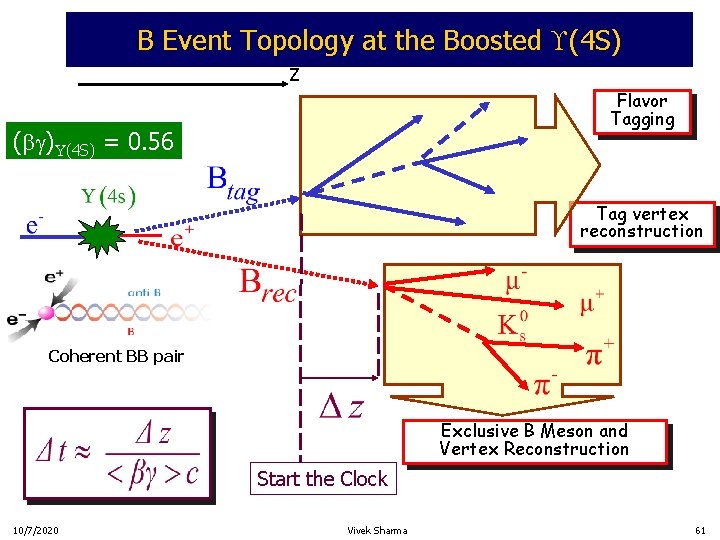
B Event Topology at the Boosted (4 S) z Flavor Tagging ( g)U(4 S) = 0. 56 Tag vertex reconstruction Coherent BB pair Exclusive B Meson and Vertex Reconstruction Start the Clock 10/7/2020 Vivek Sharma 61
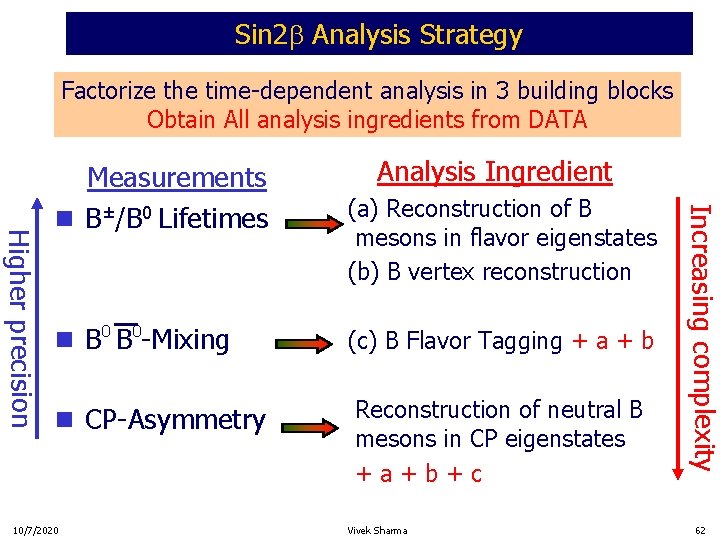
Sin 2 Analysis Strategy Factorize the time-dependent analysis in 3 building blocks Obtain All analysis ingredients from DATA n B 0 -Mixing n CP-Asymmetry 10/7/2020 Analysis Ingredient (a) Reconstruction of B mesons in flavor eigenstates (b) B vertex reconstruction (c) B Flavor Tagging + a + b Reconstruction of neutral B mesons in CP eigenstates +a+b+c Vivek Sharma Increasing complexity Higher precision Measurements n B±/B 0 Lifetimes 62
Calibrating the Detector Clock: Measure B Lifetime Need to Measure Small time intervals ~ 0. 5 ps for Asymmetry measurement 10/7/2020 Vivek Sharma 63
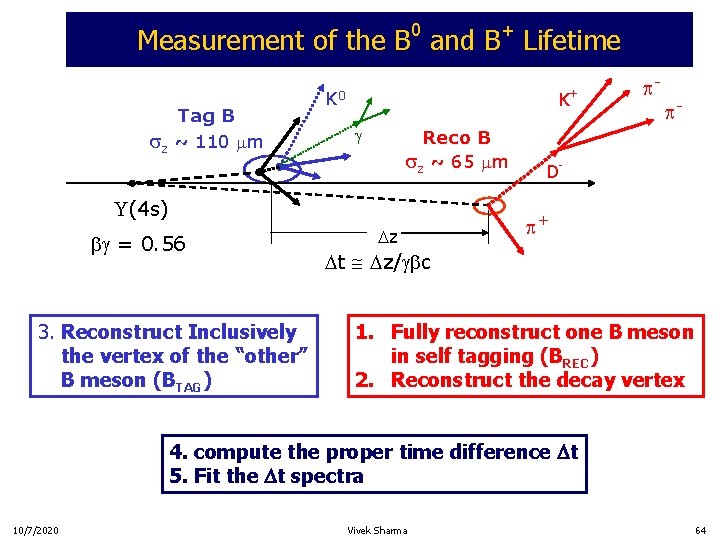
Measurement of the B 0 and B+ Lifetime Tag B sz ~ 110 mm K 0 K g Reco B sz ~ 65 mm U(4 s) g = 0. 56 3. Reconstruct Inclusively the vertex of the “other” B meson (BTAG) z + p- p- D- p+ t z/g c 1. Fully reconstruct one B meson in self tagging (BREC) 2. Reconstruct the decay vertex 4. compute the proper time difference Dt 5. Fit the Dt spectra 10/7/2020 Vivek Sharma 64
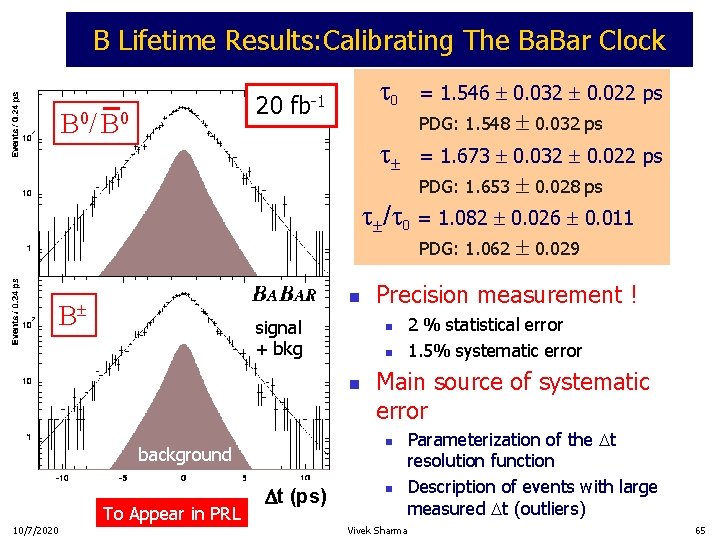
B Lifetime Results: Calibrating The Ba. Bar Clock t 0 20 fb-1 B 0/ B 0 = 1. 546 0. 032 0. 022 ps PDG: 1. 548 t 0. 032 ps = 1. 673 0. 032 0. 022 ps PDG: 1. 653 0. 028 ps t /t 0 = 1. 082 0. 026 0. 011 PDG: 1. 062 n B signal + bkg n 10/7/2020 Dt (ps) 2 % statistical error 1. 5% systematic error Main source of systematic error n background To Appear in PRL Precision measurement ! n n 0. 029 n Parameterization of the t resolution function Description of events with large measured t (outliers) Vivek Sharma 65
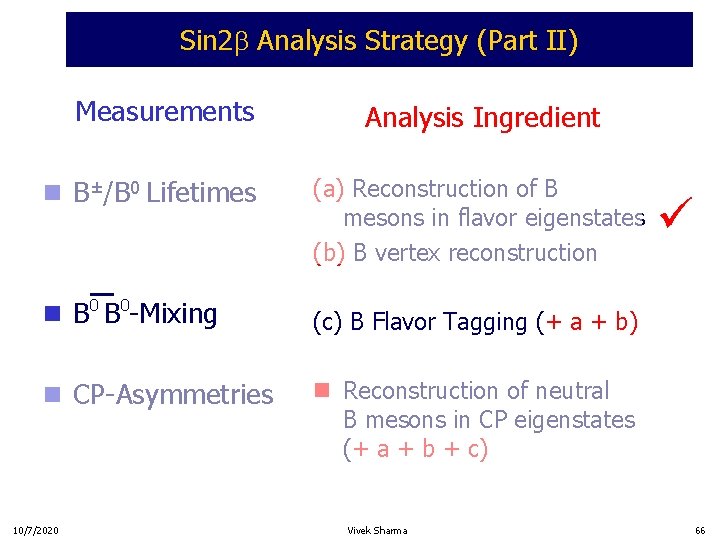
Sin 2 Analysis Strategy (Part II) Measurements Analysis Ingredient n B±/B 0 Lifetimes (a) Reconstruction of B mesons in flavor eigenstates (b) B vertex reconstruction n B 0 -Mixing (c) B Flavor Tagging (+ a + b) n CP-Asymmetries n Reconstruction of neutral B mesons in CP eigenstates (+ a + b + c) 10/7/2020 Vivek Sharma ü 66
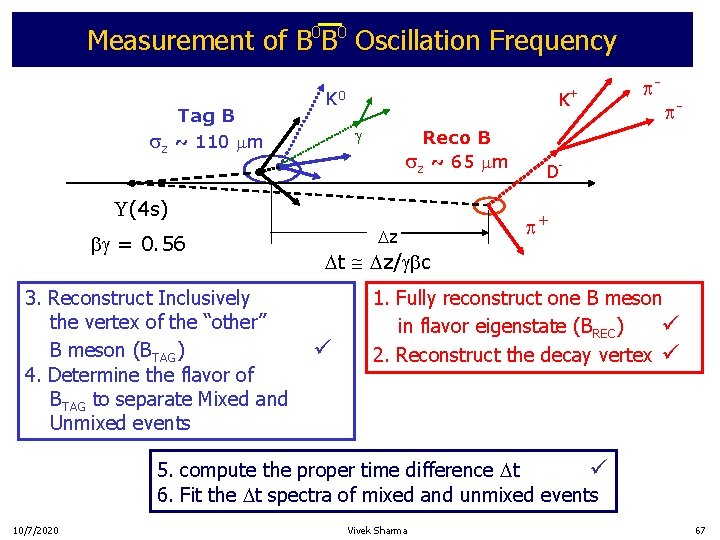
Measurement of B 0 B 0 Oscillation Frequency Tag B sz ~ 110 mm K 0 K g Reco B sz ~ 65 mm U(4 s) g = 0. 56 3. Reconstruct Inclusively the vertex of the “other” B meson (BTAG) 4. Determine the flavor of BTAG to separate Mixed and Unmixed events z + p- p- D- p+ t z/g c ü 1. Fully reconstruct one B meson in flavor eigenstate (BREC) ü 2. Reconstruct the decay vertex ü 5. compute the proper time difference t ü 6. Fit the t spectra of mixed and unmixed events 10/7/2020 Vivek Sharma 67
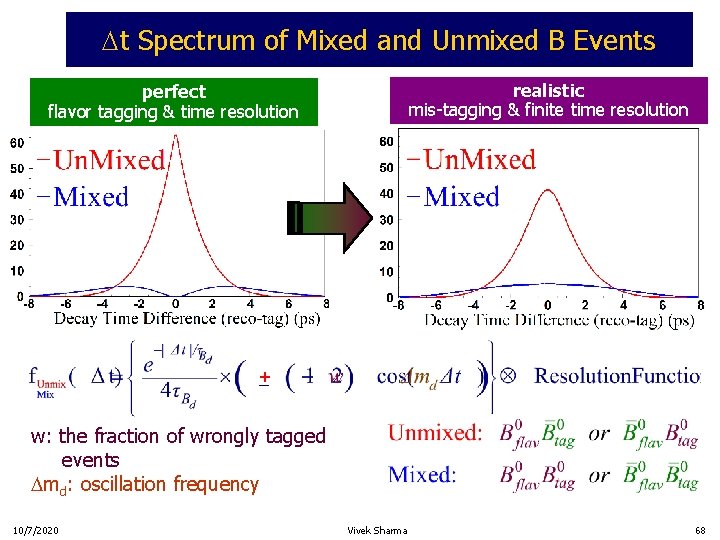
t Spectrum of Mixed and Unmixed B Events realistic mis-tagging & finite time resolution perfect flavor tagging & time resolution + _ w: the fraction of wrongly tagged events md: oscillation frequency 10/7/2020 Vivek Sharma 68
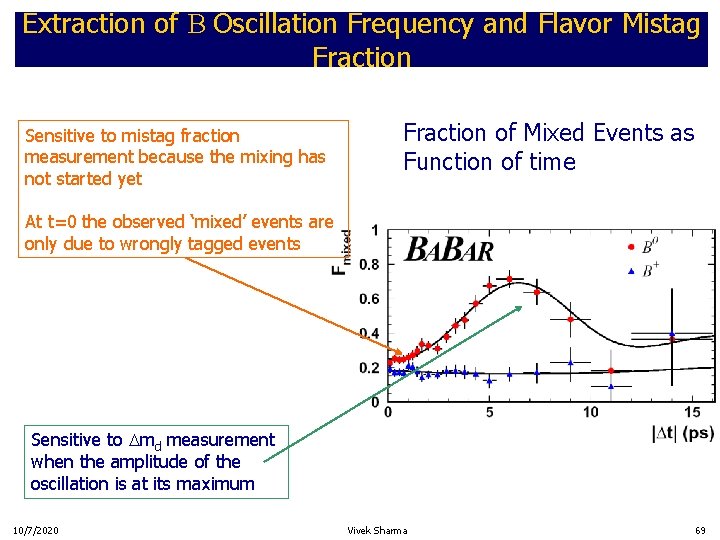
Extraction of B Oscillation Frequency and Flavor Mistag Fraction Sensitive to mistag fraction measurement because the mixing has not started yet Fraction of Mixed Events as Function of time At t=0 the observed ‘mixed’ events are only due to wrongly tagged events Sensitive to md measurement when the amplitude of the oscillation is at its maximum 10/7/2020 Vivek Sharma 69

B 0 B 0 Oscillation Measurement 20 fb-1 C. L. 28 % Dmd = 0. 519 ± 0. 020 (stat) ± 0. 016 (syst) h ps-1 10/7/2020 Vivek Sharma Preliminary 70
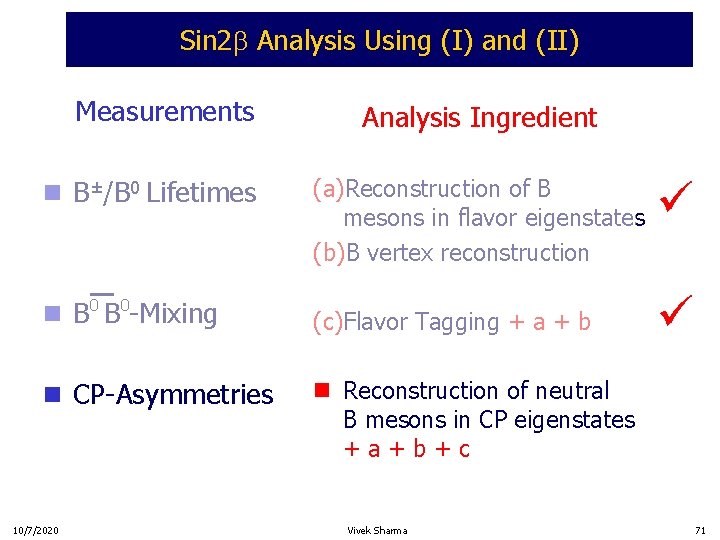
Sin 2 Analysis Using (I) and (II) Measurements Analysis Ingredient n B±/B 0 Lifetimes (a)Reconstruction of B mesons in flavor eigenstates (b)B vertex reconstruction n B 0 -Mixing (c)Flavor Tagging + a + b n CP-Asymmetries n Reconstruction of neutral B mesons in CP eigenstates +a+b+c 10/7/2020 Vivek Sharma ü ü 71
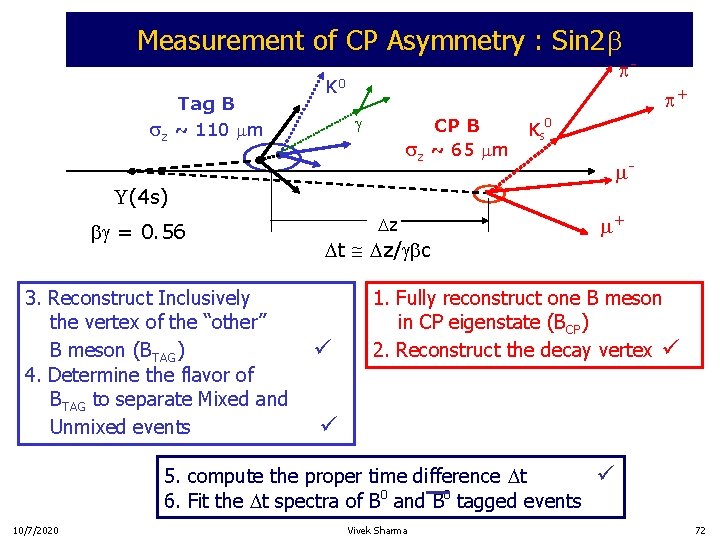
Measurement of CP Asymmetry : Sin 2 Tag B sz ~ 110 mm p- K 0 p+ g CP B sz ~ 65 mm Ks 0 m- U(4 s) g = 0. 56 3. Reconstruct Inclusively the vertex of the “other” B meson (BTAG) 4. Determine the flavor of BTAG to separate Mixed and Unmixed events z t z/g c ü 1. Fully reconstruct one B meson in CP eigenstate (BCP) 2. Reconstruct the decay vertex ü ü 5. compute the proper time difference t 6. Fit the t spectra of B 0 and B 0 tagged events 10/7/2020 m+ Vivek Sharma ü 72
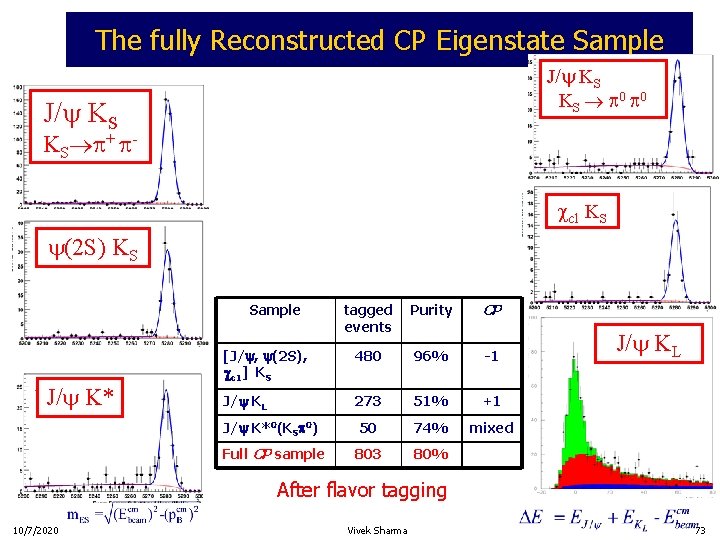
The fully Reconstructed CP Eigenstate Sample J/ KS KS p 0 J/ KS KS p+ pcc 1 KS (2 S) KS tagged events Purity CP [J/ , (2 S), cc 1] KS 480 96% -1 J/ KL 273 51% +1 J/ K*0(KSp 0) 50 74% mixed Full CP sample 803 80% Sample J/ K* J/ KL After flavor tagging 10/7/2020 Vivek Sharma 73
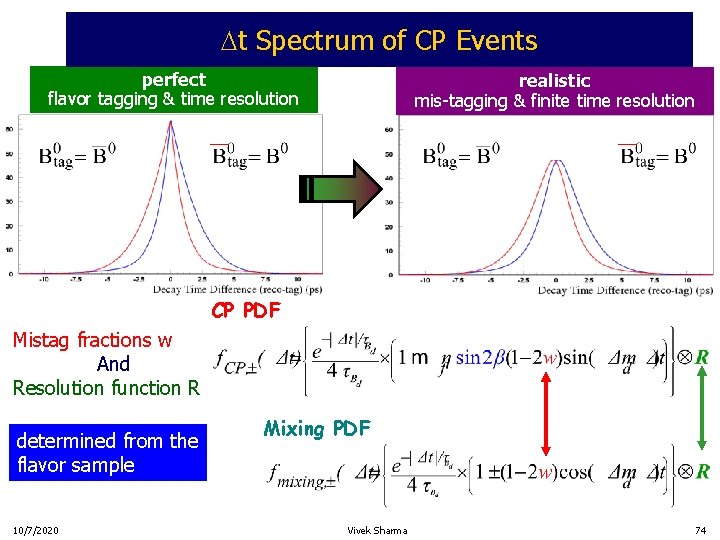
t Spectrum of CP Events perfect flavor tagging & time resolution realistic mis-tagging & finite time resolution CP PDF Mistag fractions w And Resolution function R determined from the flavor sample 10/7/2020 Mixing PDF Vivek Sharma 74
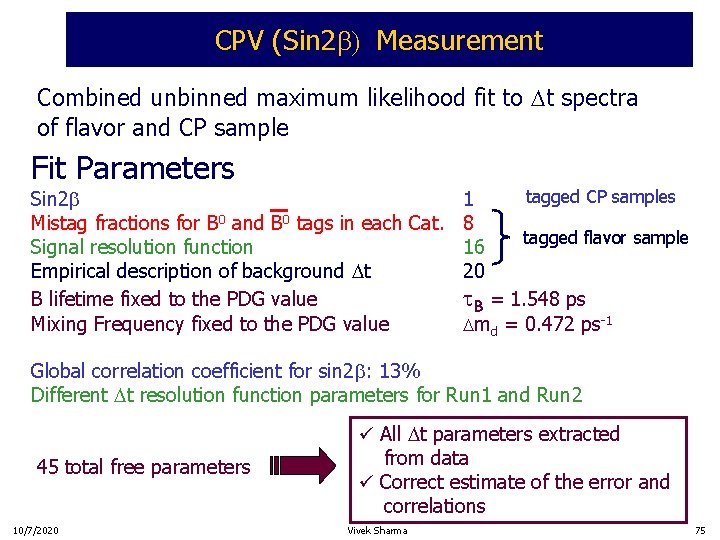
CPV (Sin 2 ) Measurement Combined unbinned maximum likelihood fit to t spectra of flavor and CP sample Fit Parameters tagged CP samples Sin 2 1 Mistag fractions for B 0 and B 0 tags in each Cat. 8 tagged flavor sample Signal resolution function 16 Empirical description of background t 20 B lifetime fixed to the PDG value t. B = 1. 548 ps Mixing Frequency fixed to the PDG value md = 0. 472 ps-1 Global correlation coefficient for sin 2 : 13% Different t resolution function parameters for Run 1 and Run 2 45 total free parameters 10/7/2020 ü All t parameters extracted from data ü Correct estimate of the error and correlations Vivek Sharma 75
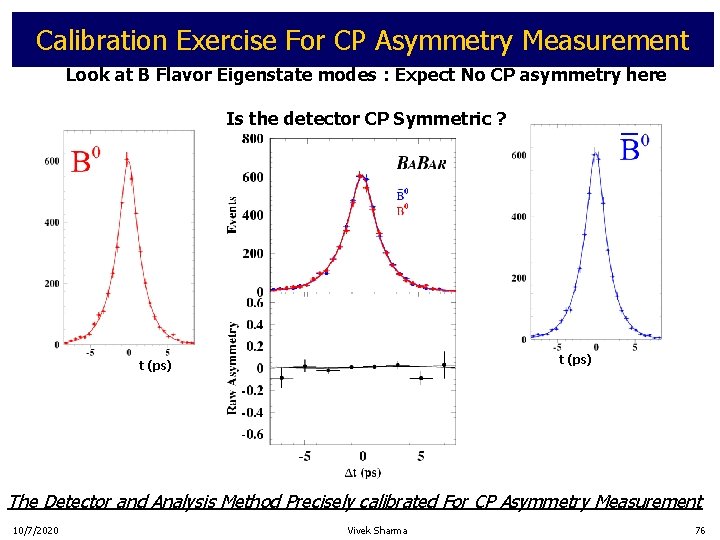
Calibration Exercise For CP Asymmetry Measurement Look at B Flavor Eigenstate modes : Expect No CP asymmetry here Is the detector CP Symmetric ? t (ps) The Detector and Analysis Method Precisely calibrated For CP Asymmetry Measurement 10/7/2020 Vivek Sharma 76
Blind analysis ! • The sin 2 b analysis was done blind to eliminate possible experimenters’ bias –The amplitude in the asymmetry ACP( t) was hidden by arbitrarily flipping its sign and by adding an arbitrary offset –The result was unblinded 1 week before public announcement this summer! 10/7/2020 Vivek Sharma 77
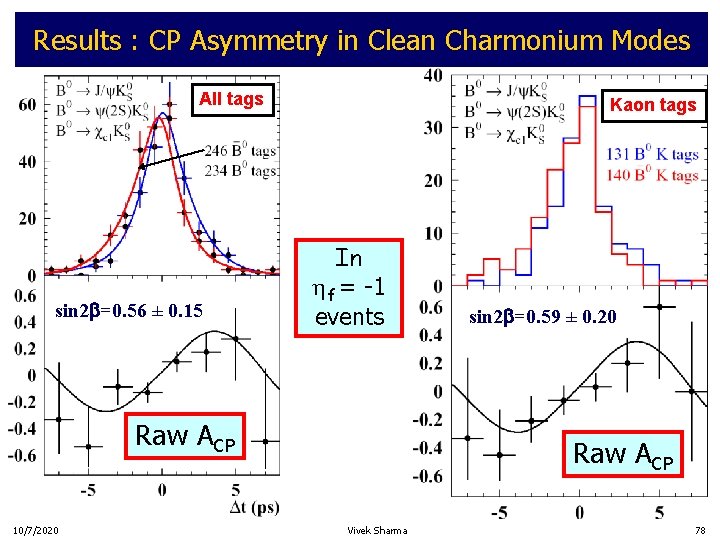
Results : CP Asymmetry in Clean Charmonium Modes All tags sin 2 b=0. 56 ± 0. 15 Kaon tags In f = -1 events Raw ACP 10/7/2020 sin 2 b=0. 59 ± 0. 20 Raw ACP Vivek Sharma 78
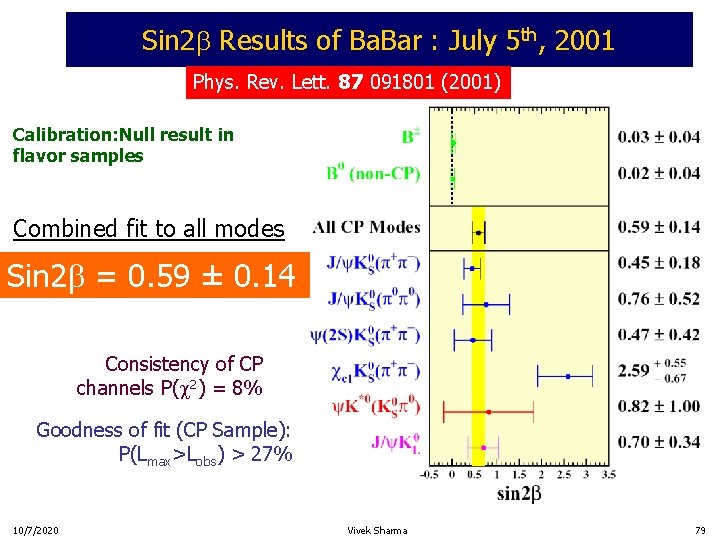
Sin 2 Results of Ba. Bar : July 5 th, 2001 Phys. Rev. Lett. 87 091801 (2001) Calibration: Null result in flavor samples Combined fit to all modes Sin 2 = 0. 59 ± 0. 14 Consistency of CP channels P(c 2) = 8% Goodness of fit (CP Sample): P(Lmax>Lobs) > 27% 10/7/2020 Vivek Sharma 79
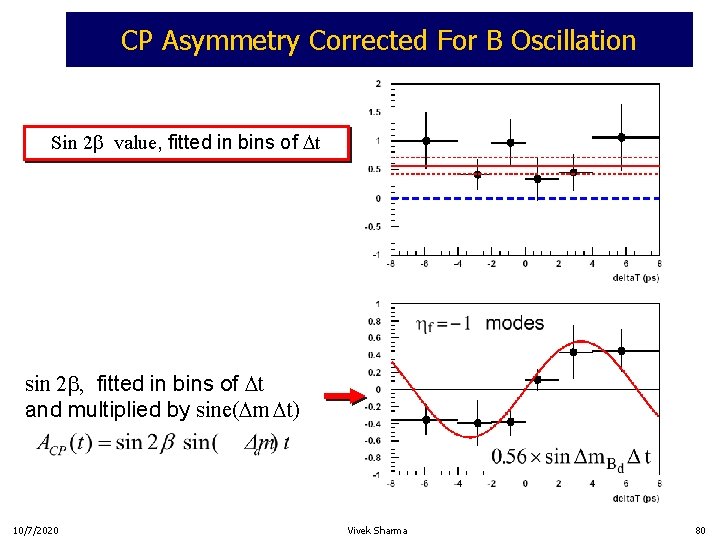
CP Asymmetry Corrected For B Oscillation Sin 2 value, fitted in bins of t sin 2 , fitted in bins of t and multiplied by sine( m t) 10/7/2020 Vivek Sharma 80
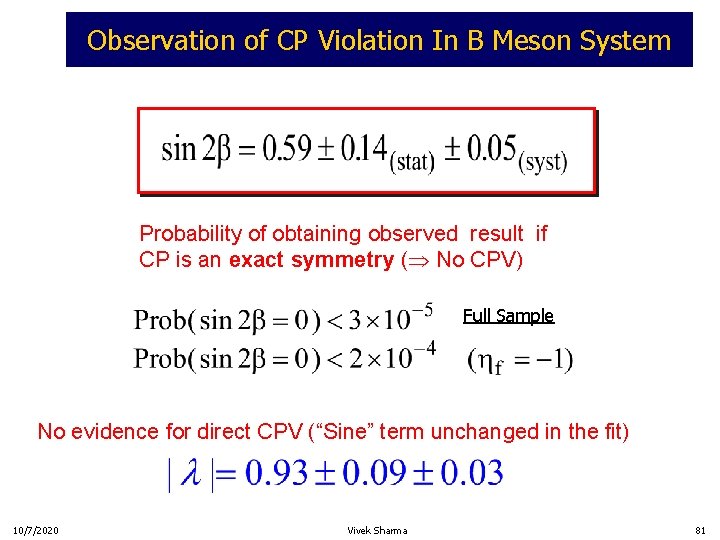
Observation of CP Violation In B Meson System Probability of obtaining observed result if CP is an exact symmetry ( No CPV) Full Sample No evidence for direct CPV (“Sine” term unchanged in the fit) 10/7/2020 Vivek Sharma 81
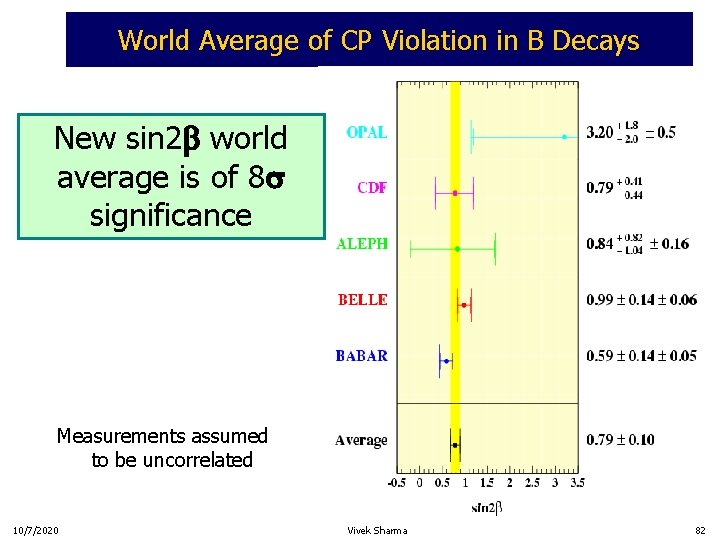
World Average of CP Violation in B Decays New sin 2 b world average is of 8 s significance Measurements assumed to be uncorrelated 10/7/2020 Vivek Sharma 82

The Unitarity Triangle and This Measurement Ba. Bar sin 2 b One solution for is consistent with measurements of sides of Unitarity Triangle (with 30/fb) Error on sin 2 is dominated by statistics will decrease as 10/7/2020 Example: Höcker et al, hep-ph/0104062 (also Vivek other recent global CKM matrix analyses) Sharma 83
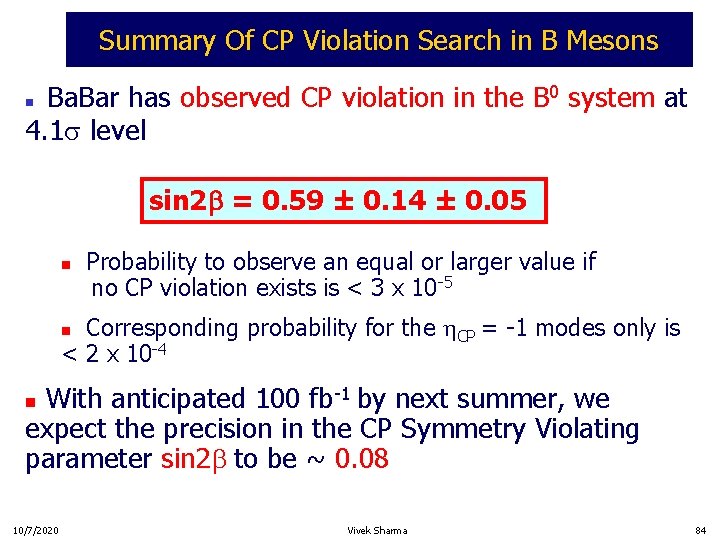
Summary Of CP Violation Search in B Mesons Ba. Bar has observed CP violation in the B 0 system at 4. 1 s level n sin 2 b = 0. 59 ± 0. 14 ± 0. 05 n Probability to observe an equal or larger value if no CP violation exists is < 3 x 10 -5 Corresponding probability for the CP = -1 modes only is < 2 x 10 -4 n With anticipated 100 fb-1 by next summer, we expect the precision in the CP Symmetry Violating parameter sin 2 to be ~ 0. 08 n 10/7/2020 Vivek Sharma 84
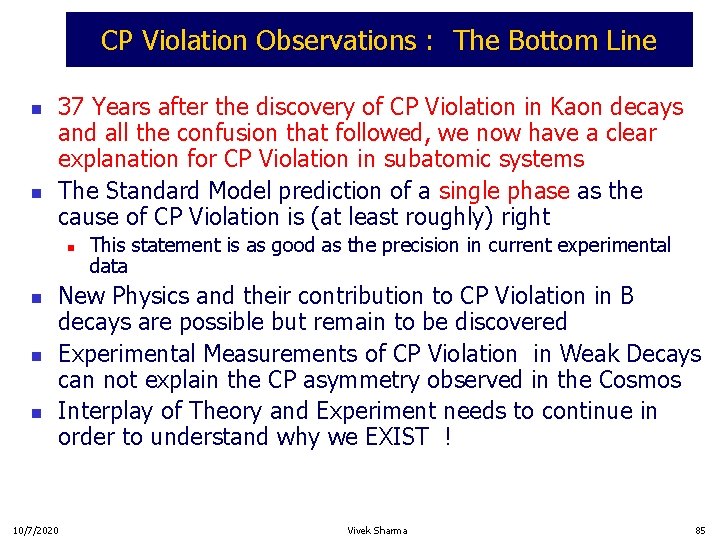
CP Violation Observations : The Bottom Line n n 37 Years after the discovery of CP Violation in Kaon decays and all the confusion that followed, we now have a clear explanation for CP Violation in subatomic systems The Standard Model prediction of a single phase as the cause of CP Violation is (at least roughly) right n n This statement is as good as the precision in current experimental data New Physics and their contribution to CP Violation in B decays are possible but remain to be discovered Experimental Measurements of CP Violation in Weak Decays can not explain the CP asymmetry observed in the Cosmos Interplay of Theory and Experiment needs to continue in order to understand why we EXIST ! 10/7/2020 Vivek Sharma 85
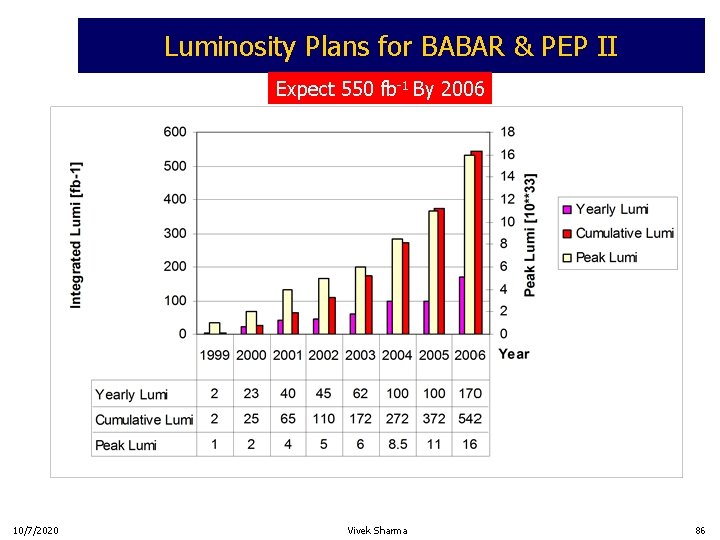
Luminosity Plans for BABAR & PEP II Expect 550 fb-1 By 2006 10/7/2020 Vivek Sharma 86
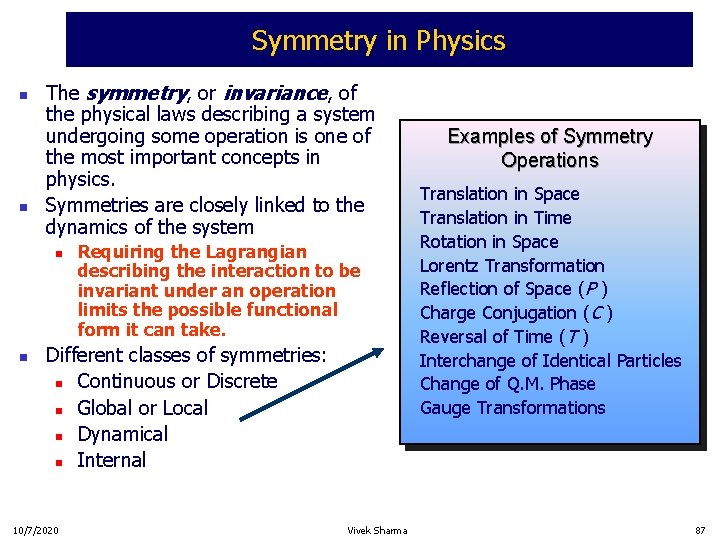
Symmetry in Physics n n The symmetry, or invariance, of the physical laws describing a system undergoing some operation is one of the most important concepts in physics. Symmetries are closely linked to the dynamics of the system n n Requiring the Lagrangian describing the interaction to be invariant under an operation limits the possible functional form it can take. Different classes of symmetries: n Continuous or Discrete n Global or Local n Dynamical n Internal 10/7/2020 Vivek Sharma Examples of Symmetry Operations Translation in Space Translation in Time Rotation in Space Lorentz Transformation Reflection of Space (P ) Charge Conjugation (C ) Reversal of Time (T ) Interchange of Identical Particles Change of Q. M. Phase Gauge Transformations 87
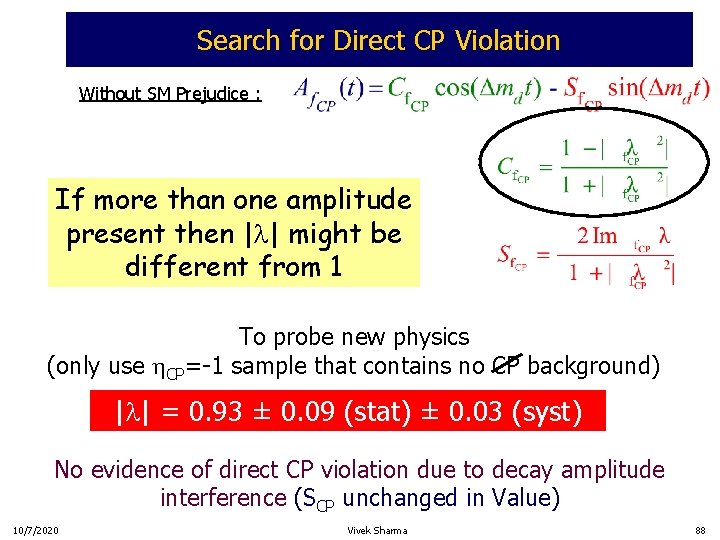
Search for Direct CP Violation Without SM Prejudice : If more than one amplitude present then |l| might be different from 1 To probe new physics (only use CP=-1 sample that contains no CP background) |l| = 0. 93 ± 0. 09 (stat) ± 0. 03 (syst) No evidence of direct CP violation due to decay amplitude interference (SCP unchanged in Value) 10/7/2020 Vivek Sharma 88

How to produce the B Mesons : The (4 S) Resonance Symmetric Collisions e+ (4 S) e- e+ g Ebeam= 5. 29 Ge. V e. Threshold for producing B mesons 10/7/2020 Vivek Sharma • Small resonance s = 1. 1 nb • S/N = 0. 25 • (4 S) B B = 100%, • two-body decay, • PB = 330 Me. V each • B meson lifetime = 1. 55 ps • boost ( g)B = 0. 06 gct = 20 m ! Small ! 89
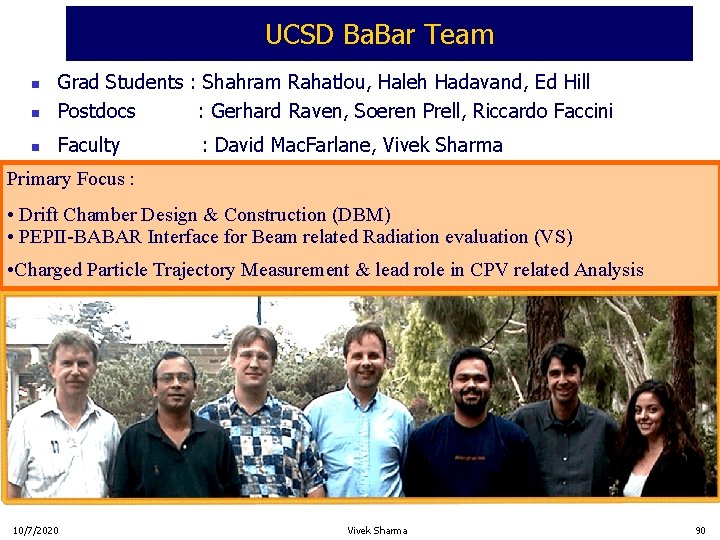
UCSD Ba. Bar Team n Grad Students : Shahram Rahatlou, Haleh Hadavand, Ed Hill Postdocs : Gerhard Raven, Soeren Prell, Riccardo Faccini n Faculty n : David Mac. Farlane, Vivek Sharma Primary Focus : • Drift Chamber Design & Construction (DBM) • PEPII-BABAR Interface for Beam related Radiation evaluation (VS) • Charged Measurement & lead role in. SR CPV related DBMParticle Trajectory VS SP GR RF Analysis. HH 10/7/2020 Vivek Sharma 90
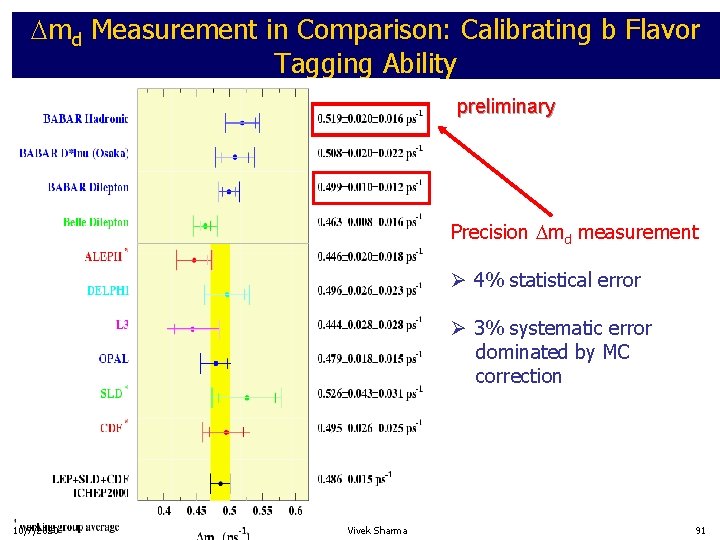
md Measurement in Comparison: Calibrating b Flavor Tagging Ability preliminary Precision md measurement Ø 4% statistical error Ø 3% systematic error dominated by MC correction 10/7/2020 Vivek Sharma 91
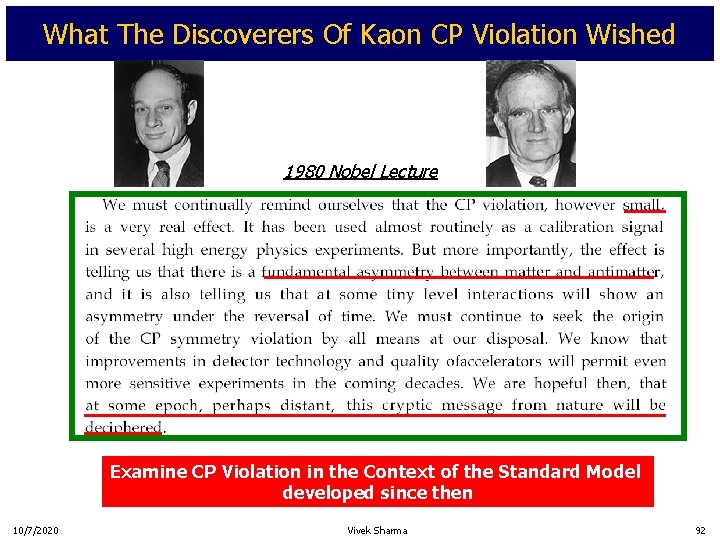
What The Discoverers Of Kaon CP Violation Wished 1980 Nobel Lecture Examine CP Violation in the Context of the Standard Model developed since then 10/7/2020 Vivek Sharma 92
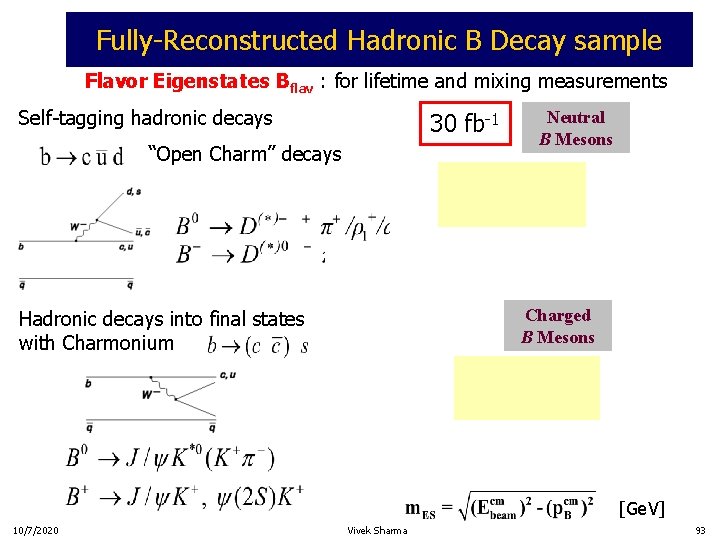
Fully-Reconstructed Hadronic B Decay sample Flavor Eigenstates Bflav : for lifetime and mixing measurements Self-tagging hadronic decays 30 fb-1 “Open Charm” decays Neutral B Mesons Charged B Mesons Hadronic decays into final states with Charmonium [Ge. V] 10/7/2020 Vivek Sharma 93
- Slides: 93