
Broad Band Spectra of Low Mass Xray Binaries
Broad Band Spectra of Low Mass X-ray Binaries: Looking at the inner accretion flow with X-ray spectroscopy Tiziana Di Salvo DSFA Università di Palermo In collaboration with: A. D'Aì, R. Iaria, N. R. Robba (Univ. Palermo), L. Burderi, E. Egron (Univ. Cagliari), A. Papitto, A. Riggio (INAF-OAC), G. Matt (Univ. Roma Tre)

Low Mass X-ray Binaries: Classification • Black Hole Candidates in X-ray binaries: Most of them have a low mass companion but a massive primary Most (if not all) are transient • Low magnetic field neutron stars in X-ray binaries: Low luminosity Atoll sources High luminosity Atolls (GX) High luminosity Z-sources High inclination sources
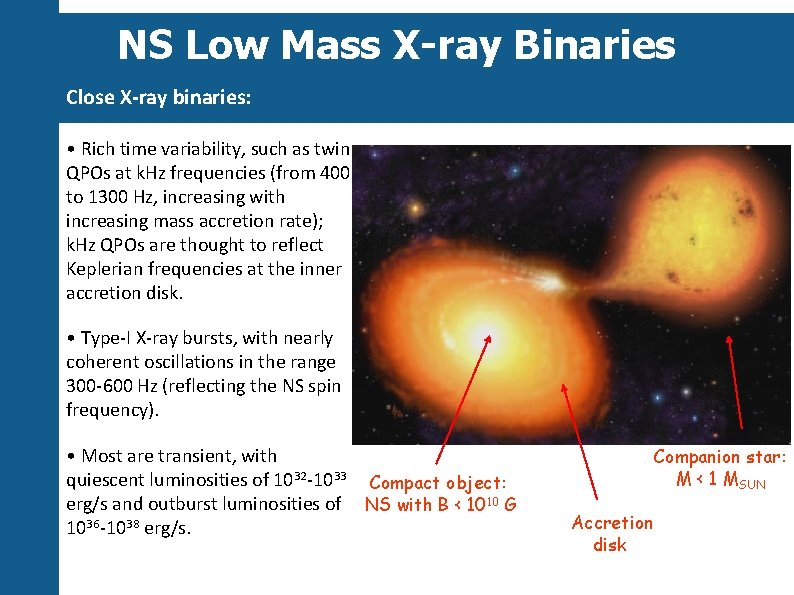
NS Low Mass X-ray Binaries Close X-ray binaries: • Rich time variability, such as twin QPOs at k. Hz frequencies (from 400 to 1300 Hz, increasing with increasing mass accretion rate); k. Hz QPOs are thought to reflect Keplerian frequencies at the inner accretion disk. • Type-I X-ray bursts, with nearly coherent oscillations in the range 300 -600 Hz (reflecting the NS spin frequency). • Most are transient, with quiescent luminosities of 1032 -1033 Compact object: erg/s and outburst luminosities of NS with B < 1010 G 1036 -1038 erg/s. Companion star: M < 1 MSUN Accretion disk
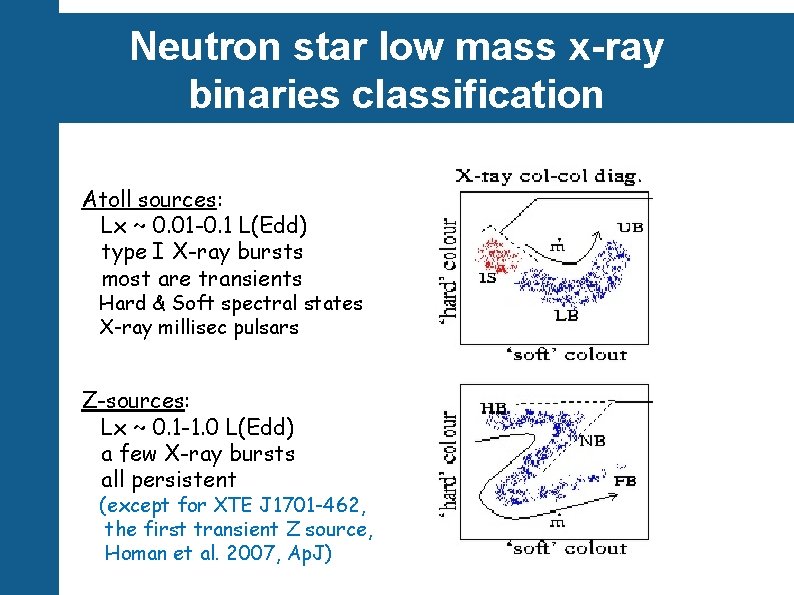
Neutron star low mass x-ray binaries classification Atoll sources: Lx ~ 0. 01 -0. 1 L(Edd) type I X-ray bursts most are transients Hard & Soft spectral states X-ray millisec pulsars Z-sources: Lx ~ 0. 1 -1. 0 L(Edd) a few X-ray bursts all persistent (except for XTE J 1701 -462, the first transient Z source, Homan et al. 2007, Ap. J)
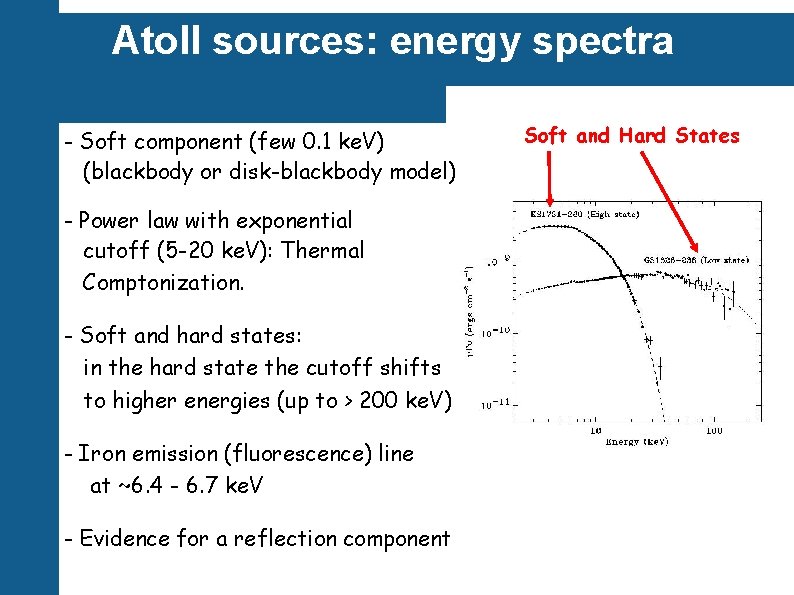
Atoll sources: energy spectra - Soft component (few 0. 1 ke. V) (blackbody or disk-blackbody model) - Power law with exponential cutoff (5 -20 ke. V): Thermal Comptonization. - Soft and hard states: in the hard state the cutoff shifts to higher energies (up to > 200 ke. V) - Iron emission (fluorescence) line at ~6. 4 - 6. 7 ke. V - Evidence for a reflection component Soft and Hard States
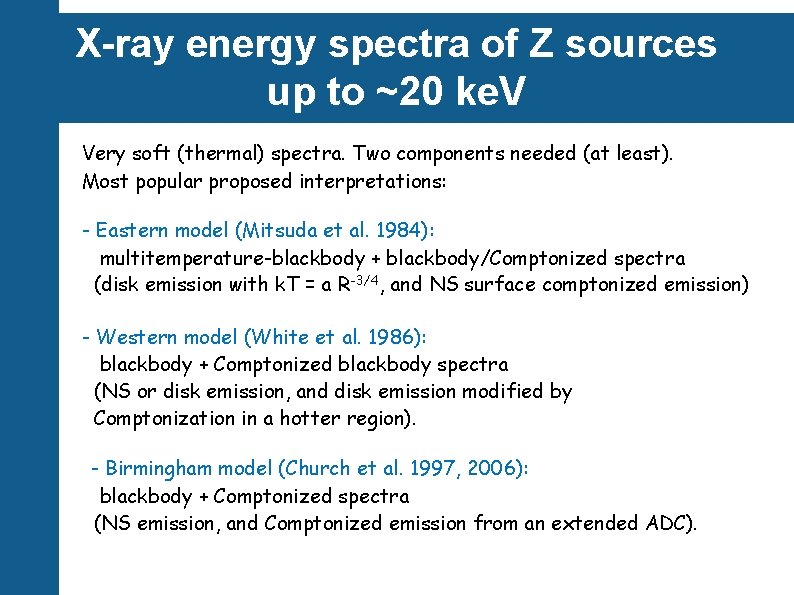
X-ray energy spectra of Z sources up to ~20 ke. V Very soft (thermal) spectra. Two components needed (at least). Most popular proposed interpretations: - Eastern model (Mitsuda et al. 1984): multitemperature-blackbody + blackbody/Comptonized spectra (disk emission with k. T = a R-3/4, and NS surface comptonized emission) - Western model (White et al. 1986): blackbody + Comptonized blackbody spectra (NS or disk emission, and disk emission modified by Comptonization in a hotter region). - Birmingham model (Church et al. 1997, 2006): blackbody + Comptonized spectra (NS emission, and Comptonized emission from an extended ADC).

Broad band Spectra of BHXBs (From Done et al. 2007, A&ARv)

Spectra of NS LMXBs: Strong Analogies with the Spectra of BHCs RXTE spectra of the X-ray burster, atoll source 4 U 1705 -44 (From Done et al. 2007, A&ARv) § § § Strong analogies with spectra of BHXBs: presence of hard/low and soft/high states. Possible difference in the temperatures of the Comptonizing region, because of extra cooling due to the soft emission from the NS surface? Comptonized component always contributing a large fraction (up to 80%) of the energy in the spectrum.
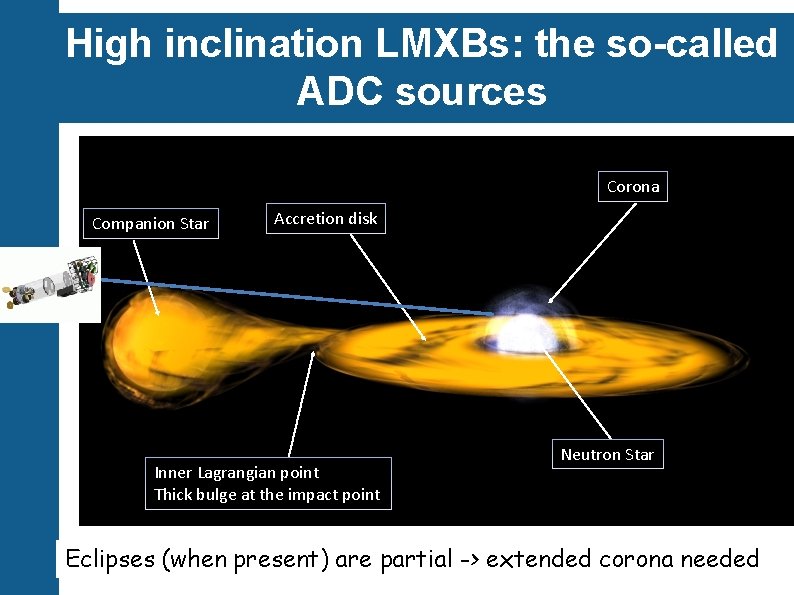
High inclination LMXBs: the so-called ADC sources Corona Companion Star Accretion disk Inner Lagrangian point Thick bulge at the impact point Neutron Star Eclipses (when present) are partial -> extended corona needed
The ADC source 4 U 1822 -371 § X-ray Binary seen at high inclination (81 -84 deg, Jonker et al. 2003): presence of dips and eclipses in the light curve. § Persistent source (little variability of the light curve) with no type-I bursts. Observed unabsorbed luminosity of a few 1036 ergs/s (Iaria et al. 2001). § Ratio Lx/Lopt = 20 (but average value for LMXBs 500) -> the intrinsic luminosity may be as high as 3 x 1037 ergs/s § Orbital period (5. 57 h) and spin period (0. 59 sec, Jonker et al. 2001) known ! § Orbital period (monitored in the last 30 years) increases at a rate of 1. 50(7) x 10 -10 s/s. Orbital evolution implies super-Eddington mass transfer rate -> the mass accretion rate onto the NS may be at the Eddington limit (Burderi et al. 2010; Bayless et al. 2010; Jain et al. 2010).

Broad band spectrum of 4 U 1822 -371: a Z-source seen at high inclination? Soft spectrum fitted by a Comptonization component (compst), partially absorbed by neutral matter: 70% of the spectrum absorbed with NH = 4 x 1022 cm-2 (interstellar absorption at least a factor of 4 lower). k. Te = 4. 7 ke. V, tau = 14 (confirmed by an XMM observation, Iaria et al. A&A, submitted) Discrete features are observed in emission. Beppo. SAX broad band spectrum of 4 U 1822371 (Iaria et al. 2001, Ap. J)
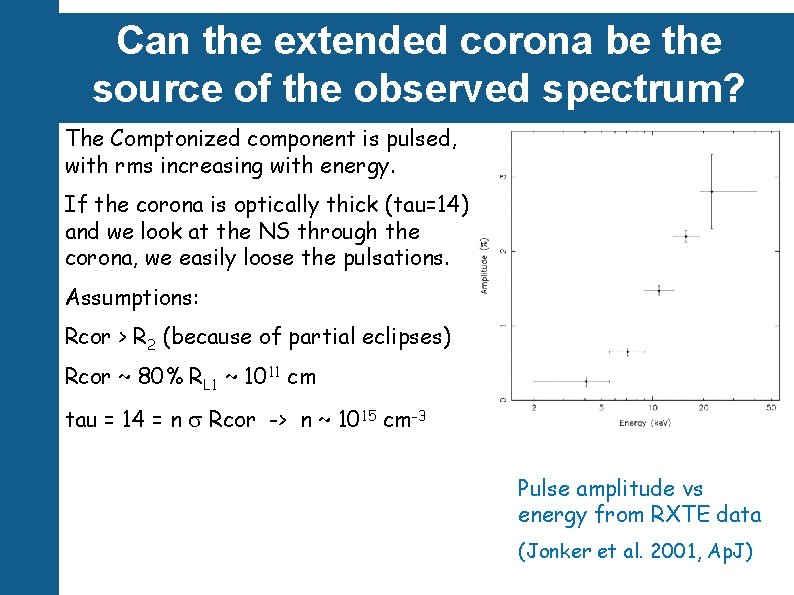
Can the extended corona be the source of the observed spectrum? The Comptonized component is pulsed, with rms increasing with energy. If the corona is optically thick (tau=14) and we look at the NS through the corona, we easily loose the pulsations. Assumptions: Rcor > R 2 (because of partial eclipses) Rcor ~ 80% RL 1 ~ 1011 cm tau = 14 = n s Rcor -> n ~ 1015 cm-3 Pulse amplitude vs energy from RXTE data (Jonker et al. 2001, Ap. J)
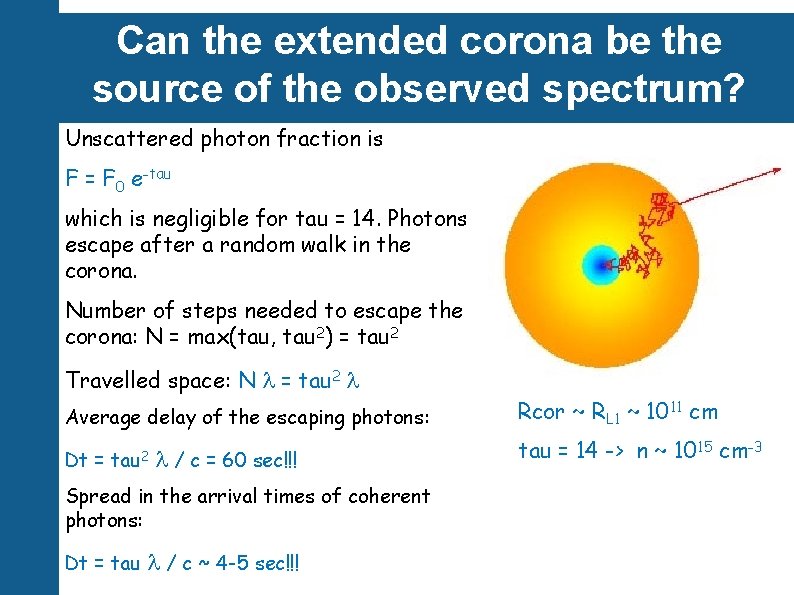
Can the extended corona be the source of the observed spectrum? Unscattered photon fraction is F = F 0 e-tau which is negligible for tau = 14. Photons escape after a random walk in the corona. Number of steps needed to escape the corona: N = max(tau, tau 2) = tau 2 Travelled space: N l = tau 2 l Average delay of the escaping photons: Dt = tau 2 l / c = 60 sec!!! Spread in the arrival times of coherent photons: Dt = tau l / c ~ 4 -5 sec!!! Rcor ~ RL 1 ~ 1011 cm tau = 14 -> n ~ 1015 cm-3
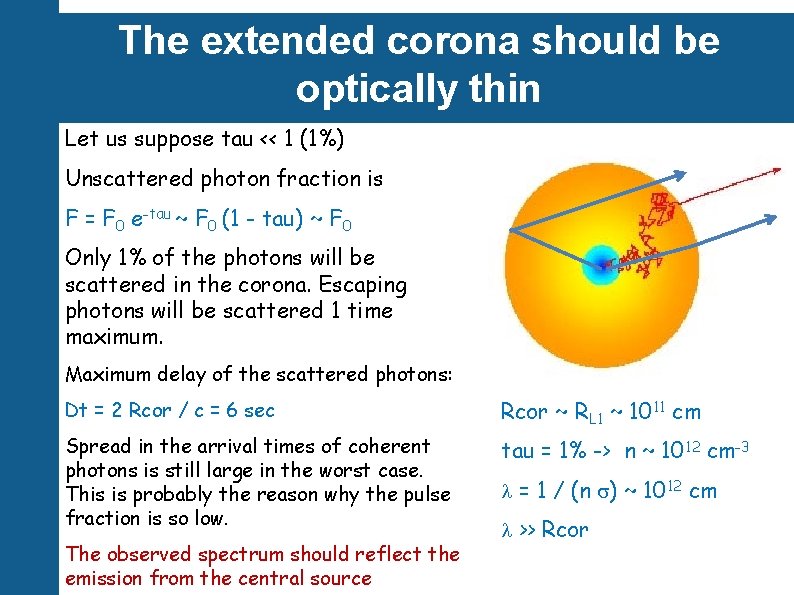
The extended corona should be optically thin Let us suppose tau << 1 (1%) Unscattered photon fraction is F = F 0 e-tau ~ F 0 (1 - tau) ~ F 0 Only 1% of the photons will be scattered in the corona. Escaping photons will be scattered 1 time maximum. Maximum delay of the scattered photons: Dt = 2 Rcor / c = 6 sec Rcor ~ RL 1 ~ 1011 cm Spread in the arrival times of coherent photons is still large in the worst case. This is probably the reason why the pulse fraction is so low. tau = 1% -> n ~ 1012 cm-3 The observed spectrum should reflect the emission from the central source l = 1 / (n s) ~ 1012 cm l >> Rcor

Iron line profiles may give unvaluable information on the inner accretion disc From the profile of a disc line we can obtain information on the ionization parameter and element abundance, the emissivity index of the disc, disc inclination with respect to the line of sight, the inner and outer radii of the emitting region in the disc. This information may be unaccessable with other observational methods.

High resolution spectroscopy of massive BHs: MCG-6 -30 -15 XMM observation of the iron line region in MCG 6 -30 -15 taken in 2001. The red wing extends to less than 4 ke. V, indicating an inner radius of less than 6 G M / C 2. Spinning black hole? (a > 0. 93) Fabian et al. (2002)
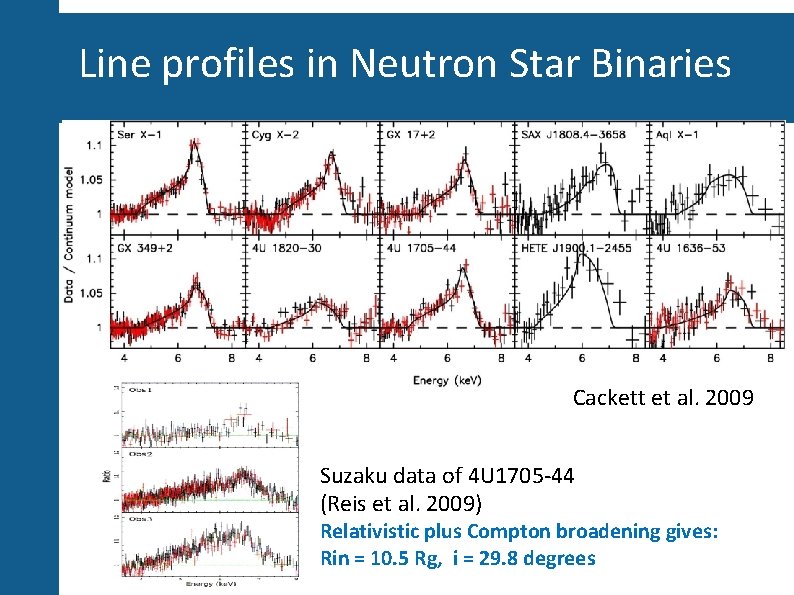
Line profiles in Neutron Star Binaries Cackett et al. 2009 Suzaku data of 4 U 1705 -44 (Reis et al. 2009) Relativistic plus Compton broadening gives: Rin = 10. 5 Rg, i = 29. 8 degrees
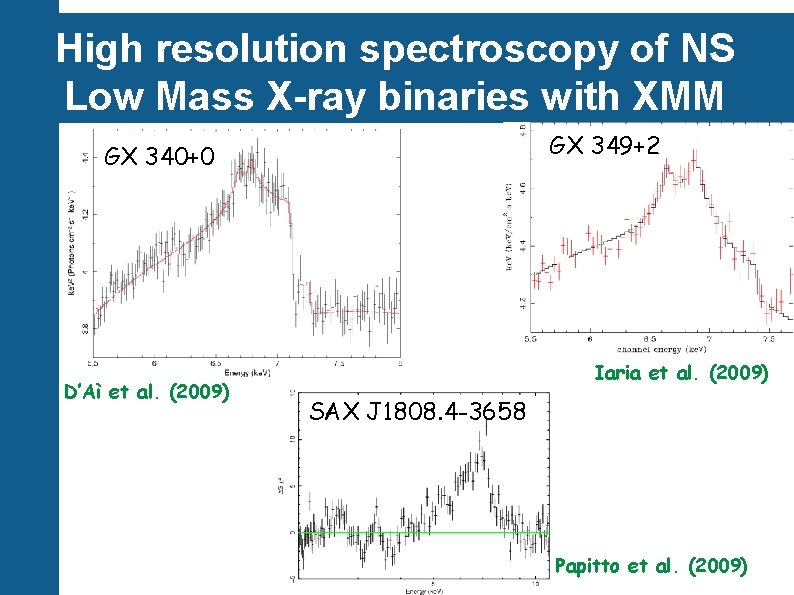
High resolution spectroscopy of NS Low Mass X-ray binaries with XMM GX 349+2 GX 340+0 D’Aì et al. (2009) Iaria et al. (2009) SAX J 1808. 4 -3658 Papitto et al. (2009)
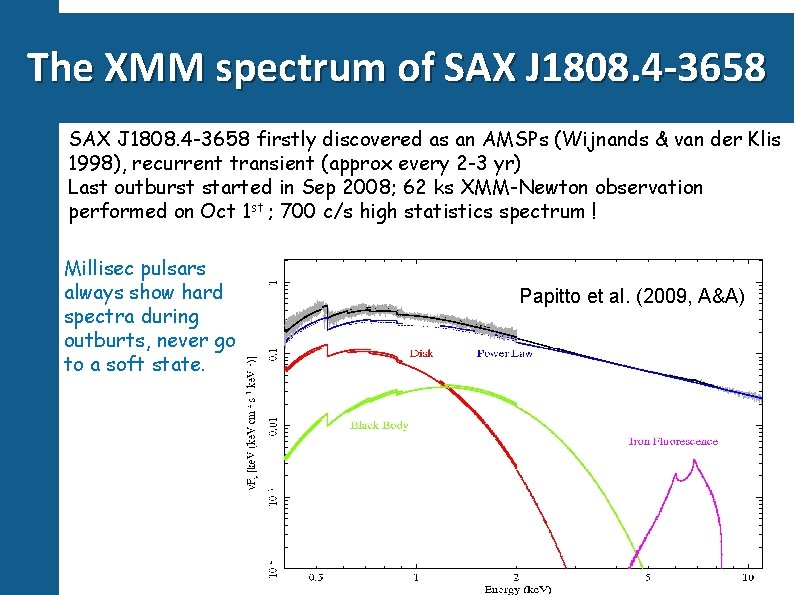
The XMM spectrum of SAX J 1808. 4 -3658 firstly discovered as an AMSPs (Wijnands & van der Klis 1998), recurrent transient (approx every 2 -3 yr) Last outburst started in Sep 2008; 62 ks XMM-Newton observation performed on Oct 1 st ; 700 c/s high statistics spectrum ! Millisec pulsars always show hard spectra during outburts, never go to a soft state. Papitto et al. (2009, A&A)
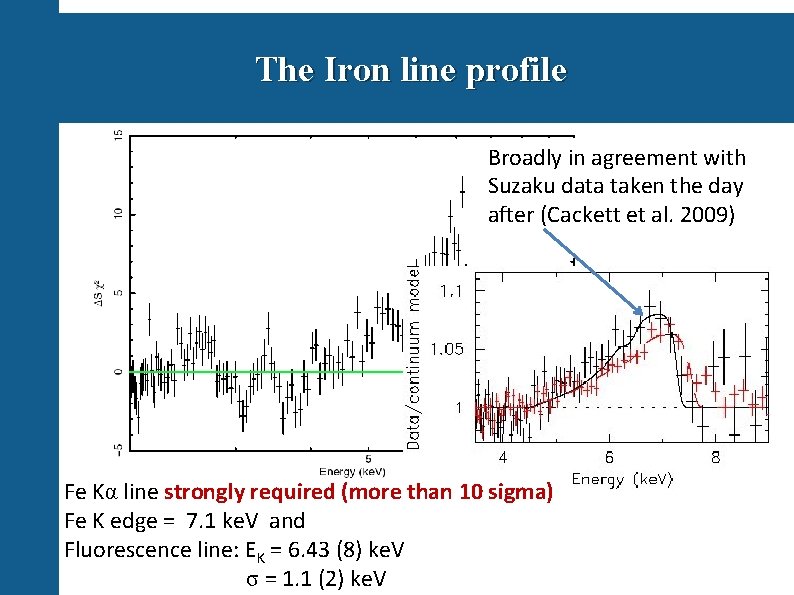
The Iron line profile Broadly in agreement with Suzaku data taken the day after (Cackett et al. 2009) Fe Kα line strongly required (more than 10 sigma) Fe K edge = 7. 1 ke. V and Fluorescence line: EK = 6. 43 (8) ke. V σ = 1. 1 (2) ke. V
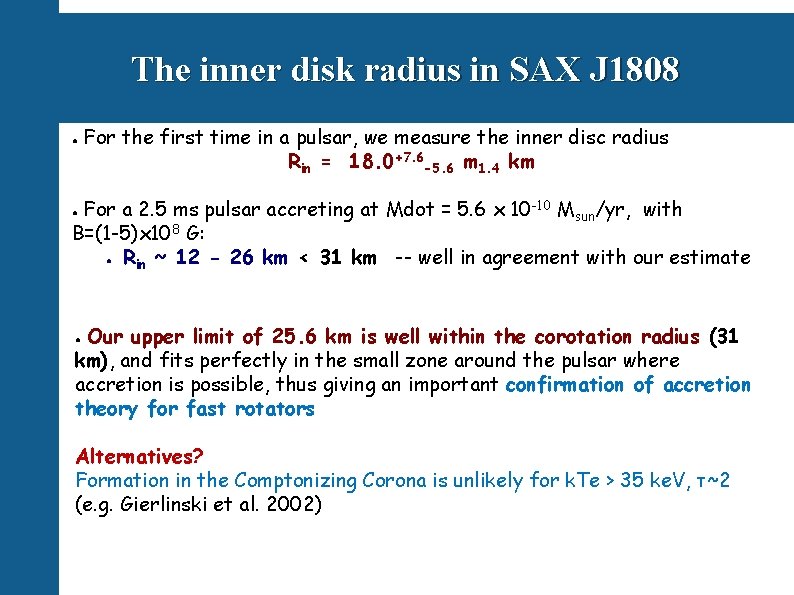
The inner disk radius in SAX J 1808 ● For the first time in a pulsar, we measure the inner disc radius Rin = 18. 0+7. 6 -5. 6 m 1. 4 km For a 2. 5 ms pulsar accreting at Mdot = 5. 6 x 10 -10 Msun/yr, with B=(1 -5)x 108 G: ● R in ~ 12 - 26 km < 31 km -- well in agreement with our estimate ● Our upper limit of 25. 6 km is well within the corotation radius (31 km), and fits perfectly in the small zone around the pulsar where accretion is possible, thus giving an important confirmation of accretion theory for fast rotators ● Alternatives? Formation in the Comptonizing Corona is unlikely for k. Te > 35 ke. V, τ~2 (e. g. Gierlinski et al. 2002)
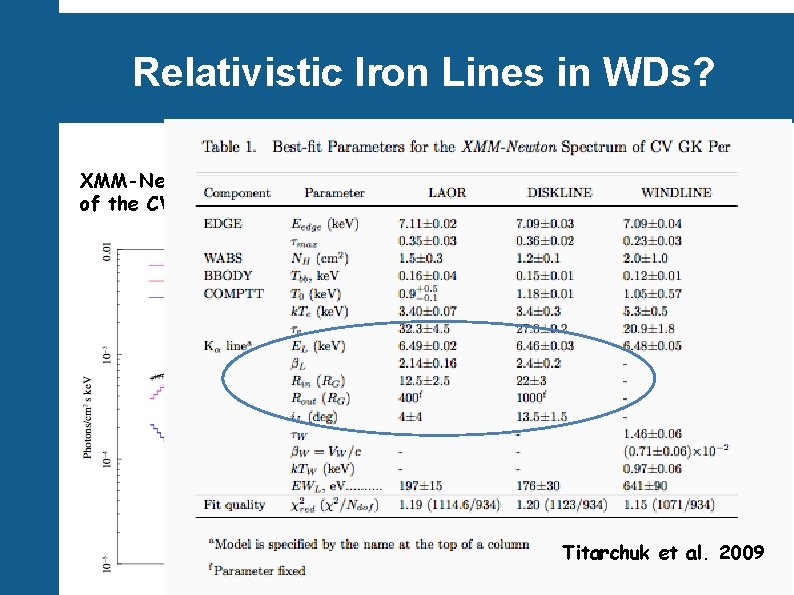
Relativistic Iron Lines in WDs? XMM-Newton observation of the CV GK Per Titarchuk et al. 2009
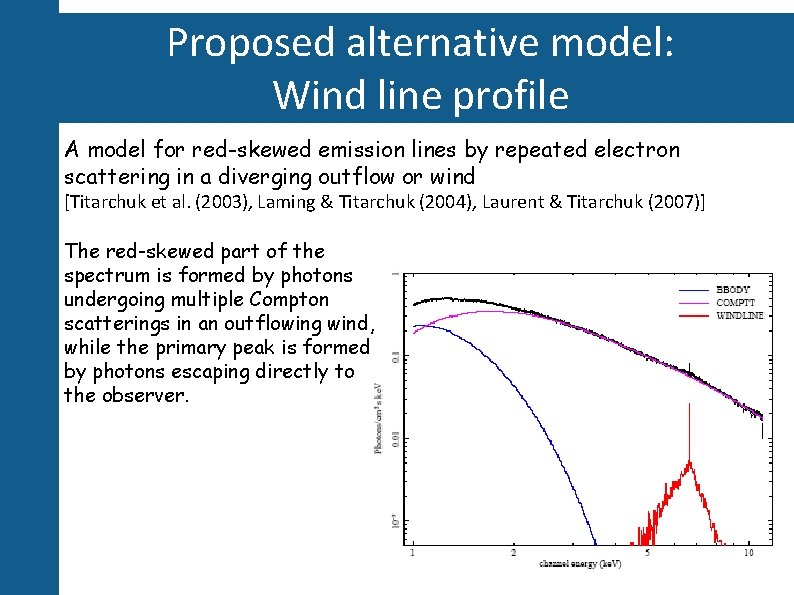
Proposed alternative model: Wind line profile A model for red-skewed emission lines by repeated electron scattering in a diverging outflow or wind [Titarchuk et al. (2003), Laming & Titarchuk (2004), Laurent & Titarchuk (2007)] The red-skewed part of the spectrum is formed by photons undergoing multiple Compton scatterings in an outflowing wind, while the primary peak is formed by photons escaping directly to the observer.
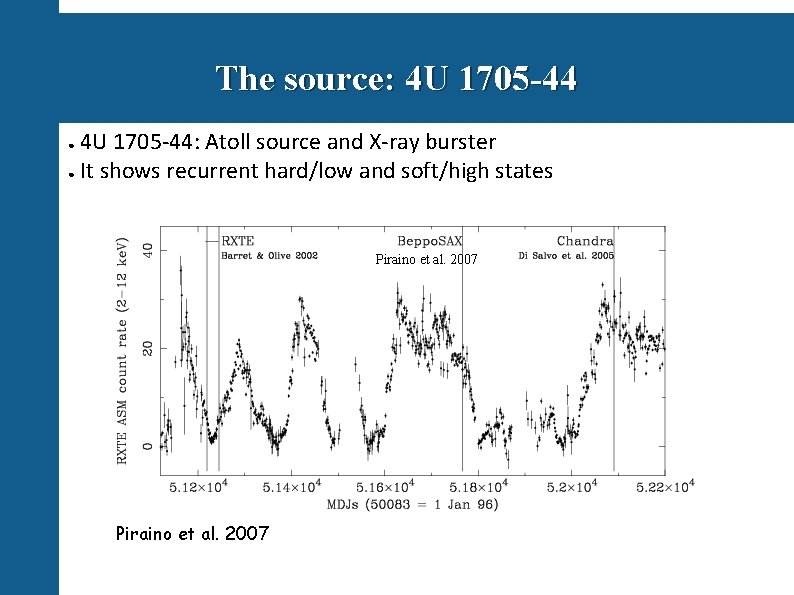
The source: 4 U 1705 -44: Atoll source and X-ray burster ● It shows recurrent hard/low and soft/high states ● Piraino et al. 2007
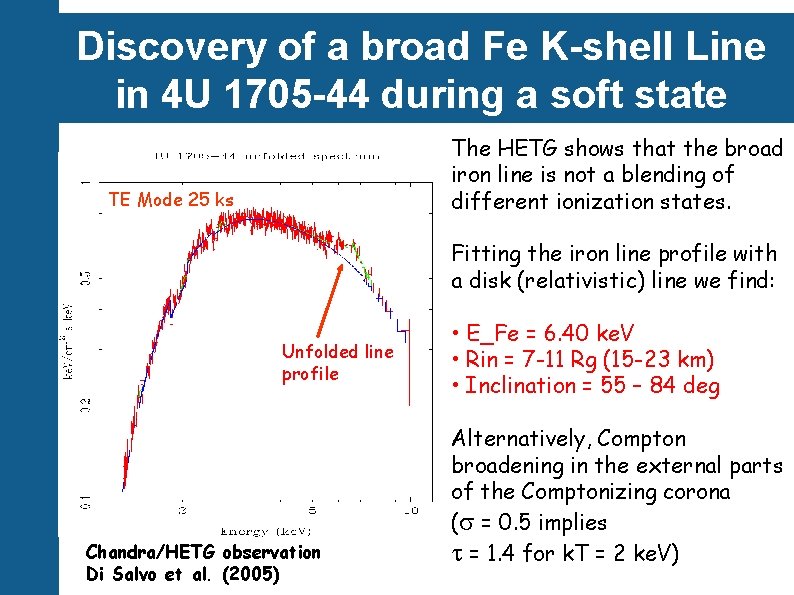
Discovery of a broad Fe K-shell Line in 4 U 1705 -44 during a soft state The HETG shows that the broad iron line is not a blending of different ionization states. TE Mode 25 ks Fitting the iron line profile with a disk (relativistic) line we find: Unfolded line profile Chandra/HETG observation Di Salvo et al. (2005) • E_Fe = 6. 40 ke. V • Rin = 7 -11 Rg (15 -23 km) • Inclination = 55 – 84 deg Alternatively, Compton broadening in the external parts of the Comptonizing corona (s = 0. 5 implies t = 1. 4 for k. T = 2 ke. V)
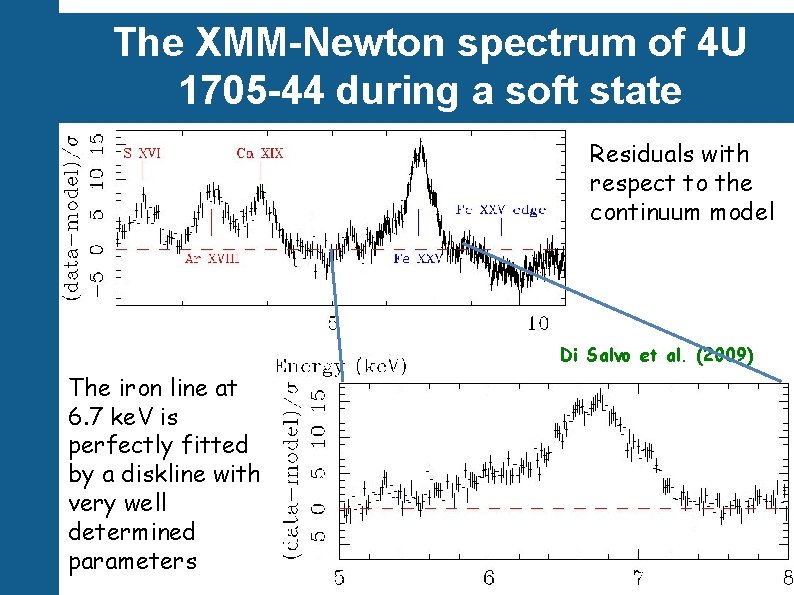
The XMM-Newton spectrum of 4 U 1705 -44 during a soft state Residuals with respect to the continuum model Di Salvo et al. (2009) The iron line at 6. 7 ke. V is perfectly fitted by a diskline with very well determined parameters
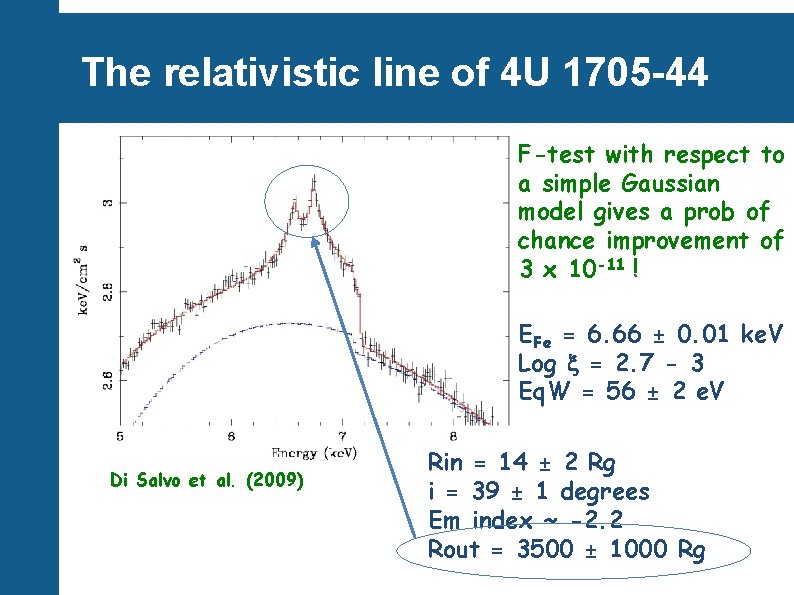
The relativistic line of 4 U 1705 -44 F-test with respect to a simple Gaussian model gives a prob of chance improvement of 3 x 10 -11 ! EFe = 6. 66 ± 0. 01 ke. V Log x = 2. 7 - 3 Eq. W = 56 ± 2 e. V Di Salvo et al. (2009) Rin = 14 ± 2 Rg i = 39 ± 1 degrees Em index ~ -2. 2 Rout = 3500 ± 1000 Rg
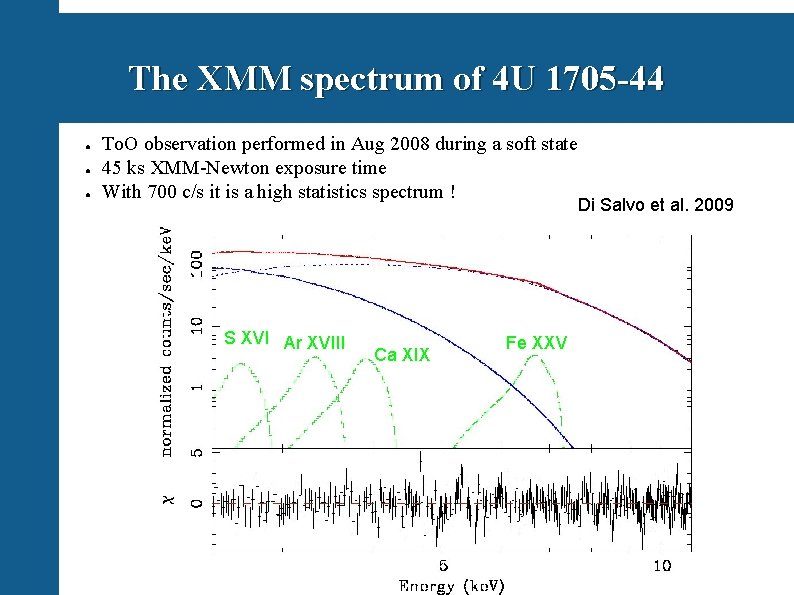
The XMM spectrum of 4 U 1705 -44 ● ● ● To. O observation performed in Aug 2008 during a soft state 45 ks XMM-Newton exposure time With 700 c/s it is a high statistics spectrum ! S XVI Ar XVIII Ca XIX Fe XXV Di Salvo et al. 2009
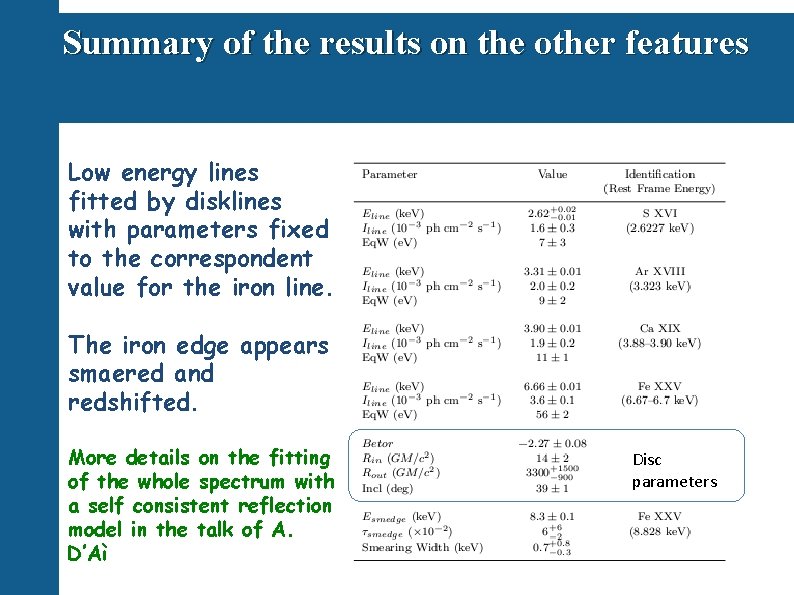
Summary of the results on the other features Low energy lines fitted by disklines with parameters fixed to the correspondent value for the iron line. The iron edge appears smaered and redshifted. More details on the fitting of the whole spectrum with a self consistent reflection model in the talk of A. D’Aì Disc parameters
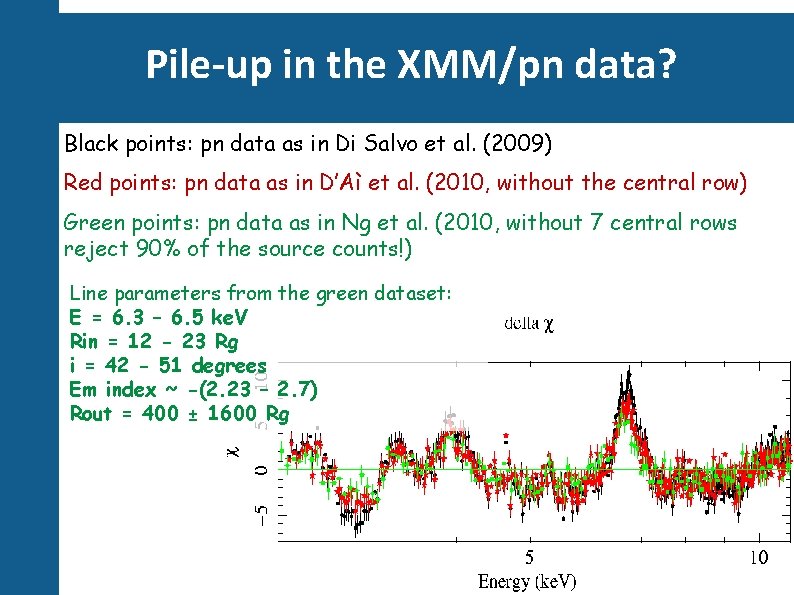
Pile-up in the XMM/pn data? Black points: pn data as in Di Salvo et al. (2009) Red points: pn data as in D’Aì et al. (2010, without the central row) Green points: pn data as in Ng et al. (2010, without 7 central rows reject 90% of the source counts!) Line parameters from the green dataset: E = 6. 3 – 6. 5 ke. V Rin = 12 - 23 Rg i = 42 - 51 degrees Em index ~ -(2. 23 – 2. 7) Rout = 400 ± 1600 Rg
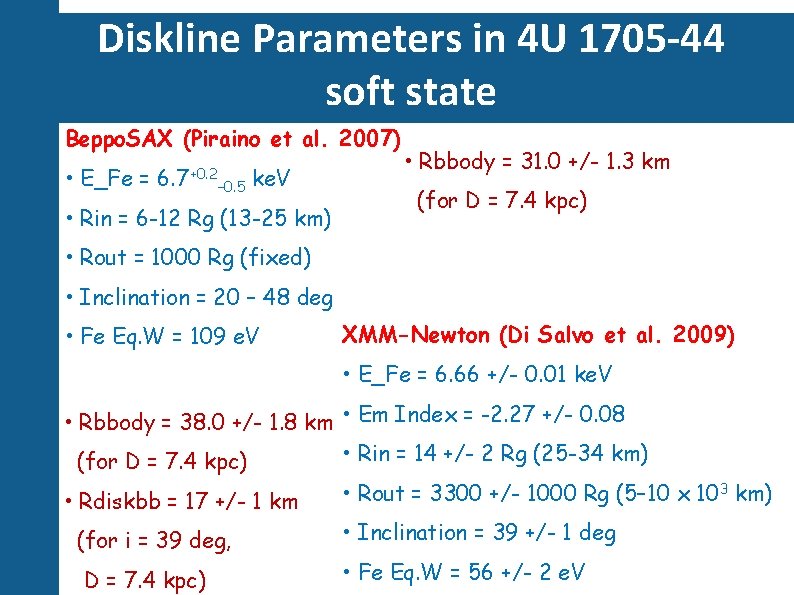
Diskline Parameters in 4 U 1705 -44 soft state Beppo. SAX (Piraino et al. 2007) • E_Fe = 6. 7+0. 2 – 0. 5 ke. V • Rin = 6 -12 Rg (13 -25 km) • Rbbody = 31. 0 +/- 1. 3 km (for D = 7. 4 kpc) • Rout = 1000 Rg (fixed) • Inclination = 20 – 48 deg • Fe Eq. W = 109 e. V XMM-Newton (Di Salvo et al. 2009) • E_Fe = 6. 66 +/- 0. 01 ke. V • Rbbody = 38. 0 +/- 1. 8 km • Em Index = -2. 27 +/- 0. 08 • Rin = 14 +/- 2 Rg (25 -34 km) (for D = 7. 4 kpc) • Rdiskbb = 17 +/- 1 km • Rout = 3300 +/- 1000 Rg (5– 10 x 103 km) (for i = 39 deg, • Inclination = 39 +/- 1 deg D = 7. 4 kpc) • Fe Eq. W = 56 +/- 2 e. V
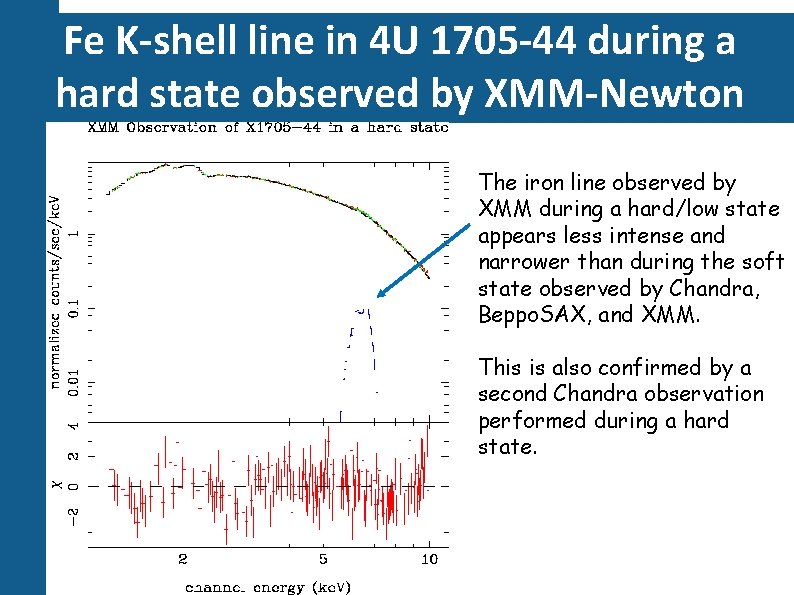
Fe K-shell line in 4 U 1705 -44 during a hard state observed by XMM-Newton The iron line observed by XMM during a hard/low state appears less intense and narrower than during the soft state observed by Chandra, Beppo. SAX, and XMM. This is also confirmed by a second Chandra observation performed during a hard state.
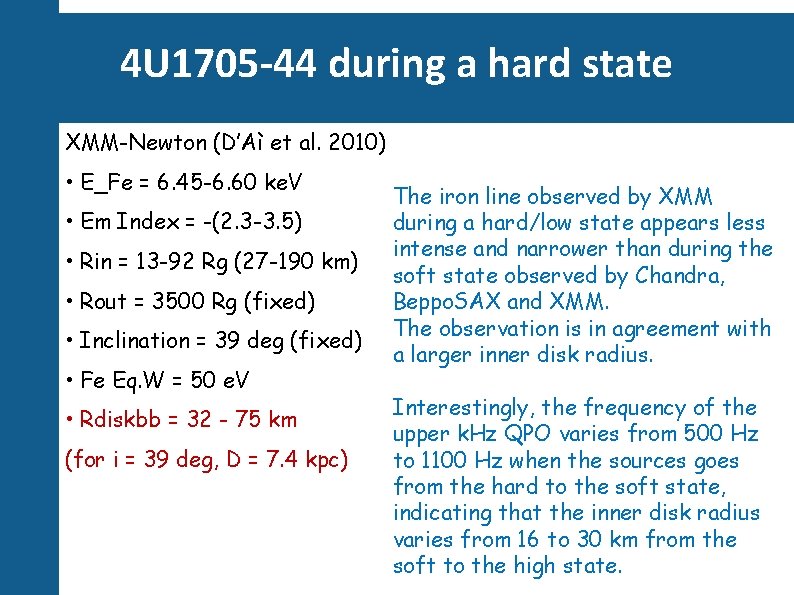
4 U 1705 -44 during a hard state XMM-Newton (D’Aì et al. 2010) • E_Fe = 6. 45 -6. 60 ke. V • Em Index = -(2. 3 -3. 5) • Rin = 13 -92 Rg (27 -190 km) • Rout = 3500 Rg (fixed) • Inclination = 39 deg (fixed) • Fe Eq. W = 50 e. V • Rdiskbb = 32 - 75 km (for i = 39 deg, D = 7. 4 kpc) The iron line observed by XMM during a hard/low state appears less intense and narrower than during the soft state observed by Chandra, Beppo. SAX and XMM. The observation is in agreement with a larger inner disk radius. Interestingly, the frequency of the upper k. Hz QPO varies from 500 Hz to 1100 Hz when the sources goes from the hard to the soft state, indicating that the inner disk radius varies from 16 to 30 km from the soft to the high state.
Conclusions There is still al lot to learn about these sources. To this aim we need good instruments (especially with good timing capability and energy resolution) able to observe such bright objects, in order to use the extraordinary statistics we obtain from bright, close by, sources. We also need complete self-consistent models to be tested on good quality data able to prove or disprove a given scenario.
Aknowledgements High Energy View of Accreting Objects: AGN and X-ray Binaries Agios Nikolaos, Crete, Greece 5 - 14 October 2010 Thank you very much!
- Slides: 35