
BrittleDuctile Mechanical properties of polymers How and why
Brittle/Ductile Mechanical properties of polymers: How and why polymers behave the way they do as a function of temperature Related LOs: > Prior Viewing – Structure of polymers, Glass transition temperature > Future Viewing – Viscoelastic properties of polymers Course Name: Temperature dependent response Level(UG/PG): PG Author(s) : Moumita Sarkar Mentor: Dr. Susy Varughese *The contents in this ppt are licensed under Creative Commons Attribution-Non. Commercial-Share. Alike 2. 5 India license
1 2 3 4 5 Learning objectives After interacting with this Learning Object, the learner will be able to: Explain how material behavior changes as a function of temperature Give explanation of such behavior on a molecular level Explain the different regimes in stress-strain curves of a polymer before failure
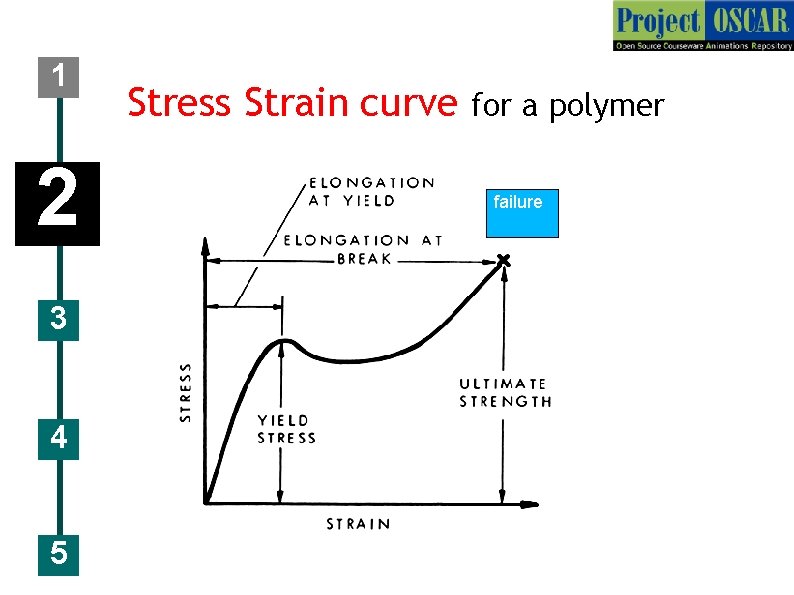
1 2 3 4 5 Definitions and Keywords 1 Stress: The tensile stress on a material is defined as the force per unit area as the material is stretched. . 2 Strain: The strain is a measure of the change in length of the sample. 3 Tensile Stress: It is the stress that leads to elongation of the material in the direction of the force, volume remaining constant. It occurs when the material is subjected to pulling or stretching force. 4 Yield stress: The maximum stress at which sudden elongation or increase in strain takes place without significant increase in the load applied. 5 Young’s Modulus: Young's modulus is the ratio of stress to strain. It also is called the modulus of elasticity or the tensile modulus. 6 Elongation to break: Elongation-to-break is the strain on a sample when it breaks. 7 Toughness: The strength of a material is the area under a stress-strain curve. It is a measure of the energy it absorbs before it breaks. 8 Glass transition temperature: It is the property of amorphous polymers below which its in a glassy state, i. e. its molecules are disordered and immobile and above which its in a rubbery state i. e. where the molecules are still disordered but can wiggle around.
1 2 3 4 5 Definitions and Keywords 1 Crystalline and amorphous polymers: Crystalline polymers have their molecules arranged in repeating patterns in 3 dimensional arrays. Hence they have highly regular and ordered structure. However, in amorphous polymers molecules are arranged randomly and polymer chains which twist and curve around one-another.
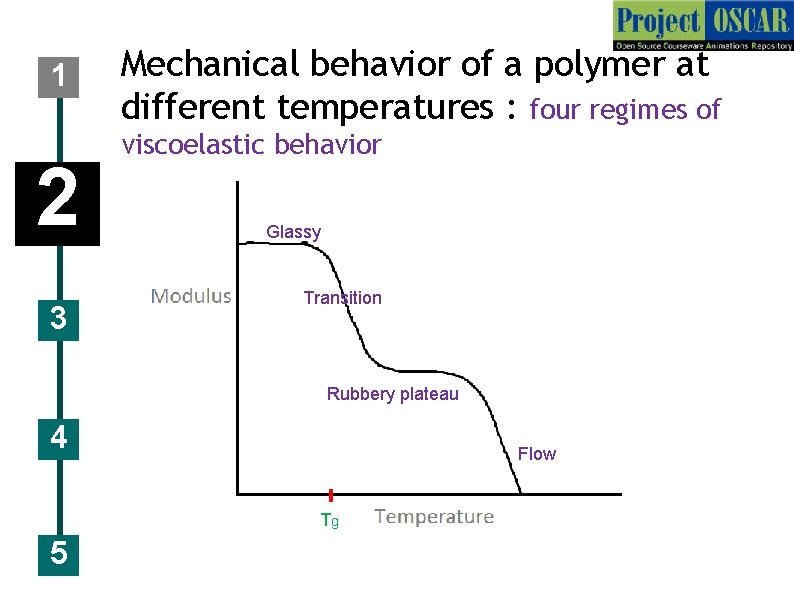
1 2 3 Mechanical behavior of a polymer at different temperatures : four regimes of viscoelastic behavior Glassy Transition Rubbery plateau 4 Flow Tg 5
1 2 3 4 5 Step 1: Description of the action/ interactivity T 1: Mechanical behavior of a polymer at different temperatures : four regimes of viscoelastic behavior Audio Narration (if any) 1 Polymer behavior changes drastically around glass transition temperature. A polymer is glassy and brittle below Tg and becomes rubbery and ductile above Tg. At still higher temperature, the material shows viscous liquid like behavior. 2 The modulus-temperature curve shows four different regimes. Text to be displayed (if any) (DT)
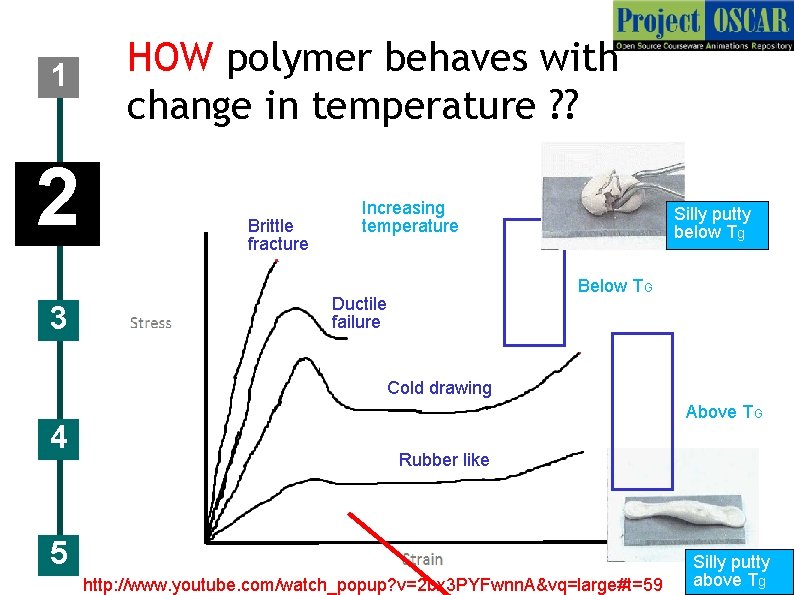
1 2 3 HOW polymer behaves with change in temperature ? ? Brittle fracture Increasing temperature Silly putty below Tg Below TG Ductile failure Cold drawing 4 Above TG Rubber like 5 http: //www. youtube. com/watch_popup? v=2 bx 3 PYFwnn. A&vq=large#t=59 Silly putty above Tg
1 2 3 4 5 Step 1: Description of the action/ interactivity T 1: HOW polymer behaves with change in temperature ? ? Audio Narration (if any) 1 The same polymers may show different behaviors different temperatures. 2 The stress strain curves of a polymer material are shown at different temperatures. 3 Silly putty when below Tg, breaks on impact as shown. whereas, it undergoes stretching above Tg. Text to be displayed (if any) (DT) Go to this video to see silly putty’s unique behavior http: //www. youtub e. com/watch_pop up? v=2 bx 3 PYFwn n. A&vq=large#t=59
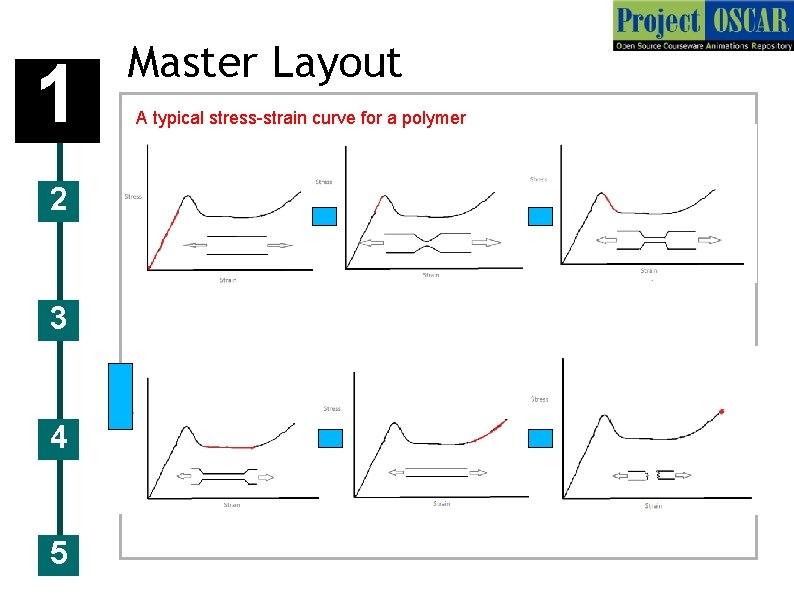
1 2 3 4 5 Master Layout A typical stress-strain curve for a polymer
1 2 3 4 5 Stress Strain curve for a polymer failure
1 Step 1: T 1: Stress Strain curve for a polymer Audio Narration (if any) 2 3 4 5 1 A designer using a polymer must understand its mechanical properties like its strength and the maximum strain the material can be subjected to before causing failure. 2 The tensile stress-strain curve is an easy way of knowing the mechanical properties of a polymer. 3 The curve is drawn by measuring the force developed on subjecting the polymer to elongation until failure. 4 Young's modulus which is a measure of stiffness is given by the slope of the curve at origin. 5 Ultimate strength is the measure of strength required to break the material. 6 Elongation at break is the strain the material undergoes just before it breaks. Text to be displayed (if any) (DT)
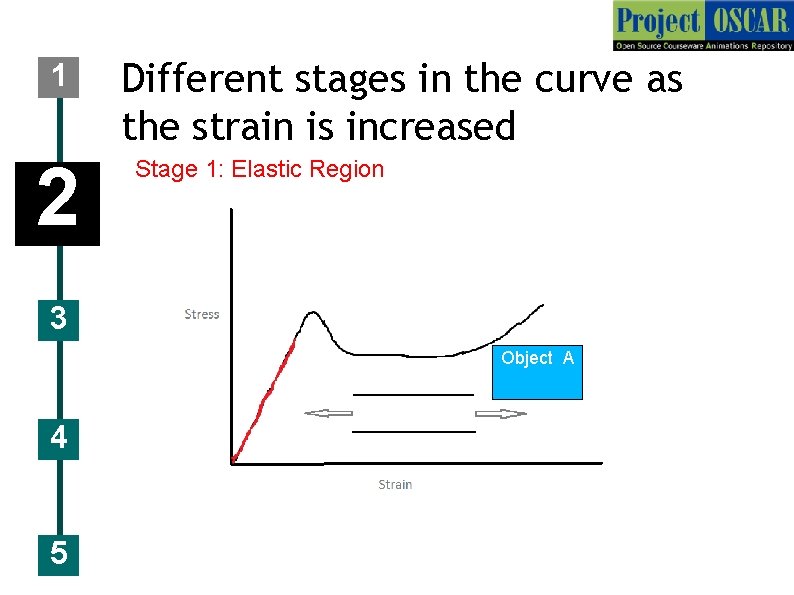
1 2 Different stages in the curve as the strain is increased Stage 1: Elastic Region 3 Object A 4 5
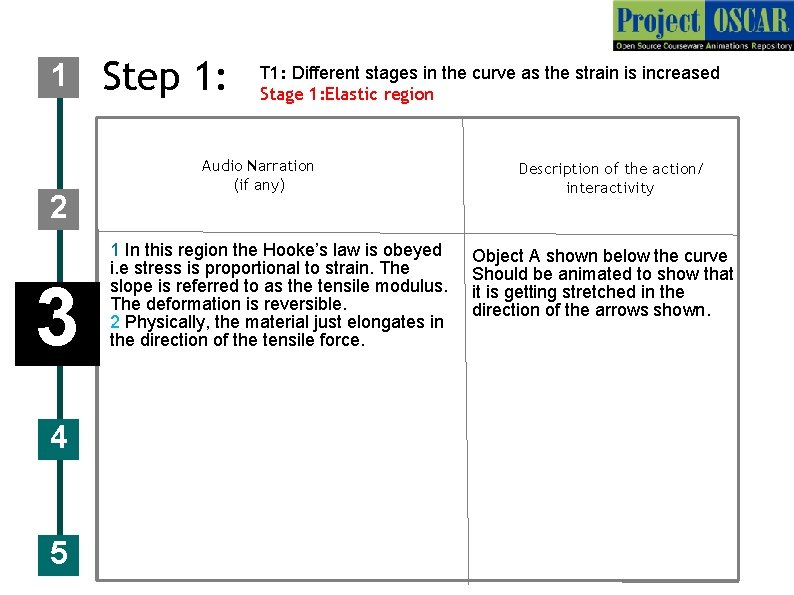
1 2 3 4 5 Step 1: T 1: Different stages in the curve as the strain is increased Stage 1: Elastic region Audio Narration (if any) 1 In this region the Hooke’s law is obeyed i. e stress is proportional to strain. The slope is referred to as the tensile modulus. The deformation is reversible. 2 Physically, the material just elongates in the direction of the tensile force. Description of the action/ interactivity Object A shown below the curve Should be animated to show that it is getting stretched in the direction of the arrows shown.
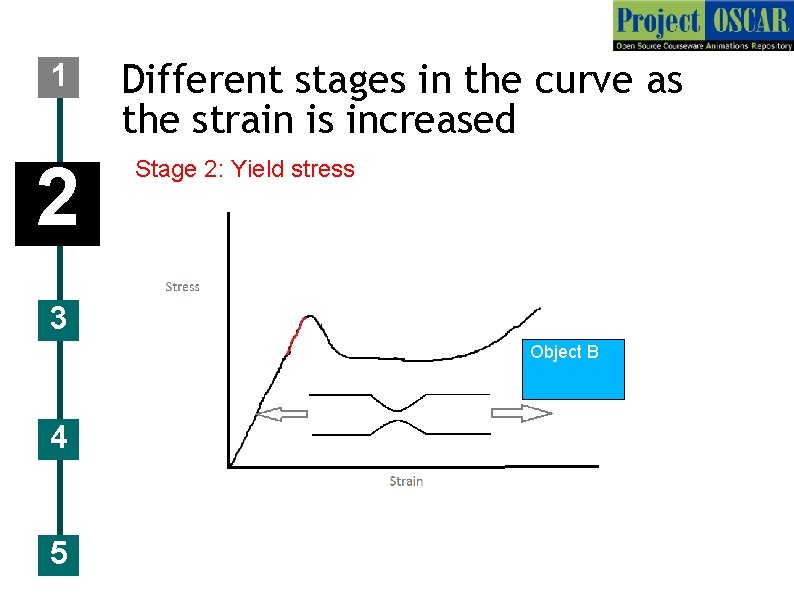
1 2 Different stages in the curve as the strain is increased Stage 2: Yield stress 3 Object B 4 5
1 Step 1: T 1: Different stages in the curve as the strain is increased Stage 2: Yield stress Audio Narration (if any) 2 3 4 5 1 This region gives the yield stress being the value of stress at the top of the curve. Physically , a dent is formed along the length of the material. Typically a brittle polymer undergoes failure at this point. Description of the action/ interactivity It should be shown in animation that the object B is undergoing a shape change as shown when Pulled in the direction of the arrow.
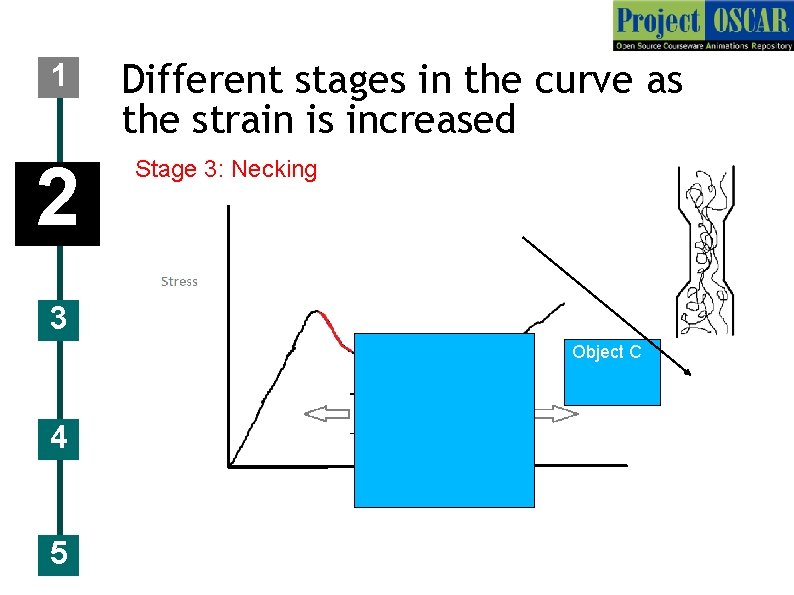
1 2 Different stages in the curve as the strain is increased Stage 3: Necking 3 Object C 4 5
1 Step 1: T 1: Different stages in the curve as the strain is increased Stage 3: Necking Audio Narration (if any) 2 3 4 5 1 In this region a local decrease in cross section occurs at a point along the length of the material. 2 The stress value decreases in this region. Description of the action/ interactivity It should be shown in animation that the object C is undergoing a shape change as shown when pulled in the direction of the arrow.

1 2 HOW polymer behaves with change in temperature Stage 4: Cold drawing 3 Object D 4 5
1 Step 1: T 1: Different stages in the curve as the strain is increased Stage 4: Cold drawing Audio Narration (if any) 2 3 4 5 1 In this stage the neck region extends along the sample. 2 The stress value remains constant. 3 At the microscopic level, the polymer molecules in this stage, unentangle and align themselves along the direction in which tensile force is applied. Description of the action/ interactivity It should be shown in animation that the object D is undergoing a shape change as shown when pulled in the direction of the arrow.
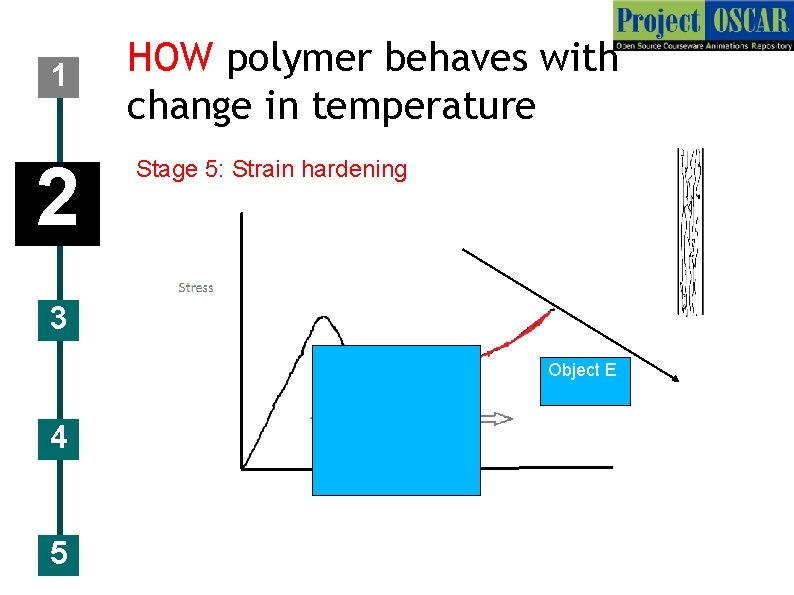
1 2 HOW polymer behaves with change in temperature Stage 5: Strain hardening 3 Object E 4 5
1 Step 1: T 1: Different stages in the curve as the strain is increased Stage 5: Strain hardening Audio Narration (if any) 2 3 4 5 1 In this stage the neck region propagates all along the sample. 2 The stress value increases until the material undergoes failure. At the microscopic level, all the polymer molecules in this stage, get alligned parallely along the direction in which tensile force is applied. Description of the action/ interactivity It should be shown in animation that the object E is undergoing a shape change as shown when pulled in the direction of the arrow.
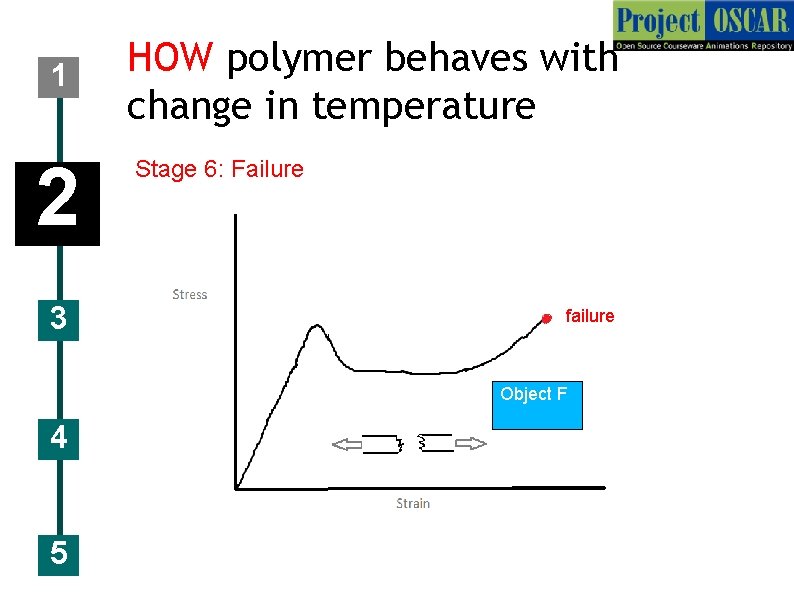
1 2 3 HOW polymer behaves with change in temperature Stage 6: Failure failure Object F 4 5
1 Step 1: T 1: Different stages in the curve as the strain is increased Stage 6: Failure Audio Narration (if any) 2 3 4 5 1 When no longer chain orientation is possible, the material undergoes a fracture. Description of the action/ interactivity It should be shown in animation that the object F breaks as shown when pulled in the direction of the arrow.

1 2 3 4 5 Semi crystalline polymer undergoing tensile stress: 4 steps
1 2 3 4 5 Step 1: Description of the action/ interactivity T 1: Semi crystalline polymer undergoing tensile stress: 4 steps Audio Narration (if any) Text to be displayed (if any) (DT) Semi crystalline material Deformation Mechanism: has an amorphous part 1. Stretching of amorphous too. When it undergoes chains. tensile stress, first the 2. Shear yielding of amorphous chains gets crystallites. stretched. Then Shear 3. separation of crystalline yielding of crystallites takes place. Then the block segments crystalline segments 4. orientation of segments separate. And finally both and amorphous chains in amorphous chains and the tensile direction crystalline blocks align and orient themselves in the direction of the force.
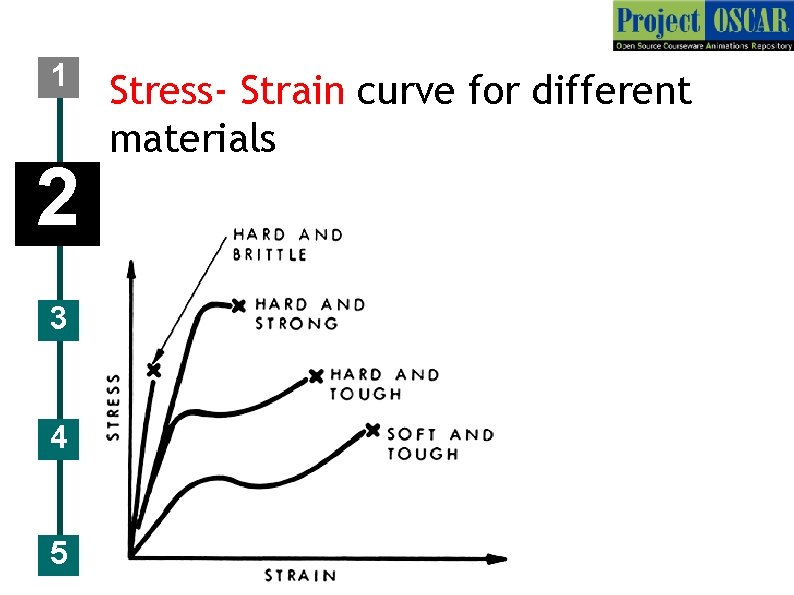
1 2 Stress- Strain curve for different materials 3 4 5 Photos courtesy of Geon Corp.
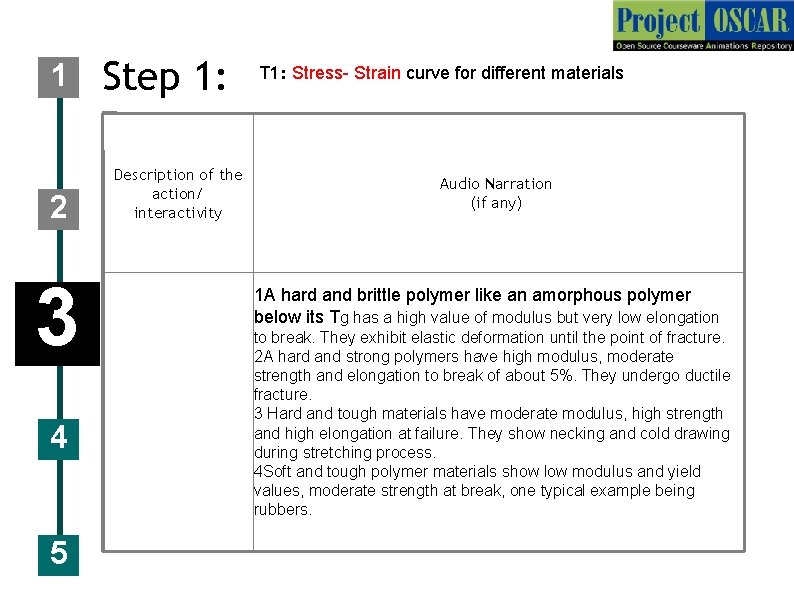
1 2 3 4 5 Step 1: Description of the action/ interactivity T 1: Stress- Strain curve for different materials Audio Narration (if any) 1 A hard and brittle polymer like an amorphous polymer below its Tg has a high value of modulus but very low elongation to break. They exhibit elastic deformation until the point of fracture. 2 A hard and strong polymers have high modulus, moderate strength and elongation to break of about 5%. They undergo ductile fracture. 3 Hard and tough materials have moderate modulus, high strength and high elongation at failure. They show necking and cold drawing during stretching process. 4 Soft and tough polymer materials show low modulus and yield values, moderate strength at break, one typical example being rubbers.
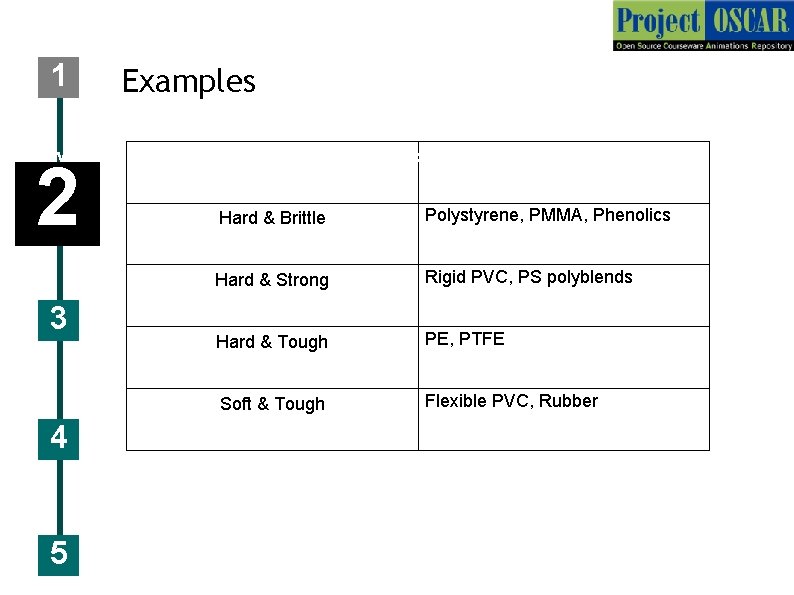
1 Examples Behavior of polymers (having different Tg) at room temperature Examples of polymers 2 3 4 5 Hard & Brittle Polystyrene, PMMA, Phenolics Hard & Strong Rigid PVC, PS polyblends Hard & Tough PE, PTFE Soft & Tough Flexible PVC, Rubber
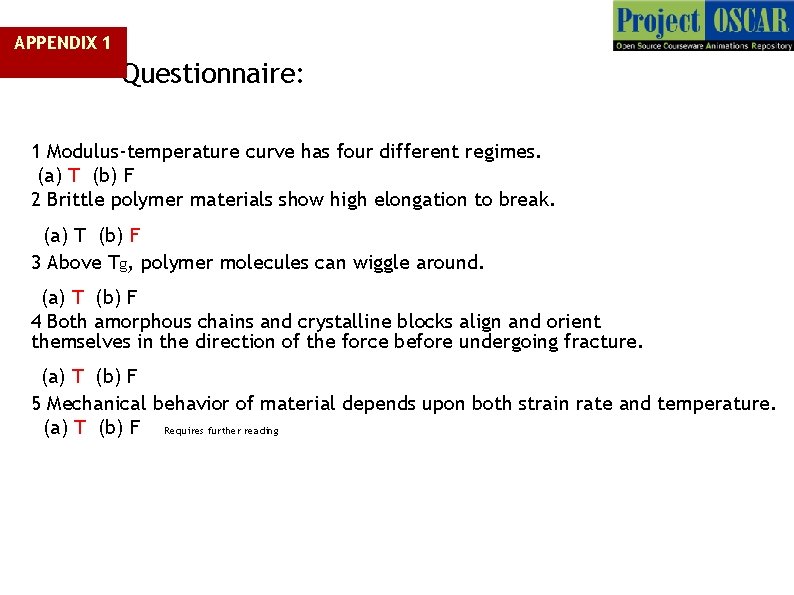
APPENDIX 1 Questionnaire: 1 Modulus-temperature curve has four different regimes. (a) T (b) F 2 Brittle polymer materials show high elongation to break. (a) T (b) F 3 Above Tg, polymer molecules can wiggle around. (a) T (b) F 4 Both amorphous chains and crystalline blocks align and orient themselves in the direction of the force before undergoing fracture. (a) T (b) F 5 Mechanical behavior of material depends upon both strain rate and temperature. (a) T (b) F Requires further reading
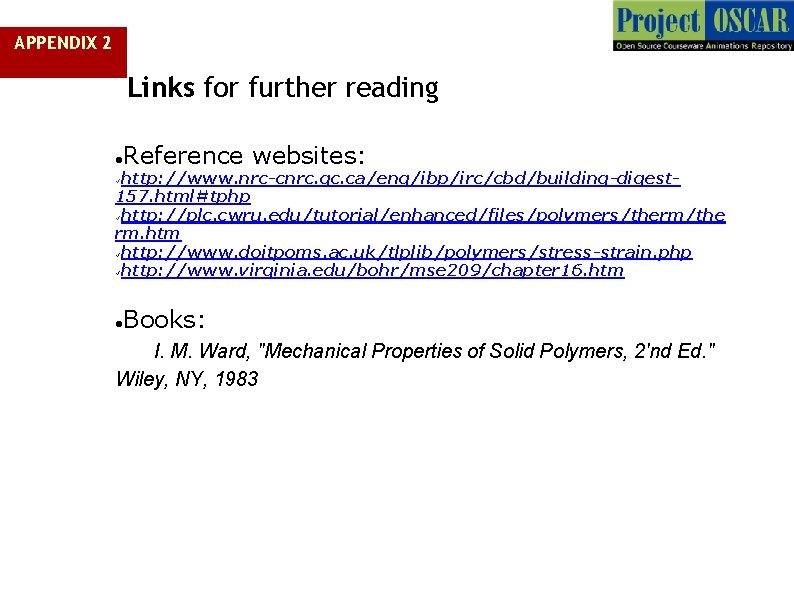
APPENDIX 2 Links for further reading Reference websites: http: //www. nrc-cnrc. gc. ca/eng/ibp/irc/cbd/building-digest 157. html#tphp http: //plc. cwru. edu/tutorial/enhanced/files/polymers/therm/the rm. htm http: //www. doitpoms. ac. uk/tlplib/polymers/stress-strain. php http: //www. virginia. edu/bohr/mse 209/chapter 16. htm Books: I. M. Ward, "Mechanical Properties of Solid Polymers, 2'nd Ed. " Wiley, NY, 1983
APPENDIX 3 Summary The mechanical properties of a polymer material can be studied by subjecting it to various stresses like tensile, compressive etc. This will help the engineer or scientist to be better equipped for designing the material as this will answer questions like how tough is the material, how brittle/ductile or how much strain it can endure before undergoing a failure. The stress-strain behavior of a polymer is very similar to a metal, but an important difference is that its properties depend upon strain rate, temperature and environmental conditions. The polymer can be brittle, plastic or highly elastic (rubber-like), Tensile modulus and tensile strengths are orders of magnitude smaller than those of metals, but elongation can be up to 1000 % in some cases. Mechanical properties change dramatically with temperature, going from glass-like brittle behavior at low temperatures to a rubber-like behavior at high temperatures. In general, decreasing the strain rate has the same influence on the strain-strength characteristics as increasing the temperature: the material becomes softer and more ductile.
- Slides: 31