
British North America 1763 1867 Timeline of Important
British North America 1763 - 1867
Timeline of Important Events 1762: 1763: 1774: 1776: 1783: 1791: 1812: 1814: 1815: 1816: 1837: 1841: Pontiac’s Resistance Royal Proclamation Quebec Act American War of Independence Treaty of Paris Loyalist Movement Constitution Act The War of 1812 The Treaty of Ghent Start of the Great Migration The Battle of Seven Oaks Rebellions Act of Union
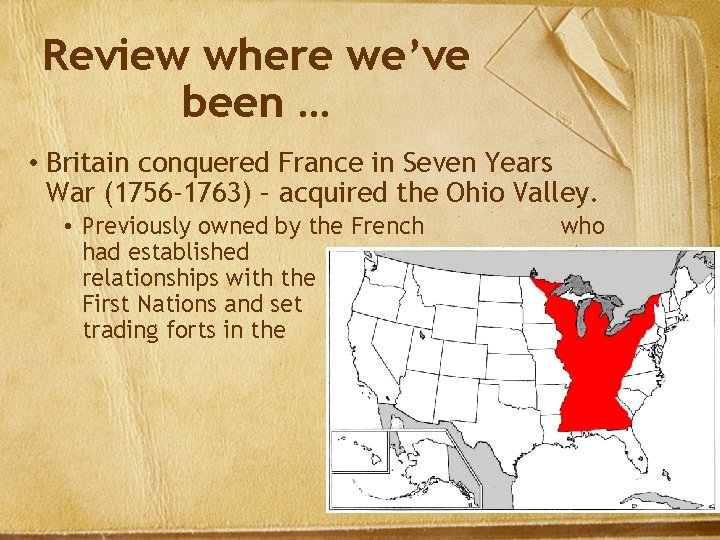
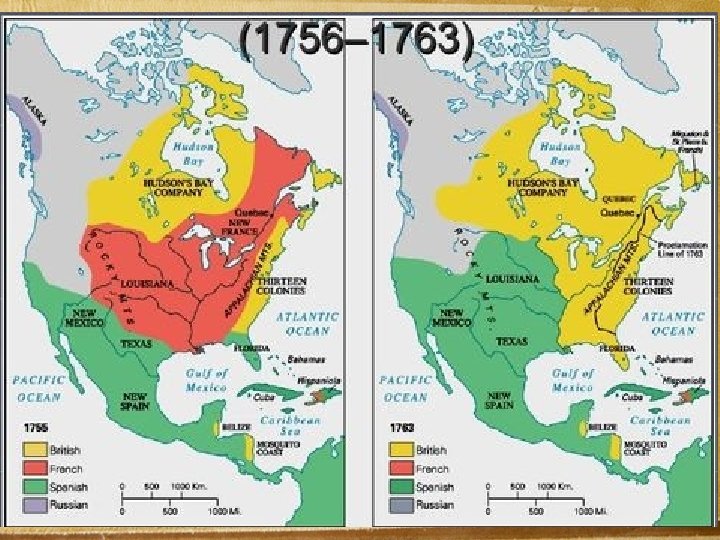
Review where we’ve been … • Britain conquered France in Seven Years War (1756 -1763) – acquired the Ohio Valley. • Previously owned by the French had established relationships with the First Nations and set trading forts in the who up area.
Relations with First Nations French • Treated them like a sovereign nation • Maintained alliance with gifts like guns, ammo, and trade goods. • First Nations expected these in order for Europeans to use their land. British • Saw First Nations as a defeated people (because the French lost the war) • Wanted to take charge of the fur trade • Saw gifts as bribes
• Jeffrey Amherst (British army officer) restricted trade with First Nations people and said that anyone wanting to trade with them required Britain’s permission. • This hurt the Aboriginal people because they had relied on the trade and gifts. • Amherst viewed Aboriginal people as a problem.
On the other hand… • First Nations’ perspective: • Had a beneficial relationship with the French, but now you cannot talk or trade with them. • The British are not giving gifts like the French were • They are more difficult to bargain with • The British do not acknowledge the First Nations people as a distinct group. • This means war…
Pontiac’s Resistance, 1762 - 1766 • Who was Pontiac? • Odawa First Nation war chief • Fought as a French ally during the Battle of the Plains of Abraham. • Afterwards, tried to build alliances with the British, but he was unsuccessful.
• His people were suffering under British rule – he decided to take action. • In 1762, he led First Nations from the Ohio Valley, Great Lakes region, and the Northwest against the British • Successfully took over 9 of the 12 British forts North-West of the Thirteen Colonies.
• By the end of 1763 peace negotiations began. • In 1766 Pontiac signed a peace treaty with the British, agreeing to give the British back their forts, as long as First Nations’ hunting grounds were protected from settlement. • This resistance demonstrated that First Nations were a threat to British control in North America
Royal Proclamation 1763 • Issued in 1763 in an effort by the British to keep peace with the First Nations peoples to avoid future wars. • Created a defined boundary between British and First Nations lands. • Goal: keep colonists and First Nations separate to avoid conflict. • Colonists were forbidden to cross the line and could not claim land for themselves.
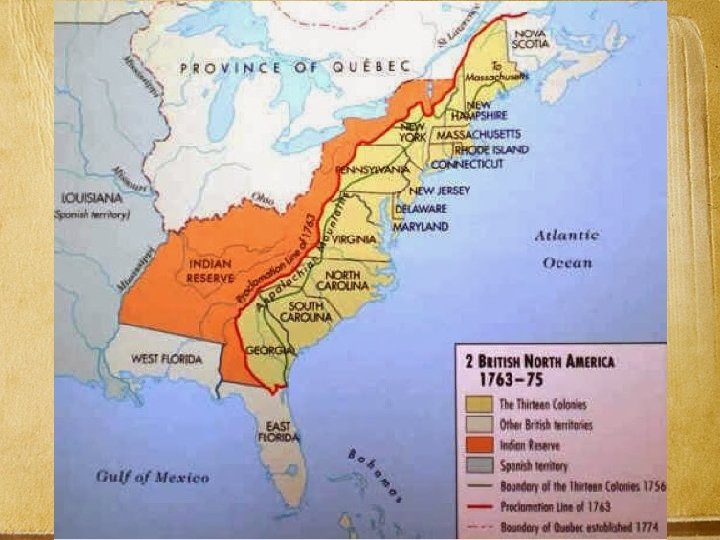
• End goal: British Crown would slowly negotiate with First Nations people to give land as needed for westward expansion. • By controlling westward expansion, Britain hoped that colonists would move northward into Quebec, decreasing the Canadien majority (French-speaking residents).
• http: //www. cbc. ca/news/politics/royalproclamation-of-1763 -canada-s-indianmagna-carta-turns-250 -1. 1927667
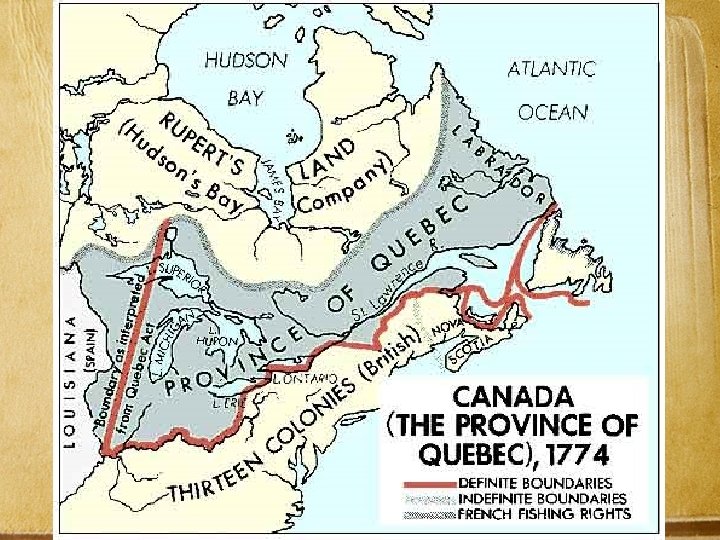
• The Royal Proclamation also established the Province of Quebec. • French residents were given their own civil government, but had some requirements: • Had to take the Serment du Test – an oath which swore that they were members of the Anglican Church. No Roman Catholics were able to hold office. • Province of Quebec was much smaller than it is today, restricted to the banks of the St. Lawrence River

Responses to the Royal Proclamation • There were mixed responses to the Royal Proclamation. • It helped to establish the land rights of First Nations by protecting the west for traditional uses. • French-speaking and Catholic people felt that their positions in Quebec were threatened, as these new government laws were put in place. • Britain’s plan to encourage colonists to move into Quebec was unsuccessful, and Canadiens remained the majority in Quebec.
The Quebec Act • Canada, A People’s History – Episode 4 • 40: 49 - 45: 06 • http: //www. dailymotion. com/video/x 16 b 01 q
Quebec Act 1774 • Sir Guy Carleton (Governor of Quebec) • Appreciated the hard work of the habitants in Quebec • Annoyed by the British members in the colony – always bickering and complaining • Realized that, although the plan had been for British immigrants to pour into Quebec, only a few ever came. • Thought it more valuable to maintain good relations with the Canadiens rather than to try to gain the support of the minimal British population.
• The British Parliament passed the Quebec Act upon the urging on Carleton. • Revoked the Royal Proclamation • Enlarged Quebec to include the Ohio Valley. • Guaranteed French language rights. • Opened some roles in the colony’s government to Roman Catholics.
• Reinstated French property and civil laws, but kept British criminal law. This unique legal blend still exists today. • Reinstated a mandatory tax (tithe) to support the Catholic church. • Canadiens were largely satisfied, British residents were MAD. This act was seen as an abuse of Britain’s power over the colonies.
Questions • How would the French see the British living in Quebec? • Why did the British feel the need to appease the French?
Answers • With the Quebec Act of 1774, Britain changed course and hoped to develop Canada as a dual community, English and French. • Trying to keep peace and buy support in the event of a revolution in the Thirteen Colonies
The American Revolution • https: //www. youtube. com/watch? v=Eytc 9 Z a. NWyc • https: //www. youtube. com/watch? v=Hl. Ui. SB XQHCw
American Revolution • The Quebec Act was just one of the issues that led to unrest in the Thirteen Colonies. • They were being heavily taxed by Britain in order to pay for various military efforts (Seven Years War, Pontiac’s Resistance), as well as maintaining a military presence in North America. • They felt that they had minimal say in how they were governed or taxed. • “No taxation without representation!” • Had fought the French for the Ohio Valley and felt betrayed by the Quebec Act.
Time for Tea – The Boston Tea Party • Occurred on December 16, 1773 • An act of defiance against British taxation. • Led by Samuel Adams, joined by over 100 men. • Disguised themselves as Mohawk people • Boarded three ships and dumped 342 chests of British East Indian Company tea overboard. • More than 92, 000 pounds of tea. • Worth about $1, 000 in today’s dollar. • Britain closed the Boston port until the damages were paid.
American Revolution • Thirteen Colonies united under their joint anger against Britain. • In 1774, 12 of the Thirteen Colonies agreed to boycott British trade until Britain would respond to them (Georgia did not attend). • In 1775, the rebels had armed clashes against British Soldiers • Rebels vs. Patriots -> historical perspectives, do they change?
• On July 4, 1776, the rebels drafted the Declaration of Independence, proclaiming that the Thirteen Colonies were no longer part of the British Empire – this action officially began the War/Revolution
• The rebels hoped that the Canadiens would join their fight against the British and tried to gain support from them. • The British hoped that the Quebec Act had satisfied the Canadiens enough not to fight against them. • When the American rebels attacked Quebec most Canadiens joined neither side, and the rebels were fought off by British soldiers. • What grounds did the rebels have for thinking/hoping the Canadiens would join their cause?
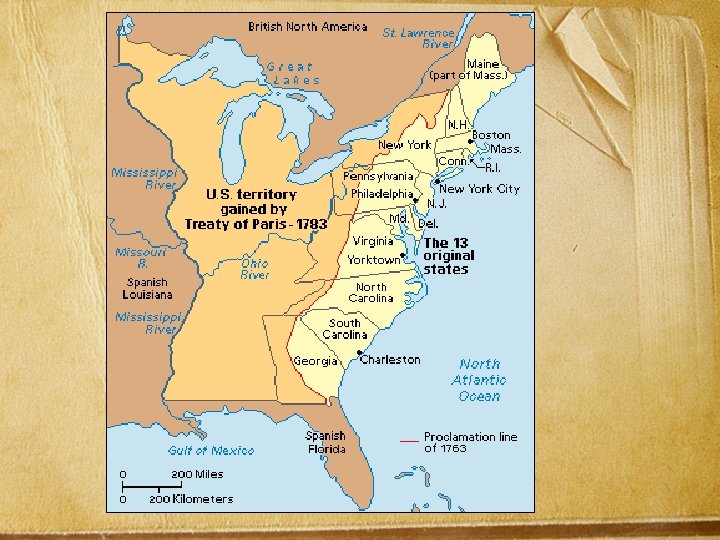
Treaty of Paris, 1783 • The Treaty of Paris officially ended the American War of Independence. • Britain did not have the funds to continue to fight, and agreed to peace at any cost. • This meant that most of the American requests were met. • Americans got the Ohio Valley. • The Treaty separated British North America from the United States of America
• Secured fishing rights for Americans along the Grand Banks (off the coast of Newfoundland) and the banks of the St. Lawrence. • Land doubling the size of the new nation • Americans agreed to restore Loyalist property confiscated during the war and prevent future persecution and confiscation of Loyalists and their property. • Both Great Britain and the United States will both have access to the Mississippi River

Who Won? • https: //www. youtube. com/watch? v=3 Ei. Sym Rr. KI 4
United Empire Loyalists • Not everyone living in the Thirteen Colonies agreed with the revolutionaries. • Those who remained loyal to Britain were called the United Empire Loyalists. • Many had been forced to flee, leaving behind their land, homes, and possessions. • Some went back to Britain or other British colonies.
• Many, about 100, 000 Loyalists moved to British North America during this time. • Mainly in Nova Scotia and Quebec (along the Great Lakes) • So many Loyalists settled in Nova Scotia that they demanded political autonomy and, in 1784, the colony of New Brunswick was created.
Why did they leave? Reason 1: Forced to flee because of persecution. Reason 2: Some had British roots and wanted to live under Britain’s rule Reason 3: Husband or Father decided to go women and children had no choice. Reason 4: Land in BNA was being offered to Loyalists
Land Loyalists • British North America was offering free land to Loyalists looking to leave the Thirteen Colonies and remain loyal to Britain. • For land Loyalists, the draw of free land was heavily influential in their decision to remain loyal to Britain.
Conscientious Objectors • People who refused to fight for religious reasons. • Did not necessarily disagree with independence from Britain, but refused to fight and were therefore persecuted by the rebels.
When the Loyalists Arrived… • The promise of free land had appealed to many Loyalists. However, when they arrived in BNA, they were greeted with much harsher conditions than they had anticipated. • Often had to wait years to receive their land • Had to become pioneers - got the land, but not much else • Not all had the skills necessary to farm • It was colder than what they were used to. • Survived through the winter due to the willingness of First Nations people to help
First Nations Loyalists • Mostly from the Six Nations Confederacy. • Fighting for their communities’ survival. • Lived in the fought-over and sought-after Ohio Valley • Were convinced that their only chance of keeping this land was to join the British • However… • First Nations people were ignored in the Treaty of Paris of 1783
![“[Given] what friendship we had shown to the English, and being conscious of the](http://slidetodoc.com/presentation_image_h2/56cea4d963b2f50af988fe0b65ea74a0/image-42.jpg "“[Given] what friendship we had shown to the English, and being conscious of the")
“[Given] what friendship we had shown to the English, and being conscious of the active part … we have taken in their favour I every dispute they have had with their enemies, we were struck with astonishment at hearing we were forgot in the treaty … We could not believe it possible such firm friends and allies could be so neglected by a nation remarkable for its honour and glory whom we have served with so much zeal and fidelity. ” - Thayendanegea (Joseph Brant), chief of one of the Six Nations who, along with his sister, encouraged their nation to enter the war.
Black Loyalists • Remember “life, liberty, and the pursuit of happiness”? • This wasn’t the experience for African slaves in the Thirteen Colonies • Were not allowed to vote, marry, congregate, or move freely. • Considered property.
• In a two-fold plan by Britain to both disrupt the economy of the Thirteen Colonies and increase their army size, Dunmore’s Proclamation was issued. • Any slave who enlisted with Britain was promised freedom and land. • However, if a Loyalist brought slaves with them to BNA, these slaves were not given freedom. • Approximately 3000 Black Loyalists came to BNA • However… • Few Black Loyalists ever got the land they were promised. • Were expected to become servants • Quality of life was not much better
Constitutional Act, 1791 • The Loyalists coming up into British North America changed the demographics. • Increased number of English-speaking population. • Increased demand for farm land. • Loyalists demanded democratic rights that were quite radical in comparison to the more traditional and conservative way the Canadiens were living.
• Sir Carleton decided to revisit the Quebec Act, revising its terms to meet the new needs. • The Constitutional Act of 1791 was born. • Recognized that there were two dominant groups in the colony: French and English
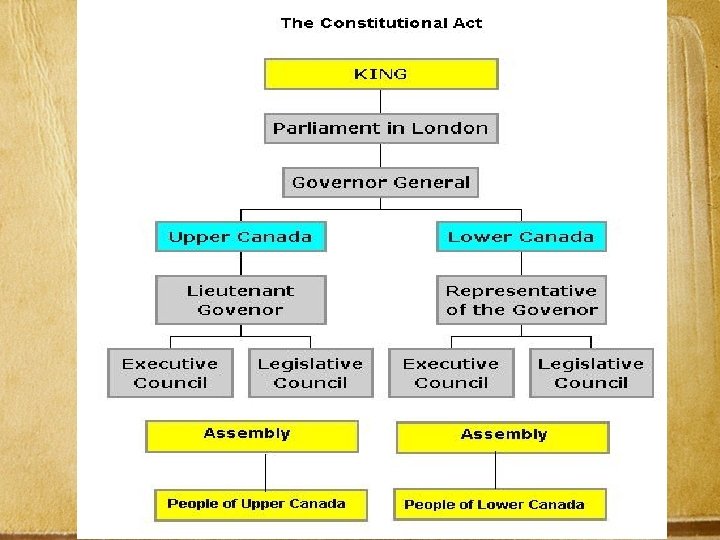
• The groups had different religions, political and legal outlooks, and economic and landowning traditions. • To reflect these diverse groups, Carleton created two separate colonies • Upper Canada (Ontario) • Lower Canada (Quebec) • Each was able to maintain its own language regulations, laws, land-owning system, and religious institutions, and have its own capital city.
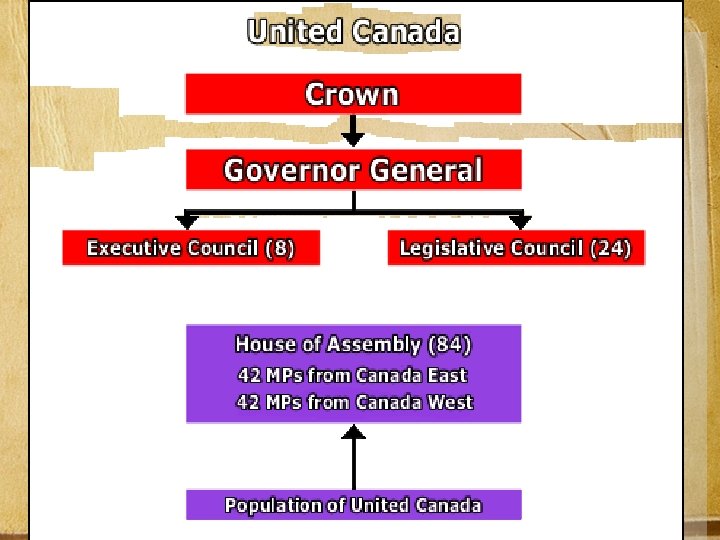
Government in the New Colonies • Oligarchy – a small ruling class • A Britain-appointed Governor General oversaw both colonies. • Each colony also had a Lieutenant-Governor (also appointed by Britain) whose job it was to choose the members of two councils for the colony – legislative council and executive council. • Colonies would have an elected assembly, but any decisions made by the assembly could be vetoed by the appointed councils, lieutenantgovernor, or Governor General.
War of 1812 • https: //www. youtube. com/watch? v=q. MXqg 2 PKJZU
War of 1812 • By 1812, a group of American politicians from the South (War Hawks) believed that the Britain was again strangling their political and economic goals. • Decided to try to permanently rid North America of British influence. • On July 12, 1812 the war began when 2000 men under the command of General William Hull invaded Upper Canada. • Britain was worried about the loyalty of Land Loyalists. • Americans quickly retreated because of supply problems
• Sir Isaac Brock, head of British forces in Canada was concerned about the lack of morale in the population after the American Invasion. • He decided to take the offensive position. • He joined forces with Tecumseh. • Leader of the Shawnee First Nations, residing in the Ohio Valley • In exchange for help, Brock promised to support the Shawnee Nation’s claim to the land.
• Together, they planned an invasion on Fort Detroit. • On August 16, they attacked. • Fort Detroit surrendered almost immediately, even though they had more men, as General Hull was terrified by the cries of Tecumseh’s forces. • This quick victory boosted the spirits of the population. When the call came for more men, many signed up.

• Many battles ensued, but the British soldiers, First Nations, and Metis people fought off the Americans. • After 2 years of fighting, the war ended in a stalemate. • The Treaty of Ghent (1814) saw no territorial, economic, or political gains for either side. • Britain had promised to protect the First Nations land in the Ohio Valley, but had not pushed the point during negotiations.
First Nations Following 1812 • After the war ended, Britain no longer required the partnership that had helped them during the war. • Rights to land were pushed to the side to make way for colonists who needed/wanted more land. • The Gradual Civilization Act of 1857 was passed with the explicit goal of assimilating First Nations people so that they “would no longer be deemed Indians. ”

Post-War Changes • Following the War of 1812, immigration to BNA increased dramatically. • Between 1784 -1815, 25 000 people had immigrated to BNA. • Between 1815 -1850, 960 000 people came to BNA from Britain. • Natural increase also led to a higher population. • The increased population resulted in more land being developed for agriculture and larger cities.
• Because of the various groups of Loyalists that had moved into BNA, many parts of the colonies were becoming increasingly diverse. • The population boom also saw the beginnings of a middle class. • New businesses in areas like clothing and timber, started to develop. • Built schools and established services. • Wanted a say in their government.
Underground Railroad • Even though Black Loyalists (formally slaves) were promised freedom in BNA, slavery was still practiced until 1834. • Not as popular as in the Southern US • Mainly occurred among Loyalists that had brought slaves with them to BNA • After 1834, many slaves escaped the United States, arriving in BNA via the Underground Railroad. • A network of safe houses that helped people escape slavery in the United States.
Underground Railroad • https: //www. historicacanada. ca/content/h eritage-minutes/underground-railroad-0
1837 Rebellions – Causes • Both Upper and Lower Canada had tried to pass laws demanding that the economic and political structure be changed to responsible government, but these laws were stopped by vetoes by the Executive and Legislative Councils. • Responsible Government – the government is held accountable to their voters. Voters can vote to support the government, or to vote in a new government.
• 1834 – Lower Canada passes the Ninety-Two Resolutions. • A reform bill demanding that the councils appointed by Britain be more accountable and receptive to the elected assembly. • Sent to Britain, not approved. • A similar situation also occurred in Upper Canada with a bill called – the Seventh Report on Grievances. • As a result of the growing unrest and the desire for change, radical groups formed in both Upper and Lower Canada
The Rebellion • In 1837, rebels in Lower Canada, known as Patriots, carried out a series of protests in Montreal. • November 16: rebel leaders resisted arrest and violence broke out. • November 25: several towns in Lower Canada were looted and burned by government troops. The rebel leaders fled. • December 7: Rebels met at a tavern, armed themselves with pitchforks and any other weapons they could find, and marched towards Toronto. They were stopped by militia. • December 8: Rebellion was over.
After the Rebellion • Those supporting the reforms in both Upper and Lower Canada did not have the means to fight against government forces. • Hundreds of rebels imprisoned • 32 hung for treason • 12 in Lower Canada • 20 in Upper Canada • Leaders from both Canada’s sought political asylum in the US.
Lord Durham’s Report • After the rebellions, Britain worried that it was losing control of the Canadas. • Lord Durham was sent over as the new Governor General and tasked with recommending solutions for the problems that led to the rebellions. • Made two main suggestions: 1. A government that would be more responsive to the wishes of the majority. 2. Uniting Upper and Lower Canada into one colony with the goal of assimilating the French. (He described them as a people with “no history and no literature”).
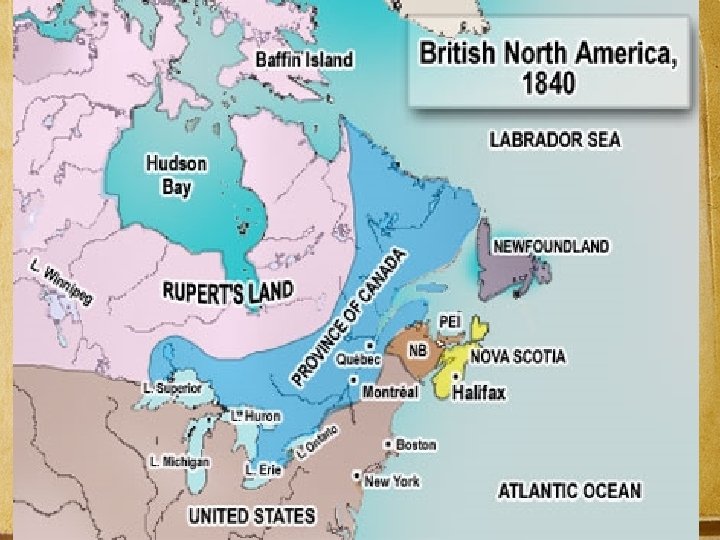
Act of Union, 1841 • United Upper and Lower Canada into one large colony. • The Province of Canada • Lower Canada -> Canada East • Upper Canada -> Canada West • United Government • Each received equal representation in government • Did not always work well together – shut down proposed bills from the other side.
- Slides: 67