
British Humor Comedy Reflecting on Humour When in
British Humor & Comedy
Reflecting on Humour When in your life have you felt funny? Unfunny? What do you find funny? What do you think makes Chinese people laugh? What makes something funny? What makes attempts at humor fail? Why is funniness so difficult to define? • Should any topics be off limits in comedy? Why or why not? • Compared with serious drama, what challenges are there in creating and performing comedy? • •
British Humour in Everyday Life
The Centrality of Humour in British Life • “In other cultures, there is ‘a time and a place’ for humour; it is a special, separate kind of talk. In English conversation, there is always an undercurrent of humour. We can barely manage to say ‘hello’ or comment on the weather without somehow contriving to make a bit of a joke out of it, and most English conversations will involve at least some degree of banter, teasing, irony, understatement, humorous self-deprecation, mockery or just silliness. ” – Kate Fox, Watching the English
The Importance of Not Being Earnest • “Sincerity is allowed, earnestness is strictly forbidden. Pomposity and self-importance are outlawed. Serious matters can be spoken of seriously, but one must never take oneself too seriously. ” • When someone does show signs of earnestness / taking oneself too seriously, the reaction is, “Oh, come off it!” • (self-important ppl are described as being “full of themselves” or “up themselves”)
Irony • Irony = when you say one thing, but mean something else • “’The problem with the English, ’ complained one American visitor, ‘is that you never know when they are joking” – English irony is always deadpan, without usual signals (winks, raised eyebrows, exaggerated tones) • When you say to a British person, “Oh really? How interesting!” they may think you are lying, or terribly bored, or genuinely surprised and truly interested. • “When we ask someone a straightforward question (e. g. , ‘How are the children? ’), we are equally prepared for either a straightforward response (‘Fine, thanks. ’) or an ironic one (‘Oh, they’re delightful – charming, helpful, tidy, studious…’ To which the reply is, ‘Oh dear. Been one of those days, has it? ’)
The Understatement (A Form of Irony) • Stiff upper lip: someone who does not show their feelings when they’re upset • “Our strict prohibitions on boasting & displays of emotion require almost constant use of understatement. Rather than risk showing excessive emotion or seriousness, we go to the opposite extreme and feign dry, deadpan indifference. ” • “We are exercising restraint, but in such an exaggerated manner that we are also (quietly) laughing at ourselves for doing so”

Examples of Understatement • A debilitating & painful chronic illness => “a bit of a nuisance” • A truly horrific experience => “well, not exactly what I would have chosen, ” “not very pleasant” • An outstanding achievement => “not bad” • An act of abominable cruelty => “not very friendly” • An unforgivably stupid misjudgment => “not very clever” • The Antarctic => “rather cold” • The Sahara => “a bit too hot for my taste” • A horrendous meal at a restaurant, with rude waiters, terrible food, & filthy tablecloths => “So, I wouldn’t recommend it”
Self-Deprecation (Another Form of Irony) • Self-deprecation = devaluing one’s personal merits/accomplishments • Function: British value the appearance of modesty; selfdeprecation fulfills the social code of modesty “How did you decide to become a brain surgeon? ” “Well, I read PPE [Philosophy, Politics and Economics] at Oxford, but I found it all rather beyond me, so I thought I’d better do something a bit less difficult” “But surely brain surgery is not that easy either!” “Oh no, it’s nowhere near as clever as it’s cracked up to be; to be honest, it’s actually a bit hit-or-miss. Its just plumbing, really, plumbing with a microscope – except plumbing’s rather more accurate. ”
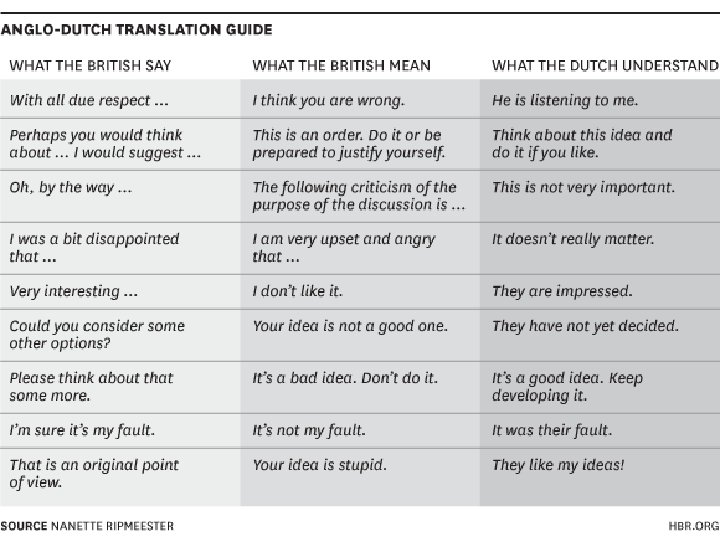
Communicating with the British • Understatement is one of the signs of British reserve (emotional restraint) • Occasionally, British reserve can lead to misunderstanding
British Comedy in Literature, Film, & TV
Different Kinds of Literary Humor • Wit: Oscar Wilde (Irish), Jane Austen • Satire: Jonathan Swift (Irish) William Makepeace Thackeray • Pun/double entendre: Shakespeare • Comic novel: Henry Fielding, Charles Dickens • Comedy of manners: Richard Sheridan (Irish), Tom Stoppard, G. B. Shaw (born in Ireland) • Sarcasm: a cutting, ironic remark intended to express contempt or ridicule
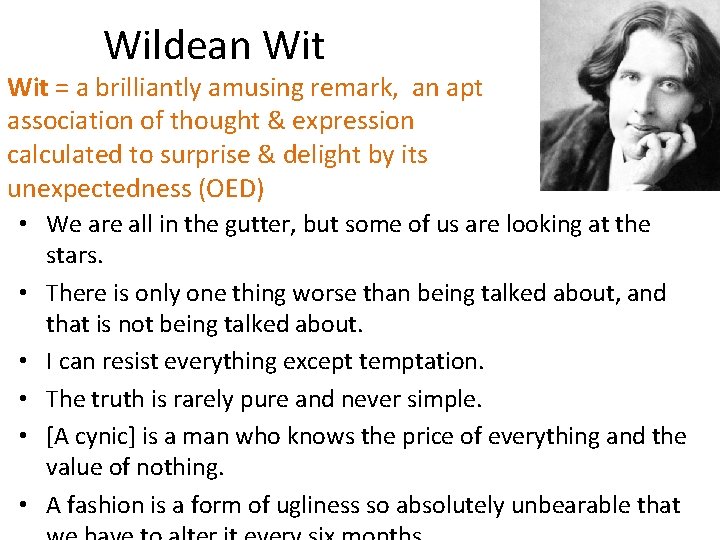
Wildean Wit = a brilliantly amusing remark, an apt association of thought & expression calculated to surprise & delight by its unexpectedness (OED) • We are all in the gutter, but some of us are looking at the stars. • There is only one thing worse than being talked about, and that is not being talked about. • I can resist everything except temptation. • The truth is rarely pure and never simple. • [A cynic] is a man who knows the price of everything and the value of nothing. • A fashion is a form of ugliness so absolutely unbearable that
Sarcasm in Jane Austen "Mr. Bennet, how can you abuse your own children in such a way? You take delight in vexing me. You have no compassion for my poor nerves. " "You mistake me, my dear. I have a high respect for your nerves. They are my old friends. I have heard you mention them with consideration these last twenty years at least. " "Ah, you do not know what I suffer. " "But I hope you will get over it, and live to see many young men of four thousand a year come into the neighbourhood. " "It will be no use to us, if twenty such should come, since you will not visit them. " "Depend upon it, my dear, that when there are twenty, I will visit them all. " Mr. Bennet was so odd a mixture of quick parts, sarcastic humour, reserve, and caprice, that the experience of three-and-twenty years had been insufficient to make his wife understand his character. Her mind was less difficult to develop. She was a woman of mean understanding, little information, and uncertain temper. When she was discontented, she fancied herself nervous. The business of her life was to get her daughters married; its solace was visiting and news.
Comedy of Manners • • Witty dialogue Sarcasm/irony Contrived situations Critiques of society, esp. marriage Portrayals of class differences Contrasts btwn urban & rural Example playwrights: Oscar Wilde, G. B. Shaw, Noel Coward, Tom Stoppard
The Incongruity Game • One person begins with an everyday activity (e. g. , hair-combing) • Person on right asks, “What are you doing? ”) • She continues to comb her hair but says she is doing something completely different (e. g. , “I’m giving a cat a bath”) • Person who asks must now begin miming giving a cat a bath • Next person asks, “What are you doing? ” • Continue!
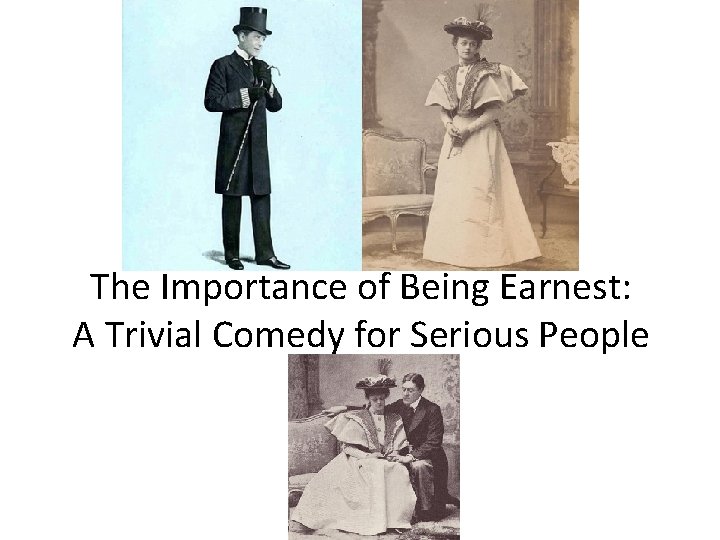
The Importance of Being Earnest: A Trivial Comedy for Serious People
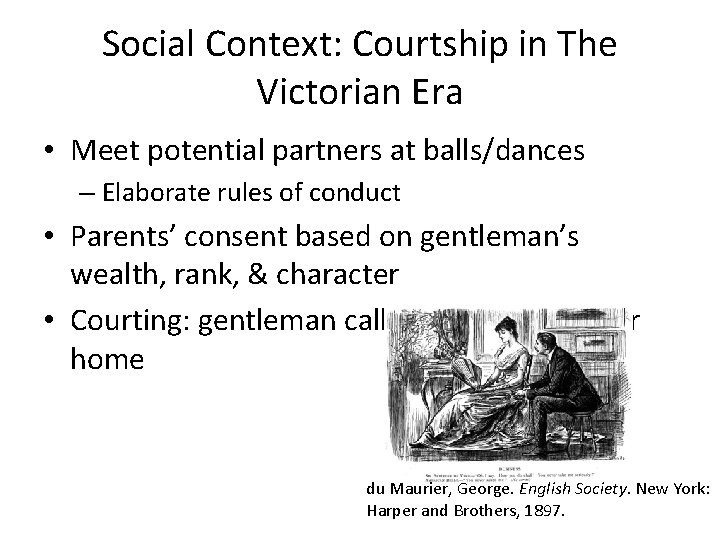
Social Context: Courtship in The Victorian Era • Meet potential partners at balls/dances – Elaborate rules of conduct • Parents’ consent based on gentleman’s wealth, rank, & character • Courting: gentleman called upon lady at her home du Maurier, George. English Society. New York: Harper and Brothers, 1897.
What is a Bunburyist?
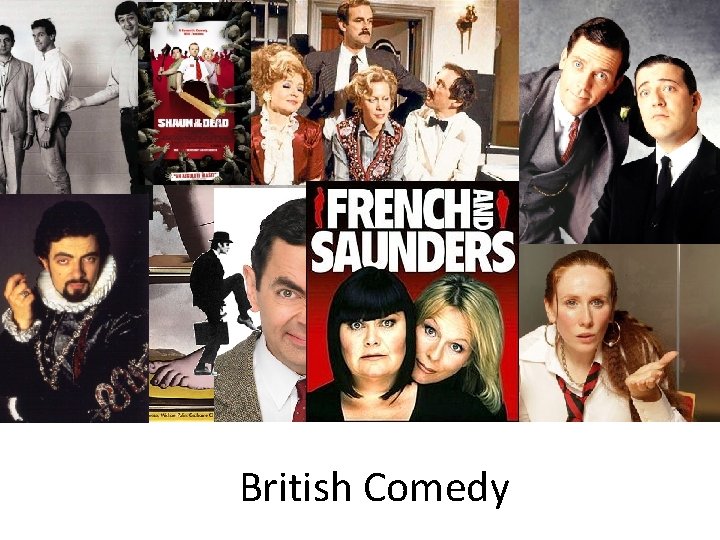
British Comedy
British Comedians • • Lenny Henry Stephen Fry & Hugh Laurie Dawn French & Jennifer Saunders Catherine Tate Eddie Izzard Sacha Baron Cohen Ricky Gervais Benny Hill
British TV Comedy - The Office - Absolutely Fabulous - Carry On series (1958 -1978) - Jeeves and Wooster - Are You Being Served - Little Britain - Monty Python’s Flying Circus
Other Things Brits Find Funny - Men in drag (men dressing as women): Dame Edna Everage, Danny La Rue, Lily Savage - Pantomime: plots from folktales (Cinderella, Aladdin, Jack and the Beanstalk)
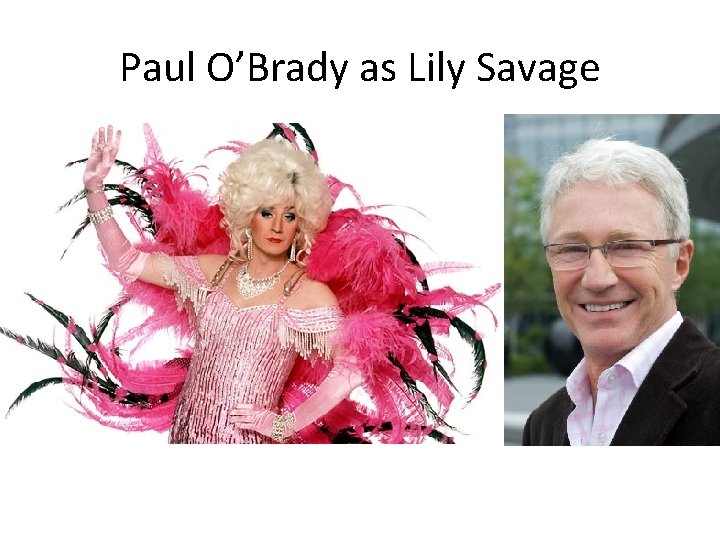
Paul O’Brady as Lily Savage
- Slides: 25